


AAdvantage vs. MileagePlus vs. SkyMiles: Which Program Fits Your Travel?
American, United and Delta each offer useful routes and award opportunities—but the best program is the one that fits how you actually travel.
Choosing an airline loyalty program sounds simple.
Determine which airline you fly most often, join its program and begin collecting miles.
But that approach combines two decisions that should be considered separately:
Which airline should I fly for this trip?
And:
Which travel currency should I deliberately accumulate?
I may choose American Airlines for one trip, Delta for another and United for the next. The route, schedule, aircraft and price can change each time.
That does not mean I need to divide my everyday spending among three airline credit cards or build substantial balances in three separate mileage programs.
Flying an airline and accumulating its miles are not the same decision.
Join All Three Programs
There is little reason not to join the free loyalty programs of airlines you might fly.
I maintain accounts with multiple airlines even when I am not deliberately accumulating their miles. Membership allows me to receive credit for eligible travel, view account-specific offers and avoid abandoning miles that I could have earned from a flight I was taking anyway.
This follows the same principle discussed in Why Every Traveler Should Join a Loyalty Program.
Join broadly.
Concentrate your earning selectively.
Those are not contradictory strategies.
You can have accounts with American, United and Delta without declaring lifelong loyalty to any of them.
Start With the Route, Not the Airline
Before comparing AAdvantage, MileagePlus and SkyMiles, determine whether the corresponding airline serves the routes you are likely to use.
Consider:
Your home airport
Available nonstop flights
Connection points
Departure and arrival times
Typical fares
Aircraft used on the route
International partner options
Where you genuinely want to travel
An airline can operate an excellent loyalty program and still be a poor fit if using it regularly requires an inconvenient connection.
Likewise, a program that receives mixed reviews may still be useful when its airline dominates your airport, offers the best nonstop routes or consistently provides schedules that fit your life.
That is why my flight-selection philosophy begins with American, Delta or United: Start With the Route, Not the Airline.
Brand loyalty should not force an inferior itinerary.

AAdvantage: Useful When American and Its Partners Fit the Goal
AAdvantage has been the most relevant of the three programs for much of my recent travel because American has often worked well from JAX.
That does not mean I automatically choose American.
It means American frequently appears among my practical options.
AAdvantage miles can also be used for award travel on American’s oneworld partners and several additional airline partners. That opens possibilities beyond flights operated by American itself.
The partner network was central to one of my own mileage strategies.
I opened an American Airlines credit card when it offered an 80,000-mile bonus. I had a specific redemption in mind: Japan Airlines First Class from Tokyo to New York.
That was the target—not a promise.
Our travel plans changed before I booked the flight. The miles remained in my AAdvantage account until another worthwhile opportunity appeared.
They eventually helped us book British Airways Business Class from Miami through London to Glasgow for our Scotland trip.
The award cost 57,500 AAdvantage miles plus $769.30 per person for a fully refundable and changeable itinerary. We separately paid $189 per person to select our British Airways seats. The same flight had a cash price of more than $3,500 per person.
The fees were significant, and the redemption was different from my original goal. But it gave us the cabin and itinerary we wanted for a trip we were actually taking.
That is the distinction.
A targeted airline-card bonus can be valuable when you understand the possible uses of the miles. It becomes far less compelling when miles are accumulated without a realistic plan.
MileagePlus: Consider the Routes and the Aircraft
United MileagePlus may be a natural fit for travelers whose airports and destinations align with United’s network and Star Alliance partners.
My experience has been different.
I have flown United domestically, but it has rarely provided the best combination of schedule, routing and price for the trips I have planned from JAX.
When considering one European itinerary, I found a United option that appeared likely to use a Boeing 757. A single-aisle aircraft is not automatically unacceptable for a long flight, but it was not my preference for that particular trip.
The airline and its loyalty program were not necessarily the problem.
The available itinerary did not fit what I valued.
Someone living near a United hub—or regularly traveling to destinations United serves well—could reach a completely different conclusion.
MileagePlus should therefore be judged against your likely trips, not against my airport or preferences.
SkyMiles: Convenient Routes Do Not Guarantee Attractive Awards
Delta has played a role in some important trips for me.
About 12 years ago, I used SkyMiles to help with travel connected to a mission trip to Kenya. I have also used the program for domestic travel and benefited from free checked bags through a Delta credit card.
I am willing to fly Delta when it offers the right flight.
I simply do not currently direct much of my everyday spending toward accumulating SkyMiles.
Award prices can vary considerably, and the number of miles required for a particular trip may be higher than I consider worthwhile. I have joked that some SkyMiles awards seem priced about as high as Bitcoin.
That does not make SkyMiles useless.
For travelers who regularly fly from a Delta hub, value Delta’s operational network or find awards that fit their travel patterns, the program can be useful. Delta also works with numerous international partners, extending its reach beyond Delta-operated aircraft.
The important question is not whether someone else considers SkyMiles valuable.
It is whether the flights available to you justify concentrating your earning there.
Compare the Programs Through Your Own Travel
None of these programs wins every category for every traveler.
AAdvantage may stand out when American routes or oneworld partner awards match your plans.
MileagePlus may become more useful when United and Star Alliance provide the best connections from your airport.
SkyMiles may be the practical choice for someone surrounded by Delta service and regularly finding acceptable award options.
Before deciding where to concentrate your earning, ask:
Which airline serves my most frequent destinations?
Can I fly nonstop, or will I always connect?
Which connecting airports am I willing to use?
Do the schedules fit the way I travel?
Which international partners interest me?
Can I find realistic award availability?
What taxes and carrier-imposed fees will I pay?
Will I use the miles soon enough to justify earning them?
What happens if my planned trip changes?
Your answers matter more than a generic ranking.
Flexible Points Keep More Doors Open
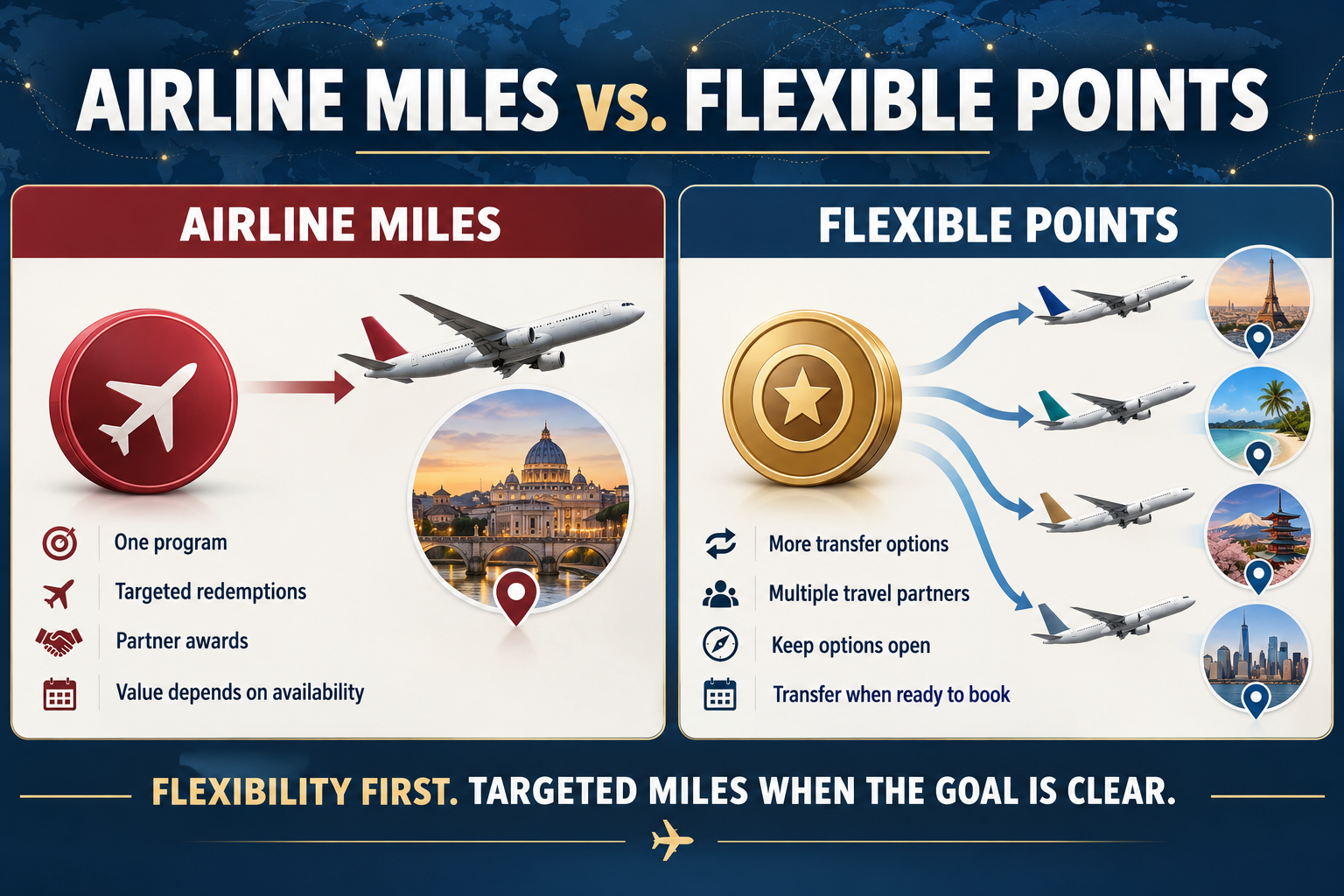
Most of my deliberate earning now focuses on flexible credit-card points rather than a single airline currency.
Flexible points may offer several possible uses, depending on the card program:
Transfer to selected airline partners
Book through a travel portal
Cover eligible travel purchases
Remain available while you compare options
That flexibility matters because I do not always know which airline will offer the right flight when I am ready to book.
An airline mile is already committed to one program.
A flexible point may allow me to wait.
If I eventually find a valuable award through a transfer partner, I can evaluate the transfer then. If the award disappears, the cash price is better or another airline offers a stronger itinerary, I have not unnecessarily trapped the points in the wrong program.
This is also why I do not transfer points merely because a temporary bonus looks attractive.
Find the award first. Confirm availability. Then transfer.
Transfers are generally a one-way decision, and available award space can disappear.
A Targeted Airline Bonus Can Still Make Sense
Preferring flexible points does not mean airline credit-card bonuses should always be ignored.
A substantial bonus can be worthwhile when:
You have a realistic redemption in mind
The airline or its partners serve the route
You understand likely taxes and fees
You can meet the spending requirement responsibly
The card’s other benefits provide value
You have another possible use if the original trip changes
My 80,000-mile AAdvantage bonus passed that test.
The Japan Airlines First Class plan did not happen, but the miles were not useless. They ultimately supported a different premium-cabin trip through another AAdvantage partner.
That experience does not prove that every airline-card bonus is valuable.
It shows why a targeted bonus is different from collecting miles simply because the number sounds impressive.
A bonus should support a travel strategy—not become the strategy.

Do Not Ignore the Complete Award Cost
A mileage price is only part of an award booking.
For every option, compare:
Miles required
Taxes
Carrier-imposed fees
Seat-selection charges
Positioning flights
Overnight hotels
Baggage charges
Cancellation and change rules
Total travel time
Cabin and aircraft
The cash price of the same or comparable ticket
Our British Airways award required only 57,500 AAdvantage miles per person, but it also carried $769.30 per person in taxes and fees. Seat selection added another $189 each. The same flight had a cash price of more than $3,500 per person.
That does not automatically make it a poor redemption.
It does mean that describing it only as a “57,500-mile flight” would leave out an important part of the decision.
The best award is not always the one requiring the fewest miles.
It is the one that provides the itinerary and experience you want at a total cost you consider worthwhile.
Your Home Airport Can Change the Answer
Right now, JAX is my closest airport. It often makes American a practical choice, but I still compare the route, schedule, aircraft and price.
After I retire in March, I expect to split my time between Central Florida and the western North Carolina mountains.
From Central Florida, GNV will be nearby, with JAX and MCO remaining possible depending on the route, schedule and price. In the western North Carolina mountains, ATL will be the closest major hub—although Atlanta traffic may make other airports within a few hours worth considering.
That could lead me to fly Delta more frequently from ATL.
It does not necessarily mean that I should begin accumulating SkyMiles heavily today.
Flexible points—and partner programs such as Flying Blue—may create additional options when award availability cooperates. Flying Blue can provide access to Delta-operated awards in some circumstances, but availability and pricing must be checked for the specific trip.
Time will tell.
My actual travel patterns after retirement may determine which airline program deserves more attention.
That is exactly the point: loyalty strategies should be allowed to change when your life changes.

My Curated Verdict
🟢 Join all three programs
AAdvantage, MileagePlus and SkyMiles are free to join. Create accounts before flying and receive the miles or benefits available from trips you are already taking.
🟢 Prioritize flexible points
Flexible credit-card points can preserve options while you compare airlines, routes, award availability and total booking costs.
Keep them flexible until you have confirmed the award you want.
🟡 Accumulate airline miles selectively
Concentrate on AAdvantage, MileagePlus or SkyMiles when the program aligns with your airport, likely destinations and realistic award goals.
A targeted credit-card bonus may make sense when you have a defined use and a reasonable backup plan.
🔴 Do not force loyalty
Do not accept a poor schedule, unnecessary connection, undesirable aircraft or unreasonable price merely to fly one airline or earn one type of mile.
The loyalty program should support the trip.
The trip should not exist to support the loyalty program.
The Bottom Line
AAdvantage, MileagePlus and SkyMiles can all provide value.
None is automatically the best program for every traveler.
Start with your home airport. Look at the routes you are likely to fly. Compare schedules, aircraft, prices, partner opportunities and award costs.
Join the programs broadly, but concentrate your earning deliberately.
For many travelers—including me—flexible points provide the strongest foundation because they preserve choices until a specific trip begins to take shape.
Then, when an airline program offers a genuinely useful opportunity, use it.
Choose the flight that fits the trip. Choose the currency that preserves your options.