


American, Delta or United: Start With the Route, Not the Airline
The best airline for your trip depends on where you live, where you are going and how much time, cost and risk the complete itinerary adds—not simply the logo on the aircraft.
Ask travelers which major U.S. airline is best, and you will hear confident answers.
One person always flies American. Another refuses to fly anyone but Delta. Someone else lives near a United hub and cannot imagine choosing differently.
Those preferences may be entirely reasonable. Loyalty benefits, credit cards, past experiences and the routes available from your home airport all matter.
But none of the three airlines is automatically the best choice for every trip.
The better question is:
Which airline offers the best complete itinerary for this particular trip?
That answer can change depending on your departure airport, destination, schedule, connection, weather, cabin and price. It can even change when the trip remains the same but a better flight appears from another airport.
Start With the Complete Travel Day
Jacksonville International Airport is normally our most convenient airport. It is approximately 30 minutes from our primary home.
Orlando International Airport is considerably farther away.
That should make Jacksonville the obvious choice—but it does not always produce the shortest or easiest travel day.
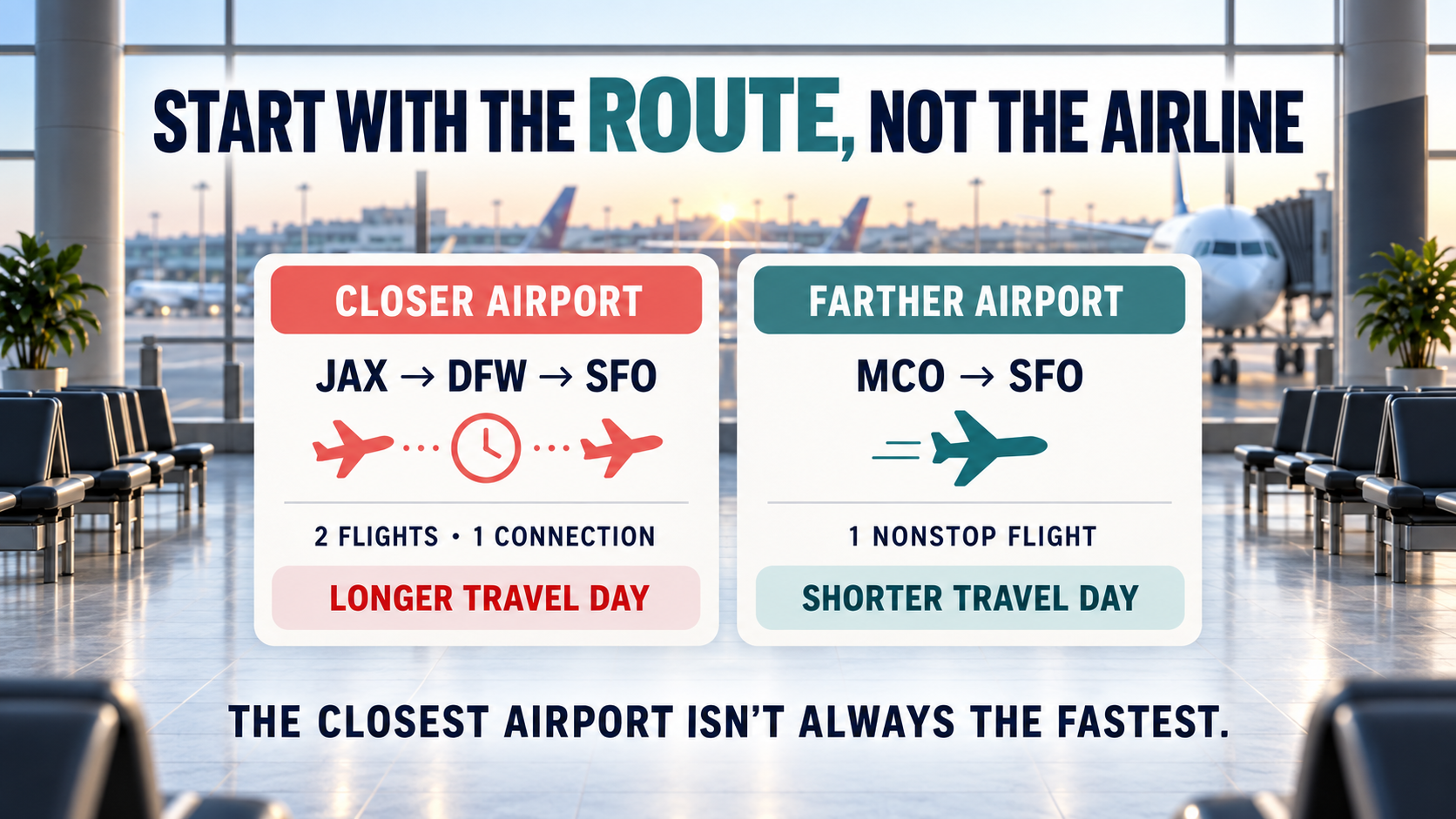
For an upcoming California trip, I initially considered flying from Jacksonville to San Francisco with a connection in Dallas–Fort Worth. Then I found a nonstop flight from Orlando to San Francisco.
We will already be in Interlachen before the trip, so driving to Orlando is manageable. More importantly, the drive to MCO followed by a nonstop flight creates a shorter overall travel day than flying from JAX through DFW.
The nonstop was offered on the American Airlines website and could be booked using credits from a previously canceled American flight. The aircraft will be operated by Alaska Airlines.
That combination made the choice fairly easy:
The canceled-flight credits could be used
The seating options were comparable
The overall price was competitive
The travel day was shorter
There was no connection
Our luggage remained with us during the drive to Orlando
More of the journey stayed within our control
Jacksonville is still the closer airport.
Orlando offered the better itinerary.
A Nonstop Flight Has Value Beyond the Time Saved
A nonstop flight is almost always a major advantage for me, although it is not available for many routes from Jacksonville.
The obvious benefit is less travel time. But removing a connection also removes several opportunities for the trip to go wrong.
With a connecting itinerary, your trip depends on:
The first flight departing on time
The connection airport operating normally
Enough time to travel between gates
Your second aircraft arriving on schedule
Your luggage making the same connection
Weather cooperating in multiple regions
The airline having a reasonable recovery option if something fails
A nonstop does not eliminate delays or cancellations. It simply removes one aircraft movement, one airport and one baggage transfer from the itinerary.
That reduction in complexity has real value.
It does not mean I would pay any price for a nonstop. A very large fare difference could still make a connection worthwhile. But the nonstop deserves more consideration than a simple comparison of ticket prices might suggest.
Look at the Direction of the Route
After connection time, I look at the route itself.
Some flight searches produce itineraries that seem to ignore basic geography. Flying from Jacksonville to New York before traveling southwest to Dallas may be technically possible, but it is not an efficient way to move across the country.
My immediate reaction is:
Don’t they own a globe?
Backtracking may occasionally be justified by a much lower price, better cabin, overnight schedule or lack of alternatives. It should not be accepted without noticing what the itinerary requires.
A strange route often means:
More time in the air
A longer total travel day
Greater exposure to weather
More opportunities for disruption
A less useful connection airport
An inconvenient arrival time
Do not assume the first options displayed by the airline or booking site are the most sensible ones. Search nearby airports, adjust the departure time and compare the routes visually.
Sometimes one itinerary stands out as soon as you consider where it is actually taking you.
A Legal Connection Is Not Necessarily a Sensible Connection
Airlines routinely sell connections that meet their scheduling rules but leave very little margin for an ordinary traveler.
American Airlines frequently displays itineraries with connections of approximately 35 minutes in Charlotte. Travelers also regularly ask whether 45 or 50 minutes is enough time to connect at a large airport such as Chicago O’Hare.
The airline may allow the booking. That does not mean the connection is comfortable—or that I want to attempt it.
A listed 35-minute connection does not provide 35 minutes to walk between gates.
The arrival time is generally the time the aircraft is expected to reach the gate. You may still need to wait for the door to open and passengers ahead of you to exit. Meanwhile, boarding for the next flight may close before its scheduled departure time.
Your usable connection time can be much shorter than the number displayed during booking.
Before accepting a short connection, consider:
The size and layout of the airport
The possibility of changing terminals or concourses
How quickly you can move
Whether you are traveling with children or someone with mobility limitations
The typical punctuality of the first flight
Seasonal weather
The location of passport control or security, when applicable
The number of later flights to your destination
A short connection may work perfectly.
It may also turn a minor delay into a missed flight.

The Connection Airport Matters
When two connecting itineraries are otherwise similar, I compare the airports.
A connection is not merely empty time between flights. It is a place where you may need to walk a considerable distance, change terminals, find food, wait through a delay or seek help after a cancellation.
I consider:
The airport’s size and layout
The scheduled connection time
The airline’s presence at that airport
Lounge availability
Typical weather
The number of later flights
My familiarity with the airport
Whether changing terminals requires another security screening
Lounge access can improve a reasonable connection, especially when the itineraries, cabins and prices are close. It does not make an unrealistic connection sensible, and I would not add hours to a trip simply to visit a lounge.
The flight still comes first.
The lounge is a tiebreaker.
Earlier Flights Usually Provide Better Recovery Options
I rarely book the last flight of the day when an earlier departure is practical.
The last flight may offer a convenient departure time or a lower fare. It also leaves fewer recovery options if the aircraft is delayed, the crew times out or the flight is canceled.
An earlier flight may give the airline several opportunities to move you later that day.
The final departure may leave you with:
An overnight delay
An unexpected hotel stay
A missed event
A late arrival without ground transportation
Limited access to customer-service assistance
No available seats until the following day
That does not mean the first flight of the morning is always best. A 5:00 a.m. departure can create its own miserable travel day, especially if the airport is several hours from home.
The goal is to balance convenience with recoverability.
If I am traveling for a cruise, wedding, tour departure or another event that cannot easily be moved, the availability of backup flights becomes particularly important.
Factor in Typical Weather
Weather should be part of the comparison before the day of travel.
A connection through Chicago in winter creates different risks from a connection through Dallas during thunderstorm season. Florida departures can be affected by afternoon storms, while airports in other regions may face snow, wind, fog or deicing delays.
No airport is immune to weather problems, and forecasts are not useful months in advance. The purpose is not to predict the exact conditions.
It is to recognize the seasonal risks built into the route.
When two flights are otherwise comparable, I may favor:
An earlier departure before afternoon storms become more likely
A connection with more time during winter
A route that avoids an unnecessary weather-prone airport
An airline with several later departures
A nonstop that removes an entire region from the itinerary
Weather does not always decide the booking, but it may help distinguish two options that initially appear equal.
Compare More Than the Ticket Price
A lower airfare can be appealing while producing a more expensive or difficult trip.
The complete cost may include:
Transportation to the airport
Parking
Checked-bag charges
Seat-selection fees
Meals during a long connection
A hotel required by the schedule
Lost vacation time
A rental-car pickup after a late arrival
The value of credits that would otherwise expire
Cabin matters too.
If I am comparing premium economy with regular economy, those are not equivalent itineraries merely because they reach the same destination. Seat comfort, legroom, boarding position, baggage benefits and flexibility may justify a higher fare—especially on a long flight.
I am willing to spend more when the difference meaningfully improves the travel day. I am not interested in paying more solely for an airline name.

Consider Which Airline Can Recover You
Flight frequency matters most when something goes wrong.
Suppose Airline A offers one attractive flight to your destination, while Airline B operates several departures throughout the day. If the prices and schedules are close, Airline B may offer the safer itinerary because it has more opportunities to recover from a disruption.
This becomes more important when:
You have a connection
You are traveling during difficult weather
You must arrive for a fixed event
The route operates only on selected days
Alternative airlines have few available seats
The final flight arrives late at night
Multiple departures do not guarantee a quick recovery. Later flights may already be full, and widespread disruptions can affect the entire schedule.
But available flights create options.
One daily departure does not.
Let Loyalty Break the Tie
Airline loyalty still matters. It simply should not lead the decision when another airline offers a clearly better itinerary.
When the route, cabin, timing and price are similar, I look at the benefits that separate the options.
Those may include:
Existing travel credits
Elite-status benefits
Complimentary checked bags
Preferred boarding
Better seat-selection options
Lounge access
Points or miles earned
The value and flexibility of the loyalty currency
Customer-service familiarity
My MCO-to-SFO booking is a good example.
The flight is operated by Alaska Airlines, but booking it through American allowed me to use credits from a canceled American flight. The credits improved the value of an itinerary that already worked well.
They did not rescue a bad route.
That distinction matters.
A free checked bag is useful, but it may not justify an unnecessary connection. Lounge access is pleasant, but it does not compensate for arriving five hours later. Earning miles in your preferred program has value, but those miles should not automatically outweigh a nonstop flight at a similar price.
Loyalty should break a tie—not excuse a worse itinerary.

A Simple Order for Comparing Flights
When several flights look reasonable, I evaluate them in this order:
Nonstop availability
A practical nonstop receives immediate preference.Complete travel time
Include the drive, parking, airport time, connection and arrival—not merely time in the air.Route logic
Notice backtracking and unnecessary distance.Connection quality
Consider both the airport and the amount of usable time.Departure and arrival times
Think about the entire day and what happens after landing.Recovery options
Look for later departures if the original flight fails.Typical weather
Consider the season and every region included in the itinerary.Cabin and fare restrictions
Compare equivalent products and understand what each ticket includes.Total cost
Add bags, seats, airport transportation, parking and other expenses.Loyalty benefits
Use credits, status, lounges and points to distinguish options that remain close.
This is not a rigid mathematical formula. Travel decisions rarely require one.
Usually, after comparing these factors, something makes one itinerary stand out above the others.
My Curated Verdict
🟢 Go for it: The sensible nonstop
Choose the nonstop when its schedule and complete cost are reasonable—even if it requires driving to a farther airport.
A longer drive may still create a shorter and more controllable travel day.
🟡 Evaluate it: The connecting itinerary
A connection may be worthwhile when it provides a substantially better fare, cabin or schedule.
Examine the route, connection airport, usable connection time, weather and recovery options before booking.
🟢 Go for it: The airline with multiple departures
When itineraries are otherwise close, favoring an airline with several flights can provide more recovery possibilities after a disruption.
Earlier departures generally preserve more options than the last flight of the day.
🔴 Skip it
Skip an itinerary that depends on an unrealistic connection, follows an illogical route or adds substantial time merely to remain loyal to one airline.
Do not allow points, lounge access or a familiar logo to make a poor itinerary look better than it is.
The Bottom Line
American, Delta and United can each offer an excellent itinerary.
They can also each offer an itinerary that makes little sense for your particular trip.
Begin with the airports, route, schedule and connection. Compare the complete travel day and the options available if something goes wrong. Then consider the cabin, total price and benefits you already hold.
If two flights remain close, let loyalty break the tie.
But start with the route.