

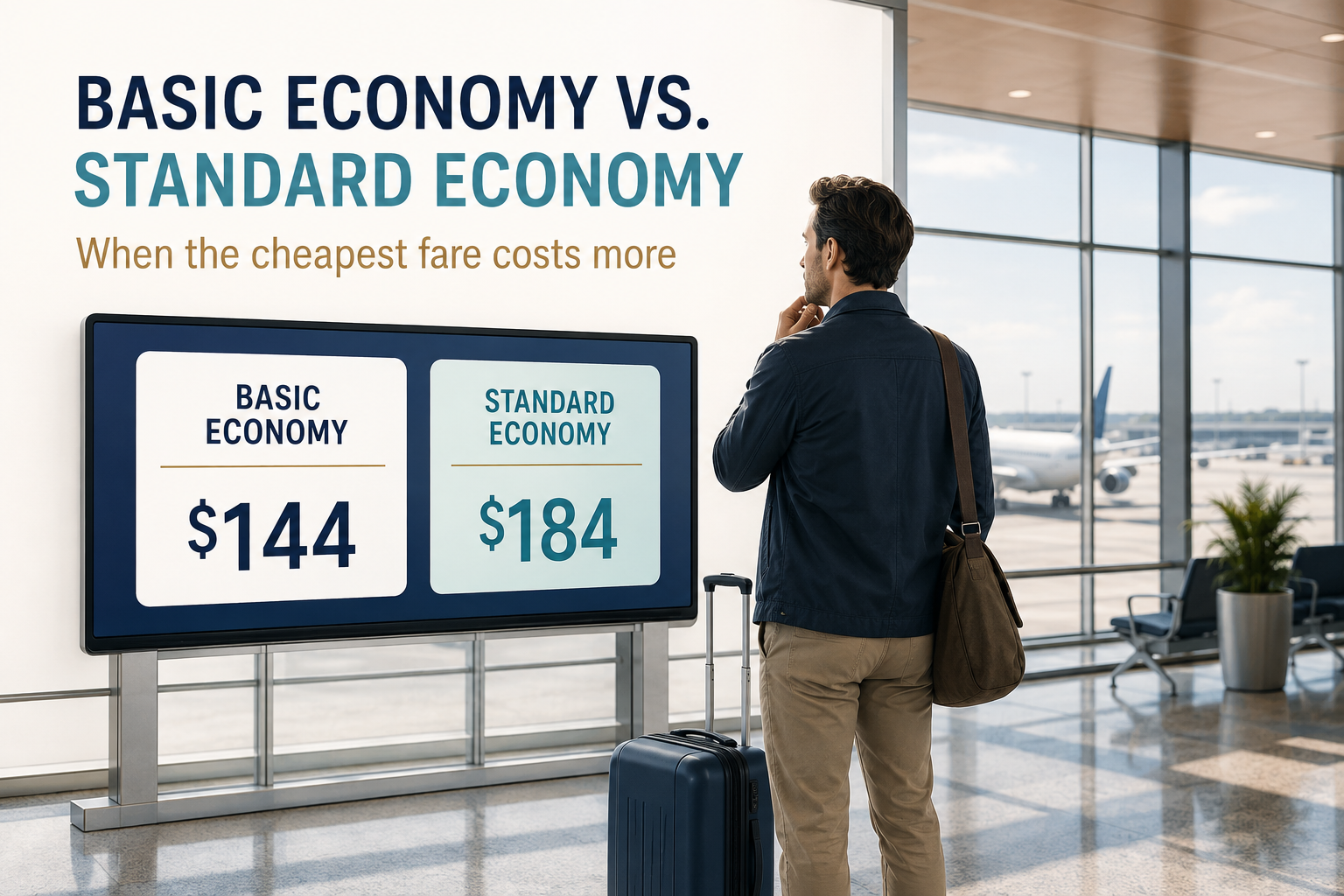
Basic Economy vs. Standard Economy: When the Cheapest Fare Costs More
The seat may be the same, but the rules surrounding it can change the value of your entire trip.
When travelers ask for a flight that “won’t break the bank,” the lowest number on the screen can feel like the only number that matters.
I understand that. Sometimes the least expensive ticket is what makes the trip possible. There is no shame in booking it.
But the first price an airline displays is not always the price of the trip you actually intend to take.
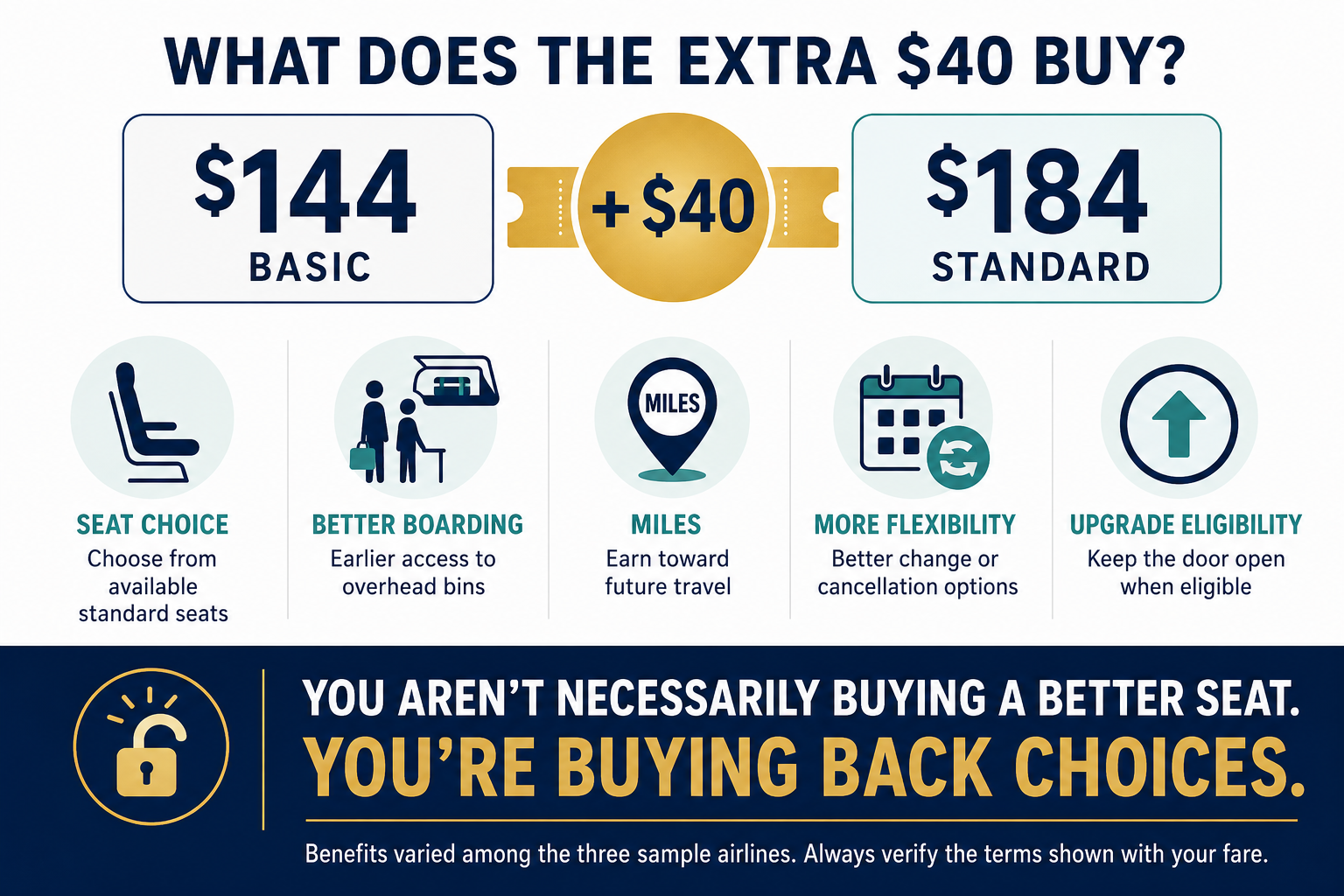
Basic Economy may mean paying separately to choose a seat, boarding near the end of the process, earning fewer—or no—miles, giving up upgrade eligibility or accepting stricter change and cancellation rules. On some airlines, it can even affect whether a full-size carry-on is included.
That does not automatically make Basic Economy a bad purchase. It makes it a purchase that deserves more than a quick glance.
The real question is not:
Which fare is cheaper?
It is:
What am I giving up, and does any of it matter on this trip?
I Have Never Booked Basic Economy
I do not have an unlimited travel budget, and I do not automatically choose the most expensive fare. I simply place more emphasis on the air-travel portion of our overall trip budget.
Getting from Point A to Point B comfortably, sitting together and retaining some flexibility have real value to me. I am willing to spend more there and economize elsewhere when necessary.
I have never booked Basic Economy.
If I were traveling alone on a short nonstop flight, carrying very little and certain of my plans, I might consider it. But most of my travel is with Gina, often involves a connection and is important enough that I prefer not to surrender control simply to secure the lowest advertised fare.
That is not an argument that everyone should make the same decision. It is an argument for knowing what you value before the airline makes the decision for you.
Basic Economy Is Usually the Same Seat With Fewer Choices
Basic Economy is often misunderstood as a separate, more cramped section of the aircraft. On the major U.S. airlines, it generally places you in the same main economy cabin.
The difference is usually not the physical seat itself. The difference is what surrounds it:
When—or whether—you can select the seat
When you board
Whether a full-size carry-on or checked bag is included
Whether you earn miles or credit toward status
Whether you remain eligible for upgrades
What happens if your plans change
That distinction matters. You may sit in the same type of seat as the traveler across the aisle while holding a ticket governed by very different rules.
A Real Search With a Nearly Perfect Comparison
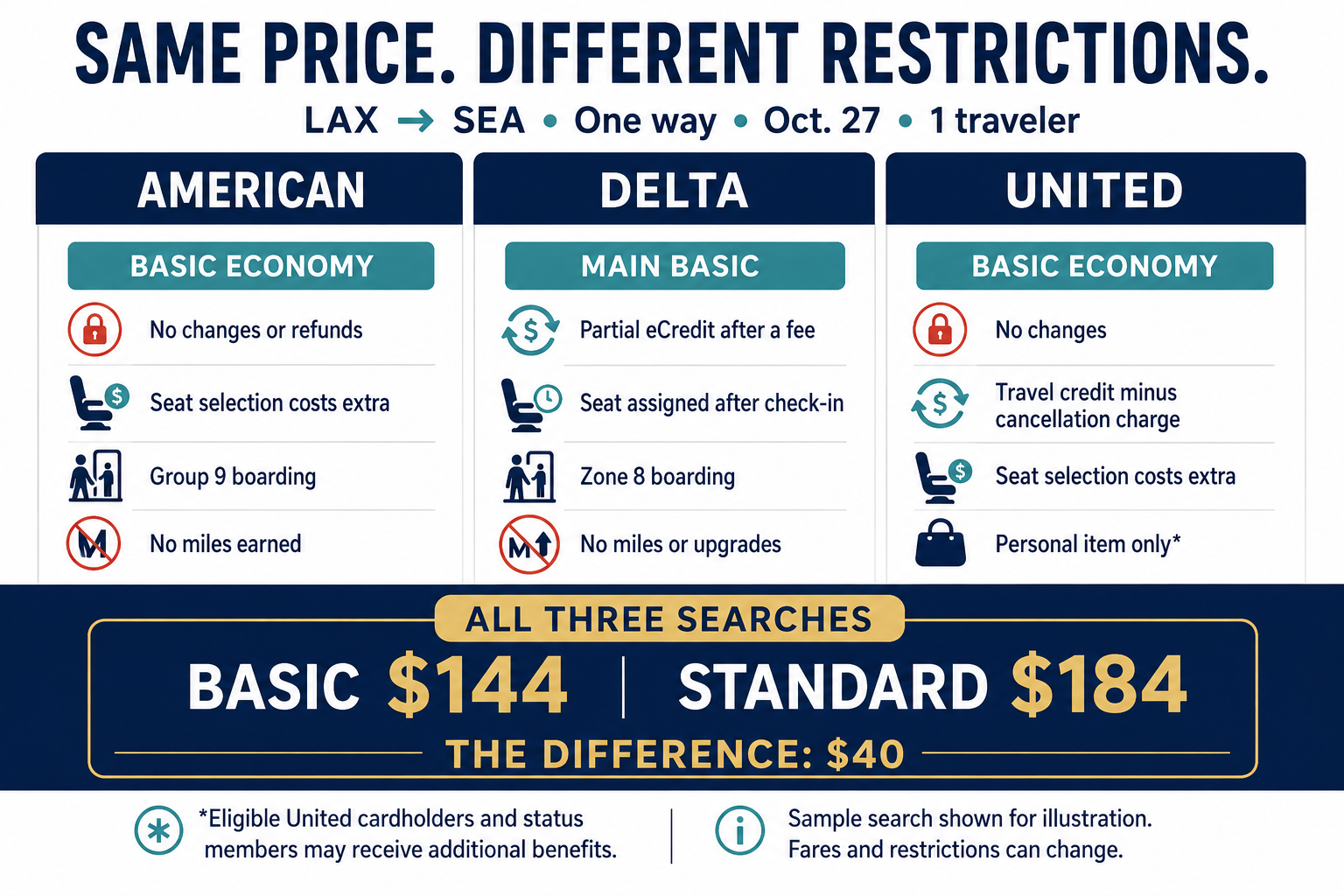
In September 2026, I searched for a one-way flight from Los Angeles to Seattle for one traveler on October 27. American, Delta and United all offered nonstop options.
The prices lined up almost suspiciously well:
Basic Economy or Main Basic: $144
Standard Economy or Main Classic: $184
Difference: $40
The numbers were identical. The rules were not.
American Airlines
American displayed Basic Economy at $144 and Main at $184.
The Basic fare shown in my search included no changes or refunds, no mileage earning and Group 9 boarding with limited overhead-bin space. Seat selection cost extra, starting at $15, and the checked-bag price was $5 higher than with the Main fare.
For $40 more, Main included standard seat selection, mileage earning, changes and a refund to travel credit. It also moved the traveler into the general boarding groups rather than Group 9.
American’s current published rules confirm that Basic Economy usually boards in Group 9 and that tickets bought after December 16, 2025, no longer earn AAdvantage miles or Loyalty Points. Eligible cardmembers and status holders may retain certain bag and boarding benefits.
Delta Air Lines
Delta now calls its former Basic Economy product Delta Main Basic. The standard option shown beside it is Delta Main Classic.
Main Basic was $144. It offered cancellation for a partial eCredit and changes for a fee, Zone 8 boarding, no mileage earning, no upgrades and a seat assigned after check-in.
Delta’s expanded details also said Main Basic passengers were not eligible for same-day confirmed changes, same-day standby or Delta Sky Club access through otherwise eligible credentials.
Main Classic cost $184 and restored advance seat selection, mileage and Medallion Dollar earning, broader change and cancellation options, upgrade eligibility for qualifying travelers and earlier boarding.
Delta confirms that Main Basic replaced the old Basic Economy name. Its published restrictions include seat assignment after check-in, Zone 8 boarding, no mileage or MQD earning and no paid or complimentary upgrades.
United Airlines
United also displayed Basic Economy at $144 and standard United Economy at $184.
Its Basic fare allowed no changes. Cancellation could produce a travel credit after a Basic Economy cancellation charge, and advance seat selection cost extra.
The most important distinction for many domestic travelers was baggage: the fare included a personal item but not a standard carry-on bag unless an eligible credit card, MileagePlus Premier status or another exemption applied.
Standard United Economy included a carry-on, seat selection, mileage earning and the ability to change without a change fee, although the fare itself remained nonrefundable.
These were sample booking results—not permanent fare charts. Prices, routes and rules change, and international Basic Economy policies may differ substantially from domestic policies. Always open the restrictions attached to the exact ticket you are considering.
What Does the Extra Money Actually Buy?
In this example, the decision was not whether to spend $144 or $500. It was whether another $40 was worth paying.
For a solo traveler taking a short nonstop flight with a personal item and firm plans, it might not be.
For two people traveling round-trip, however, that same difference becomes $160:
$40 × two travelers × two directions = $160
That is enough money to deserve a real comparison. But the comparison should not stop at $160. Add whatever you would actually purchase with the Basic fare:
Seat assignments
Checked bags
A carry-on, if the fare excludes it
Priority boarding, if offered for purchase
Any other option you consider necessary
Then ask what happens to the ticket value if someone becomes ill, a work obligation changes or another part of the trip moves.
Flexibility does not have a guaranteed cash value on the day you book. It becomes extremely valuable on the day you need it.
The Biggest Restriction Is Usually Flexibility
Baggage and seat fees are visible enough to put into a calculator. Flexibility is harder to price.
Life happens. Weather changes. Meetings move. Family situations arise. Sometimes the trip itself changes after you book it.
That is where the lowest fare can become a costly bet.
The old shorthand that “Basic Economy can never be changed or canceled” is no longer accurate across every airline. Some fares cannot be changed. Some can be canceled for a travel credit after a charge. Some airlines offer paid options that alter the original restrictions. The result may also depend on where the trip begins.
The principle, however, remains the same: Basic Economy generally gives you less control and a less favorable outcome when your plans change.
Before paying, answer these questions:
Can I change this ticket?
Can I cancel it?
Will I receive a refund, a full travel credit, a partial credit or nothing?
Is there a fee or cancellation charge?
When does any credit expire?
Do not assume the answer based on what another airline allowed—or what the same airline allowed last year.
Traveling Together Changes the Equation
Seat selection is easy to dismiss when you are traveling alone. A middle seat for two hours may be an acceptable trade for a lower fare.
It feels different when you are traveling with a spouse, friend, parent or child.
Some airlines attempt to seat young children with an accompanying adult, but that is not the same as guaranteeing that two adults traveling together will sit together. Waiting for an automatic seat assignment can leave companions separated or placed wherever space remains.
If sitting together matters, include the price of two seat assignments in the Basic Economy total. If the difference narrows substantially, the standard fare may provide better value before flexibility, boarding and mileage earning are even considered.
Paying to select seats also does not necessarily convert the underlying ticket. You may have solved the seating problem while every other Basic Economy restriction remains.
Connections Increase the Value of Control
I would be more willing to experiment with Basic Economy on a short nonstop flight than on an itinerary with a connection.
The airline still has obligations when it cancels or significantly changes a flight, regardless of the fare purchased. But a connection introduces more opportunities for the journey to go sideways: a delayed first segment, a missed connection, an aircraft change or limited remaining seats on the next flight.
A standard ticket does not prevent disruptions. It can, however, preserve more options when you need to adjust the itinerary voluntarily or when you want access to same-day travel choices.
For an important international departure, cruise embarkation, wedding, milestone celebration or once-in-a-lifetime trip, I am reluctant to trade away options for a modest savings.
My goal is not to buy the fanciest ticket. It is to protect the money already invested in the rest of the trip.
An Airline Credit Card Can Change the Math
Airline credit cards are often marketed with images of aspirational redemptions and enormous mileage balances. But you do not need to accumulate a million miles for business class to Asia to receive meaningful value from one.
Sometimes the useful benefit is far less glamorous:
Checking a suitcase without another fee
Boarding before the overhead bins are full
Retaining a carry-on benefit that a Basic fare would otherwise restrict
Receiving an onboard-purchase discount
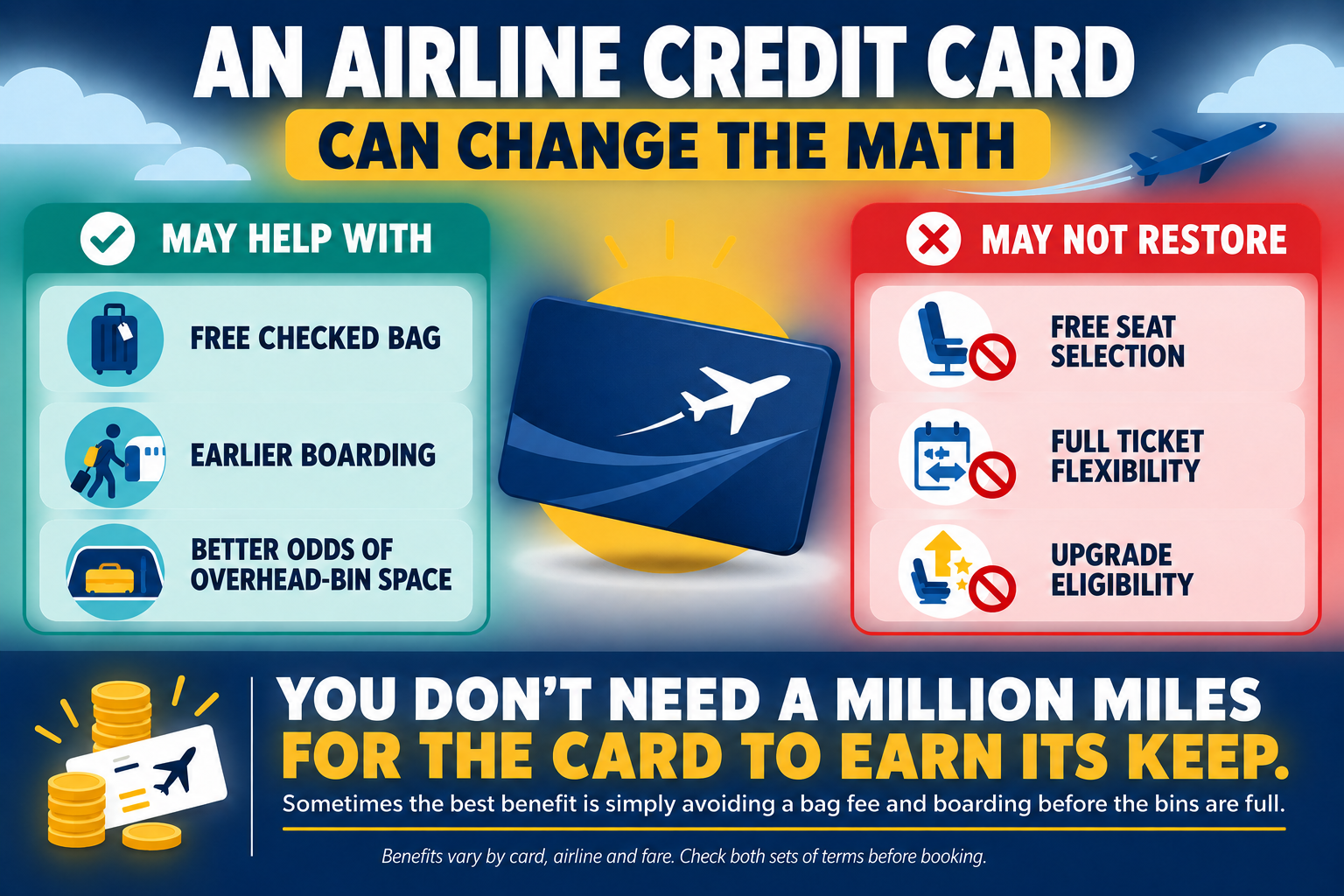
American states that eligible AAdvantage credit cardmembers may retain a free first checked bag on qualifying domestic itineraries and board according to the group associated with the card rather than the normal Basic Economy group.
United identifies eligible cardmembers among the travelers who may bring a full-size carry-on with Basic Economy. Cards such as the United Explorer Card advertise a checked-bag benefit and priority boarding. Delta’s eligible co-branded cards may also provide checked-bag benefits.
That can change the arithmetic considerably.
But an airline card does not automatically turn Basic Economy into standard economy. It may not restore free seat selection, full flexibility, upgrade eligibility or every mileage benefit.
Compare both documents:
The restrictions attached to the fare
The benefits attached to your exact card
The useful calculation is:
Basic fare + seats + bags + other required extras − applicable card benefits
compared with:
Standard fare + any remaining extras
That is a more honest comparison than looking only at the first two prices on the screen.
When Basic Economy May Be the Right Choice
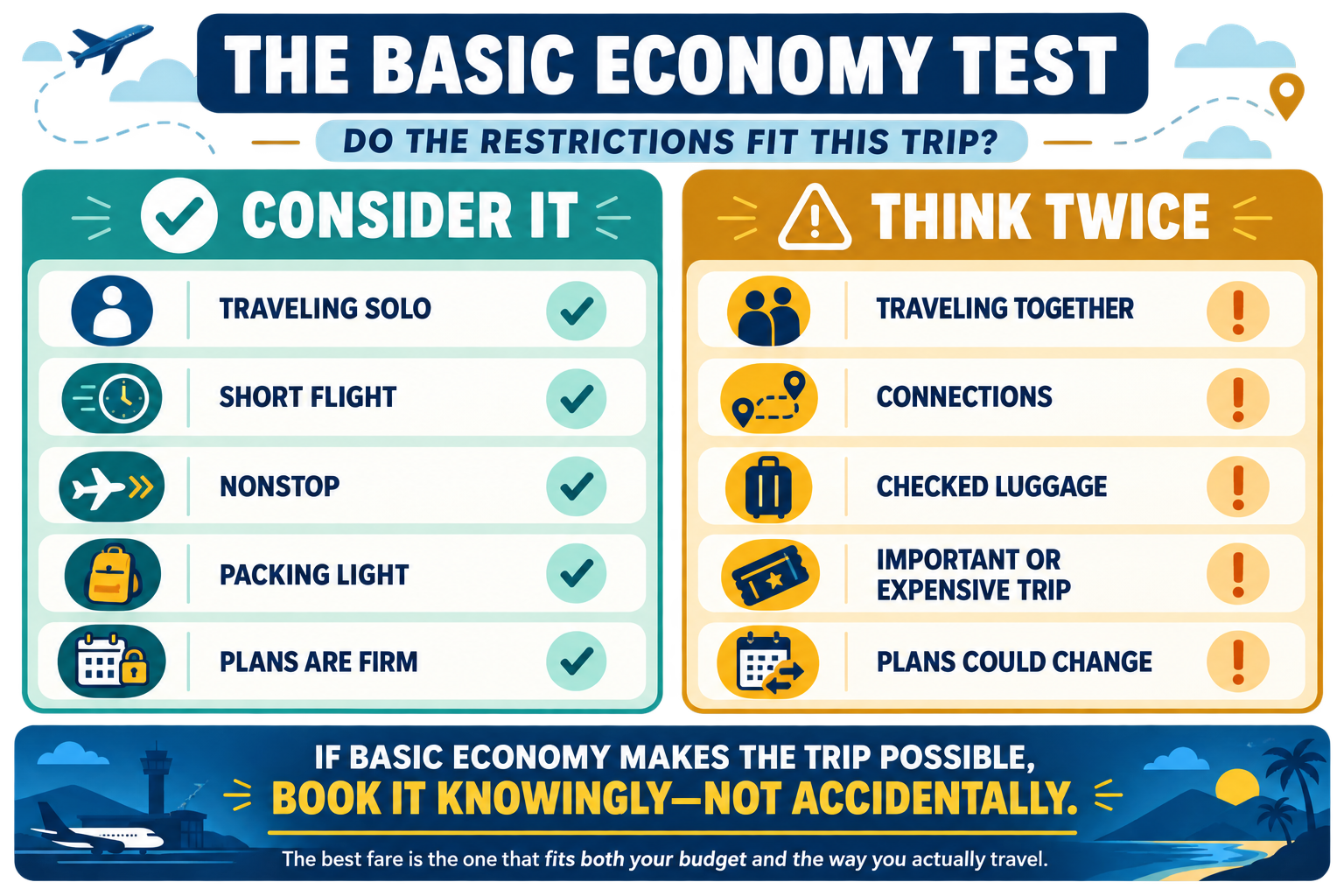
Basic Economy may be entirely reasonable when:
You are traveling alone
The flight is short
The itinerary is nonstop
Everything fits in the included baggage allowance
You do not care where you sit
Your schedule is firmly set
The savings remain meaningful after adding necessary extras
If that describes the trip, understand the restrictions, take the savings and go.
If Basic Economy is what makes the trip possible, there is no shame in booking it. The goal is simply to understand exactly what you are giving up before clicking Buy.
When I Would Pay for Standard Economy
I would lean toward the standard fare when:
Traveling with Gina or anyone I want to sit beside
Taking a longer flight
Making a connection
Checking luggage
Depending on overhead-bin space
Booking far in advance
Traveling for an important event
Facing any meaningful chance that plans could change
Standard Economy is not automatically the better deal. It is the better deal when the included choices are worth more to you than the difference in price.
The Curated Upgrades Verdict
Basic Economy is not automatically bad. It is a calculated bet that your plans will not change and that the restrictions will not matter to you.
Sometimes that bet makes sense.
But do not compare only the two fares. Compare the total trip you actually intend to take.
I do not pay more simply because an airline labels a fare an upgrade. I pay more when the additional cost buys something I value: flexibility, control, comfort or a smoother journey.
In our LAX-to-Seattle example, the extra $40 did not necessarily buy a better physical seat. It bought back choices.
And sometimes choices are the most practical upgrade of all.