

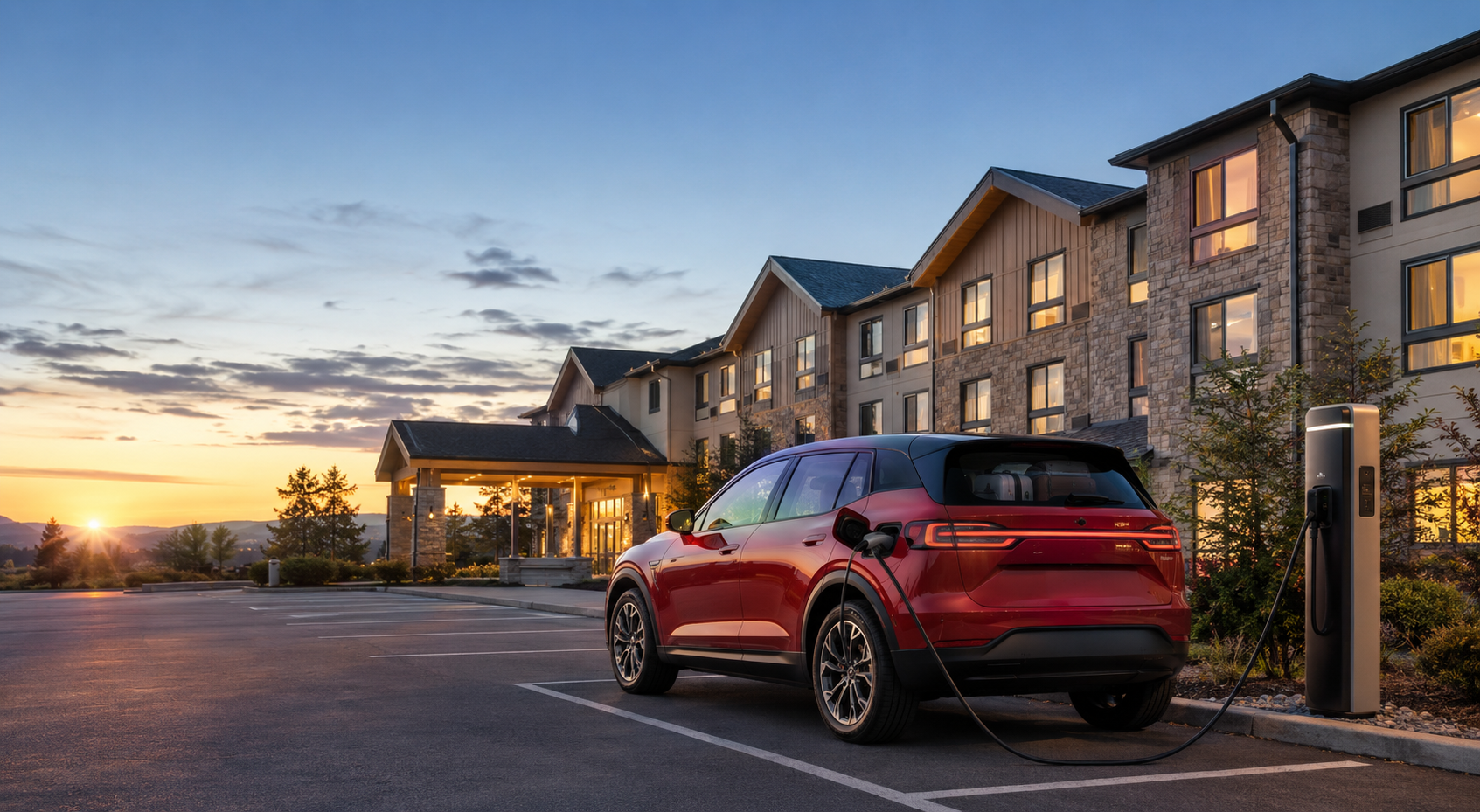
Charge While You Sleep
The smarter way to plan an EV road trip without wasting vacation time
One of the biggest concerns people have about taking an electric vehicle on a road trip is the time they expect to spend waiting for it to charge.
That hasn’t been our experience.
We bought our first Tesla, a Model Y, in 2023 and moved to a Model X in March 2026. We’ve taken both on long trips, including a roughly 1,400-mile round trip to Chincoteague, Virginia, a 900-mile round trip to our North Carolina cabin and previous drives to Havelock, Biloxi and the mountains of North Georgia.
Charging has yet to become an inconvenience.
The secret isn’t finding a charger that fills the battery instantaneously. It is building charging into time we were already going to spend.
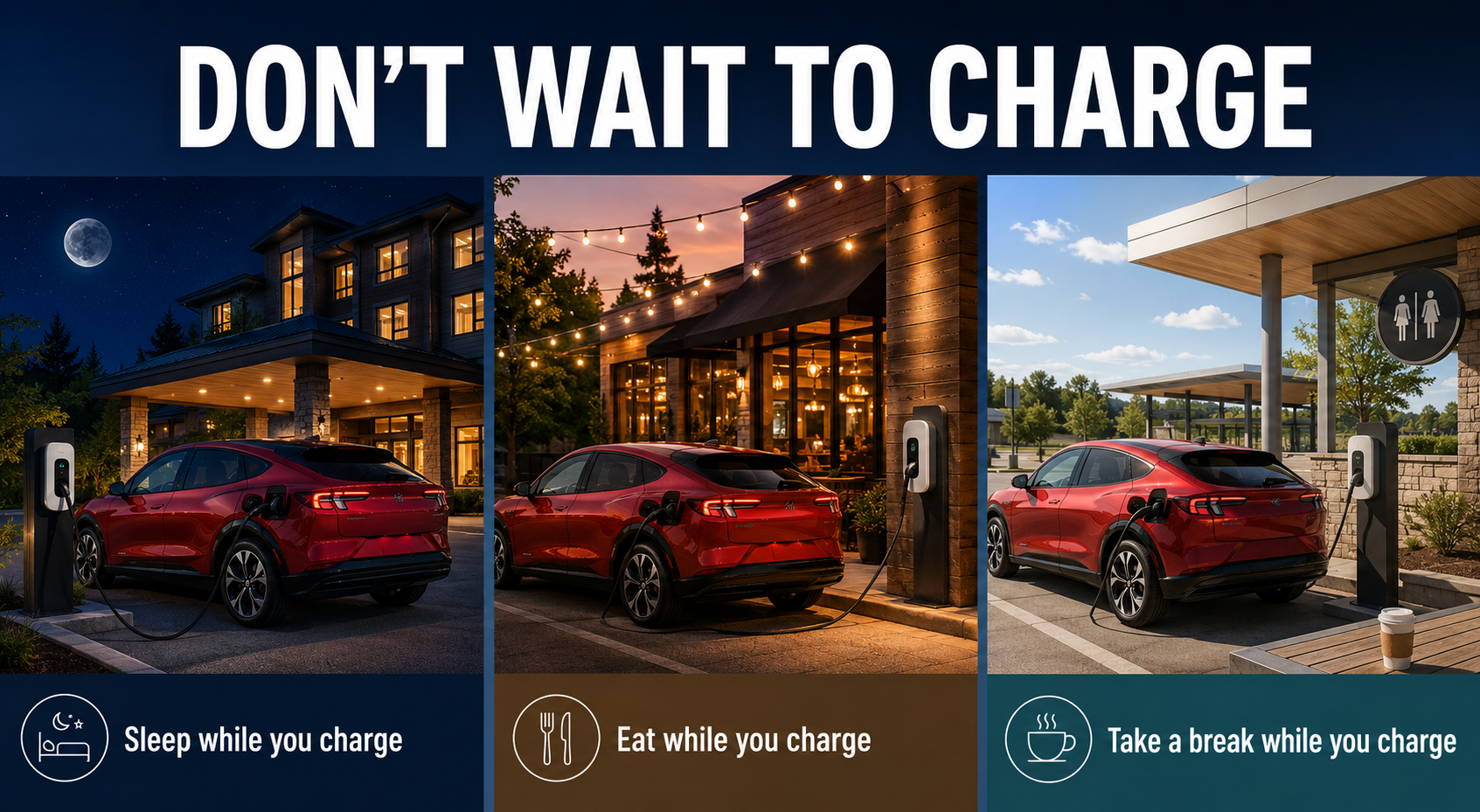
We charge while we sleep.
We charge while we eat.
We charge during the same restroom, coffee and pet breaks we would take in any vehicle.
The car charges while our trip continues.
The real upgrade is time
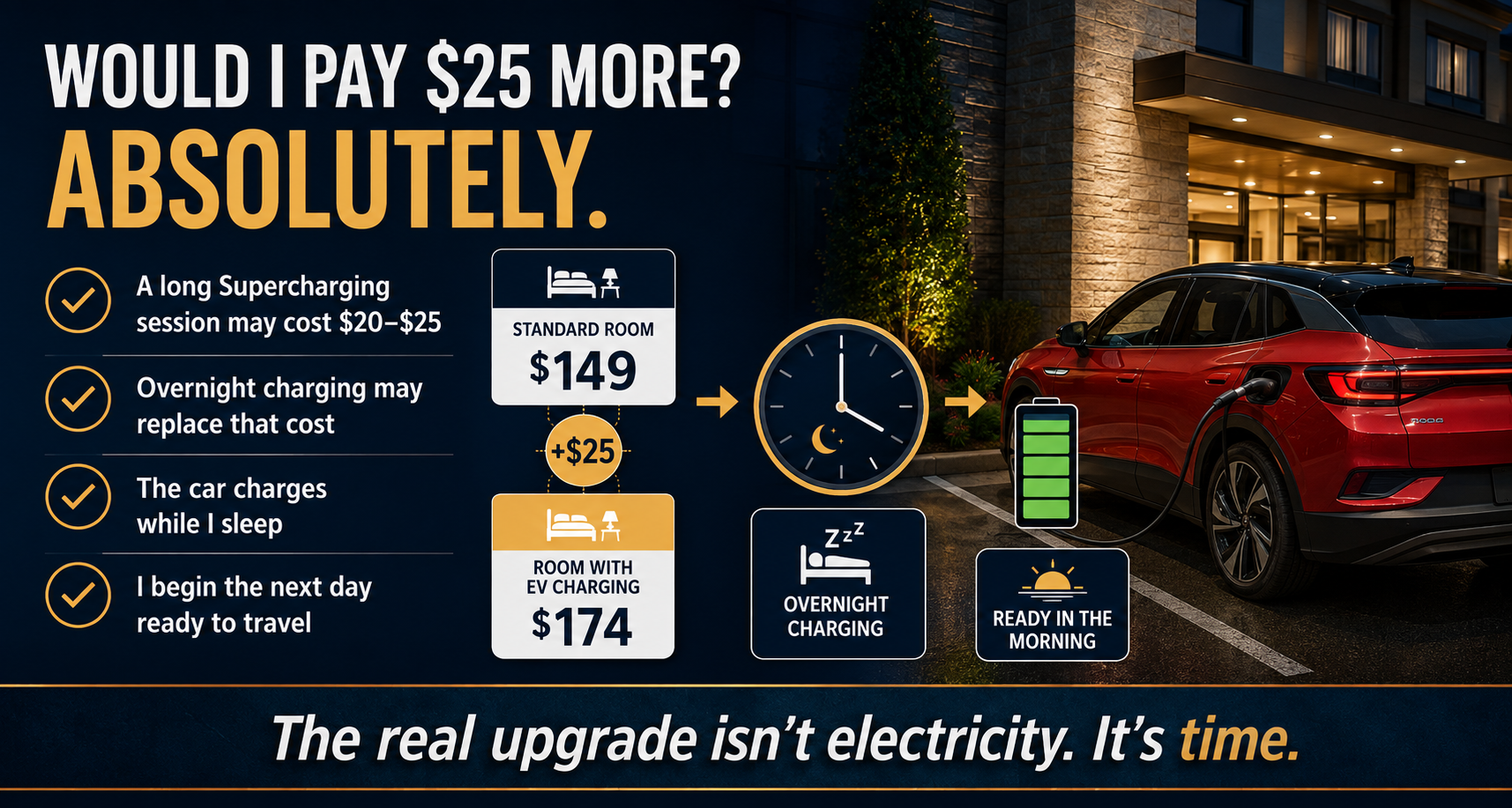
Charging overnight at a hotel may save money, especially when it is complimentary for guests. But the potential savings aren’t the biggest benefit for me.
The real upgrade is time.
A longer Supercharging session can cost me about $20 to $25. Because of that, I would happily pay approximately $25 more for an otherwise comparable hotel with dependable overnight charging.
Even if the financial difference is a wash, the hotel charger still wins on convenience.
Instead of stopping at a Supercharger the following morning, I can plug in at the hotel, check into the room, have dinner, sleep and leave with enough charge to continue the trip.
I haven’t sacrificed part of my evening to charge. I haven’t added another stop to the following morning. The vehicle replenished its battery during hours when it would have been sitting in the hotel parking lot anyway.
That doesn’t mean I’ll pay any price for a room simply because the hotel has a charger. The property still has to meet our other needs. But when I’m comparing similar hotels near a major interstate, dependable charging can easily break the tie.
My $25 calculation
When comparing two hotels, I consider:
The difference in room price
Any separate parking or charging fee
The Supercharging cost I may avoid
The time another charging stop would require
The convenience of beginning the next day ready to travel
My personal threshold is about $25. Yours may be different, but don’t compare room prices without assigning some value to your time.
Slower charging can be smarter charging
DC fast chargers and Tesla Superchargers are designed to replenish a battery quickly during a driving day. A hotel’s Level 2 charger is much slower, but charging speed matters considerably less when I’m asleep.
In our experience, a Level 2 charger can add around 30 miles of range per hour. The U.S. Department of Energy’s guide to EV charging uses approximately 25 miles per hour as a general estimate.
Actual results vary by vehicle, charger, available power, temperature and other conditions. But even at the lower estimate, an overnight stay can add substantial range.
A couple of hours during dinner may add enough for local sightseeing. Several evening hours could add well over 100 miles. A full night may provide enough energy for much of the following day.
A standard 110-volt outlet is another matter.
During a cabin-shopping trip to Clayton, Georgia, our Airbnb didn’t have an EV charger. We plugged the Model Y into a standard outlet, but it added very little range.
Fortunately, there was a Level 2 charger in town. We used it while going out to eat at night.
We weren’t waiting for the car. The car was charging while we had dinner.
That experience helped define our broader rule:
Charge while you sleep. If you can’t do that, charge while you eat.
An interstate hotel is different from a destination
The value of charging at the hotel depends partly on how we are using the property.
An overnight stop along the interstate
On a long road trip, we may only need a clean, comfortable place to sleep before continuing the next morning.
Major interstate exits often have several comparable hotels. That allows me to prioritize charging without making a major compromise on location, quality or price.
We used hotel chargers during overnight stops in both directions on our Chincoteague trip. We did the same on an earlier Model Y trip between Kingsland, Georgia, and Havelock, North Carolina.
Those are ideal “charge while you sleep” situations. We needed a hotel anyway, so choosing one with a charger allowed the vehicle to prepare for the next leg while we rested.
A multi-night destination
Charging is still a consideration at the destination, but it becomes one part of a larger decision.
For a longer stay, I consider:
How many miles we expect to drive locally
Whether reliable public charging is nearby
Whether we’ll pass a convenient fast charger arriving or departing
How long the car will remain parked
Whether the better lodging is worth choosing despite not having charging
When I traveled to Biloxi in the Model Y, the hotel where I stayed for four nights had a charger. That made local driving and the eventual trip home easier.
But I wouldn’t automatically reject a great hotel, vacation rental or cabin because it doesn’t have a charger. Our Clayton experience showed that a nearby Level 2 charger can work perfectly when it fits naturally into dinner or another activity.
The charger should improve the trip—not dictate the entire vacation.
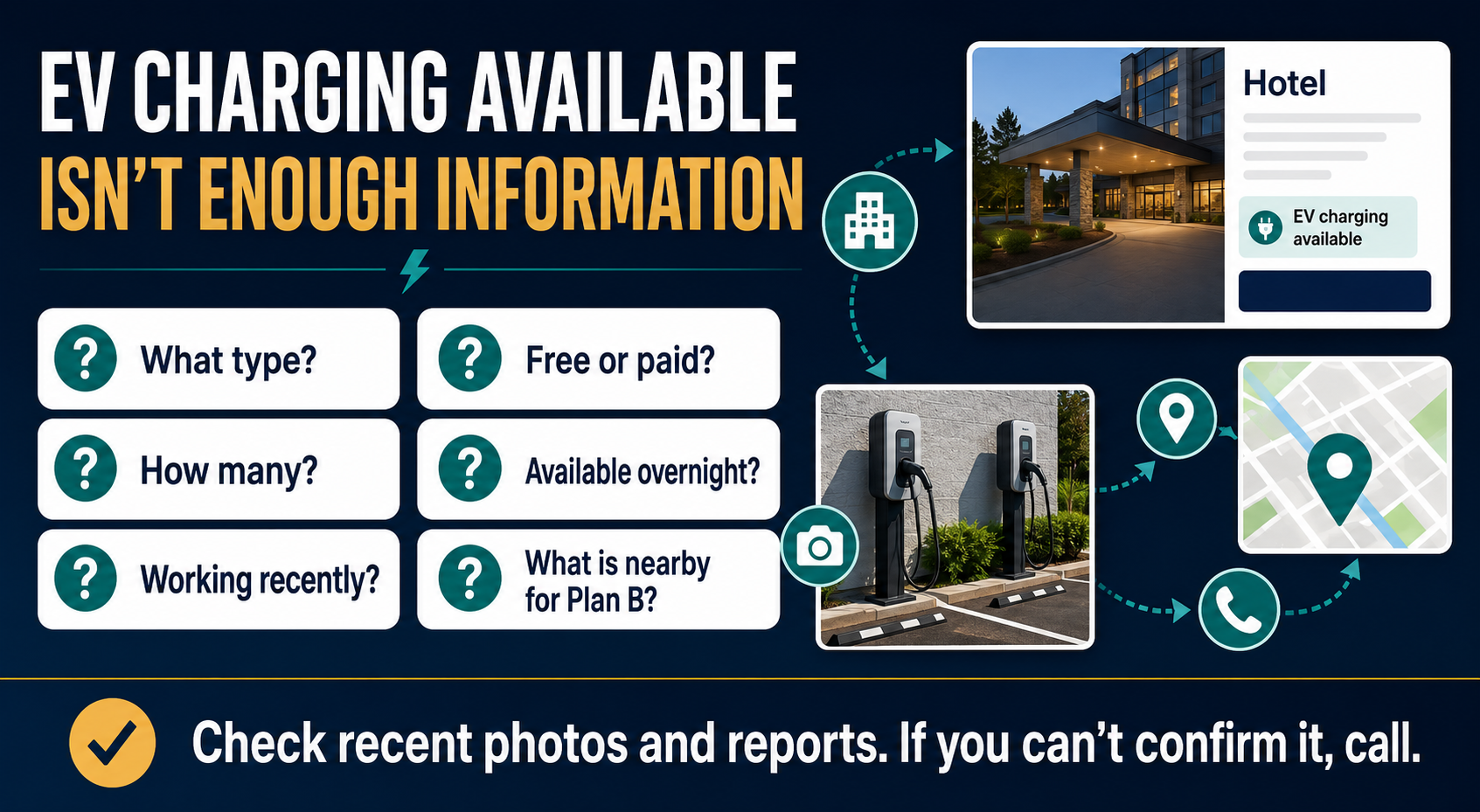
“EV charging available” isn’t enough information
When booking a hotel, I look for photographs of its chargers on the hotel website or check recent reports and pictures on ePlugShare.
If I can’t confirm what is actually there, I call the hotel.
My first two questions are simple.
What type of chargers do you have?
How many do you have?
Those details matter.
A hotel with several Level 2 chargers offers a different experience from a 150-room property with one plug. A Tesla Wall Connector, universal Level 2 charger and standard electrical outlet may all be described online as “EV charging,” but they don’t provide the same charging speed or compatibility.
I may also ask:
Are the chargers reserved for hotel guests?
Are they available overnight?
Are they free, paid or included with parking?
Does charging require an app?
Is front-desk activation required?
Have the chargers been working reliably?
So far, none of the hotel chargers we’ve used have required separate payment, an app or front-desk activation. That is our experience, not something travelers should assume at every property.
Look for recent photographs and user reports. If you can’t verify the details, pick up the phone and ask.
Arrive with a buffer
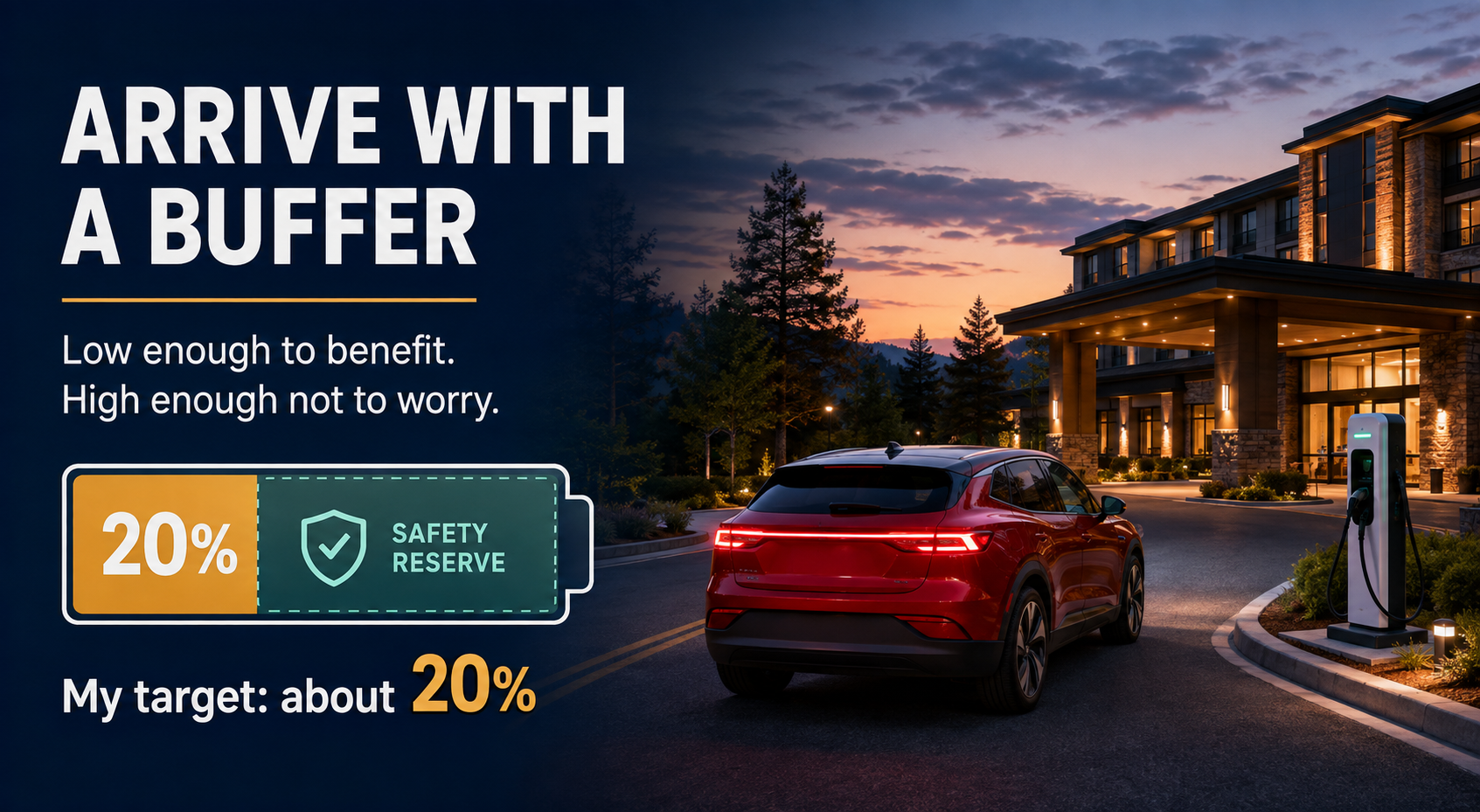
There is a difference between arriving low enough to make good use of the hotel charger and arriving so low that an unexpected delay becomes stressful.
I generally plan to reach a charging hotel with about 20% of the battery remaining.
That gives me a useful overnight charging opportunity while preserving a buffer for:
Traffic delays
An unexpected detour
Greater heating or air-conditioning use
Driving conditions that consume more energy than predicted
A longer meal or restroom stop
Leaving the climate running in Pet Mode when appropriate
Twenty percent isn’t a universal rule. It is simply the target that works for me.
I don’t want to arrive with a nearly full battery because that reduces the value of the overnight charger. But I also don’t want to build the day around reaching one specific plug with almost nothing remaining.
My goal is to arrive low enough to benefit and high enough not to worry.
Chargers fail, but the trip doesn’t have to
Not every charger we’ve encountered has worked.
We found a public Level 2 charger in Chincoteague that was inoperable. At a hotel in Benson, North Carolina, one of the non-Tesla Level 2 chargers was broken. We have also reached Supercharger locations where an individual stall wasn’t working.
But we have never arrived somewhere and been completely unable to charge.
That distinction matters.
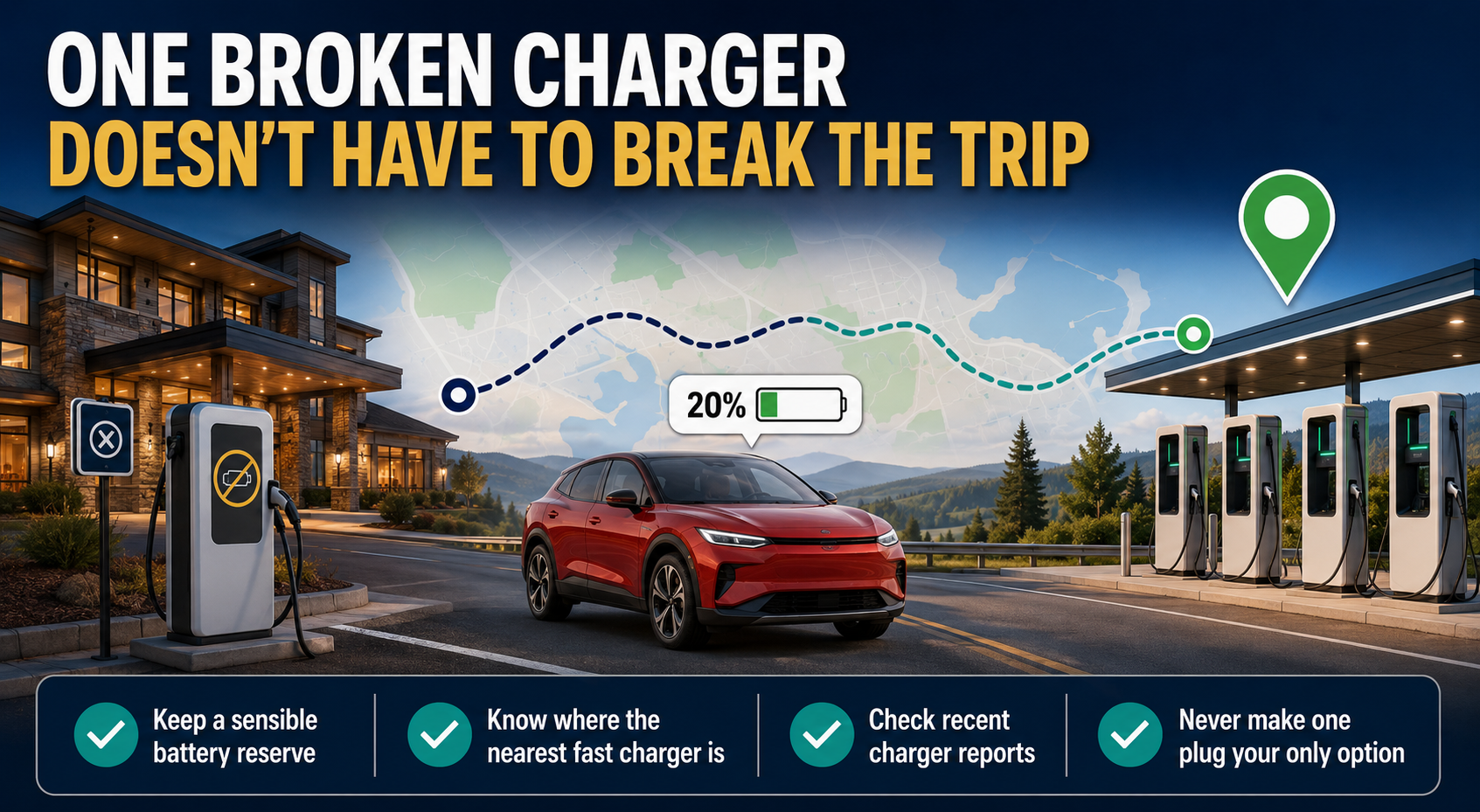
A broken charger is inconvenient. It isn’t necessarily a crisis when there are several plugs or another charging location nearby.
Before relying on overnight charging, know your alternative. That might be:
Another charger at the property
A nearby Level 2 station
A fast charger before reaching the hotel
A fast charger shortly after departure
Enough remaining battery to continue elsewhere
If a hotel charger looks questionable, I can Supercharge before stopping for the night.
Tesla’s Trip Planner and charging guidance recommends charging stops and updates the plan as the trip progresses. Other EV manufacturers and charging apps offer their own route-planning tools.
The Department of Energy Alternative Fueling Station Locator can also help travelers locate public charging beyond a single vehicle or charging network.
A backup plan doesn’t mean I expect something to go wrong. It means one broken or occupied charger doesn’t get to control the trip.
Charge when you would naturally stop
When we need to Supercharge during a driving day, I try to coordinate it with a stop we would have made in any vehicle.
After about three hours on the road, we may be ready to:
Use the restroom
Buy coffee
Eat a meal
Stretch our legs
Give the animals a break
Those aren’t EV charging delays. They’re normal road-trip stops.
About 90% of the time, the Tesla tells me it has enough charge to continue before I’ve finished using the men’s room and buying a coffee.
Occasionally, the car is ready before we are.
The goal isn’t to eliminate every charging stop. It is to avoid spending time waiting solely for the battery.
Don’t treat the charger like reserved parking
Hotel charging works best when travelers share it considerately.
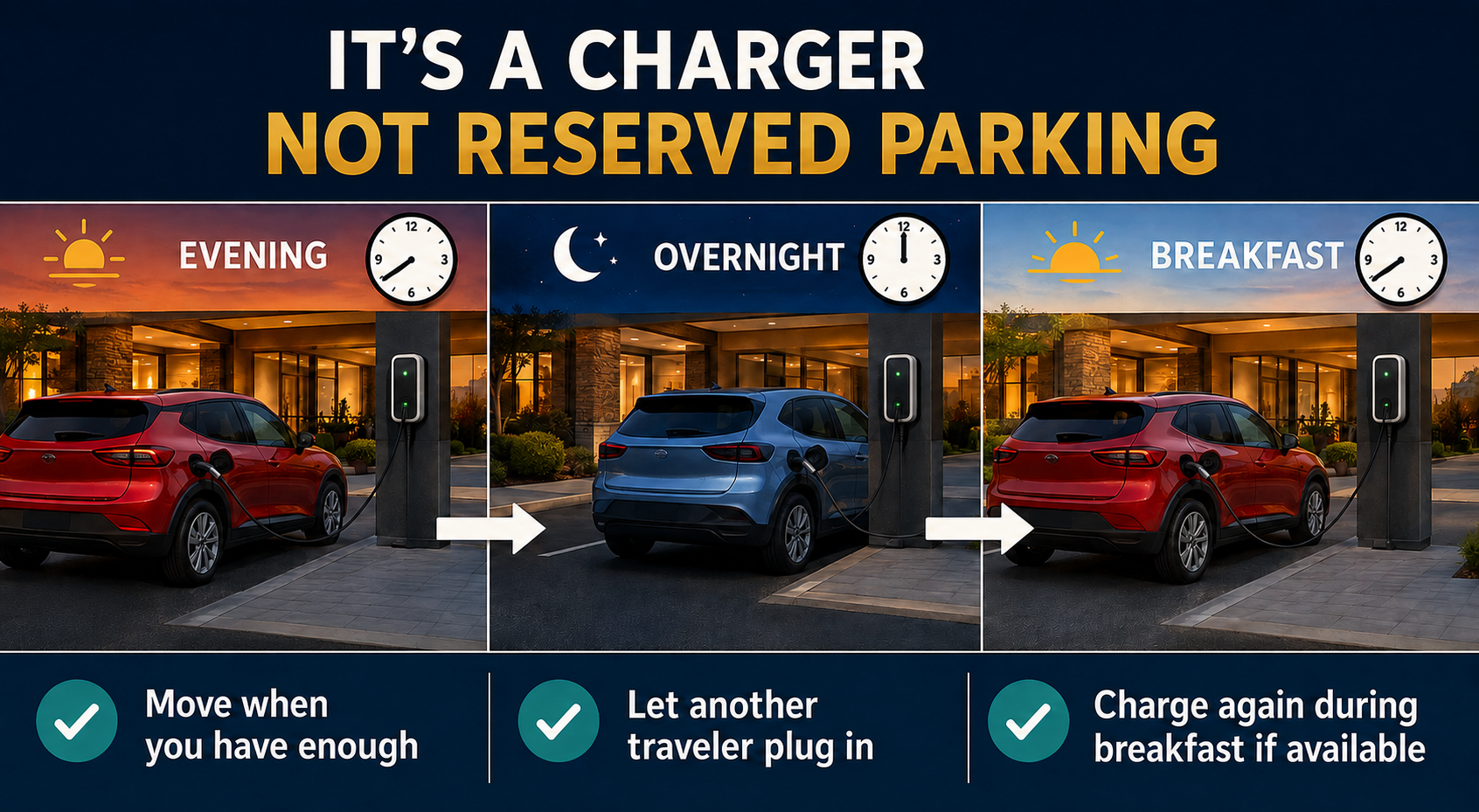
I’m mindful that another guest may arrive needing the charger. The Tesla tells me when it has enough charge to continue the journey, and I’ll move it so someone else can plug in.
That doesn’t always mean waiting for 100%.
Sometimes I move the vehicle earlier because I don’t want my sleep interrupted later. If the charger remains available, I can reconnect first thing in the morning and add more range while we have breakfast.
The basic etiquette is simple:
Don’t occupy the space if you aren’t charging.
Move when you have enough to comfortably continue.
Pay attention to notifications from the vehicle or charging app.
Follow the property’s time limits or charging rules.
Remember that the charger is a shared amenity, not reserved parking.
A little consideration makes overnight charging work better for everyone.
What about range anxiety?
We haven’t experienced it on these trips.
That includes traveling in both the Model Y and Model X, staying at interstate hotels, visiting destinations without charging at the lodging and encountering occasional broken chargers.
That doesn’t mean we travel without a plan.
Confidence comes from knowing:
The estimated charge when we reach the destination
Where we expect to stop
What type of charging is available
Whether an important hotel charger has been verified
Where the nearest alternative is
How much battery buffer makes us comfortable
Planning doesn’t create anxiety. Good planning removes it.
The goal isn’t to account for every possible mile before leaving home. It is to make sure that no single charger, hotel or unexpected detour becomes the only thing standing between you and the next part of the trip.
The smartest charging stop
The best charging stop isn’t necessarily the fastest one.
It is the one that fits naturally into the journey.
Sometimes that means plugging into a Level 2 charger at a hotel and waking up ready to travel. Sometimes it means charging in town while having dinner. On a long driving day, it may mean using a fast charger while everyone visits the restroom, stretches and buys coffee.
In each case, the car charges while we do something we wanted or needed to do anyway.
That is why EV charging has yet to become an inconvenience for us.
The key isn’t avoiding every charging stop.
It is avoiding wasted time.
Charge while you sleep. Eat while you charge. Stop when you need a break—and let the car get ready while you do.