

Cruise Embarkation Day: Start Your Vacation the Smart Way
A little preparation can turn boarding day from a logistical chore into the first full day of your cruise.
Embarkation day is more than the process of getting onto a ship. It is the first day of your vacation—and on many cruises, several hours of dining, exploring, relaxing, and entertainment are available before the ship ever leaves the pier.
Those first hours can also feel confusing. Your checked luggage may not have arrived. Your stateroom may not be ready. The buffet may be crowded, the ship’s app may need attention, and reservations may already be filling.
The solution is not to race around the ship trying to do everything. It is to handle a few important tasks early, carry the right essentials, and then start enjoying the experience.
These strategies apply broadly to ocean and river cruising, but boarding procedures differ by cruise line, ship, itinerary, and departure port. Always follow the arrival instructions provided for your particular sailing.
Arrive in the Departure City Early
If reaching the ship requires a flight, arrive in the departure city at least one day before embarkation whenever possible.
A same-day flight leaves very little margin for weather, mechanical problems, missed connections, or delayed luggage. The ship generally will not wait for independently arriving passengers whose flights run late.
An inexpensive hotel night near the port can protect the much larger investment you have already made in the cruise.
For international departures, arriving even earlier may be worthwhile. An extra day provides time to recover from an overnight flight, adjust to the time zone, and deal with delayed luggage before boarding.
River cruises require the same caution. The vessel may depart from a city-center landing rather than a large cruise terminal, and docking locations can occasionally change. Recheck your final documents and transfer instructions shortly before departure.
Complete the Digital Work Before Leaving Home
Download the cruise line’s app and complete online check-in before traveling to the port. Do not assume you will have strong cellular service or reliable public Wi-Fi inside the terminal.
Before leaving home:
Complete online check-in for every passenger.
Download or print boarding passes.
Confirm the assigned arrival window.
Review travel-document requirements.
Download luggage tags.
Add a payment method for onboard purchases.
Review available dining, entertainment, and excursion reservations.
Screenshot essential booking information as a backup.
Make sure everyone in your party can access the information they need.
A screenshot or printed copy can be valuable if an app freezes, a phone battery dies, or the terminal’s connection becomes overloaded.
Follow Your Assigned Arrival Time
Do not confuse the ship’s scheduled departure time with your terminal arrival time.
Cruise lines generally assign or recommend an earlier arrival window so passengers can check luggage, pass through security, verify documents, and complete boarding before final check-in closes. Some lines may ask passengers who arrive too early to wait or return during their assigned window.
Allow additional time for traffic, parking, rental-car returns, shuttles, and finding the correct terminal. Large ports may serve several ships simultaneously, and the correct terminal is not always obvious.
River-cruise embarkation is usually quieter, but the location may be less obvious than a conventional cruise terminal. Confirm the ship’s current docking location instead of relying exclusively on an old map or a generic port address.
Prepare Your Luggage Before Reaching the Terminal
Attach the cruise line’s luggage tags before arriving at the pier. Include your name and a reliable contact number, but avoid displaying unnecessary personal information.
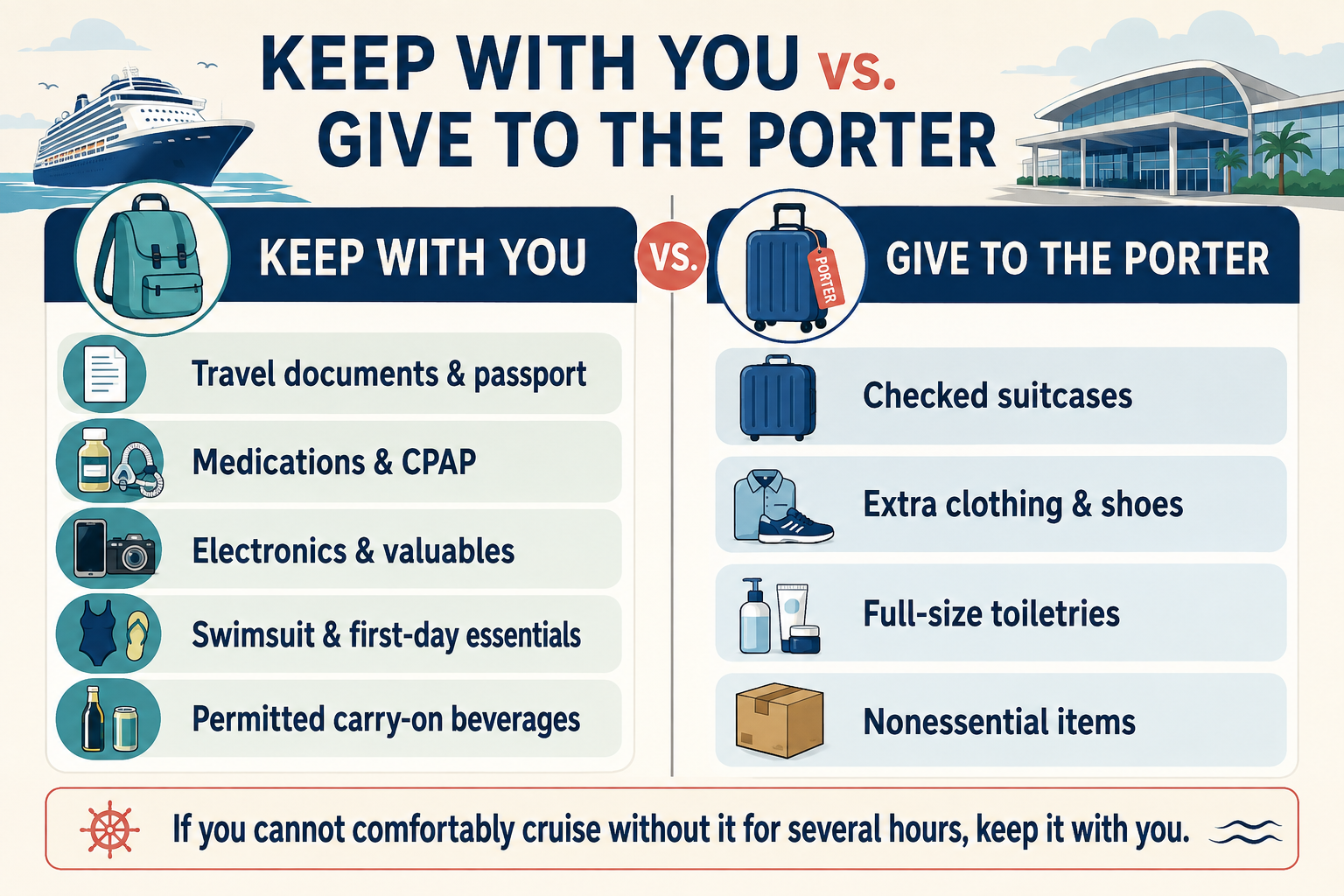
At many ocean-cruise terminals, porters accept larger suitcases and transfer them into the ship’s luggage-delivery system. Your bags may not reach your stateroom for several hours.
River-cruise luggage handling is often more direct. A crew member, driver, or local representative may transfer bags from your motorcoach or arrival point. The principle is still the same: keep anything essential with you until you are inside your stateroom.
Never surrender:
Passports and travel documents
Prescription medications
CPAP equipment and other medical devices
Wallets, money, and credit cards
Phones, cameras, computers, and other electronics
Jewelry and irreplaceable valuables
Anything you may need before dinner
Pack for the First Several Hours
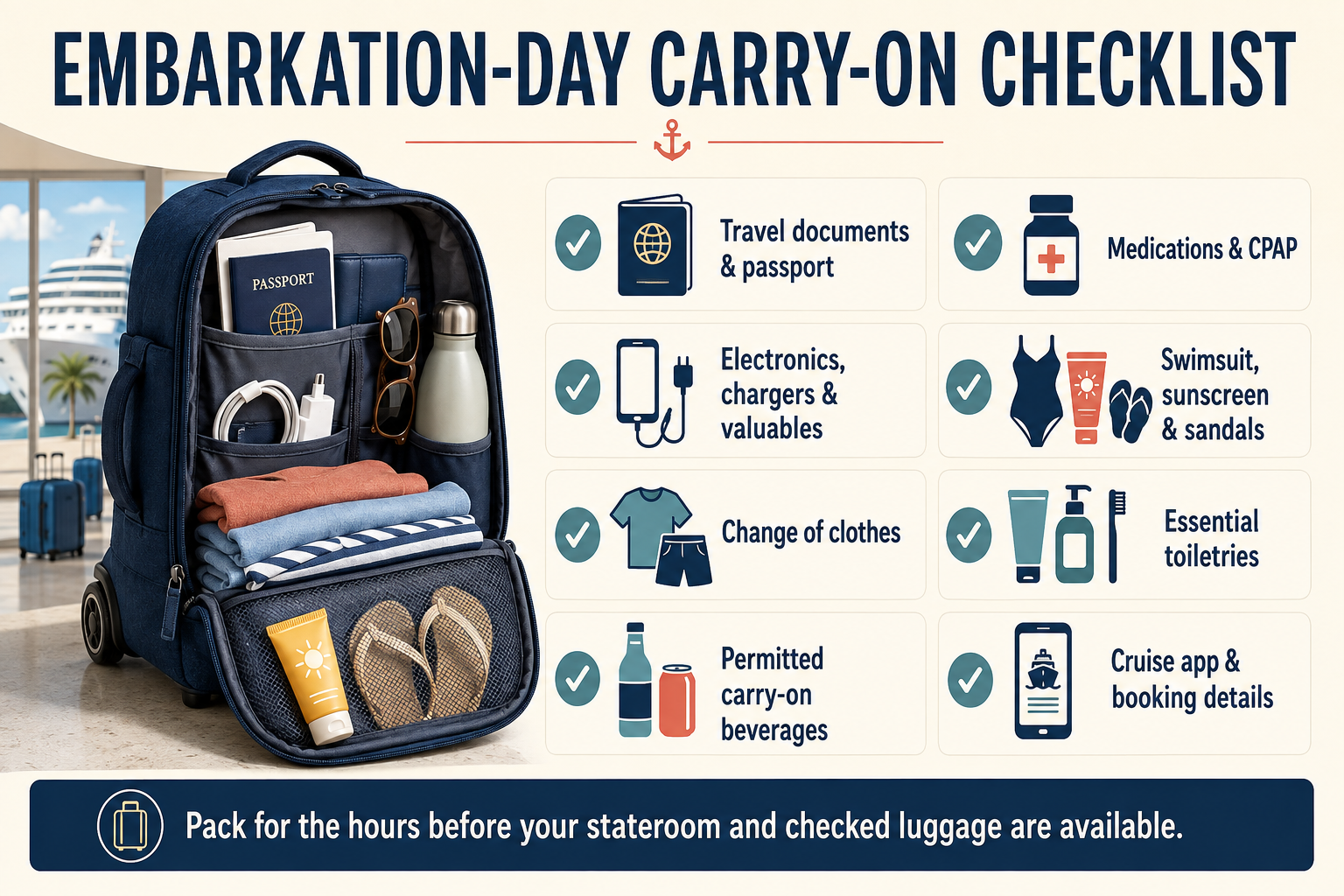
Think of your embarkation carry-on as a first-day bag—not simply somewhere to keep your passport.
Staterooms are not always available when boarding begins, and checked luggage may arrive later in the afternoon or evening. Pack everything you need to remain comfortable until both are available.
Your carry-on should include:
Travel documents and identification
Prescription and essential over-the-counter medications
CPAP equipment and medical supplies
Phone, camera, chargers, and power bank
Wallet, money, and valuables
Swimsuit, sunscreen, and sandals
A change of clothes
Essential toiletries
Eyeglasses, contacts, and hearing-aid supplies
Cruise-app and booking information
Any beverages specifically permitted by your cruise line
Beverage allowances differ substantially. Some cruise lines allow limited wine, soda, or water; others restrict the type, quantity, packaging, or location where it may be consumed. Check the current policy for your sailing rather than relying on a general cruise-packing list.
Keep Your Documents in Your Hands
Do not place passports, birth certificates, boarding passes, visas, or other required documents in checked luggage.
Keep them together in an easily accessible pocket or document holder. You may need to present them more than once while moving through the terminal.
Document requirements vary according to citizenship, itinerary, departure country, and ports visited. Some closed-loop cruises beginning and ending at the same U.S. port may accept alternatives to a passport book, but a passport book can be critical if an emergency requires you to leave the ship and fly home internationally.
The U.S. Department of State specifically notes that a passport card cannot be used for an international flight back to the United States. Review the State Department’s cruise-travel guidance.
Handle the Important Tasks First
Once onboard, resist the urge to join the largest crowd you see. You do not need to rush directly to the main buffet or stand outside a closed stateroom corridor.
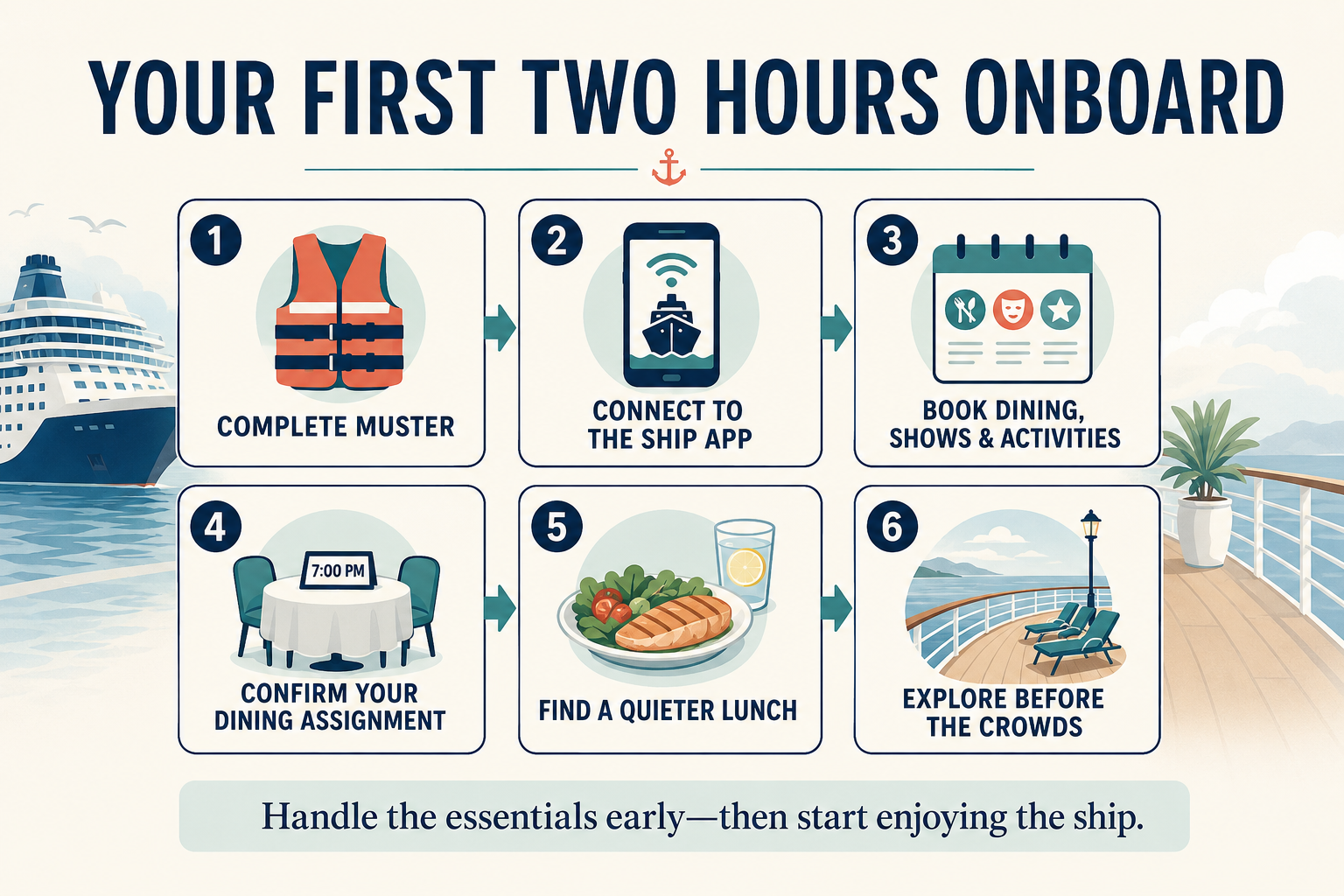
Use the first hour or two to complete the few tasks that can affect the remainder of the cruise.
Complete the safety requirement
Complete the ship’s muster or safety procedure as instructed. Depending on the cruise line and vessel, this may involve watching a safety presentation in the app or stateroom, reporting to an assigned muster station, attending an in-person briefing, or completing a combination of steps.
The safety briefing is mandatory. The International Convention for the Safety of Life at Sea requires embarking passengers to receive appropriate safety instruction, although the exact process varies by ship.
Completing it early removes an obligation from the rest of your afternoon.
Connect to the ship’s app
Join the ship’s network and open the cruise app. Many apps provide schedules, deck plans, reservations, onboard-account information, menus, and messaging.
Connecting to the ship’s network does not necessarily mean purchasing an internet package. Some cruise lines allow their app to function on the onboard network without paid general internet access.
Make time-sensitive reservations
Check dining, shows, activities, spa appointments, and other experiences that require reservations. Some may already have been available before the cruise, while others may release additional inventory on embarkation day.
Do not spend your first afternoon filling every minute of the trip. Reserve the experiences that matter most and leave room for spontaneity.
Confirm your dining arrangements
If your cruise uses fixed dining, verify the assigned time, dining room, and table information. If you requested a private table, dietary accommodation, or a particular seating arrangement, embarkation afternoon is the best time to address it.
Flexible dining passengers should check whether reservations are recommended during peak hours.
River cruises generally have simpler dining arrangements and fewer competing venues, but it is still worth confirming dinner time, seating expectations, and any dietary requests.
Find a quieter lunch
The main buffet is often the first venue passengers encounter, which can make it the busiest.
Check the app or daily schedule for alternatives such as a main dining room, café, outdoor grill, casual restaurant, or smaller buffet area. Starting with a calmer lunch can change the feel of your entire afternoon.
Explore While the Ship Is Still Quiet
Embarkation afternoon is an excellent time to learn the ship’s layout.
Locate:
Your dining room
The theater or entertainment venues
Guest Services
The medical center
Your muster station
Quiet lounges and outdoor decks
The route back to your stateroom
The gangway area used for port days
Photographing deck maps or saving locations in the app can make the ship easier to navigate later.
On a river ship, take time to learn the smaller vessel’s public areas, dining room, lounge, upper deck, and gangway procedures. River ships are easier to navigate, but their compact size makes the crew orientation particularly useful.
Inspect Your Stateroom
When your room becomes available, check it before completely unpacking.
Make sure:
The bed configuration is correct.
The bathroom and cabin appear clean.
Lights, outlets, safe, climate controls, and plumbing work.
Requested medical equipment or accessibility items are present.
Luggage has not been delivered to the wrong room.
Any minibar or chargeable items are understood.
Report problems promptly and politely. It is easier for the crew to correct an issue during embarkation afternoon than late that evening.
Once your luggage arrives, unpack and place empty suitcases under the bed or in another designated storage area. A smaller, organized cabin immediately feels more comfortable.
Prepare Your Phone Before Leaving Port
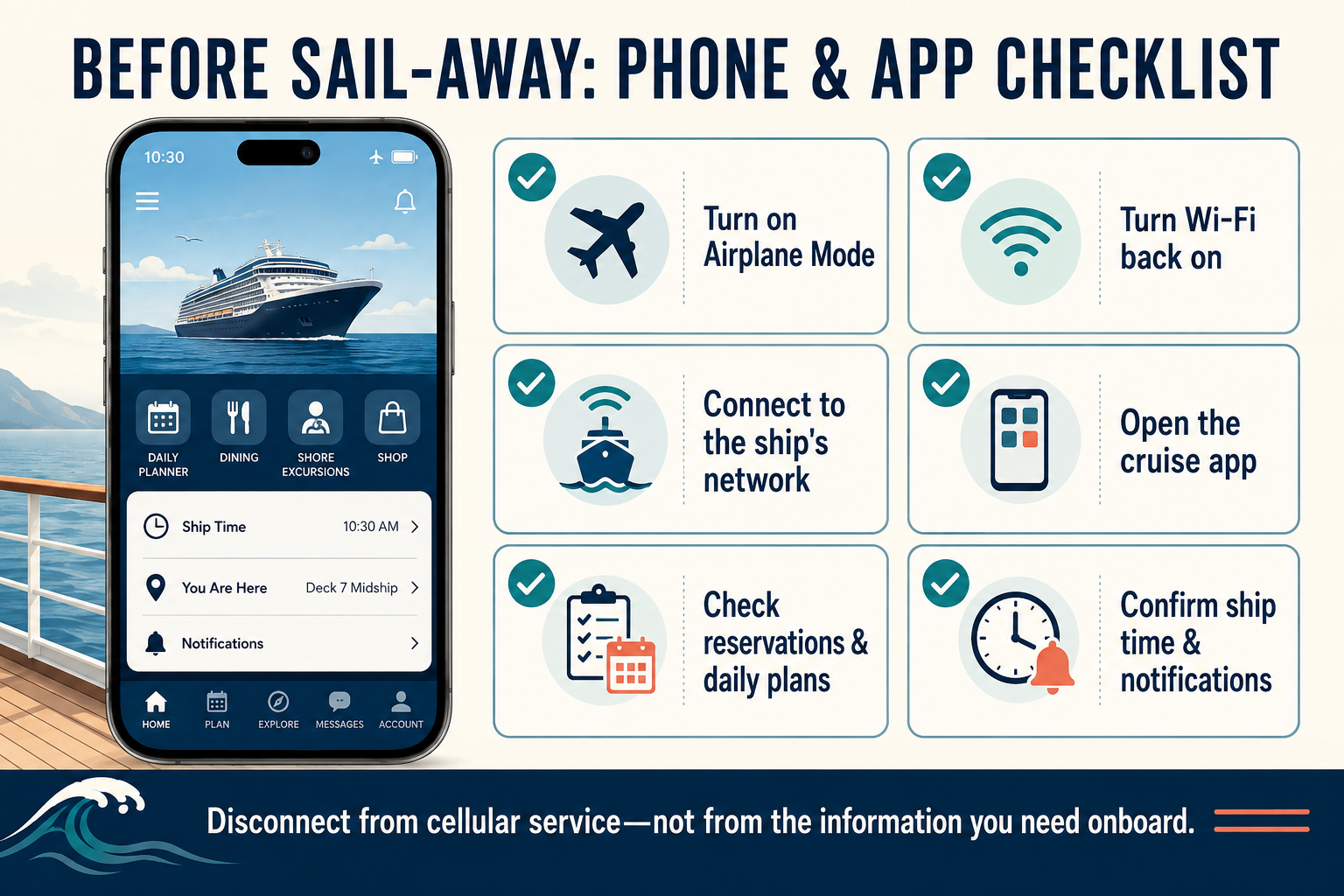
A phone connected to a shipboard cellular network can generate expensive roaming charges. Before the vessel leaves normal land-based cellular coverage, place your phone in Airplane Mode and then manually turn Wi-Fi back on.
Use this sequence:
Turn on Airplane Mode.
Turn Wi-Fi back on.
Connect to the ship’s network.
Open the cruise app.
Confirm reservations and daily plans.
Check ship time and notification settings.
If needed, enable Bluetooth separately for headphones, watches, hearing devices, or other accessories.
Do not assume that disabling data roaming alone prevents every possible charge. Confirm international and maritime coverage directly with your mobile carrier before traveling.
Make Time for Sail-Away
Once the practical tasks are complete, stop managing the trip for a while.
Find an open deck, observation lounge, balcony, or river-ship terrace and watch the departure. It is one of the few moments every passenger shares: the lines are cast off, the terminal begins to recede, and the vacation feels real.
Embarkation day does not have to be a frantic race through a checklist. Prepare before arriving, keep the essentials with you, complete the time-sensitive tasks early, and then let the cruise begin.
Important Policy Note
Cruise-line policies, travel-document requirements, embarkation locations, boarding times, luggage procedures, beverage allowances, app functions, and safety processes can change. Verify current information with your cruise line and the appropriate government authorities before departure.
Information current as of August 2026.