

Duty-Free Doesn’t Mean Rule-Free
What happens to your alcohol, perfume and tobacco when you bring them home to the United States
Airport duty-free shops make everything feel easy.
You’ve cleared security. Your flight is boarding in an hour. And there, glowing beneath suspiciously flattering lighting, is a bottle of Scotch, a carton of cigarettes or a bottle of perfume that suddenly seems like an essential part of the trip.
And it says DUTY FREE.
So you’re good, right?
Mostly.
Until you land.
Because “duty-free” doesn’t mean the purchase is exempt from every customs, tax, import and airport-security rule for the rest of its natural life.
It means something much narrower.
And understanding that difference can save you from an unpleasant surprise when you bring that purchase home.
First: What Does Duty-Free Actually Mean?
Duty-free does not mean:
“I bought this at an airport, so nobody can ever tax it again.”
Duty-free refers to the customs duty and tax treatment of the purchase where you bought it. U.S. Customs and Border Protection specifically warns that something purchased in a duty-free shop can still be subject to duty when it enters another country.
That includes American duty-free shops.
Suppose you’re flying from the United States to Japan and spot a bottle of Jack Daniel’s at duty-free before departure.
Whether that bottle can enter Japan, how much alcohol you can bring in and whether you’ll owe anything upon arrival are questions for Japan, not the American duty-free store.
So for the outbound side of this article, our advice is simple:
Before buying duty-free merchandise to take overseas, check your destination country’s current import rules.
Now let’s turn the airplane around.
Because bringing things home to the United States is where this gets interesting.
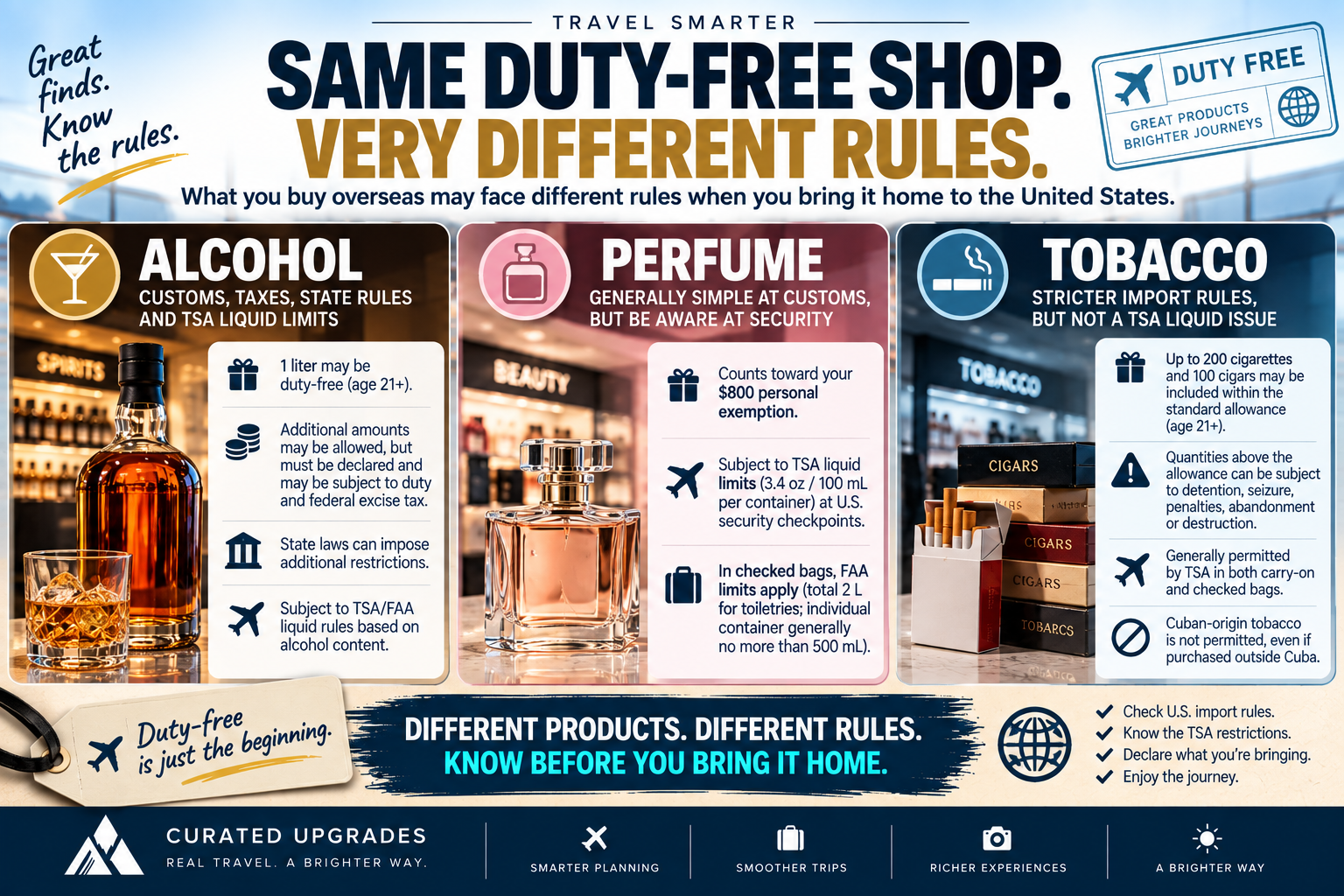
Three Products. Three Different Sets of Rules.
Walk through almost any major international duty-free shop and three products dominate the landscape:
Alcohol. Perfume. Tobacco.
They may be sitting twenty feet apart.
U.S. rules don’t treat them the same way.
Alcohol can involve a customs allowance, federal duty and excise tax, state law, FAA restrictions and TSA liquid rules.
Perfume generally counts toward your personal merchandise exemption, while larger bottles can become an issue when you encounter another TSA checkpoint.
Tobacco doesn’t have the same liquid problem, but U.S. import rules are considerably stricter.
So instead of asking:
“Can I buy this duty-free?”
Ask:
“What happens to this particular item when I bring it home?”
The $800 Personal Exemption
For many qualifying U.S. residents returning from overseas, CBP provides an $800 personal exemption for merchandise acquired abroad. There are exceptions and eligibility requirements, but $800 is the standard exemption most travelers will encounter.
But there’s an important distinction.
The $800 exemption concerns the value of merchandise.
Some products also have quantity limits within that exemption.
Alcohol and tobacco are the two big examples.
In other words, you can’t stuff your suitcase with cartons of cigarettes and then announce:
“Good news. They only cost $799.”
Nice try.
The quantity rules didn’t disappear.
Alcohol: One Liter Duty-Free Is Not a One-Liter Maximum
For a qualifying returning U.S. traveler age 21 or older, one liter of alcohol may generally be brought into the United States duty-free.
But this is where an internet myth frequently appears.
One liter duty-free does not mean one liter is the most alcohol you may legally bring home.
CBP says additional quantities may be imported for personal use, but they can be subject to duty and federal excise tax. State restrictions can also apply. There is no single federal personal-use maximum, although large quantities can raise commercial-import questions.
CBP even provides an example of a traveler returning from Europe with two liters of liquor. One liter falls within the allowance, while the second is dutiable.
So if you find two bottles of Scotch in Scotland that you really want to bring home, the lesson isn’t:
“Bottle number two is illegal.”
It’s:
Declare what you have.
If duty or tax is due, let CBP determine it.
And remember that state alcohol laws can be more restrictive than the federal rules.
For the current federal rules, I’d send readers directly to CBP’s Bringing Alcohol Into the United States guidance.
There’s Also an Airline Safety Rule
Customs isn’t the only agency with an opinion about your Scotch.
The FAA regulates alcoholic beverages carried aboard aircraft.
For alcohol containing more than 24% but no more than 70% ABV, the current limit is 5 liters per passenger, and it must be in unopened retail packaging.
Alcohol containing more than 70% ABV, or more than 140 proof, is prohibited in both carry-on and checked baggage. Alcohol at 24% ABV or less isn’t subject to that particular hazardous-material quantity restriction.
So one bottle can create several completely different questions:
Can I import it?
Do I owe duty or tax on it?
Does state law impose another restriction?
Can I carry it on the aircraft?
Duty-free status doesn’t answer any of those questions by itself.
For unusual bottles or quantities, check FAA PackSafe alcohol guidance before packing.
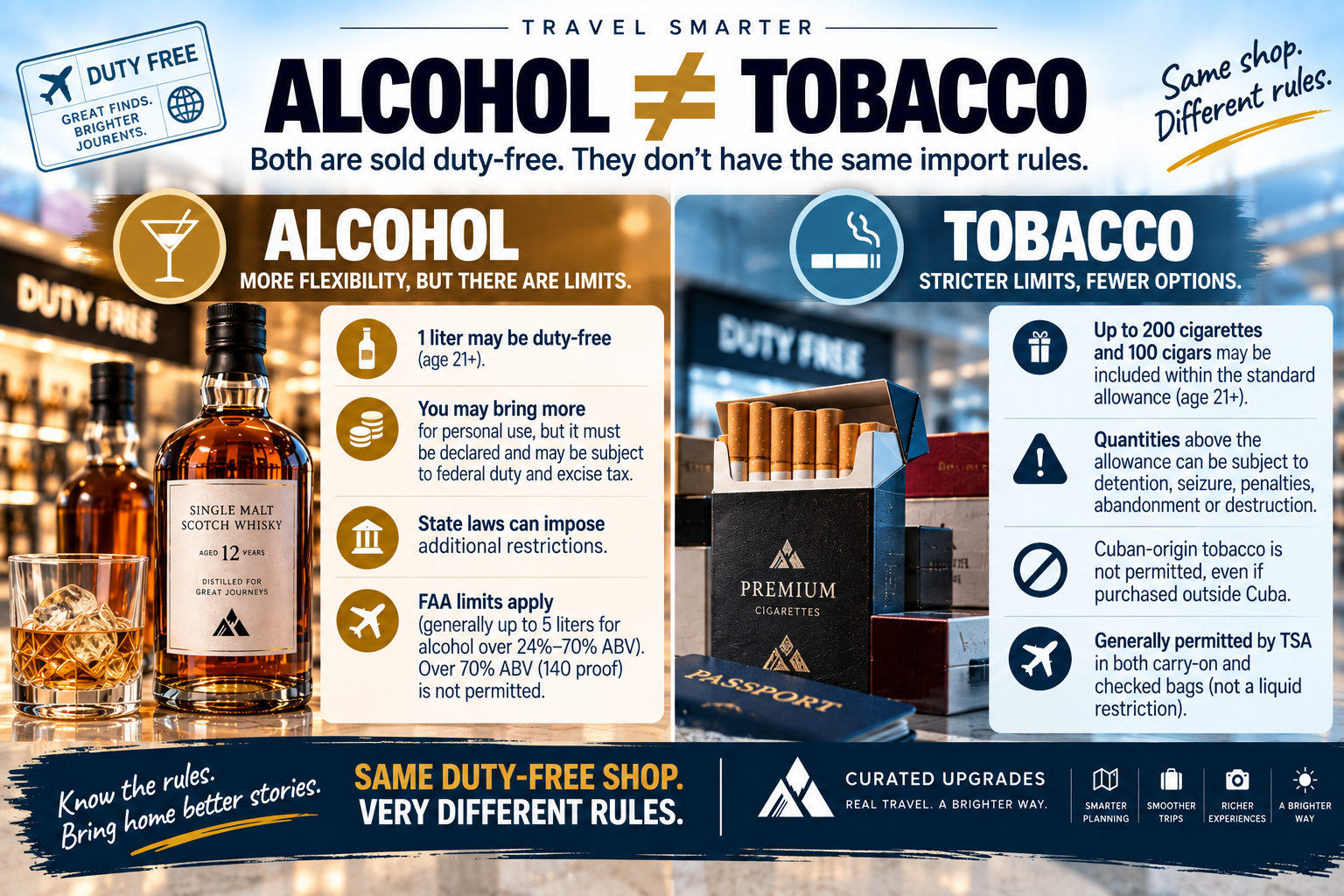
Tobacco: “I’ll Just Pay the Duty” Is Not a Safe Assumption
Tobacco works differently.
For eligible returning residents age 21 or older under the standard exemption, CBP currently permits up to 200 cigarettes and 100 cigars within the applicable allowance when arriving from countries other than certain beneficiary countries and U.S. insular possessions.
Two hundred cigarettes is typically one carton.
But here’s the important difference from alcohol:
You shouldn’t assume that exceeding the tobacco allowance simply means declaring another carton and paying a few dollars.
CBP says tobacco quantities not permitted under a traveler’s personal exemption can be subject to detention, seizure, penalties, abandonment and destruction.
That’s a very different proposition from bringing home an additional bottle of whisky.
So if the duty-free store is running a spectacular cigarette promotion, know your applicable allowance before stocking up.
You can check the current rules at CBP’s tobacco guidance for returning travelers.
And Then There Are Cuban Cigars
This is a perfect example of why where something originated can matter more than where you bought it.
You may encounter Cuban cigars while traveling in Europe, Canada or elsewhere.
That does not make them legal to bring into the United States.
Current U.S. rules do not allow travelers subject to U.S. jurisdiction to bring Cuban-origin alcohol or tobacco into the United States as accompanied baggage for personal use. Cuban-origin goods can be acquired in a third country for personal consumption outside the United States, but that doesn’t give them a ticket home in your suitcase.
So:
“But I bought the cigars legally in Europe”
doesn’t answer the U.S. import question.
Again:
Duty-free doesn’t mean rule-free.
Perfume Is Different Again
Now consider that bottle of perfume.
Perfume doesn’t have the same special returning-traveler quantity allowance as alcohol or cigarettes. For the ordinary traveler, its value generally becomes part of the merchandise you’re bringing home.
But perfume has another problem.
It’s a liquid.
And that can matter enormously if you have another airport-security checkpoint ahead of you.
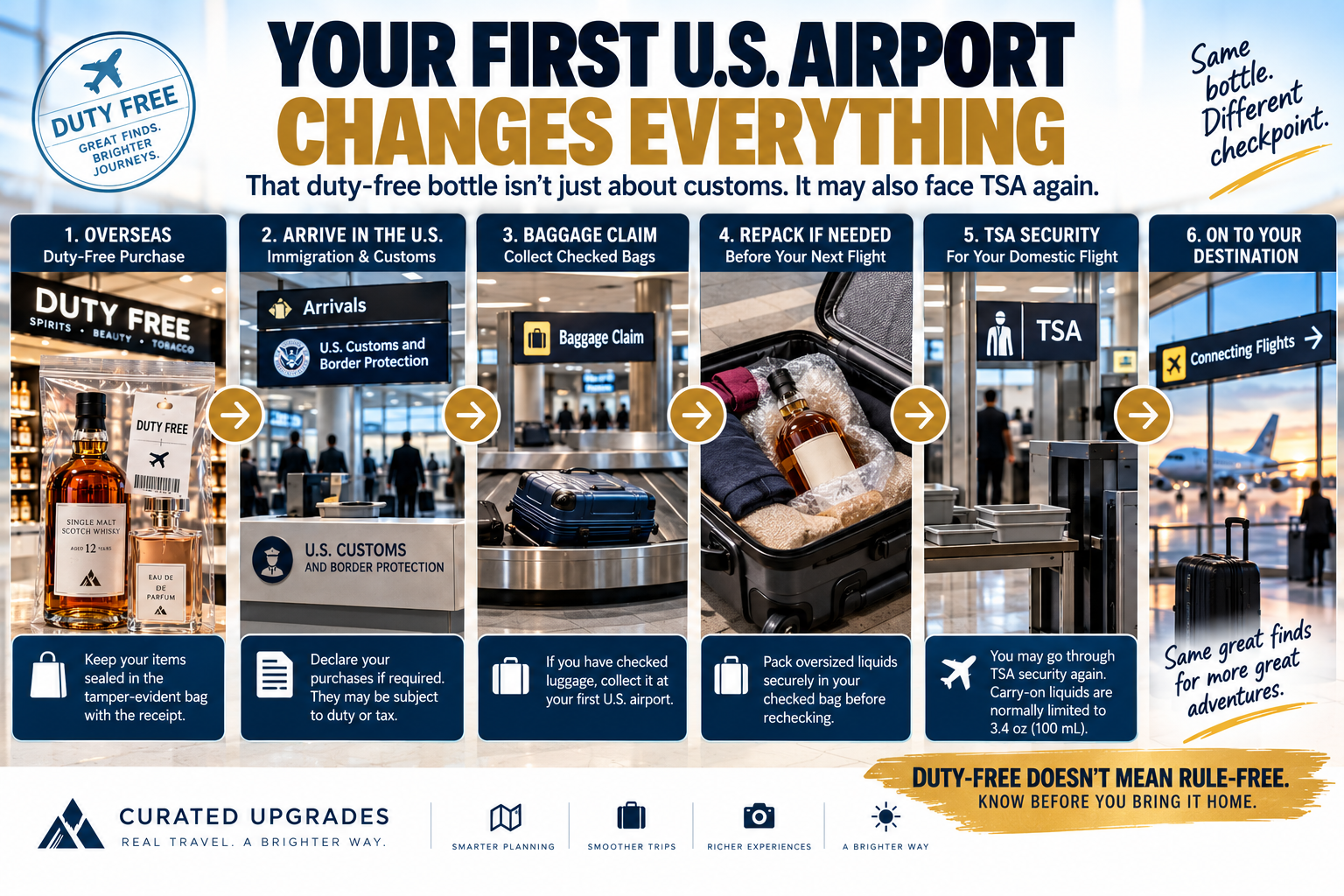
Your First U.S. Airport Can Change Everything
Let’s say you’re flying:
Paris → Boston → Columbus
You buy a 750 mL bottle of whisky and a 150 mL bottle of perfume at duty-free in Paris.
You board the international flight with your purchases.
Then you arrive in Boston.
Boston isn’t simply a connection.
It’s your first U.S. arrival.
That means you deal with the applicable U.S. entry and customs procedures there. If your itinerary requires you to collect your checked luggage, you retrieve it before continuing onward.
And then comes the part travelers sometimes overlook:
You may have to go through TSA security again before your domestic connection.
Now that 750 mL bottle of whisky and 150 mL bottle of perfume are oversized liquids at a U.S. security checkpoint.
The normal TSA carry-on liquid limit is 3.4 ounces / 100 mL per container. The FAA likewise notes that liquids, gels and aerosols in carry-on baggage remain subject to TSA’s 100 mL security limit.
The bottle didn’t change.
The checkpoint did.
If I Have My Checked Suitcase, That’s Where the Bottle Is Going
There are special procedures that can apply to qualifying international duty-free liquids.
But if I’m standing at my first U.S. airport with my checked suitcase already in front of me, I prefer the simpler solution.
Securely pack the oversized liquid in the checked suitcase before rechecking the bag.
Wrap the bottle properly.
Protect it from impact.
Then recheck the suitcase and continue to TSA without trying to carry a full-size bottle through the checkpoint.
This isn’t about finding a clever loophole.
It’s about removing a potential problem from the trip.
A bottle of Scotch exploding inside your suitcase technically eliminates the oversized-liquid problem, but it is not the Curated Upgrades solution I had in mind.
Perfume Has Its Own Baggage Rules
Perfume and cologne are treated as medicinal/toiletry articles under FAA hazardous-material rules when applicable.
For ordinary perfume packed in checked baggage, the FAA currently limits medicinal and toiletry articles to 2 liters or 2 kilograms total per person, with each container limited to 500 mL or 0.5 kg.
There is also a specific FAA exception for perfume and cologne purchased through airport or airline duty-free shops and carried on the person or in carry-on baggage. Customs rules and security screening can still apply.
For the current aviation rules, see FAA PackSafe guidance for perfume and toiletry articles.
Cigarettes Don’t Have the Same Liquid Problem
Here’s where tobacco actually becomes simpler.
A carton of ordinary cigarettes isn’t a 750 mL bottle of liquid.
So while Customs is very interested in how much tobacco you’re importing, cigarettes don’t encounter the same 100 mL liquid issue as whisky or perfume at your connecting TSA checkpoint.
That distinction is important.
Same duty-free shop.
Different product.
Different agency.
Different rules.
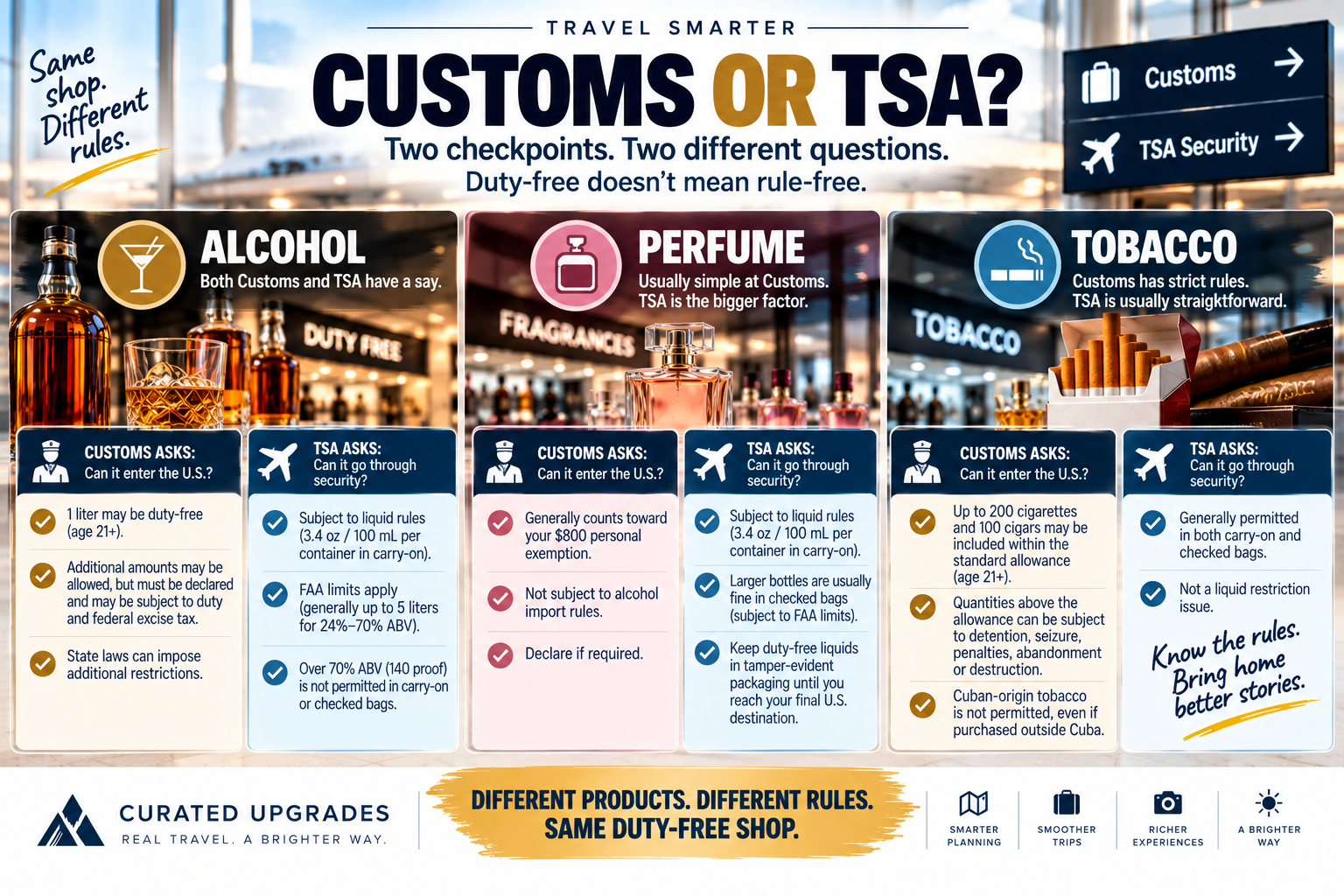
Customs and TSA Are Asking Different Questions
This is probably the simplest way to remember the entire article.
CUSTOMS ASKS:
Can this enter the United States?
How much are you bringing?
Does it qualify for your exemption?
Do you owe duty or tax?
TSA ASKS:
Can this item go through this security checkpoint?
Those questions sometimes overlap in your journey, but they're not interchangeable.
Your bottle of whisky might be perfectly legal to import and still be too large for the normal TSA carry-on liquid rule.
Your carton of cigarettes might be perfectly acceptable to carry through TSA but exceed your applicable customs allowance.
Your perfume might be completely unremarkable to Customs but become the problem child at your domestic security checkpoint.
Knowing which agency’s rules you're dealing with makes the whole thing much easier to understand.
Declare It
If there is one place I wouldn’t try to get clever, it’s Customs.
Buying something duty-free doesn’t mean CBP doesn’t need to know about it.
Declare purchases as required.
Keep your receipts.
Know roughly what you bought and what you paid.
If you exceed an allowance, declare it.
CBP can determine whether duty, tax or another restriction applies.
The goal isn’t to memorize the entire U.S. tariff schedule while circling over Boston.
It’s to know what you're carrying and be upfront about it.
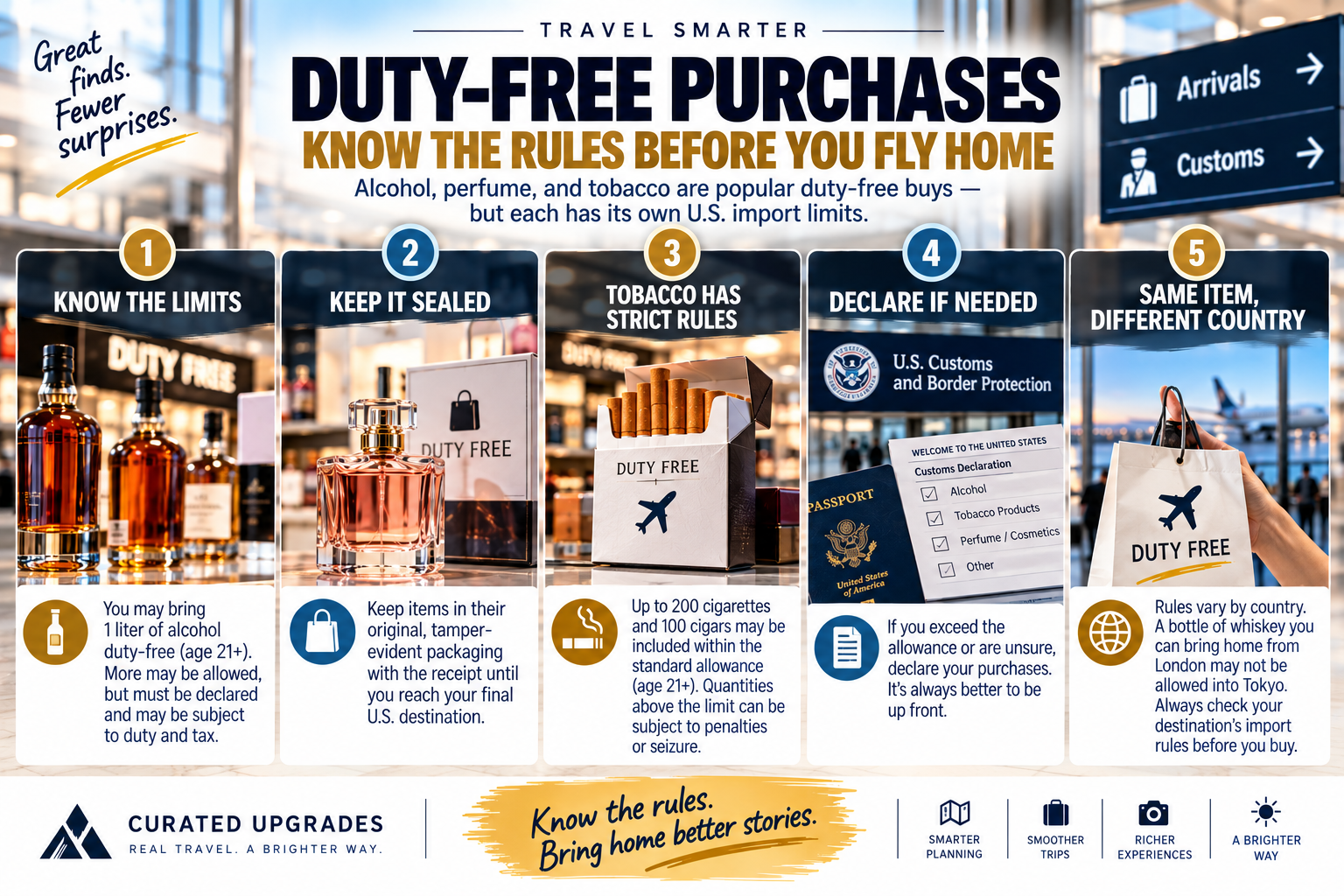
Before You Buy: Five Things to Remember
1. Know the limits.
Alcohol, tobacco and other products can have different customs allowances and restrictions.
2. Keep duty-free purchases and receipts together.
Especially with liquids, don't casually discard the receipt or packaging while you're still traveling.
3. Tobacco has stricter import rules.
Don't assume excess cigarettes or cigars can simply be admitted after paying duty.
4. When in doubt, declare it.
Let CBP determine what applies rather than gambling on your own interpretation.
5. The destination country gets a vote, too.
If you're buying Jack Daniel’s at a U.S. duty-free shop to take to Tokyo, check Japan's current import rules before buying it.
The words DUTY FREE on the shopping bag don't override the laws at your destination.
Final Thoughts
Duty-free shopping isn’t something travelers need to fear.
You just need to understand what the words actually mean.
A bottle of Scotch can be perfectly legal to buy.
Perfectly legal to bring into the United States.
Subject to duty because you exceeded your allowance.
And subject to a completely different set of rules when you reach your next airport-security checkpoint.
All of those things can be true at the same time.
Because you're dealing with different rules at different points in the journey.
So enjoy the duty-free shop.
Buy the bottle you've been looking for.
Bring home the perfume.
And if you're buying tobacco, know your allowance before loading up on cartons.
Just remember:
Duty-free doesn’t mean rule-free.
Know what you bought. Know where you're taking it. And know which checkpoint comes next.