

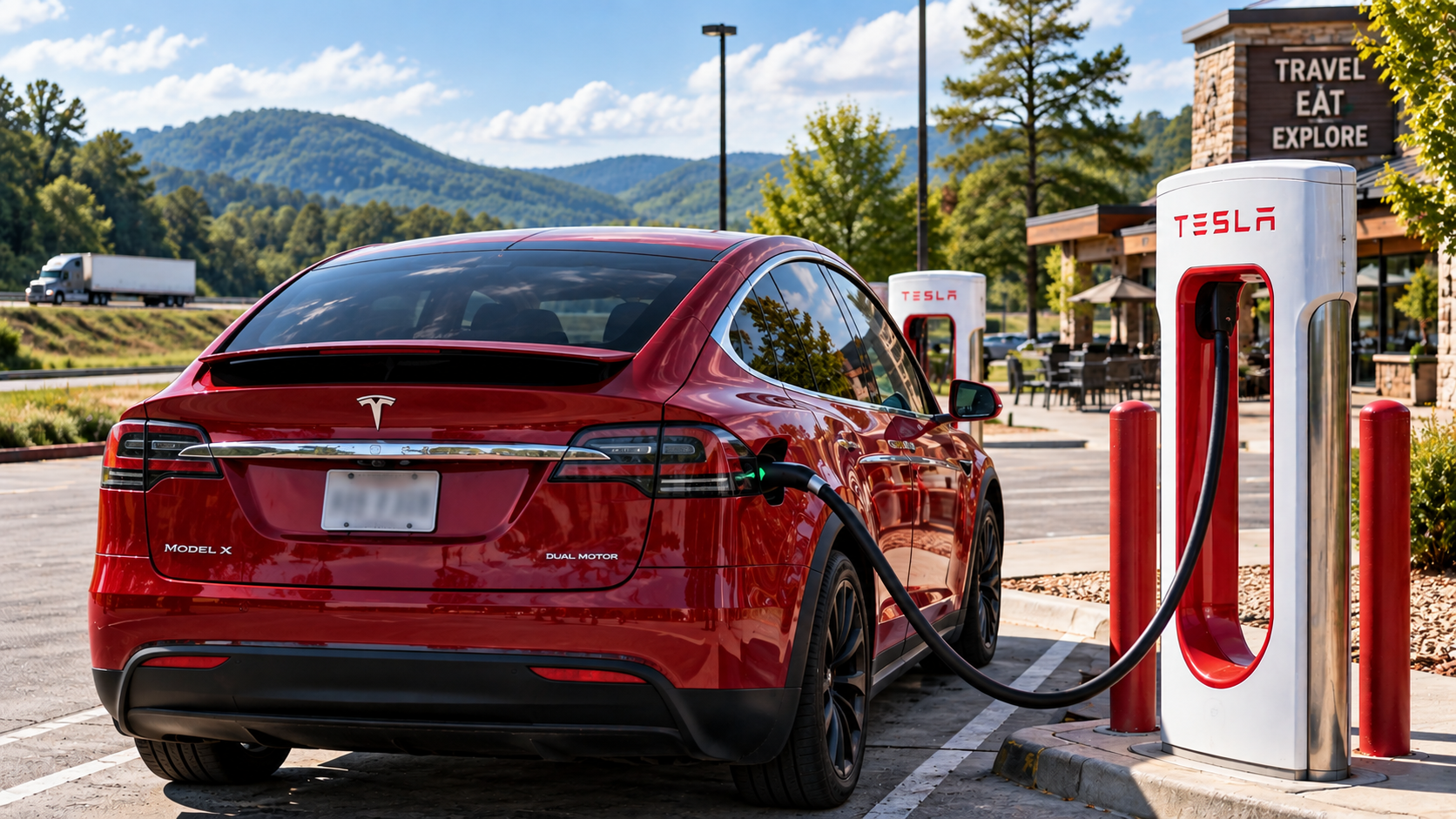
EV vs. Gas on a Road Trip: What It Actually Cost Me
Two real road trips. Actual Tesla charging bills. A comparable gasoline SUV. No laboratory test, no perfect-speed efficiency run, and no pretending the electricity already in the battery was free.
There are plenty of calculators that will tell you how much cheaper an electric vehicle is supposed to be than a gasoline vehicle.
I wanted to know something simpler:
What did mine actually cost?
I had the receipts.
During the summer of 2026, I took my Tesla Model X on two very different road trips from southeast Georgia. One took us roughly 1,400 highway miles round trip to Chincoteague and Virginia’s Eastern Shore. The other was an 850-mile round trip to our cabin near Hayesville, North Carolina.
Tesla’s app recorded my charging along the way, including my actual Supercharger expenses. That gave me one side of the comparison without having to invent much of anything.
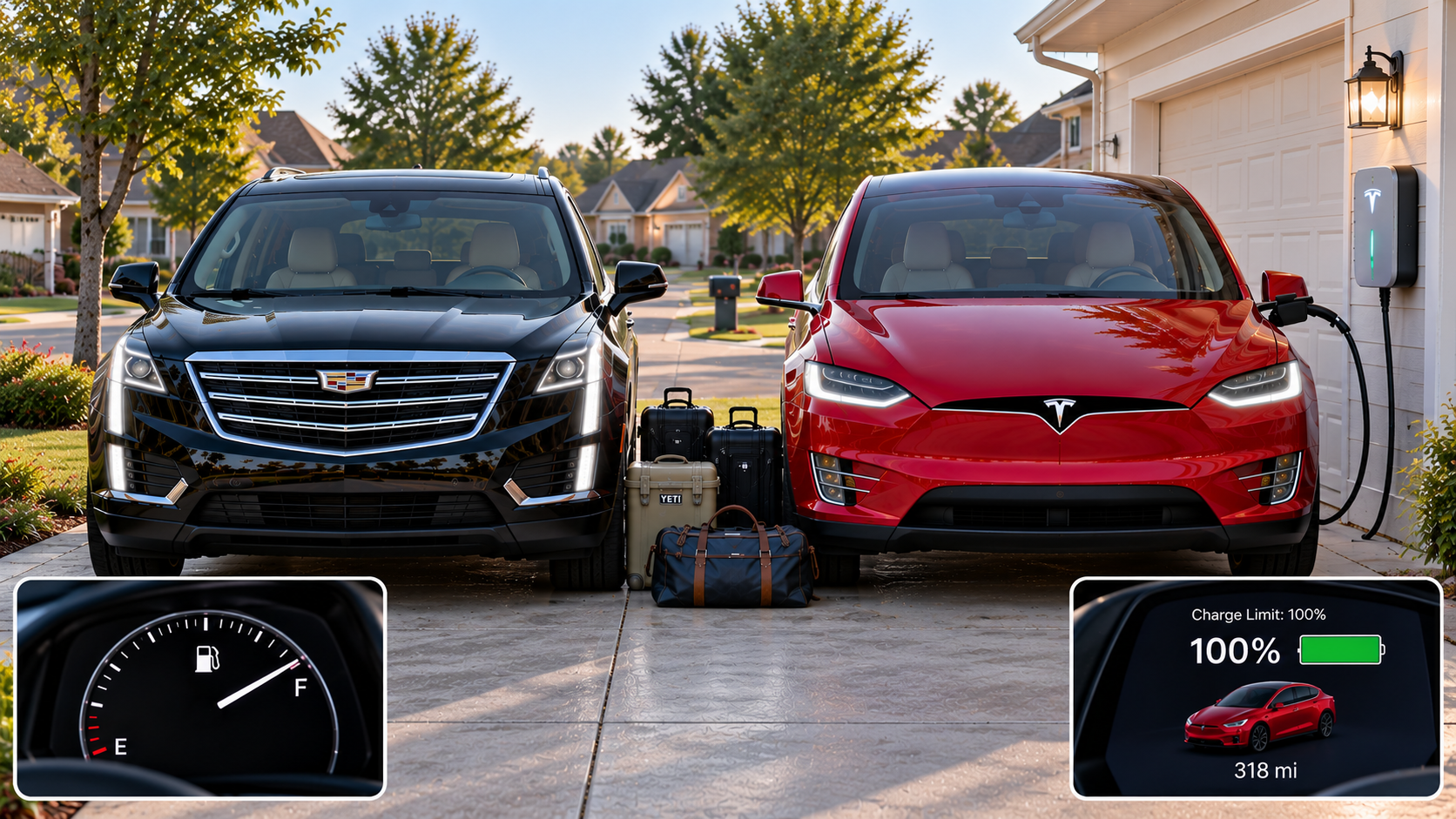
For the gasoline side, I used a vehicle I know well: a 2017 Cadillac XT5 FWD, a similarly sized gasoline SUV I previously owned.
And I tried very hard not to make the EV win.
I used conservative electricity costs. I counted the electricity already in the Tesla when we left home. I gave the Cadillac a full tank to start. And I didn’t drive the Tesla at 60 mph in the right lane trying to squeeze every possible mile out of the battery.
On the interstate, I normally run around 75 to 80 mph.
That matters. Tesla notes that driving style, speed, elevation, outside temperature and other conditions can affect energy use and the charging plan calculated for a trip. Its Trip Planner takes those factors into account when routing a vehicle between chargers.
So this isn’t a best-case EV experiment.
It’s a road trip.
Start Full. Count Everything.
One thing bothered me immediately when I started thinking about this comparison.
If I leave home with the Tesla charged to nearly 100%, it would be easy to look only at the Supercharger receipts from the trip. But that would make the electricity already sitting in the battery magically free.
It wasn’t.
The same rule applies to the Cadillac. It gets to leave with a full tank, but the gasoline in that tank isn’t free either.
So my basic rule was simple:
Both vehicles start full, and I count the energy needed for the trip.
For the Cadillac, I used 25 mpg as my road-trip fuel-economy assumption. Cadillac rated the 2017 XT5 FWD at 27 mpg highway, so using 25 mpg gives the gasoline SUV a reasonable real-world number for the way I actually drive rather than assuming I’ll duplicate its published highway rating.
For electricity at home and at our cabin, I used 15 cents per kWh.
That number deserves an explanation.
My actual electricity rates were lower. But long before writing this comparison, I had entered 15 cents into the Tesla app as my charging cost.
That’s just how I tend to do the math. I’d rather overestimate an expense and underestimate a savings than make the numbers look better than they really are.
So I left it alone.
Trip 1: Southeast Georgia to Chincoteague, Virginia
Our first trip ran from southeast Georgia to Virginia’s Eastern Shore and back, roughly 1,400 highway miles round trip.
For the gasoline comparison, I used an average regular-gas price of $3.93 per gallon for the corridor during our trip. Actual prices at individual stations, particularly those convenient to the interstate, could have been higher or lower.
At 25 mpg, the Cadillac would need approximately:
1,400 miles ÷ 25 mpg = 56 gallons
At $3.93 per gallon:
56 gallons × $3.93 = $220.08
Call it $220 for the gasoline trip.
Now let’s look at what actually happened in the Tesla.
On the northbound trip, I stopped at Superchargers in Walterboro, South Carolina; Halifax, North Carolina; and Exmore, Virginia.
Coming home, I charged in Norfolk, Virginia; Halifax again; Florence, South Carolina; and Hardeeville, South Carolina.
Here’s what those seven actual charging sessions cost:
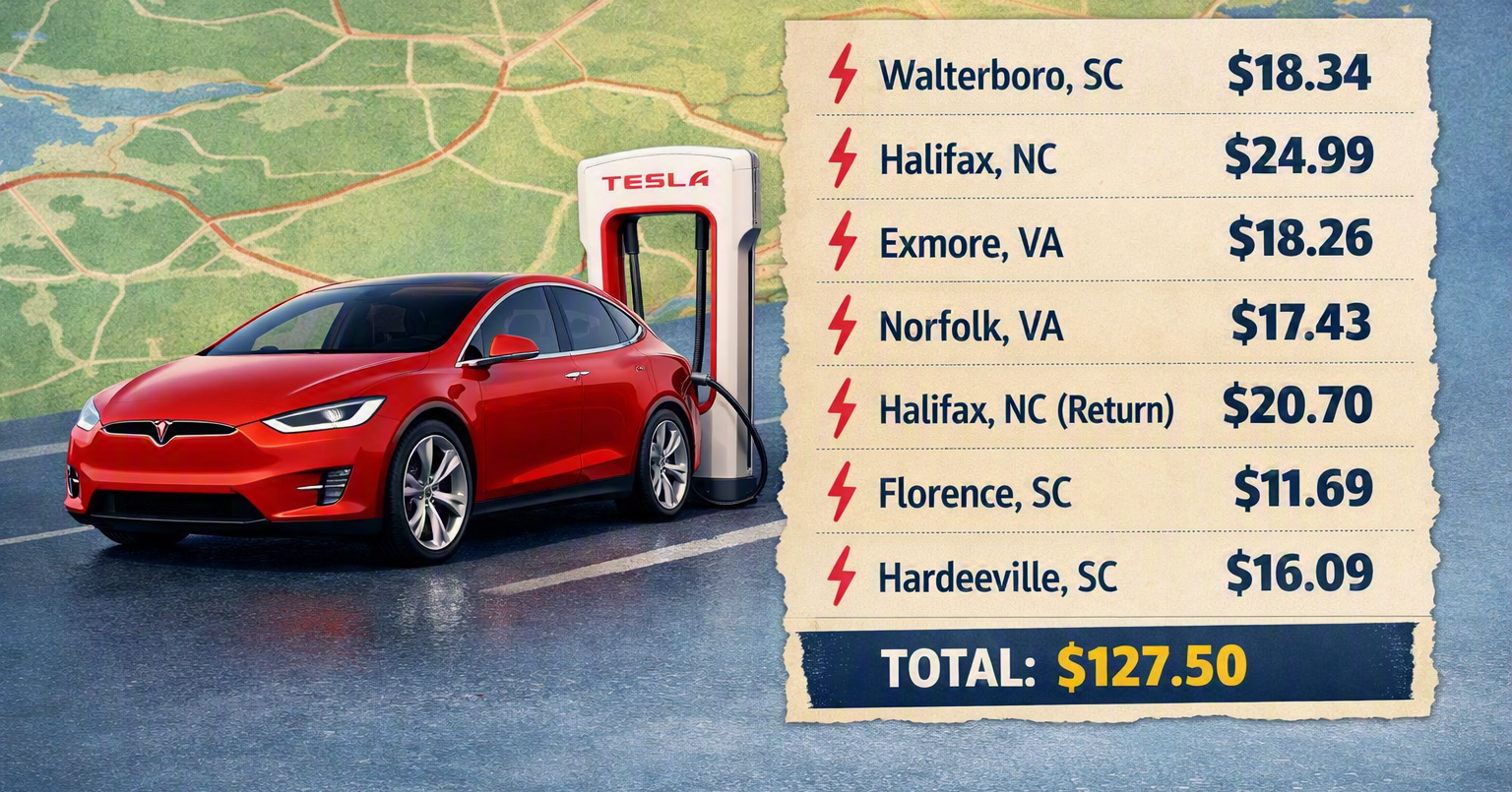
Add approximately $11 of home charging, and my actual out-of-pocket charging cost for the road trip was about:
Tesla: $139
Cadillac: $220
That’s about $81 less in energy cost for the Model X.
But there’s another part of this trip that matters.
The hotels.
The Hotel Charged the Tesla. It Didn’t Charge Me.
We used complimentary Level 2 charging at hotels on both the northbound and southbound portions of this trip.
Actual cost to me:
$0.
That raises an obvious question.
Is it fair to count free hotel charging in an EV-versus-gas comparison?
I think it is, for a simple reason.
We needed the hotel room regardless of which vehicle we drove.
We didn’t rent an extra room so the Tesla could charge. The room cost the same whether there was a Model X or a Cadillac sitting outside.
Charging was simply one of the amenities available to a guest, much like breakfast, a swimming pool or a fitness center.
The EV traveler could use that particular amenity. The gasoline traveler couldn’t.
That’s exactly the kind of situation behind Tesla’s Destination Charging network, which includes hotels, restaurants and other places where a vehicle may be parked for several hours or overnight.
That doesn’t mean hotel charging is always free. Tesla’s Destination Charging information shows pricing for individual locations in the vehicle or Tesla app, so it’s worth checking rather than assuming every hotel charger is complimentary.
In this case, ours was.
And if it hadn’t been?
Based on my actual charging history, another typical paid road-trip charging stop would have cost roughly $17 to $20.
Add $20 to the Tesla total and we’d still be around $159 instead of $220.
Free hotel charging helped.
It didn’t create the entire difference.

What About All Those Charging Stops?
Seven Supercharger sessions on one road trip sounds like a lot.
And this is where an EV road trip looks different from a gasoline road trip.
You do have to stop to charge.
But it can sound worse on paper than it feels on an actual trip.
When we’re traveling that kind of distance, we’re going to stop anyway.
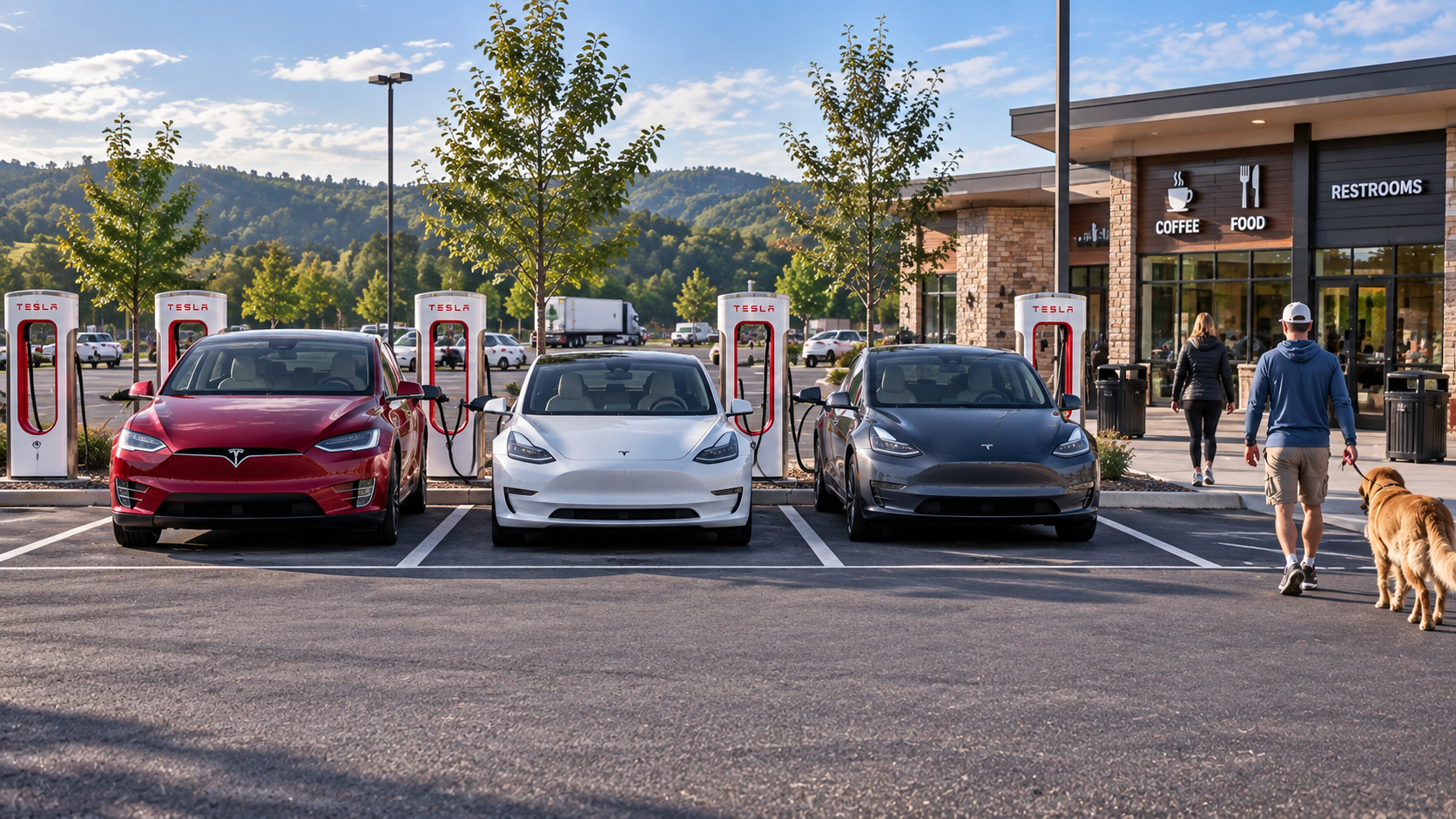
Coffee. Restroom. Something to eat. Stretch our legs. Walk the dog.
Tesla’s Supercharger network is designed for long-distance travel, and charging sites are generally located along popular travel routes near restaurants, shops, restrooms and other amenities.
The car also handles much of the planning. Tesla’s Trip Planner automatically adds charging stops when needed and can show charger availability and nearby amenities.
That doesn’t mean charging takes zero time, and I’m not going to pretend every charging stop perfectly overlaps with something we would have done anyway.
Sometimes you are waiting for the car.
But plenty of times, the car is charging while we’re doing something we needed to do anyway.
That’s an important distinction when evaluating an EV road trip from behind a steering wheel instead of from a spreadsheet.
Trip 2: Southeast Georgia to Hayesville, North Carolina
The second trip was different.
Our cabin near Hayesville is about 425 miles from home, giving us an 850-mile round trip.
This route also trades the relatively flat coastal highway driving of the Chincoteague trip for elevation changes as we get into north Georgia and western North Carolina.
For this trip, I used an average gasoline price of $3.77 per gallon.
At 25 mpg:
850 miles ÷ 25 mpg = 34 gallons
Then:
34 gallons × $3.77 = $128.18
Call the Cadillac’s gasoline cost:
$128
The Tesla’s charging total for the trip period was:
$82
That included three Supercharger sessions:
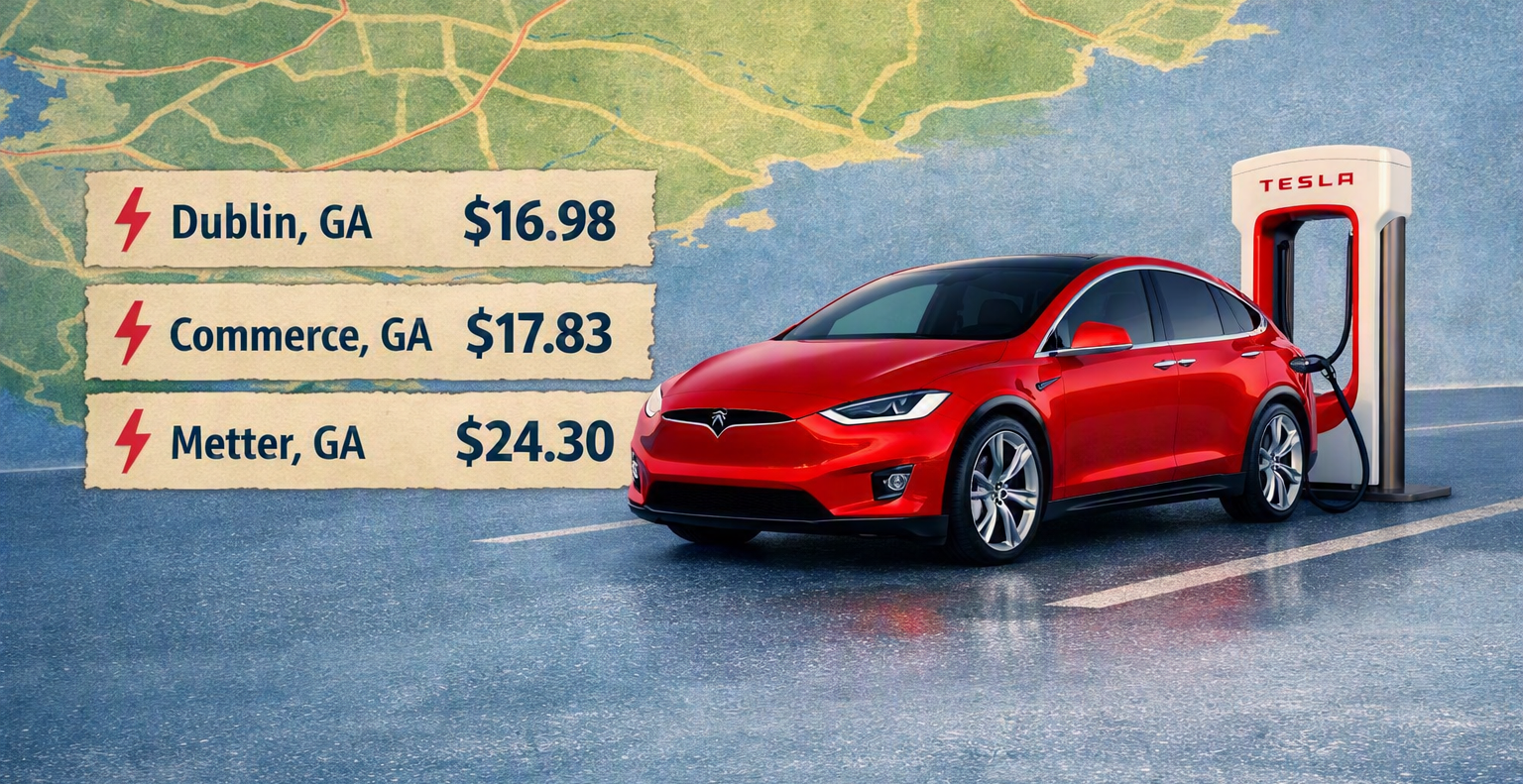
It also included electricity used charging at home and at the cabin.
Again, I didn’t substitute my lower actual utility rate to make the Tesla look better.
I let the Tesla app use the 15-cent-per-kWh figure I had already entered.
That makes the $82 number slightly conservative.
I’m fine with that.
Two Very Different Trips. A Very Similar Result.
Chincoteague / Virginia Eastern Shore: Approximately 1,400 miles, $139 for charging, comparable fuel cost of $220, $81 less.
Hayesville / Western North Carolina: Approximately 850 miles, $82 for charging, comparable fuel cost of $128, $46 less.
On the Chincoteague trip, the Tesla’s energy cost was roughly 37% lower.
On the Hayesville trip, it was roughly 36% lower.
That’s what caught my attention.
The trips weren’t particularly similar.
One was substantially longer. The terrain was different. Charging opportunities were different. Gasoline prices were different. One included complimentary hotel charging.
Yet the basic result was remarkably consistent.

The Tesla App Can Be a Little Misleading
There is one more wrinkle worth understanding if you’re using Tesla’s Charge Stats to calculate your own trip costs.
Not every dollar displayed in the app necessarily represents a dollar that actually left your wallet.
For the Chincoteague trip, Tesla showed 497 kWh charged and a total spending figure of about $157.
But part of that was categorized as “Other” charging.
Tesla calculated a dollar value for that electricity using the 15-cent-per-kWh rate I had entered.
The problem?
Some of that charging occurred at hotels where I actually paid nothing.
Tesla wasn’t wrong about the electricity going into the car. It was assigning a value to electricity obtained somewhere other than a Supercharger.
That’s useful for estimating energy costs.
It isn’t necessarily the same thing as a credit-card receipt.
The same distinction works in the other direction at our cabin. Electricity there isn’t free. In that case, assigning a cost to “Other” charging makes sense.
So when looking at your own Tesla Charge Stats, don’t automatically assume:
“Total Spent” = “Money I actually paid during the trip.”
Look at where the charging occurred.
“Miles Added” Isn’t the Same as Miles Driven
There’s another number in the Tesla app that can lead you astray.
Miles added.
For the Chincoteague period, Tesla reported 1,015 miles added from charging.
That doesn’t mean I drove only 1,015 miles.
Displayed range and the amount of range added during a charging session are estimates, not an odometer reading. Tesla itself notes that real-world range varies with factors including speed, weather and elevation, while its navigation system continually estimates the energy needed to reach upcoming destinations and charging stops.
That’s particularly relevant when you’re driving 75 to 80 mph, using climate control, carrying luggage and encountering changing terrain and weather.
For a road-trip cost comparison, I care about actual road miles and actual energy purchases, not how many theoretical miles the car says were added during charging.
So, Is an EV Cheaper on a Road Trip?
For these two trips, mine was.
But that’s a narrower conclusion than saying “EV road trips are always cheaper.”
Electricity rates vary. Supercharger prices vary. Gasoline prices vary. Vehicle efficiency varies. Driving speed matters. Weather matters. Terrain matters. Hotel charging may be free, paid or unavailable.
And the gasoline vehicle you compare against matters enormously.
Compare my Model X with a highly efficient gasoline hybrid and the numbers would look different. Compare it with a large gasoline SUV getting substantially less than 25 mpg and they’d look different in the other direction.
That’s why I like using actual trips instead of trying to declare a universal winner.
My experience across these two trips was straightforward:
About $139 versus $220 to Chincoteague.
About $82 versus $128 to Hayesville.
And I got those results without using my lowest possible electricity rate, without pretending the starting battery charge was free, and without driving slowly to manufacture an impressive efficiency number.
On these two road trips, under the conditions I actually encountered, the Model X cost me about 36% to 37% less in energy than I estimate the Cadillac XT5 would have cost in gasoline.
That’s the number I wanted when I started digging through the charging history.
Not what a calculator said should happen.
What actually happened.
A Note About the Numbers
This comparison reflects my own trips and driving conditions in summer 2026. Charging prices, electricity rates and gasoline prices vary by place and change over time. Tesla also notes that Supercharger pricing varies by location, with current pricing displayed on the vehicle touchscreen.
The gasoline figures are estimates based on trip mileage, a 25-mpg road-trip assumption for the Cadillac XT5 and the gasoline prices used for each trip. Tesla Supercharger expenses came from my actual charging history. Home and cabin charging were valued at 15 cents per kWh, an intentionally conservative figure that was slightly higher than my actual electricity rates at the time.
Your vehicle, route, speed, weather, charging choices and local energy prices can produce very different results.