

Getting Foreign Currency Overseas: Why I Skip Pre-Ordering Currency and Use an ATM
After more than 40 years of international travel, this is how I handle cash, cards, ATM fees and currency conversion without making money complicated
Remember travelers’ checks?
I do—because I used them.
When I was in the Navy in the early 1980s, arriving in another country meant carrying cash off the ship and finding a hotel or local exchange kiosk willing to change it. American Express travelers’ checks eventually felt like an upgrade.
Later, I started ordering foreign currency from my bank before departure. After that came the airport currency-exchange counters, which were convenient but rarely generous.
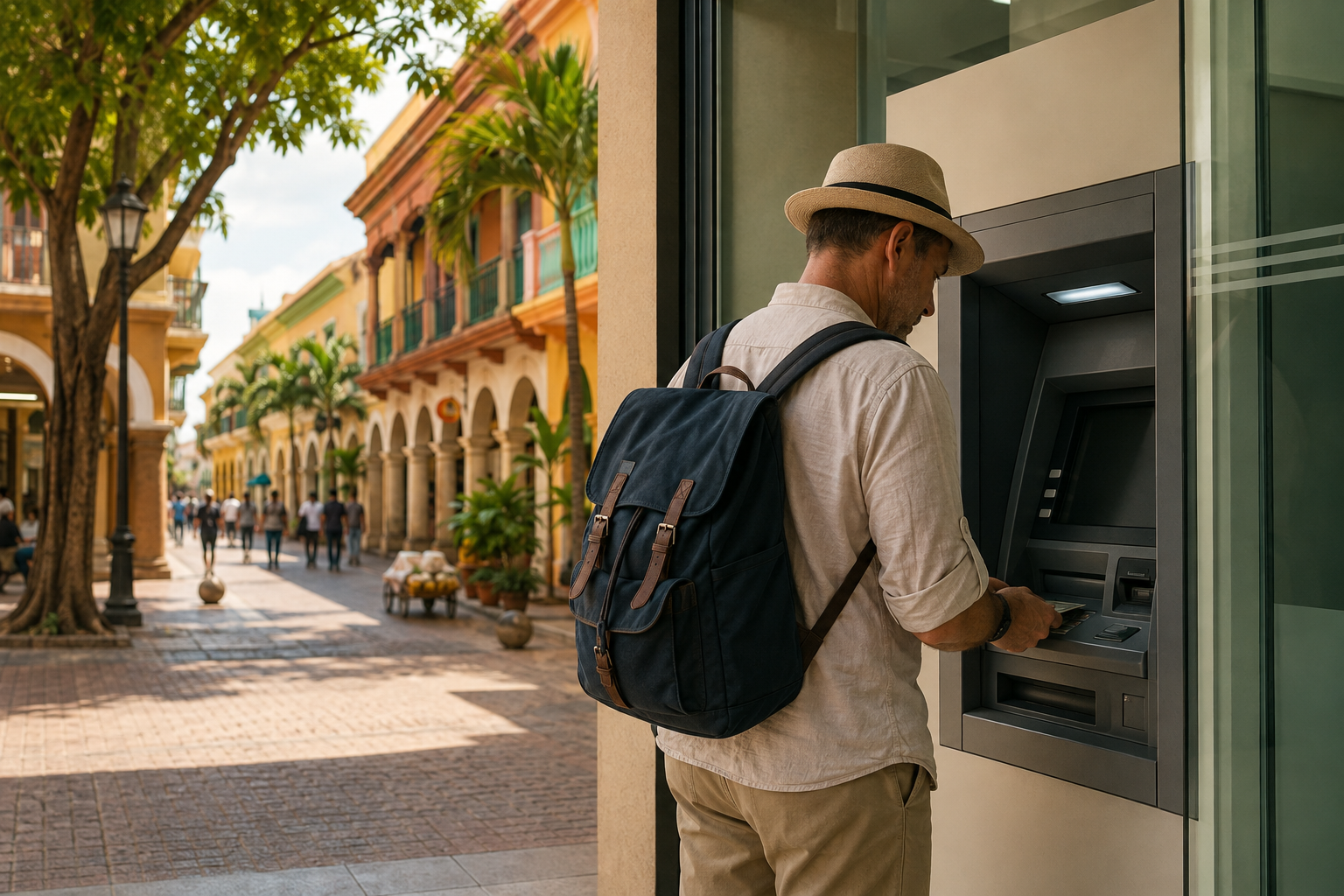
Today, my strategy is considerably simpler: I use credit cards for most purchases and get local currency from a reputable bank ATM after I arrive.
I have had 100% success using bank ATMs at arrival airports for roughly 20 years. That does not mean every traveler should arrive everywhere with no cash. Destination, arrival time, itinerary and ATM reliability still matter. But for most of my trips, ordering a thick envelope of foreign bills before departure has become unnecessary.
What About the Foreign Currency I Already Have?
I usually arrive in Europe with approximately €50 in bills and a few euro coins—but not because I order them before every trip.
They are simply left over from earlier travel.
I also have a few British pounds and some Japanese yen tucked away. I do not exchange small leftover amounts back into U.S. dollars. Converting the money again can mean accepting another exchange spread, and many exchange services will not accept foreign coins at all.
Instead, that leftover money becomes starter cash for the next trip. It is enough for a coffee, tip, train ticket or unexpected cash-only purchase before I visit an ATM.
That is different from deliberately buying foreign currency before every trip.
When I Make an Exception
When I traveled to Kenya, I obtained approximately $50 worth of Kenyan currency before departure. ATM availability at Nairobi’s airport can be hit or miss, and I did not want our arrival to depend entirely on finding a working machine.
That was a destination-specific decision, not my normal routine.
If you are arriving in the middle of the night, immediately leaving for a remote area or visiting a destination where airport ATM reliability is questionable, bringing a small amount of local currency can be sensible.
The objective is not to follow an absolute rule. It is to avoid unnecessary exchange costs while making sure you can function after landing.
My Three-Part Payment Strategy
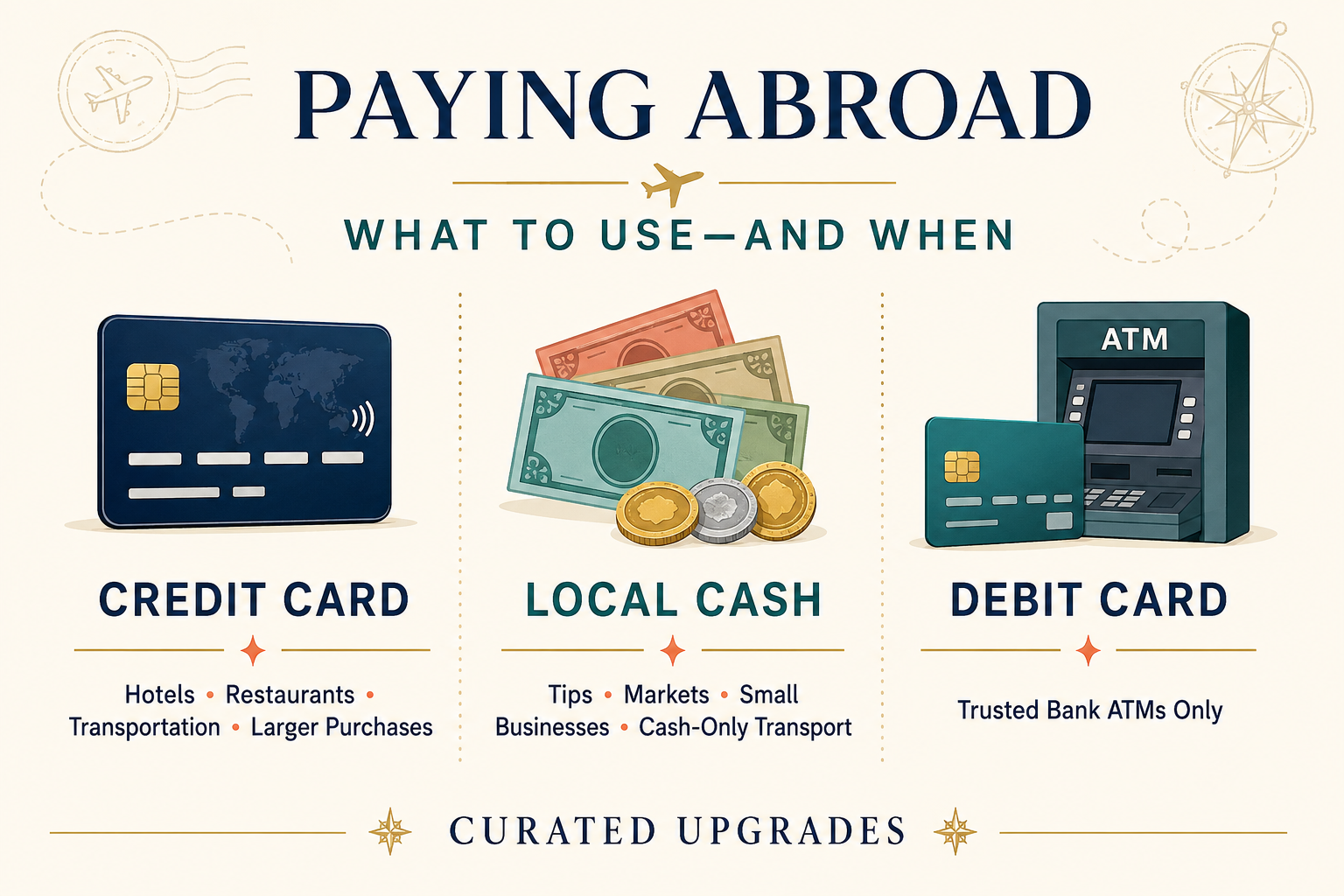
I travel with three distinct payment tools, and each one has a specific job.
Debit Card: ATM Withdrawals Only
My ATM debit card has one purpose: withdrawing cash from a bank ATM.
I do not normally use it for restaurant bills, hotels, shopping, fuel or other routine purchases. A debit transaction reaches directly into the checking account where my actual money is held.
If someone compromises a credit card, I can dispute the charge without the purchase immediately draining my checking account. An unauthorized debit transaction may temporarily remove real money while the bank investigates. Federal liability protections can also depend on how quickly a lost card or unauthorized transfer is reported.
Consumer Financial Protection Bureau: Unauthorized debit transactions
Chase: Dining, Fuel and EV Charging
I use my Chase card for dining, fuel and EV charging because those purchases fit the card’s stronger rewards categories. It also does not charge me a foreign transaction fee.
Capital One Venture X: Most Other Purchases
My Capital One Venture X handles most of our remaining purchases. It also has no foreign transaction fee, and I earn miles on eligible spending.
I have an American Airlines AAdvantage credit card with no foreign transaction fee, but I normally bring it only when American Airlines is part of the trip. I also have an American Express card that does not charge foreign transaction fees, although I rarely use it overseas.
For me, the decision is not simply which card avoids an international fee. Several of my cards do. I choose the card that gives me the most useful rewards or benefits for that particular purchase.
Before traveling, verify the terms of your specific cards. An issuer may offer some cards without foreign transaction fees while charging them on other products.
You do not necessarily need a premium card to avoid foreign transaction fees. Some no-annual-fee cards also waive them. The right card is the one whose fees, rewards, acceptance and benefits fit your travel habits.
Affiliate disclosure: Curated Upgrades may receive a referral bonus if you apply through one of these links. A referral offer may differ from the best publicly available offer. Compare current offers, fees and card terms before applying.
Our Backup Plan Is Built Into Our Wallets
Gina carries the same cards I do, but her physical cards have unique card numbers.
If one of us loses a card, I can freeze that individual card in the issuer’s app while the other person’s card remains available. We can secure the missing card without necessarily shutting down the entire account during the trip.
We also keep virtual versions of our credit cards in Google Wallet. If one physical wallet disappears, losing access to every payment method becomes much less likely.
That is the real value of a backup-card strategy. It is not merely owning multiple cards. It is making sure one loss, theft or fraud alert cannot bring your trip to a halt.
How Much Cash Do I Withdraw?
My usual ATM withdrawal is approximately $400 worth of local currency, but that is not a fixed rule.
The amount depends on:
How widely cards are accepted
How remote we will be
Whether we expect cash-only markets, taxis or small businesses
How easily we can reach another reputable ATM
The country’s tipping and payment customs
The fees associated with each withdrawal
In Panama, for example, our spending was probably divided about 50/50 between cash and cards. Panama commonly uses U.S. dollar banknotes, so using cash there was particularly straightforward.
If we are staying in a major city with widespread card acceptance, I may need less cash. If we are heading into a remote area, I would rather leave the airport with enough local currency than assume the next village will have a working ATM.
How I Carry the Cash
When I withdraw cash, I divide it between Gina and me. We each carry a portion in our wallet rather than keeping the entire amount together.
My wallet stays in my front pocket.
In more than 40 years of international travel, I have never had my wallet picked. I do not use an elaborate hidden pouch, but I do rely on basic street awareness:
Stay out of dark or isolated areas
Do not display a stack of money
Avoid traveling with a lot of expensive jewelry
Pay attention to the people and activity around you
Do not keep every payment method in one place
Splitting the cash means that one lost wallet would be inconvenient, but it would not leave us completely without money.
This is what has worked for me. Travelers should choose a carrying method appropriate for their destination, comfort level and circumstances.
Choose a Bank-Affiliated ATM
Not every airport ATM is a bad deal, and not every machine outside a bank is automatically fraudulent. The more useful distinction is who operates it.
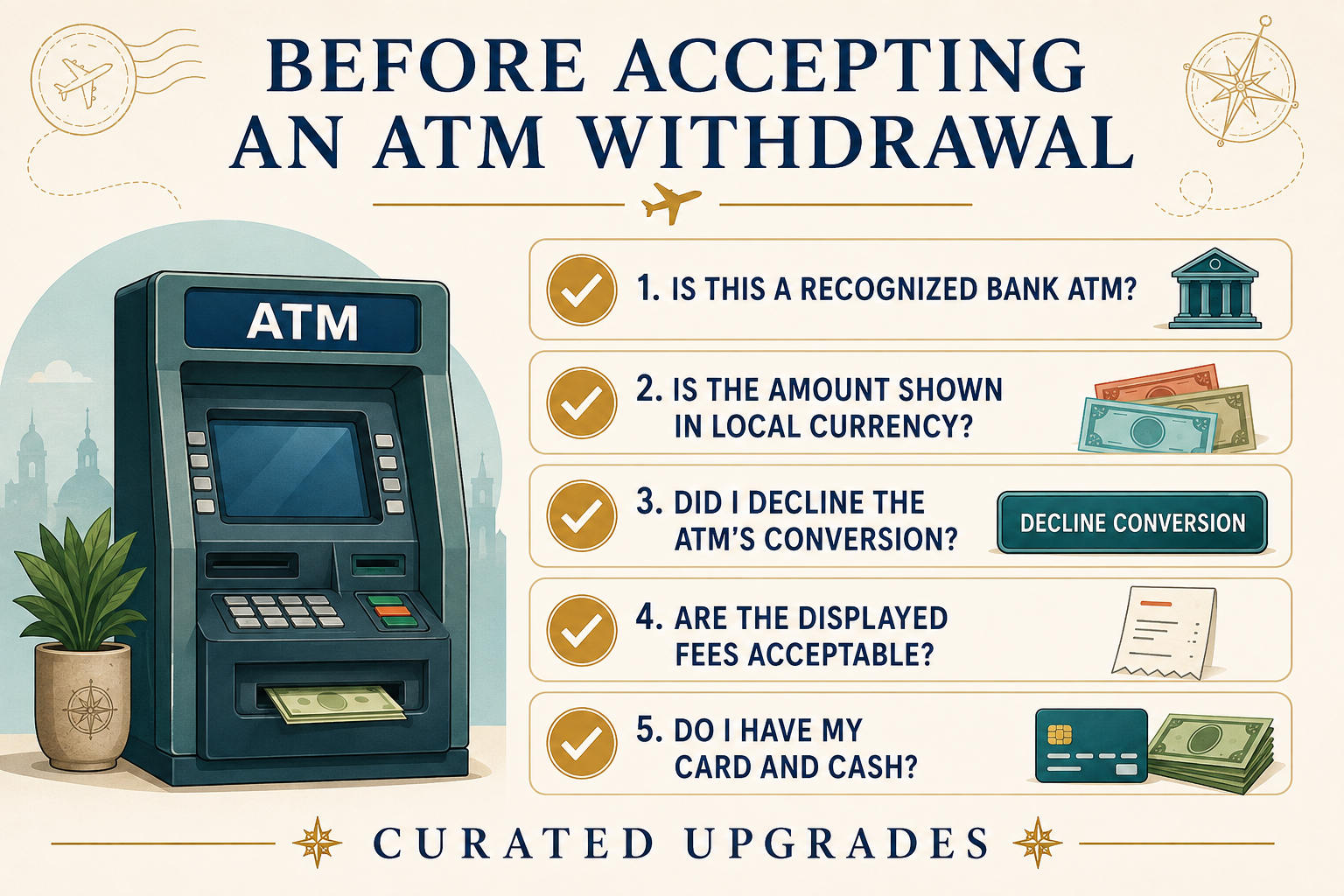
I prefer an ATM operated by a recognized local bank. A machine attached to a staffed bank branch is even better because someone may be available to assist if it retains your card.
I avoid privately operated or merchant ATMs in souvenir shops, convenience stores and heavily touristed areas whenever possible. Those machines may impose higher fees or prominently encourage dynamic currency conversion.
My credit union reimburses ATM fees charged by other banks. It does not reimburse merchant ATM fees, so choosing the right machine directly affects what the withdrawal costs me.
Before leaving home, check:
Your bank’s international ATM fee
Any foreign transaction or currency-conversion fee
Out-of-network ATM charges
Third-party ATM reimbursement rules
Per-transaction withdrawal limits
Daily withdrawal limits
Some accounts are specifically travel-friendly. Schwab Bank Investor Checking currently advertises unlimited rebates for qualifying ATM cash-withdrawal fees worldwide and no foreign transaction fees. Fidelity’s Cash Management Account currently advertises global reimbursement of eligible ATM fees and no Fidelity foreign debit transaction fee.
Terms and exclusions apply, and policies can change. Verify the current account agreement before relying on any reimbursement promise.
The One Time My ATM Withdrawal Was Declined
In roughly 20 years of getting cash from bank ATMs after arrival, I have encountered one problem—and the ATM was not actually the problem.
My credit union had a $500 limit on a single ATM withdrawal. I was trying to withdraw €500, which converted to more than $500.
The transaction kept getting declined.
I had just crossed the Atlantic, was a little jet-lagged and needed a few minutes to realize that €500 and $500 were not the same thing. I requested a slightly smaller euro amount, and the withdrawal worked.
It was a good reminder that withdrawal limits are generally measured against the U.S.-dollar value leaving your account, not merely the number displayed in local currency.
If an overseas ATM declines your withdrawal:
Check the approximate dollar value of the amount requested.
Try a smaller amount.
Confirm your bank’s per-transaction and daily limits.
Check whether the local ATM imposes its own limit.
Review your banking app for a fraud alert.
If necessary, try another bank-affiliated ATM.
Be careful about repeatedly submitting transactions without understanding the fees. Multiple smaller withdrawals may produce multiple ATM charges.
Always Choose Local Currency
This is the most important money rule in the article:
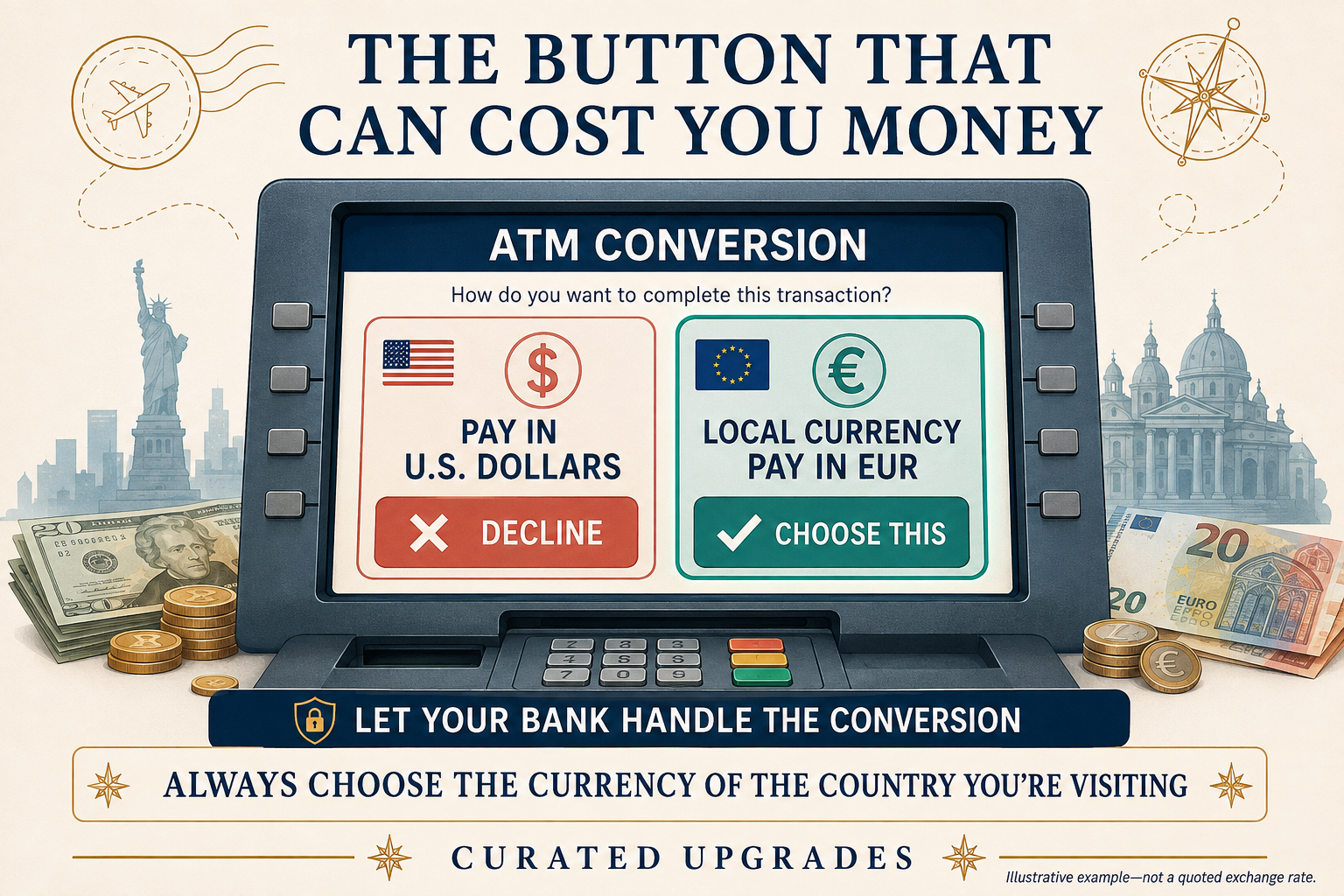
At an ATM or card terminal, choose the currency of the country you are visiting.
An ATM, hotel, restaurant or shop may offer to convert the transaction into U.S. dollars. This is known as dynamic currency conversion, or DCC.
The dollar amount can feel helpful because it is familiar. But the conversion uses an exchange rate selected by the ATM operator or payment provider and typically includes a markup or additional fee.
I encounter these conversion offers regularly. I always select local currency and let my bank or credit-card network handle the conversion.
The same rule applies to:
ATM withdrawals
Restaurant bills
Hotel charges
Retail purchases
Rental-car payments
Ticket machines and fuel pumps
Depending on how the screen is worded, look for options such as:
Decline conversion
Continue without conversion
Charge in local currency
Let my bank convert
Pay in EUR, GBP, JPY or the applicable local currency
The buttons can be confusing. Focus on the currency, not simply whether the button says “accept” or “decline.”
If you are in Japan, choose yen. If you are in the United Kingdom, choose pounds. If you are in a eurozone country, choose euros.
Choosing local currency does not eliminate a foreign transaction fee if your own card charges one. All the credit cards I normally consider for international travel waive that fee, but travelers should verify the terms of their specific card before departure.
I Keep a Rough Exchange Rate in My Head
Before and during a trip, I keep a rough idea of the current exchange rate in mind.
I do not calculate every purchase to the penny. I simply want to know whether 1,000 units of local currency represent roughly $7, $70 or $700.
When I receive a paper receipt, I often note the approximate dollar value on it. That gives me a quick record of what we spent and something to compare with the charge that eventually appears on my credit-card account.
Using the local-currency option and letting my bank handle the conversion has never caused me a problem.
Do You Still Need to Notify Your Banks?
Many card issuers no longer require or even accept travel notices.
Chase says it no longer accepts travel notifications, and Capital One says cardholders do not need to notify it before traveling. Modern fraud-detection systems monitor account activity automatically.
I still check with my bank and card issuers a few days before an international trip.
They normally tell me a travel notice is unnecessary—but I feel better asking anyway.
More importantly, I make sure:
My phone number and email address are current
Transaction and fraud alerts are active
I can sign into each issuer’s app
My debit-card PIN works
I know how to freeze a missing card
I can receive authentication codes overseas
I have saved the international customer-service numbers
If your issuer does not accept travel notifications, accurate contact information and app access are much more valuable than repeatedly trying to submit one.
Never Use a Credit Card for an ATM Withdrawal
A credit-card ATM withdrawal is normally treated as a cash advance, not a purchase.
It may carry:
A cash-advance fee
An ATM operator fee
A higher interest rate
Interest beginning immediately without the normal purchase grace period
Use a debit card for cash withdrawals. Reserve credit cards for eligible purchases unless you are dealing with a true emergency and understand the cost of the cash advance.
My Pre-Departure Money Checklist
Check the foreign transaction fee on every card.
Review international ATM and out-of-network fees.
Confirm which third-party ATM fees are reimbursed.
Check per-transaction and daily withdrawal limits.
Make sure each debit-card PIN works.
Update phone numbers and email addresses.
Turn on purchase, withdrawal and fraud alerts.
Test the banks’ mobile apps.
Load eligible cards into a mobile wallet.
Carry at least two credit cards.
Divide cards and cash between traveling companions.
Save international customer-service numbers.
Confirm that security codes can reach you overseas.
Check whether the destination warrants bringing a small amount of cash.
The Simplest Strategy Usually Wins
I have watched international travel money progress from cash and hotel exchange counters to American Express travelers’ checks, bank currency orders, airport kiosks, ATMs, contactless cards and virtual wallets.
The tools have changed, but my objective has remained the same: arrive prepared without paying unnecessary fees or carrying more cash than the trip requires.
For most destinations, my current strategy is straightforward:
Use a credit card with no foreign transaction fee for most purchases.
Choose the card that provides the most useful rewards for that purchase.
Use a debit card only at reputable bank ATMs.
Withdraw enough cash for the destination and itinerary.
Split cash and backup cards between travelers.
Decline dynamic currency conversion.
Always choose local currency.
Let the bank or card network perform the conversion.
If a destination has an unreliable airport ATM, a late-night arrival or an immediate trip into a remote area, bringing a small amount of currency may be worth the peace of mind.
Smart travel is rarely about following one absolute rule. It is about understanding the tradeoffs and choosing the option that fits the trip in front of you.
Information verified August 2026. Bank policies, card benefits, fees, exchange practices and consumer-protection rules may change. Confirm current terms with your financial institutions before traveling. This article provides general educational information and is not individualized financial or legal advice.