

The Heathrow Tax Trap: Why Your “Free” Award Flight Costs So Much
You found the award seat. You have the miles. Then the airline wants hundreds of dollars. Before blaming Heathrow, it helps to know who is actually sending you the bill.
There are certain numbers you expect to see when you're searching for an award flight.
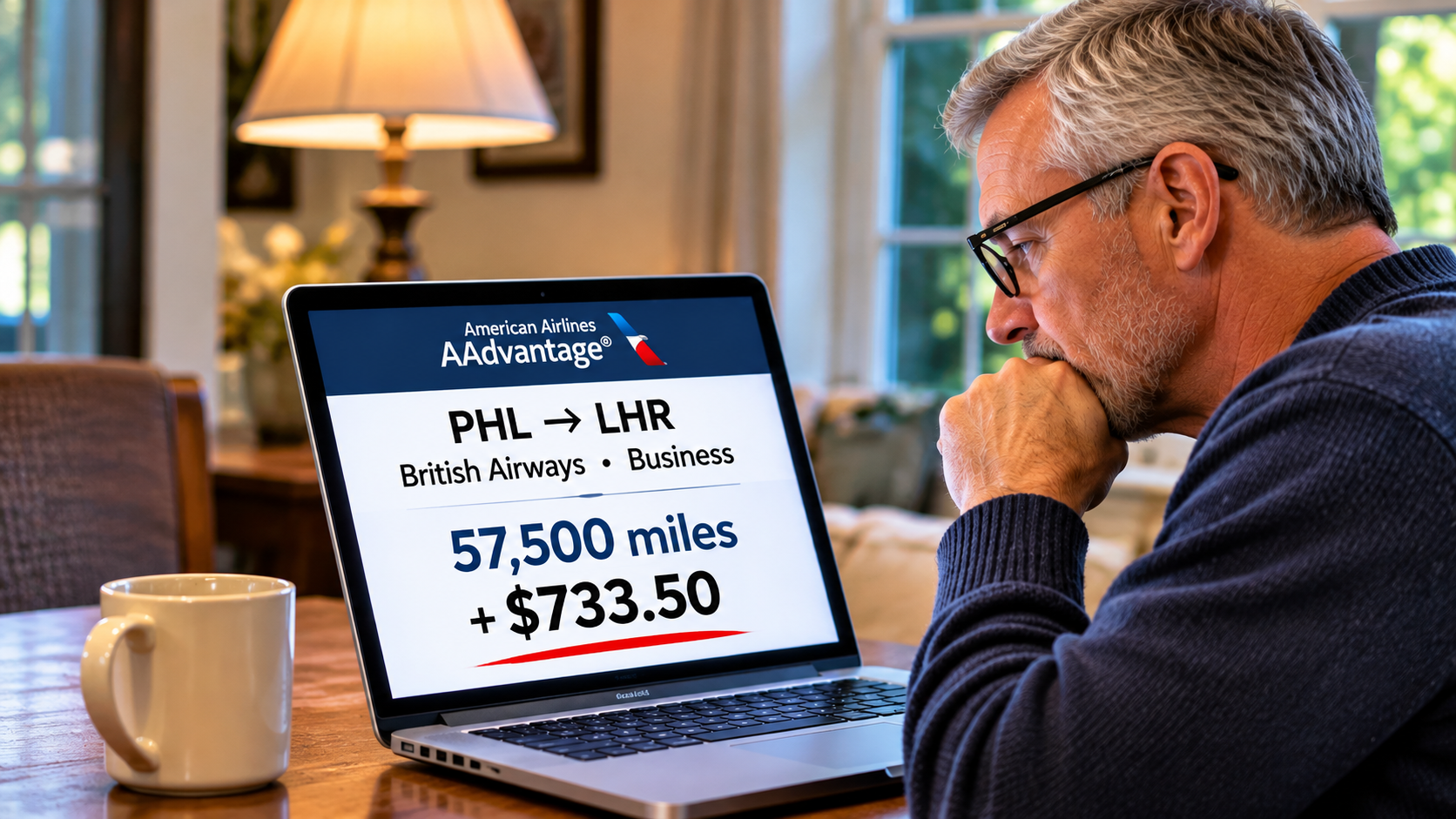
57,500 miles for business class from Philadelphia to London?
That got my attention.
Then I saw the other number.
$733.50.
Wait. I thought I was using miles.
If you've spent much time reading about award travel to London, you've probably heard about the dreaded “Heathrow taxes.” London is notorious for expensive award tickets, particularly in premium cabins, so seeing hundreds of dollars next to an award didn't exactly come as a shock.
But I wanted to know what we were actually paying.
So I opened the cost details.
Of that $733.50 cash charge, $700 was labeled as a carrier-imposed fee.
That was interesting.
Because we weren't leaving Heathrow.
We were flying to Heathrow.
And the UK's Air Passenger Duty, the expensive departure tax that gets much of the blame, applies to flights beginning in the UK. It isn't charged simply because your airplane lands in London. The UK government publishes the current Air Passenger Duty rates, including the higher standard rate that applies to long-haul premium-cabin travel.
So our $733.50 bill wasn't really a story about Heathrow taxes at all.
At least not yet.
Same Airport. Different Airline. Very Different Bill.
There was something else sitting right on the same American Airlines search screen.
Another nonstop business-class flight from Philadelphia to London.
Same date. Same origin. Same destination. Same cabin.
But this one was operated by American Airlines instead of British Airways.
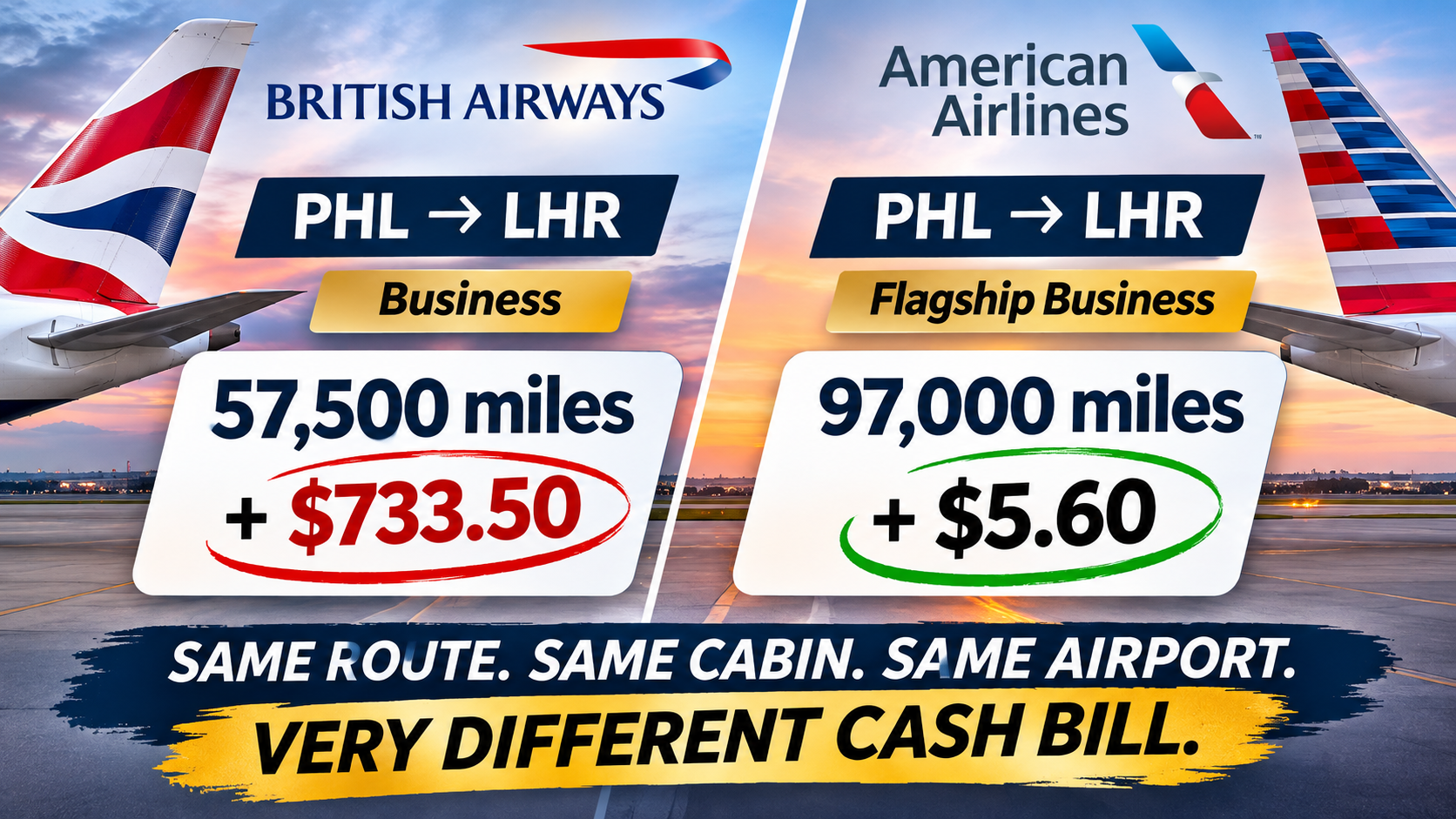
The British Airways flight cost:
57,500 AAdvantage miles + $733.50
The American flight cost:
97,000 AAdvantage miles + $5.60
Both airplanes were going to Heathrow.
The airport didn't change. The destination didn't change. The cabin didn't change.
The airline changed, and the cash bill changed by $727.90.
American required 39,500 more miles, so this isn't as simple as saying the American award was better. It's a choice between spending more miles or spending more cash.
American also warns AAdvantage members that some partner awards, including British Airways, can have additional charges. Its program terms say award travelers are responsible for applicable taxes, fees and surcharges assessed by governments or airline partners. You can see that distinction in American's AAdvantage award-travel FAQ.
But we can already say one thing with certainty:
That $733.50 wasn't simply a “Heathrow tax.”
Okay. What Happens When We Fly the Other Direction?
Now I wanted to see what happened when we actually departed Heathrow.
So we reversed the search.
London Heathrow to Philadelphia. Business class. Nonstop. British Airways.
The award price was familiar:
57,500 AAdvantage miles.
The cash wasn't.
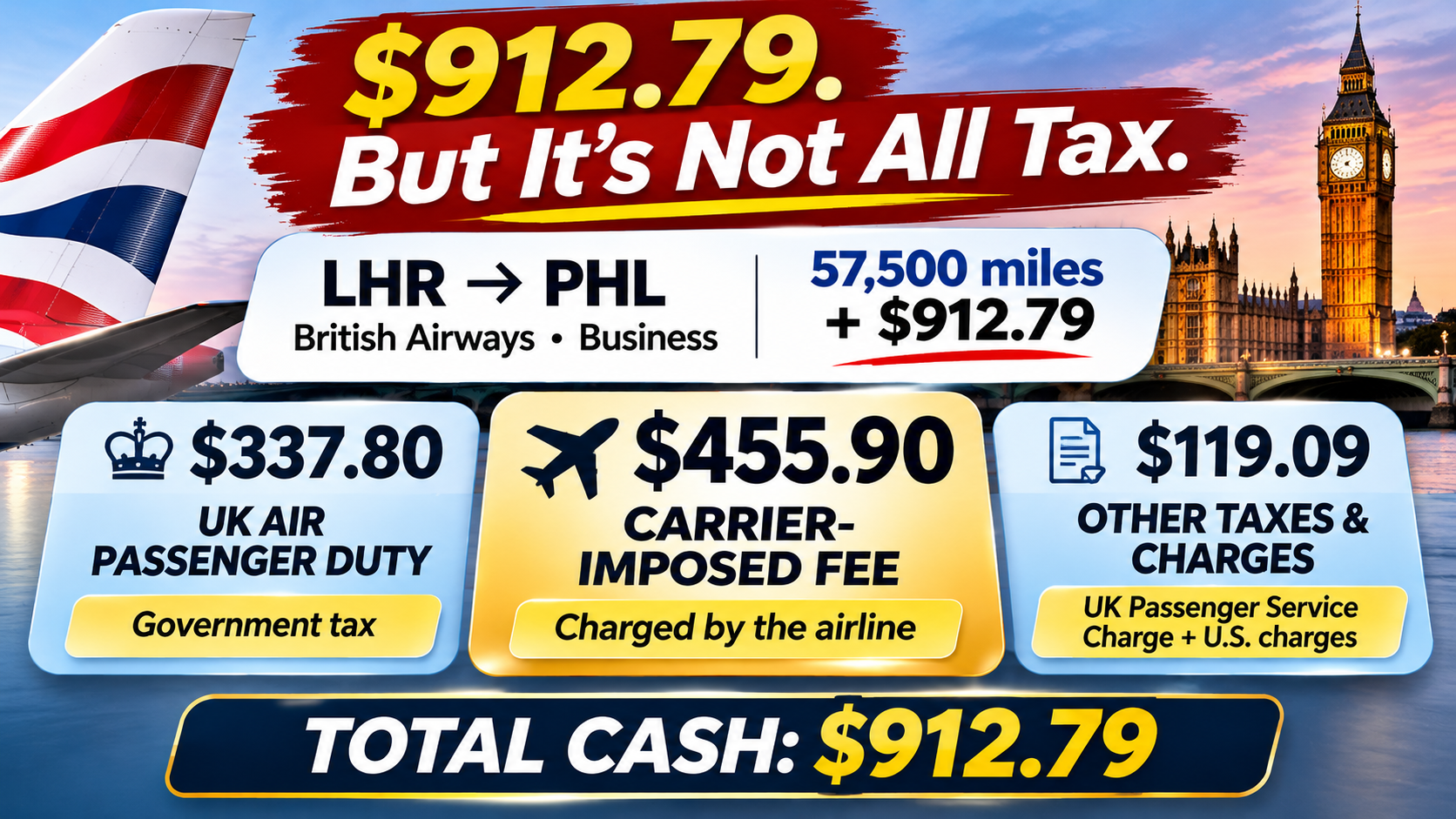
$912.79.
This time, when we opened the details, the famous UK departure tax finally appeared.
UK Air Passenger Duty: $337.80.
There was also a $77.10 UK Passenger Service Charge and several smaller U.S. government charges.
But there was something else.
Carrier-imposed fees: $455.90.
Now we could see what was happening.
The $912.79 wasn't one giant Heathrow tax.
It was a stack.
Of our $912.79 cash payment:
$337.80 was UK Air Passenger Duty.
$455.90 was a carrier-imposed fee.
$119.09 was other taxes and charges.
And British Airways makes the distinction remarkably clear. Its own passenger notice explaining taxes and carrier charges says its carrier-imposed charges are levied by British Airways and are not taxes, fees or charges imposed by a government or third party.
That's about as definitive as it gets.
What Is Air Passenger Duty?
Air Passenger Duty, usually shortened to APD, is a UK government tax on passengers departing the United Kingdom.
The amount depends on where you're going and the class of travel.
For flights beginning on or after April 1, 2027, the UK government set the standard APD rate for Band B destinations at £251.95. Band B covers destinations approximately 2,001 to 5,500 miles from the UK, and the standard rate applies to travel above the lowest class.
That's why premium-cabin travelers can get hit particularly hard.
For our 2027 London-to-Philadelphia business-class search, American displayed the APD as $337.80.
That's a real government tax.
But remember the flight in the opposite direction.
Philadelphia to London came with a $733.50 cash payment even though UK APD wasn't part of the bill.
That's why blaming every expensive London award on APD can send you looking for the wrong solution.
Then What Is a Carrier-Imposed Fee?
This is where the terminology can make an award ticket look more mysterious than it really is.
Government taxes are imposed by governments.
Airport charges come from airports or other authorities.
A carrier-imposed charge comes from the airline.
British Airways explains that distinction on its own taxes, fees and carrier charges page.
That doesn't automatically make an award bad.
It does mean I want to know what I'm paying before deciding whether the award makes sense.
If the UK government is charging me APD to leave the country in business class, there's not much shopping around that's going to make that particular tax disappear while I still start the same journey in London.
But if hundreds of dollars are coming from an airline's own surcharge structure, I can ask different questions.
What happens if I fly another airline?
What happens if I book through another loyalty program?
What happens if I leave from somewhere else?
That's when opening another tab can become surprisingly profitable.
What If We Book Through British Airways Instead?
We also searched British Airways' own Avios program.
And the numbers changed again.
For London to Philadelphia in business class on the same date and route, British Airways showed an option at:
99,000 Avios + $499
American was offering the British Airways-operated nonstop for:
57,500 AAdvantage miles + $912.79
These weren't necessarily the exact same flight, so I wouldn't treat this as a seat-for-seat comparison.
But it demonstrates something important about award travel.
The loyalty program you use can change the balance between points and cash.
British Airways even showed us multiple pricing combinations that allowed us to spend fewer Avios by paying more cash. BA explains that its Reward Flights combine Avios with a cash amount covering taxes, fees and carrier charges, and that travelers can reduce the Avios requirement by paying additional cash.
So asking:
“How many miles does this flight cost?”
isn't always enough.
A better question is:
“How many miles AND how much cash?”
Saving tens of thousands of miles isn't necessarily a bargain if doing it costs several hundred additional dollars.
And spending more miles isn't necessarily wasteful if it keeps a substantial amount of real money in your bank account.
The points don't get to make that decision for you.
But Is $733.50 Actually a Bad Award?
This is where the cash fare matters.
The British Airways PHL–LHR business-class ticket we priced was selling for $3,739 one way.
Our award was:
57,500 miles + $733.50.
Yes, that $700 carrier-imposed fee is ugly.
But the award was still replacing roughly $3,005 of the cash fare with 57,500 miles.
Using the common cents-per-point calculation:
CPP = (Cash Fare − Award Cash Payment) ÷ Miles × 100
that works out to about:
5.23 cents per mile.
The American-operated flight is interesting for the opposite reason.
The comparable cash fare was also $3,739, while the award cost:
97,000 miles + $5.60.
That produces about:
3.85 cents per mile.
So the award with the horrible-looking $733.50 cash payment actually produced the higher CPP.
That doesn't automatically make British Airways the better choice.
If I'd rather spend another 39,500 miles and keep $727.90 in my pocket, the American award could easily be the better choice for me.
That's why I don't think CPP should make the decision.
It gives us useful context. It doesn't get to plan the trip.
Can You Just Avoid Heathrow?
This is where award-travel advice can get clever in a hurry.
One common suggestion is to start the trip home somewhere outside the UK.
So we tried Dublin.
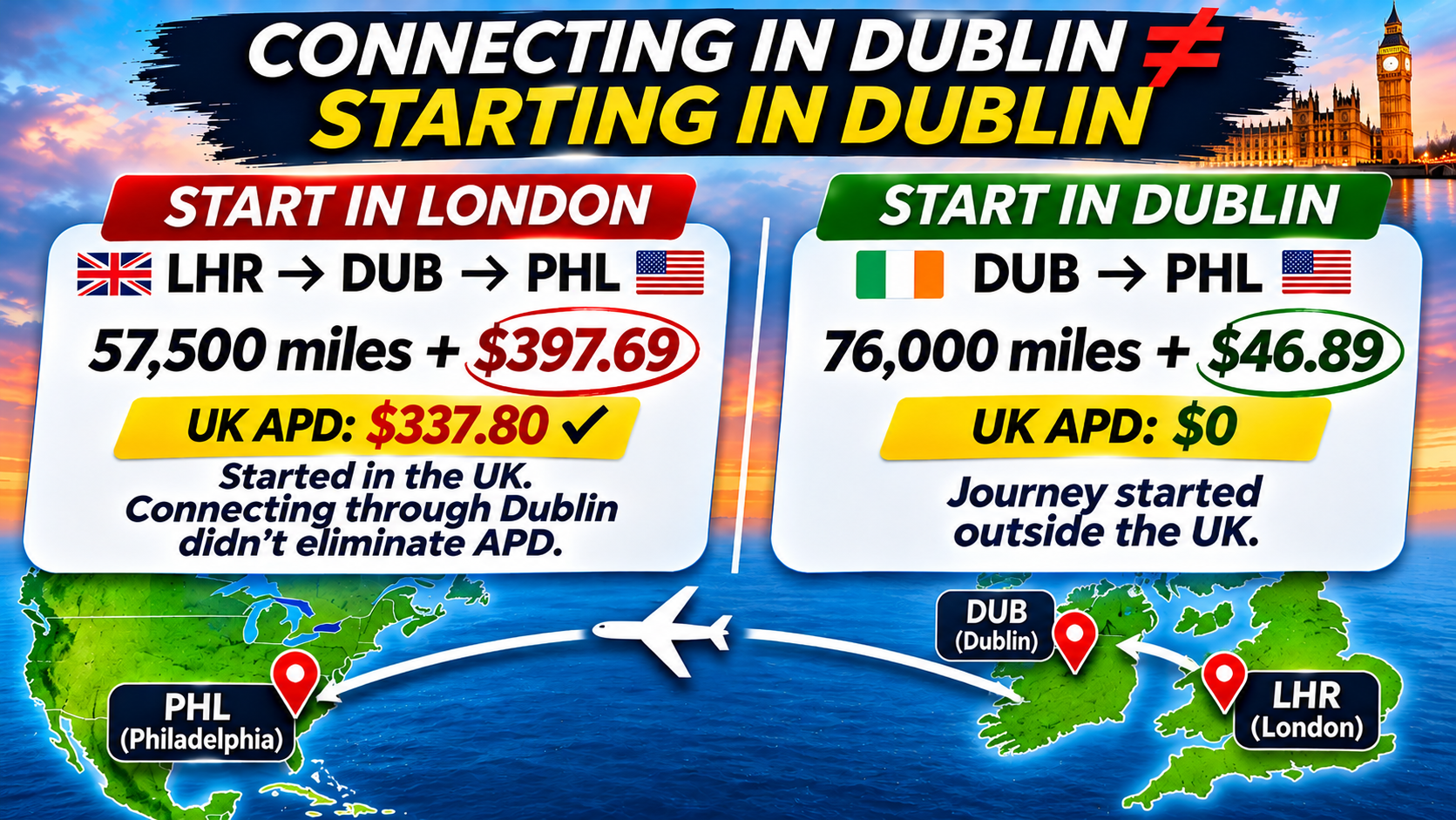
We found a nonstop American Airlines business-class award from Dublin to Philadelphia for:
76,000 AAdvantage miles + $46.89.
The comparable cash fare was $2,668.
Compare that with our British Airways nonstop from Heathrow:
57,500 miles + $912.79
against a $2,913 cash fare.
That's an enormous difference in cash.
But before declaring Dublin the winner, there's an important catch.
We changed two things.
We started outside the UK, so UK Air Passenger Duty no longer applied.
But we also switched from British Airways to American Airlines, avoiding the BA carrier-imposed charge we'd seen on our Heathrow award.
So it would be misleading to say:
“Flying from Dublin saved us $865.90 in Heathrow taxes.”
It didn't.
And there's another problem.
You have to get to Dublin.
The Clever Hack Still Has to Make Sense
We found inexpensive flights between London and Dublin. Getting there wasn't particularly difficult.
But inexpensive isn't the same as free.
Maybe you need another flight. Maybe you need a hotel. Maybe you lose part of a vacation day. Maybe you're dealing with luggage and separate tickets.
Suddenly your brilliant award-travel hack has turned into another travel day.
Would I do it?
🟢 Go for it! if Ireland were already part of the trip or Dublin were somewhere we genuinely wanted to spend a couple of days before flying home. Now the lower cash cost is helping us build a trip we actually want.
🟡 Maybe. if the savings are substantial enough to justify repositioning and we have plenty of time. I'd price the entire detour before deciding.
🔴 Pass on it. if we're sacrificing a vacation day, adding a hotel and another flight, hauling luggage through another airport and creating separate-ticket risk just so we can say we “beat Heathrow.”
The trip still has to make sense.
Connecting Through Dublin Isn't the Same Thing
There's one wrinkle worth knowing because we actually found it in our searches.
We also priced:
LHR → DUB → PHL
The award was:
57,500 miles + $397.69.
And there it was again:
UK Air Passenger Duty: $337.80.
Connecting through Dublin didn't make the APD disappear.
HM Revenue & Customs treats qualifying connected flights as one journey and bases APD on the final destination and class of travel. For international connections, flights generally qualify as connected when they're on the same or conjunction tickets and the onward international flight leaves within 24 hours. HMRC explains the connected-flight rules here.
So:
LHR → DUB → PHL
starts in the UK. The qualifying connection through Dublin doesn't erase the long-haul APD.
But:
DUB → PHL
starts outside the UK.
No UK departure means no UK APD.
That's a small distinction with a potentially large price tag.
Now Put the Cash Fare Back Into the Equation
Once we had all these award prices, I wanted one more piece of information.
What would these tickets cost if we didn't use miles at all?
That's where the picture became more interesting.
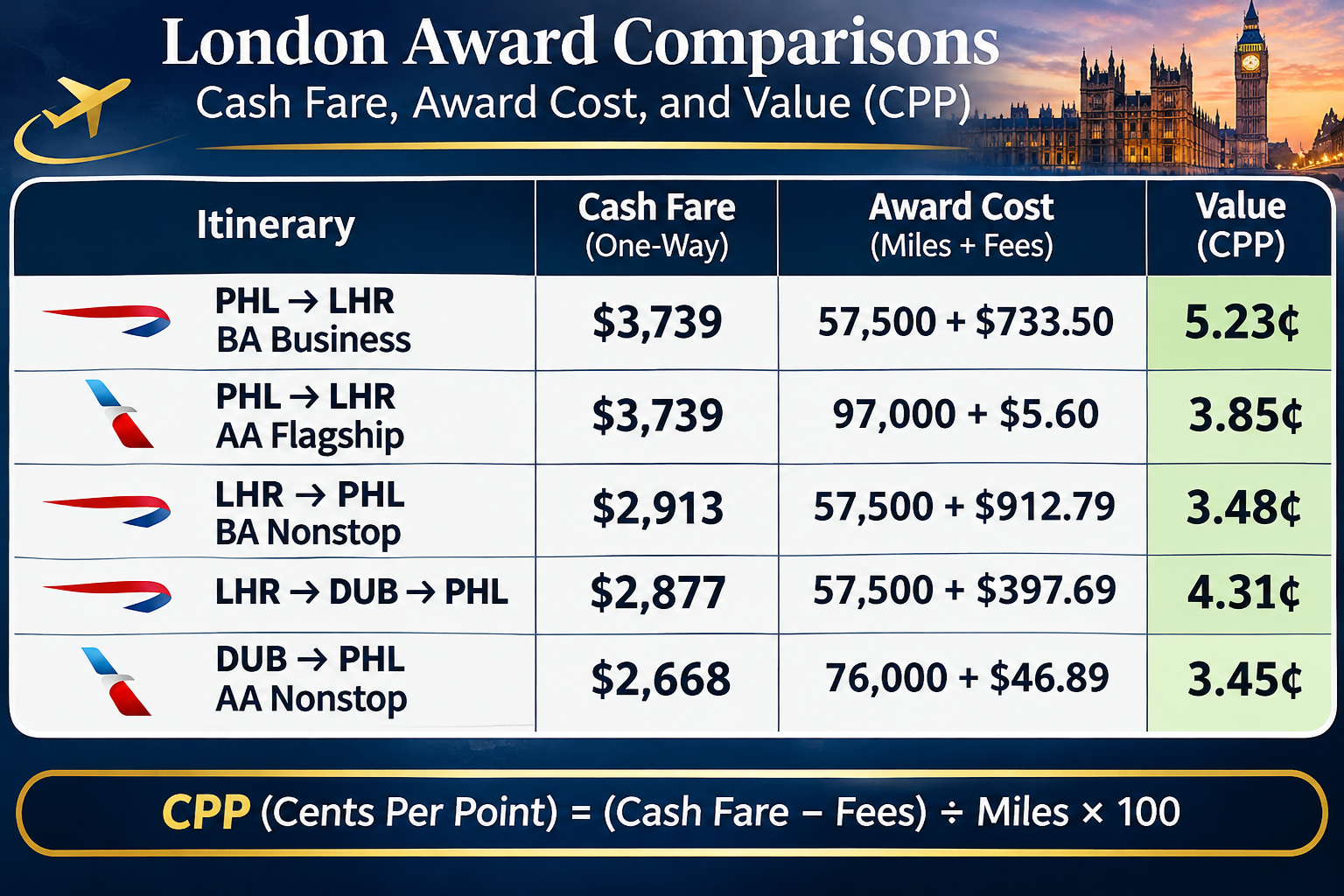
Our one-way business-class cash fares were:
PHL → LHR, British Airways: $3,739
PHL → LHR, American: $3,739
LHR → PHL, nonstop: $2,913
LHR → DUB → PHL: $2,877
DUB → PHL, nonstop: $2,668
Now we could compare not just the fees, but what the miles were actually replacing.
And that's how we ended up with an odd result.
The award with the most offensive-looking surcharge wasn't necessarily the worst redemption.
High Fees Don't Automatically Mean a Bad Award
Our searches produced CPP values ranging from about 3.45 to 5.23 cents per mile.
Every one of those numbers looks pretty good on paper.
But here's where I stop letting CPP drive the bus.
The British Airways PHL–LHR award gave us the highest CPP at 5.23 cents per mile, despite charging $733.50 in cash.
The American award on the same route produced a lower 3.85 cents per mile, but required only $5.60 out of pocket.
Which would I book?
That depends on what I have more of.
Miles?
Cash?
And what else could I do with those extra 39,500 miles?
CPP is useful because it gives us context.
But I wouldn't spend $727.90 just to brag that I squeezed another 1.38 cents of theoretical value from each mile.
That's spreadsheet travel.
I want the actual trip.
So What Exactly Are You Paying?
By the time we finished searching, our original question had changed.
We started with:
Why are Heathrow taxes so expensive?
We ended with:
Who is actually charging me all this money?
That's a much better question.
When an award ticket comes with a surprisingly large cash payment, that bill can contain several different things.
Government taxes, including UK Air Passenger Duty.
Airport and passenger charges.
Carrier-imposed charges, which come from the airline rather than the government.
And then there's the way the loyalty program itself structures the award, deciding how many miles or Avios it wants and how much cash you'll pay alongside them.
Those differences can completely change which award makes sense.
The Curated Upgrades Take
🔴 Don't assume a huge cash charge on an award ticket is all taxes.
Our Philadelphia-to-London British Airways award proved that immediately. Of the $733.50 cash payment, $700 was labeled carrier-imposed.
🟢 Open the cost details.
Don't stop at “57,500 miles + $733.50.” Find out what's actually inside that $733.50.
🟢 Compare the operating airline.
On our Philadelphia-to-London search, changing from British Airways to American changed the cash payment from $733.50 to $5.60, although it also increased the mileage requirement by 39,500 miles.
🟢 Compare loyalty programs when you can.
American and British Airways structured our searches very differently. More miles and less cash may be better for you. Fewer miles and more cash may be better for someone else.
🟡 Use CPP as information, not a commandment.
A high CPP doesn't pay your credit-card bill. A lower CPP doesn't automatically mean you made a bad redemption.
🟡 Consider another departure city, but count the whole trip.
Dublin dramatically reduced the cash portion in our search. That doesn't automatically mean we'd reposition there just to save money.
The extra flight, hotel, transportation, luggage, time and aggravation all count.
Because that's the part of award travel that's easy to forget when we're staring at a spreadsheet.
The goal isn't to beat Heathrow.
The goal isn't to squeeze the theoretical maximum value out of every mile.
And the goal definitely isn't to spend an extra vacation day bouncing around Europe just so you can tell the internet you paid $46.89 alongside your award.
The goal is to use your miles to build a trip you actually want to take.
So the next time you find a great award to London and nearly fall out of your chair when you see the cash payment, don't immediately blame Heathrow.
Open the details.
You might discover that Heathrow isn't the one sending you most of the bill.