


Your Hotel Is Unacceptable: When Can You Leave and Get Your Money Back?
The room is dirty. Something important doesn't work. Or the hotel is nothing like you expected. When can you reasonably leave, and how do you protect your chances of getting your money back?
You open the hotel room door and immediately think:
We're not staying here.
Sometimes that's an easy emotional decision.
The financial decision can be a lot more complicated.
In the United States, there isn't a general federal hotel rule that says a room becomes officially “unacceptable” at a particular point and automatically entitles you to a refund.
So before you grab your luggage and head for another hotel, it helps to understand exactly what kind of problem you're dealing with.
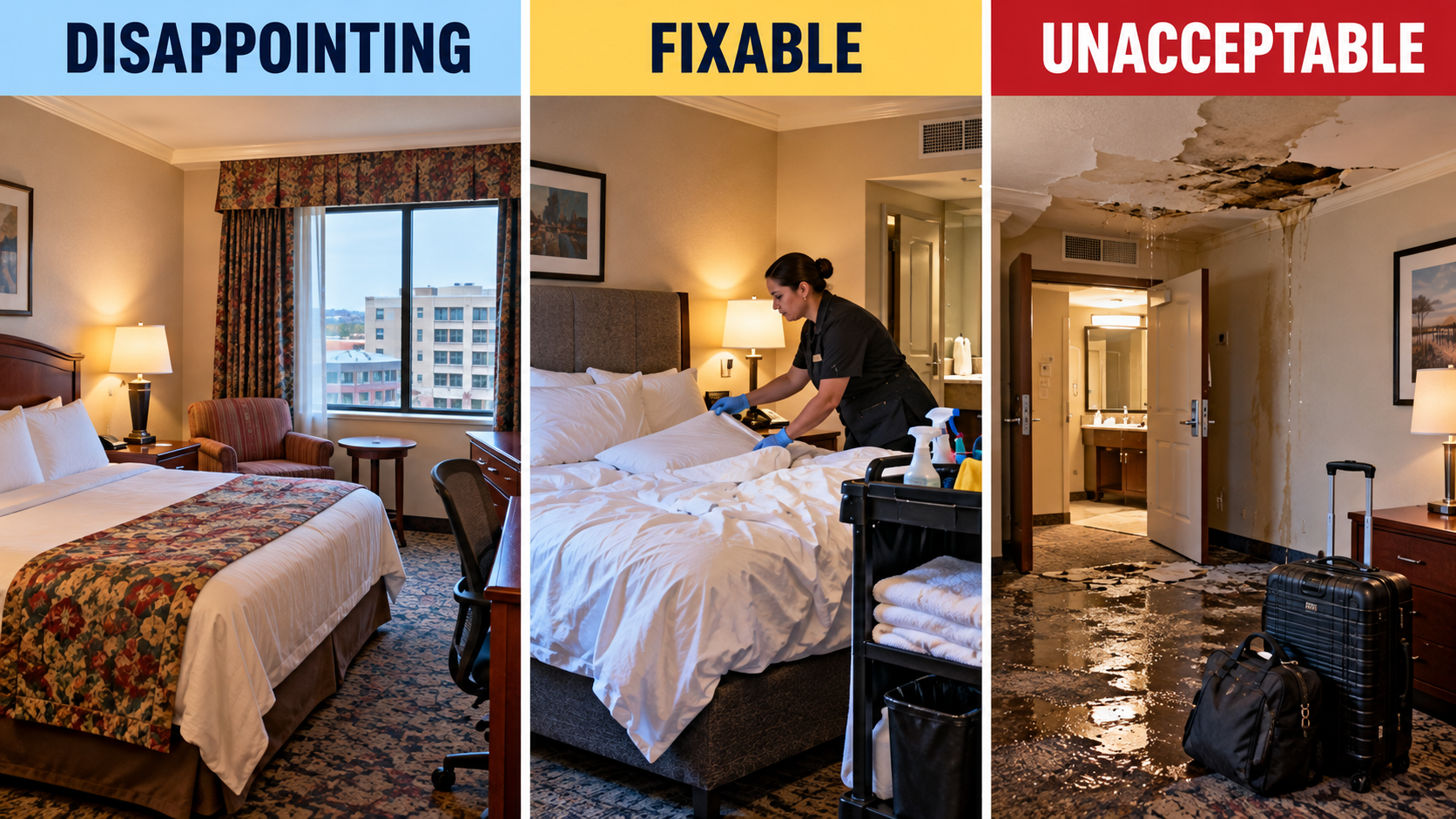
Disappointing, Fixable or Unacceptable?
Not every bad hotel experience is the same.
A room can be disappointing without being unusable. Maybe the hotel is dated, the room is smaller than you expected or the view isn't particularly inspiring.
Then there are real but fixable problems. The room wasn't cleaned properly. The air conditioning isn't working. There's a plumbing problem. The bedding needs to be replaced.
Give the hotel an opportunity to correct those.
And then there are more serious situations involving sanitation, safety or conditions that simply haven't been resolved.
That's when leaving becomes a much more reasonable option.
A Bad Room Doesn't Automatically Mean a Refund
This is where expectations matter.
There isn't a nationwide federal chart that says:
Dirty sheets = one free night.
Broken air conditioning = full refund.
Water leak = three nights plus 20,000 points.
Hotels are subject to state and local lodging, health and safety requirements, along with consumer laws, reservation terms and their own policies.
Those requirements can be substantial.
For example, Florida law requires licensed lodging establishments to provide adequate sanitary facilities and to be properly lighted, heated, cooled and ventilated, while operating with regard to guests' health, comfort and safety. Online Sunshine
Florida lodging sanitary and safety requirements
But that's an example of a state lodging regulation, not a nationwide automatic-refund rule.
The practical question usually becomes:
Can the hotel reasonably fix the problem?
Before You Walk Out, Give Them a Chance
Unless you're dealing with an immediate safety issue, don't silently pack your bags and disappear.
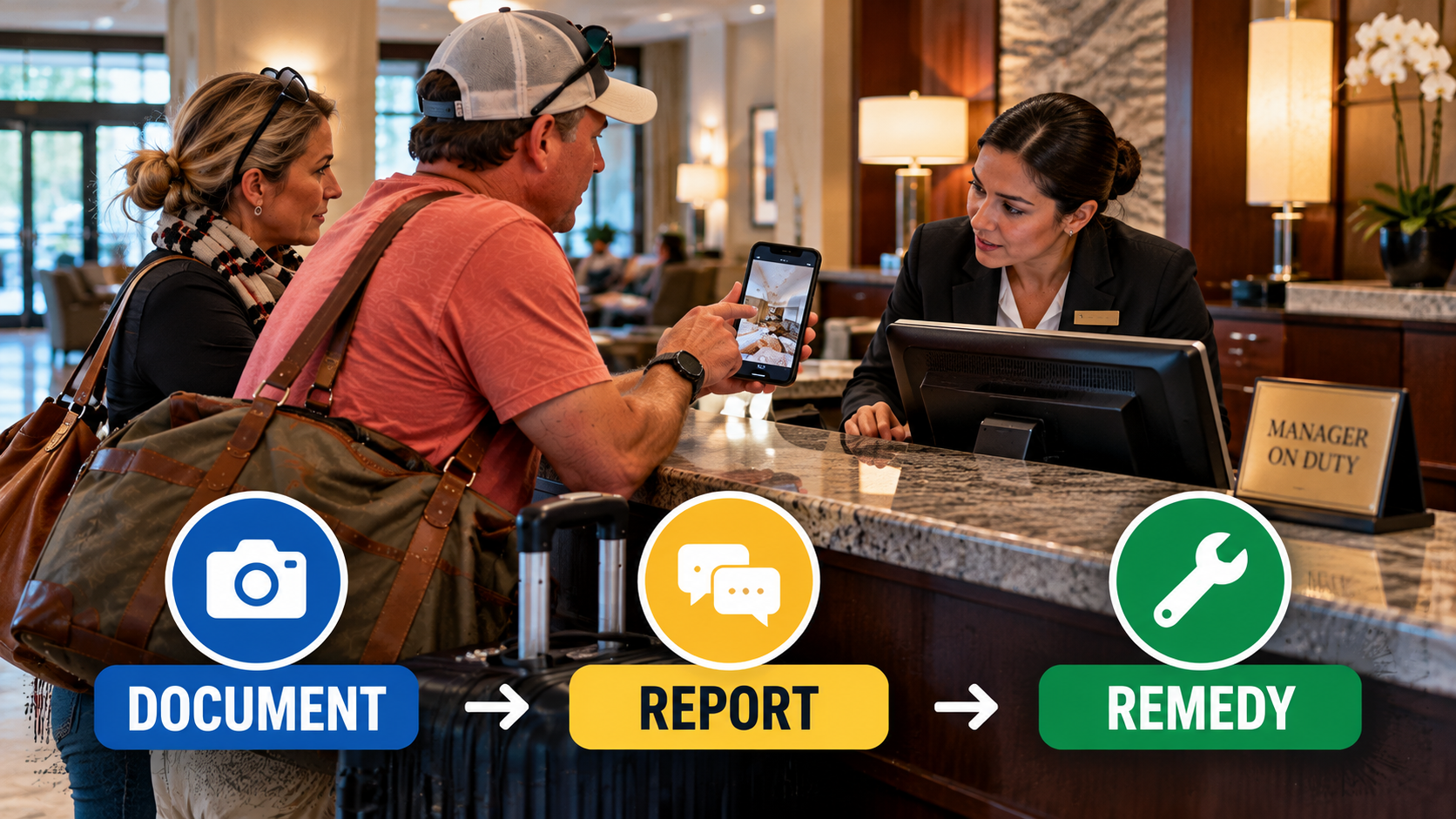
Take a few photos or a short video of the problem.
Then report it.
If the hotel offers to clean the room, repair the problem or move you to another suitable room, you've given them the opportunity to make things right.
That matters.
If your shower doesn't work and the hotel immediately offers an equivalent room with working plumbing, it's harder to argue that the only acceptable solution was leaving the property and receiving a complete refund.
On the other hand, if the hotel can't or won't correct a serious problem, your position becomes considerably stronger.
When Leaving Becomes Reasonable
There's no universal line painted across every hotel-room doorway.
But there's an enormous difference between:
“I don't like this room.”
and
“I reported a serious problem, and the hotel cannot provide an acceptable solution.”
If you're dealing with significant sanitation problems, unusable plumbing, serious water damage, dangerous conditions, major security concerns or another substantial unresolved problem, protecting yourself may matter more than continuing an argument at the front desk.
If there's an immediate safety concern, leave first. Document what you reasonably can without putting yourself at risk.
Otherwise, talk to management before leaving.
And make your request very clear:
“I've reported the problem and it hasn't been resolved. I don't believe this room is acceptable to stay in. If you can't provide a suitable alternative, I'd like to check out and have the unused nights refunded.”
Now you're not simply abandoning the reservation.
You're asking the hotel to release you from it.
Sometimes the Best Resolution Is Leaving
We've done exactly that.
We once checked into a hotel that simply wasn't working for our trip. Among other disappointments, transportation we'd expected wasn't available, and after seeing the property we knew we didn't want to spend the rest of our stay there.
We could have spent hours arguing about everything we disliked.
Instead, we talked to management.
They waived the resort fee, we stayed the first night, and then we moved to another hotel.
Was that because we had discovered some magic legal right to leave?
No.
We negotiated an exit that worked for both sides and got on with our trip.
Sometimes the best upgrade really is checking out.
Get the Agreement Before You Leave
Whenever practical, this is the part I wouldn't skip.
If the hotel agrees to refund your unused nights, waive an early-departure charge or otherwise release you from the reservation, get that documented.
An email is great.
A revised folio is great.
A message through the hotel's app is great.
Even the manager's name and a written notation of what was agreed is better than relying on:
“Don't worry. It'll be taken care of.”
Famous last words.

What If You Prepaid or Booked Through a Third Party?
This is where things can become messy.
If you booked through an online travel agency, start with the hotel while you're there because the hotel is the one that can inspect the room, move you or agree that you should be released from the stay.
But the hotel may not be the company holding your money.
For example, Expedia's current terms say refunds go back to the original payment method and are made by the party that took the original payment.
So if the hotel agrees that your unused nights should be refunded, ask them to document that authorization.
Then contact the company that actually charged you.
That little piece of documentation can be much more useful than finding yourself trapped in:
Hotel: “Call the booking company.”
Booking company: “Call the hotel.”
Repeat until retirement.
What About a Credit-Card Dispute?
Treat this as an escalation tool, not your opening move.
The Consumer Financial Protection Bureau recommends first trying to resolve a problem with the company that sold the product or service. If that doesn't work, a credit-card dispute may be available depending on the circumstances. Consumer Financial Protection Bureau
Federal billing-error protections also have important deadlines. CFPB guidance says written billing-error notices generally must reach the card issuer within 60 days after the charge first appears on the statement, although disputes involving defective goods or services can involve a different process. Consumer Financial Protection Bureau
CFPB guidance on credit-card disputes and refunds
That's another reason to save your photographs, reservation confirmation, messages with the hotel, names of employees you spoke with and any documentation showing what the hotel agreed to do.
The Curated Verdict
🟢 DOCUMENT IT AND GIVE THE HOTEL A CHANCE TO FIX IT
If the problem can reasonably be corrected or the hotel can move you to a suitable room, that may be the fastest solution.
🟡 IF THEY CAN'T FIX IT, NEGOTIATE YOUR EXIT
Ask management to release you from the reservation and refund the unused nights. Get the agreement documented whenever possible.
🔴 DON'T ASSUME WALKING OUT AUTOMATICALLY MEANS A REFUND
Leaving may be completely reasonable. Getting your money back is a separate question.
The Bottom Line
If the hotel is merely disappointing, asking for a refund is one thing. If there's a serious documented problem the hotel can't or won't resolve, asking to leave without paying for unused nights is a much stronger conversation.
Document it. Report it. Give them a reasonable chance to fix it. If they can't, negotiate your exit and get the agreement in writing.
Then go rescue the rest of your trip.
Hotel policies, reservation terms, consumer protections and lodging regulations vary by property, booking channel and jurisdiction. This article provides general travel information, not legal advice. Information current as of October 2026.