

How to Choose the Right Cruise Cabin
The best stateroom is not necessarily the most expensive—it is the one that fits how you actually cruise.
I have cruised in interior cabins, oceanview cabins and balcony cabins. I have shared one room with my wife and teenage son, booked connecting cabins for our family, placed the kids in an interior cabin near our oceanview room and sailed in an inexpensive lower-deck cabin on a Viking river cruise.
I have not stayed in a cruise suite—yet.
Those experiences have taught me that the most expensive cabin is not automatically the best cabin. Sometimes a balcony is worth paying for. Sometimes two modest cabins work far better than squeezing a family into one upgraded room. Sometimes the low-deck cabin without a verandah is the real upgrade because it leaves money available for the parts of the trip you will remember.
For me, a cruise stateroom has a fairly limited job: provide a bathroom, a comfortable bed, some privacy and a place to reset.
Almost everything I boarded the ship to experience is outside that door.
The passenger in the expensive balcony cabin and the passenger in the last interior cabin all the way aft still eat at the same buffet, order dinner in the same main dining room, watch the same show in the theater, visit the same ports and lose the same money at the blackjack table.
That does not make every cabin equal. It means the right question is not, “What is the nicest cabin I can afford?”
The better question is:
What is the least expensive cabin that will let me enjoy this particular cruise comfortably?
Cabin categories, layouts and policies vary by cruise line, ship and sailing. Always study the deck plan and the description of the exact category you are considering.
Start With How You Will Use the Cabin
Before comparing prices, decide how you expect to use your room.
Ask yourself:
Will the itinerary include several sea days?
Do you enjoy slow mornings with coffee outside?
Will you return to the cabin during the day?
Are you comfortable using public decks for fresh air and scenery?
Are you traveling with children, friends or extended family?
Does anyone need quiet, accessibility features or convenient elevator access?
Are you sensitive to motion?
Would you rather spend the difference on excursions, dining or another trip?
A balcony can be wonderful on an ocean cruise with several sea days. I enjoy a lazy morning with coffee outside, and on a longer sailing it is nice to open the door and bring fresh air into the room.
I still book balconies relatively rarely.
If the itinerary is port-intensive and I expect to spend most of the day exploring, the balcony may receive very little use. In that situation, an interior or oceanview cabin may deliver everything I need.
Book for the way you actually travel—not for the way the upgrade looks in the brochure.
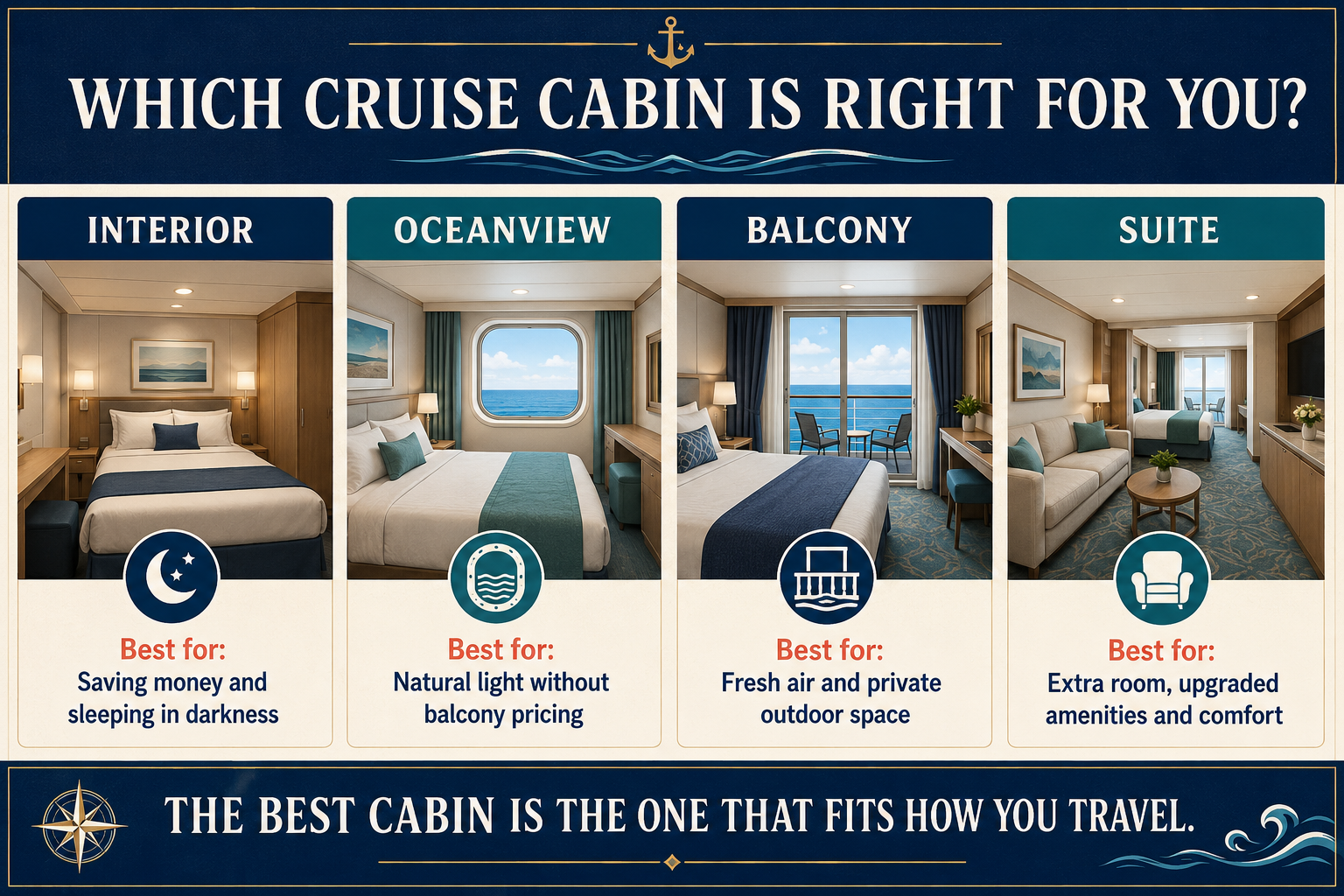
Interior, Oceanview, Balcony or Suite?
Most ocean ships offer several broad accommodation types, although the names and features vary considerably.
Interior cabins
Interior cabins generally offer the lowest entry price because they do not have a traditional exterior window.
They can be a smart choice when:
You primarily use the room for sleeping and getting ready.
You prefer complete darkness at night.
You want to spend more of the budget elsewhere.
You are comfortable finding outdoor space elsewhere on the ship.
Some newer ships offer interior cabins with virtual windows, promenade views or windows facing an interior neighborhood. These may provide more visual interest, but privacy and sightlines deserve careful attention.
Oceanview cabins
Oceanview cabins provide natural light through a window or porthole without the price of a private balcony.
They can offer an excellent middle ground. You can see the weather, watch the ship enter port and avoid the enclosed feeling of an interior cabin without paying for outdoor space you may not use.
Check whether the view is fully unobstructed. Lifeboats, ship structures or unusually positioned windows may limit what you can see.
Balcony cabins
Balcony cabins provide private outdoor space and are particularly attractive on scenic itineraries or cruises with multiple sea days.
The value depends on use. A balcony that becomes part of your daily routine can meaningfully improve a cruise. A balcony visited twice during a port-heavy itinerary may be an expensive place to dry a swimsuit.
Also examine the actual balcony type. Depending on the ship, the room may face the ocean, the ship’s wake, an interior neighborhood or a promenade. Privacy, shade, wind and furniture can vary.
Suites
Suites may provide substantially more room and sometimes include priority services, exclusive venues, upgraded dining, Wi-Fi, beverage benefits or other privileges.
Do not assume every suite includes the same benefits. Compare the complete package for the exact ship and category.
I am willing to pay more when an upgrade changes the entire trip. I am much less interested when it only changes the room.
Choose the Right Part of the Ship
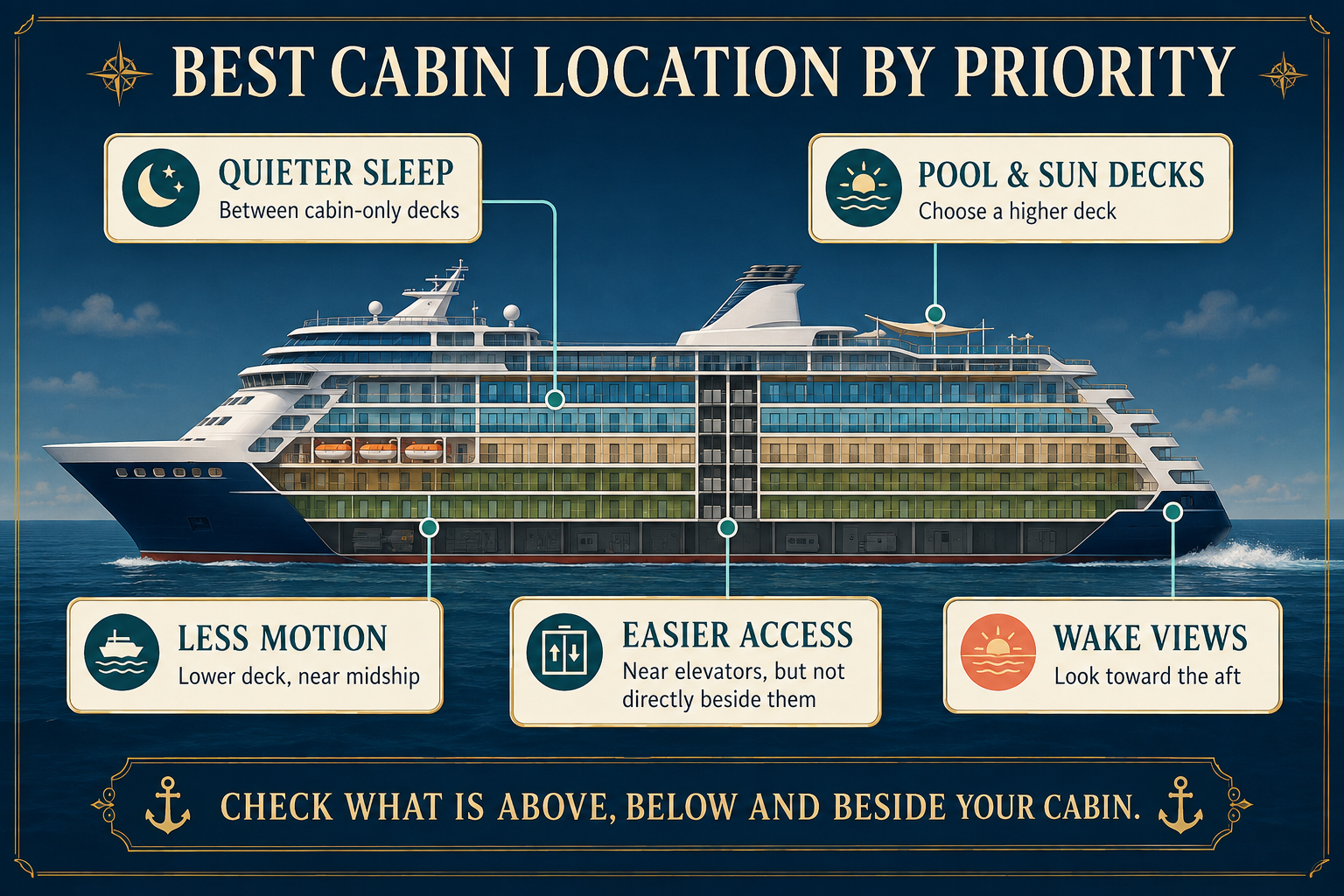
Cabin category is only half the decision. Location can matter just as much.
For less motion
A lower-deck cabin near the middle of the ship is generally the first place to look if motion concerns you. Cabins high on the ship or toward the extreme forward and aft sections may experience more noticeable movement.
No cabin can eliminate motion completely, and sea conditions vary. If motion sickness is a serious concern, discuss prevention with an appropriate healthcare professional before traveling.
For easier access
A cabin near elevators can reduce walking and simplify navigation, especially on a large ship. This may be valuable for travelers with mobility limitations or anyone who expects to move frequently between the room and a particular venue.
“Near the elevator” does not have to mean directly beside the elevator lobby. A short distance away may provide convenience with less passing traffic.
For pools and upper decks
A higher cabin can provide faster access to pools, outdoor decks and casual dining. The tradeoff may be more motion, more elevator demand and possible noise from public areas overhead.
For wake views
Aft-facing cabins can offer memorable views of the ship’s wake. They may also require longer walks and can experience vibration, motion or noise depending on the vessel.
For a quiet retreat
Look for a cabin surrounded by other cabins—above, below and beside you. This does not guarantee silence, but it removes several common sources of public-area noise.
Read the Deck Plan Before Booking
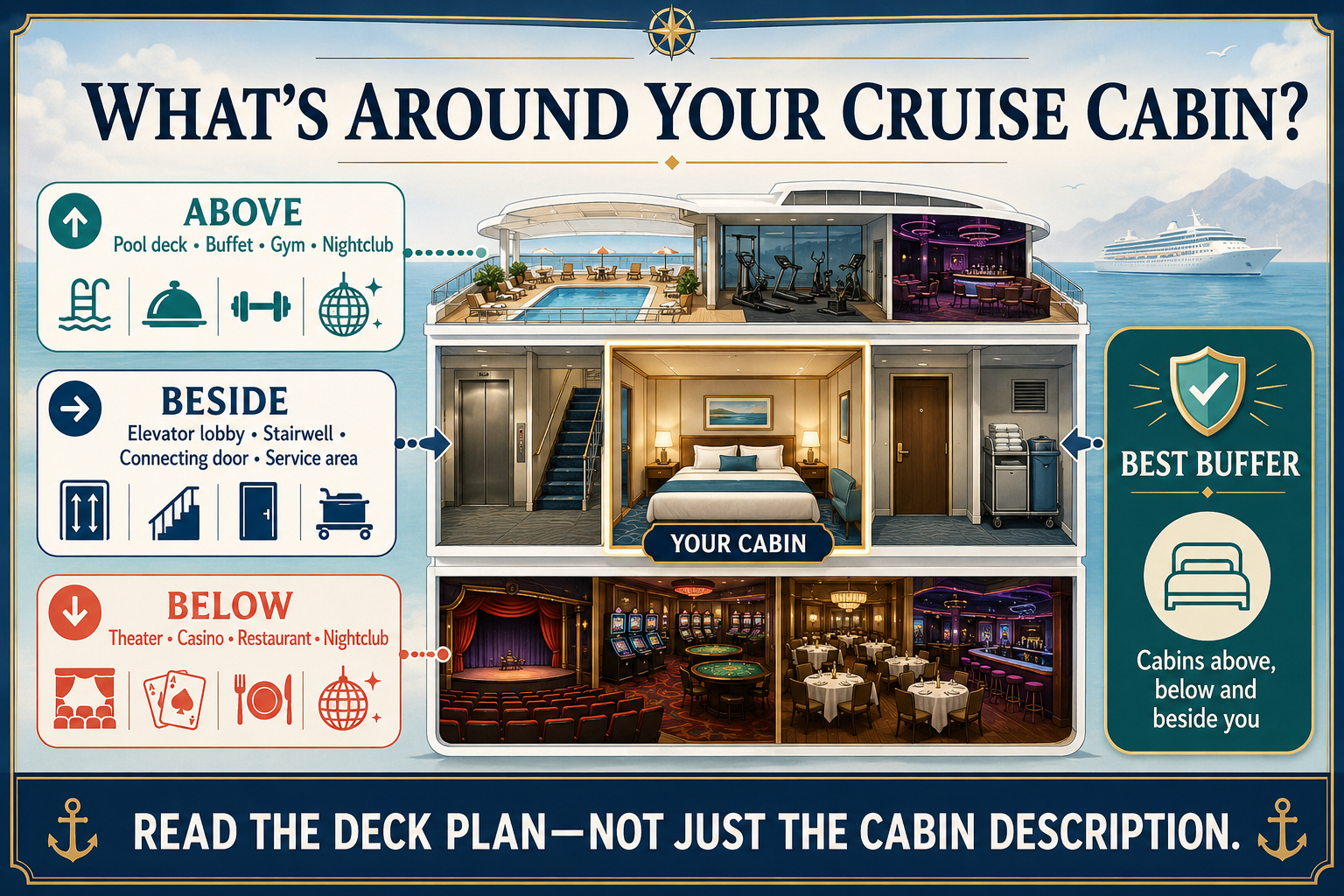
A cabin description tells you what is inside the room. The deck plan tells you what may affect it.
Study the decks immediately above and below your proposed cabin, not merely the deck containing it.
Potential noise sources can include:
Pool decks
Buffets and restaurants
Kitchens and service areas
Fitness centers
Theaters
Casinos
Nightclubs
Elevator lobbies
Stairwells
Crew workspaces
A cabin below the pool deck may hear chairs moving early in the morning. A room above a nightclub may be inconvenient for someone who goes to bed early but irrelevant to someone who plans to close the nightclub.
That distinction matters. These locations are not automatically bad; they are tradeoffs to evaluate.
Connecting doors can also allow more sound to travel between cabins. They are enormously useful when you need the connection, but a light sleeper who does not know the neighboring passengers may prefer a room without one.
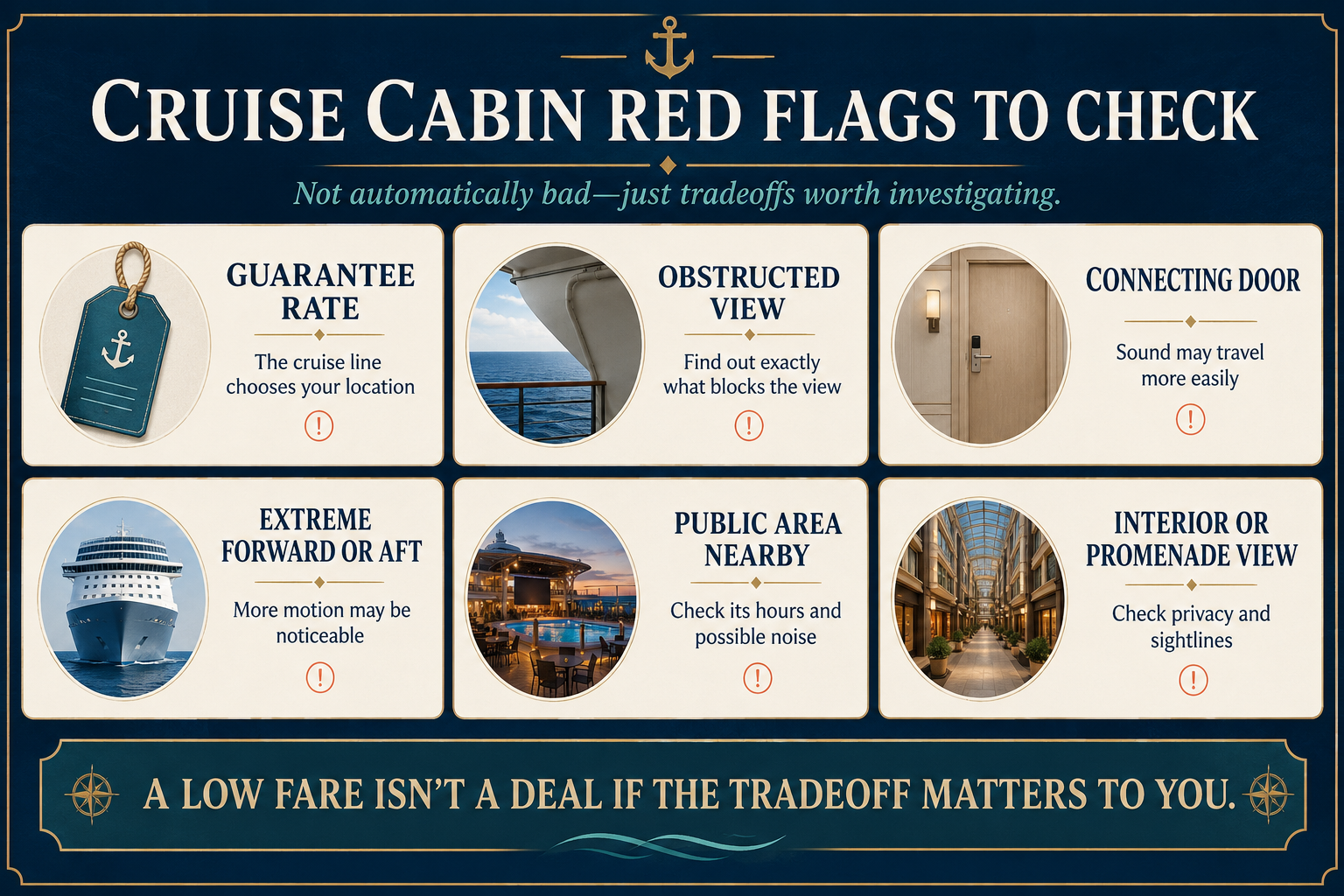
Investigate the Red Flags—Do Not Automatically Reject Them
Certain words and locations deserve a closer look before you commit.
Guarantee cabin
A guarantee fare usually means the cruise line chooses your specific room within an eligible category. It may save money, but you surrender control over location.
Royal Caribbean notes that guests booked in guarantee cabins may not be placed near other traveling parties and that assigned rooms can have obstructed views. Other cruise lines have their own rules. Review the exact terms before booking. Royal Caribbean: Guarantee Stateroom FAQ
A guarantee cabin is best treated as a trade: you receive a lower or promotional fare in exchange for accepting the cabin the cruise line assigns.
Do not choose this option if proximity to family, accessibility, bedding configuration or a particular location is essential.
Obstructed view
“Obstructed” can mean anything from a minor structural element to a lifeboat occupying much of the view.
Look for photographs, category diagrams and the specific degree of obstruction. If the price is right and your priority is natural light rather than a perfect view, an obstructed cabin can represent good value.
Connecting door
A connecting door is valuable for families but may allow additional sound to pass between rooms. Confirm whether the rooms are truly connecting or merely adjacent.
Extreme forward or aft location
Forward and aft cabins may provide distinctive views or lower prices, but motion, vibration, wind and walking distance can be more noticeable.
Nearby public area
Check both the type of venue and its operating hours. A café closing early creates a different environment than a nightclub operating well past midnight.
Interior-facing view
Promenade and neighborhood-facing cabins can be entertaining and may cost less than traditional ocean-facing rooms. Check privacy, lighting and whether passengers in public areas or opposite cabins can see inside.
Ocean and River Cruise Cabins Require Different Thinking
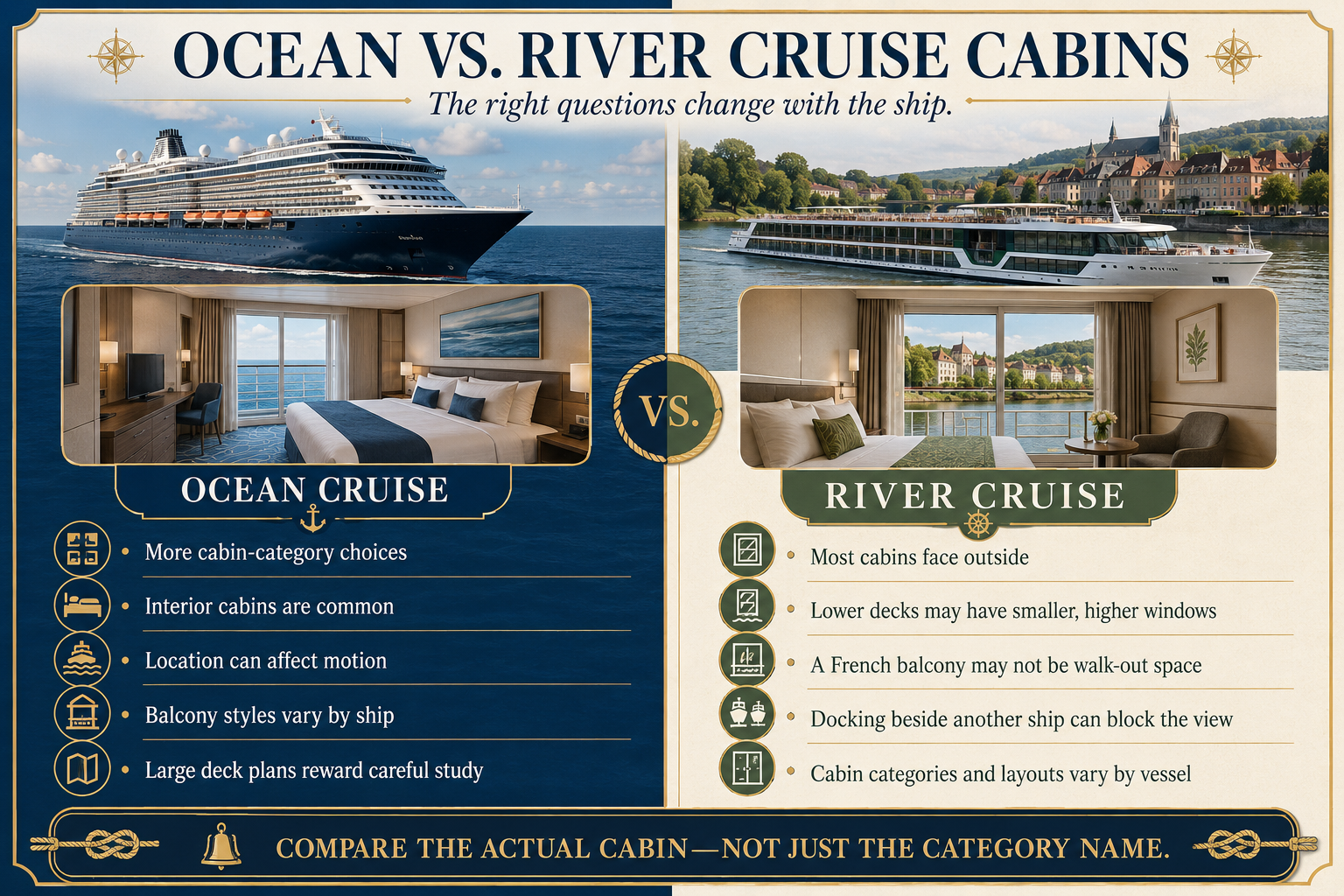
A river ship is not simply a smaller ocean ship. Its dimensions, public spaces and relationship to the shore change how you should evaluate a cabin.
Most river-cruise cabins face outside, but the size and style of the window can depend on the deck. Lower-deck rooms may have smaller windows positioned higher on the wall.
A French balcony also may not be a walk-out balcony. Viking, for example, describes French-balcony rooms on several Longships as having a floor-to-ceiling sliding glass door. That provides light, air and an open view, but not necessarily an outdoor platform where you can place chairs. Viking: Longship Stateroom Example
River ships may also dock directly beside one another. Your beautiful river view can temporarily become a close view of another ship. Curtains are useful.
Why our lower-deck Viking cabin worked
On our Viking river cruise, Gina and I selected a lower-deck cabin without a verandah. It was approximately half the price of a verandah room booked by people we met onboard.
They told us they hardly used their verandah.
We did not feel deprived. The ship offered plenty of topside space for fresh air and scenery, and we spent our days ashore or in the public areas. We traveled the same river, ate the same meals and joined the same excursions.
For us, the lower-priced cabin was the upgrade because it preserved money without meaningfully reducing the experience.
That choice will not suit everyone. A traveler who enjoys private outdoor time every morning might reach the opposite conclusion. The point is to pay for the experience you will use.
Families Should Compare One Cabin With Two
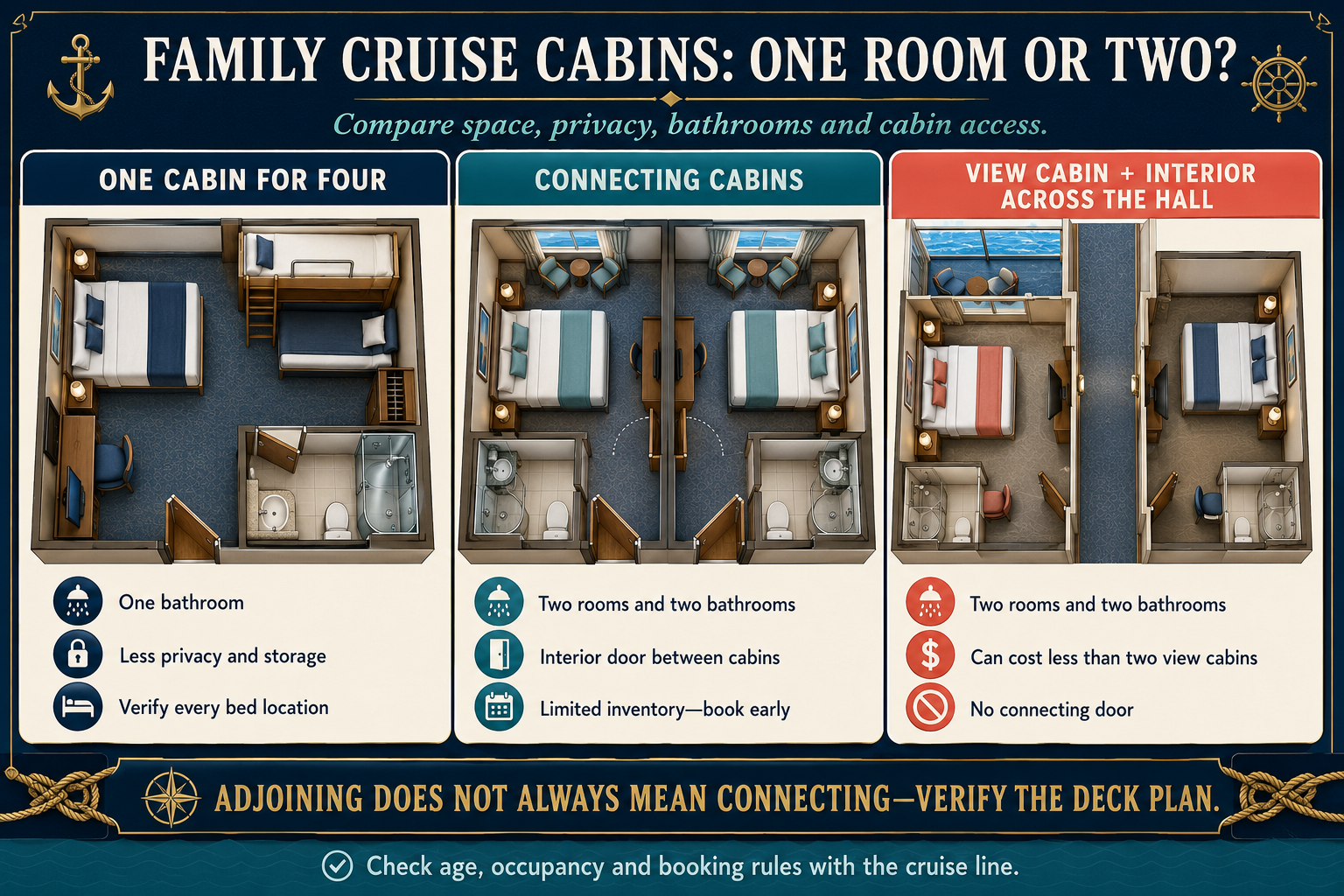
A cabin advertised for three, four or even five passengers may technically accommodate everyone. That does not mean everyone will be comfortable.
MSC, for example, advertises family configurations involving multiple connecting cabins, each with its own bathroom, on selected ships. Availability and configurations vary. MSC Cruises: Stateroom FAQ
Our family has tried several arrangements.
Three people in one oceanview cabin
Gina and I once shared an oceanview cabin with our teenage son.
Three people technically fit, but “fits” and “works comfortably” are not the same thing.
Privacy disappeared quickly, the bathroom became a bottleneck and—let’s be honest—teenage boys do not always improve the air quality in a small cabin. The window was welcome, but it did not create more usable space.
That experience taught me that maximum occupancy is not the same as comfortable occupancy.
Two connecting cabins on Royal Caribbean
On a later Royal Caribbean cruise, Gina and I stayed in one cabin while our teenage son and twenty-something daughter shared the connecting room.
The difference was enormous.
Everyone had more privacy. The kids could come and go without passing through our space, but the interior door kept the family connected when we wanted it. When the kids were elsewhere on the ship, Gina and I effectively had convenient access to two bathrooms.
Connecting cabins provide something beyond square footage: flexibility. The family can be together without everyone being underfoot.
Nearby cabins on MSC
On an MSC cruise, Gina and I booked an oceanview cabin while the kids stayed in an interior room across the corridor and a little farther down. My dad joined us in a solo cabin that did not carry a single supplement for that sailing.
We gave up the convenience of a connecting door, but gained privacy and independence.
The kids had enough autonomy to enjoy the ship without being directly underfoot, yet they remained nearby. Gina and I had our own space, and my dad could join a multigenerational trip without paying the usual double-occupancy premium.
This arrangement can work particularly well with older teenagers and adult children. Families with younger children need to examine cruise-line age and occupancy rules carefully. Depending on the line, passenger ages and cabin locations, an adult may need to be officially booked in each room.
Also remember that adjoining or adjacent does not necessarily mean connecting. Verify the deck plan and confirm the presence of an interior door.
Consider Solo and Accessible Cabins Early
Solo cabins can help individual travelers avoid paying a fare based on double occupancy, but they are not available on every ship or sailing. Compare the solo fare with the complete price of a standard cabin because promotions can change the calculation.
Accessible cabins should be selected according to actual functional needs. Features may include wider doorways, turning space, accessible bathrooms, lower fixtures and other modifications.
Royal Caribbean states that its accessible staterooms are intended for guests who need those features and describes accommodations such as turning space in sleeping, bathroom and sitting areas. Other lines have their own designs and request procedures. Royal Caribbean: Accessible Staterooms
Travelers needing an accessible room, medical equipment or a particular cabin configuration should reserve early and communicate directly with the cruise line or a knowledgeable travel advisor.
Decide Whether the Upgrade Changes the Room or the Trip
This is where I keep my wallet a little closer.
A slightly larger room, nicer décor or a more impressive category name usually will not persuade me by itself. There need to be perks thrown in—not merely sprinkled on.
We once booked a Royal Caribbean offer that included both Wi-Fi and a drink package. Those were benefits we could use throughout the cruise, not only while standing inside the room.
When comparing an upgrade, ask:
What is the total fare difference?
Are Wi-Fi, drinks, dining or onboard credit included?
Would you have purchased those benefits separately?
Do the perks cover everyone in the room?
Are gratuities or service charges added?
Does the upgrade improve the entire cruise or merely the cabin?
Will you lose a preferred location?
Are the terms refundable or changeable?
A cabin upgrade and a vacation upgrade are not always the same thing.
I will pay more when the upgrade changes the trip. I am much less interested when it only changes the room.
Understand Bids and Last-Minute Upgrade Opportunities
Some cruise lines offer post-booking bidding programs. Royal Caribbean’s RoyalUp program, for example, allows eligible passengers to submit offers for higher categories. Eligibility is not guaranteed, and an accepted upgrade may not provide control over the exact cabin location. Royal Caribbean: RoyalUp
Before bidding:
Compare the bid with the current retail upgrade price.
Check whether the charge is per person or per cabin.
Understand which passengers are included in the calculation.
Assume you may lose your carefully selected location.
Consider whether linked or nearby family cabins could be separated.
Verify whether the decision becomes final once accepted.
There is also one simple question worth asking at check-in:
Are any paid stateroom upgrades available?
The answer may be no. The employee may direct you to another desk or tell you that the ship is full. Asking still costs nothing.
As I often say:
If you don’t ask, the answer is always no.
Before accepting a last-minute offer, confirm the total price, exact location, included benefits, effect on other cabins in your party and whether the decision is final.
Use This Final Cabin Checklist
Before entering your payment information, confirm:
The cabin category
The exact cabin number or guarantee terms
Bed configuration and location of additional beds
Maximum occupancy and comfortable occupancy
Bathroom count
Window, balcony or obstruction details
Forward, midship or aft position
Deck number
What is directly above and below
Elevator, stairwell and service-area proximity
Connecting-door status
Accessibility features
Family age and occupancy rules
Included perks
Gratuities and additional charges
Cancellation and upgrade terms
Then ask the most important question:
Will I genuinely use what I am paying for?
The Best Cabin Is the One That Protects the Trip
There is no universally best cruise cabin.
The right choice may be a balcony for coffee during several days at sea. It may be two connecting cabins that restore privacy to a family vacation. It may be an oceanview room near an interior cabin for older children. It may be a solo room without a single supplement.
It may also be the least expensive interior cabin on the ship.
The stateroom is not the cruise. It is where I sleep, shower, change and recharge between the things I actually came aboard to enjoy.
Choose a cabin that performs that job well. Pay more when the added space, location or benefits will materially improve the trip.
Sometimes the room upgrade is worth every dollar.
Sometimes keeping the money is the upgrade.
Important Policy Note
Cabin categories, layouts, occupancy rules, accessible features, upgrade programs, guarantee terms, included benefits, fees and embarkation-day availability vary by cruise line, ship and sailing and can change without notice. Verify all details directly with the cruise line before booking or accepting an upgrade.
Information reviewed August 2026.