


JAL or ANA? Comparing Every Cabin on the Flight to Japan
Economy to First Class, the better choice may depend less on the airline and more on the aircraft and seat you actually book.
Japan Airlines or ANA?
That sounds like a simple question. Pick an airline, choose a flight and go to Japan.
Except it isn’t quite that simple.
Both are highly regarded Japanese airlines, and both offer everything from Economy seats to some truly extravagant First Class suites. But there can be significant differences not only between JAL and ANA, but between two airplanes operated by the same airline.
A Boeing 787 may offer a different experience from an Airbus A350-1000. One version of a 787 may be different from another. And an airline’s newest Business Class seat might only be installed on certain aircraft.
So before asking whether JAL or ANA is better, ask a more useful question:
Which airline, on which aircraft, in which cabin, gives me the better experience for this particular trip?
That’s where things get interesting.
First, Check the Aircraft
This may be the single most important lesson in the entire comparison.
A ticket that says Business Class tells you the cabin you purchased. It does not necessarily tell you what seat you'll be sitting in.
JAL's newest flagship is the Airbus A350-1000, with completely redesigned cabins from Economy through First Class. ANA, meanwhile, offers several different Business Class products depending on aircraft, including THE Room and the newer THE Room FX.
The same principle applies farther back in the airplane.
Before booking an expensive long-haul flight, write down three things:
Airline. Aircraft. Seat product.
Then look at the seat map.
Better yet, take a screenshot. Aircraft substitutions happen, but at least you'll know exactly what you intended to buy.
Economy: Sometimes One Seat Across Makes a Big Difference
Here is one of the most interesting apples-to-apples comparisons in the entire article.
Boeing 787 versus Boeing 787.
On JAL's SKY SUITE international 787s, Economy was deliberately configured 2-4-2 rather than the 3-3-3 layout commonly found on the Dreamliner. JAL's SKY WIDER II seats were introduced at about 19 inches wide with approximately 33 inches of pitch.
That 2-4-2 configuration can be particularly attractive when two people are traveling together.
Choose a pair along the window and one person gets the window while the other gets the aisle.
No middle seat.
No climbing over a stranger.
And no stranger climbing over you.
ANA's 787 Economy cabins generally use the more conventional 3-3-3 arrangement, although the exact seat and pitch depend on the aircraft configuration.
Neither approach automatically makes one airline better. A traveler who prioritizes legroom might reach a different conclusion than a couple who places a premium on having their own two-seat pair.
But that's exactly the point.
Curated Upgrade Question
On a 12-hour flight, how much would you pay to turn 3-3-3 into 2-4-2?
For some travelers, the answer may be nothing.
For two people traveling together, that missing middle seat could be one of the most meaningful upgrades available in Economy.
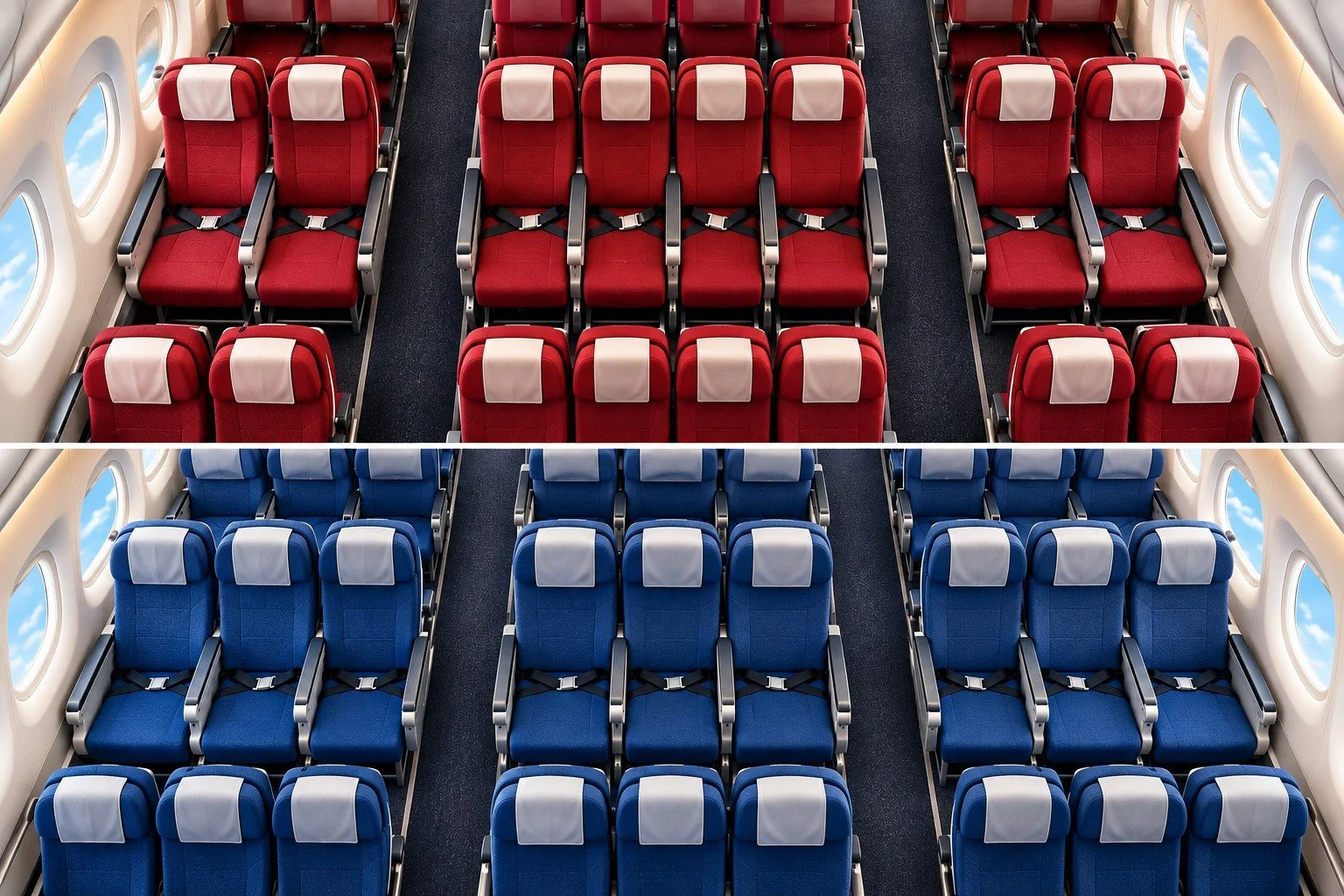
Same aircraft type, different philosophy: JAL's SKY SUITE 787 Economy uses 2-4-2 seating, while ANA's 787 Economy commonly uses 3-3-3.
One important warning: don't turn this into “JAL always has 2-4-2 Economy.”
It doesn't.
JAL's newer A350-1000 Economy cabin is 3-3-3, with 155 Economy seats, approximately 18.1-inch seat width and roughly 33 to 34 inches of pitch.
Once again:
Check the aircraft.
Premium Economy: This Is Where Things Get Interesting
Premium Economy is sometimes marketed as if it's simply Economy with a few extra inches.
On a long flight to Japan, those inches matter. But there is more to compare than a tape measure.
The JAL A350-1000 Premium Economy seat is arranged 2-4-2, with 24 seats, approximately 42 inches of pitch and roughly 19 inches of width.
But its most interesting feature may be what happens when you recline.
The seat reclines within its own space rather than tilting backward into the passenger behind it. JAL also provides powered recline and a powered legrest.
ANA's Premium Economy product varies by aircraft. Some ANA 787-9 configurations offer about 38 inches of pitch and 19.3 inches of width, while ANA's newer 206-seat 787-9 increases pitch to approximately 40 inches and increases the recline range as well.
So this isn't simply:
42 inches beats 38 inches.
The more interesting question is what happens to your personal space when the person in front of you reclines.
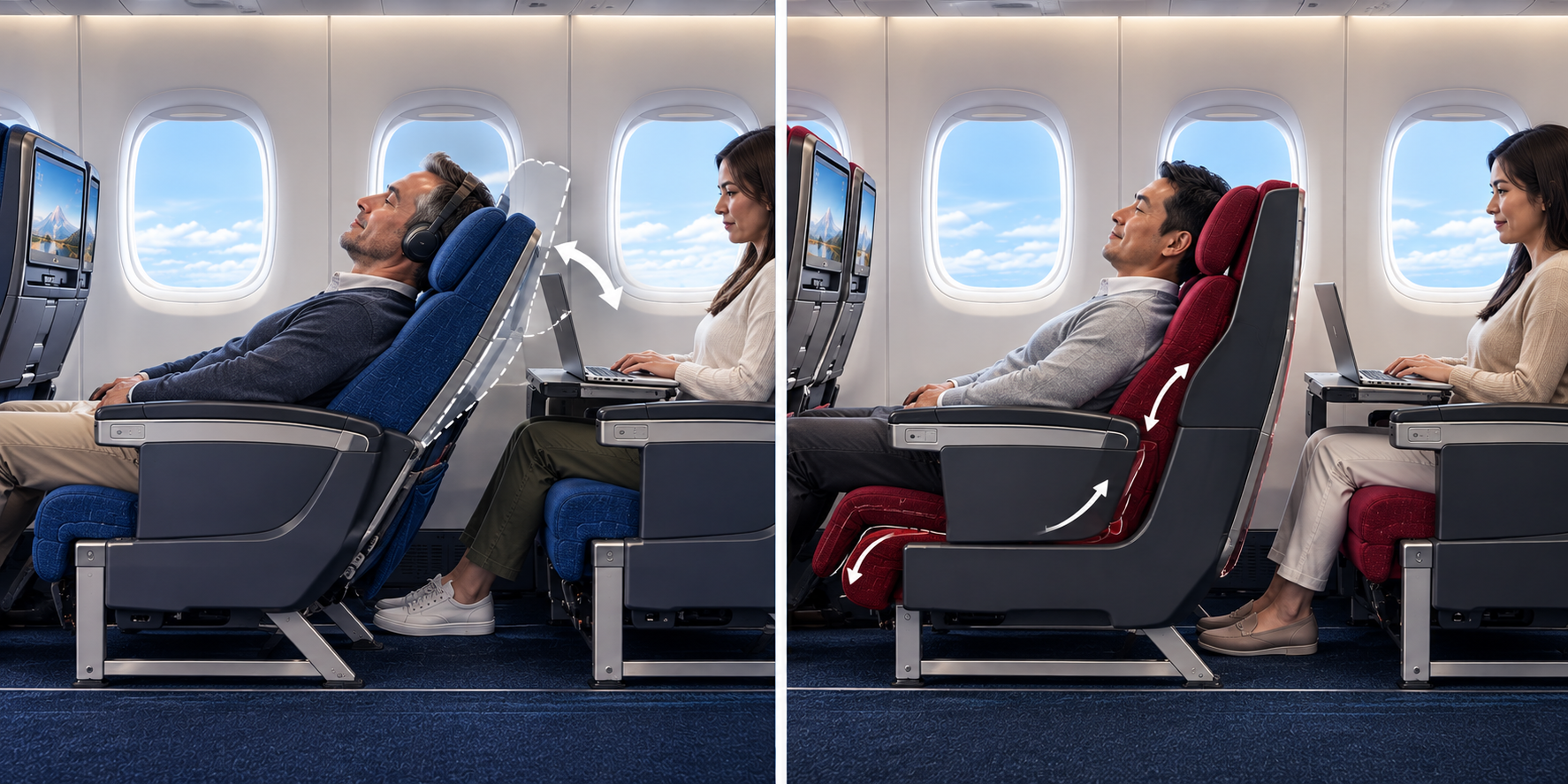
If you plan to work on a laptop, eat slowly, or simply dislike having the seat in front of you migrate toward your face somewhere over the Pacific, that's worth considering.
Business Class: THE Room vs. JAL's New Suite
Now we've entered a very different neighborhood.
ANA's THE Room on the newer 212-seat Boeing 777-300ER uses an unusual arrangement of alternating forward- and rear-facing seats. There are 64 Business Class seats, each with direct aisle access, a privacy door, a fully flat bed and a 24-inch 4K monitor.
The defining feature, though, is width.
THE Room feels less like a conventional airline seat and more like a small sofa inside a private compartment.
JAL took a different approach with its A350-1000 Business Class suite.
Its 54 suites are arranged 1-2-1, all with direct aisle access. Each has a privacy door, approximately 22 inches of seat width, a bed reaching roughly 78 inches, a 24-inch 4K screen, substantial storage and even a personal wardrobe. JAL also incorporated speakers into the headrest.
Premium Economy isn't only about legroom. Seat design can determine how much of your space remains yours when the passenger ahead reclines.
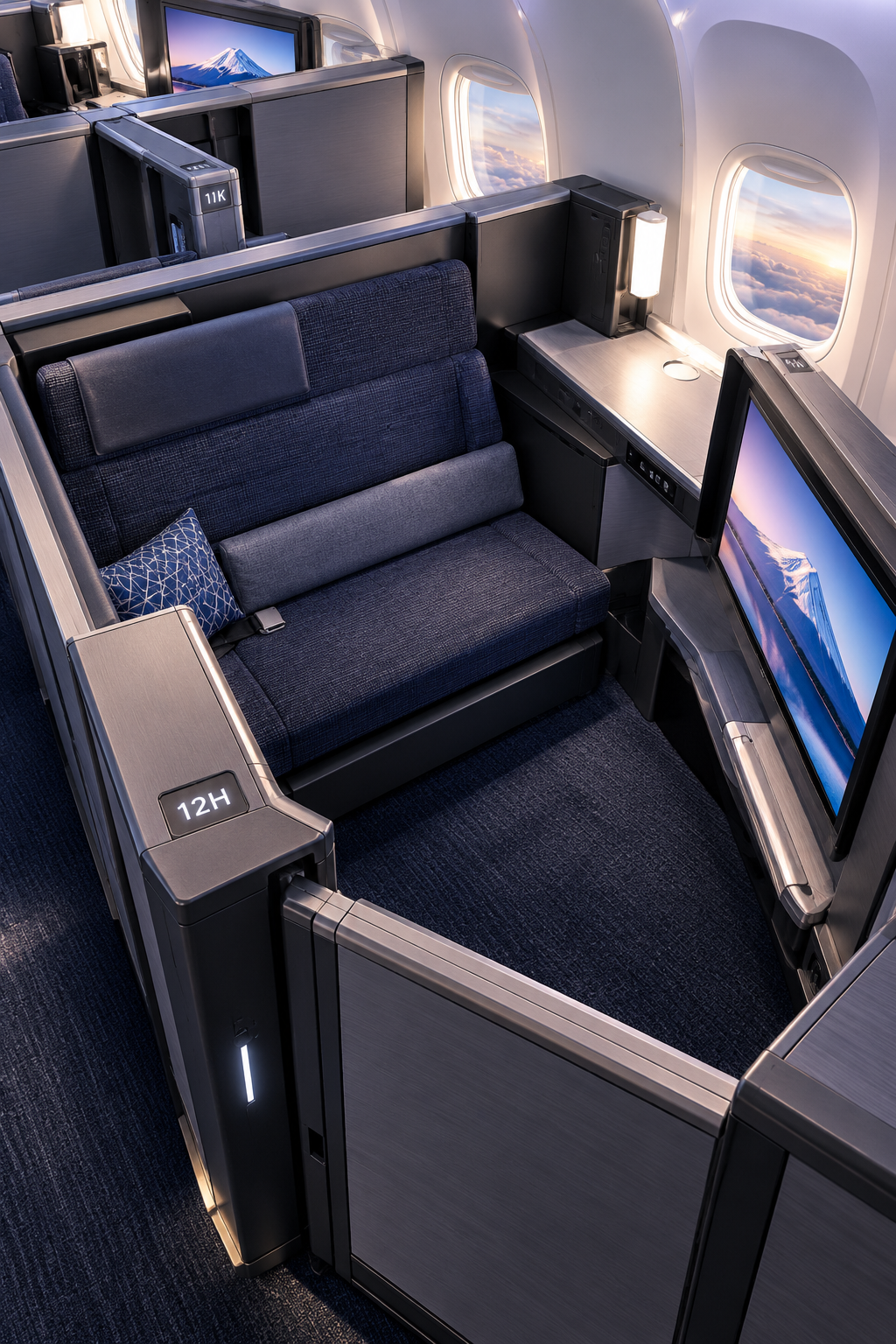
ANA THE Room • Boeing 777-300ER
Conceptual illustration based on the seat design.
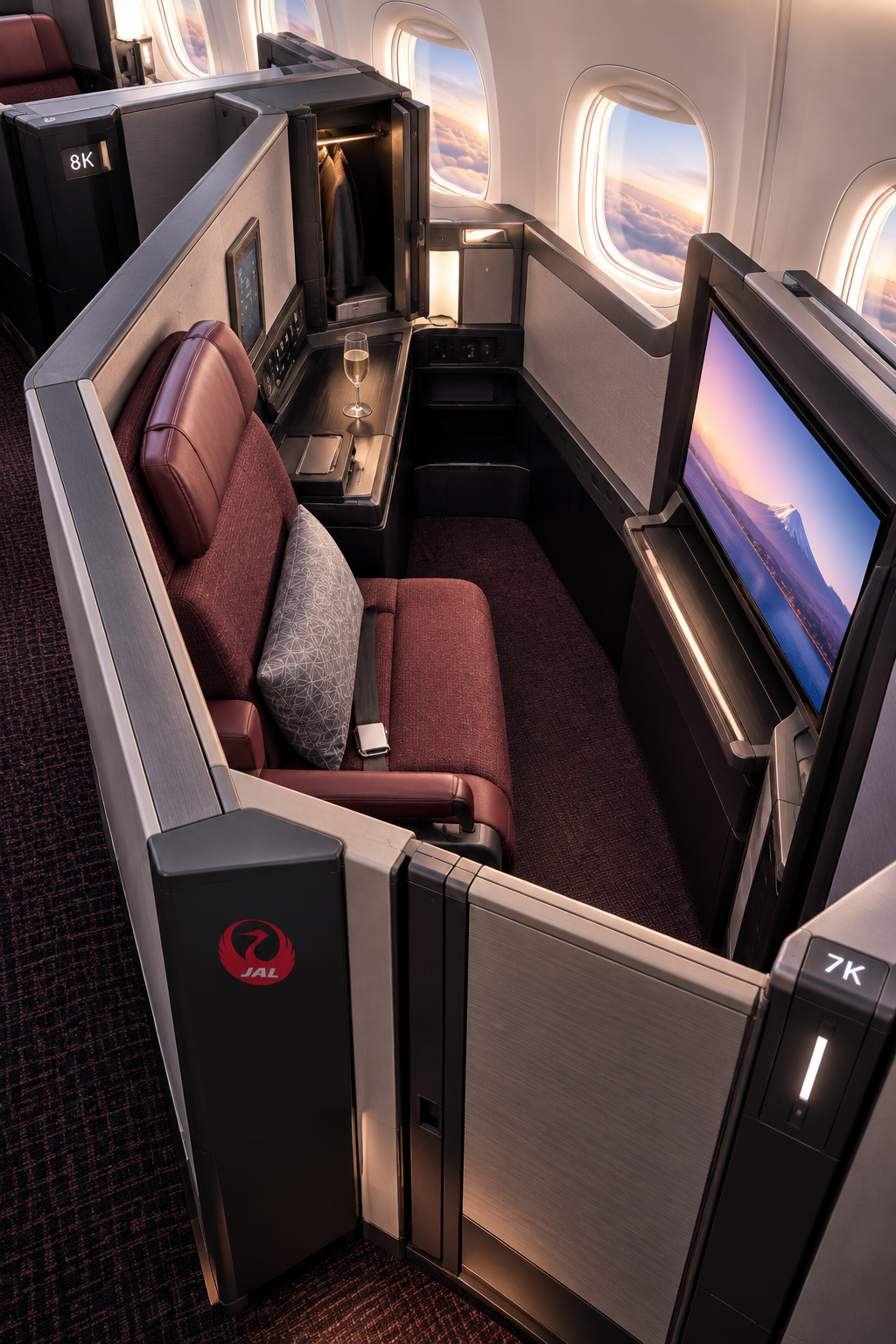
JAL Business Class • Airbus A350-1000
Conceptual illustration based on the seat design.
Which would I choose?
At this level, we're comparing various degrees of freaking awesome.
ANA emphasizes extraordinary width and a living-room feeling. JAL's A350-1000 offers a more forward-facing cocoon with excellent privacy and storage.
Schedule matters.
Price matters.
Award availability matters.
And if you're traveling with someone, the particular seats you can actually reserve matter.
This is not a situation where I'd add three hours to an itinerary merely because somebody on the internet declared one seat the winner.
First Class: When Business Class Isn't Ridiculous Enough
Then there's First Class.
The crème de la crème.
The cabin for travelers with mountains of disposable income, mountains of points, or perhaps a particularly compelling argument for why those points were accumulated in the first place.
JAL's A350-1000 First Class consists of only six suites in a 1-1-1 arrangement.
And “seat” is becoming an increasingly inadequate word.
The suite is approximately 48.4 inches wide, converts into different bed configurations with a maximum bed length of roughly 80 inches, and includes a 43-inch 4K screen, substantial storage, a personal wardrobe and a minibar.
ANA's THE Suite on its newer 212-seat 777-300ER is similarly rarefied territory. There are only eight First Class suites, each with a privacy door, fully flat bed, 43-inch 4K monitor, closet and substantial personal storage.
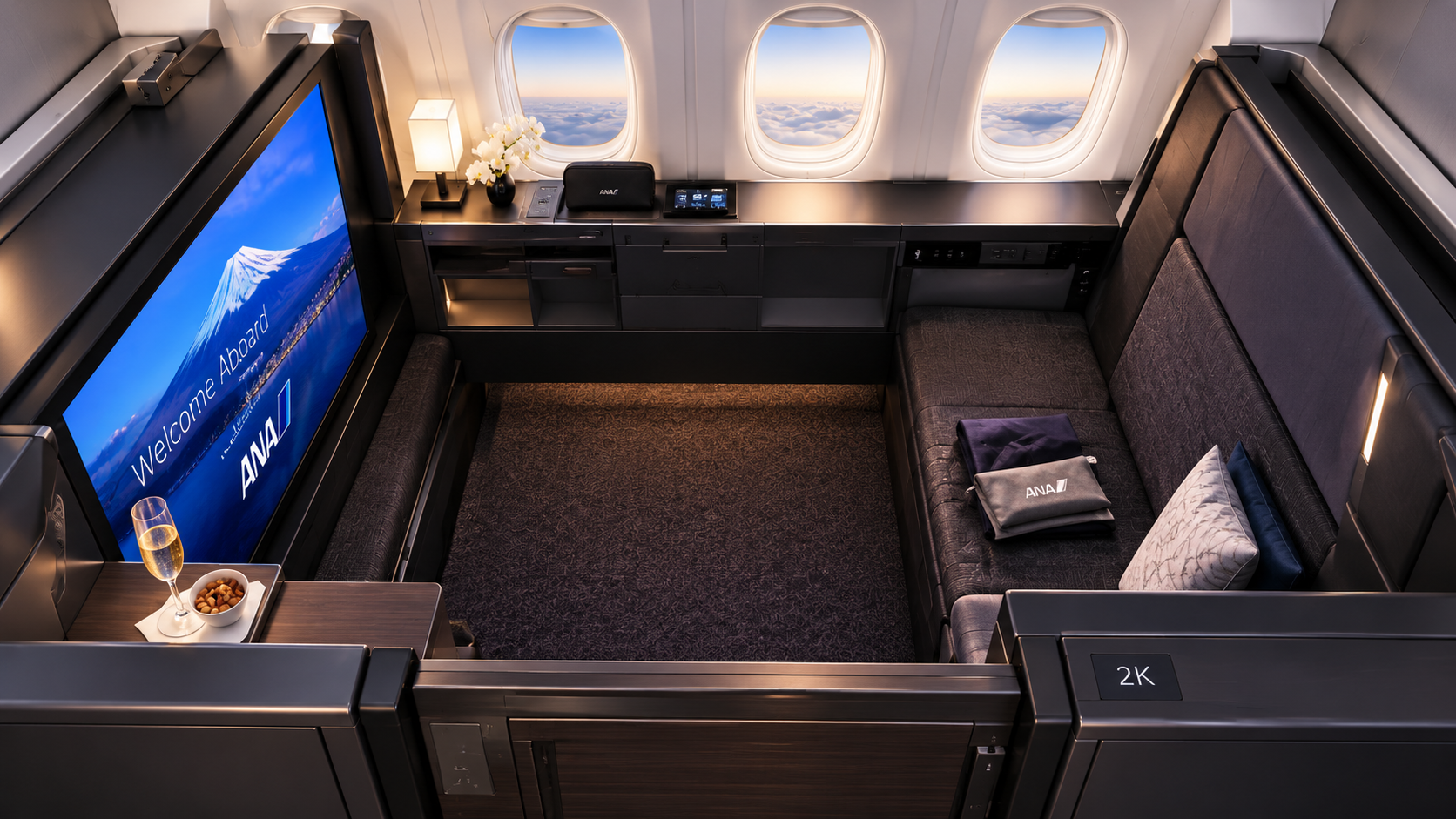
ANA THE Suite • Boeing 777-300ER First Class
Conceptual illustration based on the seat design.
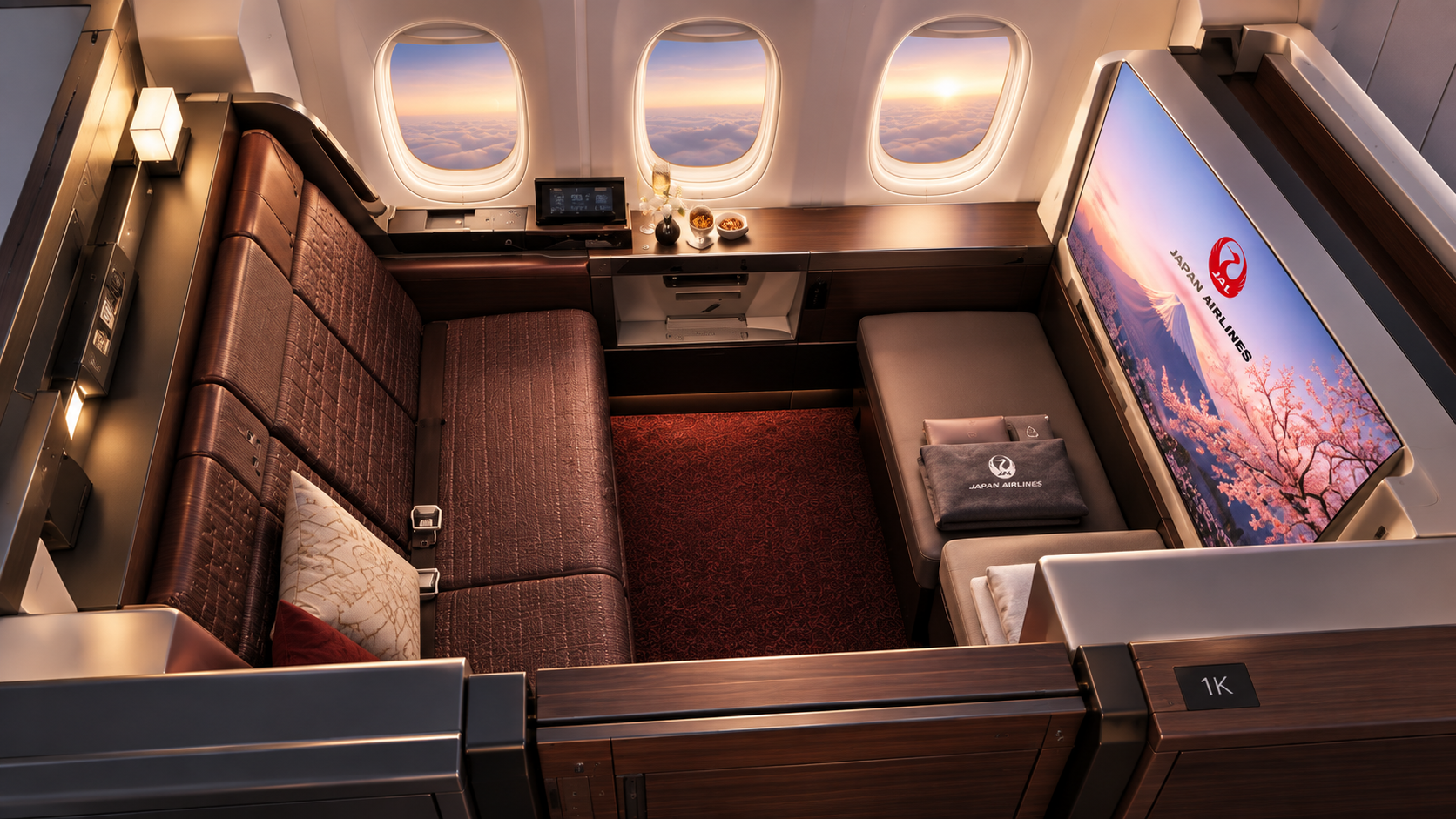
JAL First Class • Airbus A350-1000
Conceptual illustration based on the seat design.
At this point the question isn't whether First Class is “necessary.”
Of course it isn't.
Neither is a 43-inch television at 38,000 feet.
The better question is what it costs relative to Business Class, particularly when you're using miles.
Because sometimes the cash difference is absurd.
And sometimes the mileage difference creates one of those rare opportunities when something you'd never pay cash for becomes attainable.
Incidentally, despite all this airborne extravagance, neither JAL nor ANA gives you an onboard shower.
Eventually even First Class passengers must confront the indignity of an airplane lavatory.
Don't Forget the Ground Experience
Your seat isn't the entire premium-cabin experience.
Premium passengers may also receive priority check-in, priority boarding, additional baggage allowances and lounge access depending on the cabin, airport and itinerary.
That means the relevant question isn't simply:
Does this airline have a great lounge?
It's:
Which lounge will I actually use on my itinerary?
The answer can change depending on whether you're departing from the United States, connecting in Tokyo, or starting your trip in Japan.
I wouldn't choose a 12- or 14-hour flight based primarily on a lounge.
But if two options are otherwise close, the ground experience belongs in the comparison.
Then Bring Points Into the Conversation
This is where the entire exercise can change.
Points and miles can make a flight you would never purchase with cash suddenly worth considering.
But I wouldn't begin by asking:
Which flight costs the fewest miles?
I'd start with:
Which flights and seats would I actually like to experience?
Then see what the points can do.
For a concrete example, consider published one-way award requirements between New York and Japan for travel during March 2027.
ANA's published Regular Season North America-Japan award chart lists 25,000 miles for Economy, 36,000 for Premium Economy, 52,500 for Business and 85,000 for First Class. ANA publishes its seasonal international award charts here.
JAL's published New York-Japan base rates are 27,000 miles for Economy, 40,000 for Premium Economy and 55,000 for Business. JAL's March First Class requirement is 125,000 miles. For Economy through Business, JAL's Award Ticket PLUS system can require additional miles when seats aren't available at the base level; PLUS does not apply to First Class. JAL explains its international award requirements and Award Ticket PLUS here.
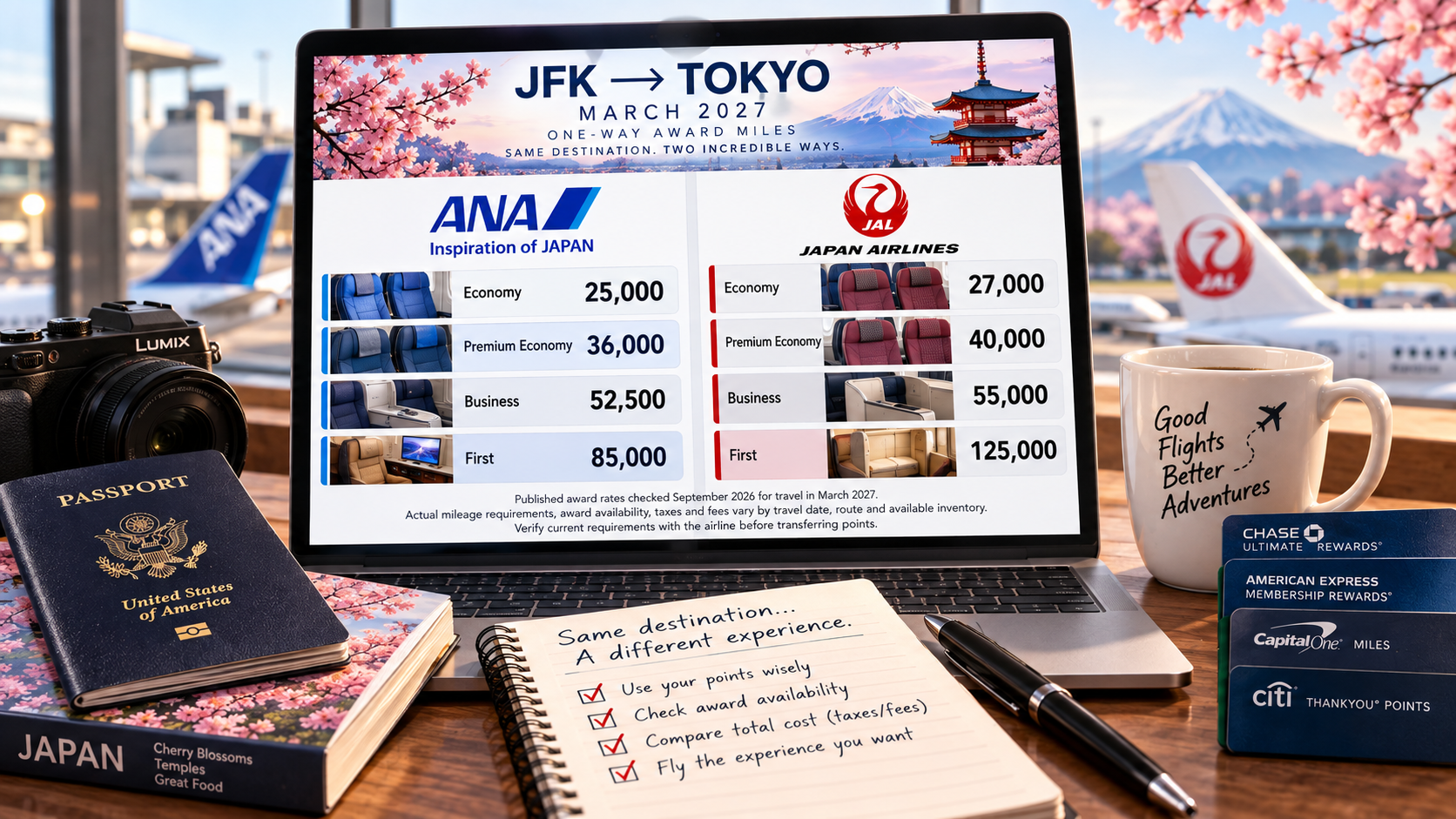
Published award rates checked September 2026 for March 2027 travel. Award availability, mileage requirements, taxes and fees can vary. Verify current requirements before transferring points.
And there's the Curated Upgrades question hiding in plain sight.
Suppose Business Class is already excellent.
How many more points would you spend to experience First Class once?
Or would you rather keep those points and use them toward another trip?
There isn't one correct answer.
That's what makes points interesting.
They don't merely reduce the cost of travel.
Used strategically, they can change what kind of travel becomes possible.
And one rule is worth putting in bold:
Never transfer flexible points until you've verified the award you want is actually available and you've confirmed the transfer rules.
Award space has an unfortunate habit of disappearing at precisely the moment you become emotionally attached to it.
So, JAL or ANA?
After comparing all four cabins, there still isn't a universal winner.
And that's a good thing.
For two people flying Economy on certain 787s, JAL's 2-4-2 layout could be enormously appealing.
In Premium Economy, JAL's A350-1000 fixed-back design deserves attention, while ANA's exact product varies by aircraft.
In Business, ANA THE Room and JAL's A350-1000 suite take different approaches to creating an exceptional private space.
And in First Class, we're well beyond transportation and firmly into experience territory.
The right answer depends on the trip in front of you.
So before booking:
Check the aircraft.
Check the seat.
Check the schedule.
Check the price.
Check the points.
Then decide whether the difference actually improves your trip.
Because the best upgrade isn't necessarily the airline name painted on the tail.
It's the part of the trip that gets meaningfully better for you.