


Map First, Book Second: Plan the Experience Before the Reservations
Before you choose a flight, hotel or package, decide what you actually want the trip to feel like.
It is easy to begin planning a trip with the first thing you can book.
You find an appealing airfare, reserve a hotel with points or commit to a package that looks like a good value. Then you begin building the vacation around that decision.
Sometimes that works perfectly.
Other times, the first reservation quietly dictates the entire trip. You add long drives, inconvenient stops or places you never particularly wanted to visit because you are now trying to make everything fit around something you already booked.
I prefer to begin somewhere else:
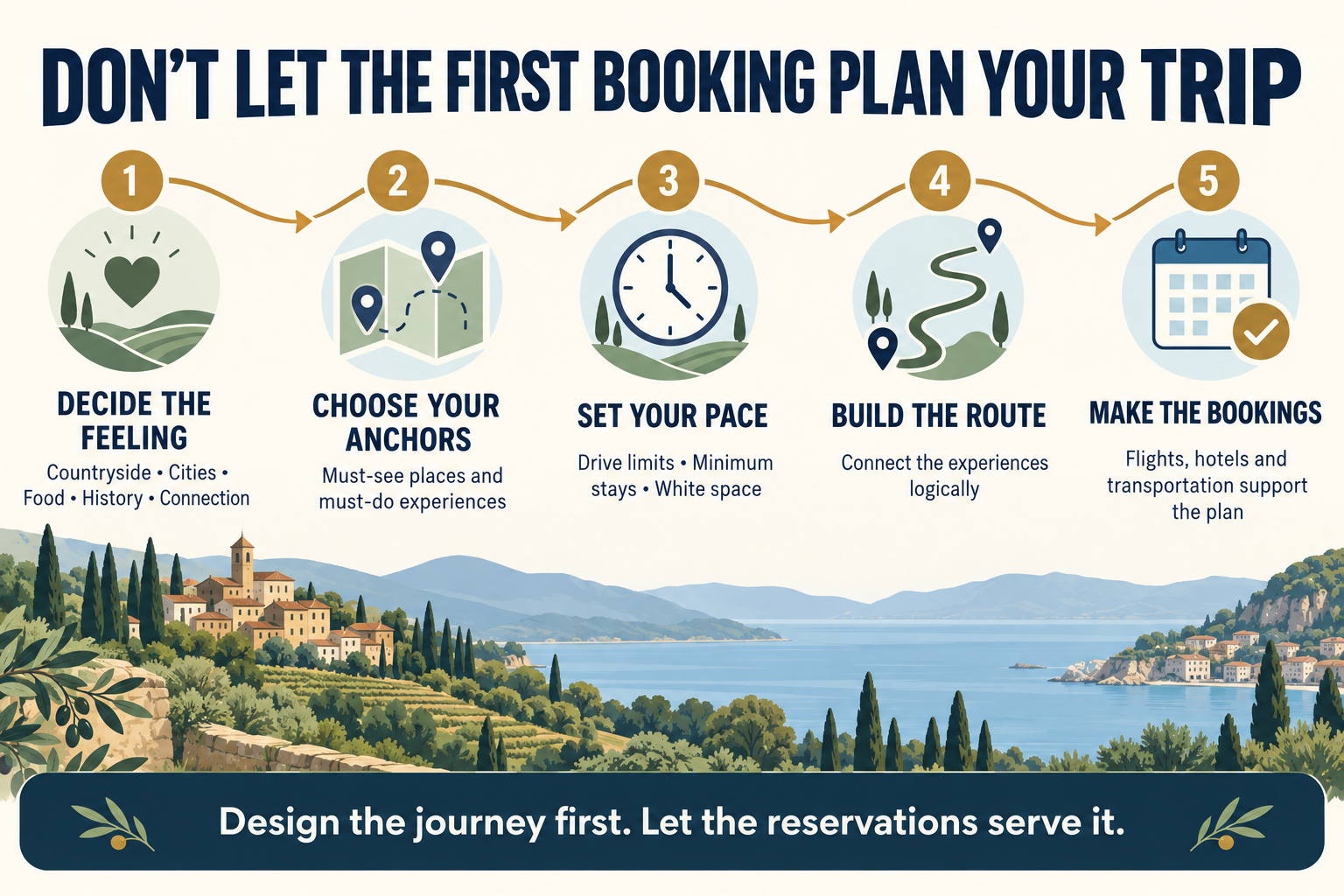
Decide what you want to experience first.
Map the journey around those priorities. Then book the flights, accommodations and transportation that support it.
Begin With the Experience, Not the Price
Before opening an airline website or searching for hotel availability, ask a few broader questions:
What do we want this trip to feel like?
What experiences would make it memorable?
How quickly do we want to travel?
Do we want cities, countryside or a mix?
How much time are we comfortable spending in transit?
Do we want a full itinerary or room to be spontaneous?
Which places or activities would we genuinely regret missing?
These answers create the framework for the trip.
A discounted hotel is not a bargain if it puts you far away from everything you want to experience. An inexpensive flight may not be worth it if the schedule costs you a meaningful day. A famous attraction does not belong on your itinerary simply because someone else says it is a must-see.
Design the journey first. Let the reservations serve it.
How We Used This Approach in Ireland
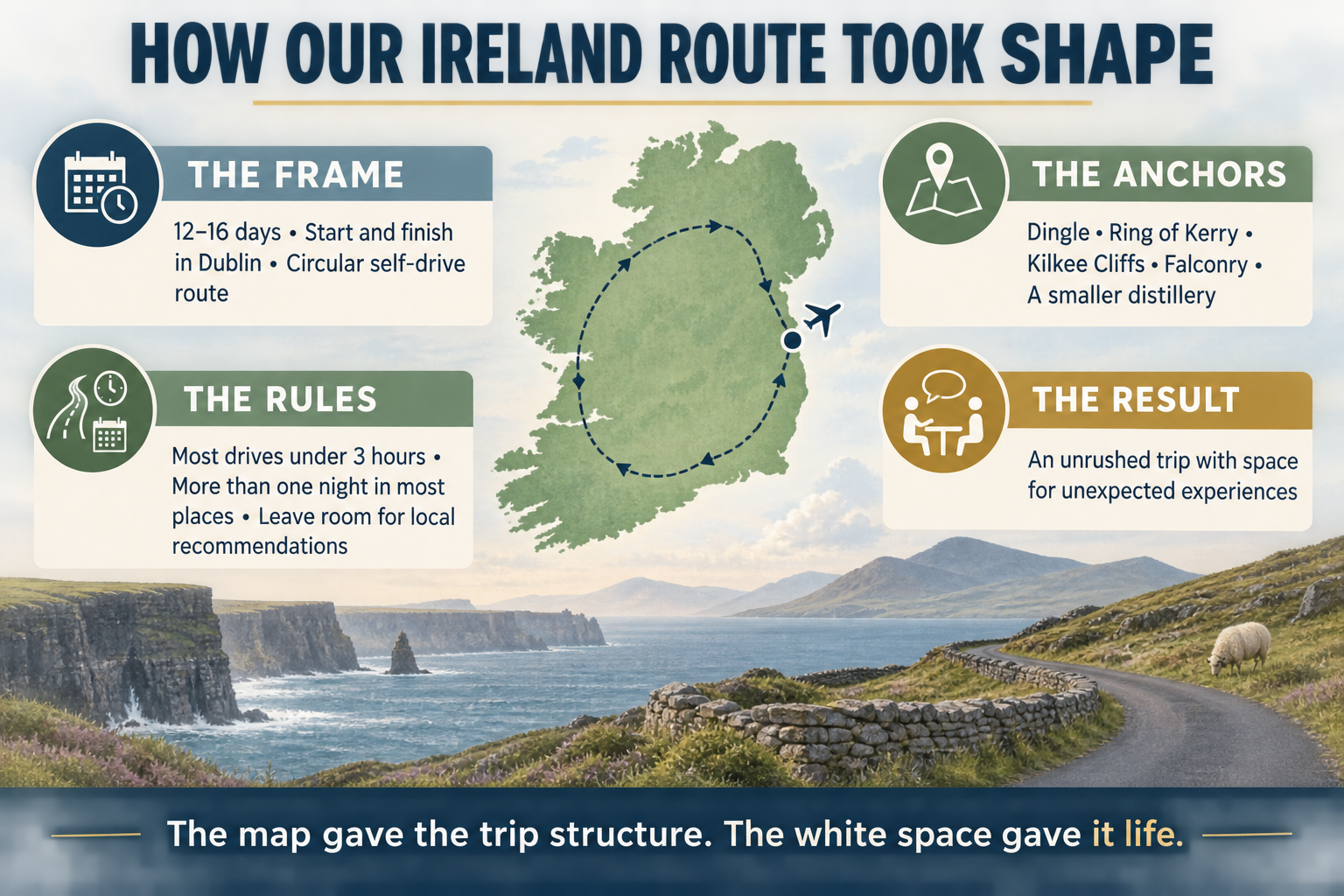
When we began planning our trip to Ireland, we had a rough timeframe of 12 to 16 days.
We knew we would most likely begin and end in Dublin, so we opened Google Maps and started exploring the possibility of a circular route.
We were not beginning from scratch. We had spoken with two different couples about their Ireland trips and talked with my uncle, who had also been. Their experiences gave us ideas and helped identify some potential highlights.
But we did not simply copy anyone else’s itinerary.
We knew Dingle, the Ring of Kerry and the Kilkee Cliffs were priorities. Those became our geographic anchors.
We also established two important rules:
We wanted most drives between overnight stops to remain under three hours.
We wanted to stay more than one night in most places.
Those rules mattered just as much as the destinations. We did not want to spend the trip constantly packing, checking out and racing to the next hotel.
We wanted Ireland to feel unrushed.
Add the Experiences You Want to Remember
Once we had our initial route, we began adding experiences.
Falconry was high on our list. We also wanted to visit a distillery, but we were more interested in something with history and personality than one of the most mainstream names.
That is how we came across Kilbeggan.
We liked its backstory, and it fit our developing route perfectly. It was not added because every Ireland itinerary told us we had to go there. It earned its place because it matched our interests without forcing the rest of the trip to bend around it.
A local barkeep in Dingle later spent time explaining the differences among several Irish whiskeys. That conversation reinforced our decision. Kilbeggan had been the right distillery for us.
That is the difference between collecting attractions and designing a trip.
A Recommendation Is Not an Obligation
Not every well-known attraction belonged on our map.
We skipped the Blarney Stone for several reasons. We were traveling not long after COVID, and kissing a rock that hundreds of other people had kissed did not seem especially wise. It also felt very touristy, was out of the way and held little personal appeal for us.
That does not mean the Blarney Stone is a bad attraction. It means it was not important to our trip.
We made a different decision with Limerick.
Someone else had told us how much they enjoyed staying there. We already knew cities were generally not our style, but we included it anyway.
The stay was fine. Nothing was particularly wrong with it. But the hotel experience felt impersonal compared with our other accommodations. We were simply another hotel-room guest, and the stay paled in comparison with the smaller and more personal places we enjoyed elsewhere.
That taught us something:
Just because someone says a place is great does not mean you have to include it when it is not your jam.
Recommendations are possibilities—not obligations.
You do you.
Filter Every Recommendation Through Your Own Trip
Advice from friends, relatives, guidebooks and travel websites can be incredibly useful. The key is filtering that advice through your own priorities.
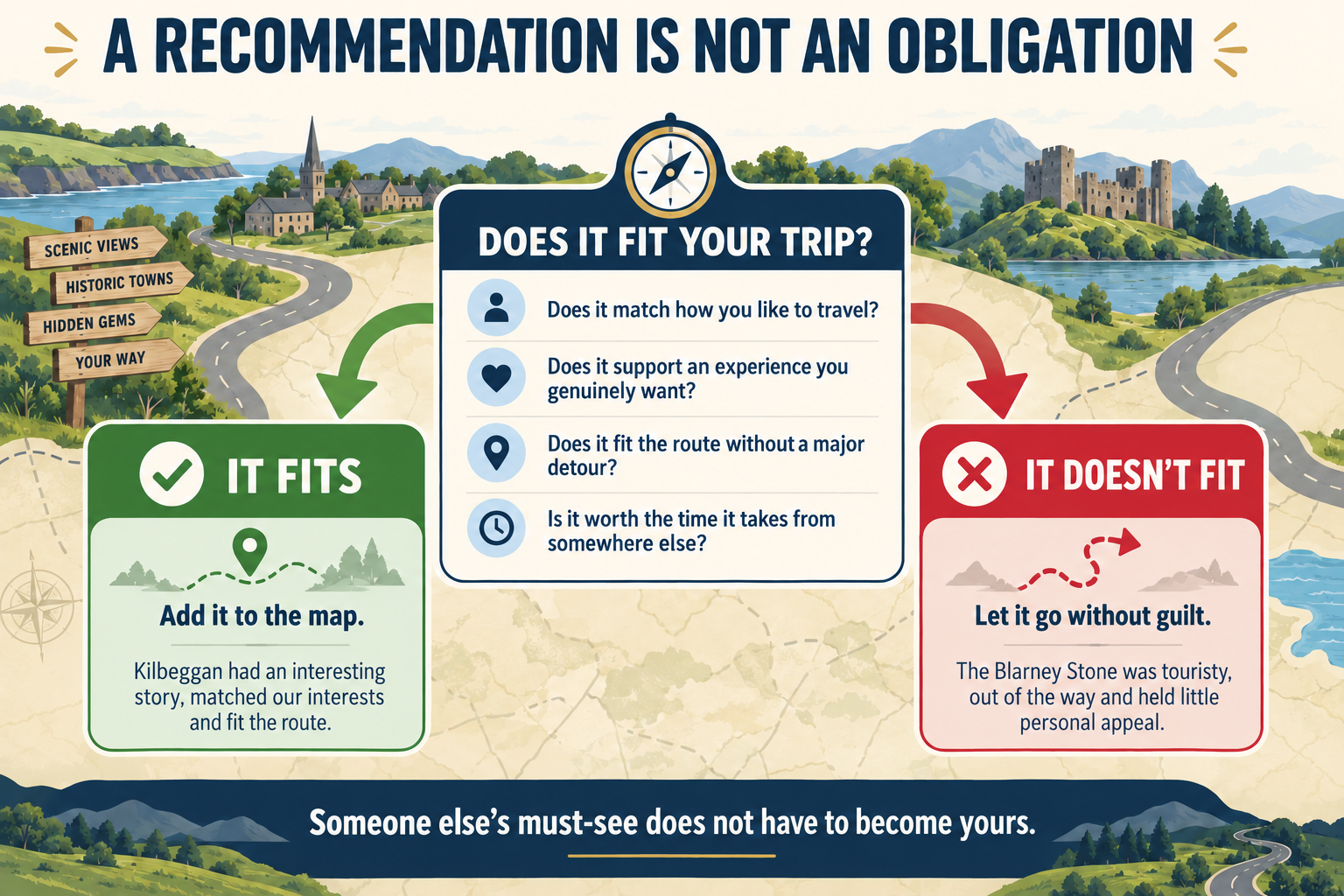
Before adding a recommendation, ask:
Does it match how we like to travel?
Does it support an experience we genuinely want?
Does it fit the route without creating a major detour?
Is it worth the time it will take away from somewhere else?
Are we interested in it—or do we simply feel that we are supposed to see it?
Kilbeggan passed that test.
The Blarney Stone did not.
Limerick probably would not have passed if we had been more honest with ourselves about the kind of stays we enjoy.
A trip becomes more personal when you stop treating every recommendation as an assignment.
Build White Space Into the Map
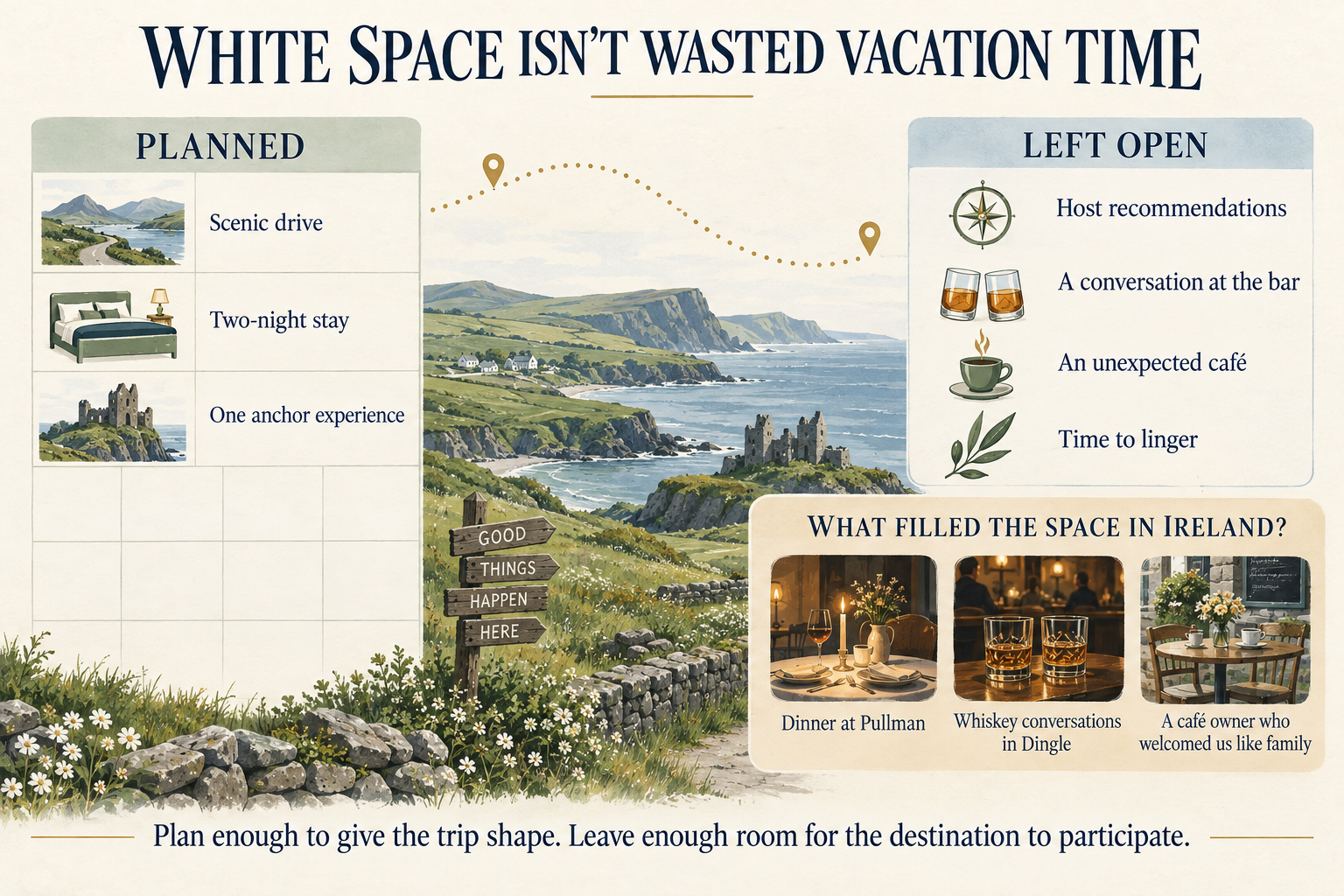
One of the best things we did was leave a lot of unscheduled room in the itinerary.
We had confirmed accommodations and anchor experiences, but we did not plan every meal, every stop or every hour.
That white space allowed us to listen to recommendations from the people who actually lived in the places we were visiting.
It is how we came to eat at Pullman.
It gave us time to talk with the barkeep in Dingle who explained Irish whiskey instead of simply pouring us a drink and moving on to the next customer.
At another stop, a café owner sat with us during lunch, welcomed us like family and included us in conversations with the other diners. It felt less like visiting a restaurant and more like joining a potluck dinner.
Those experiences could not have been reserved months in advance.
They happened because the itinerary had enough structure to keep the trip moving and enough flexibility to let Ireland participate.
White space is not wasted vacation time.
It is where some of the best travel memories happen.
Plan the Pace Before You Book the Hotels
A map also exposes problems that are easy to miss when accommodations are booked one at a time.
A hotel may look perfect until you realize it creates a five-hour drive after a one-night stay. A destination may seem close on a map, but the actual route may involve narrow roads, ferries or slower scenic driving.
Establishing your pace first helps determine:
How many bases you actually need
Where a one-night stop makes sense
Where two or three nights would be better
Whether an attraction fits naturally
Whether the route leaves time to enjoy the destination
Whether you are creating a vacation or an endurance test
Our preference was to keep most relocation drives under three hours and remain more than one night in most places.
Your limits may be different. The important thing is deciding them deliberately.
There is no prize for seeing the greatest number of places.
Let the Map Challenge Your Assumptions
Mapping a trip is not just about drawing lines between destinations. It helps you test whether the journey you are imagining actually works.
You may discover that:
A famous stop requires a significant detour
Two attractions are close enough to share one base
An open-jaw flight eliminates unnecessary backtracking
One longer trip works better than two shorter international trips
A highly recommended city does not fit your travel style
An overlooked village creates the perfect overnight stop
A slower route produces a better vacation
The map gives your ideas a reality check before nonrefundable reservations make them harder to change.
Some Trips Belong on the Shelf
Starting with the experience does not mean every dream trip should be booked immediately.
Cherry blossoms in Japan remain an experience we would love to have. But the most likely timing has not always worked with school schedules and the other realities of our lives.
So that trip stays on the shelf for now.
That is not abandoning the idea. It is recognizing that a destination and the experience you want there may require the right season, the right amount of time and the right moment in life.
A good trip idea does not become bad simply because it is not right for this year.
Sometimes planning well means saving the experience for your future self.
Our Map-First Planning Process
Here is the basic process we now use:
1. Decide what you want the trip to feel like
Relaxed or energetic? Rural or urban? Structured or spontaneous? Comfortable or adventurous?
2. Choose your anchor experiences
Identify the places and activities you would genuinely regret missing.
3. Establish your pace
Set limits for driving time, consecutive one-night stays and how much scheduled activity feels comfortable.
4. Put the anchors on a map
Look at their actual locations and begin identifying a logical direction of travel.
5. Add experience-based stops
Look for distilleries, falconry, restaurants, scenic drives, historic sites or other experiences that support the trip you want.
6. Remove what does not fit
Skip stops that require excessive detours, duplicate another experience or appeal more to someone else than to you.
7. Protect some white space
Leave room for local recommendations, unexpected discoveries and days when you simply want to linger.
8. Choose the transportation
Decide whether the journey works best as a round trip, open-jaw itinerary, road trip, rail journey or combination.
9. Make the reservations
Book the flights, vehicle and accommodations only after you understand the journey they need to support.
My Curated Verdict
🟢 Go for it
Build the trip around the experiences, places and pace that matter most to you.
Use recommendations for inspiration, map the route and make reservations that support the journey you designed.
🟡 Evaluate it
Pause when a great airfare, hotel redemption, package or recommendation begins dictating the rest of the trip.
It may still be worthwhile, but examine the driving time, location, tradeoffs and effect on the overall experience before committing.
🔴 Skip it
Leave out stops that are out of the way, too rushed, overly touristy for your taste or included only because someone else called them a must-see.
A famous attraction that does not interest you is not a missed opportunity.
The Bottom Line
Travel planning should not begin with filling in reservation confirmations.
It should begin with deciding what you want to experience.
Our Ireland itinerary worked because we identified our anchors, established a comfortable pace and built a circular route around them. The map gave the trip structure. The white space gave it life.
Not every choice was perfect. Limerick reminded us to trust our own travel style. Kilbeggan showed what happens when an experience fits both your interests and your route. The unplanned conversations reminded us why an itinerary should never be packed too tightly.
Start with the feeling.
Choose the experiences.
Build the route.
Then make the bookings.
Design the journey first. Let the reservations serve it.