

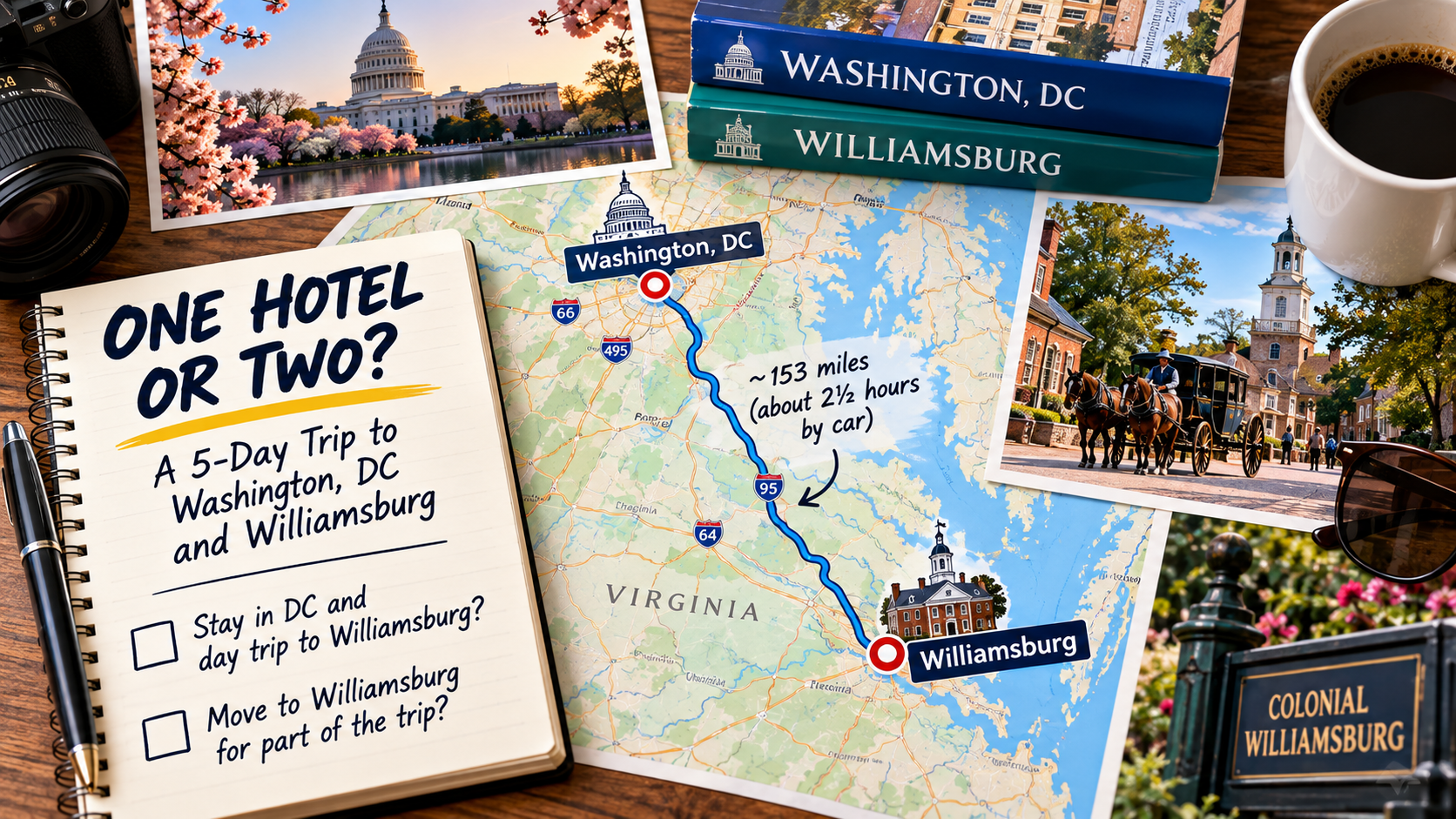
One Hotel or Two? When Moving Hotels Is Worth the Hassle
Staying put is easier. Moving can save hours of backtracking. Before you decide, look at what actually happens to your vacation day.
One of the most common itinerary questions sounds simple:
Should we stay in one hotel and take day trips, or move hotels as we travel?
Ask ten travelers and you'll probably get eleven answers.
Some people would rather drive an extra two hours than pack a suitcase again. Others start getting restless after three nights in the same place. Neither is wrong.
The better question isn't what someone else would do.
It's what each choice does to your time.
A Five-Day Trip: Washington, DC and Williamsburg
Let's give ourselves a real example.
Washington, DC and Williamsburg, Virginia are about 153 miles apart by road. Under typical traffic conditions, that's roughly a 2½-hour drive each way. Travelmath
Suppose you have five days in the area and want to visit both.
You could stay in Washington for the entire trip and make Williamsburg a day trip. Or you could spend part of the trip in Washington, check out and relocate to Williamsburg.
Neither option automatically wins.
But they create very different days.
Stay Put and Make Williamsburg a Day Trip
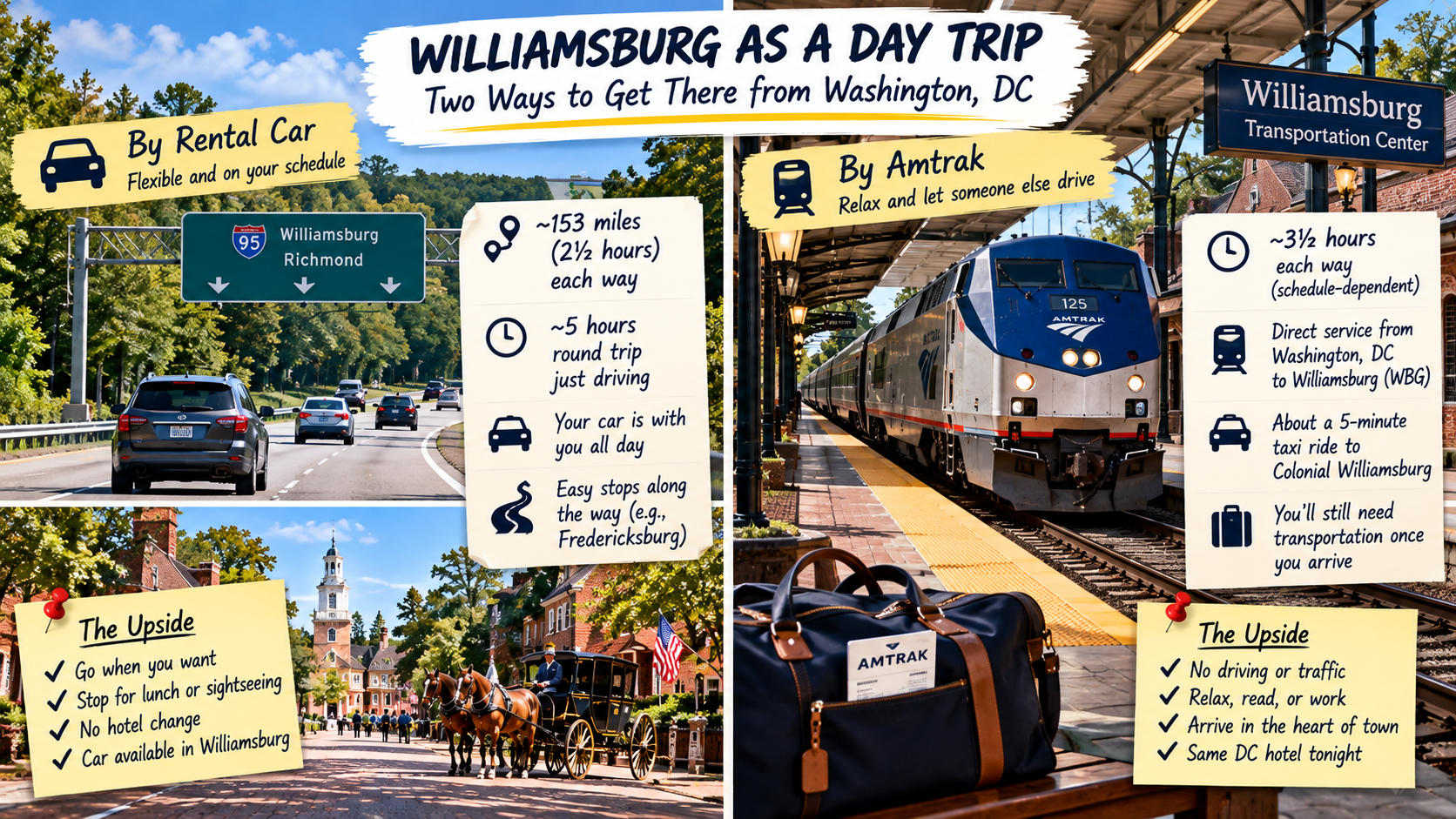
If you're driving, Williamsburg means roughly five hours in the car round trip before allowing for traffic.
That's a substantial chunk of a vacation day. But when the sightseeing is finished, you return to the same hotel. No packing. No checkout. No new room. Your luggage never moves.
Rail changes the equation, but not necessarily in the way you might expect.
Amtrak's Northeast Regional serves Williamsburg directly from Washington. Current schedules put the trip at roughly 3½ hours each way, depending on the train.
That's longer than the typical drive, but those hours aren't equivalent. One has you driving I-95. The other lets someone else do the driving while you read, work, nap or stare out the window.
And then there's what happens when you arrive.
Amtrak's Williamsburg station is downtown, and Amtrak says Colonial Williamsburg is about a five-minute taxi ride away. But the station isn't necessarily the last place you'll want to visit that day.
How are you getting to lunch? Another attraction? Somewhere farther outside the historic area? Back to the station?
The train may solve A to B beautifully. You still need to think about B to C, D and E.
Or Move to Williamsburg
Now change one thing.
Instead of returning to Washington that evening, check out and move to Williamsburg.
You've eliminated the return journey. You're also waking up in Williamsburg the following morning instead of starting another travel day from Washington.
That sounds pretty compelling.
Except moving hotels isn't just the time spent traveling between them.
You have to pack. Check out. Move your luggage. Travel. Check in. Unpack again.
And there's a little piece of hotel math that often gets ignored when people build an itinerary:
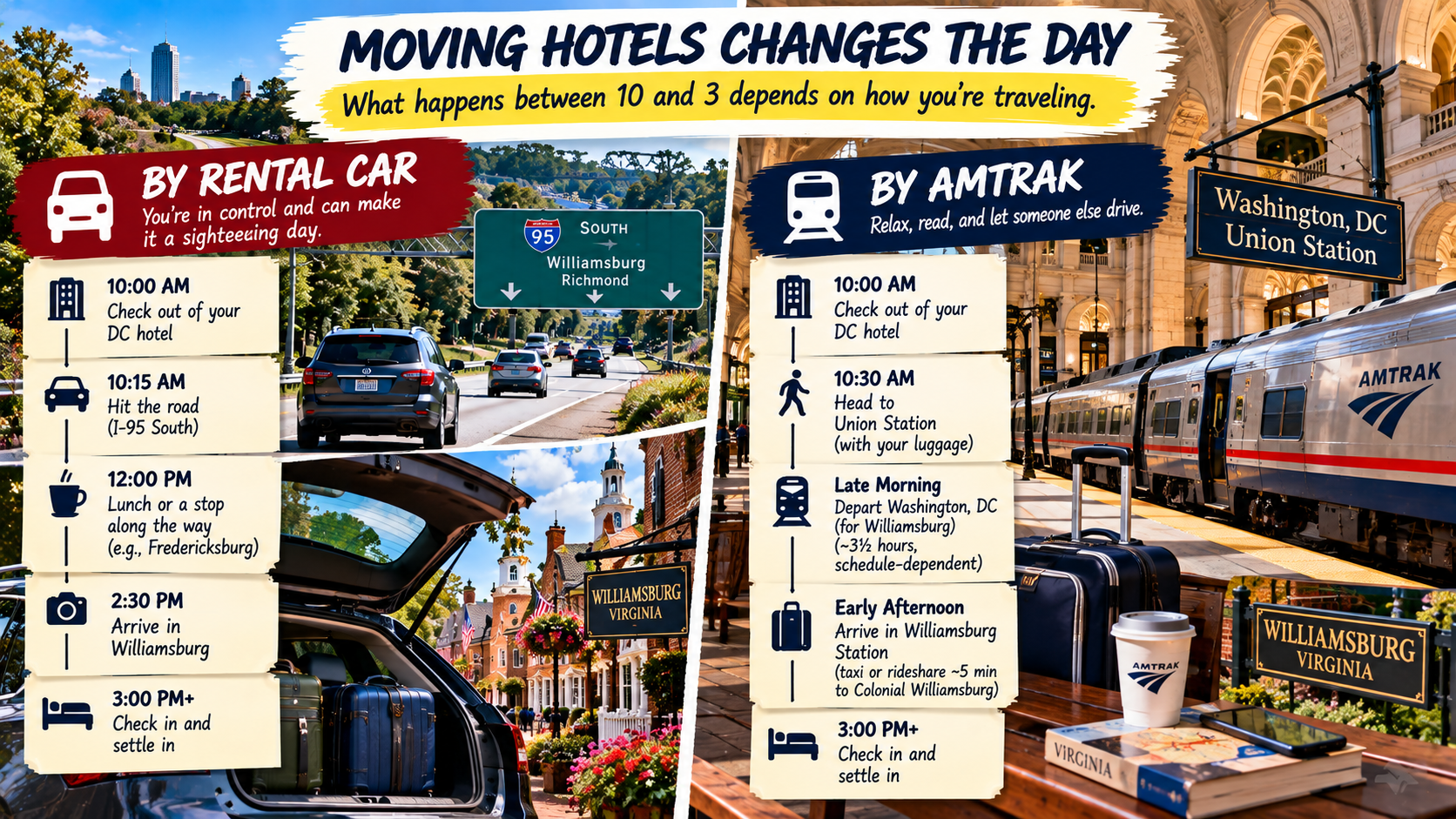
Checkout might be 10:00 or 11:00. Check-in might be 3:00 or 4:00.
What are you doing in between?
The Five Hours Between Rooms
With a rental car, this can be remarkably easy.
Check out, put the bags in the trunk and leave.
Stop for lunch. Visit something along the way. Take the scenic route. Arrive at the next hotel after check-in begins.
Instead of treating the hotel change as lost time, you've made the transfer part of the sightseeing day.
Without a car, the same hotel move can look very different.
If you're taking the train, the luggage comes with you to the station. It comes onto the train. And it comes off with you in Williamsburg.
That doesn't make rail a bad choice. Spending a few hours relaxing on a train may be far more appealing than driving through Virginia traffic.
But you need to finish the plan.
Can you drop your bags at the hotel before the room is ready? Does the train schedule mean you'll arrive after check-in anyway? How are you getting from the station to the hotel?
And don't automatically assume the station will solve the luggage problem. Williamsburg's Amtrak station lists no checked baggage storage.
Those are small details until you're standing somewhere at 1:30 in the afternoon with two rolling suitcases.
Transportation Can Change the Answer
That's why distance alone isn't enough when deciding whether to change hotels.
An hour between two places with a rental car might be nothing. Your luggage stays in the trunk and you have transportation available all day.
That same move using trains, buses and rideshares might involve a station, luggage, transfers and several separate rides once you arrive.
The reverse can also happen. Two cities connected by fast, convenient rail may work beautifully as a day trip even though they're farther apart than two places that require a complicated drive.
So don't just ask:
How far away is it?
Ask:
How long does it actually take, and how am I getting around once I'm there?
Don't Crowdsource a Personal Preference
This is where travel forums and social media can get entertaining.
Ask ten travelers whether you should stay in one hotel or two and you'll get plenty of opinions, but most of them are based on what they like.
It's a little like asking whether you should order fries or tater tots with your hamburger.
For the record, we're firmly on Team Tater Tot. The little crispy nooks and crannies hold ketchup better.
That's not travel advice.
That's just science.

Look at the Day, Not Just the Hotel
Before deciding to stay put or relocate, look at what each option actually does to your itinerary.
If staying in one hotel creates hours of repeated backtracking, moving may give some of that time back.
If the next destination is only an hour away, packing everything and changing hotels may create more hassle than it solves.
If you're driving, the hours between checkout and check-in might become a great sightseeing day.
If you're traveling by train or bus, luggage storage, schedules and local transportation deserve a little more attention.
And if you simply hate changing hotels, that's relevant too.
There isn't a magic number of miles or hours when you're supposed to move.
The goal isn't to build the itinerary someone on the internet thinks is best.
It's to understand the tradeoffs well enough to build the one that works for you.