


Open-Jaw Flights: Stop Making Your Vacation Backtrack
Fly into one city and home from another. A simple change in how you search for flights can give you more time where you actually want to be.
Most people start planning a vacation by searching for a round-trip flight.
Home airport.
Destination.
Departure date.
Return date.
Search.
And there's nothing wrong with that if you're spending the entire trip in one place.
But what if you aren't?
What if you're planning a road trip? Or traveling through several cities? What if the natural end of your vacation is hundreds of miles from where it began?
Suddenly that ordinary round-trip ticket creates a problem.
You spend the vacation moving forward...
…and then spend part of your final day going backward just because your flight home leaves from the airport where you started.
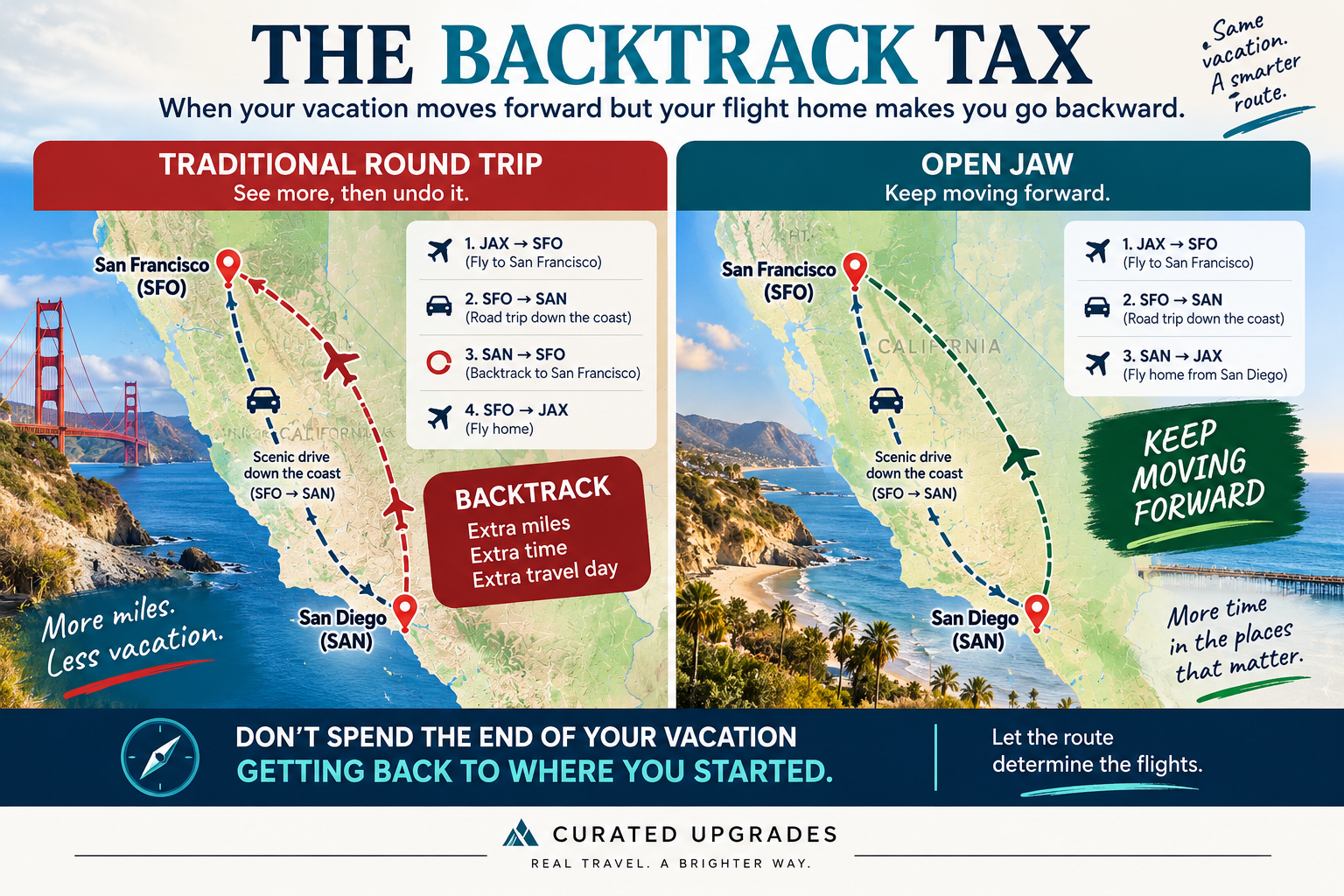
I call that the Backtrack Tax.
It doesn't necessarily appear on your credit-card statement.
You pay it in miles, transportation costs, hotel nights, aggravation and, most importantly, vacation time.
There is another option.
Fly into one city. Fly home from another.
That's an open-jaw itinerary.
And for the right trip, it can completely change how you build the vacation.
What Is an Open-Jaw Flight?
The name makes it sound considerably more exotic than it is.
Imagine your trip on a map.
You fly from your home airport to City A.
You travel overland, by train, ferry, rental car or another flight to City B.
Then you fly home from City B.
The two long-haul flights don't connect at the destination end, leaving an open space between them. On a route map, that gap resembles an open jaw.
Hence the strange name.
But when you're actually searching for airfare, you may not see a button labeled Open Jaw.
Look for Multi-City.
Instead of:
Jacksonville → San Francisco → Jacksonville
you search:
Jacksonville → San Francisco
and
San Diego → Jacksonville
Your vacation fills the space in between.
Our California Trip Is a Perfect Example
We're currently planning a California trip for 2027, and it's exactly the kind of vacation where a traditional round trip can start dictating the itinerary.
We want to begin around San Francisco and eventually work our way south toward San Diego.
If we buy a normal round-trip ticket to San Francisco, we've created an obligation.
At some point after reaching Southern California, we have to turn around.
That could mean another flight, a long drive, another hotel, or some combination of logistics designed for one purpose:
Getting back to an airport we've already left behind.
Why?
Because that's where the round-trip ticket says we need to be.
Instead, we can search for flights into San Francisco and home from San Diego.
Now the route makes sense.
Jacksonville → San Francisco
Then the vacation happens.
San Francisco. The California coast. Whatever stops ultimately make our itinerary.
Eventually, San Diego.
And when we're finished?
San Diego → Jacksonville.
No ceremonial pilgrimage back to San Francisco required.
This Is Really About Time
Saving money is great.
I like saving money.
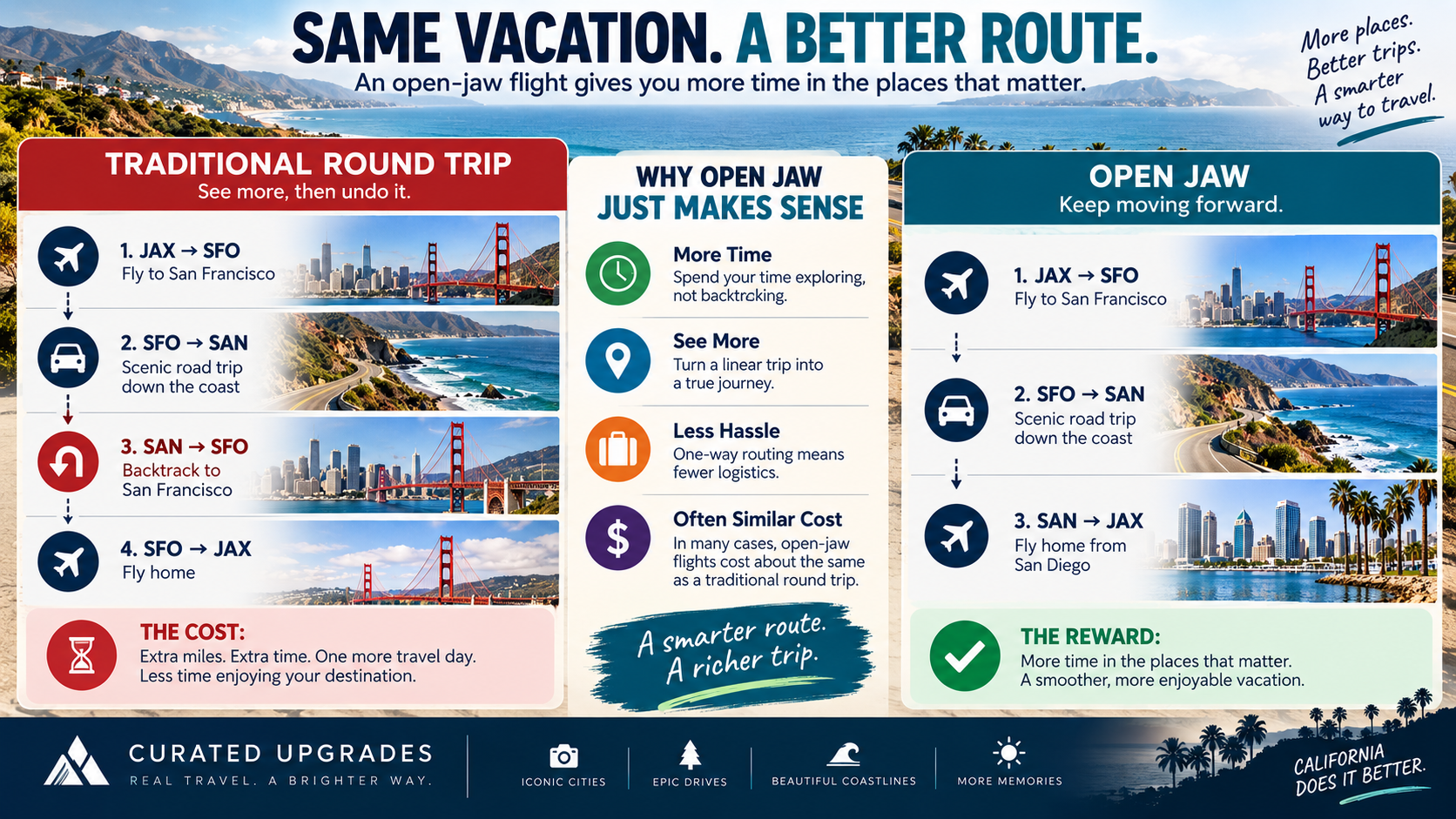
But this isn't primarily a cheap-flight strategy.
It's a time strategy.
Suppose getting back to your original airport requires most of a day.
Maybe there's a long drive.
Maybe you need another hotel.
Maybe you have to return the rental car, catch a separate flight and then deal with another airport.
Even if the open-jaw ticket costs a little more, what are you getting for that money?
Another afternoon in San Diego?
One more great dinner?
A relaxed morning instead of a six-hour drive?
That's where the Curated Upgrades math gets different.
The cheapest itinerary isn't automatically the best-value itinerary.
Sometimes spending a little more on the airfare buys back a day of your vacation.
And time saved is one of my favorite upgrades.
Open Jaw Doesn't Have to Mean Crossing a Continent
Our upcoming Scotland trip is another good example.
We're flying into Glasgow and eventually flying out of Edinburgh.
Those cities aren't on opposite sides of Europe.
That's the point.
An open-jaw itinerary doesn't have to involve some grand international expedition from London to Rome.
We're building a road trip through Scotland. Glasgow makes sense at the beginning. Edinburgh makes sense at the end.
So that's what the flights do.
We don't need to distort the road trip simply to get ourselves back to the airport where it started.
The map determines the flights. The flights don't determine the map.
That's really the larger philosophy here.
If you've followed our Map First, Booking Second approach, this should sound familiar.
Figure out what you actually want the trip to look like.
Then see how transportation can support it.
Don't start with a round-trip airfare and spend the next six months forcing the vacation to fit inside it.
But Does an Open-Jaw Ticket Cost More?
Maybe.
And that's exactly why you should compare it.
I wouldn't use a rule that says open-jaw tickets are always cheaper, always more expensive, or usually identical to a traditional round trip.
Airfare isn't that cooperative.
Search both.
Compare:
Option A: Traditional round trip
Option B: Multi-city/open jaw
Then don't stop at the airfare.
If the round trip requires you to get from San Diego back to San Francisco, include that too.
Rental car.
Fuel.
Train or airfare.
Possible hotel.
Meals.
And the value of your time.
A $100 airfare difference can look very different if the “cheaper” option creates another $200 in transportation and burns most of a vacation day.
That's the Backtrack Tax.
It belongs in the comparison.
What About the Middle of the Open Jaw?
That's your vacation.
And there is no rule for how you have to connect the two cities.
For California, we're considering a road trip.
Elsewhere, it might be a train.
It could be a ferry.
It could be another flight.
Or several of those.
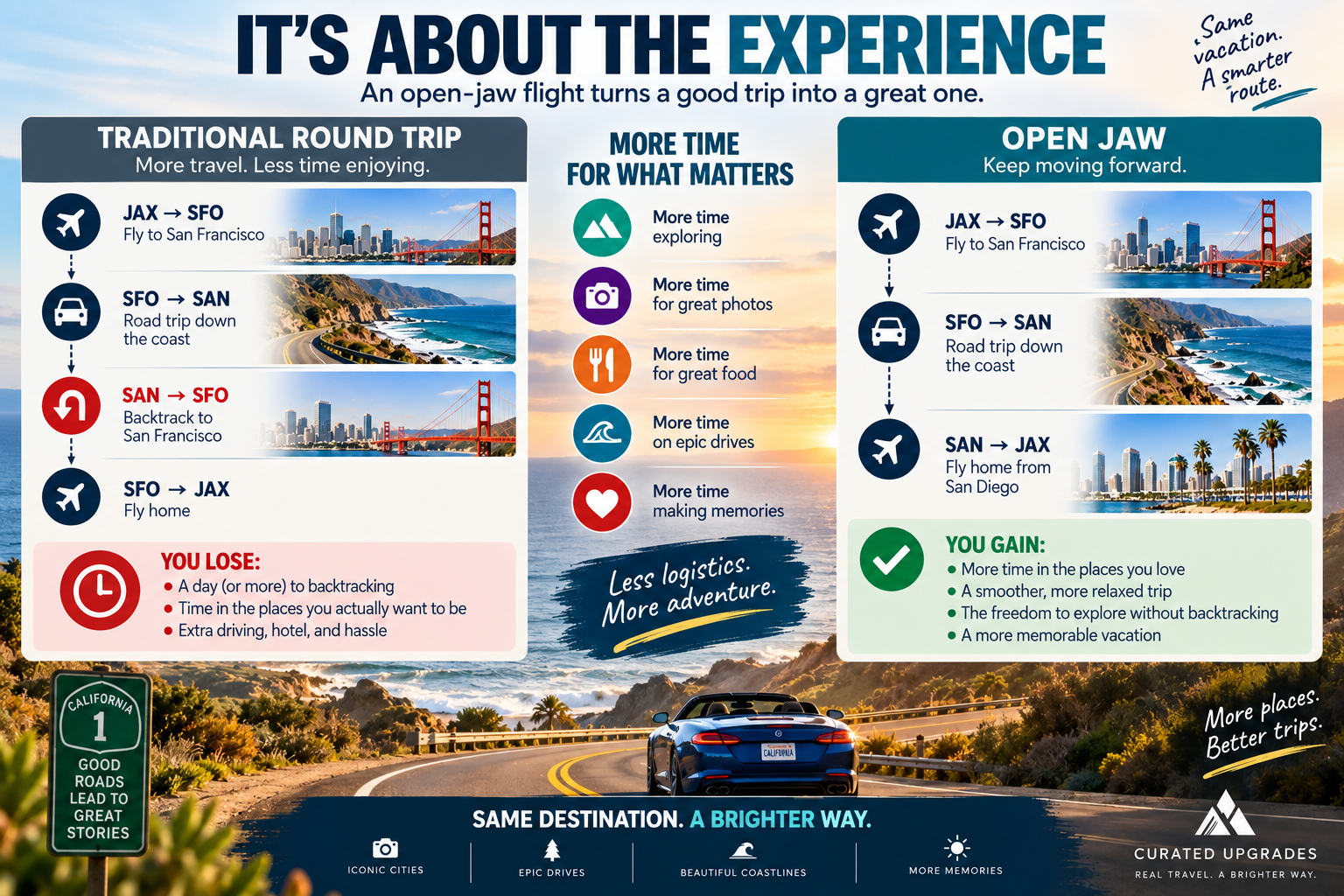
The important part is that you aren't automatically building the entire trip around returning to your first airport.
There is one big caution if you're considering a rental car:
Check the one-way rental cost before committing.
Domestic one-way rentals can work beautifully, but rates and drop fees vary.
International one-way rentals can get considerably more complicated. Crossing borders may be restricted, and dropping a car in another country may be expensive or simply unavailable.
Check the actual rental terms for your route before you build the vacation around the idea.
The open jaw should remove friction.
It shouldn't create a different flavor of it.
Award Travel Makes This Even More Interesting
Here's where open-jaw thinking can become especially useful for those of us using points and miles.
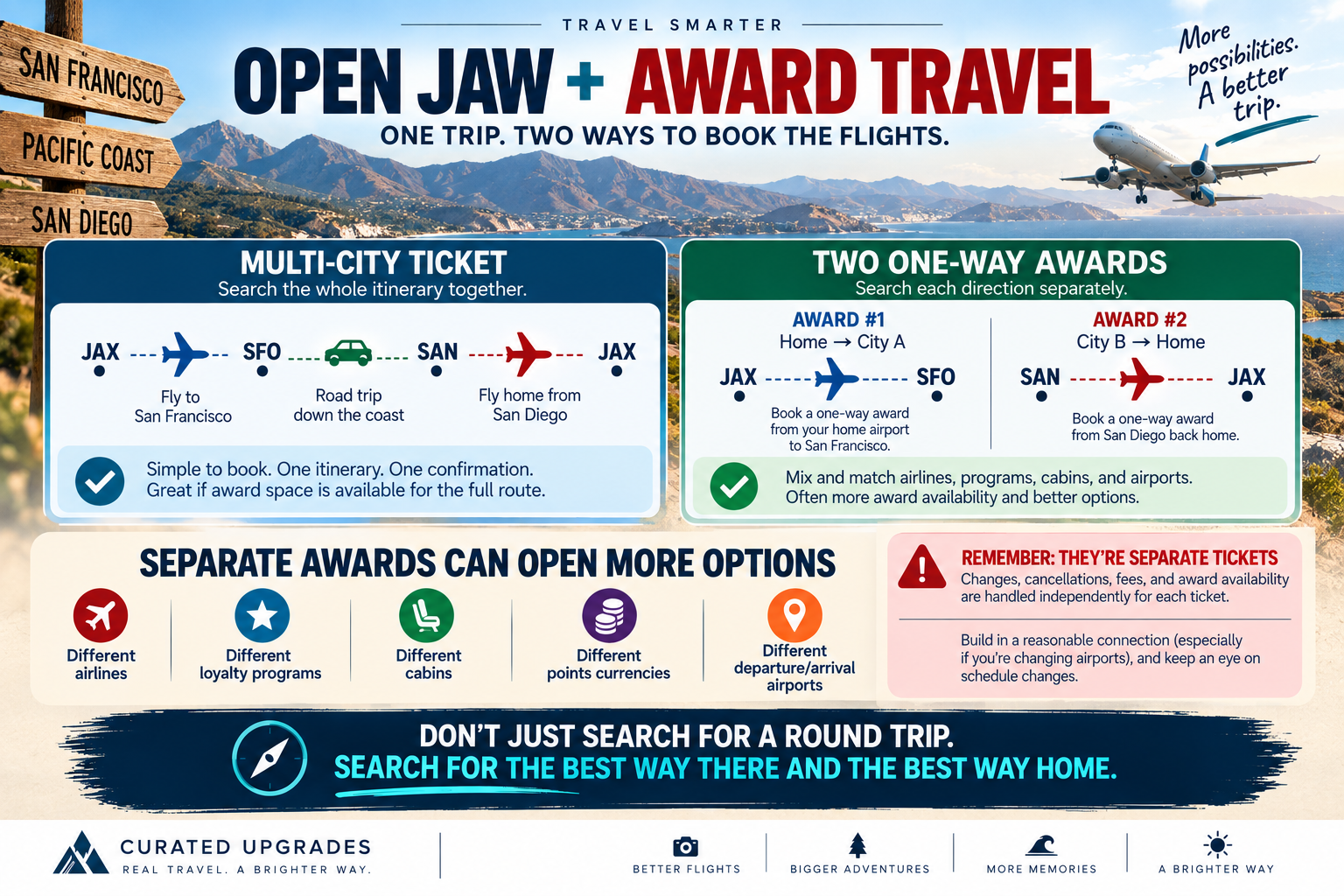
You don't necessarily need to book the two long-haul flights together.
You can search each direction independently.
Instead of asking:
“Can I find the perfect round-trip award?”
ask:
“What's the best way to get there?”
Then separately:
“What's the best way to get home?”
That seemingly small change can open a much larger search.
Maybe one airline has excellent award availability outbound but nothing useful coming home.
Maybe one loyalty program works better in one direction and another program works better in the other.
Maybe you find business class outbound and decide premium economy is perfectly fine for the return.
Maybe the best award flies into one airport while the best return originates somewhere else.
That's okay.
You're effectively building the open jaw yourself with two one-way award tickets.
And when award seats are scarce, that flexibility can be extremely valuable.
Separate Awards Come With Separate Rules
There's a trade-off.
If you book two independent one-way awards, they're exactly that:
Independent.
Changes to one don't automatically change the other.
Cancellation policies can differ.
Fees can differ.
Award availability can disappear while you're deciding what to do.
So I wouldn't find a spectacular outbound award and then blindly transfer points before knowing whether I have a reasonable way home.
Remember one of our most important points-and-miles rules:
Never transfer points until you're ready to book.
Find the seats.
Understand the transfer.
Understand the rules.
Then book.
And if separate tickets create a connection somewhere along the way, give yourself enough time. An itinerary that works beautifully on a spreadsheet can become considerably less beautiful after a delayed flight.
Search Multi-City Even If You Ultimately Book Something Else
This may be my favorite takeaway.
You don't need to decide in advance that you're booking an open jaw.
Just search it.
When we're planning California, I'll compare:
Round trip to San Francisco.
Round trip to San Diego.
Multi-city into San Francisco and home from San Diego.
Potential award options in each direction.
Then I'll look at the entire trip.
Not merely the airfare.
The flights are transportation.
The vacation is the product we're actually buying.
When Does an Open Jaw Make Sense?
I wouldn't attach an arbitrary rule like “only use this for trips longer than nine days.”
A short trip between two well-connected cities could work perfectly.
A long trip centered entirely around one city may have no reason to use an open jaw at all.
Instead, I'd ask one question:
Does the trip naturally end somewhere different from where it begins?
If yes, search an open jaw.
Road trips are obvious candidates.
So are rail journeys, cruises that begin and end in different ports, multi-city European trips, trips across Japan, and itineraries combining two regions.
You don't have to book it.
You just need to know what the alternative costs.
When I'd Skip It
Sometimes the old-fashioned round trip wins.
Maybe it's substantially cheaper.
Maybe your trip naturally loops back.
Maybe returning the rental car to the original location saves enough money to justify the drive.
Maybe the best flight schedule is from the original airport.
Or maybe you simply want to spend the entire vacation in one place.
Perfect.
The goal isn't to make every trip open jaw.
The goal is to stop assuming round trip is the only shape a vacation can have.
Final Thoughts
Travel planning gets more interesting when you stop letting the airfare search box make the first decision.
Open the map.
Find where the trip naturally begins.
Find where it naturally ends.
Then see whether your flights can follow the journey instead of forcing the journey to follow your flights.
Sometimes a traditional round trip will still make the most sense.
Sometimes an open jaw will save money.
And sometimes it may cost a little more but give you back an entire day of your vacation.
That's a trade I'm always willing to examine.
The map should determine the flights. The flights shouldn't determine the map.
And whatever you do:
Don't spend the end of your vacation getting back to where you started.