

Beneath the Lava and Above the Clouds: Exploring Oregon's Volcanic Landscape
From ancient lava tubes to a crater-top walk, three remarkable places showed us the power of Oregon's volcanic past.
When we planned our week in Central Oregon, we knew we wanted to see Crater Lake. What we didn't realize was how much of the surrounding landscape had been shaped by volcanoes, or how many opportunities we'd have to explore that history up close.
During our seven nights near Powell Butte, Gina and I found ourselves exploring three very different volcanic attractions: Redmond Caves, Lava Butte, and Lava River Cave.
One was a quiet archaeological site tucked near an airport. Another took us to the rim of a volcanic cinder cone, overlooking miles of hardened lava. The third led us underground into a passage created by molten rock.
We didn't tackle all three in one exhausting sightseeing marathon. We discovered them over several days, fitting them around leisurely breakfasts, lunches, and whatever else caught our attention.
That's one of the things we enjoyed most about Our Week in Central Oregon: Why We Chose Powell Butte Instead of Bend. We had time to explore without feeling we needed to rush.
Redmond Caves: A Window Into the Past
On May 31, 2025, we enjoyed breakfast in Redmond before heading to Redmond Caves Recreation Site.
This wasn't a major tourist attraction with elaborate facilities or a crowded visitor center. We parked in a dirt lot and explored on foot.
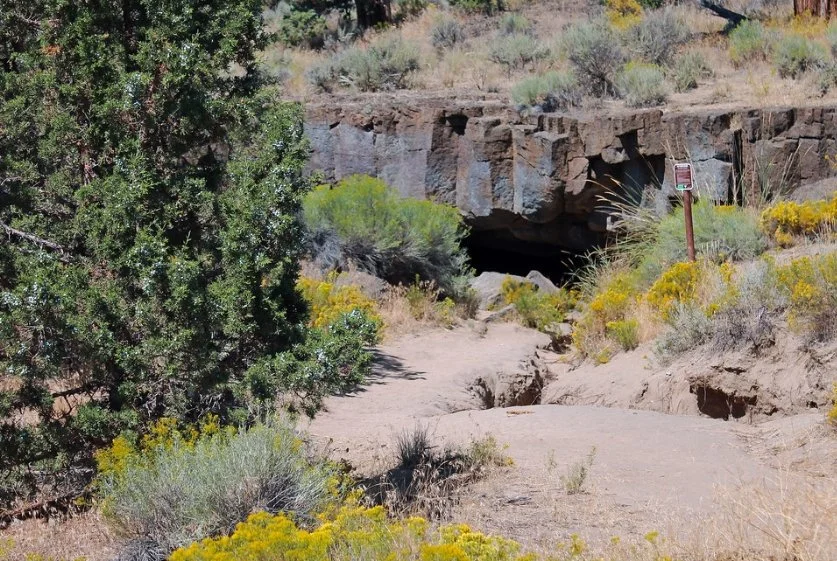
The landscape was rocky and rugged, with paths winding through dry vegetation toward openings in the volcanic rock. There were warnings about rattlesnakes, so we paid attention to where we stepped.
The caves themselves were interesting, although not particularly extensive from what we explored. Some openings allowed us to venture inside, but this wasn't the sort of place where we'd spend hours wandering through enormous underground chambers.
What interested us just as much was the history.
According to the Bureau of Land Management, the site contains five caves formed when part of a lava tube collapsed. Indigenous peoples used the area over thousands of years, with evidence of human use dating back approximately 6,000 years.
Standing there, it was fascinating to consider how people once lived in this environment.
No air conditioning. No electric lights. None of the everyday conveniences we tend to take for granted.
It puts things into perspective when we complain about losing electricity for a few hours or having to do without something we're accustomed to.
The people who lived here generations ago had to be resourceful and resilient. We enjoyed getting a small glimpse into that history.
Was it worth stopping? Absolutely, particularly because we were already in Redmond. It was an interesting, low-key stop that didn't require a major commitment of time or money.
Lava Butte: Standing on the Edge of a Volcano
The following day, June 1, we visited Lava Butte.
If Redmond Caves offered a glimpse into how people lived among Oregon's volcanic formations, Lava Butte demonstrated just how dramatically an eruption could reshape the land.
We drove up to the summit, parked, and walked around the crater rim.
The walk took us a little over half an hour. We didn't find it especially strenuous, although the terrain and elevation changes would make it challenging for someone with significant mobility limitations.
But the views were extraordinary.
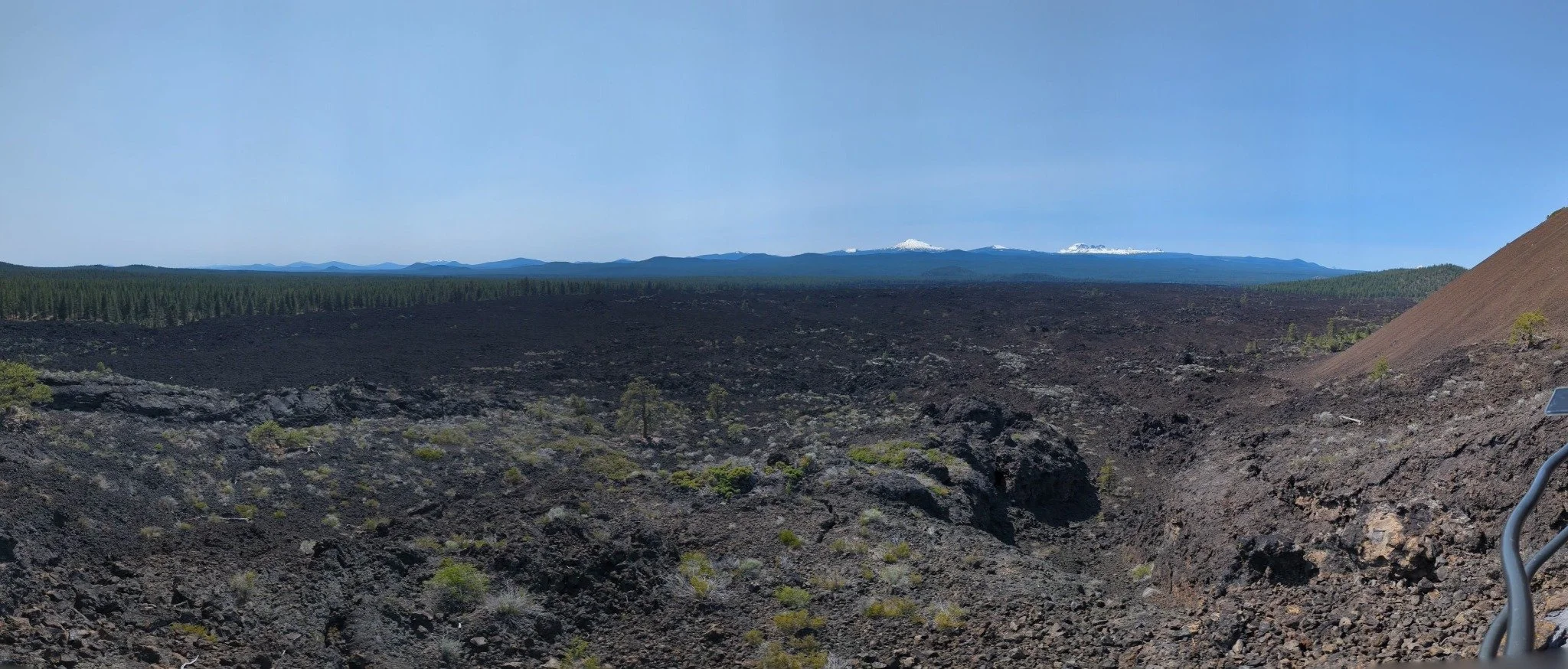
Below us stretched an enormous expanse of dark volcanic rock, with forests and mountains extending toward the horizon.
What struck us most wasn't any single feature. It was the sheer scale of the landscape.
There were no strip malls, sprawling subdivisions, or rows of houses interrupting the view. Just open country, volcanic rock, trees, and distant mountains.
Looking across the lava field, it was hard not to think about the tremendous forces that created it.
The heat of molten rock. The violence of an eruption. The transformation of an entire landscape.
And then, long after the eruption, the quiet beauty left behind.
It's the kind of place that makes you feel very small.
Not in a frightening way, but in a way that reminds you how powerful nature is and how little control we really have over it.
We also walked through the visitor center, where exhibits helped explain the volcanic history and the differences visible across the surrounding landscape.
The Newberry National Volcanic Monument protects an extraordinary collection of volcanic features, and Lava Butte is one of the most accessible ways to appreciate that landscape from above.
For us, this was one of those experiences where the scenery itself was the attraction. We didn't need a strenuous hike or an elaborate activity.
We simply enjoyed being there.
Lava River Cave: Exploring Beneath the Surface
On June 2, we took our volcanic exploration underground at Lava River Cave.
We discovered the attraction while looking for an interesting, relatively easy outing. We already had our America the Beautiful pass, and the additional cost for our timed reservation and one rented flashlight came to about $9.
We had no trouble finding parking, and there were plenty of available spaces during our visit.
Before entering, we rented a flashlight. That turned out to be money well spent.
The cave has no permanent lighting along its underground route, and we didn't want to depend on our phone batteries to illuminate the way.
Once inside, the experience was completely different from Redmond Caves.
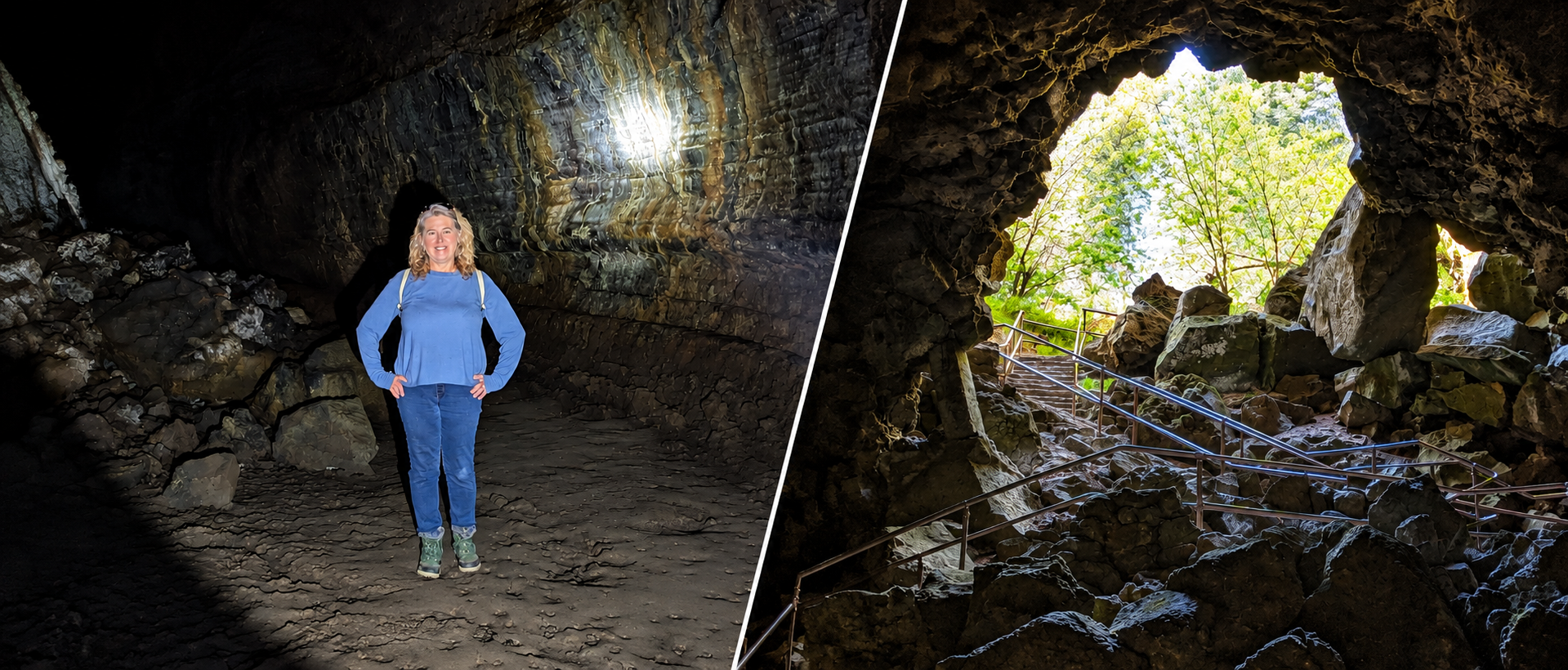
This was a genuine journey through a long underground lava tube, surrounded by rock that had been shaped by flowing molten lava.
It was cool and a little damp, but we were comfortable.
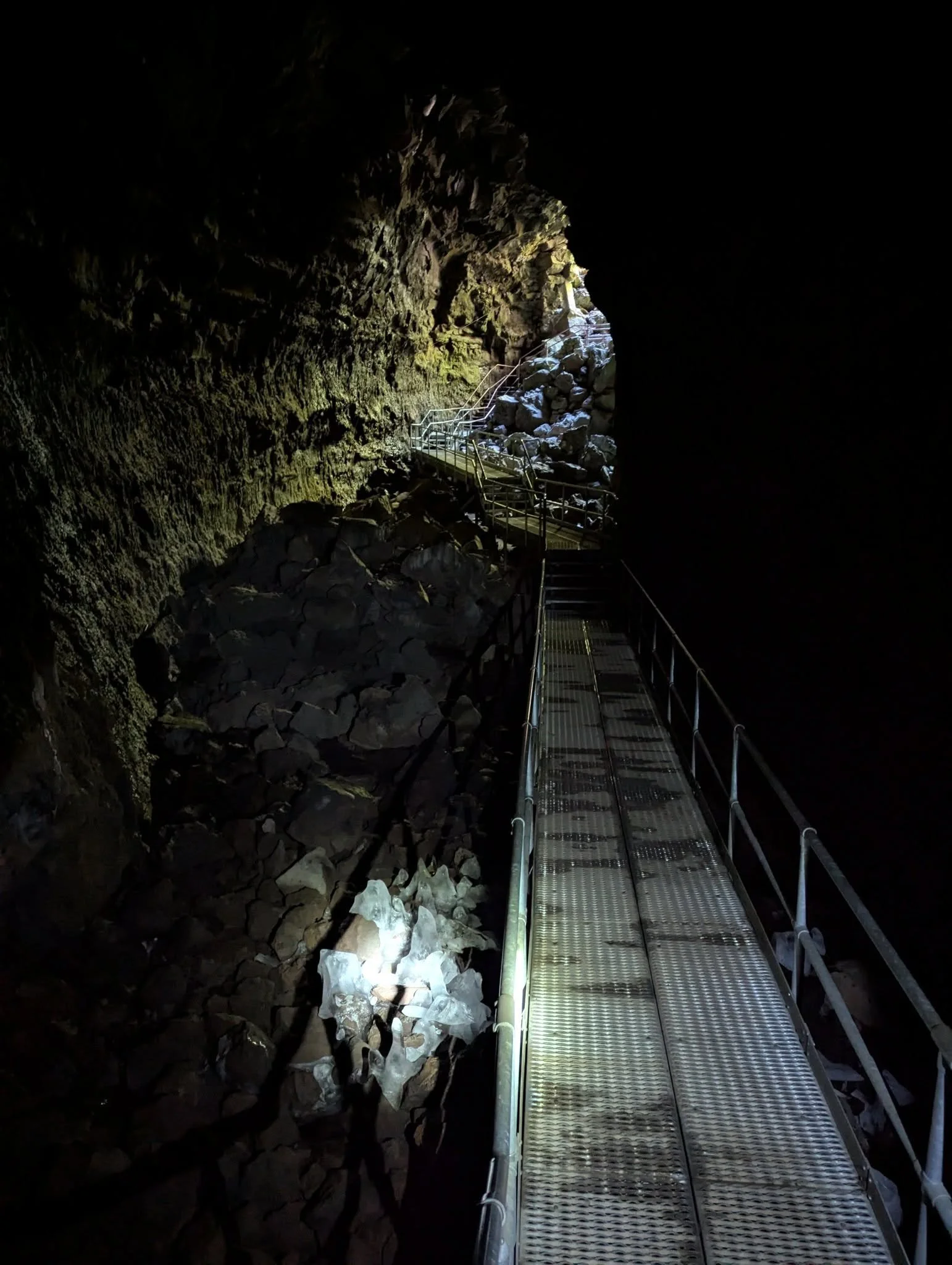
The walking route included purpose-built stairs, metal walkways, and handrails in certain sections. There were also stretches of uneven natural ground, with ruts and rocks that required us to watch our footing.
We wouldn't describe it as a particularly strenuous outing for someone comfortable walking on uneven surfaces, but it definitely wasn't a smooth, accessible pathway.
We made our way to the end of the visitor route and back, spending approximately an hour and fifteen minutes to an hour and a half underground.
We weren't racing through it.
We stopped to look around, examine the rock formations, and appreciate the fact that we were walking through a passage created by volcanic activity thousands of years ago.
The darkness added to the experience. Outside the reach of our flashlight, much of the cave simply disappeared into blackness.
It was quiet, unusual, and fascinating.
What the Walk Is Really Like
One of the most useful things we can share about Lava River Cave is that the developed stairs and walkways don't make the entire experience easy or accessible.
The ground varies considerably.
Some sections have sturdy metal walkways and railings. Others require you to navigate uneven, rocky surfaces. There are also stairs and changes in elevation.
We wouldn't recommend this attraction for someone using a wheelchair or mobility scooter. Crutches could also present a considerable challenge.
And this is not the place to break in a brand-new pair of white sneakers.
Wear sturdy shoes with good traction, bring appropriate clothing, and carry reliable lighting.
The Forest Service describes the cave as approximately one mile long, making the complete out-and-back exploration roughly two miles. It also advises visitors to expect a temperature around 42°F and to carry at least two light sources. Conditions and requirements are detailed in the Forest Service's Lava River Cave visitor information.
After emerging, we spent a little more time walking around the grounds and reading the interpretive signs. They helped put the size of the surrounding lava fields and the region's volcanic history into perspective.
We later continued to Sisters, where we enjoyed lunch at High Camp Taphouse.
That's the beauty of exploring Central Oregon at a relaxed pace. A morning underground can be followed by a good lunch and an entirely different landscape in the afternoon.
Planning Your Own Volcanic Adventure
These three places offered very different experiences, and we'd recommend approaching them with different expectations.
Redmond Caves is a relatively short, informal stop. Admission is free, and the site is generally open year-round, but there are no restrooms or other visitor amenities. The BLM advises sturdy footwear, multiple light sources, and caution around rattlesnakes. The site has no accessible facilities.
Lava Butte is primarily about the views. The crater-rim walk offers a memorable perspective on the lava fields, but summit vehicle access and seasonal arrangements can change. Check the Forest Service's current information before making plans.
Lava River Cave requires the most preparation. Timed vehicle reservations, seasonal operating hours, cave safety orientation, proper footwear, and reliable lighting all matter. The cave isn't suitable for every visitor, and it shouldn't be treated as a simple paved stroll.
As of October 2026: These recommendations reflect our May and June 2025 experiences and the available visitor guidance. Reservations, fees, operating dates, road access, and site rules can change. Always check the Deschutes National Forest and Bureau of Land Management before visiting.
Our Verdict: Are Oregon's Volcanic Attractions Worth Visiting?
🟢 Go for it! Lava Butte. The crater-rim views and enormous lava field made this one of our most memorable volcanic experiences. It's especially rewarding for travelers who appreciate dramatic landscapes without needing an all-day hike.
🟢 Go for it! Lava River Cave. A genuinely unusual experience and well worth the effort if you're comfortable with stairs, darkness, and uneven footing. We enjoyed taking our time and exploring the entire visitor route.
🟡 Maybe. Redmond Caves. Interesting history, free admission, and a worthwhile stop if you're already in Redmond. We enjoyed it, but wouldn't suggest building an entire day's itinerary around it.
The Power of Nature, Above and Below Ground
What stayed with us wasn't simply that we'd visited three volcanic attractions.
It was how different they were.
At Redmond Caves, we thought about the people who had lived among these formations thousands of years ago.
At Lava Butte, we stood above a vast field of hardened rock and tried to imagine the force required to create it.
And at Lava River Cave, we walked through a passage left behind by molten lava.
Three different perspectives on the same extraordinary natural history.
None required us to rush, and none needed to consume an entire vacation day.
We were simply two people exploring a beautiful part of Oregon, learning something along the way, and enjoying each other's company.
Sometimes that's all an adventure needs to be.