

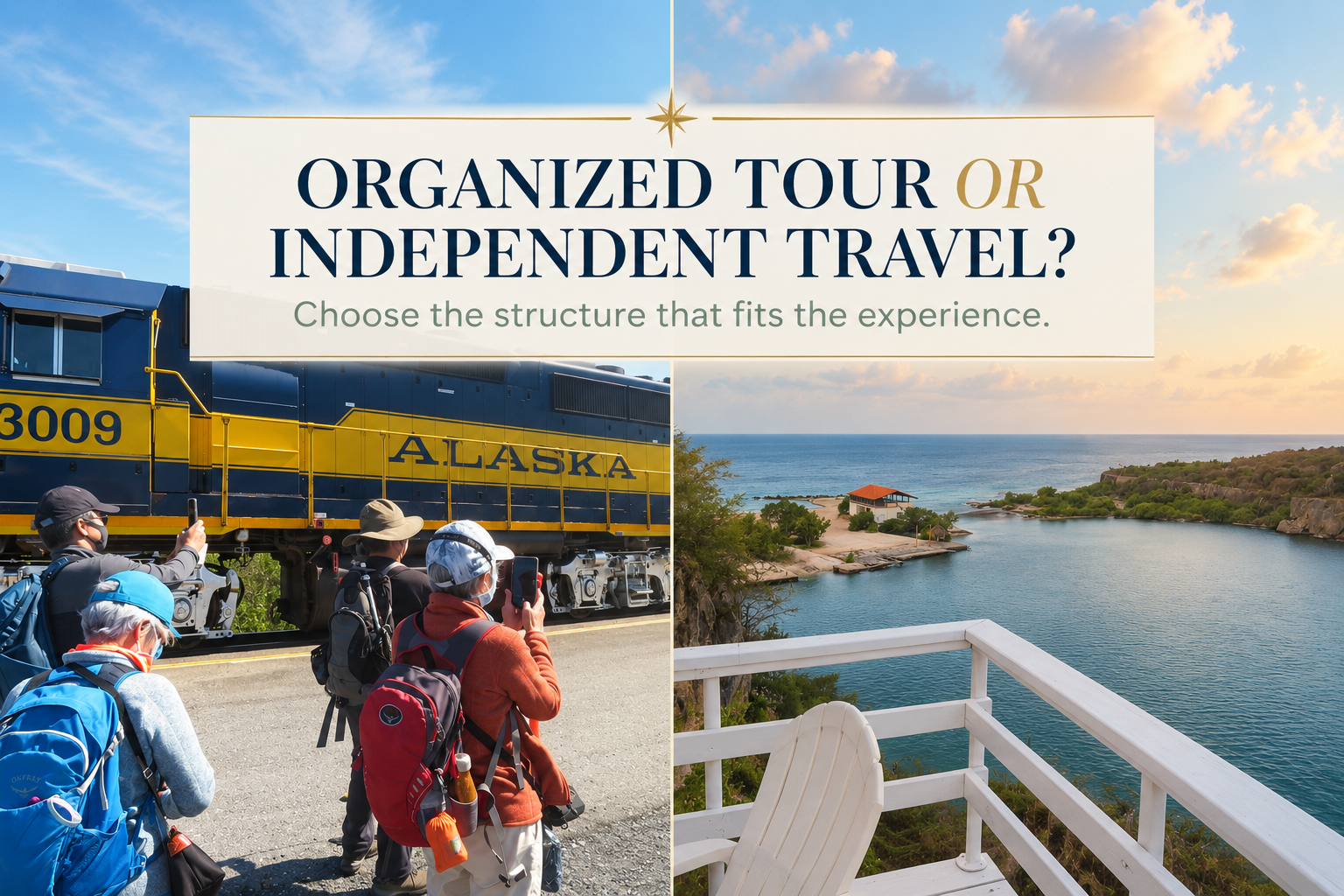
Organized Tour or Independent Travel? Choose the Right Structure for Your Trip
Tours can remove logistical stress. Independent travel can provide freedom and deeper local connections. The right choice depends on the destination and the experience you want.
Most of our vacations are independently planned. We tend to stay in an area long enough to explore it, eat in local places and change plans when something interesting catches our attention.
But one of our best trips was a fully organized tour of Alaska.
That does not mean organized tours are better. It means the structure was right for that destination and that particular trip.
The real question is not whether you are a “tour person” or an “independent traveler.”
It is:
How much structure will help you enjoy the destination—and how much will begin to get in the way?
Organized Travel Removes the Logistics
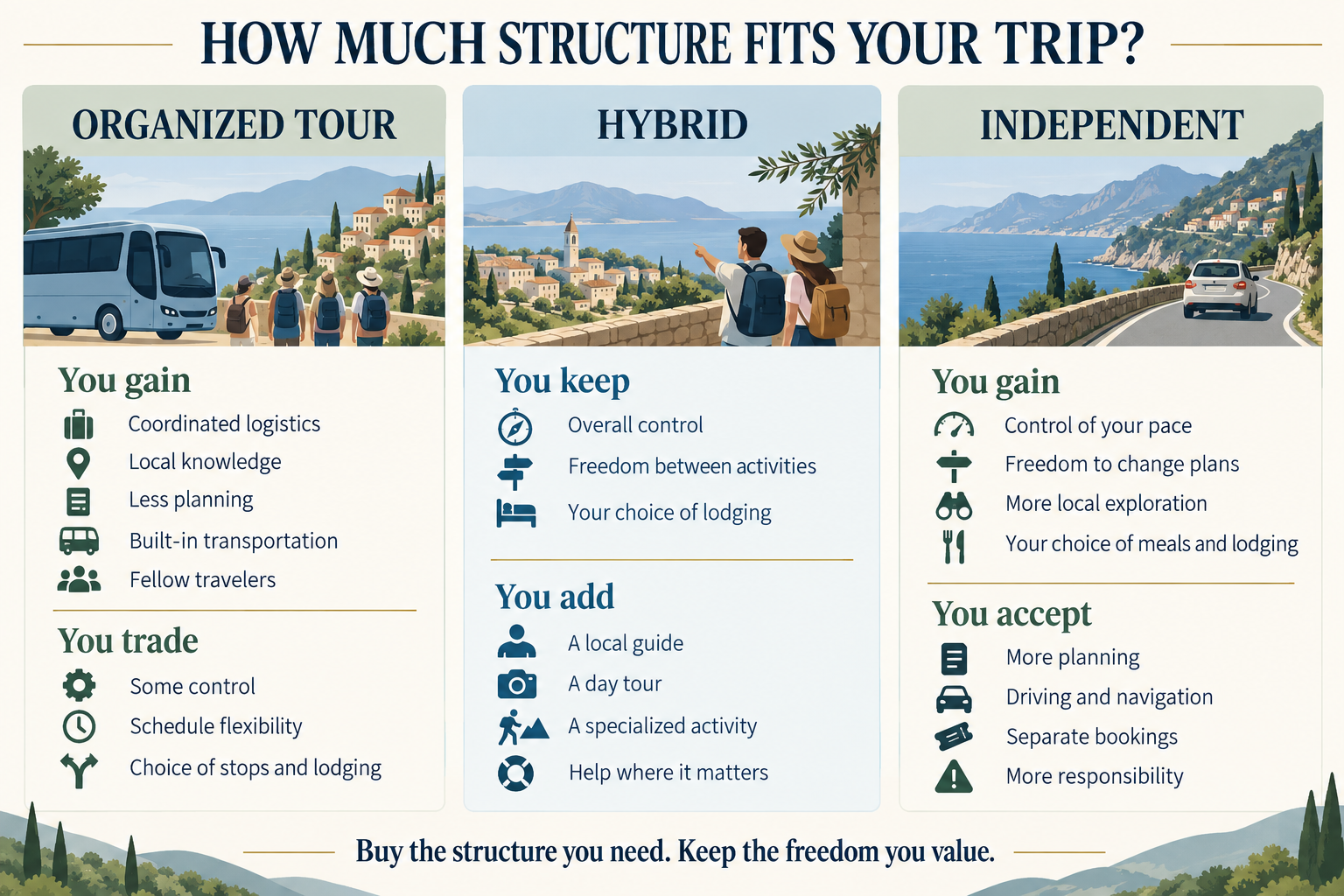
The greatest advantage of an organized tour is simple: someone else coordinates the moving parts.
Depending on the trip, that may include:
Transportation
Lodging
Luggage handling
Admission tickets
Guides
Activities
Some meals
Timing between destinations
That convenience can be especially valuable when a trip covers a large area, transportation is complicated or the destination requires substantial advance planning.
You still experience the destination. You simply spend less time figuring out how to get from one experience to the next.
Why Alaska Worked So Well for Us
Our 12-day Alaska trip with Alaskan Tour Guides was the only traditional multiday organized tour we have taken.
Our group had 12 travelers, one resident driver-guide and one van. The itinerary took us from Anchorage north toward Denali and then south through Homer and Seward before returning to Anchorage.
Almost everything on the itinerary appealed to us. There was a good mix of included activities, scenic travel and free time for optional experiences. During a custom day in Denali, we added a whitewater rafting trip.
We did not have to coordinate hotels, move our luggage or determine how to reach the next destination.
We just had to show up.
The tour did not take away our independence. It took away the logistics.
The trip exceeded our expectations, but the people were also a major part of the experience. We still correspond with nine members of the group.

Convenience Comes With Tradeoffs
An organized itinerary means giving up some control.
You may not choose:
The hotels
How long you stay at each stop
The restaurants
When the day begins
How much time you spend somewhere
Which activities receive the most attention
Our Alaska itinerary suited us extremely well, so those compromises did not feel burdensome. If several scheduled activities had not interested us, the same structure might have felt restrictive.
Before booking, read the full day-by-day itinerary—not merely the list of highlights. Consider the early mornings, travel time, meal arrangements, physical requirements and amount of genuinely free time.
The convenience only has value when you like what has been arranged.
Group Size Changes the Experience
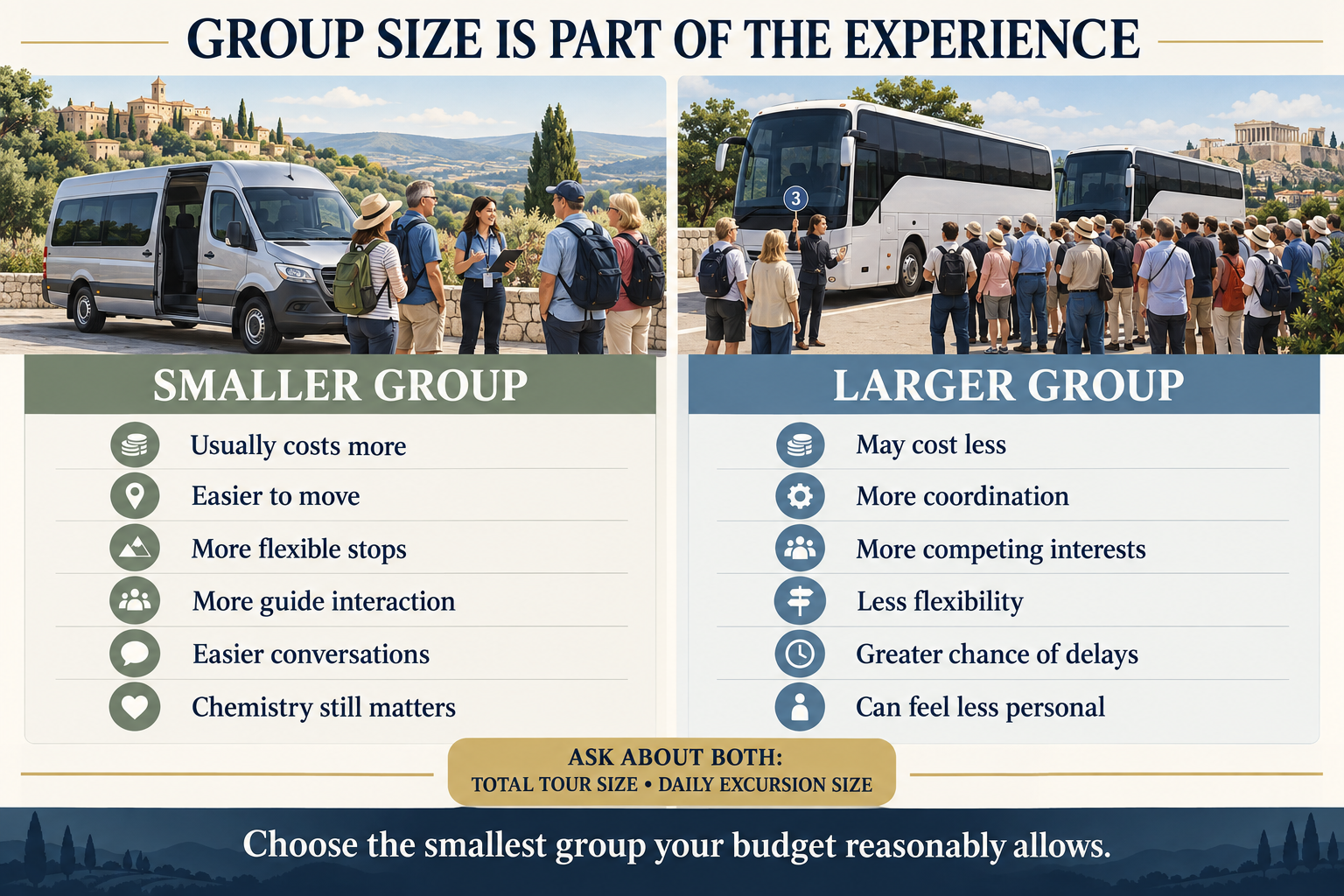
A “group tour” might mean 12 people in a van or several motorcoaches arriving together.
Those are entirely different experiences.
Smaller groups often cost more, but they are generally easier to move. Stops may feel less rushed, conversations with the guide can be more natural and it is easier to get to know the other travelers.
Larger groups may offer a lower price, more departure dates or access to places that are difficult to arrange independently. They also require more coordination and can feel less personal.
Our Viking river cruise illustrated the difference. The ship itself felt relatively intimate, and the included daily excursions were optional. But when several buses of passengers departed for the same excursion, the experience ashore felt much larger.
When comparing tours, ask about both:
The maximum number of travelers on the overall trip
The number who may participate in each daily excursion
You Cannot Choose Your Fellow Travelers
The group can become one of the best parts of a tour—or one of its greatest uncertainties.
My fear with a large group is always that there will be one person who dominates the guide’s time with a hundred questions that have little to do with what everyone is experiencing:
“What kind of paintbrush did Leonardo use? Is that royal blue or navy blue? Did he paint it in this room? Did his mother teach him to paint?”
A capable guide can usually manage that personality, but group dynamics matter.
Small groups do not guarantee perfect chemistry, and large groups do not guarantee a bad experience. A smaller group simply makes every personality more noticeable.
That worked in our favor in Alaska. We had an excellent group and formed friendships that continued after the trip.
Independent Travel Provides Freedom
On an independent trip, you decide where to stay, how quickly to move and whether today’s plan still sounds appealing when you wake up.
Curaçao is a good example.
We wanted an easy escape, so we rented a small house with an amazing view and hired a rental car. We avoided the busiest tourist areas, ate most of our meals in local places and explored the island as we pleased. We spent only one day in Willemstad.
Down the street from the house, we found a litter of puppies living among the rocks and brush. We bought a large bag of dog food and fed them every day.
That experience was not listed in a guidebook or scheduled on an itinerary. It happened because we were staying in one place and had time to notice what was around us.
Independent travel often creates more opportunities for one-on-one conversations with local people and a stronger sense of everyday life in the destination.

These puppies lived near our rental house in Curaçao. Feeding them became part of our daily routine—an experience that never appeared on an itinerary.
Freedom Also Means Responsibility
Independent travel requires you to handle the details that a tour company would otherwise coordinate.
That may include:
Researching neighborhoods
Reserving lodging
Renting and driving a vehicle
Understanding local roads
Buying attraction tickets
Managing schedule changes
Solving problems when something goes wrong
Some people enjoy that process. Others find that the planning begins to feel like a second job.
Independent travel can also involve expensive mistakes. A poorly located rental, unrealistic driving plan or missed advance reservation can affect the entire trip.
Freedom is valuable—but it is not free of responsibility.
A Hybrid Trip May Offer the Best Balance
The decision does not have to be all or nothing.
You can plan the overall trip independently and add professional help when it meaningfully improves the experience.
We visited Manuel Antonio in Costa Rica without hiring a guide. In France, we independently visited the Louvre and Eiffel Tower, took an evening river cruise and booked a day trip to Versailles.
At the Vatican, however, I deliberately booked the smallest guided group I could find within our budget. The local expertise was valuable, but I did not want to experience the Vatican as part of a busload of people.
We have also added guided rafting trips in Alaska, Washington and Utah to otherwise independent travel.
This hybrid approach lets you retain control of the trip while paying for expertise where it matters most.
Plan the overall trip independently, then add local guidance where it improves the experience.
Compare the Complete Cost
An organized tour may appear expensive because transportation, lodging, activities and some meals are bundled together.
Independent travel may appear less expensive because each component is priced separately.
Compare equivalent costs:
Lodging
Transportation
Fuel and parking
Admissions
Guided activities
Meals
Planning time
Convenience
Cancellation terms
Also consider the cost of getting something wrong.
A tour’s premium may be worthwhile when it removes difficult transportation or gives you access to experiences you would struggle to arrange. It may provide little value when the destination is easy to navigate and you want substantial unscheduled time.
The question is not simply which option costs less.
It is which one provides the experience you want at a price you consider worthwhile.
My Curated Verdict
🟢 Go for it: Independent travel
Choose independent travel when you enjoy planning, want control of your pace and value spontaneous local experiences.
It works especially well when transportation is manageable and you want to remain in one area long enough to explore it.
🟡 Evaluate it: An organized tour
Consider a tour when the itinerary genuinely appeals to you and the structure removes meaningful logistical work.
Pay close attention to group size, pace, included experiences, free time and the difference between the total tour group and daily excursion groups.
🟢 Go for it: A hybrid trip
Plan independently and add a small tour, local guide or specialized activity when expertise, access or transportation will improve a particular experience.
🔴 Skip it
Skip any tour whose schedule, group size or included activities do not fit the way you want to travel—even if the price appears attractive.
Likewise, do not choose independent travel merely to prove that you can handle everything yourself when the logistics will consume time you would rather spend enjoying the destination.
The Bottom Line
An organized tour can provide convenience, local knowledge and companions with whom you may form lasting friendships.
Independent travel can provide freedom, spontaneous discoveries and deeper conversations with the people who live in the destination.
Neither approach guarantees a better trip.
Decide what you want to experience before choosing how you will travel.
Buy the structure you need. Keep the freedom you value.
Then go experience the world.