


Rental Car Insurance Without the Counter Panic
Credit-card benefits may cover damage to the rental vehicle—but liability, country restrictions and large deductibles can leave important gaps.
It is one of the most vulnerable moments in travel.
You have just stepped off an airplane after a long flight. Your body thinks it is 3:00 a.m. You are hauling your bags, dragging your feet and standing at a rental-car counter in an unfamiliar place.
The agent asks one seemingly simple question:
“Would you like to add our full coverage?”
Your mind goes blank.
You cannot remember whether your personal auto policy covers an overseas rental. You are fairly certain your travel credit card includes something—but you cannot remember what, where or under which conditions.
So you make a financial decision while tired, hurried and standing in front of a line of equally tired travelers.
Some people buy everything for peace of mind. Others decline everything because they once read that their credit card “covers rental cars.”
Neither approach is much of a strategy.
Rental-car coverage is confusing because several different protections may overlap—and several important risks may remain uncovered. The right answer depends on your card, personal insurance, destination, rental agreement, vehicle and tolerance for paying expenses upfront.
My goal is not to tell you always to buy the rental company’s coverage or always to decline it.
It is to help you understand the question before you reach the counter.
Start With the Most Important Distinction
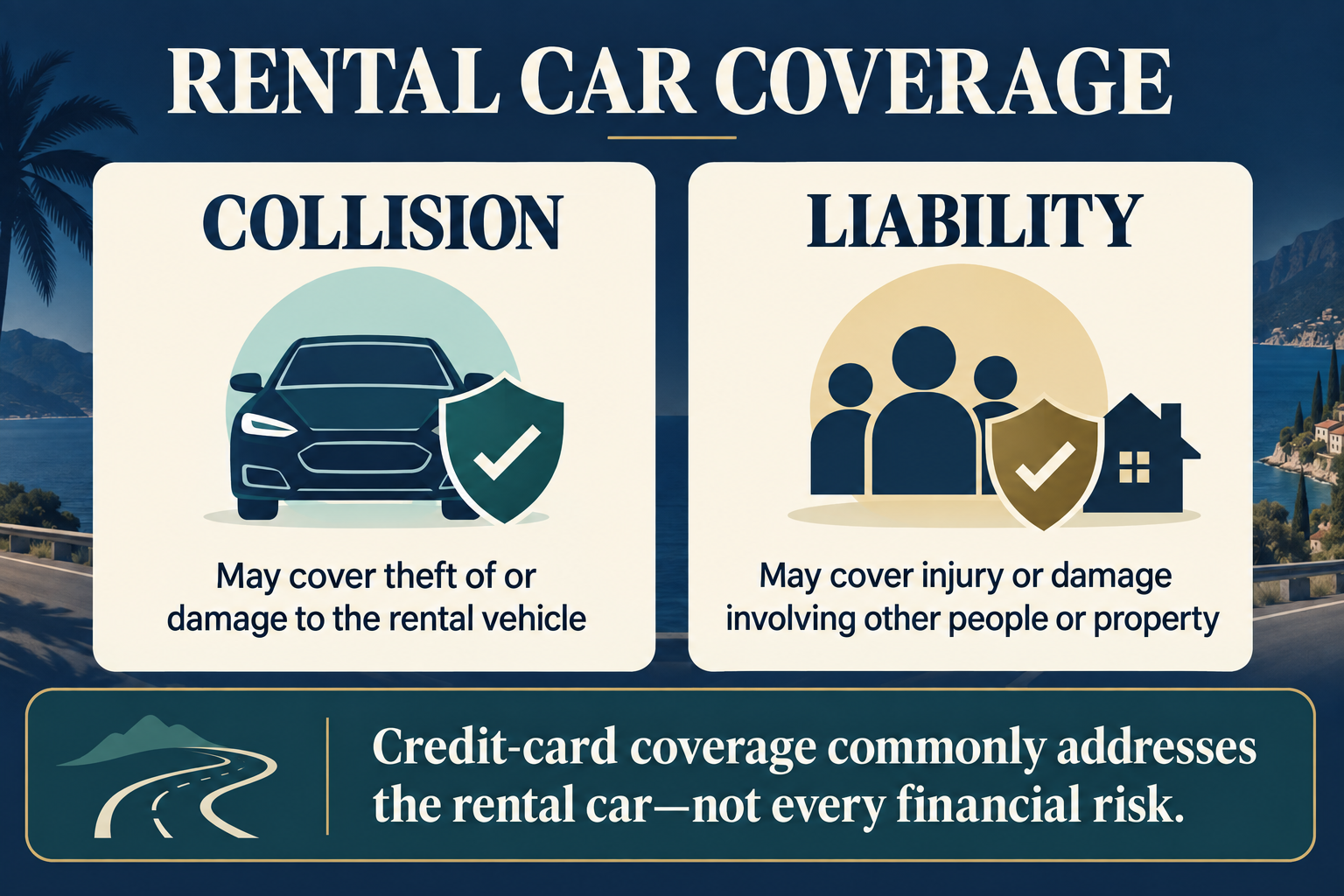
Credit-card rental protection and liability insurance are not the same thing.
Credit-card benefits commonly focus on theft of or physical damage to the rented vehicle. Depending on the card and its current terms, coverage may also include eligible loss-of-use charges, administrative fees and towing after a covered loss.
That does not necessarily cover:
Injuries to another person
Damage to another vehicle
Damage to someone else’s property
Medical expenses
Personal belongings stolen from the vehicle
Mechanical breakdowns
Every vehicle category
Every country
Every rental duration
That distinction matters because a traveler can have excellent collision protection for the rental car and still have a serious liability gap.
Before declining anything, identify both sides of the equation:
What protects the rental vehicle?
What protects you if you injure someone or damage their property?
Do not assume that the phrase “rental-car insurance” answers both questions.
What Primary and Secondary Coverage Actually Mean
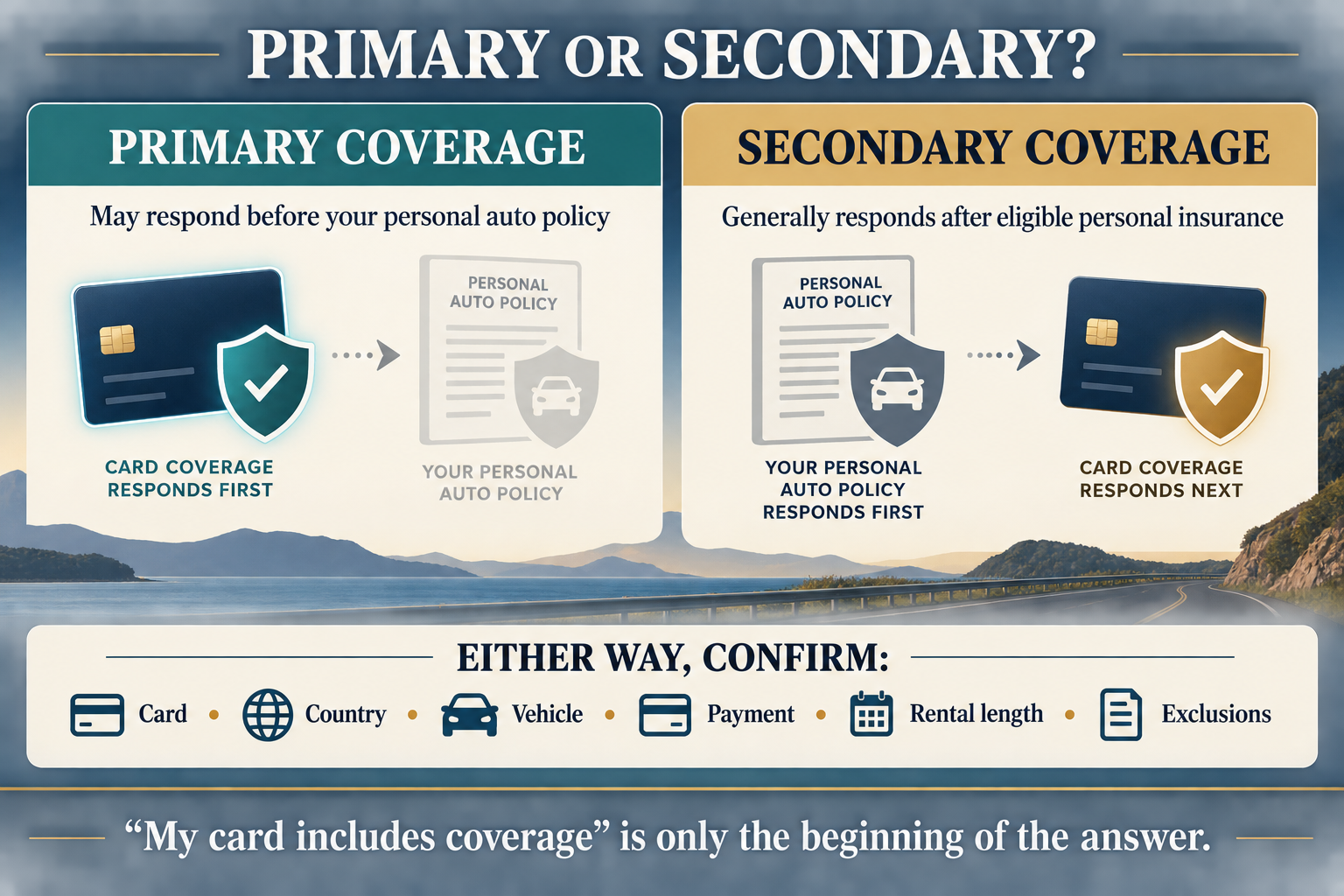
Another commonly misunderstood distinction is the difference between primary and secondary credit-card coverage.
Primary coverage
Primary credit-card coverage may respond to an eligible collision or theft claim before your personal auto policy.
That can be valuable because you may not need to begin by filing a collision claim with your own automobile insurer. You still must follow the card benefit’s rules, submit the required documents and wait for the claim to be evaluated.
Primary does not mean unlimited.
It also does not mean that liability, personal injuries, belongings or every possible charge are covered.
Secondary coverage
Secondary credit-card coverage generally applies after other eligible insurance has been considered.
Inside the United States, that may mean your personal auto policy responds first. The card benefit may then reimburse certain eligible expenses that remain, such as a deductible.
Outside the United States, the interaction may differ if your personal policy does not cover international rentals. Never assume that a secondary benefit automatically becomes primary without checking the actual guide.
The label matters—but the details matter more.
The Card in Your Wallet Is Only the Beginning
I carry several cards with different rental-car benefits. I do not choose one based on the color of the plastic or a vague memory that it includes travel protection.
I match the card to the rental.
For example, the Capital One Venture X currently provides primary auto-rental collision coverage when its requirements are met. Its official guide describes protection for eligible theft, collision damage, loss-of-use charges, administrative fees and towing.
It specifically does not cover injuries, damage to another vehicle or personal liability.
The current Venture X Visa benefit guide also excludes rentals in Israel, Jamaica, the Republic of Ireland and Northern Ireland. That makes it potentially useful for our upcoming Scotland rental—but not something I would rely upon for a rental across the Irish Sea.
My Chase Sapphire Preferred currently provides primary auto-rental coverage for qualifying rentals in the United States and abroad. Its benefit guide also says some countries or rental agencies may require a letter of coverage.
My Delta SkyMiles Blue American Express Card is different. Its included rental-car loss and damage benefit is secondary, does not include liability coverage and has its own country and vehicle exclusions.
Those examples illustrate the real lesson:
A premium card may provide an excellent benefit without providing every protection you need.
Benefits can also change. Always use the current guide associated with your exact card—not an old blog post, internet forum or summary for a different product.
My International Rental-Car Document System
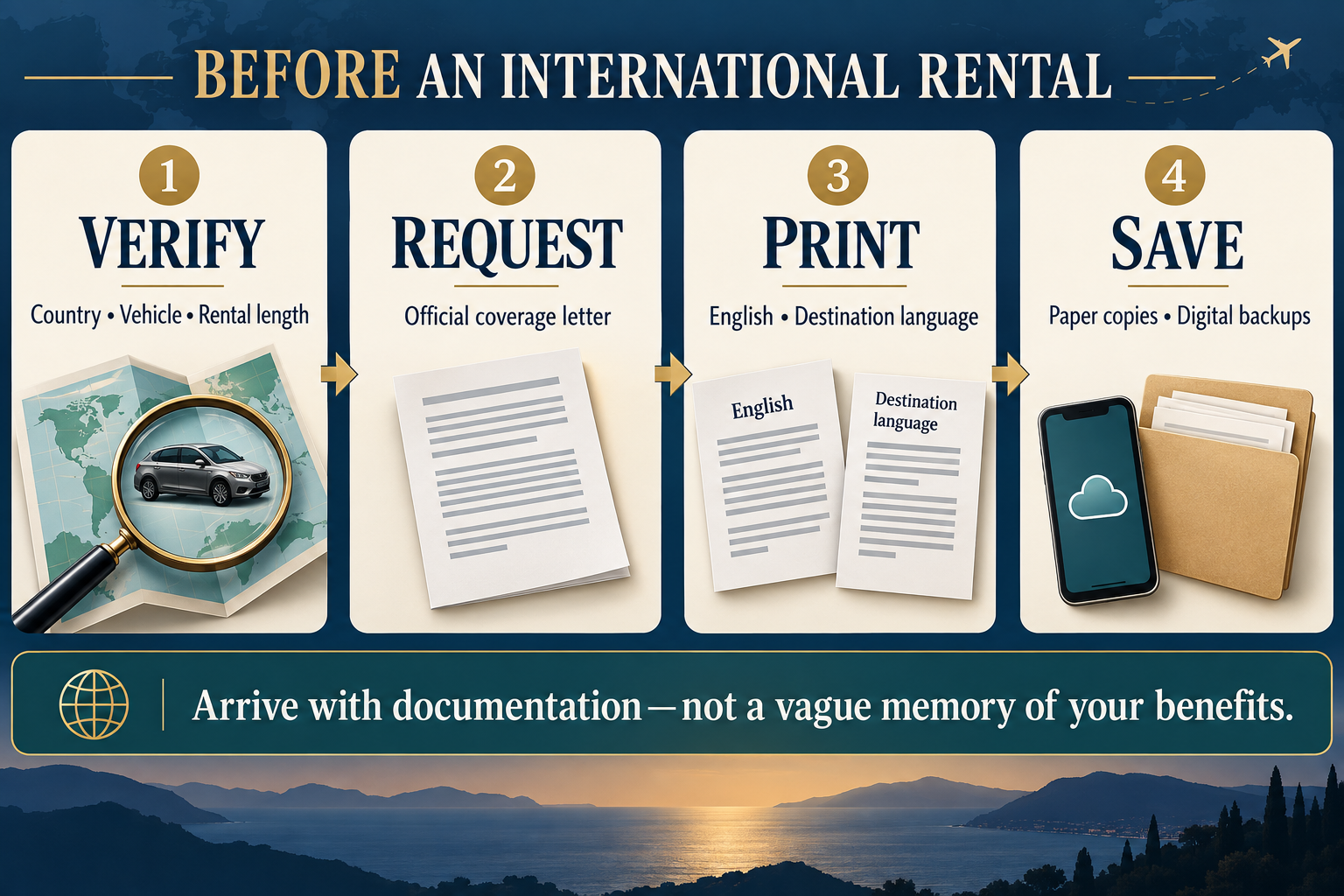
Before an international rental, I request an official coverage or eligibility letter from the card’s benefit administrator.
For a Visa benefit, the letter comes through Visa’s benefit system—not from a rental-counter employee and not from my own homemade summary.
I then:
Print the official letter in English
Print another copy in the destination’s local language when available
Scan the documents
Save digital copies where I can reach them offline
Carry the paper copies with the rental paperwork
Confirm the rental agency’s requirements before departure
The digital copy is useful as a backup.
The printed copy is what I want in my hand at the counter.
A phone battery can die. Airport Wi-Fi can fail. A benefits portal can refuse to load. A printed document does not need a password or cellular signal.
Why I Print the Local-Language Version
During a rental in Paris, I scraped the front bumper while maneuvering through a tight underground parking garage.
Anyone who has driven through one of those garages knows the problem. The ramps can be steep, narrow and tightly curved, with concrete walls that feel uncomfortably close to the vehicle.
The scrape was not catastrophic, but it was noticeable.
When I returned the car at Charles de Gaulle Airport, the employee saw the bumper damage and began documenting it.
I did not argue or try to explain my credit-card benefits from memory. I handed over the official Visa coverage paperwork, including a copy in French.
The employee reviewed it, processed the return and accepted the documentation. I caught my flight and never received a later charge or claim dispute.
I cannot promise every damage return will be that simple. A coverage letter does not eliminate your responsibility to follow the rental agreement or the card’s claim procedure.
But I would much rather begin that conversation with official documentation in the employee’s language than with a screenshot and a nervous explanation.
That is the difference between hoping you are covered and arriving prepared to demonstrate it.
Renting in the United States
Domestic rentals are often simpler—but they are not automatic.
A personal automobile policy may extend some of your existing coverage to a rental vehicle in the United States. The limits, deductibles, covered drivers, vehicle exclusions and permissible uses generally follow the policy’s terms.
Before assuming that protection applies, ask your insurer:
Does my liability coverage extend to a domestic rental?
Does my collision and comprehensive coverage extend?
What deductible applies?
Are loss-of-use or administrative charges covered?
Are all intended drivers covered?
Are there excluded vehicle types?
Does coverage change for a long-term rental?
Does it apply to rentals for business use?
If your personal policy provides adequate liability protection and your card provides qualifying primary collision coverage, declining the rental company’s collision waiver may be reasonable.
But confirm both protections first.
Travelers who do not own a vehicle or carry personal auto insurance should pay particular attention to liability. A credit card’s collision benefit does not magically replace a personal auto policy.
Renting in Scotland and the United Kingdom
Scotland introduces two separate questions:
Will your card benefit apply?
How much could the rental company charge you while a claim is being resolved?
Even when a card covers an eligible collision, the rental agreement may carry a substantial excess—the UK term commonly used for a deductible.
If the vehicle is damaged, the rental company may charge that amount to your card. You may then need to submit the claim and wait for reimbursement.
That creates a cash-flow question as much as an insurance question.
Could you comfortably absorb a large temporary charge? Do you have enough available credit? Are you willing to collect repair estimates, rental documents, photographs and other records after returning home?
For our upcoming Scotland trip, I plan to use the Venture X benefit after reconfirming the current terms, obtaining the official Visa letter and verifying acceptance with the rental company.
I will still compare the cost of reducing the excess.
Sometimes paying for a zero- or reduced-excess option is not mathematically necessary. It may nevertheless be worthwhile if it removes a financial concern from a demanding driving environment.
Driving on the left, shifting with the opposite hand and navigating narrow Highland roads will already require my attention. I do not need to prove anything by accepting more risk than I want.
Renting in Ireland
Ireland is exactly why I do not use the phrase “covered worldwide.”
Some cards exclude both the Republic of Ireland and Northern Ireland. Others may provide coverage, subject to the current benefit terms and the rental agency’s requirements.
My Venture X Visa guide currently lists both as excluded. My Chase Sapphire guide describes worldwide coverage and explains that some countries or rental agencies may require a coverage letter.
That does not mean I would arrive in Dublin with only the card and an assumption.
Before an Irish rental, I would ask the rental company in writing:
Can I decline its collision waiver?
Is a coverage letter required?
How recently must the letter have been issued?
Is a printed copy required?
Does the letter need specific wording?
What coverage remains mandatory or included?
What excess or deposit applies?
Are tires, glass, wheels and undercarriage excluded?
How large will the credit-card hold be?
If the answer remains unclear, purchasing the rental company’s broader protection may be a reasonable choice.
The goal is not to win a confrontation at the counter. The goal is to leave with a legal rental, appropriate protection and no financial surprises.
Renting in Mexico
Mexico presents another reason to separate collision from liability.
A U.S.-issued credit-card benefit may cover eligible damage to the rental vehicle while providing no protection for injuries or damage involving other people and property.
Do not assume that your U.S. personal policy or credit card satisfies the rental’s local liability requirements.
Before booking, ask the company to provide a written explanation of:
Liability coverage included in the quoted price
Liability limits
Optional supplemental liability coverage
Collision or theft waivers
Deductibles
Deposits and credit-card holds
Excluded roads or prohibited uses
Tires, wheels, glass and undercarriage coverage
Accident-reporting procedures
The complete price with mandatory charges
Extremely low advertised rates deserve particular scrutiny. Compare the final price—including required protection and taxes—not merely the daily price displayed in a search result.
Our blue Jeep rental in Cozumel was a memorable part of the trip. It is also a reminder that crossing an international border changes the questions you need to ask.

Our Jeep rental in Cozumel—a reminder that rental-car coverage and legal requirements can change when you cross an international border.
Vehicle Type Can Change the Answer
Even when the destination is covered, the vehicle may not be.
Benefit guides commonly exclude at least some of the following:
Antique vehicles
Exotic or exceptionally expensive cars
Motorcycles and mopeds
Recreational vehicles
Limousines
Cargo vans
Certain passenger vans
Vehicles with open cargo beds
Rentals with a driver
Peer-to-peer car-sharing arrangements
Vehicles used off road
Rentals exceeding the permitted duration
Do not assume an SUV, pickup, van, luxury vehicle or specialty rental qualifies because a conventional sedan would.
This matters when accepting an upgrade, too.
A complimentary move from a midsize sedan into a specialty or high-value vehicle might change the benefit analysis. Confirm that the replacement vehicle remains eligible before driving away.
The Words “Full Coverage” Are Not Enough
“Full coverage” is a convenient sales phrase, not a precise explanation.
Ask the rental agent to identify exactly what the product includes and what it leaves out.
Depending on the location and contract, rental-company products may include some combination of:
Collision or loss damage waiver
Theft protection
Reduced or zero excess
Supplemental liability protection
Personal accident coverage
Personal-effects coverage
Roadside assistance
Tires and glass protection
A collision damage waiver may not technically be an insurance policy. It may instead be an agreement that the rental company will waive or limit its right to charge you for covered damage.
The practical question remains the same:
What can the company still charge you if something happens?
Ask about exclusions involving tires, wheels, windshields, roofs, interiors, keys, misfueling, undercarriages and unauthorized roads or drivers.
A Credit-Card Benefit Is Usually Reimbursement
Even with primary coverage, do not assume you can hand the keys back and walk away without any financial exposure.
The rental company may charge your card for damage or retain some or all of the deposit. You may then need to file a claim with the benefit administrator.
That claim may require:
The initial and final rental agreements
A police or accident report
Photographs
A repair estimate
An itemized repair bill
Proof of payment
A demand letter from the rental company
Credit-card statements
Evidence that you declined the rental company’s waiver
Other documents requested by the administrator
Report damage promptly. Claim-notification and documentation deadlines vary by card.
Keep every record until the rental is closed, the final receipt is correct and any claim is fully resolved.
Inspect the Vehicle Before Leaving
Insurance questions should not distract you from documenting the vehicle itself.
Before driving away, photograph or record:
Every side of the vehicle
Bumpers and body panels
Wheels and tires
Windshield and other glass
Roof, when safely visible
Interior condition
Existing scratches, dents and stains
Odometer
Fuel gauge or battery level
Make sure existing damage is recorded through the rental company’s designated procedure.
After returning the vehicle, retain the photographs until the final receipt is settled.
Should You Buy the Rental Company’s Coverage?
There is no universal answer.
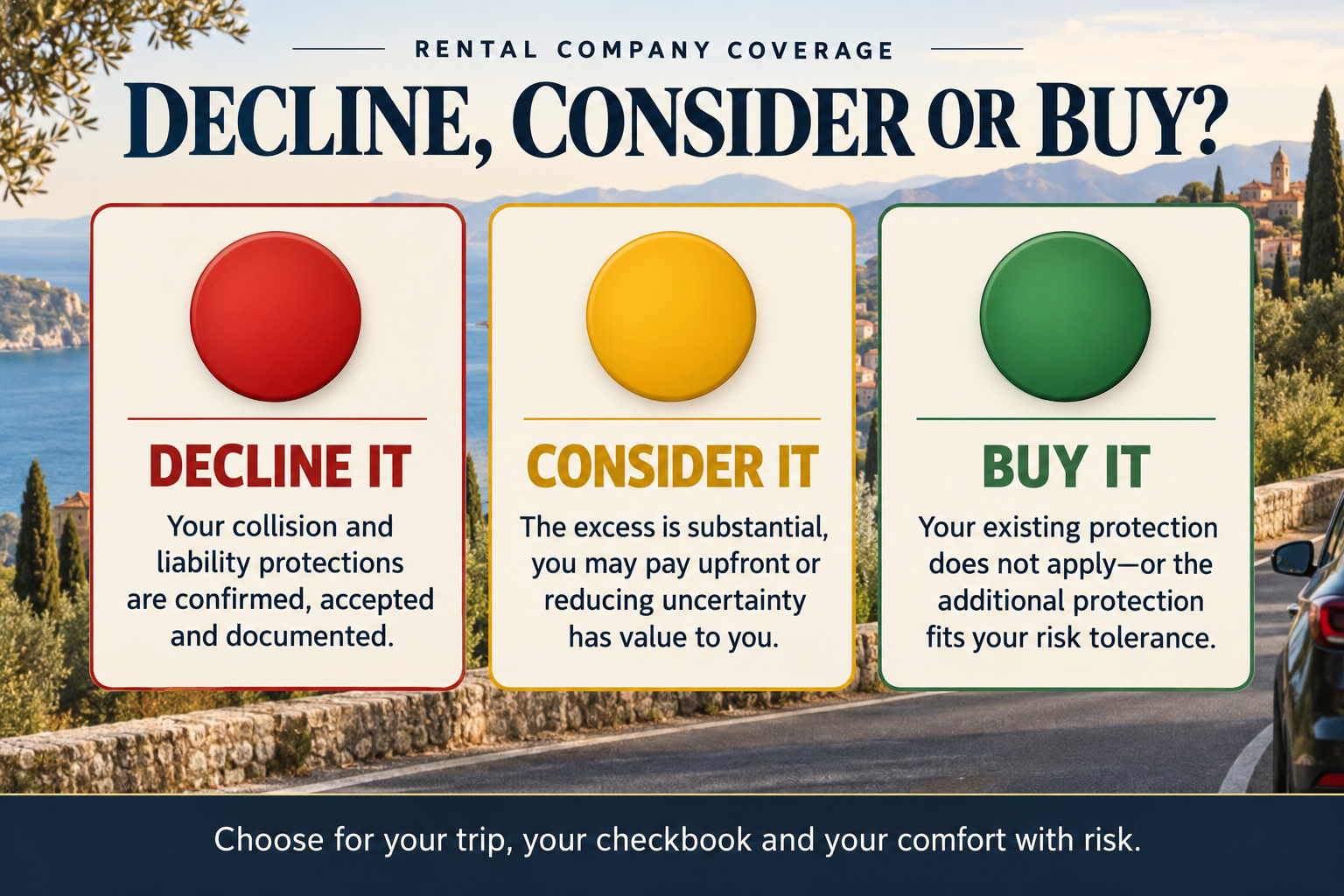
🟢 Buy it
Consider buying the rental company’s protection when your existing collision or liability coverage does not apply, the card excludes the country or vehicle, or the additional protection fits your tolerance for risk.
It may also make sense when you want to reduce a substantial excess or avoid carrying a large temporary charge while seeking reimbursement.
🟡 Consider it carefully
Pause when your card appears to provide collision coverage but leaves uncertainty around liability, excluded damage, deposits, local acceptance or the claims process.
Compare the full-trip price—not merely the daily add-on.
Then decide whether reducing that uncertainty is worth the cost to you.
🔴 Decline it
Declining the rental company’s collision waiver may be reasonable when your collision and liability protections are confirmed, the rental agency accepts them, the vehicle and rental duration qualify, and you have the required documentation.
Do not decline simply because someone online said premium cards cover everything.
My Before-You-Rent Checklist
Before every significant rental, especially overseas, I want clear answers to these questions:
What protects the rental vehicle?
What provides third-party liability protection?
Is the card coverage primary or secondary?
Is the country covered?
Is the exact vehicle category covered?
Is the complete rental duration covered?
Must I decline the rental company’s CDW or LDW?
Must I pay the entire rental with the eligible card?
Are all drivers named on the agreement?
Does the rental company require a coverage letter?
What excess, deposit or credit-card hold applies?
What damage categories are excluded?
What documents and deadlines apply after a claim?
Could I comfortably pay a large charge while awaiting reimbursement?
If I cannot answer those questions, I am not ready to decline coverage.
The Bottom Line
Rental-car insurance should not be decided through panic, pride or a half-remembered internet post.
A premium travel card can provide extremely valuable collision protection. It does not necessarily provide liability coverage, eliminate every deductible, cover every destination or spare you from paying a damage charge upfront.
Personal auto insurance may fill some gaps at home while doing little or nothing overseas.
The rental company’s protection may be overpriced for one trip and worth every penny for another.
My approach is straightforward:
Verify the card. Verify the country. Verify the vehicle. Verify the liability protection. Bring the paperwork.
Then decide what fits your trip, your checkbook and your comfort with risk.
That is not fear-driven travel.
It is prepared travel.