

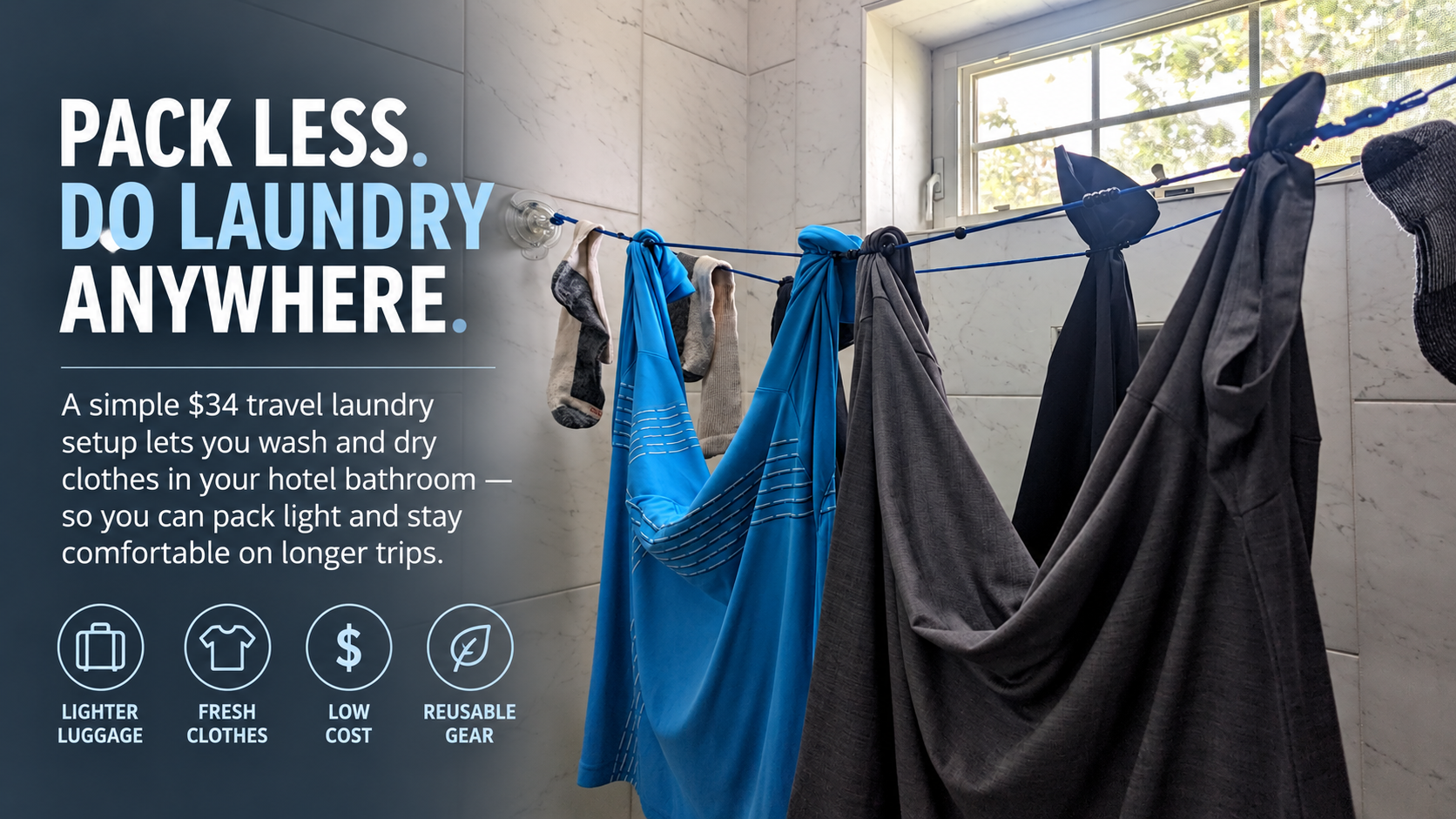
The $34 Travel Laundry Kit I’m Taking on a 20-Day Trip
Pack less of what takes up space. Pack enough of what doesn’t.
Affiliate Disclosure: This article contains affiliate links. If you make a qualifying purchase through these links, Curated Upgrades may earn a commission at no additional cost to you. As an Amazon Associate I earn from qualifying purchases.
We leave home in mid-April and won't return until early May.
That's 20 days on the road.
I could pack 20 days of clothes. We're checking bags, so technically I have the room. But I don't particularly want to drag nearly three weeks of clothing around Scotland, unpack it, repack it, carry it into small B&Bs and hotels, and then bring half of it home barely worn.
So I started looking at the problem differently.
Instead of asking:
“How many clothes do I need for 20 days?”
I asked:
“How little clothing can I comfortably bring if I can wash some of it along the way?”
That led to a travel laundry setup that cost me about $34, takes up very little room in a suitcase and, except for the detergent, should be reusable trip after trip.
But before trusting it for 20 days in Scotland, I wanted to know whether it actually worked.
So I soaked some clothes.
Really soaked them.
The Goal Isn't to Pack 20 Days of Everything
I'm not trying to travel for three weeks with two shirts and a toothbrush.
There's a point where packing lighter stops making travel easier and starts becoming a hobby.
My goal is much simpler:
Pack less of what takes up space. Pack enough of what doesn't.
If I ultimately bring something like four pairs of trousers and seven shirts for a 20-day trip, that's a substantial reduction from packing a fresh outfit every day.
Socks?
If I bring 20 pairs of socks, I'm perfectly fine with that.
Twenty pairs of socks take up considerably less suitcase space than another dozen pairs of trousers.
The trick is figuring out which clothes are worth washing along the way.
I Don't Want to Spend an Afternoon Doing Laundry
There are plenty of other ways to handle laundry on a long trip.
We could find a laundromat. We could use a hotel laundry service. In some towns, we might find a wash-and-fold service where we can drop everything off and collect it later.
And we may do exactly that at some point.
But on a 20-day road trip through Scotland, I don't want laundry becoming part of the itinerary unless it needs to be.
Our typical afternoon might have us checking into a hotel or B&B around 3:00 or 4:00. One of us can start unpacking and setting up the CPAP machines while the other sets up the clothesline and washes a few things in the sink.
Within about 30 minutes, we can be back out the door for dinner or another couple of hours exploring.
The laundry can dry while we're doing something we'd rather be doing.
And carrying the kit changes the hierarchy.
The laundromat or laundry service becomes Plan B.
Maybe we hit several damp days and things aren't drying. Maybe we've accumulated more laundry than makes sense to wash in a sink. Maybe we happen across a convenient laundromat or an inexpensive wash-and-fold service near one of our longer stops.
Fine.
The point isn't to avoid laundromats at all costs.
It's to avoid having to find one.
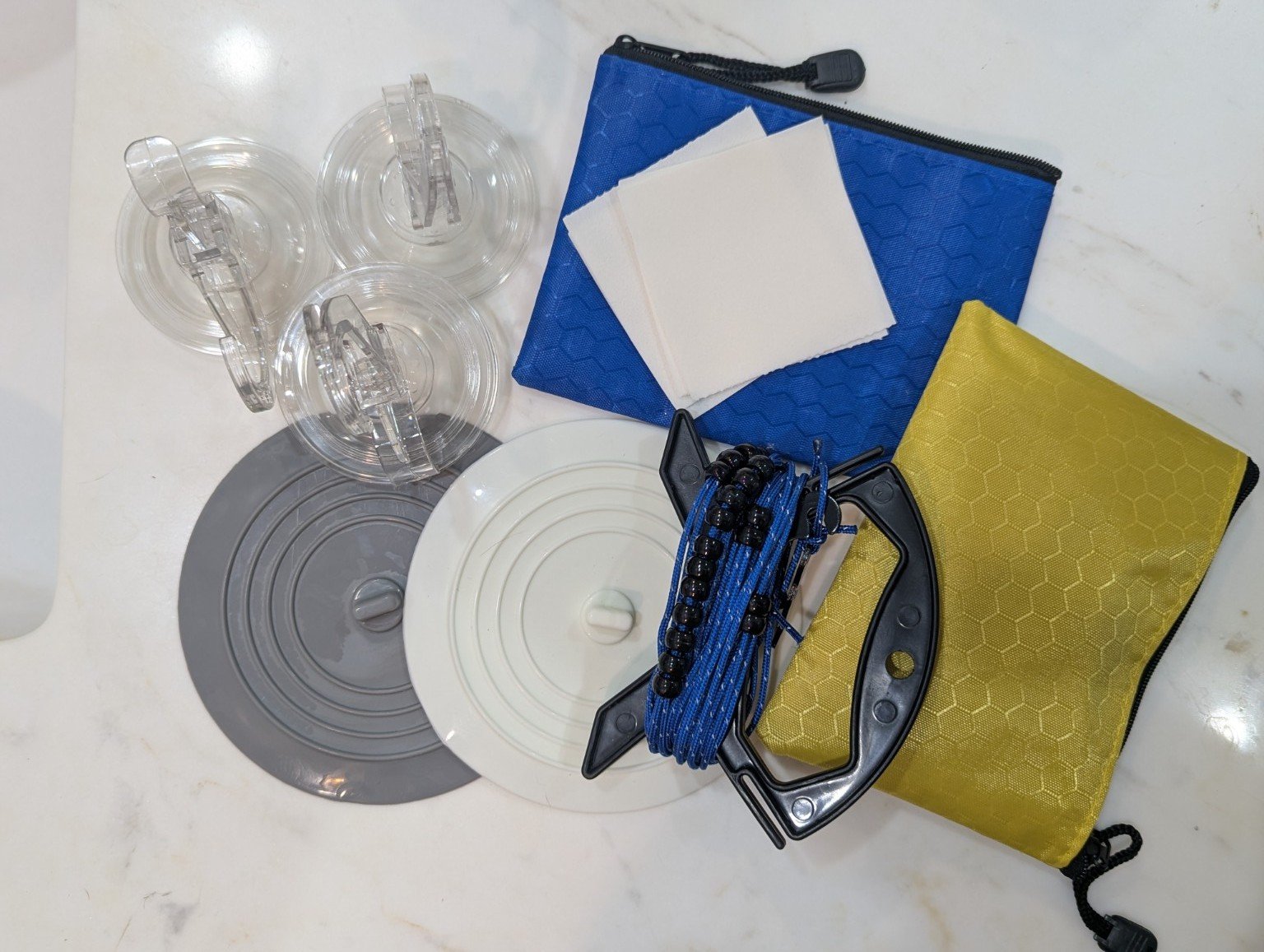
My $34 Travel Laundry Setup
Nothing here is particularly sophisticated.
That's part of the appeal.
The setup starts with the OWLDACIOUS two-pack travel clothesline, which cost me $9.99. Each line is about 11.5 feet long and has sliding beads that can hold clothing without separate clothespins. Each also winds onto its own holder and fits inside a small zippered pouch.
I added an Antimbee three-pack of reusable suction-cup hooks for $9.96. These aren't my preferred attachment points. They're backups for bathrooms where I can't find anything solid to secure the clothesline to.
Then came a V-TOP two-pack of 5-inch silicone drain stoppers for $3.96. Hotel and B&B sinks aren't standardized. Instead of trusting whatever stopper happens to be installed, the flat silicone disc simply covers the drain.
Finally, I bought Fisroa laundry detergent sheets for $9.85 for 150 perforated sheets.
Total purchase price: $33.76.
And even that number is slightly misleading.
The photograph above shows everything I bought. I don't need to carry both drain stoppers or the entire package of detergent sheets. More importantly, the clotheslines, suction cups and drain stopper aren't consumed when I use them.
They're reusable.
The only thing I'm really consuming every time I wash clothes is a tiny piece of detergent.
Prices are what I paid and can change.
One Detergent Sheet Becomes Four Sink Washes
The detergent sheets are perforated. The package contains 150 full sheets and is marketed as providing up to 300 loads when the sheets are divided.
For a few pieces of clothing in a bathroom sink, I went smaller.
I separated each full sheet into quarters.
That means my $9.85 package potentially gives me 600 quarter-sheet portions.
For my testing, one quarter was plenty for a small sink wash. Before traveling, I'll separate however many pieces we expect to need and put them in a small Ziploc bag to keep them dry.
No bottle. No liquid. Almost no space.
And at $9.85 for 600 quarter-sheet portions, the detergent itself costs roughly 1.6 cents per sink wash.
Of course, detergent wasn't really the part I was worried about.
I wanted to know whether I could fill a bathroom sink in the first place.
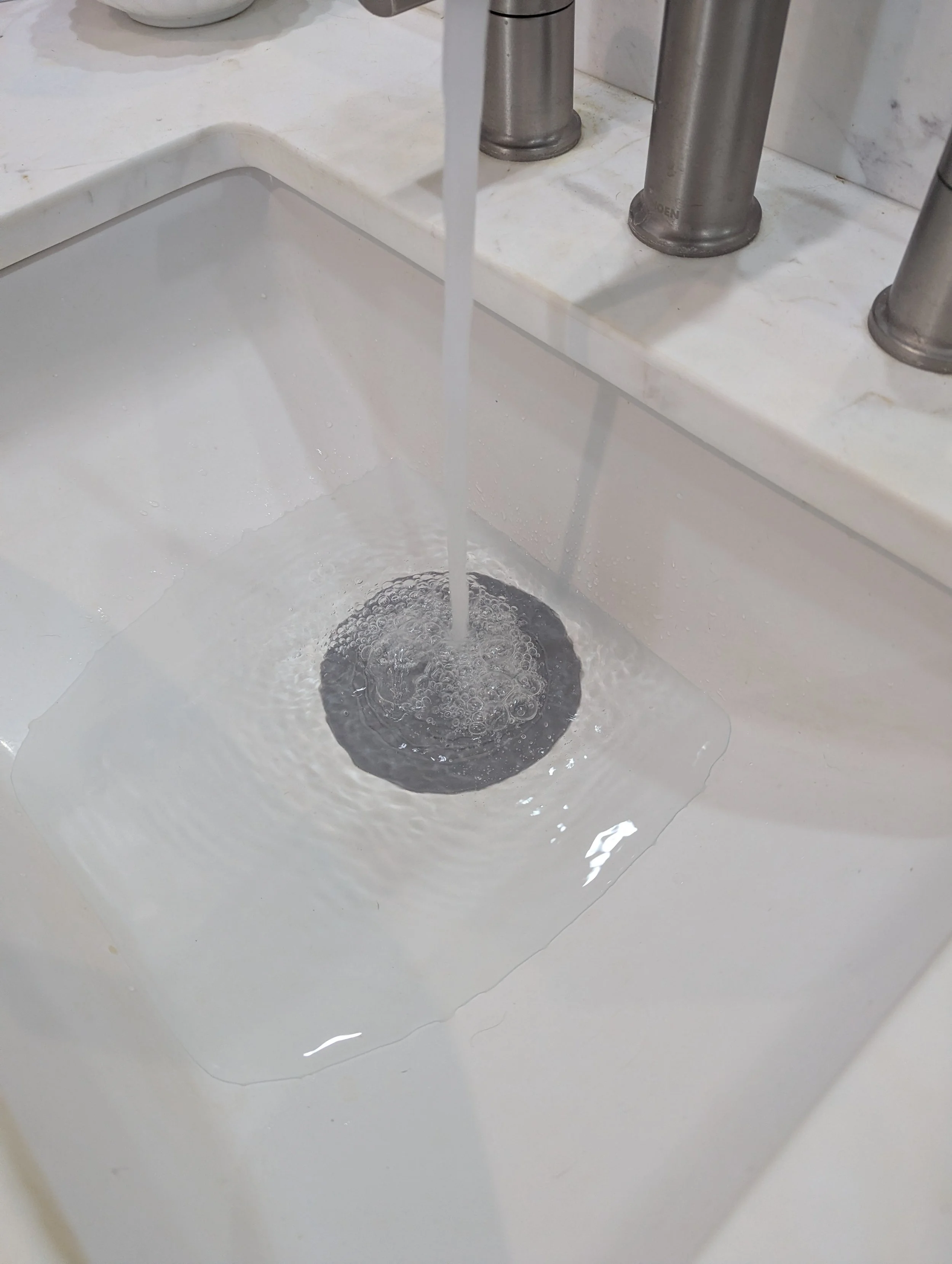
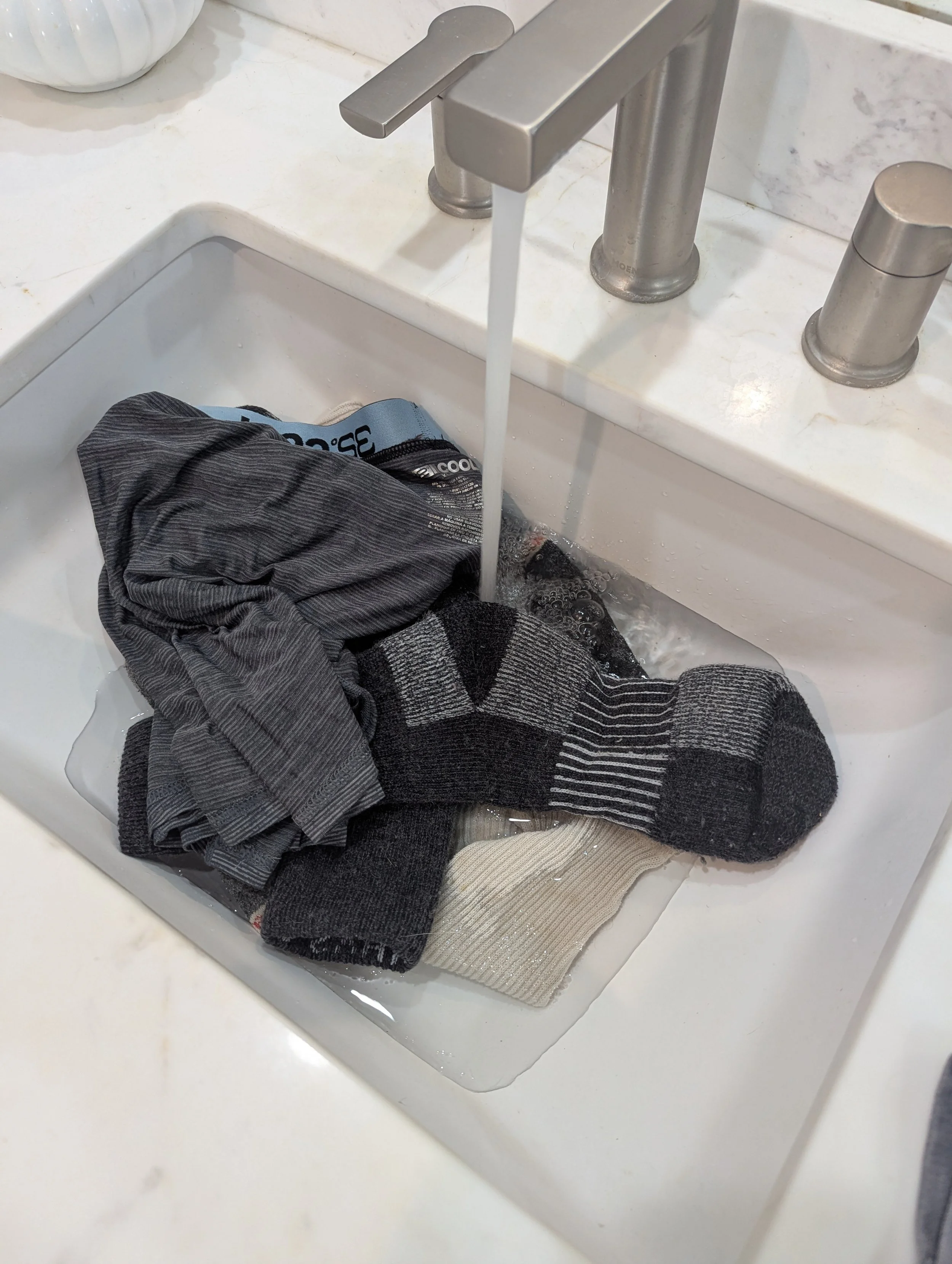
The flat stopper worked exactly as intended.
Cover the drain. Fill the sink. Now I have a wash basin.
For the test, I soaked the clothes thoroughly and then gently wrung them out by hand.
No washing machine.
No spin cycle.
And deliberately, no towel-roll trick to remove additional moisture before hanging them.
I wanted to see what the drying setup could handle without giving it much help.
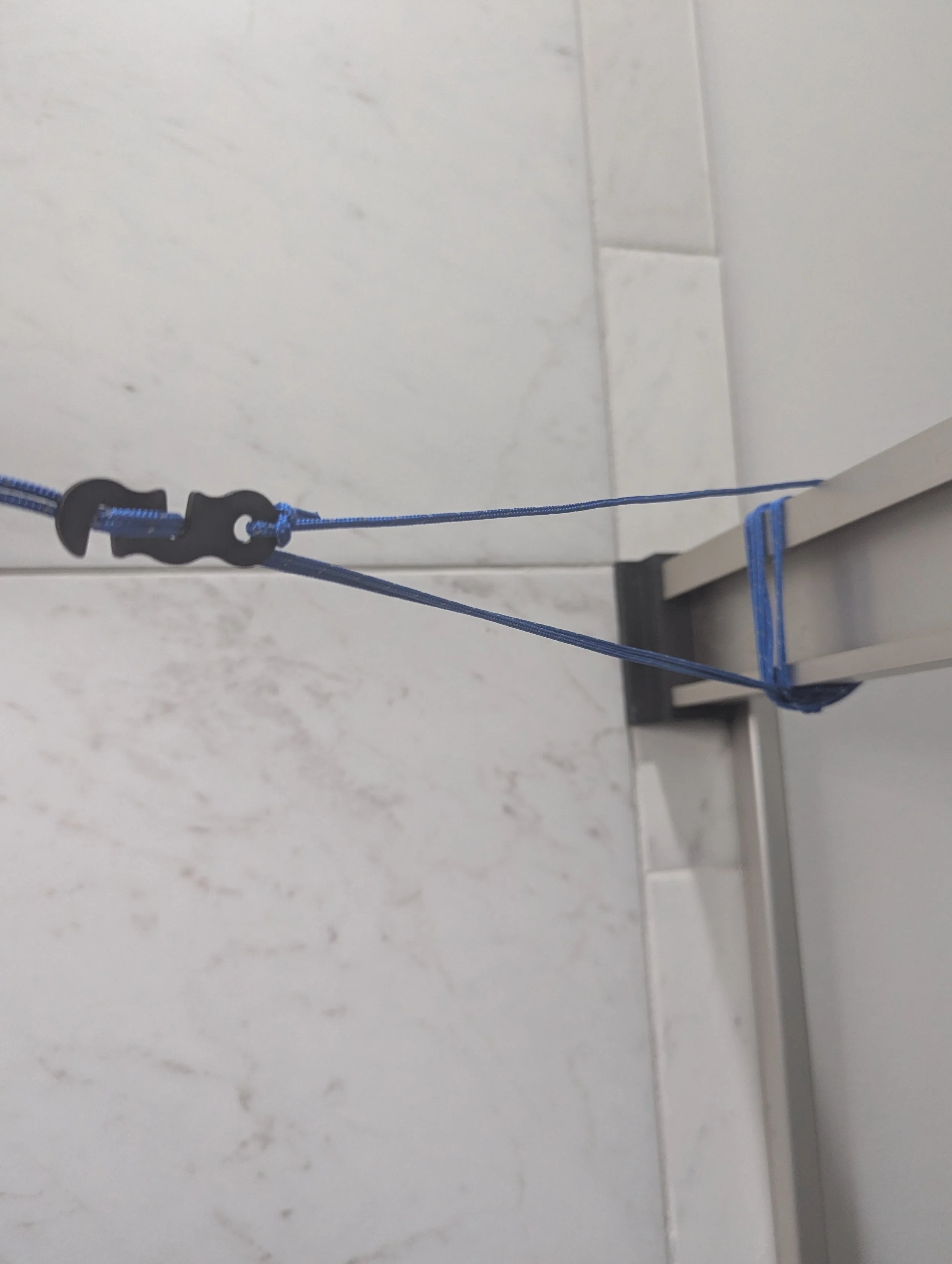
First Test: Can I Actually Turn a Bathroom Into a Laundry Room?
My first clothesline setup was easy.
I attached the lines to solid points already available in our shower.
It was extremely secure.
Even loaded with very wet clothing, I wasn't particularly concerned about the attachment points.
And then I realized something.
I had designed a terrific travel laundry setup...
for my bathroom.
We're going to be staying in a series of hotels, guest houses and B&Bs. I have no idea what each bathroom will look like or whether I'll conveniently find two solid attachment points exactly where I need them.
That's why I added the suction cups.
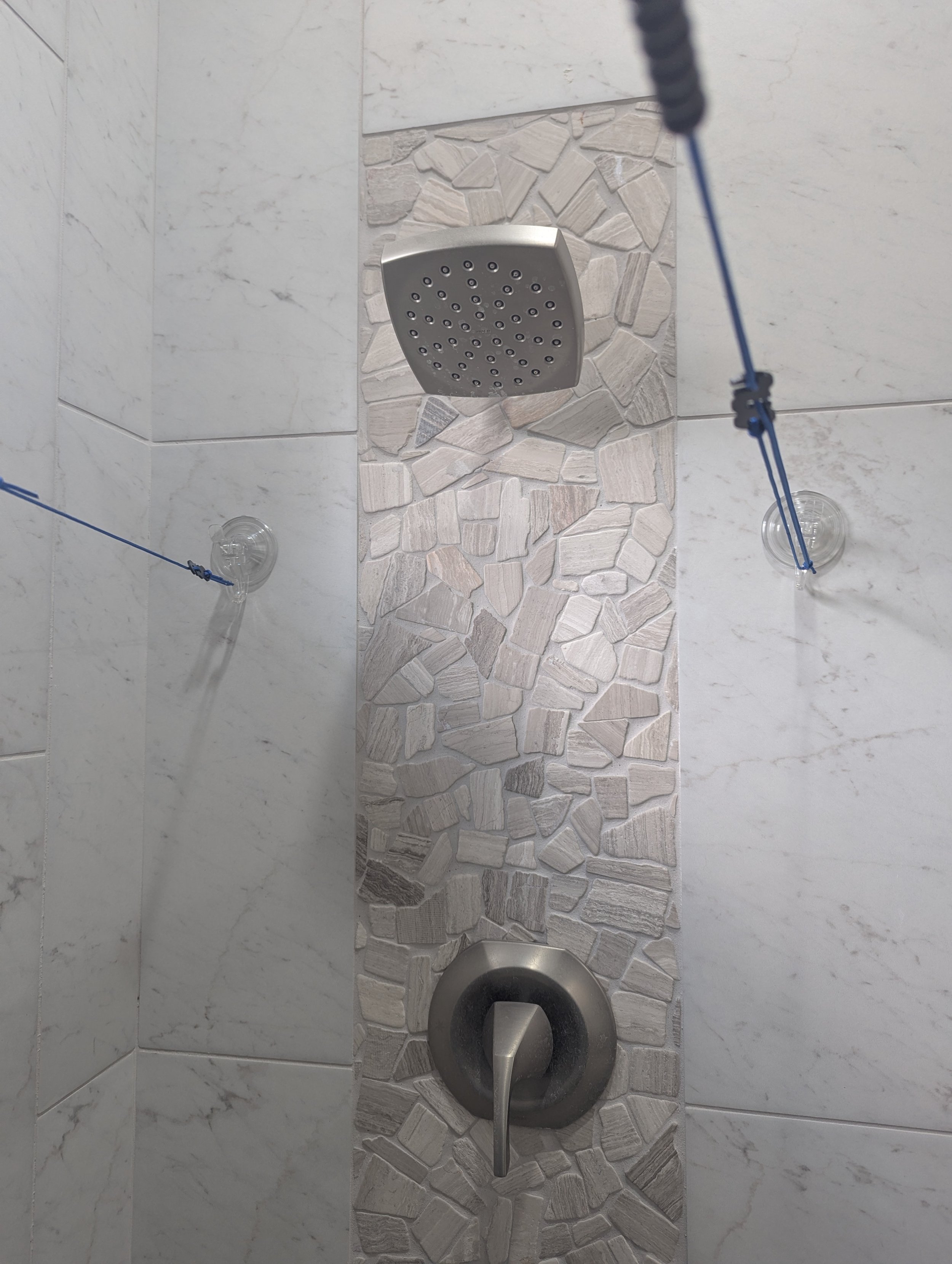
The Suction Cups Worked. With an Asterisk.
The suction-cup hooks I bought are advertised to support up to 11 pounds each.
They stuck extremely well to the smooth shower wall.
But my testing exposed something that an 11-pound rating doesn't really tell you:
The direction of the load matters.
A hook holding something straight down isn't experiencing the same forces as a hook being pulled sideways by a tightly tensioned clothesline.
With my entire load of soaking-wet clothing on the lines, including a wet pair of trousers, one suction cup eventually came away from the wall.
That was probably the most useful failure of the entire test.
I removed the trousers.
The suction cups held the remaining laundry without a problem.
Then I hung the wet trousers directly from the suction-cup hooks by their belt loops.
Now the weight was pulling much more vertically instead of yanking sideways against a tensioned clothesline.
That held.
So I've already developed my first rule for using this setup on the road:
Use solid fixtures as clothesline anchors whenever they're available. Use the suction cups when you need them, but keep the heaviest wet items off a horizontally tensioned line.
That's something I wouldn't have learned from the product listing.
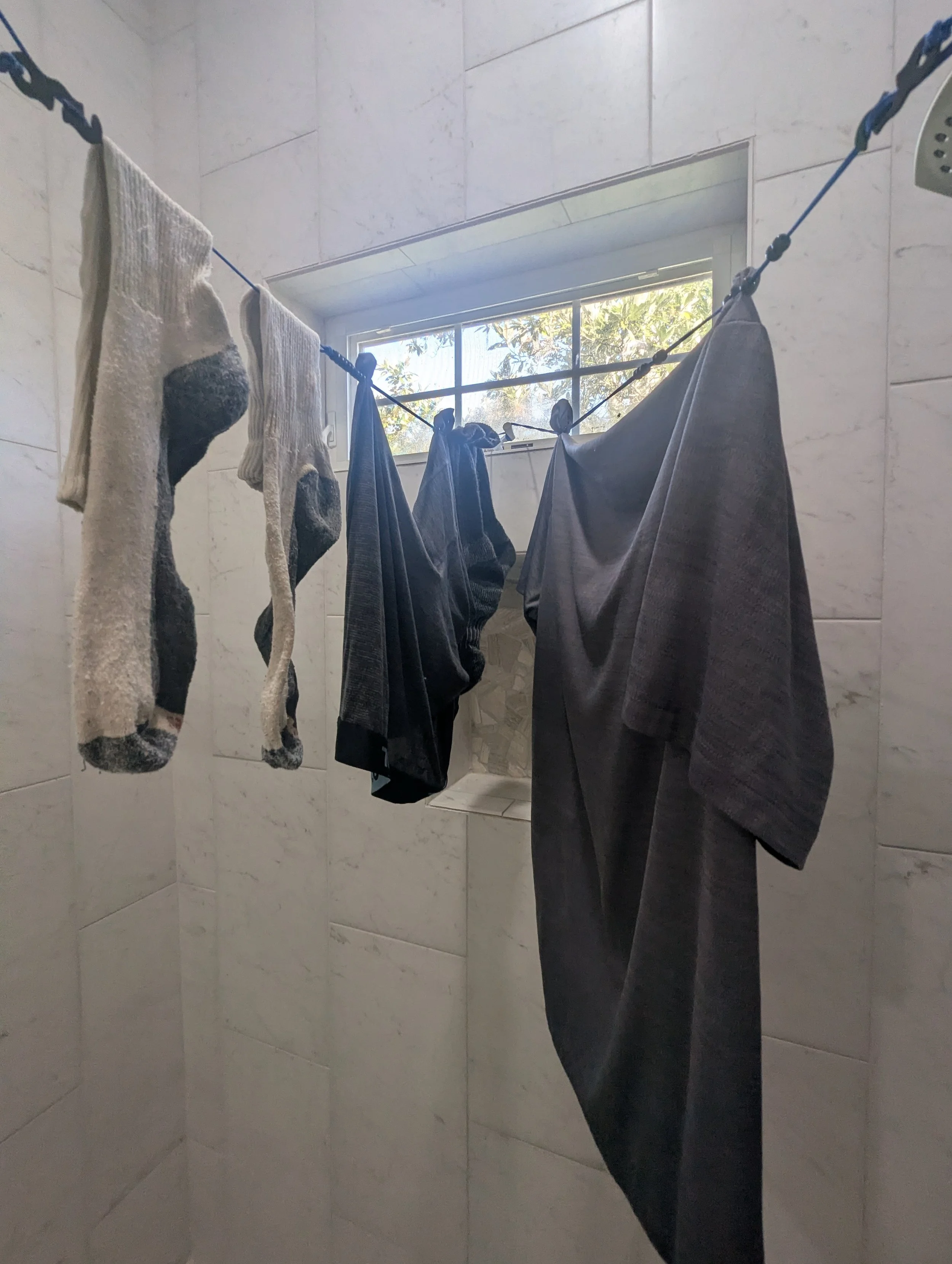
No Clothespins Required
The clotheslines have another feature I particularly like.
Instead of carrying clothespins, you pull a small section of the garment between two of the sliding beads.
That worked with the shirts, underwear and socks I tested.
When I'm finished, the lines wind back onto their holders and disappear into their little storage pouches.
It's a surprisingly compact solution.
But attaching wet clothes to a line isn't much of an accomplishment.
The real question was whether they'd actually be wearable the next morning.
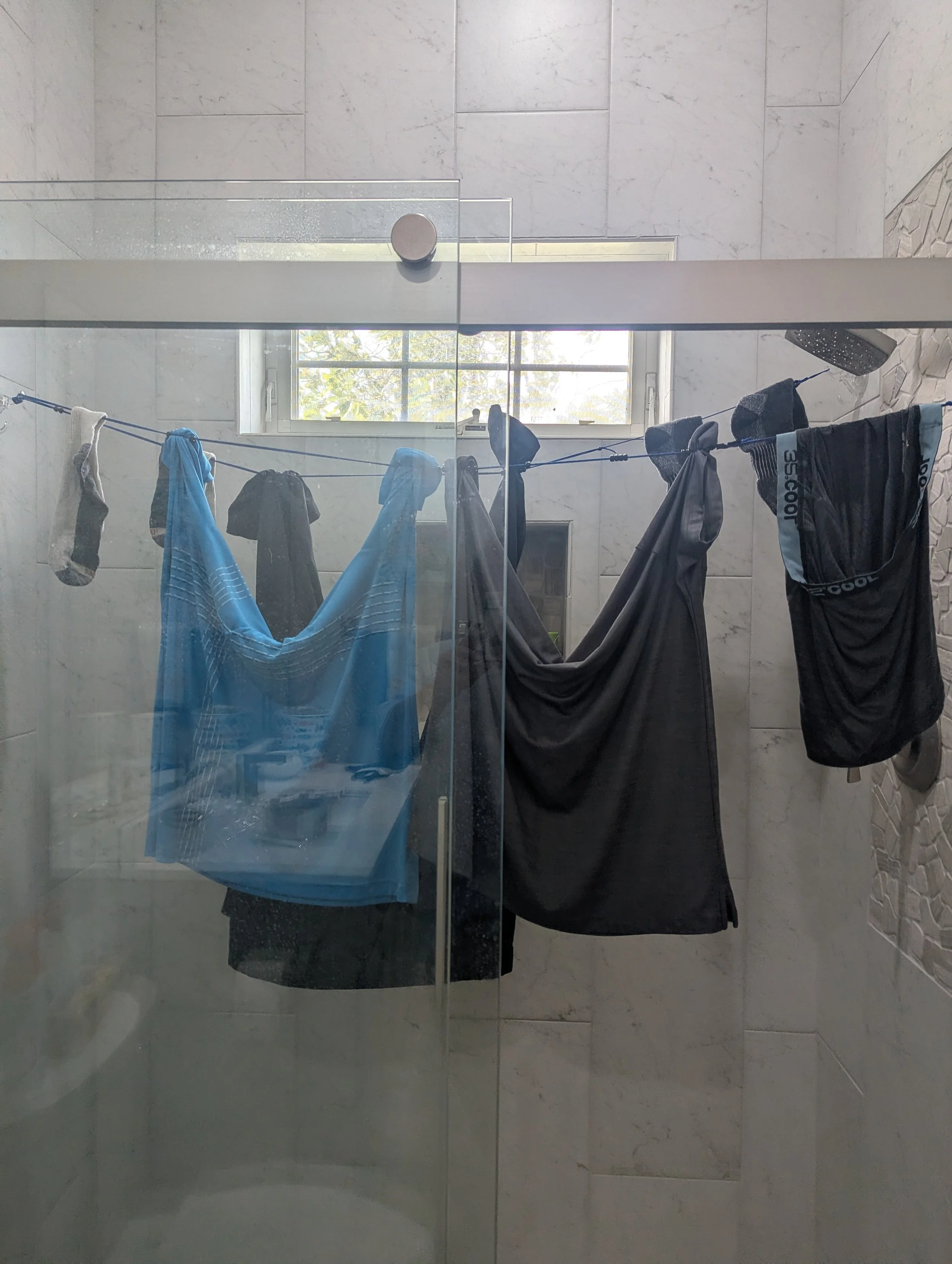
Then I Tried to Make the Drying Test Fail
My intended routine in Scotland is pretty straightforward.
Check in sometime in the afternoon.
Get settled.
Wash a small load.
Hang it.
Go out for dinner or explore.
Come back. Sleep. Pack everything the next morning.
So I tried to recreate that at home, except I deliberately made the drying conditions pretty lousy.
My final test load consisted of one pair of quick-dry trousers made from roughly 90% polyester, two quick-dry golf shirts, one pair of poly/spandex briefs, one pair of wool socks and one pair of everyday athletic cotton socks.
And I didn't merely dampen them for the photograph.
I soaked everything.
Everything went up at approximately 4:00 PM.
Then I shut the bathroom door.
No exhaust fan.
No fan blowing into the room.
No intentional air circulation.
The house was around 75°F.
I had gently wrung out the clothing by hand but hadn't rolled it in towels or done anything else to speed the process.
Then I waited.
Six Hours Later
At around bedtime, roughly six hours after I'd hung everything, there was already a noticeable difference between the fabrics.
The briefs were almost dry.
The quick-dry golf shirts were still damp, but getting close.
The trousers were a little wetter, particularly around the heavier waistband.
And the socks?
They weren't close.
So I left everything hanging and went to bed.
The 5:00 AM Test
At about 5:00 the following morning, roughly 13 hours after I'd hung the laundry, I checked again.
The trousers were dry.
Both golf shirts were dry.
The briefs were dry.
The socks weren't.
They were still damp from the top toward the toes. The toe areas retained enough moisture that I could actually wring some additional water out.
That's a pretty dramatic difference.
But I don't consider it a failure.
I consider it useful information.
The Clothes Matter as Much as the Clothesline
The trousers surprised me most.
After discovering the limitations of using suction cups to anchor a heavily loaded clothesline, I'd hung the trousers directly from the hooks by their belt loops.
That left them only about an inch away from the shower wall.
I expected the wall-facing side to remain damp.
It didn't.
They were dry the next morning.
I've since repeated the experiment with trousers simply folded over a clothes hanger.
They still dried overnight.
Would I try this with jeans?
Not a chance.
A heavy pair of cotton jeans presents an entirely different drying problem.
And that's when this experiment stopped being merely a test of four pieces of laundry gear.
The clothesline matters.
The drain stopper matters.
The detergent matters.
But the clothing you choose matters just as much.
The Socks Took Two Nights. And That's Fine.
I left the socks hanging.
After a second night, they were dry.
That gives me a perfectly workable strategy.
At a two-night stop, I can wash socks.
At a one-night stop, I probably won't.
Or I can simply bring enough socks that it doesn't matter.
Because they're socks.
If I ultimately bring something around 20 pairs of socks, four pairs of trousers and seven shirts for 20 days on the road, I still consider that a win.
I'm not trying to win a minimalist-packing contest.
I'm trying to reduce the bulky stuff.
There's no prize waiting at Edinburgh Airport for the traveler with the fewest socks.
This Isn't Really About Doing Laundry
That's what surprised me about this experiment.
I started out testing clotheslines, suction cups, detergent sheets and a drain stopper.
But those aren't really the upgrade.
The upgrade is needing fewer clothes.
For about $34, I now have a laundry setup that can travel with us repeatedly. Almost everything is reusable. The only ongoing consumable costs pennies per hand wash.
More importantly, my initial test showed that the quick-dry clothing I'm deliberately choosing for Scotland can survive a sink wash late in the afternoon and, even under intentionally poor drying conditions, be ready to wear the next morning.
The socks need longer.
So I'll bring more socks.
Problem solved.
The Home Test Passed. Now I'm Taking It on the Road.
There's an important caveat to everything above.
My bathroom is not Scotland.
This test happened in a Georgia house at around 75°F.
A hotel room in Scotland in April could be cooler. It could be warmer. It could be more humid or considerably drier. The bathroom might have excellent ventilation or almost none.
I don't know.
And I'm not going to pretend that one home test proves otherwise.
That's why this isn't the end of the experiment.
It's the beginning.
Before Scotland, this little kit is coming on a couple of shorter trips with us.
On an upcoming weekend hotel stay, I'll wash something simple, probably one pair of quick-dry trousers, and see what happens overnight in an unfamiliar bathroom.
Later, we'll take the kit to Montana. We'll actually have a washer and dryer available there, which makes it a perfect low-risk test. I won't need to hand wash anything. I can wash one pair of trousers in the sink anyway and see how the system performs in a very different environment.
Then comes Scotland.
Twenty days on the road.
Different hotels and B&Bs. Different bathrooms. Different temperatures. Different humidity.
That's when I'll find out whether this little setup genuinely keeps laundry from becoming part of the itinerary.
I'll update this article as the road tests come in.
Pack It or Pass It?
🟢 PACK IT: The basic system
For about $34, the home test was convincing enough that the kit has earned a place in our Scotland luggage.
🟢 PACK IT: Quick-dry shirts, trousers and underwear
All were dry the following morning despite deliberately unfavorable test conditions.
🟡 EVALUATE: Suction cups as clothesline anchors
They're useful backup equipment, but an advertised vertical weight rating doesn't tell you how they'll respond to the sideways forces created by a heavily tensioned clothesline. I'll use fixed anchor points whenever possible.
🟡 EVALUATE: Socks
They dried, but needed two nights under my test conditions. I'll either wash them during longer stays or simply pack more of them.
🔴 PASS IT: Jeans for sink-wash-and-wear travel
At least for me.
I'm not interested in spending a Scottish vacation wondering whether a pair of wet denim will become wearable sometime before we fly home.
The lesson so far isn't that everyone needs to hand wash their clothes on vacation.
It's much simpler:
Pack less of what takes up space. Pack enough of what doesn't.
And if this system works the way I hope it will, the laundromat stays exactly where I want it:
Plan B.