

Traveling With an Aging Parent
Plan for the person they are today, remove the friction, and make the time together count.
I see variations of the same question in travel forums all the time.
"My parents are getting older, and I want to take them on a big trip. How do I plan it without exhausting them?"
Sometimes the question comes from the other direction:
"I'm in my late 70s. Is it too late for me to start traveling?"
The answers usually head straight for logistics. Travel insurance. Mobility assistance. Accessible hotel rooms. Compression socks. Cruise itineraries.
Those things can absolutely matter.
But after traveling with my own parents as they got older, and eventually as Alzheimer's changed our family, I've come to think the most important part starts somewhere else.
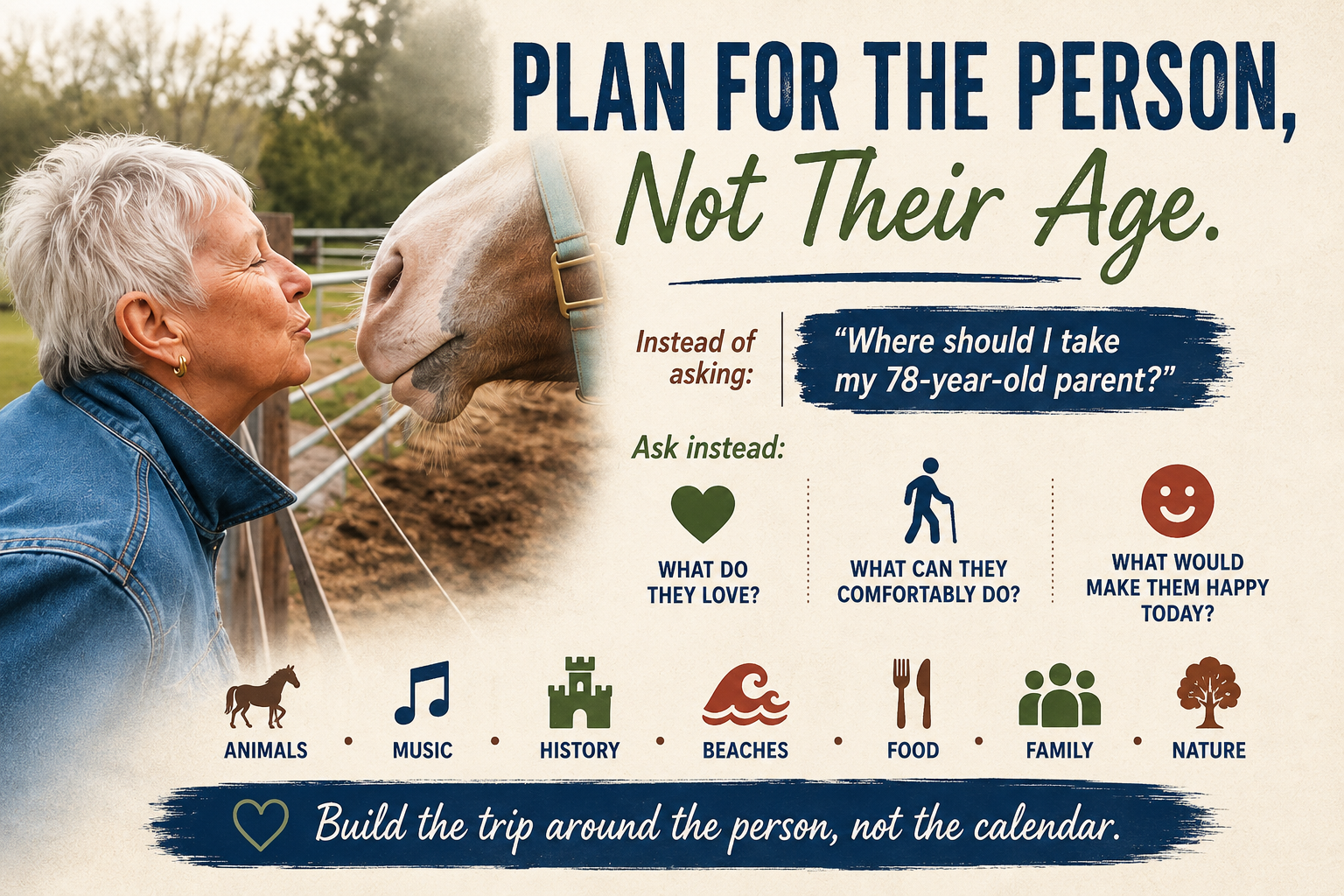
Plan for the person, not their age.
What do they love? What can they comfortably do now? What would make them happy?
Then build the easiest version of that trip you can.
Because traveling with an aging parent isn't about helping them see as much of the world as possible before time runs out.
It's about meeting them where they are right now and finding a way to share some of the world with them.
Don't Wait for the Milestone
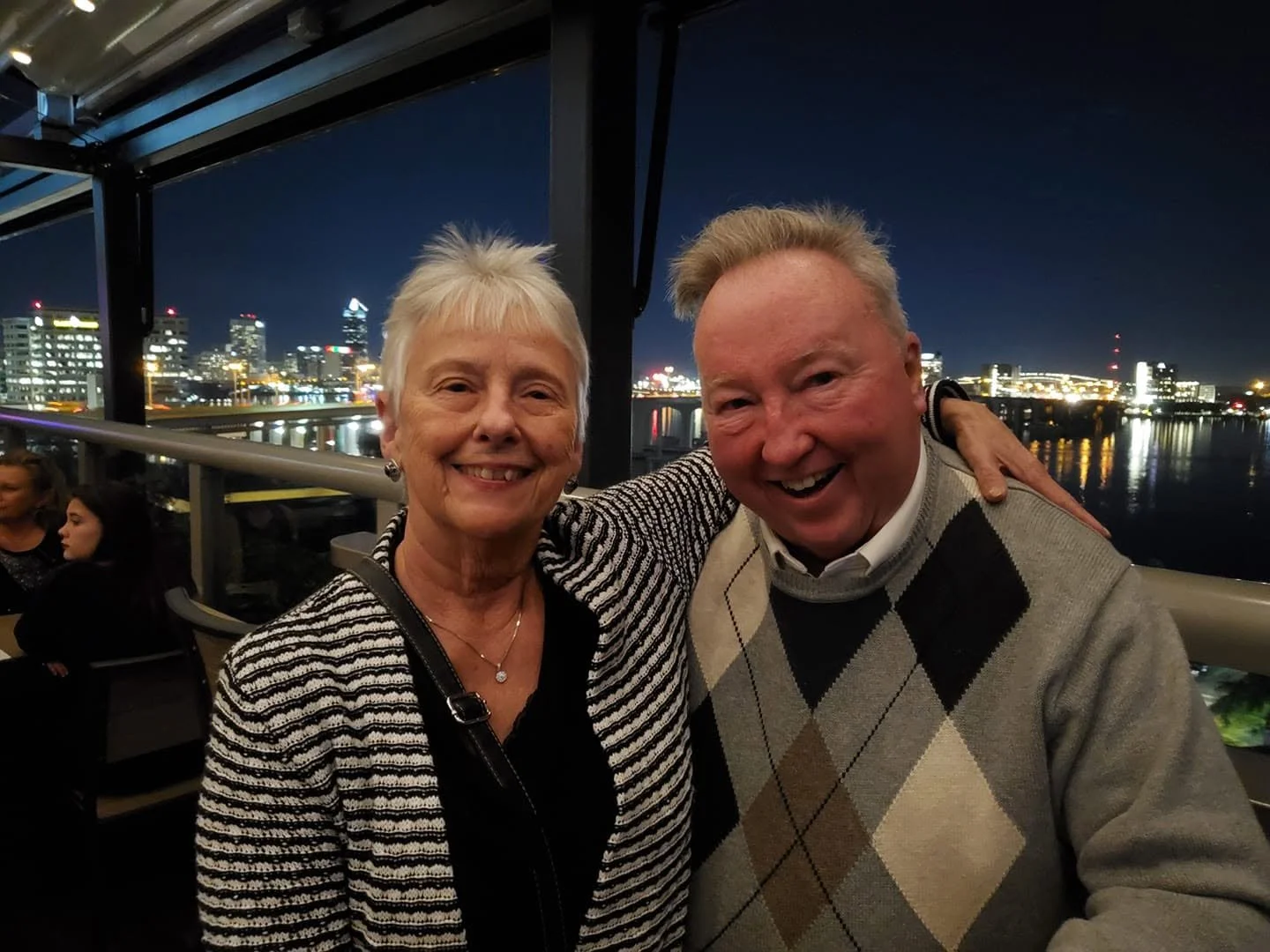
My dad and stepmom, Sue, honeymooned on Cape Cod.
They loved it there. They even named the first of several cockapoos they would own Pebbles, inspired by the rocky beaches.
I had always thought their 50th wedding anniversary deserved something special.
Then Alzheimer's changed the calendar.
As Sue's condition deteriorated, it became pretty obvious that waiting for the actual milestone didn't make much sense. Even if she lived long enough to reach their 50th, there was no guarantee the Sue who loved Cape Cod would still be able to experience returning there.
Their anniversary was November 28, so we decided to stop waiting.
We went for Thanksgiving week.
I booked nonstop flights from Jacksonville to Boston for five of us. Gina and I went, our son Owen came along, and so did Dad and Sue. We rented a minivan and a three-bedroom house right on the beach.
Dad and Sue got the master suite with an ocean-view balcony.
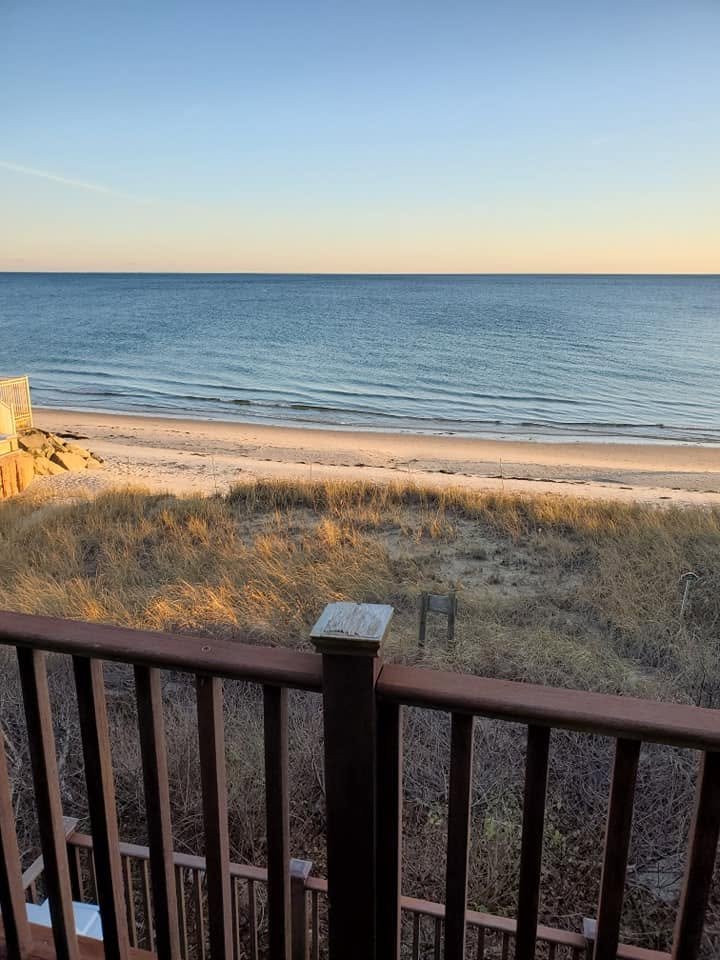
Sometimes the best upgrade isn't another activity. It's giving someone a place where they can sit, relax and simply enjoy being there.
We didn't do anything particularly spectacular that week.
And that's one of the reasons I remember it so fondly.
We drove around. We found a few restaurants that were still open in the off-season. We watched the ocean. A lone fox wandered through the yard a couple of times.
Mostly, we listened to Dad reminisce about a place that meant something to him.
For Thanksgiving, Dad and I bought lobster and scallops from a local fishmonger and cooked dinner together.
Then, with three days left before we were flying home, Dad went to the grocery store and apparently provisioned us for winter.
He came back with two enormous pies, two bottles of wine and a large bottle of vodka.
The women didn't drink.
We were leaving in three days.
Somehow, Dad remained confident in his purchasing decision.
But there was another purpose to that week that had nothing to do with Cape Cod.
Dad had become Sue's full-time caregiver, and it was taking a toll. With all of us there, he didn't have to carry everything himself.
During that week, Sue also became particularly attached to Gina. Gina became her person, her BFF.
And somewhere between watching the ocean, cooking Thanksgiving dinner and simply spending time together, we realized Dad couldn't continue managing Sue's deteriorating condition by himself.
We decided they should move in with us so we could help.
A vacation had quietly become something much bigger.
That's one of the things travel can do when you stop treating the itinerary as the point.
The Illusion of the Checklist
One of the easiest mistakes to make when traveling with an older parent is trying to show them everything.
"They may never get back here. We have to see it all."
So another museum gets added. Another tour. Another attraction. Another restaurant reservation.
Eventually you've created a magnificent itinerary that nobody has enough energy to enjoy.
I think there's a better question:
What would make today a good day?
For some travelers, one substantial activity per day is plenty. Maybe you visit the museum in the morning and spend the afternoon having a long lunch. Maybe everyone goes back to the hotel for a few hours. Maybe you sit on the balcony.
Downtime isn't wasted vacation time.
And if everyone is having a wonderful time somewhere, you don't necessarily have to leave simply because the itinerary says something else comes next.
We learned that lesson even more clearly with Sue.
The Memory Doesn't Have to Last for the Moment to Matter
Gina and I had previously spent a relaxing long weekend at Southern Cross Ranch in Madison, Georgia.
Later, we decided to take Dad and Sue there as a Christmas gift.
We already knew the place, which helped.
More importantly, we knew Sue.
Sue loved horses. Actually, Sue loved just about every kind of animal.
And Southern Cross had horses.
Even better, it had baby horses.
The ranch provided our meals, so there wasn't much for us to organize once we arrived. We could spend time around the corral, look at the horses, watch the dog wandering around and simply enjoy being there.
There were families with small children around too, another thing Sue loved.
Then Bob entered the story.
Bob was the local cat. He took a shine to Sue and apparently decided that Dad and Sue's room was now also Bob's room.
He spent the weekend with them.
We didn't fill the weekend with activities.
Sue looked at horses. She watched the kids. She enjoyed the animals. Bob kept her company.
She smiled a lot.
And Dad got another break from carrying the full weight of caregiving because Gina and I could do the heavy lifting with Sue.
By this point Alzheimer's meant that many of these experiences didn't stay with her.
She enjoyed the moments, and then they faded from her memory. But not from ours.
That taught me something important about travel and memory.
Sue loved animals, especially horses. We didn't need to find a vacation for an "older traveler." We needed to find a trip for Sue.
We tend to judge an experience by whether someone will remember it.
I'm not sure that's the right standard.
A good meal still tastes good even though it ends. A beautiful sunset isn't pointless because tomorrow there will be another one.
And happiness experienced by someone with memory loss is still happiness.
The memory doesn't have to last forever for the moment to have mattered.
Sometimes the Trip Is for the Person Staying Home
Later, our son Owen was spending a week at Space Camp in Huntsville, Alabama.
By then, caring for Sue was weighing heavily on Dad physically, mentally and spiritually.
But Dad wasn't going to ask us for a break.
That wasn't him.
Sometimes you don't ask someone like that whether they need help.
You just help.
So Sue came to Huntsville with us.
We dropped Owen at Space Camp and the three of us, Gina, Sue and me, settled into the Drury Hotel.
Dad stayed home.
Sue regularly asked us the same two questions.
"Where's Norm?"
And then:
"Where's Sophie?"
Sophie was her dog.
We had saved a picture of Sophie curled up in her little bed. Whenever Sue worried about her, we'd pull out the picture.
Sophie was fine. She was just napping.
Every time, Sue would look at the picture and give us essentially the same response:
"So sweet."
We told her Dad was working and would join us later.
Then we'd move on with the day.
There wasn't much point in trying to make Huntsville into an ambitious sightseeing trip. We had breakfast at the hotel every morning and then found something Sue might enjoy.
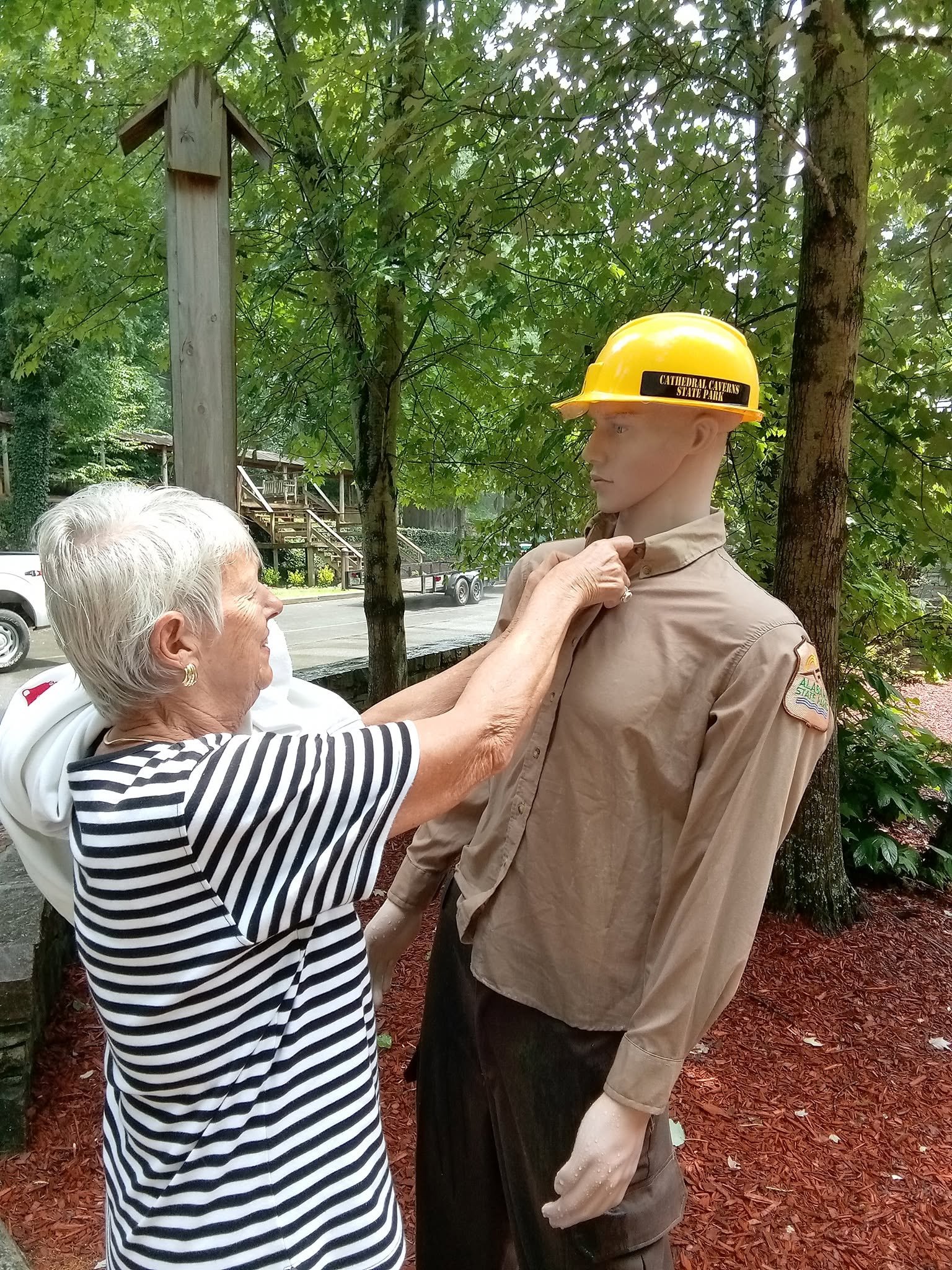
We drove to Lynchburg, Tennessee, one day and visited Jack Daniel's.
There, Sue encountered a worker who clearly wasn't meeting her standards.
Granted, he was a mannequin.
His collar was apparently wrong.
Sue fixed it.
Mostly, though, Huntsville became about two of Sue's favorite things:
Animals and ice cream.
We found a beautiful downtown park with trees, a pond, a red arched bridge and lots of ducks.
Then we found a quaint little shop serving light sandwiches and ice cream.
Sue loved ice cream.
The women working there took a liking to her. They would give us some old bread so we could go feed the ducks.
We went back three times in five days.
And why wouldn't we?
Travel tells us we're supposed to constantly seek something new.
But Sue liked the shop.
She liked the women there.
She liked the ducks.
She liked the ice cream.
So we went back.
Sometimes the best itinerary decision you can make is to repeat the thing that works.
Meanwhile, Dad got something he badly needed but would never have requested for himself: a few days when he wasn't solely responsible for another human being.
Traveling with an aging parent sometimes means looking beyond the person getting into the car with you.
There may be a caregiver standing in the driveway who desperately needs the trip too.
Remove the Friction
This is where some of the practical travel advice really does matter.
But I don't think of it primarily as “senior travel.”
I think of it as removing friction.
A nonstop flight may cost more than one with a connection. A centrally located hotel may be more expensive. A comfortable vehicle may cost more than the smallest rental car. Staying several nights in one hotel might mean seeing less territory.
That's okay.
When we went to Cape Cod, I booked the nonstop flight.
I rented the minivan.
I rented a house where Dad and Sue could be comfortable and gave them the master suite overlooking the ocean.
Those weren't extravagances for the sake of luxury.
They made the trip easier.
When you're traveling with someone whose energy, mobility or confidence isn't what it once was, sometimes the smartest upgrade is simply the option that asks less of them.
You aren't spending money on luxury. You're spending money to remove friction.

Let Them Keep Their Independence
Removing friction doesn't mean taking over every decision.
There's a balance.
Older parents are still adults, and having an adult child suddenly manage every detail of their lives can feel very different from having someone make travel easier.
Dad provided a pretty good reminder of that when he later booked his own cruise cabin.
Against my better judgment.
But I'm getting ahead of myself.
The point is that the goal isn't to infantilize someone because they're older.
Ask what they want.
Let them make choices they're capable of making.
Help where help is useful.
And quietly engineer away the things that don't need to be difficult.
Sometimes Companionship Is the Destination
Eventually, Sue's condition progressed to the point that she entered nursing care.
Later, she passed away.
Dad struggled.
He loved cruising and at one point tried taking a cruise by himself.
He didn't enjoy it.
The ships were still there. The food was there. The shows were there.
But he was lonely.
He was searching for what life looked like without Sue, and apparently cruising alone wasn't the answer.
So we took him with us on a sailing aboard MSC Meraviglia.
Dad booked his own cabin, despite my preference that I help with it, and managed to choose one closer to a stairwell than an elevator.
That meant more walking than he would have liked.
It wasn't a disaster.
It was simply one of those little things I now think about when planning travel with someone older.

Dad loved cruising, but after Sue died he discovered he didn't particularly love cruising alone. So we went together.
Dad didn't spend the cruise chasing ports or excursions.
Neither did we.
He mostly stayed aboard. We enjoyed some private-island time, but the ports weren't really the point.
Dad liked the shows.
He liked interacting with the crew and getting to know the bartenders.
And at family dinners, Dad held court.
He told stories.
Lots of stories.
We didn't have to cook. We didn't have to clean. Nobody had to stand in the kitchen at five o'clock asking the question that has plagued families since the invention of dinner:
"What are we going to eat tonight?"
We just showed up at the table.
After Sue died, Dad didn't need us to find him some grand new adventure.
He needed people to share an old one with.
That's something I've come to appreciate more and more.
Sometimes companionship is the destination.
A Different Way to Measure a Trip
We tend to measure travel with numbers.
How many countries?
How many attractions?
How many miles?
How many things did we cross off the list?
Traveling with Dad and Sue changed that for me.
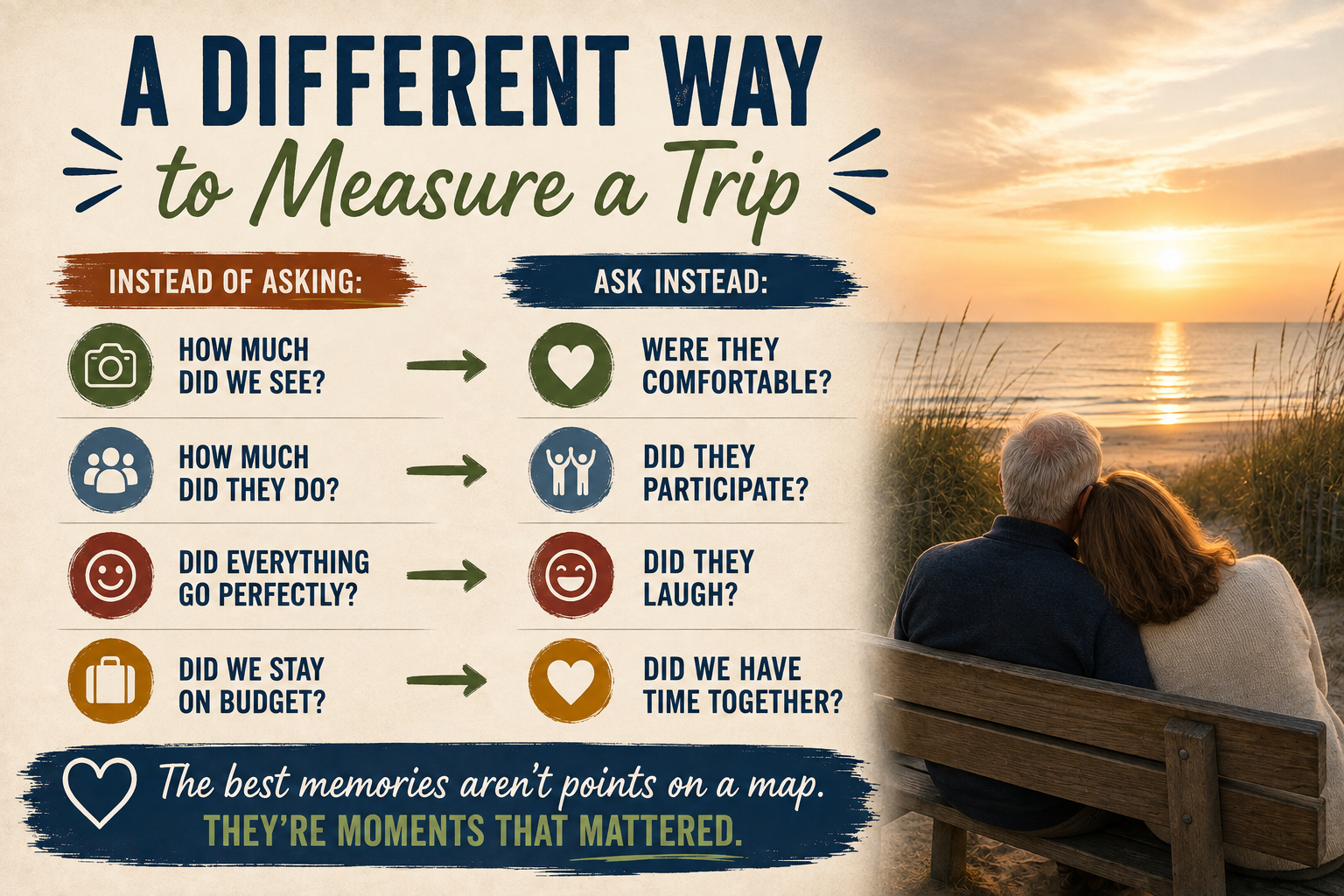
There are different questions worth asking.
Were they comfortable?
Did they participate in their own way?
Did they laugh?
Did we have time to actually be together?
If the answer is yes, I'm not particularly concerned that we only visited one attraction instead of four.
Plan for the Person They Are Today
There's another trap that's easy to fall into when traveling with a parent you've known your entire life.
You remember who they were.
Maybe Dad used to walk ten miles without thinking about it.
Maybe Mom once wanted to see every museum in town.
Maybe they used to drive twelve hours straight to get somewhere.
That doesn't necessarily describe the person standing in front of you today.
And that's okay.
Don't plan for the 55-year-old version of your parent.
Don't plan for some generic 78-year-old you read about online either.
Plan for this person.
Sue loved animals.
So we took her to horses.
She loved ice cream.
So we got ice cream.
She liked feeding ducks.
So we fed ducks.
And when she loved it, we came back and did it again.
Dad loved cruising, talking with people and telling stories over dinner.
So after Sue was gone, we gave him people to cruise with and a dinner table where he could hold court.
It wasn't complicated.
It was personal.
The Trip Doesn't Have to Be Perfect
I sometimes think travel planning has become too obsessed with optimization.
Find the perfect fare.
Build the perfect itinerary.
Get the perfect room.
See every important attraction.
Maximize every day.
I've certainly done my share of that.
But some of my most important family travel memories aren't particularly impressive on paper.
A fox wandering outside a rented house.
Cooking lobster and scallops with Dad.
Two ridiculous pies and far too much alcohol.
Bob the cat moving into my parents' room.
Sue leaning toward a horse.
Showing her the same picture of Sophie over and over.
"So sweet."
Straightening a mannequin's collar.
Feeding ducks.
Going back for more ice cream.
Dad telling stories at dinner.
None of those would make anybody's Top 10 Things to Do list.
They made ours.
And that's enough.
Final Thoughts
When I first started thinking about traveling with older parents, I probably thought about it the same way many people do.
Where should we take them?
What should we see?
How much can they handle?
Those aren't bad questions.
They're just not the most important ones.
Ask what they love.
Make the difficult parts easier.
Slow the itinerary down.
Let them maintain as much independence as they comfortably can.
Pay attention to the caregiver.
And don't assume there will always be a better time next year.
Today, Dad and Sue are both gone.
When I look back at those years, I don't find myself dwelling on the repetitive questions or all the difficult parts of caring for someone whose world was getting smaller.
I remember Cape Cod.
I remember Dad and me cooking Thanksgiving dinner.
I remember Sue leaning over the fence toward a horse.
I remember Bob deciding he belonged in their room.
I remember her fixing that mannequin's collar.
I remember Gina becoming her BFF.
I remember ducks and ice cream.
And I remember Dad holding court at dinner on a cruise ship, telling stories we'd probably heard before.
I'd happily listen to one of them again.
Alzheimer's eventually took many of those trips away from Sue.
She didn't remember all of it.
We do.
And that was reason enough to go.
Better travel isn't always about going farther or spending more. Sometimes it's about changing what you value along the way.