

Traveling With GLP-1 Medications: Storage, TSA Rules & Practical Tips
What travelers taking Ozempic, Wegovy, Mounjaro, Zepbound and similar injectable medications should know before leaving home
Medical disclaimer: This article provides general travel information, not medical advice. Medication formulations, injector designs and storage instructions can change and may differ by country. Always verify the requirements for your exact medication with your prescribing physician, pharmacist and the drug manufacturer before traveling. Consult your healthcare provider before changing, delaying or skipping a dose.
Traveling with an injectable GLP-1 medication can initially sound complicated.
Will the medication stay cold enough? Can injection pens go through airport security? What happens if the hotel refrigerator freezes them? Do you need to change your injection day before leaving?
The reassuring news is that many injectable GLP-1 and GIP/GLP-1 medications can remain outside the refrigerator for a manufacturer-approved period. Depending on the medication and the length of your trip, you may not need to keep your pens refrigerated while traveling.
However, every medication has its own time limits, temperature range and storage instructions. The first and most important step is always to verify the rules for your exact prescription.
The Most Common Misconception About GLP-1 Travel
Many travelers assume that an injectable GLP-1 pen must remain continuously refrigerated from the moment it leaves home until it is used.
That is not always true.
Several commonly prescribed medications—including Ozempic, Wegovy, Mounjaro and Zepbound—have manufacturer-approved periods during which they may remain unrefrigerated, provided they stay within the specified temperature range.
That can make a typical vacation considerably easier. Instead of trying to maintain a refrigerated cold chain throughout every flight, hotel stay and sightseeing day, some travelers may only need to protect their medication from excessive heat, freezing and direct sunlight.
But these allowances are not interchangeable. Never apply the storage instructions for one medication to another.
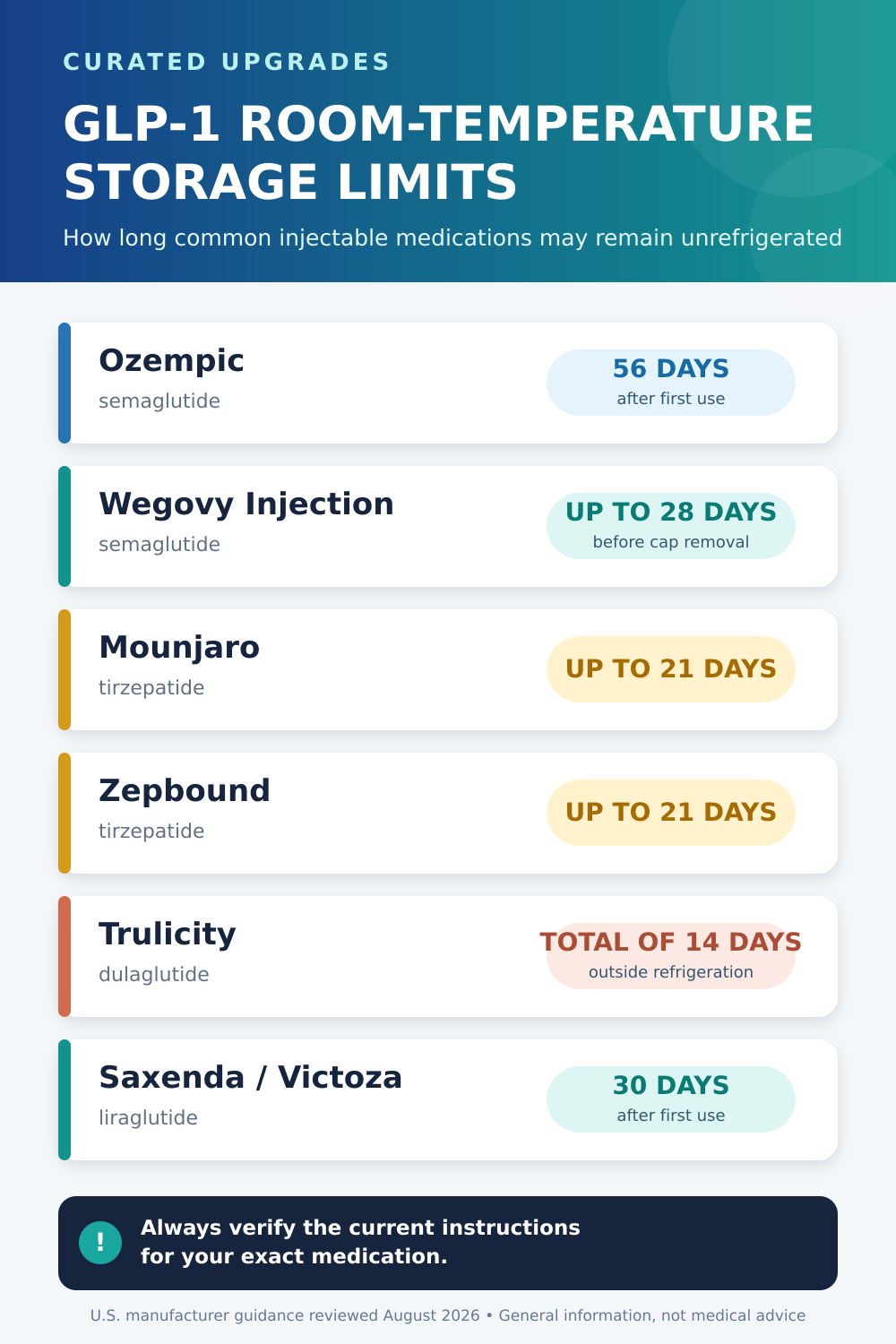
GLP-1 Room-Temperature Storage Limits
The following information summarizes current U.S. manufacturer guidance. Product formulations and injector designs available in other countries may have different requirements. Verify your specific medication’s storage limits with your health professional.
Ozempic
After first use, an Ozempic pen may generally be stored for up to 56 days either in the refrigerator or at a controlled room temperature of 59°F to 86°F (15°C to 30°C).
Unused pens should remain refrigerated until first use.
Protect the pen from excessive heat and sunlight, keep the cap on when it is not in use and never use an Ozempic pen that has frozen.
Wegovy Injection
Before removing the cap, a Wegovy injection pen may generally remain outside the refrigerator for up to 28 days at temperatures between 46°F and 86°F (8°C to 30°C).
Keep the pen in its original carton to protect it from light. Discard it if it has frozen, exceeded the approved temperature or remained outside refrigeration beyond the permitted period.
These instructions apply to Wegovy injection pens. Oral formulations have different storage requirements.
Mounjaro
Mounjaro pens may generally be stored unrefrigerated for up to 21 days at temperatures no higher than 86°F (30°C).
Keep the medication in its original carton to protect it from light and do not use it if it has frozen.
Because injector designs and instructions may differ, verify the rules for your specific Mounjaro device before departure.
Zepbound
Zepbound may generally be stored outside the refrigerator for up to 21 days at temperatures no higher than 86°F (30°C).
Manufacturer instructions state that Zepbound stored at room temperature should not be returned to the refrigerator. Record the date it was removed so you can keep track of the permitted storage period.
Trulicity
A Trulicity pen may generally remain at room temperature, no higher than 86°F (30°C), for a total of 14 days.
Protect it from direct heat and light. Because this is one of the shorter unrefrigerated windows, travelers taking longer trips may need to plan for continuous refrigerated storage.
Saxenda and Victoza
After first use, Saxenda and Victoza pens may generally be stored for 30 days either refrigerated or at temperatures between 59°F and 86°F (15°C to 30°C).
Unused pens should remain refrigerated. Protect pens in use from excessive heat, sunlight and freezing.
Does Refrigerating the Pen Again Reset the Timer?
Do not assume that placing medication back inside a refrigerator resets its unrefrigerated time allowance.
Some medications have a cumulative limit on time outside refrigeration. Others specifically should not be returned to refrigeration after room-temperature storage. The rules also differ between unused pens and pens already in use.
Before traveling, ask your physician or pharmacist:
When does the unrefrigerated period begin?
Is the time outside refrigeration cumulative?
May the pen be returned to refrigeration?
Does refrigeration extend the expiration period?
What should you do if the pen becomes too warm or too cold?
Writing the date on the medication carton when its unrefrigerated storage period begins can help you avoid losing track.
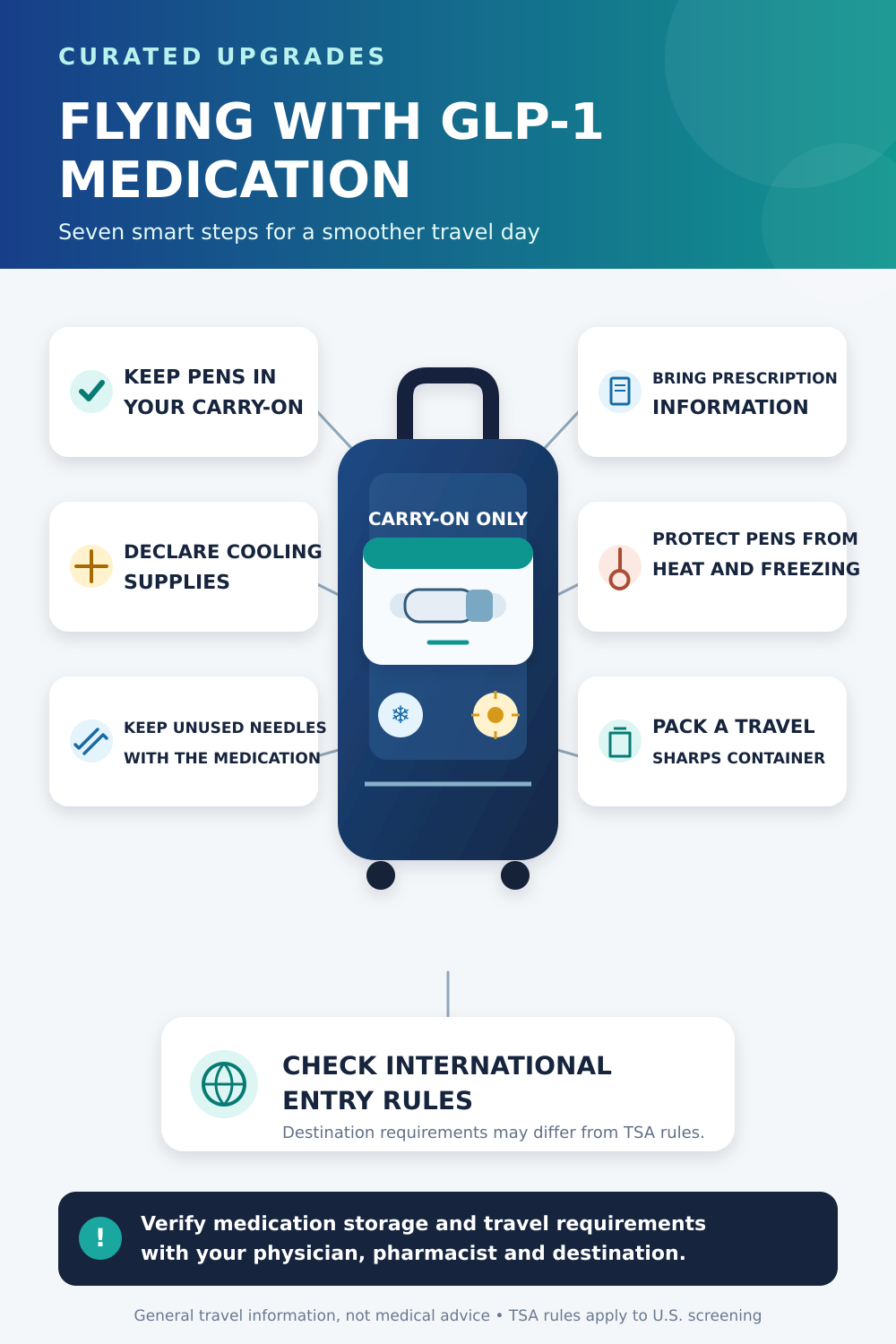
Keep GLP-1 Medication in Your Carry-On
Essential medication belongs in your carry-on or personal item—not in checked luggage.
Checked bags can be delayed, misdirected or lost. Their contents may also be exposed to temperatures outside your medication’s approved storage range.
Keep the following items together in an easily accessible medication pouch:
Injection pens
Pen needles or injection supplies
Alcohol swabs
Prescription information
Required cooling equipment
Physician documentation
Manufacturer contact information
If an airline asks passengers to gate-check carry-on bags, remove the medication pouch before handing over your bag.
Can GLP-1 Pens Go Through TSA Security?
Yes. Injectable prescription medication and associated supplies are permitted through TSA screening.
Medically necessary liquids and reasonable quantities of medical cooling supplies may exceed the normal carry-on liquid limits. TSA also permits unused syringes when they are accompanied by injectable medication.
Tell the TSA officer that you are carrying injectable medication and related supplies before screening begins. You may be asked to remove the medication or cooling supplies from your bag for separate inspection.
A simple declaration is sufficient:
“I am carrying medically necessary injectable prescription medication, unused needles and related supplies. I have placed them together in this pouch.”
If you are carrying cooling packs:
“I am carrying medically necessary injectable medication and cooling packs for temperature control. I am declaring them for separate screening.”
TSA does not generally require prescription medication to be in its original pharmacy container. However, clearly labeled medication is recommended, and original packaging can make screening and international border inspections easier.
Final screening decisions are made by the TSA officers at the checkpoint.
Download the Free GLP-1 Travel Cheat Sheet
For an easy-to-save version of the storage information, TSA scripts and packing checklist, download the two-page GLP-1 Medication Travel Cheat Sheet.
It is designed to be:
Saved to your phone
Printed before departure
Shared with a traveling companion
Used as a packing checklist
Referenced at airport security
The text is selectable, so you can also copy the TSA scripts or checklist items
The cheat sheet provides general travel information and reflects U.S. manufacturer and TSA guidance reviewed in August 2026. Always verify the current requirements for your medication with your physician, pharmacist or manufacturer.
Do You Need a Medication Cooler?
Possibly—but not every traveler does.
If your entire trip falls within the medication’s approved unrefrigerated period, and you can keep the pens safely within the permitted temperature range, refrigeration may not be necessary.
That does not mean the medication can remain anywhere in your luggage. You must still protect it from:
Hot vehicles
Direct sunlight
Beach bags
Outdoor excursions
Unair-conditioned rooms
Heat near an airplane window
Freezing outdoor temperatures
An insulated medication case may moderate short-term temperature changes, but it does not guarantee that the contents will remain within a specific temperature range.
What If Your Trip Is Longer Than the Unrefrigerated Limit?
Speak with your physician or pharmacist before departure if your trip will exceed the medication’s approved unrefrigerated period.
You may need to maintain the medication continuously within its refrigerated range using a purpose-built medication cooling system.
Before relying on any cooler, determine:
Whether it maintains the required temperature range
How long it works without electricity
Whether it uses batteries, power, gel packs or evaporative cooling
Whether it will work during flights and long layovers
Whether it requires an international power adapter
Whether the pen could touch a frozen surface
Whether it displays or records the internal temperature
Be cautious of products advertised as “TSA approved.” TSA permits categories of medically necessary supplies through screening but does not certify individual medication-cooler brands.
Protect Your Medication From Freezing
Freezing can damage injectable GLP-1 medications. Do not use a pen that has frozen, even if it later thaws.
If you use frozen gel packs, keep the medication from touching them directly. Place a protective barrier between the pens and frozen surfaces.
A small towel or other insulating layer may help prevent direct contact, but it does not guarantee a safe temperature. A thermometer or temperature-monitoring device provides better information.
If you suspect that a pen froze, overheated or remained outside its permitted range too long, contact your pharmacist or the manufacturer before using it.
Be Careful With Hotel Mini-Fridges
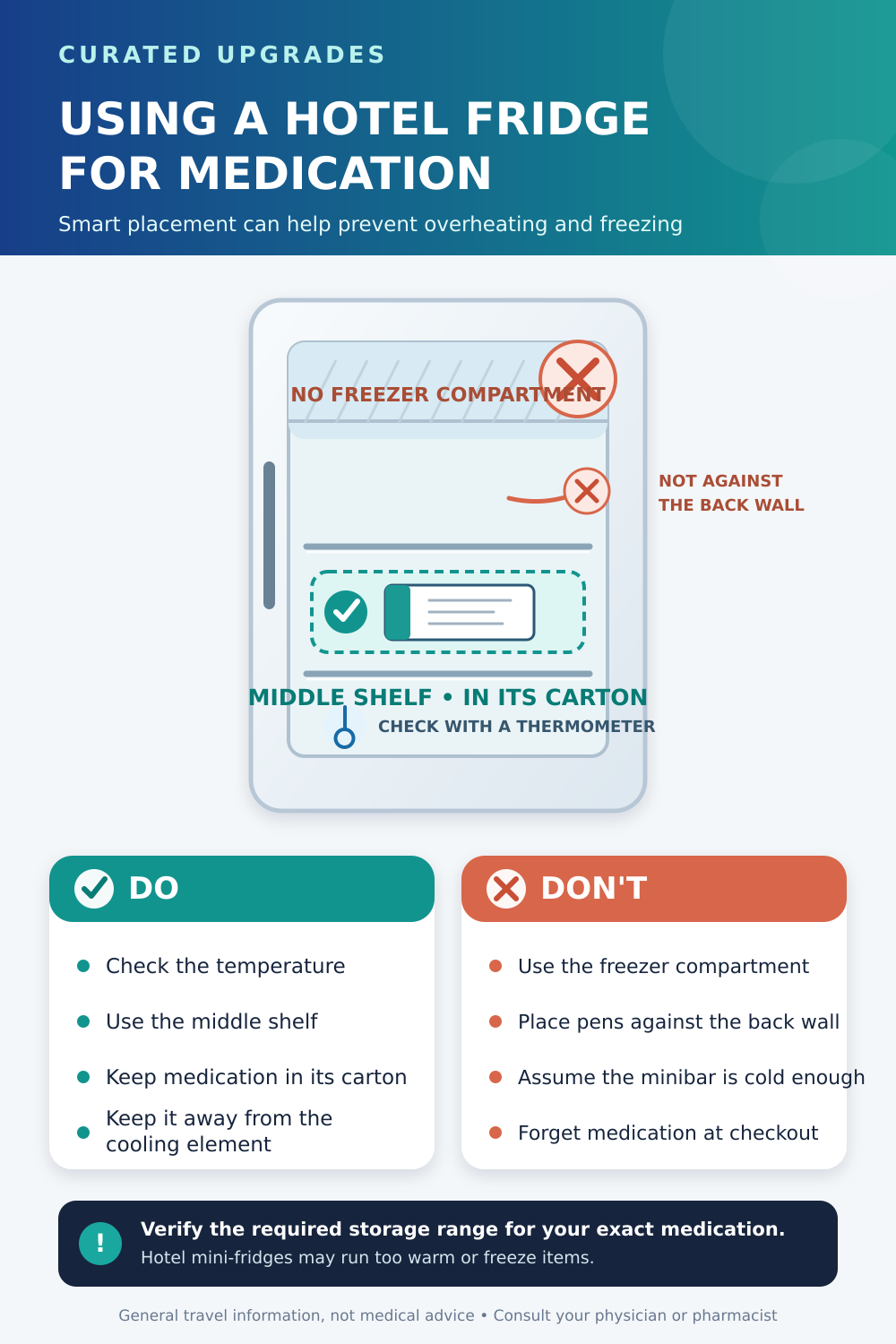
An ordinary hotel minibar is not necessarily a reliable medication refrigerator.
Some units do not remain cold enough. Others cycle unpredictably or freeze items placed near the back wall or cooling plate.
Before arriving, ask whether the hotel can provide a refrigerator suitable for medication storage.
If you use an in-room refrigerator:
Check its temperature with a refrigerator thermometer.
Keep pens away from the freezer compartment.
Do not place them directly against the cooling element or back wall.
Keep them in their original carton when required.
Label the medication so housekeeping does not move or discard it.
Add the medication to your checkout-day checklist.
If the refrigerator cannot maintain the required range, ask whether the hotel offers secure medication refrigeration.
Can You Change Your Injection Day Before Traveling?
Some weekly injectable GLP-1 medications allow patients to change their regular injection day as long as a specified minimum interval has passed between doses.
That flexibility may help some travelers simplify their dosing schedule. However, changing your injection day is not the same as freely delaying, skipping or doubling a dose.
Each medication has its own missed-dose instructions.
Never adjust your injection schedule based solely on general information found online. Discuss the complete itinerary with your prescribing physician before making a change.
Provide your physician with:
Your usual injection day and time
Your departure and return dates
The number of time zones crossed
The number of doses normally required
Your planned access to refrigeration
Follow the individualized instructions you receive.
Managing GLP-1 Side Effects While Traveling
Travel can disrupt meals, hydration, sleep and normal bathroom habits. Those changes can make common GLP-1 side effects harder to manage.
Before departure, discuss what to do if you experience:
Nausea or vomiting
Diarrhea
Constipation
Abdominal discomfort
Reduced appetite
Dehydration
Low blood sugar if you use certain additional diabetes medications
A missed or incomplete dose
Keep physician-approved remedies in your carry-on and drink fluids regularly. Hydration is particularly important during long flights, active excursions and hot-weather travel.
Seek medical assistance for severe or persistent symptoms or for any warning signs identified by your physician or medication guide.
International Travel Requires Additional Research
TSA rules apply to airport screening within the United States. They do not determine what another country permits through customs or security.
Before an international trip, check the destination country’s official embassy, customs or health-ministry guidance concerning:
Injectable medication
Needles and syringes
Prescription-label requirements
Physician letters
Medication quantity limits
Restricted medications
Disposal of used pens and needles
Consider carrying a physician’s letter listing:
Your full name
The medication’s generic and brand names
Your prescribed dosage
Your need for injection supplies
Your physician’s contact information
Keep this documentation with the medication rather than in checked luggage.
Your GLP-1 Travel Packing Checklist
Before leaving home, pack or verify:
The correct number of injection pens
Additional medication if prescribed and legally permitted
Pen needles or injection supplies
Original cartons and pharmacy labels
Prescription information
Physician documentation for international travel
Alcohol swabs and gauze
A small travel sharps container
Verified cooling equipment when required
A refrigerator thermometer or temperature monitor
Prescriber, pharmacy and manufacturer contact information
A plan for delays or lost medication
The Bottom Line
Traveling with an injectable GLP-1 medication is usually manageable with a little advance preparation.
Many commonly prescribed medications do not require continuous refrigeration during a typical short vacation. But every medication has its own temperature range, unrefrigerated time limit and handling instructions.
Verify the current requirements for your exact medication with your prescribing physician, pharmacist or manufacturer before every trip. Keep the medication in your carry-on, protect it from excessive heat and freezing, and never change your injection schedule without guidance from your healthcare provider.
Medication labeling and transportation rules can change. Review current manufacturer instructions, TSA guidance and destination-country requirements before departure.