

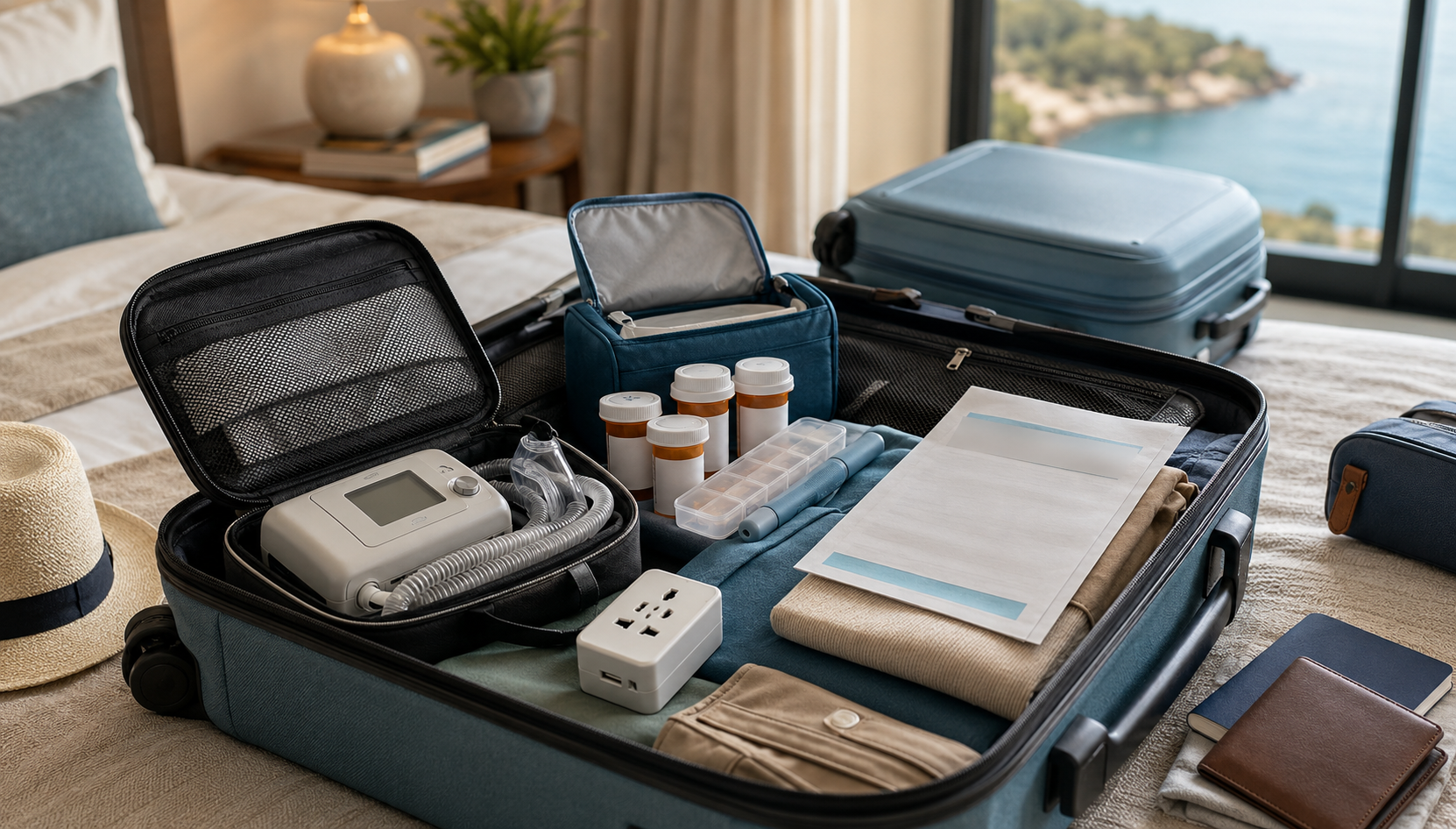
Traveling With Prescription Medications: What to Know Before You Go
From pill organizers and original bottles to country-specific restrictions, here’s how to prepare without packing your entire medical history
Spend a few minutes in almost any travel group on Facebook and you will eventually see the question:
“How do you travel with your prescription medications?”
The answers usually fall into two camps.
On one side are travelers who place their pills in the same weekly organizer they use at home. They have flown internationally for years, never been questioned and see no reason to change.
On the other side are people carrying original pharmacy bottles, printed prescriptions, a complete medication list and a signed physician’s letter—everything short of a multilingual hologram of their doctor confirming that every tablet is legitimate.
Then come the warnings:
Japan bans all ADHD medication.
An ordinary prescription could land you in a Turkish prison.
Every country limits visitors to a 30-day supply.
TSA requires every pill to remain in its original bottle.
Some of those claims contain a piece of truth. Others are exaggerated, incomplete or simply wrong.
The factual answer lies between “nobody ever checks” and “bring your complete medical record.”
Most travelers will probably never be asked to identify their medication. But hope is a bad plan—especially when a prescription is medically essential or legally restricted at the destination.
Important: Medication and customs rules can change. This article provides general travel information, not medical or legal advice. Verify current requirements with your healthcare provider and the official embassy, consulate, customs agency or health authority for every destination and applicable transit country.
My Own Experience: I’m the Guy With the Pill Organizer
My personal habits have not always matched the most conservative travel advice.
I normally arrange my daily medications in a pill organizer, just as I do at home. I have traveled internationally that way and have never had anyone ask me to identify the pills.
In fact, I have not been stopped and interviewed by a customs officer since 1988.
That experience is real, and it probably resembles the experience of most travelers. Border officers are not routinely opening every visitor’s bags and inspecting every cholesterol tablet.
But my experience proves only that I have not been inspected. It does not establish what another country’s law requires.
I also understand the risk I am accepting. None of my current prescriptions is immediately essential to my health. If an officer confiscated my medication, it would be inconvenient, but I would be fine.
Someone traveling with heart medication, seizure medication, insulin or another medically critical prescription faces a very different calculation.
The important question is not only:
“How likely am I to be inspected?”
It is also:
“What happens if I am inspected, the medication is confiscated or my bag disappears?”
If the consequences would be serious, prepare for more than the most likely outcome.
TSA Screening Is Not the Same as Customs Law
Three different sets of rules may affect medication during an international trip:
Airport security rules
Airport-security agencies determine what may pass through the checkpoint and enter the aircraft cabin.
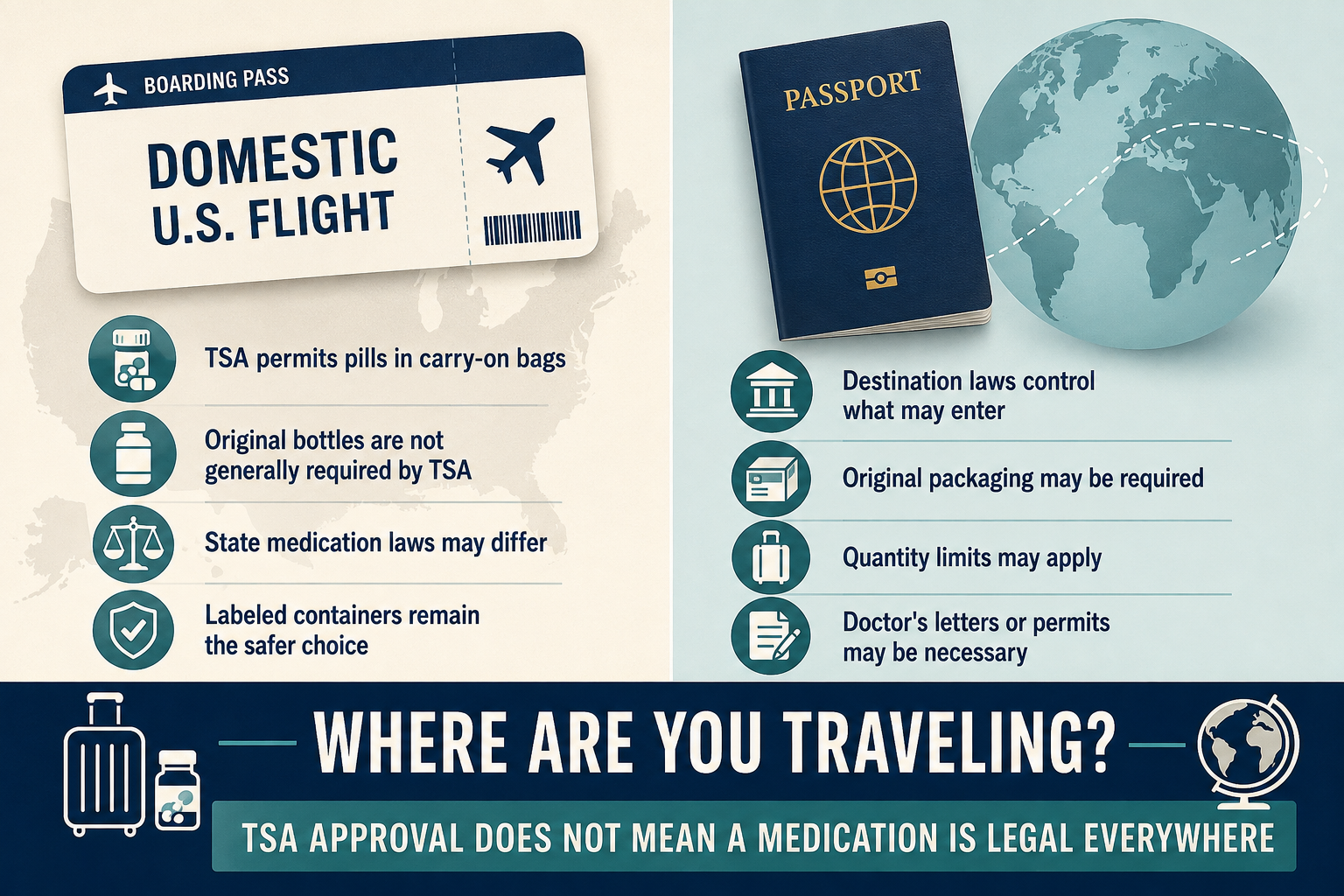
In the United States, TSA permits pills and other solid medications in carry-on and checked baggage. TSA does not generally require solid medication to remain in its original pharmacy bottle, although it notes that individual states may have their own medication-labeling laws.
TSA also permits medically necessary liquids, creams and gels exceeding the ordinary 3.4-ounce or 100-milliliter limit. These items should be declared to the officer and may require additional screening.
https://www.tsa.gov/travel/security-screening/whatcanibring/medical
Customs and border rules
Customs authorities decide what may legally enter a country.
They may consider:
The medication’s active ingredient
Whether it was prescribed to you
How much you are carrying
Whether the quantity appears consistent with personal use
Whether original packaging is required
Whether you need a prescription, physician’s letter or permit
Whether the medication must be declared
The destination’s drug laws
A medication that is legal and routinely prescribed in the United States may be controlled or prohibited elsewhere.
A U.S. prescription proves that an American healthcare provider prescribed the drug. It does not override another country’s criminal or drug-importation laws.
That distinction is the foundation of responsible international medication planning:
Passing through TSA does not mean your medication is legal at the destination.
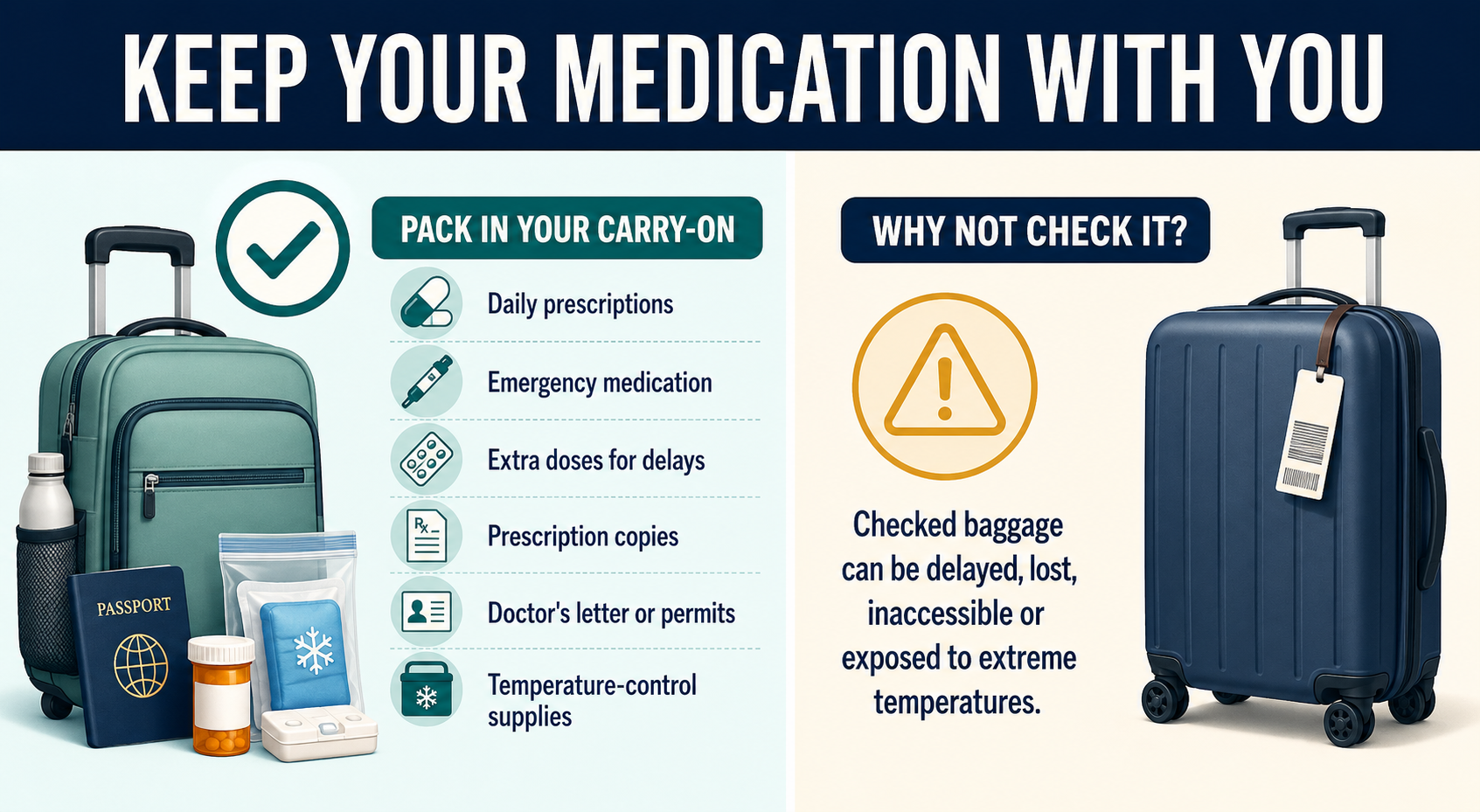
Keep Medication in Your Carry-On
Whether you use original bottles or a pill organizer, essential medication belongs in your carry-on or personal item—not in checked luggage.
Checked baggage can be:
Lost
Delayed
Misrouted
Inaccessible during a disruption
Exposed to extreme heat or cold
Gate-checked unexpectedly
We learned how consequential delayed baggage can become when our luggage failed to arrive during a trip to Ireland. It remained missing for seven days.
Clothing and toiletries could be replaced. Medically essential prescriptions would have created a much more serious problem.
If the airline requires you to gate-check a carry-on, remove the medication first. A small medication pouch kept inside your personal item makes that easier.
Bring enough medication for the trip and a reasonable delay, but do not assume that “extra” can mean any quantity you choose. Some countries impose strict personal-use limits.
Pill Organizer or Original Bottles?
This is where official guidance and everyday travel habits often diverge.
A pill organizer is:
Compact
Convenient
Familiar
Easier than carrying several bulky pharmacy bottles
But it is not evidence.
If an officer finds unidentified pills, the organizer does not establish:
What each pill contains
Whether it belongs to you
Who prescribed it
What dosage you take
Whether the quantity is for personal use
Whether the active ingredient is legal
The CDC recommends keeping medication in its original labeled container during international travel and avoiding pill organizers because the contents may be difficult to identify.
https://www.cdc.gov/yellow-book/hcp/travelers-with-additional-considerations/traveling-with-prohibited-or-restricted-medications.html
That does not mean everyone carrying an organizer will be detained. It means that if your number comes up, you have made the explanation more difficult.
A balanced approach is:
Carry original labeled containers when the destination requires them.
Use original containers for controlled or medically critical prescriptions.
Retain documentation identifying everything you carry.
If practical, fill your organizer after reaching the destination.
If you choose to travel only with an organizer, understand that you are accepting the risk that an officer may not accept your verbal explanation.
Most travelers will never be questioned about their medication. But if you are questioned, “I’ve done this for years” will not identify the pills.
What Counts as a Copy of Your Prescription?
Advice to “bring a copy of every prescription” sounds simple, but many Americans never receive a paper prescription.
The doctor sends it electronically to the pharmacy, and the patient receives a labeled bottle. There may be no traditional paper order to photocopy.
Modern medication documentation can include:
The original labeled pharmacy container
A medication profile printed by the pharmacy
A medication list downloaded from your patient portal
Prescription information from the pharmacy’s app
A photograph of the complete pharmacy label
A recent after-visit summary
A physician’s letter when required
A pharmacy-generated medication profile may be the easiest option. Ask whether your pharmacy can print a current list showing your name, medication, dosage, prescriber and prescription number.
Digital documentation is useful, but save it for offline access. A pharmacy app that requires an internet connection, American phone service or text-message verification may be inaccessible at a foreign border.
Screenshots or downloaded PDFs provide a practical backup.
Match the Preparation to the Medication
Not every traveler needs the same documentation.
Ordinary prescriptions and OTC medications
Examples include many cholesterol, thyroid and routine maintenance medications.
A sensible preparation level is:
Carry the medication in your carry-on.
Retain the original labeled packaging when traveling internationally.
Carry a pharmacy or patient-portal medication list.
Know the medication’s generic name.
Bring only a reasonable personal-use quantity.
Verify destination requirements.
A signed physician’s letter is not universally required for every ordinary prescription.
Controlled, injectable or unusual medications
Extra preparation is appropriate for:
ADHD stimulants
Opioid pain medication
Anti-anxiety medication
Certain sleep medications
Injectable drugs
Syringes and needles
Large medically necessary liquids
Unusual medical supplies
Large quantities of medicine
Depending on the destination, you may need:
Original labeled packaging
A prescription copy
A signed physician’s letter
An advance import permit
A customs declaration
Documentation translated into a required language
Prohibited medication
A physician’s letter cannot legalize a prohibited substance.
If the destination bans the active ingredient, your options may be to:
Leave it at home
Discuss a legal alternative with your prescriber
Change the destination
Follow an official permit process if one exists
Never stop or substitute prescribed medication without consulting your healthcare provider.
What Happens if Your Number Comes Up in Italy?
Italy provides a useful example because its rules apply even to routine personal medication without supporting the Facebook image of tourists being imprisoned over Lipitor.
Current State Department guidance, based on information from Italy’s Ministry of Health, says foreign visitors may bring:
Up to a 30-day supply of personal medication
Medication intended for themselves
A copy of the prescription
Travelers should not bring excessive quantities or carry prescriptions for other people.
https://travel.state.gov/en/international-travel/travel-advisories/italy.html
Suppose an Italian customs officer opens your carry-on and finds 12 different tablets in an organizer.
The issue is not necessarily that owning a pill organizer is a criminal offense. The problem is that you may be unable to establish what those tablets are and whether they comply with Italian requirements.
The officer may:
Ask you to identify the medication
Request the prescription and dosage
Conduct additional inspection
Refer the matter to another authority
Confiscate medication that cannot be identified or legally admitted
Take further action if the substance is prohibited, controlled or carried in suspicious quantities
For an ordinary medication, original packaging and a pharmacy-generated medication profile may resolve the question quickly.
For loose unidentified tablets, the outcome depends much more heavily on officer discretion.
Four Examples That Show Why the Destination Matters
There is no universal 30-day rule and no single documentation package that works everywhere.
Italy: Routine medicine still has entry rules
Italy generally permits a foreign visitor to carry up to a 30-day personal supply with a prescription copy.
The lesson is not that Italy is waiting to arrest travelers with cholesterol medication. It is that ordinary medication can still be subject to quantity and documentation rules.
Japan: Adderall is prohibited
Japan is the clearest example of a valid American prescription not being enough.
Japan’s Narcotics Control Department specifically says that Adderall cannot be imported. Its amphetamine ingredient is classified as a stimulant, and individual travelers cannot bring it into Japan even for medical treatment.
Vyvanse is treated differently. Its active ingredient, lisdexamfetamine, may be imported with advance permission.
Those distinctions matter. “Japan bans all ADHD medication” is inaccurate. The traveler must check the actual active ingredient.
Japan Narcotics Control Department
Singapore: Original packaging and documentation matter
Singapore allows up to a three-month supply of certain unrestricted personal medications, but it expects qualifying medicine to be:
Lawfully prescribed
In its original container or packaging
Labeled with the patient’s name, medication name and quantity
Accompanied by a valid prescription or doctor’s letter
Controlled medication may require advance approval, while prohibited substances cannot be imported for personal use.
Singapore Health Sciences Authority
Singapore’s rules demonstrate why blanket claims are unreliable. Italy generally limits visitors to 30 days; Singapore may allow three months for qualifying medication.
Georgia: OTC at home can be illegal abroad
The country of Georgia has strict drug laws covering some medications commonly available in other countries.
Products containing codeine provide a useful example. A medication sold without a prescription elsewhere may be illegal or heavily restricted in Georgia. Foreign travelers have faced detention, prosecution and fines.
UK Government—Georgia Entry Requirements
Never assume that “over the counter” means unrestricted internationally.
Check the Active Ingredient, Not Just the Brand
Drug classifications are normally based on ingredients—not familiar American brand names.
Before traveling, identify:
The brand name
The generic name
Every active ingredient
The dosage
The total quantity carried
This matters particularly for combination products such as:
Cold and flu remedies
Sleep aids
Pain relievers
Cough medicines
Decongestants
Allergy medication
A familiar OTC product may contain codeine, pseudoephedrine or another ingredient that is controlled at the destination.
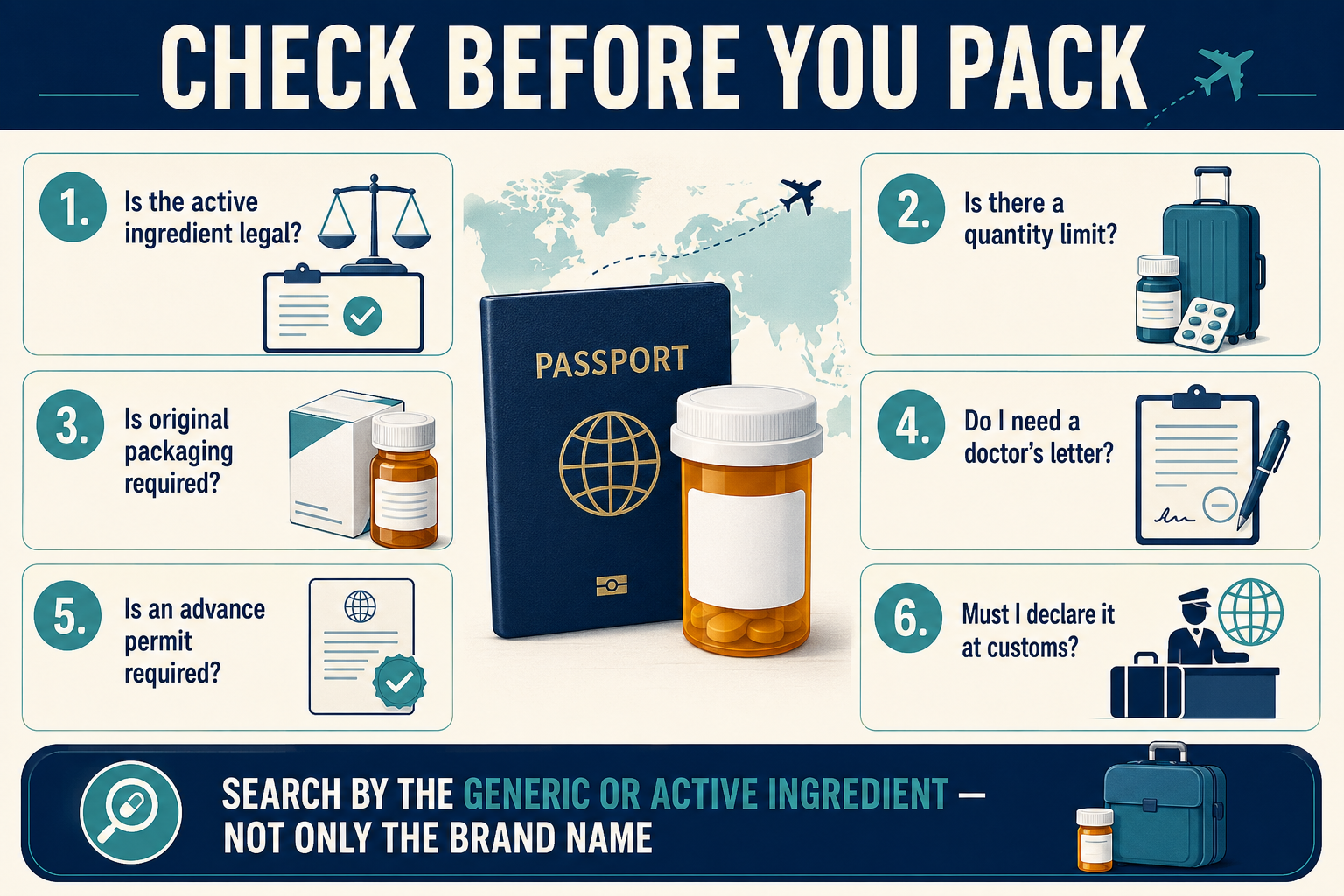
For each destination and applicable transit country, ask:
Is the active ingredient legal?
Is there a quantity limit?
Is original packaging required?
Do I need a physician’s letter?
Is an advance permit required?
Must I declare the medication at customs?
Begin with official government sources:
The destination’s embassy or consulate
Its ministry of health
Its customs authority
The U.S. State Department destination page
Your physician or pharmacist
Social-media replies can help identify questions to investigate. They should not be treated as legal authority.
What About CBD and Medical Marijuana?
State legalization has created substantial confusion among American travelers.
A state medical-marijuana card has no legal force at an international border. Legal possession at home does not authorize you to carry marijuana into another country.
CBD can be equally complicated.
Products marketed as:
Hemp-derived
THC-free
Full-spectrum
Medical CBD
Legal in all 50 states
may still be prohibited at the destination. Product labels also do not guarantee that an item contains no detectable THC.
Singapore, for example, treats CBD, hemp products and cannabis derivatives as controlled substances. Its Central Narcotics Bureau warns that importation or possession can be an offense even when a product contains only trace amounts.
Singapore Central Narcotics Bureau—CBD and Hemp
Never travel internationally with marijuana, CBD oil, gummies, creams, vape products or other cannabis-derived items until you have verified the destination’s current law through an official source.
When Is a Doctor’s Letter Worth Carrying?
You do not need a notarized multilingual letter for every bottle of routine medication.
A physician’s letter becomes more important when traveling with:
Controlled substances
Injectable medication
Syringes or needles
A medication restricted at the destination
Large quantities
Unusual equipment
A drug requiring an import permit
Medication that is medically critical
The letter should generally include:
Your full legal name
The medication’s generic and brand names
Strength and dosage
Frequency and method of administration
Total quantity carried
Medical necessity
Related equipment or supplies
The prescriber’s contact information and signature
Include only as much medical detail as the destination requires.
The CDC provides a medication-letter template for healthcare professionals.
CDC Yellow Book—Template Letters
Build a Medication List
Carry a current list containing:
Prescription medications
Generic and brand names
Dosages and frequency
Over-the-counter drugs
Vitamins and supplements
Medication allergies
Relevant medical conditions
Physician contact information
Pharmacy contact information
Keep:
One copy with the medication
One offline copy on your phone
One backup with a trusted person at home
A current medication list can also help a local healthcare provider prevent interactions or medication errors during an emergency.
FDA—Create and Keep a Medication List
What if Medication Is Lost or Confiscated?
Replacing a prescription abroad may not be as simple as transferring it to another pharmacy.
A foreign pharmacy may not be able to fill an American prescription. Brand names, formulations and dosage strengths may differ. Counterfeit or substandard medication is also a concern in some countries.
If essential medicine is lost:
Contact your prescribing physician.
Contact your pharmacy and insurer.
Call your travel-insurance assistance service.
Seek help from a reputable local physician or hospital.
Use a licensed pharmacy recommended by a trustworthy medical provider.
Contact the nearest U.S. embassy or consulate for help locating medical services.
Do not automatically ask someone at home to mail replacement medication. International medication shipments are often tightly regulated and may be delayed or confiscated by customs.
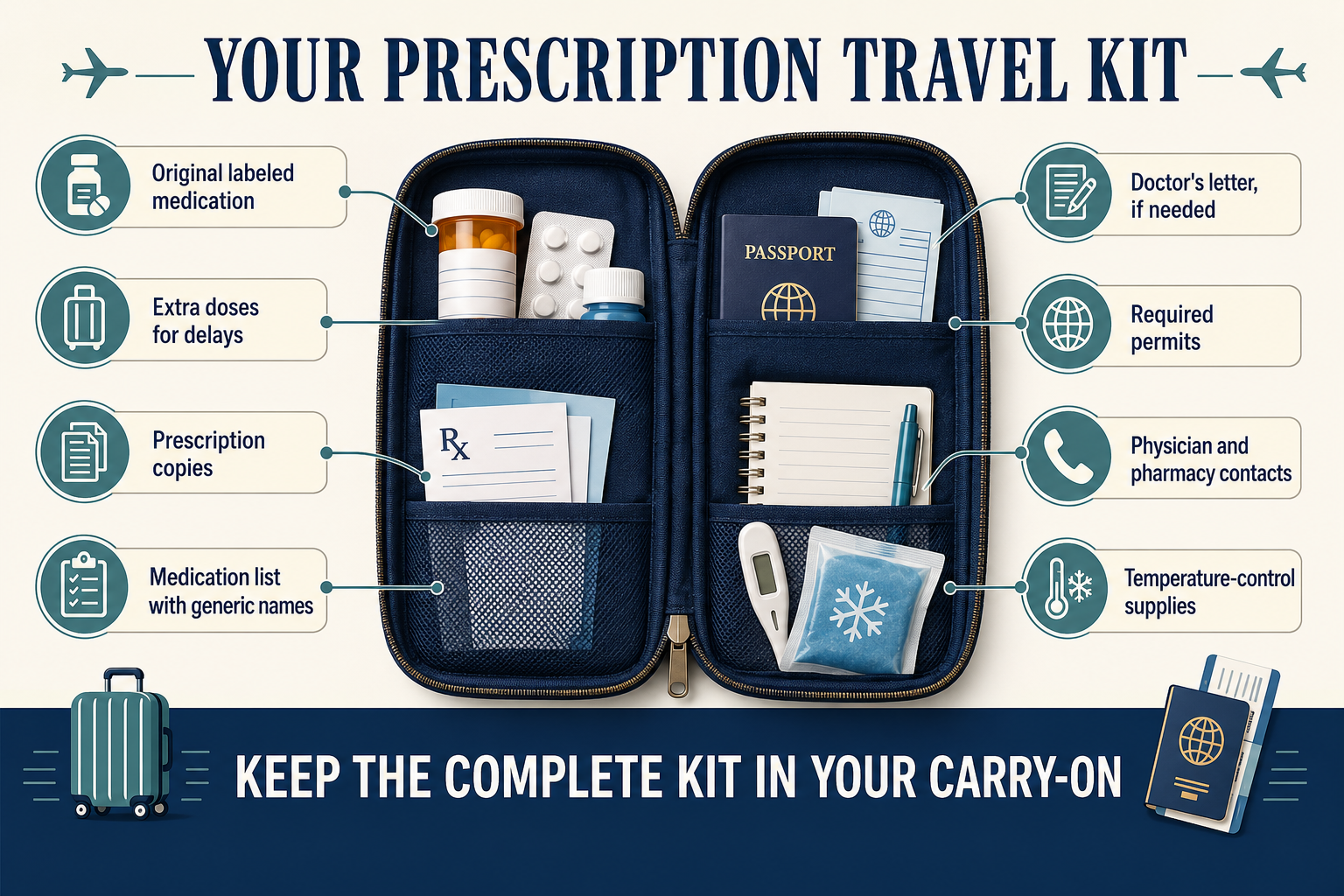
The Prescription Travel Kit
A well-prepared traveler does not need to carry an entire medical archive.
The goal is to carry enough information to:
Identify the medication
Show that it belongs to you
Establish the prescribed dosage
Demonstrate personal use
Meet destination-specific requirements
Obtain appropriate help during an emergency
Your medication kit might include:
Original labeled medication
Extra doses permitted for travel delays
Prescription or pharmacy records
A medication list using generic names
A physician’s letter when necessary
Required import permits
Physician and pharmacy contact information
Appropriate temperature-control supplies
Hope Is a Bad Plan
The overwhelming majority of travelers may never have a customs officer examine their medication.
You may use a pill organizer for decades without a question. I have.
But the absence of an inspection is not the same as compliance, and another traveler’s experience does not tell you what will happen when your number comes up.
Preparation should match both the legal risk and the medical consequences.
If losing the medication would be a minor inconvenience, you may choose to accept more risk. If losing it would threaten your health—or if the drug is controlled or prohibited—the conservative approach is well worth the modest effort.
You do not need a multilingual hologram of your physician.
You need a credible way to identify what you are carrying, show that it belongs to you and demonstrate that the quantity is for legitimate personal use.
Pack as though the next customs officer may ask you to identify every pill.
They probably won’t.
But hope is still a bad plan.