


TSA PreCheck vs. Global Entry vs. CLEAR+
Which airport shortcut is actually worth paying for?
Airports contain plenty of delays we cannot control.
Weather changes. Flights arrive late. Gates move. Luggage occasionally takes a different vacation than its owner.
But we can make some of the routine parts of flying easier.
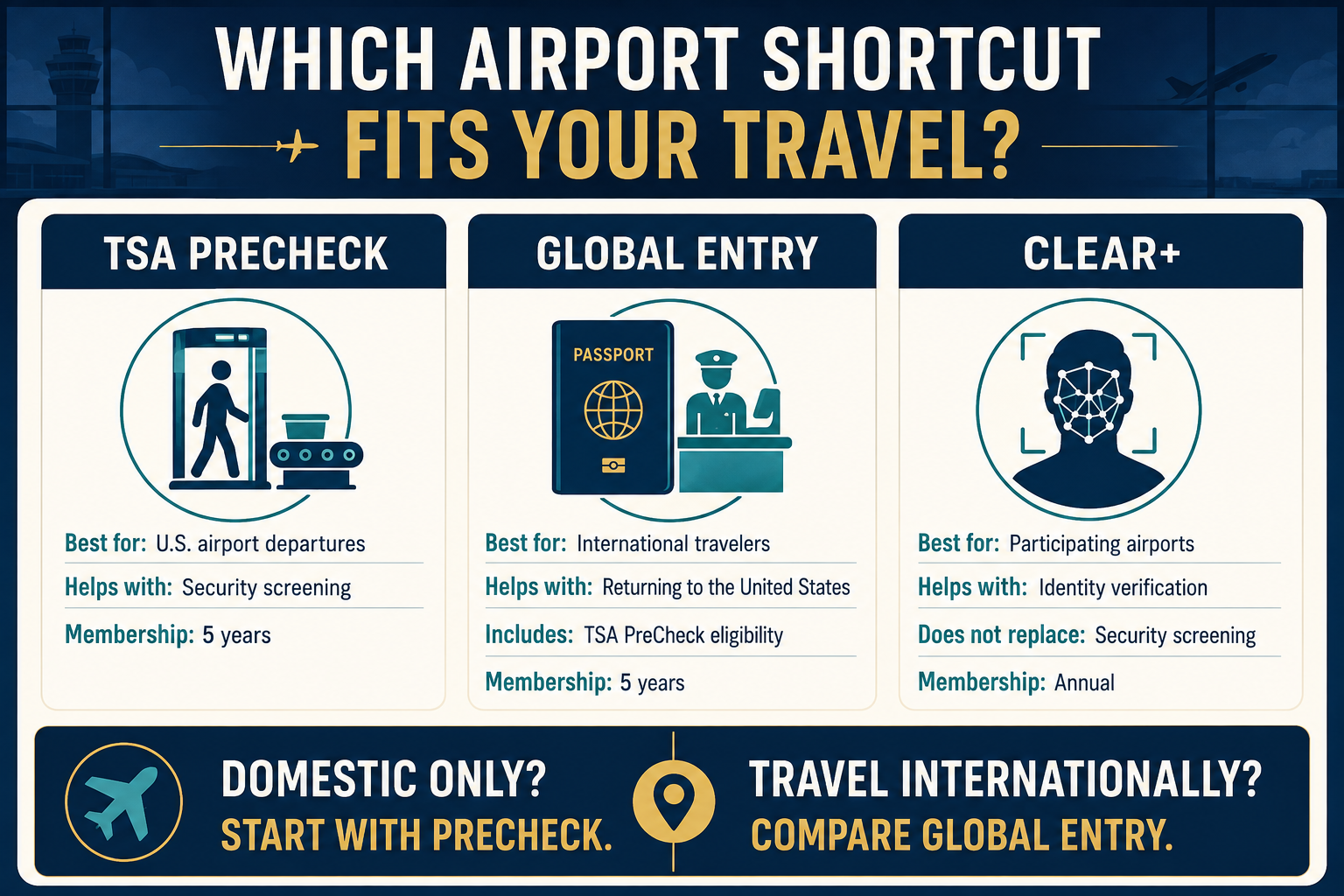
TSA PreCheck, Global Entry and CLEAR+ are all promoted as ways to save time at the airport. They are often discussed together, but they do not provide the same service.
TSA PreCheck helps with security screening before departing from a participating U.S. airport.
Global Entry helps eligible travelers return to the United States after international travel—and includes eligibility for TSA PreCheck.
CLEAR+ uses identity-verification technology at participating airport security checkpoints, but you still proceed to physical security screening.
The right choice depends on where you travel, how frequently you fly and which airport bottleneck you are trying to avoid.
For many international travelers, Global Entry will provide the most complete value.
For someone who flies primarily within the United States, TSA PreCheck may be all that is needed.
CLEAR+ can add another layer of convenience at participating airports, particularly when paired with PreCheck, but its annual price requires a different value calculation.
The goal is not to collect every membership available.
It is to spend less of your trip standing in line.
What TSA PreCheck Does
TSA PreCheck is designed to simplify the security-screening process at participating U.S. airports.
Approved travelers receive a Known Traveler Number, commonly called a KTN. Add that number to your airline reservation or frequent-flyer profile so it can be associated with your boarding pass.
When the TSA PreCheck indicator appears on the boarding pass, the traveler may use the designated PreCheck lane where available.
The familiar benefits can include leaving on:
Shoes
Belts
Light jackets
Travelers may also be allowed to leave compliant liquids and laptops inside their bags during screening.
TSA PreCheck membership is generally valid for five years, although approval and expedited screening are never guaranteed for every individual trip.
TSA now works with multiple official enrollment providers, so application and renewal prices can vary. Check the current choices rather than relying on a fee quoted in an older article.
OFFICIAL LINK: Apply for TSA PreCheck and compare enrollment providers
TSA PreCheck is the most straightforward choice for a traveler who:
Flies primarily within the United States
Wants an easier departure-security experience
Rarely or never travels internationally
Does not need expedited processing when returning to the United States
Wants a five-year program rather than an annual subscription
I had TSA PreCheck for years before applying for Global Entry. Gina had used PreCheck for approximately four years.
It made departures easier, and for domestic travel alone, it can provide excellent value.
What Global Entry Adds
Global Entry is operated by U.S. Customs and Border Protection. It is intended to expedite processing for preapproved, low-risk travelers entering the United States.
The current adult application fee is $120, and an approved membership generally lasts five years. Global Entry members are also eligible for TSA PreCheck benefits, provided their membership information is correctly associated with the airline reservation.
That combination is why Global Entry is usually the first program I would compare if international travel is part of your life.
Instead of paying for TSA PreCheck and later deciding that you also want Global Entry, you can apply for Global Entry and receive both sets of benefits if approved.
Global Entry may fit travelers who:
Take international trips
Want expedited processing when returning to the United States
Also want TSA PreCheck eligibility for U.S. departures
Are willing to complete the application, background review and interview
Can plan far enough ahead to finish enrollment before the membership is needed
Global Entry is not simply a faster version of TSA PreCheck.
It solves a different airport problem.
PreCheck helps on the way out.
Global Entry helps when you return—and includes PreCheck eligibility for future departures.
OFFICIAL LINK: Learn about and apply for Global Entry
What CLEAR+ Does—and Does Not Do
CLEAR+ is different from both government programs.
At participating airports, CLEAR+ uses identity-verification technology to help members move through the travel-document portion of the security checkpoint. After identity verification, the traveler still proceeds to baggage and physical security screening. CLEAR+ can be used with TSA PreCheck, but it does not replace PreCheck or the TSA screening process.
Think of the process this way:
CLEAR+ helps confirm who you are.
TSA PreCheck changes how eligible travelers are screened.
Global Entry helps process eligible travelers returning to the United States and includes PreCheck eligibility.
CLEAR+ is currently advertised at $219 per year before eligible discounts or statement credits. Because it is an annual membership rather than a five-year program, the financial calculation is substantially different.
CLEAR+ may be worth evaluating if:
Your regular airports have CLEAR+ lanes
The standard identity-verification line is frequently long
You travel often enough to benefit from an annual membership
You can combine CLEAR+ with TSA PreCheck
A credit card or partner discount reduces your actual cost
Before paying, confirm that CLEAR+ is available at the airports and checkpoints you regularly use.
An airport may participate without offering CLEAR+ at every terminal or checkpoint. A benefit that looks impressive on a credit-card page has limited value if it is unavailable where you fly.
OFFICIAL LINK: Check current CLEAR+ locations and pricing
Which One Should You Choose?
Choose TSA PreCheck If:
You primarily fly within the United States and want a simpler security-screening experience.
Compare Global Entry If:
You travel internationally—or reasonably expect to during the next five years—and also want TSA PreCheck eligibility.
Consider CLEAR+ If:
You frequently use participating airports, value a potentially faster identity check and can justify or offset the annual cost.
Consider Using PreCheck and CLEAR+ Together If:
Both are available at your regular checkpoint and saving additional time is worth the cost to you.
None of these programs eliminates every airport line.
Their value depends on whether they improve the airports, terminals and types of trips you actually use.
Is Global Entry Worth $120?
A credit-card reimbursement is a nice benefit, but it is not the reason I recommend comparing Global Entry.
Even if I had paid the full $120 application fee for each of us, I would still consider it money well spent.
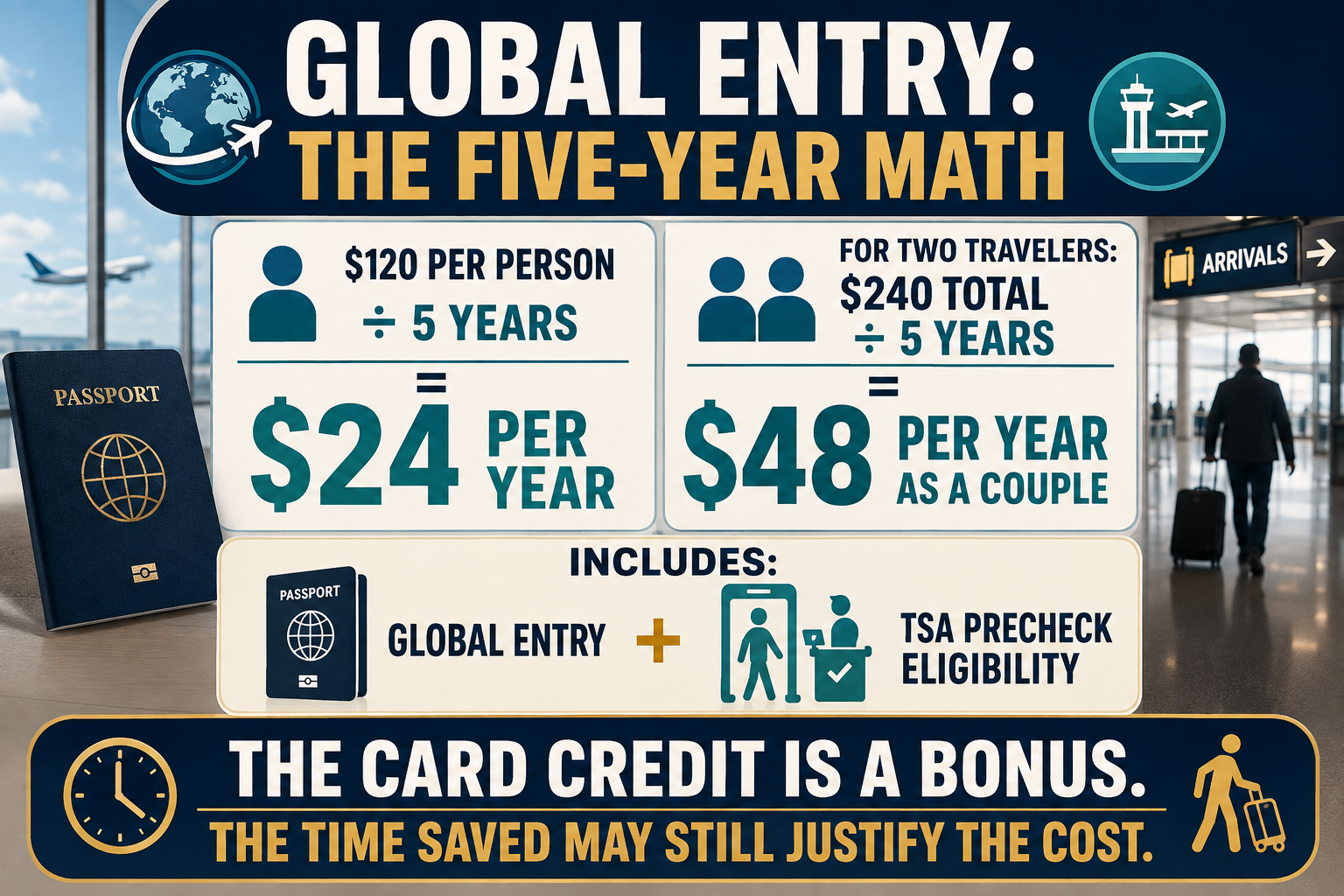
The five-year math is simple.
For one traveler:
$120 ÷ five years = $24 per year
For two travelers:
$240 ÷ five years = $48 per year as a couple
For that cost, an approved traveler receives Global Entry benefits when returning from international trips and TSA PreCheck eligibility for departures from participating U.S. airports.
One smooth international arrival—or one particularly unpleasant security line avoided—can make that annualized cost feel quite reasonable.
Use an eligible credit-card benefit if you have one.
But do not automatically dismiss Global Entry because you must pay the application fee yourself.
The card credit improves the value. It does not create all of the value.
The Hardest Part May Be Getting the Interview
Submitting a Global Entry application is only the beginning.
After applying, you must wait for conditional approval. Processing times vary considerably. Some applicants are approved quickly, while others wait much longer.
Once conditionally approved, the applicant must complete an interview before receiving final approval.
Finding a convenient interview appointment can be frustrating. Enrollment centers near major airports may show few openings, and the available appointments may be months away or require a special trip.
That is where Enrollment on Arrival can help.
My Seasoned-Traveler Tip: Use Enrollment on Arrival
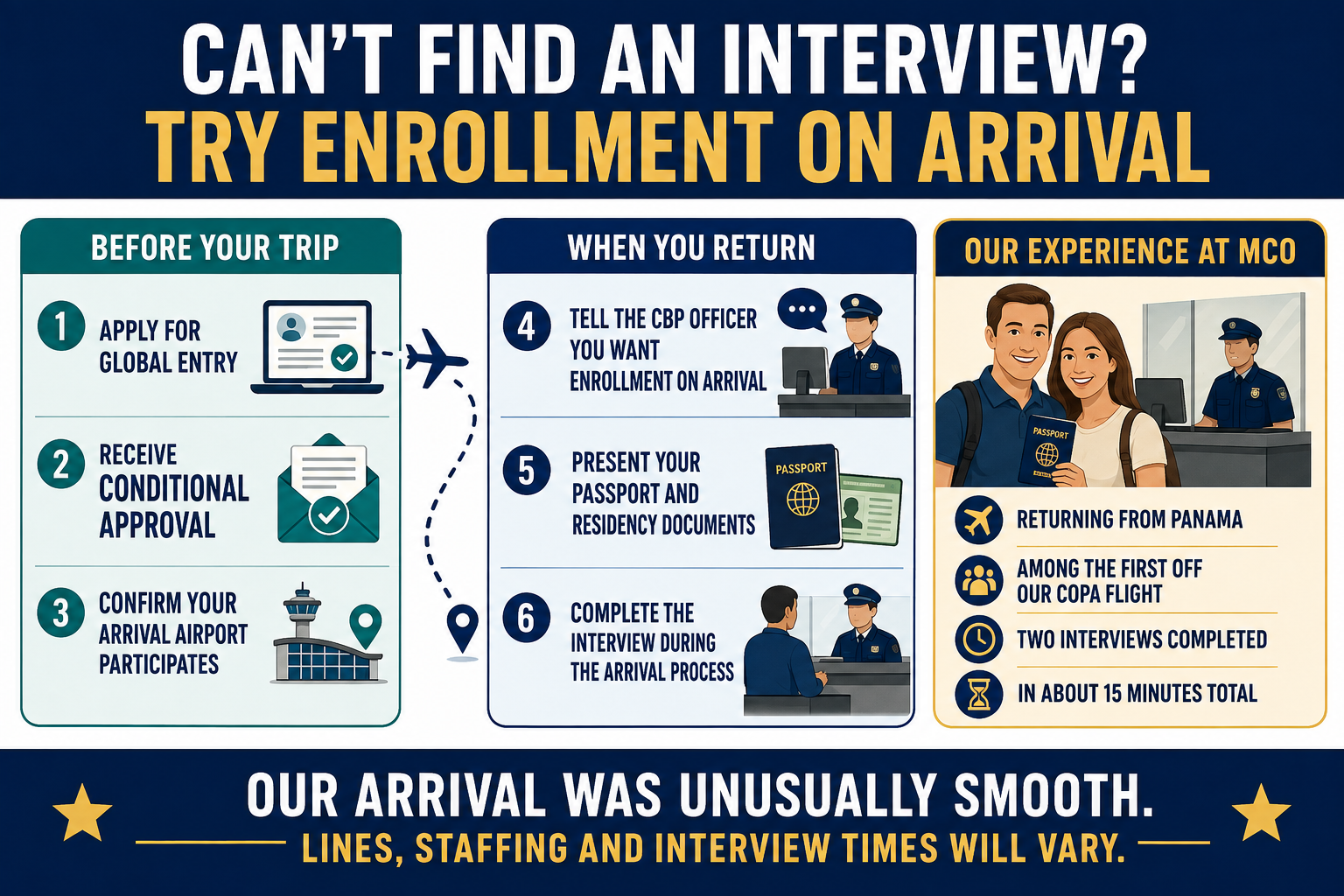
Enrollment on Arrival allows a conditionally approved Global Entry applicant to complete the required interview when returning to the United States through a participating airport or eligible preclearance location.
You must apply and receive conditional approval first.
Enrollment on Arrival is not a way to skip the application or background review.
When returning from an international trip:
Follow the signs for immigration and customs.
Tell the CBP officer you are conditionally approved for Global Entry.
Ask to complete Enrollment on Arrival.
Present the required documents.
Complete the interview during the arrival process.
CBP says applicants should bring a valid passport and evidence of residency, such as a driver’s license with a current address, mortgage statement, rental statement or utility bill. Lawful permanent residents should also carry their permanent resident card.
Confirm that your arrival location participates and review its current operating information before relying on this option.
OFFICIAL LINK: Global Entry Enrollment on Arrival locations and requirements
How We Completed Both Interviews at MCO
Gina and I used Enrollment on Arrival after returning from Panama last spring.
Before the trip, we had submitted our Global Entry applications and received conditional approval. The remaining step was the interview.
Rather than scheduling separate appointments, we planned to ask about Enrollment on Arrival when we landed at Orlando International Airport.
We were flying first class on Copa Airlines, which put us among the first passengers off the plane and near the front of the immigration line.
We told the officer that we were conditionally approved and wanted to complete Enrollment on Arrival.
Both of our interviews were completed in approximately 15 minutes total.
That was an unusually smooth experience.
Being among the first people off the aircraft helped. Lines, staffing, operating hours and individual interview times will vary. I would never promise that another traveler will be finished in 15 minutes.
But our experience demonstrates why Enrollment on Arrival is worth considering when local interview appointments are difficult to find.
We were already returning from an international trip. We had our passports with us. We were already standing in the immigration area.
Instead of making two separate trips to an enrollment center, we used an arrival we were taking anyway.
That is my favorite kind of upgrade:
Less time, less effort and no unnecessary appointment.
Check Your Wallet Before Paying
A growing number of travel credit cards reimburse eligible TSA PreCheck, Global Entry or NEXUS application fees.
But similar-sounding cards do not always have identical benefits—and benefits can change.
That lesson played out while we were planning this article.
I knew our Capital One Venture X offered an application-fee credit. I also believed our $95 Chase Sapphire Preferred offered one.
Initially, we questioned whether I was confusing the Preferred with the more expensive Sapphire Reserve.
It turns out my memory was correct.
Chase added an application-fee credit to the Sapphire Preferred beginning June 15, 2026. It now offers up to $120 every four years toward a TSA PreCheck, Global Entry or NEXUS application charged to the card.
The Capital One Venture X also currently provides up to $120 for Global Entry or TSA PreCheck, with one eligible statement credit per account every four years.
That gives us a straightforward renewal plan:
Use the Venture X credit for one Global Entry renewal.
Use the Sapphire Preferred credit for the other renewal.
Two travelers. Two eligible card accounts. Two application fees potentially covered.
The key word is account.
An authorized-user card does not necessarily create another separate application-fee credit. Read the benefit terms before charging multiple applications to the same account.
The Credit Should Not Justify the Card by Itself
A $120 credit is valuable.
It is not, by itself, a good reason to open or keep a credit card with an annual fee.
A Global Entry credit offered once every four years averages no more than $30 per year in potential value. The card must still earn its place in your wallet through the combination of benefits you will realistically use.
Consider:
Annual fee
Travel credits
Lounge access
Earning categories
Transfer partners
Travel protections
Baggage or boarding benefits
Application-fee credits
Benefits you genuinely use—not merely benefits listed on the website
The smartest approach is to check the cards you already carry before paying the application fee.
If one provides a credit, use it.
If none does, decide whether the program is still worth paying for directly.
In our case, Global Entry would still be worthwhile even if we paid cash for both memberships.
The reimbursement is a bonus.
A Note About Premium Cards and CLEAR+
Some premium cards also provide CLEAR+ credits.
The American Express Platinum Card currently has an $895 annual fee and offers up to $219 per calendar year toward CLEAR+, along with either a Global Entry or TSA PreCheck application-fee credit under its current terms.
That does not make CLEAR+ free in the broader sense.
You are still paying the card’s annual fee, and the benefit only creates value if you use it.
Do not add up every advertised credit and assume you have received that much value. Judge each benefit by what you would reasonably have paid without the card.
If you regularly use CLEAR+ and already receive enough value from the card’s other benefits, the credit can be excellent.
If your airport does not have a useful CLEAR+ lane, the statement credit is unlikely to improve your travel.

Before You Apply
Use this quick checklist:
Confirm the Program Fits Your Travel
Do you primarily fly domestically, or do you also travel internationally?
Check the Airports You Actually Use
Verify that your usual airports and terminals offer the relevant lanes or processing options.
Search Your Existing Card Benefits
Look for a current TSA PreCheck, Global Entry, NEXUS or CLEAR+ statement credit.
Apply Through the Official Site
Avoid unofficial services that charge extra to complete forms you can submit yourself.
Enter Your Information Carefully
Your name and identifying information must be accurate and consistent.
Save Your Membership Information
Once approved, add your Known Traveler Number to your airline profiles and future reservations.
Check Every Boarding Pass
Do not assume PreCheck was attached correctly. Look for the indicator before reaching security so you have time to correct missing information when possible.
Begin Renewal Early
Do not wait until the week before an important trip to discover that your membership is expiring.
The Curated Upgrades Verdict
Choose TSA PreCheck
If you primarily fly from U.S. airports and want a more convenient departure-security experience, PreCheck may be all you need.
Choose Global Entry
If you travel internationally, Global Entry will often provide the strongest overall value because it combines expedited U.S. arrival processing with TSA PreCheck eligibility.
Add CLEAR+ Selectively
CLEAR+ can complement PreCheck at participating airports, but check your regular terminals and actual out-of-pocket cost before paying for an annual membership.
Use Enrollment on Arrival
If you are conditionally approved for Global Entry and cannot find a convenient appointment, investigate completing the interview when returning from an international trip.
Check Your Credit Cards
Use an application-fee or CLEAR+ credit when it is already part of a card that provides enough overall value.
Do not acquire an expensive card solely to avoid a $120 fee every five years.
Final Thoughts
Travel is full of things you cannot control—weather, delays, missed connections and lost luggage.
You can, however, make some of the routine parts easier.
Choose the program that matches the way you actually travel. Check whether a card already in your wallet will cover the fee. If it will not, compare the direct cost with the time and aggravation the program may save.
For us, Global Entry was worthwhile even before considering the card credits.
The application took some effort. Conditional approval required patience. But Enrollment on Arrival allowed us to complete both interviews during a trip we were already taking, and approximately 15 minutes at MCO gave us benefits for the next five years.
Sometimes the best airport upgrade is not a better seat or a private lounge.
Sometimes it is simply spending less of your trip standing in line.