

Two Weeks in Ireland: What Worked, What Didn’t & What We’d Do Again
A missed connection, seven days without luggage and a road trip that refused to go exactly as planned taught us more about traveling Ireland than a perfect itinerary ever could.
Ireland had been waiting for us for a while.
Early in our relationship, Gina and I were sitting over drinks talking about places we hoped to visit someday. We each wrote down three destinations in the United States and three outside the country.
Without comparing notes first, we both put Ireland at the top of our international lists.
A few years, a wedding and eventually a pandemic later, we started turning that shared idea into an actual trip.
We had roughly two weeks. We knew we wanted to drive. And we knew we did not want to spend those two weeks racing from one famous attraction to another.
We wanted smaller towns. Scenic roads. Local food. Interesting places to stay. Time to talk with people. Enough structure to know where we were sleeping each night, but enough empty space to let Ireland have some say in what happened between breakfast and dinner.
It took us longer than expected to get there.
And once we finally did, Ireland didn't unfold exactly according to plan.
That's part of why we're still talking about it.
We Started With the Ireland We Wanted to Experience
Friends and family who had already visited Ireland gave us plenty of ideas.
That was helpful, but it also taught us an important lesson before the trip even began:
Someone else's great itinerary does not automatically make a great itinerary for you.
One couple shared a detailed route that seemed to account for nearly every available hour. There were plenty of good ideas in it, but looking at the schedule made me tired before we'd even booked the flights.
We borrowed one particularly intriguing idea from it: spending a night in a medieval castle near Nenagh.
The rest became input rather than instructions.
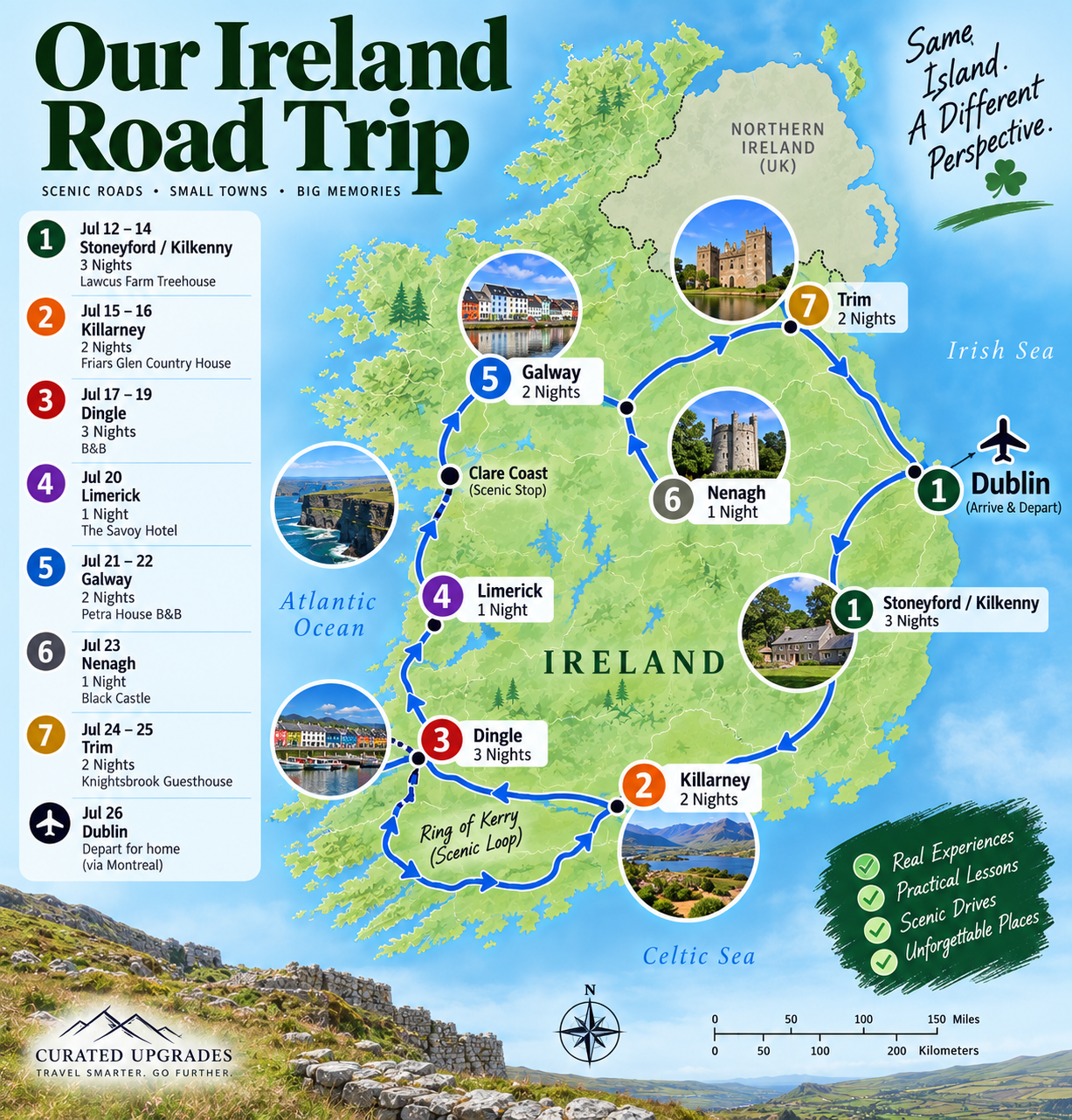
We knew we wanted Dingle and the Ring of Kerry. We wanted to experience falconry. We wanted a distillery, preferably one with history and personality rather than simply the biggest name. We liked the idea of the Kilkee Cliffs more than building a day around the much more famous Cliffs of Moher.
And we wanted unusual accommodations mixed with small, locally run B&Bs.
Just as important were the things we didn't particularly care about.
We weren't trying to collect every famous Irish attraction. The Blarney Stone, for example, held little appeal to us. We were traveling in the aftermath of COVID, the idea of kissing a rock that thousands of other people had kissed wasn't particularly enticing, and visiting it would have pulled us away from the route we wanted.
So we skipped it.
A trip does not become incomplete because you leave out something everyone says you're supposed to see.
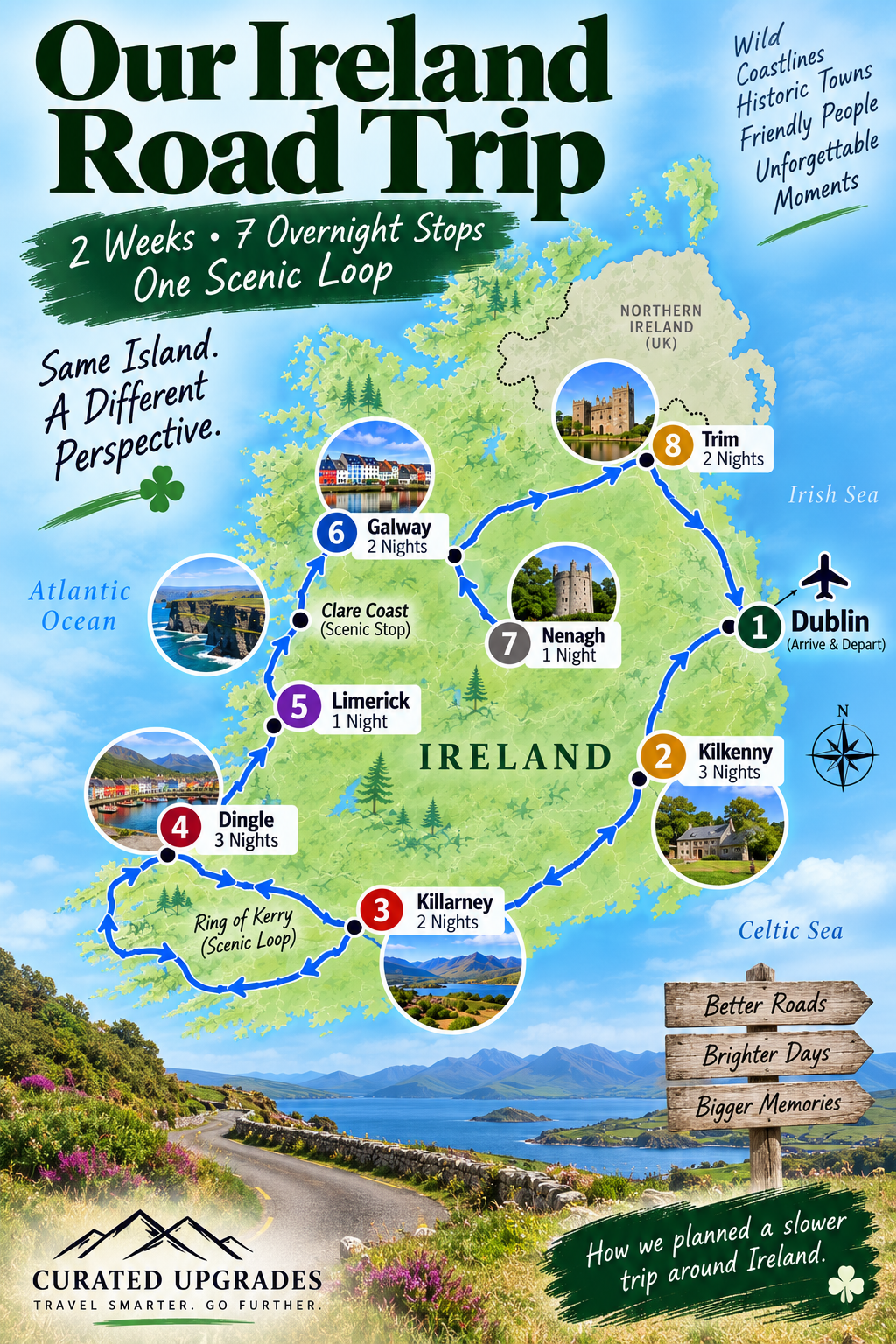
Our route eventually formed a loop from Dublin through the countryside and back to Dublin again.
We tried to keep most drives between overnight stops manageable, and we preferred multiple-night stays when possible. Three nights in Dingle was intentional. Two nights near Killarney gave us a full day for the Ring of Kerry without packing the car again the next morning.
We wanted to see Ireland.
We didn't want to spend the entire trip checking out of Ireland.
Then We Didn't Get to Ireland
Actually, that wasn't the first time.
We had originally planned the trip for the summer of 2020. We were well into the process and had already booked some of our accommodations, including a night at the Black Castle near Nenagh.
Then COVID shut down the world.
Ireland went back onto the bucket list.
When travel became practical again, we started rebuilding the trip we'd planned two years earlier. Some things had changed, but Ireland was still Ireland, and we still wanted to take the trip.
So in July 2022, we finally headed for Dublin.
And Ireland escaped us again.
We were flying Air Canada from Orlando to Dublin through Toronto. Our Orlando flight kept getting delayed, but we were repeatedly assured that our connection would be protected.
Then, while we were still trying to reach Toronto, I received a message telling me the Dublin flight was boarding.
That was pretty much that.
We reached Toronto around midnight. Our Dublin flight was gone. Our checked luggage was somewhere in the system. The airport was largely shutting down, and there wasn't exactly a welcoming committee waiting to explain what happened next.
Eventually we received a hotel voucher and got a few hours of sleep.
Instead of waking up in Ireland the next morning, we woke up in Toronto.
After waiting two years to get there, we were going to have to wait one more day.
Our first planned night in Ireland was gone.
We called the rental-car company and our first accommodation to explain what had happened. The rental company adjusted our reservation. We lost the cost of the missed lodging night.
Then we went back to the airport and waited most of the day for another flight to Dublin.
It wasn't how we'd pictured beginning our bucket-list trip.
But we still had nearly two weeks ahead of us.
That mattered.
The Trip Survived Because It Had Room to Bend
We eventually landed in Dublin a day late.
Our luggage did not.
We reported the missing bags, picked up our rental car and began the trip with essentially what we'd carried onto the airplane.
For the next week, our luggage followed us around Ireland without ever quite catching us.
We bought what we reasonably needed and saved the receipts. Our first hosts helped by washing clothes for us. We kept updating the airline as we changed locations.
Finally, while we were in Dingle, our bags caught up with us.
Seven days after we arrived.
There is a separate lesson in that experience about delayed baggage, passenger rights, what belongs in your carry-on and why you should document every expense. Those lessons apply whether you're going to Ireland, Italy or Indianapolis.
But Ireland taught us something broader:
A good travel plan isn't one that prevents everything from going wrong. It's one that can survive when something does.
We hadn't prepaid every hour of every day. We weren't changing hotels every night. Missing the first day hurt, but it didn't cause a chain reaction that destroyed the rest of the itinerary.
We adjusted.
Then we got on with the trip we'd waited two years to take.
Some of Our Best Upgrades Weren't Upgrades at All
Our first stay was at Lawcus Farm near Kilkenny.
Not a resort.
A treehouse.
It sat down a path from the main guesthouse on a small working farm. There were pigs nearby, countryside outside the window and breakfast back at the main house.
After the airport ordeal, it was almost comically different from where we'd spent the previous night.
That first evening, we ended up at Malzards Pub. We had Indian food delivered to the pub, drank our first proper Guinness in Ireland and learned a little about hurling from the bartender.
Nobody had sold us an “Authentic Irish Pub Experience.”
We just went to the pub.
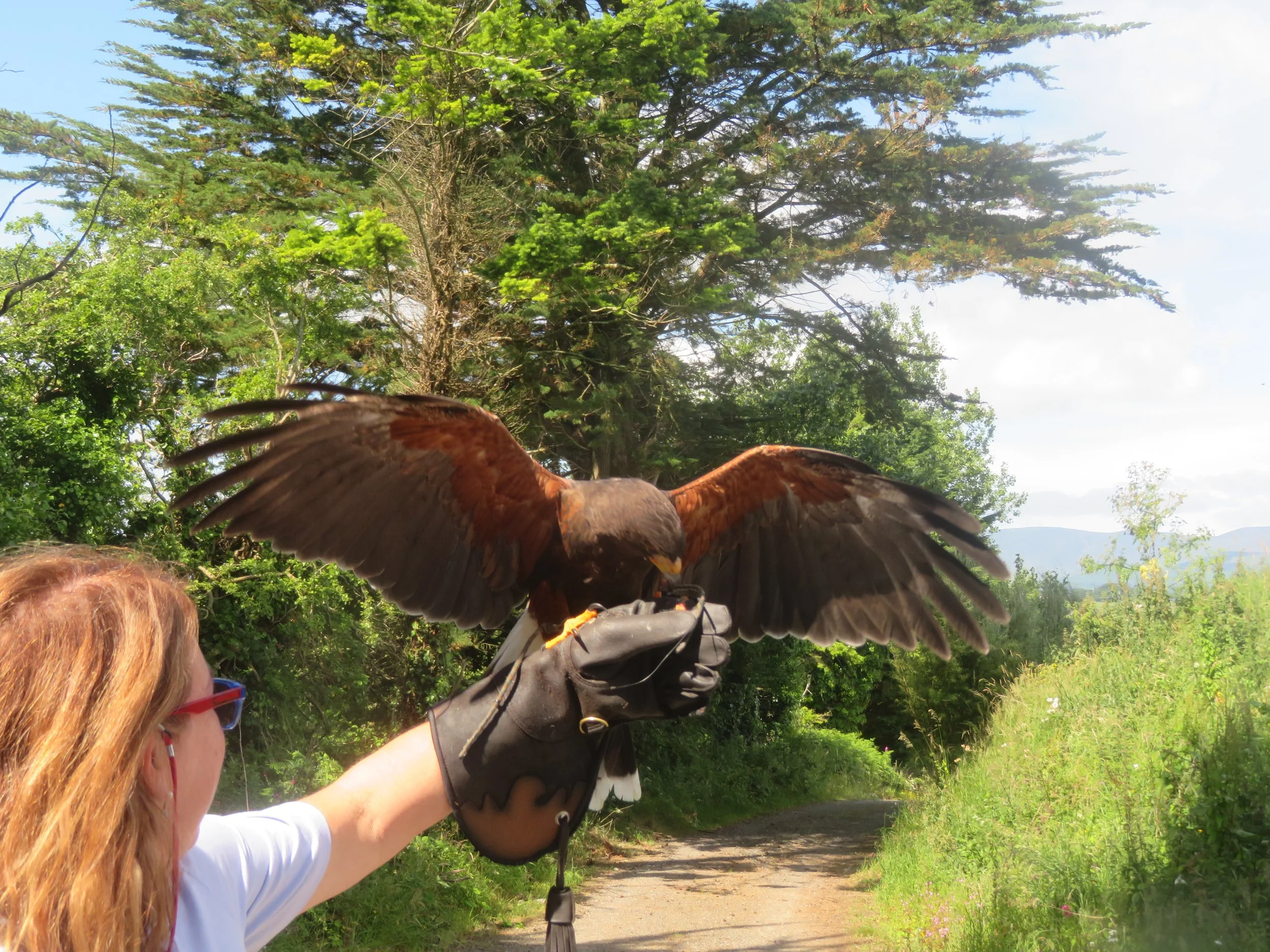
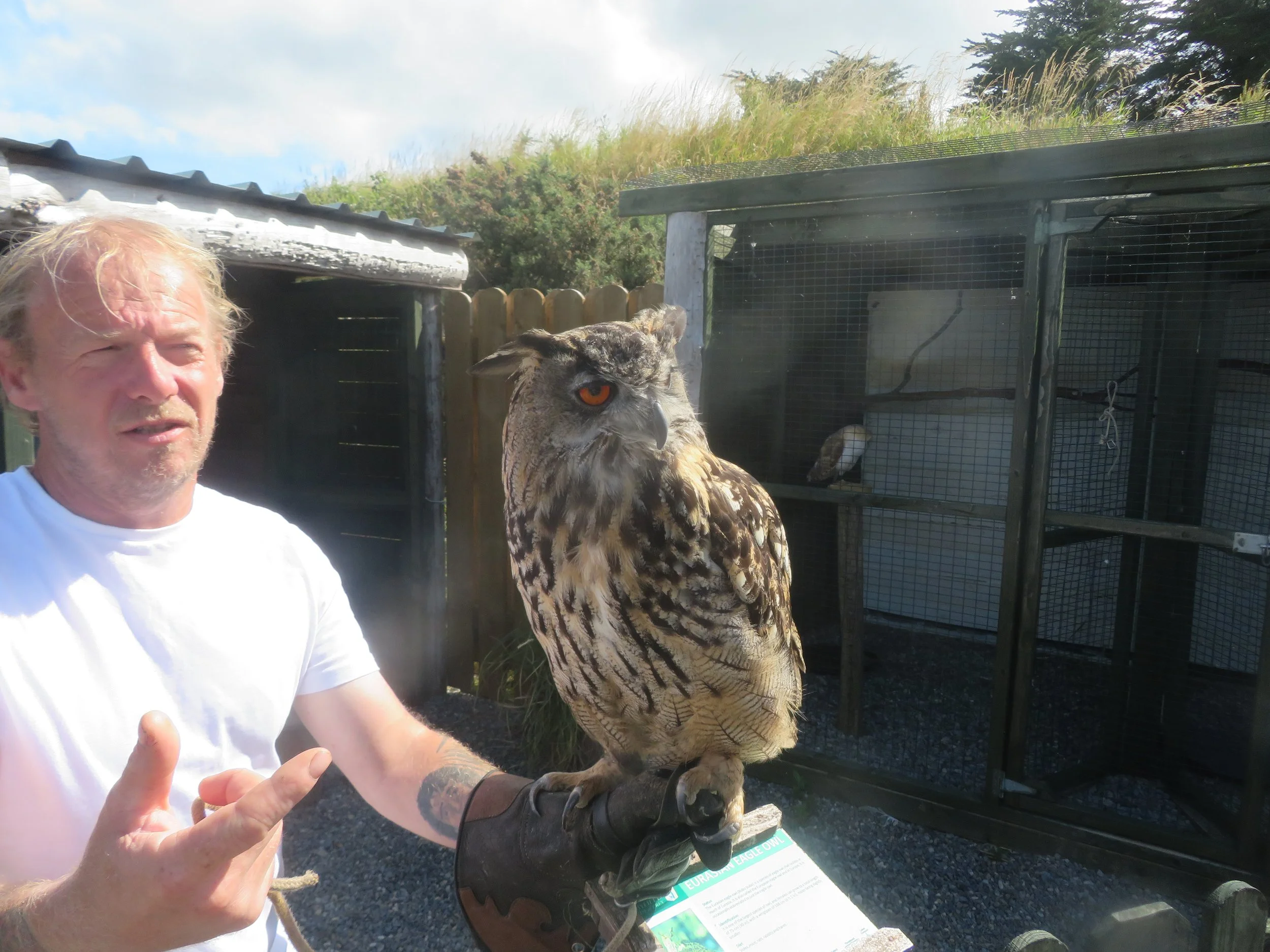
The next day brought one of the experiences we'd deliberately built the trip around: a private visit with Willie Cochran at Mayfield Birds of Prey.
We expected a falconry experience.
What we got was considerably more personal.
With tourism still recovering after COVID, there wasn't another group waiting behind us. Willie showed us more of his daily routine, including weighing and feeding the birds and explaining how he decided which birds would fly and which needed rest.
And then we flew Mikey the hawk.
Those are the kinds of experiences that make us willing to spend money while traveling.
Not necessarily a larger room.
Not necessarily another star beside the hotel's name.
Access, time and experience can be upgrades too.
Ireland Kept Rewarding Us for Slowing Down
From Kilkenny we made our way toward Killarney, stopping at Dunmore Cave along the way.
We stayed two nights at Friars Glen Country House near Killarney National Park. Deer wandered nearby in the mornings, and the location gave us the breathing room for a full Ring of Kerry day.
We weren't trying to “complete” the Ring of Kerry.
We drove it.
We stopped when something interested us. Staigue Ring Fort made the cut. So did Skelligs Chocolate, where rich hot cocoa was a perfectly reasonable travel decision.
Then came Dingle.
We had intentionally given Dingle three nights, and it became our favorite stop of the trip.
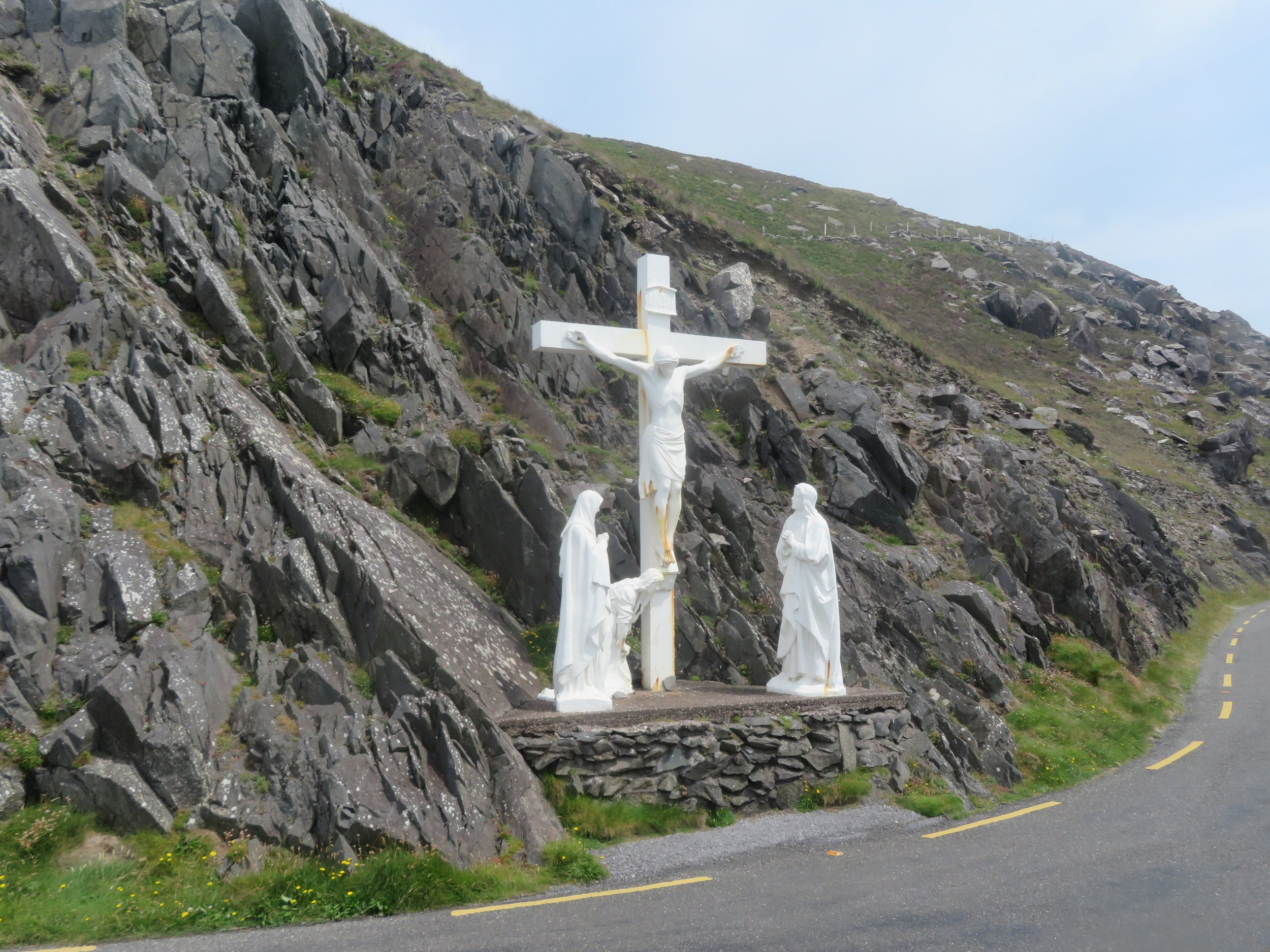
We stopped at Inch Beach on the way in. We drove Conor Pass. We hiked up toward Peddler's Lake. At one point, the road became narrow enough that getting past an approaching van involved folding in the mirrors and becoming considerably more interested in the location of the cliff beside us.
We ate at The Fishbox.
We listened to live music at The Dingle Pub.
A bartender spent time talking with me about Irish whiskey and reinforced my interest in visiting Kilbeggan later in the trip. I tried one of Kilbeggan's better whiskeys, kept tucked away behind the bar, and remembered it.
And somewhere amid all of that, our luggage finally arrived.
I couldn't tell you today what was remarkable about the B&B where we stayed in Dingle.
It was fine.
The house was fine. The hosts were fine. We slept well.
And I think that is worth acknowledging.
Not everything on a great trip needs to become a story.
Years later, we remember the mountain road, the lake, the food, the music, the bartender and how happy we were to see our suitcases.
The things that remain vivid are usually the things that made an impression.
A Four-Star Hotel Taught Us Something Too
After Dingle, we spent a night at The Savoy in Limerick.
It was one of the more conventional splurges of the trip.
And it was our least-favorite stay.
There was nothing catastrophically wrong with it. Limerick wasn't terrible. The hotel wasn't terrible.
It simply wasn't us.
After farm stays, small B&Bs, conversations with hosts and several days in Dingle, we suddenly felt like two more guests in another city hotel.
We had included Limerick partly because someone else had enjoyed it.
They weren't wrong.
Neither were we.
A place can be excellent and still be the wrong choice for you.
That lesson has influenced how we plan trips ever since.
Recommendations are possibilities, not obligations.
Famous Isn't Automatically Better
Leaving Limerick, we headed north along the Clare coast toward Galway.
One of our intentional choices was to spend our cliff time at Kilkee.
The Cliffs of Moher are one of Ireland's signature attractions. We knew that. We also knew the quieter Kilkee experience sounded more like us.
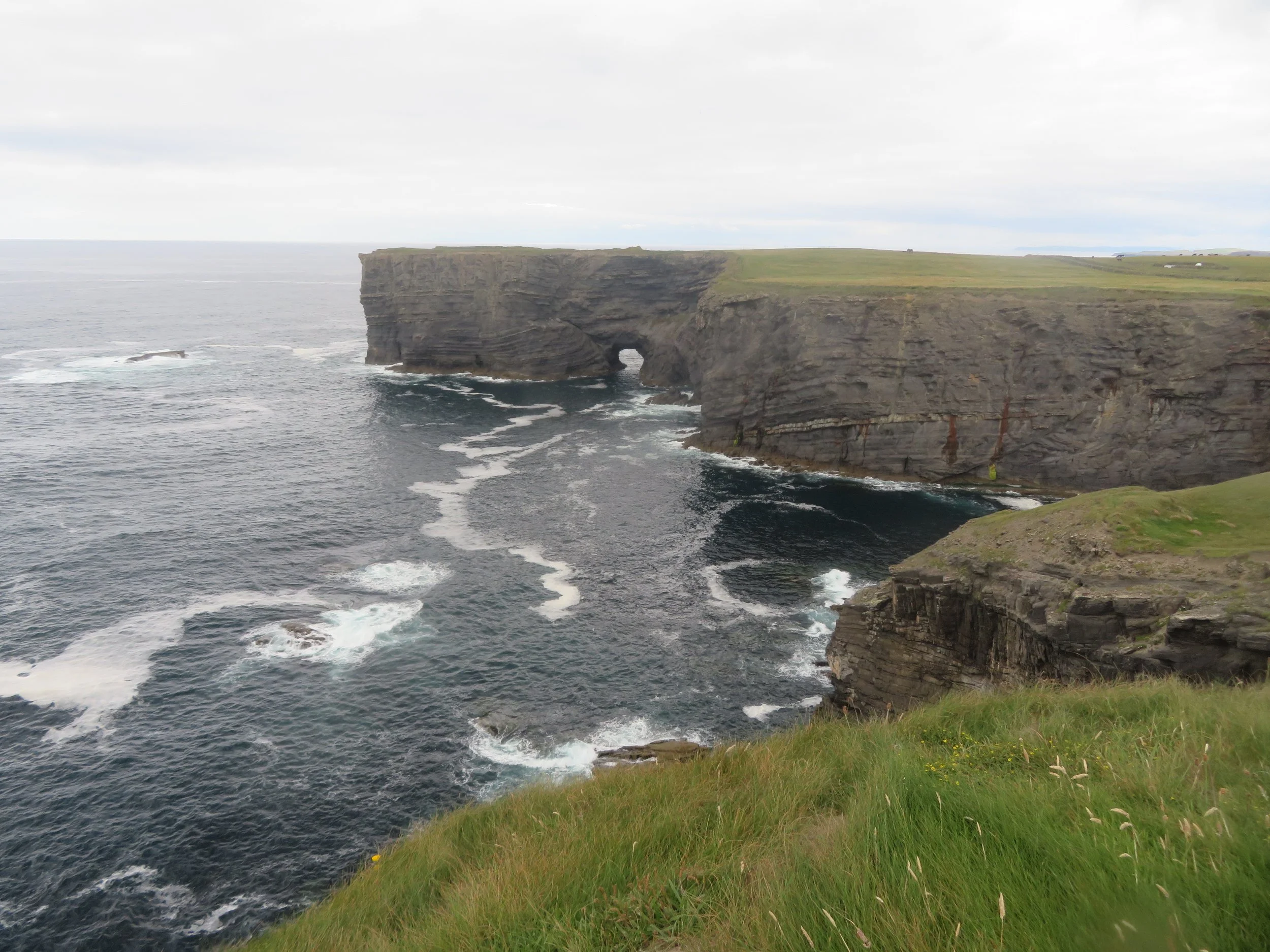
We spent our time exploring the cliffs around Kilkee and later continued north toward Galway.
That isn't advice to skip the Cliffs of Moher.
It's advice to ask a better question than:
What does everyone go see?
Ask:
Which experience sounds better to me?
Sometimes those answers are identical.
Sometimes they're not.
Spending More Can Still Be the Right Answer
We aren't opposed to luxury.
We just want the expense to improve something we actually value.
Galway gave us one of the best examples.
We stayed at Petra House, a small B&B run by Paul and Amy, close enough that we could easily get into town. It was comfortable, personal and exactly the kind of lodging that had been working for us.
Then we splurged on dinner at The Pullman Restaurant at Glenlo Abbey.
The restaurant occupied historic railway carriages overlooking the grounds. From the setting and service through the meal itself, everything came together into what we later described in our review as our favorite meal of the entire two-week trip.
We also enjoyed a formal afternoon tea at The Connacht Hotel.
Those weren't everyday expenses.
They were intentional ones.
That distinction matters to us.
Traveling smarter doesn't mean spending as little as possible. It means understanding what you're paying for and whether it improves the experience you care about.
The Castle That Waited for Us
The Black Castle near Nenagh had been part of our Ireland plans from the beginning.
We had originally reserved a night there for our 2020 trip. COVID canceled that along with everything else, but when we began rebuilding the trip for 2022, we still had the owners' contact information from our original reservation.
There was one problem.
The castle was supposed to be closed for the season by the time our new itinerary brought us through Nenagh.
We emailed the owners anyway.
Rather than simply telling us they were closed, they delayed their own return home by a week so we could finally spend the night in the castle we'd first booked two years earlier.
That made the stay special before we ever walked through the door.
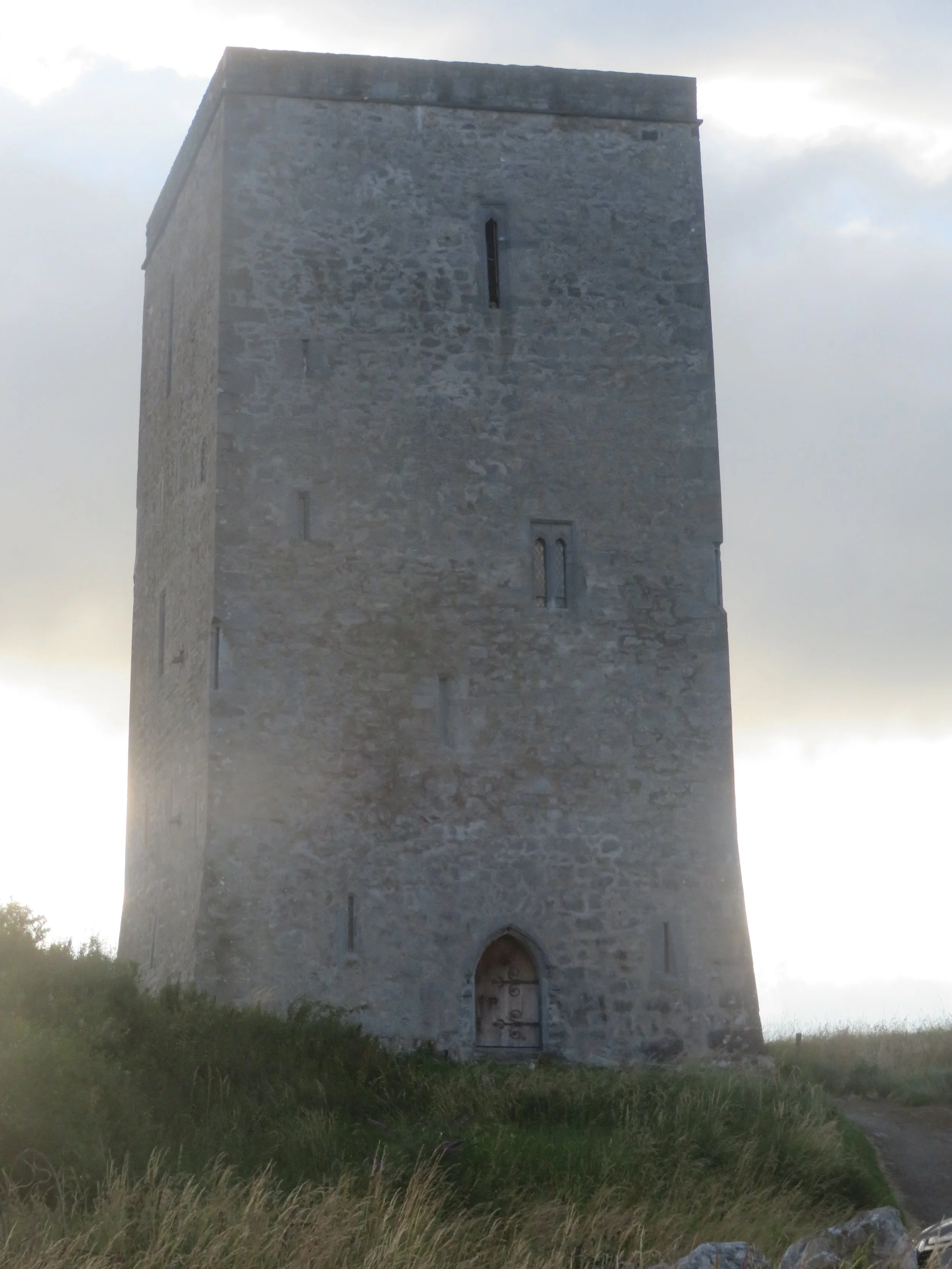
The Black Castle is a restored 16th-century tower house. This wasn't a castle-themed hotel with a reception desk and modern rooms hiding behind old stone walls.
We essentially had a medieval tower house to ourselves.
There was no television glowing from the wall. No room-service menu.
The Great Hall didn't even have electricity.
And it became our favorite accommodation of the entire trip.
Part of that was the castle itself. Part was the sheer fun of spending a night somewhere so completely different from an ordinary hotel.
But knowing what the owners had done to make our long-delayed stay possible made it something more.
The contrast with our conventional upscale hotel in Limerick has stayed with me.
One offered considerably more luxury.
The other offered a story, a sense of place and hospitality that began before we'd even arrived.
The castle won.
Memorable and luxurious are not synonyms.
Sometimes the better upgrade is the experience someone went out of their way to make possible.
The People Became Part of the Destination
Our final base was Trim.
We stayed at Knightsbrook Guesthouse with our host, Mary, and visited Trim Castle, famous in part for its appearance in Braveheart.
We also made our way to Kilbeggan Distillery, where I had booked a special experience and eventually left with a 14-year-old bottle.
But one of my favorite memories from that part of the trip doesn't involve a castle or whiskey.
It involves cheese.
We had discovered an Irish cheese we loved. When Mary learned how much we'd enjoyed it, she actually went shopping and found a wheel for us to take home.
At another stop during the trip, a café owner pulled up a chair while we ate and joined the conversation with us and the other diners.
It felt less like we'd entered a business and more like we'd shown up at somebody's potluck.
You can't build those moments into an itinerary.
You can only build an itinerary that leaves enough room for them to happen.
What Worked
Looking back, several decisions made this trip better.
We decided what kind of Ireland we wanted before trying to see all of Ireland. That made it easier to skip things that didn't fit.
We gave important places more than one night. Dingle is the clearest example. Three nights gave it time to become a place rather than another pin on the map.
We mixed planned experiences with white space. Falconry required advance planning. Conversations in pubs did not.
We chose accommodations for experience as well as convenience. The treehouse and Black Castle became part of the trip rather than merely places to sleep.
We listened to local people. Some of the best information we received came after we arrived.
And perhaps most importantly:
We didn't abandon the trip when the trip stopped cooperating.
What Didn't
The flight plan obviously didn't work.
Our baggage strategy could have been better. Seven days without checked luggage has a way of making you reconsider exactly what belongs in your carry-on.
Limerick didn't fit us as well as we'd hoped.
And I'm sure there were other small misses that neither of us remembers anymore.
That's okay.
A successful trip doesn't require retroactively declaring every decision brilliant.
Sometimes discovering what doesn't fit your travel style is part of becoming a better traveler.
What We'd Do Again
We'd drive.
We'd choose a few anchors rather than a giant list of must-sees.
We'd stay several nights in the places that matter most.
We'd seek out smaller, locally run accommodations.
We'd deliberately book one or two unusual stays.
We'd spend money on experiences that create access, connection or memories rather than automatically choosing the most expensive version of everything.
We'd leave room for recommendations after we arrive.
We'd talk to people.
And we'd give Dingle at least three nights.
No deliberation required on that one.
What We'd Do Differently
We'd be more deliberate about what goes into our carry-ons.
We'd trust our own travel preferences sooner rather than adding a stop mainly because somebody else loved it.
And we'd continue resisting the temptation to fill every empty space on the itinerary.
If anything, Ireland reinforced our preference for slower travel.
The empty spaces weren't holes in the plan.
They were where some of the best parts happened.
My Curated Verdict
🟢 GO FOR IT
Build an Ireland trip around the experiences that genuinely interest you. Give yourself enough time to drive, stop, talk to people and spend multiple nights in the places that matter most.
Consider locally run B&Bs and unusual accommodations. Some of our least conventional stays became our favorites.
🟡 EVALUATE IT
Treat every famous attraction, highly rated hotel and enthusiastic recommendation as an option.
Ask what it adds to your trip, how much time it requires and what you give up to include it.
That applies to everything from the Cliffs of Moher to a four-star hotel.
🔴 SKIP IT
Don't turn Ireland into a scavenger hunt.
You don't need to kiss every stone, photograph every cliff or change hotels every night to prove you saw the country.
A packed itinerary may allow you to visit more places while experiencing fewer of them.
The Bottom Line
Our Ireland trip didn't begin the way we'd imagined.
In fact, it didn't begin when we'd imagined either.
COVID postponed it for two years. Then a missed connection postponed it another day. When we finally arrived, our luggage decided to take a separate vacation.
Yet when Gina and I talk about Ireland now, those aren't the first things we remember.
We remember a treehouse.
We remember Mikey the hawk.
We remember deer outside our B&B, hot chocolate on the Ring of Kerry and a road near Dingle narrow enough to make me question several life choices.
We remember live music and Irish whiskey. The Pullman. A medieval castle without electricity whose owners rearranged their own plans so we could finally spend the night there.
We remember a B&B host who went shopping for cheese because she knew we'd fallen in love with it.
We remember people who had no idea they were becoming part of our story.
That's why I wouldn't hand someone our itinerary and tell them to copy it.
I'd tell them to start with the questions.
What do you want Ireland to feel like?
What experiences matter enough to build the trip around?
How quickly do you really want to move?
What are you willing to skip?
And have you left enough room for something you couldn't possibly plan?
Answer those first.
Then build your Ireland.
Because the best thing our itinerary did wasn't take us everywhere.
It gave Ireland enough room to surprise us.