

Who Really Owns the Rental-Car Companies—and Does It Matter?
The familiar airport brands mostly belong to three corporate families—but price, location and pickup convenience still matter more than the logo.
Walk through an airport rental-car center and it can appear that you have a dozen completely independent companies competing for your business.
Enterprise. National. Alamo. Hertz. Dollar. Thrifty. Avis. Budget. Payless.
That is a lot of signs—but far fewer parent companies.
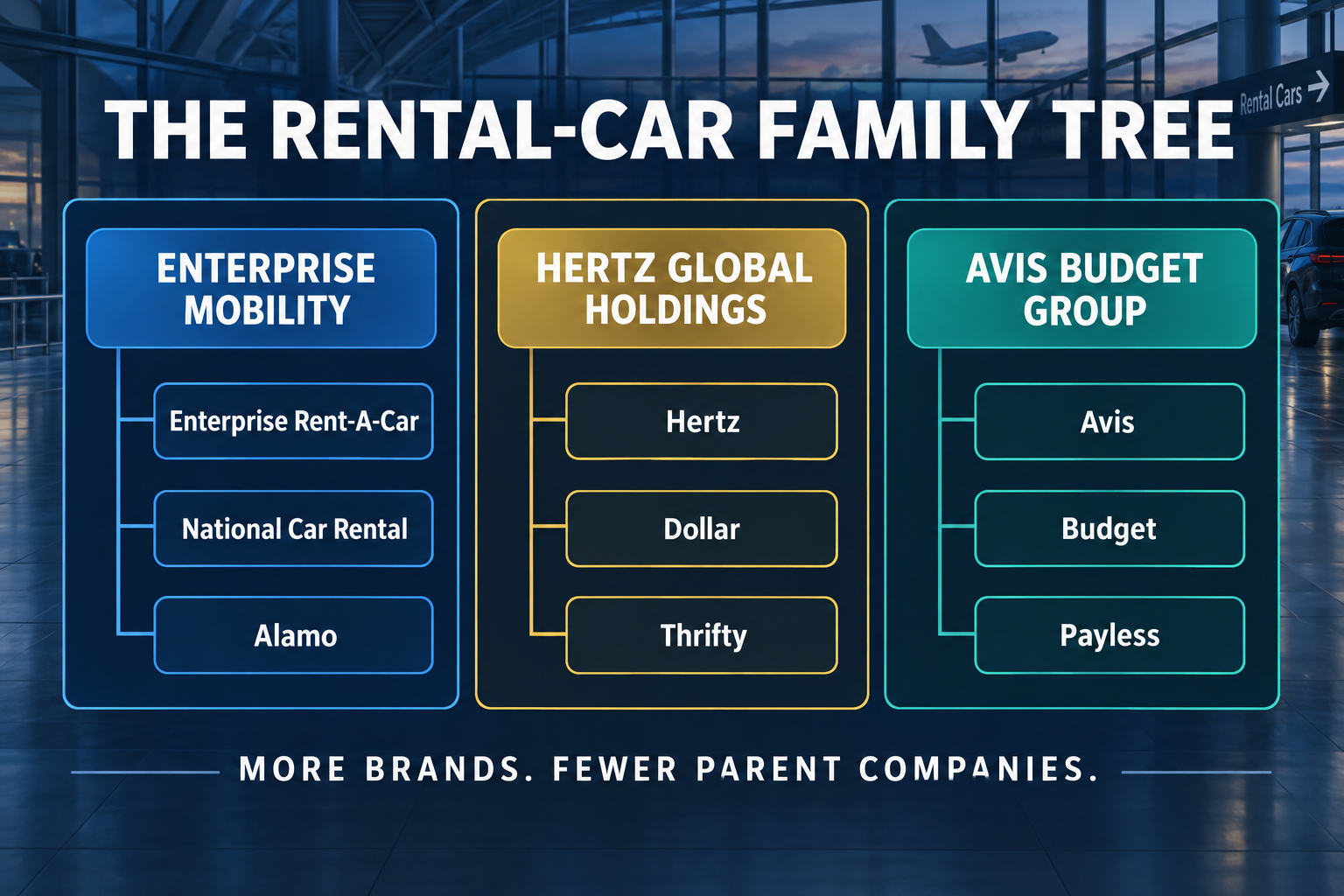
Many of America’s most familiar rental-car brands belong to three major corporate families: Enterprise Mobility, Hertz Global Holdings and Avis Budget Group.
Knowing that family tree is useful. It can help you compare brands, understand why two companies occasionally share a counter and avoid assuming that switching between affiliated brands means dealing with an entirely different organization.
But shared ownership does not mean every company offers the same price, vehicle or rental experience.
I have rented from all of these major brands at one time or another, for both work and leisure. My conclusion is simple:
The parent company is useful information—but it is not the deciding factor.
Three Major Rental-Car Families
This is not a complete list of every brand or service each corporation owns. It is the family tree for nine of the rental names American travelers are most likely to encounter.
Enterprise Mobility
Enterprise Mobility operates three familiar rental brands:
Enterprise Rent-A-Car
National Car Rental
Alamo
The brands generally serve different parts of the market.
Enterprise has an extensive network of airport and neighborhood locations and handles leisure, business and insurance-replacement rentals.
National is closely associated with frequent business travelers and expedited services such as the Emerald Aisle at participating locations.
Alamo is positioned primarily as a value-oriented leisure brand serving vacation destinations and airport travelers.
Hertz Global Holdings
Hertz Global Holdings operates:
Hertz
Dollar
Thrifty
Hertz is the group’s flagship global rental brand, while Dollar and Thrifty generally compete for more price-conscious renters. The company also operates other brands and services, but these are the three names most American airport travelers will recognize.
Avis Budget Group
Avis Budget Group operates:
Avis
Budget
Payless
Avis is generally positioned as the premium brand, Budget as the value-oriented alternative and Payless for particularly price-conscious travelers.
The company also owns other transportation brands, including Zipcar and Budget Truck Rental, so this is not its entire corporate portfolio.
What Shared Ownership Can—and Cannot—Tell You
I have encountered affiliated brands operating from the same counter or rental facility. Dollar and Thrifty may share space. Avis and Budget may appear beside each other. Enterprise, National and Alamo may operate from the same consolidated rental center.
That is a useful clue about the corporate relationship, but it does not prove that every sibling brand shares one interchangeable fleet, reservation system or customer-service operation.
Practices can vary by:
Airport
Local operator
Franchise arrangement
Vehicle availability
Reservation type
Time of day
Loyalty membership
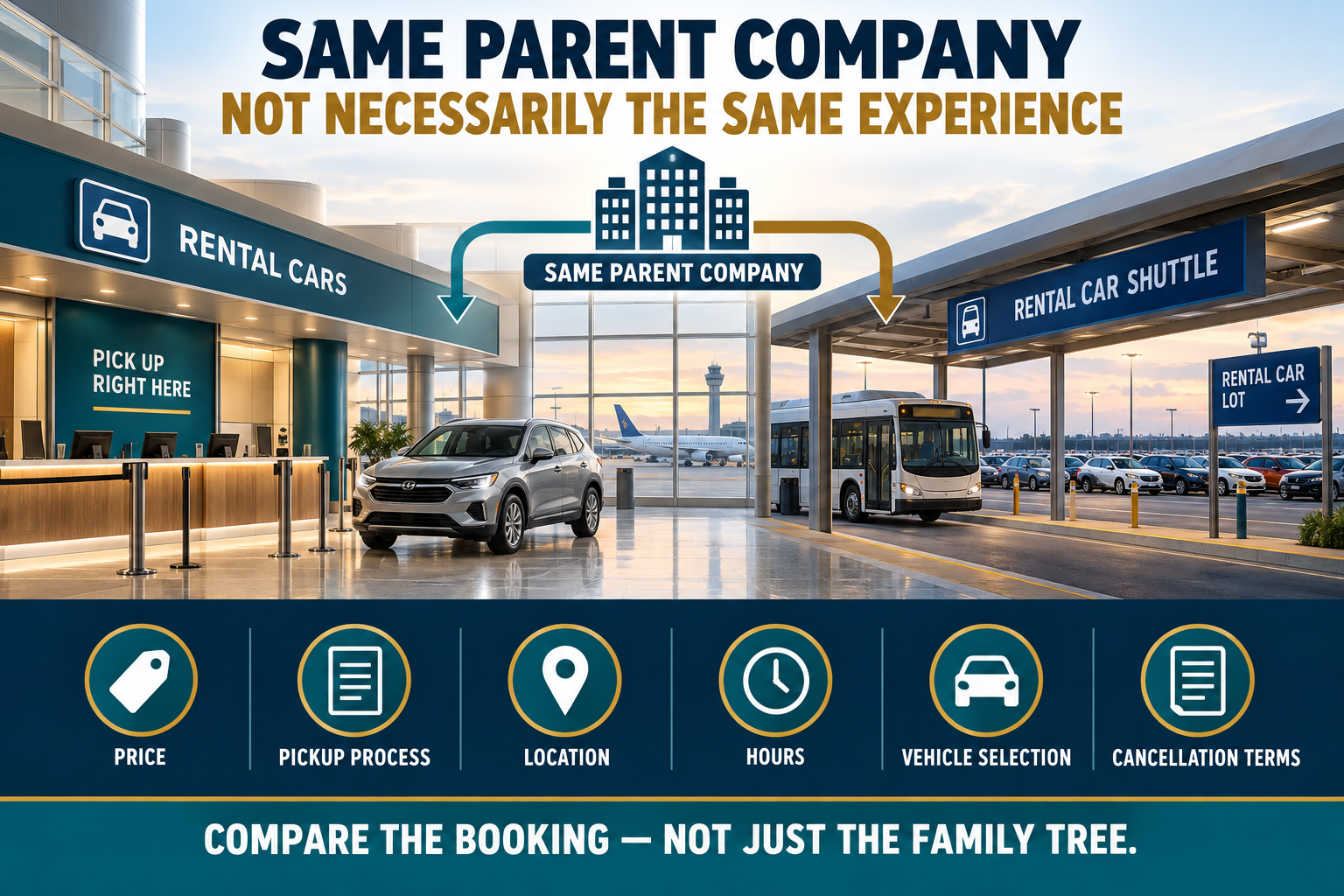
A lower-priced reservation with an affiliated brand may result in a vehicle similar to one offered by the premium brand. It may also involve a different counter, longer wait, different cancellation rules or a more distant pickup location.
Shared ownership does not make two reservations identical.
I Begin With Price—but I Don’t Stop There
When I travel for work, someone else is generally paying and the reservation tends to be driven by price.
For personal travel, I still care about price—but I have more freedom to consider what I want from the vehicle and how easily I can pick it up.
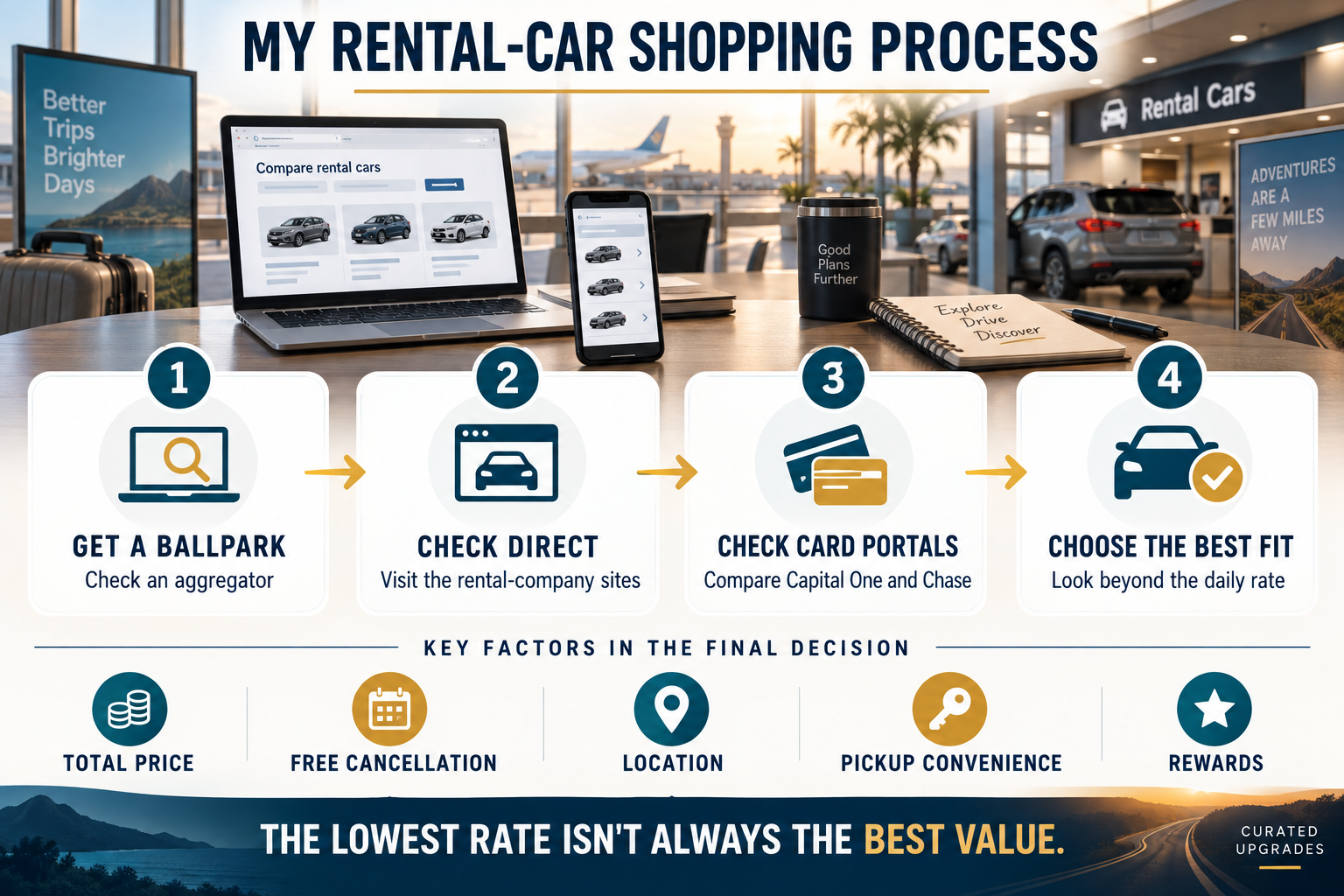
I normally begin with Hotwire or another aggregator. That gives me a general sense of the market without requiring me to search every rental company individually.
Once I understand the ballpark price, I check:
The rental companies’ own websites
Capital One Travel
Chase Travel
The cancellation terms
The pickup location
The rewards I will earn
The actual vehicle class available
My last three rental cars were booked through Capital One Travel. For those particular reservations, Capital One offered the best pricing, free cancellation and 10X miles with my Venture X card.
That does not mean Capital One will always win. It means it won those three comparisons.
Capital One currently advertises 10X miles for Venture X cardholders on rental cars booked through Capital One Travel, but card benefits can change and individual reservations have their own cancellation rules. Confirm the current Capital One Travel benefits before booking.
The important lesson is not that one portal is always best. It is that the daily rate is only one part of the comparison.
Compare the Complete Reservation
Two listings for the same vehicle class may still be meaningfully different.
Before choosing the cheaper one, I compare:
The final price
I look beyond the initial daily rate and compare the complete total, including taxes and mandatory fees.
Cancellation terms
A slightly higher refundable rate can be more valuable than the cheapest prepaid reservation—especially when plans are still changing.
Mileage and fuel rules
Unlimited mileage may be important on a road trip. Fuel policies can also affect the real cost.
Pickup and return hours
A bargain is less useful if the counter closes before a delayed flight arrives or opens too late for the return trip.
Loyalty and airline rewards
I maintain memberships with the major rental-company loyalty programs. Many of them offer opportunities to earn rental rewards or miles with participating airline programs.
The rules vary, and selecting airline miles can sometimes involve additional conditions or surcharges. I treat those rewards as part of the comparison—not as the only reason to book.
Pickup convenience
This can be the deciding factor.
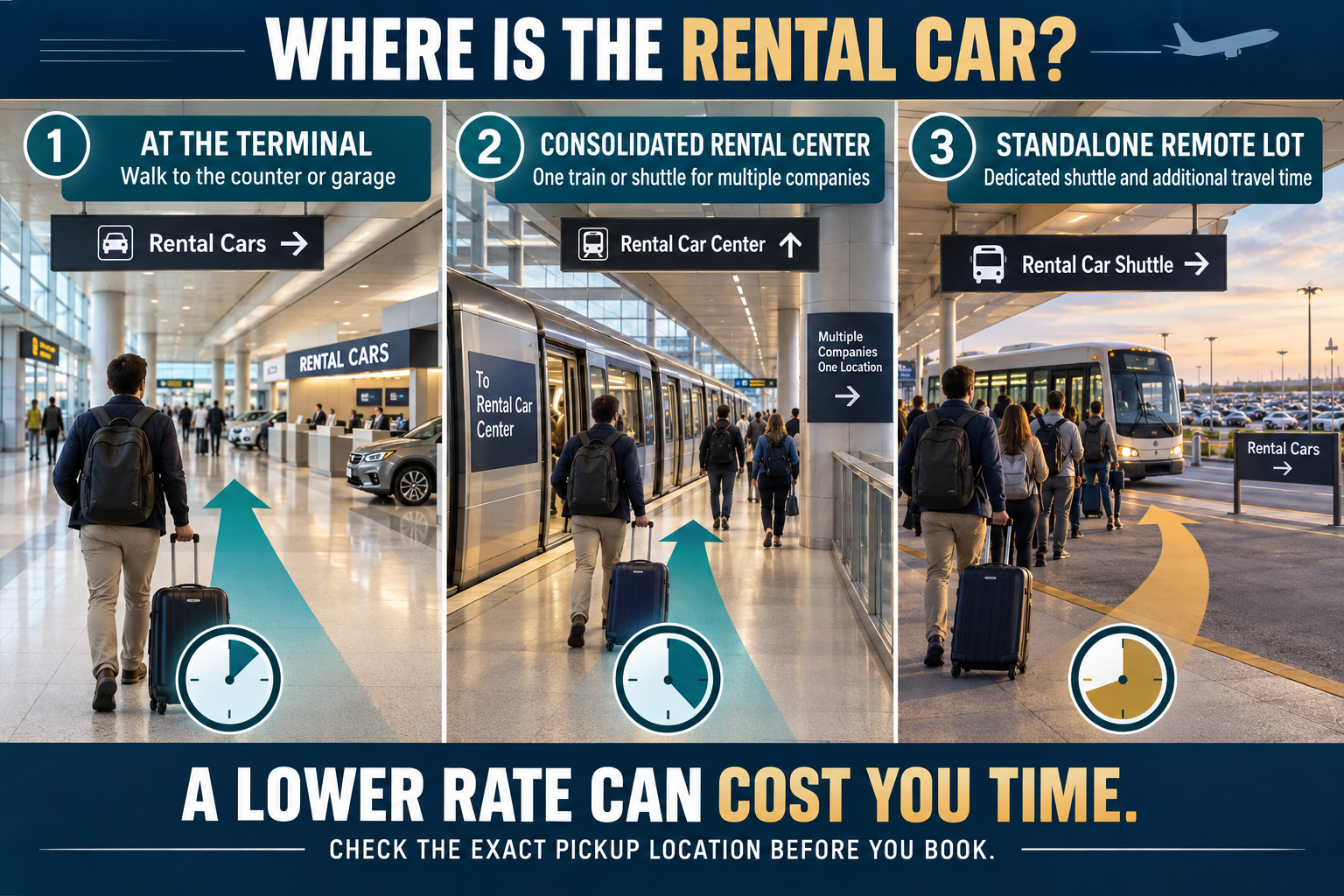
The cheapest rental can quickly become less attractive if it requires waiting for a dedicated shuttle, traveling well beyond the airport and standing in another long line after arriving at the lot.
“At the Airport” Can Mean Several Different Things
Rental listings often use broad airport language, but there are important differences among:
A counter and garage directly at the terminal
A consolidated rental center reached by an airport train or shared shuttle
A standalone lot reached by that company’s dedicated shuttle
I have experienced all three.
At some airports, every major rental company is located in the same consolidated center. In that situation, the train or shuttle ride does not substantially affect which company I choose because everyone begins with the same transportation step.
San Diego, for example, operates a consolidated Rental Car Center served by continuous airport shuttle buses. Review San Diego International Airport’s current rental-car instructions.
Phoenix also has a consolidated Rental Car Center. My earlier experience involved a bus, but today the facility is connected to the terminals by the PHX Sky Train. Airport arrangements change, which is precisely why travelers should verify the current instructions instead of relying on an older trip report.
The arrangement that makes me hesitate is a standalone rental company located substantially farther from the airport, with its own shuttle and longer pickup or return process.
I encountered one in Denver that felt particularly remote. My experience included longer waits and less service than I expected. That does not mean every independent or remote lot provides poor service, but I now consider the transportation time part of the price.
Saving a few dollars is not always worthwhile if it adds uncertainty at both ends of the rental.
Sometimes a Corolla Really Is a Corolla
For many trips, a rental car is simply transportation.
I am not buying it. I am not making payments on it for five years. I need it to carry us and our luggage safely from the airport to the places we actually came to experience.
In those situations, my philosophy is straightforward:
A Corolla is a Corolla.
I do not automatically pay more because one familiar logo is considered more prestigious than another. If the vehicle class, terms and pickup experience meet my needs, I am happy to choose the better value.
However, that philosophy changes when the vehicle becomes part of the trip.
Sometimes the Vehicle Is the Upgrade
There are trips when I specifically want a convertible. The open-air drive and the destination may make the vehicle part of the experience.
On another trip, I may want a four-wheel-drive Jeep or SUV because of the roads, terrain, weather or destination.
In those cases, I shop for the vehicle I want and then compare prices among the companies offering it.
One important caution: rental companies generally reserve a vehicle class, not a guaranteed make and model, unless the listing explicitly says otherwise. A photograph of a Jeep, Mustang or another recognizable vehicle may be followed by the words “or similar.”
If a particular model matters, read the description carefully and contact the location before booking. Even then, fleet availability can change.
Pay more when the vehicle genuinely improves the experience or supplies capability the trip requires—not simply because a premium badge appears over the counter.

Long Lines Don’t Always Mean More Upselling
The original version of this article idea assumed that discount rental counters always subjected customers to more aggressive sales pitches.
That has not consistently matched my experience.
I have stood in plenty of long rental-car lines. When the counter is extremely busy, I have sometimes noticed less upselling—not more—because the employees are trying to move everyone through.
Optional products can be offered by premium and value brands alike:
Collision or loss-damage waivers
Supplemental liability coverage
Roadside-assistance plans
Prepaid fuel
Toll programs
Vehicle upgrades
The best defense is not choosing one particular logo. It is understanding your existing insurance and credit-card coverage before arriving.
Coverage varies by card, country, vehicle type and reservation. Never assume that holding a travel card automatically covers every rental or every possible loss.
Loyalty Can Make the Premium Worthwhile
I belong to the loyalty programs offered by the major rental companies. Membership is generally free, and enrolling gives me another option when comparing reservations.
Depending on the program, membership level, location and booking type, benefits may include:
A shorter counter process
A dedicated line
A preassigned vehicle
The ability to select from a designated area
Faster returns
Rental credits or points
Airline-mile earning
Not every benefit applies to every reservation or location. Enrollment may be required before booking, and reservations made through some third parties may not receive every loyalty benefit.
But when an eligible program lets me bypass or shorten a long counter line, that has real value.
The premium is not necessarily buying a better sedan.
It may be buying back part of my travel day.

My Curated Verdict
🟢GO FOR IT
Compare affiliated rental brands instead of automatically choosing the premium name. Begin with an aggregator, but check direct prices and your eligible credit-card portals before booking.
🟡EVALUATE
Look closely at the complete reservation:
Final price
Free cancellation
Pickup location
Transportation to the lot
Counter hours
Vehicle class
Loyalty benefits
Rewards earned
A modestly higher price may be justified when it saves meaningful time or provides the vehicle the trip actually needs.
🔴SKIP IT
Do not assume:
Shared ownership guarantees the same vehicle or service
The cheapest daily rate is automatically the best value
“Airport location” means the counter is inside the terminal
A pictured make and model is guaranteed
Your loyalty or credit-card benefits apply automatically
The Logo Is Only the Beginning
Understanding the rental-car family tree makes you a better-informed shopper, but it does not make the decision for you.
I have rented from all three major corporate families and their better-known brands. I do not have one company that wins every time.
Sometimes I choose the lowest practical price.
Sometimes I pay more for a convertible or four-wheel-drive vehicle.
Sometimes a portal offers the best combination of price, cancellation terms and rewards.
And sometimes the upgrade worth buying is simply an easier pickup and more time enjoying the destination.
That is the Curated Upgrades approach:
Compare the complete experience. Spend more where it improves the trip. Save where it does not.
If you decide that asking for a better vehicle is worth trying, continue with How to Ask for a Rental-Car Upgrade.