

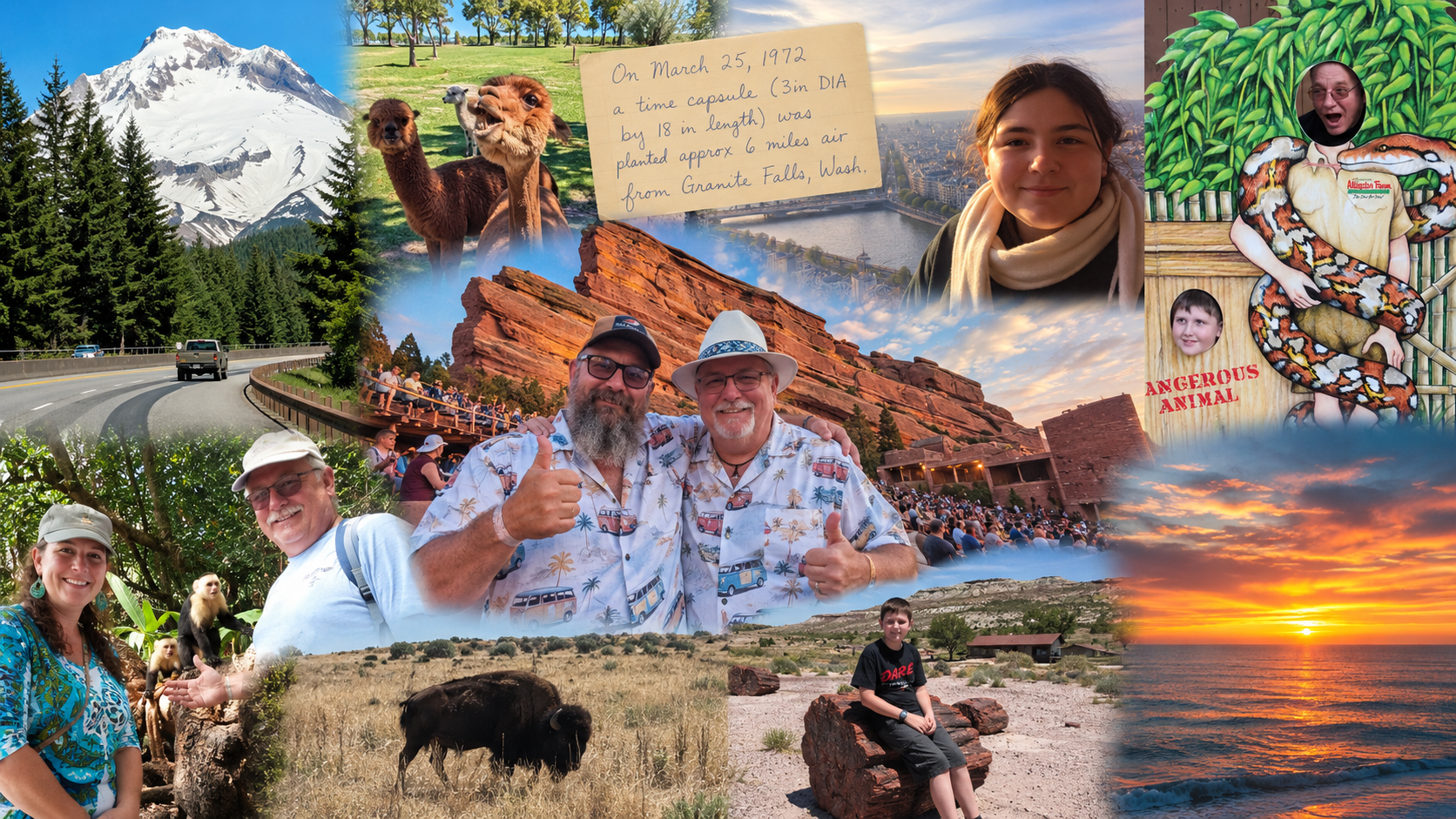
Capture the Story, Not Just the Photos
The best travel photos don’t just show where you went. They remind you what happened while you were there.
I take a lot of pictures when I travel.
So this isn't going to be one of those articles telling you to put down the camera, stop taking pictures and “live in the moment.”
My advice is almost the opposite.
Take the picture.
Take the picture in front of the famous landmark. Photograph the beautiful sunset. Get the family together for the awkward group shot. Take pictures of the meal, the weird roadside attraction, the rental car, the handwritten sign and the ridiculous thing that made everybody laugh.
But don't assume the photograph will remember the story for you.
Twenty years from now, the picture may tell you where you were.
The story tells you why that day mattered.
Building Curated Upgrades has reminded me of this over and over. I've gone digging through old photographs looking for something to illustrate an article and found pictures that aren't particularly remarkable.
Then I look at one and think:
Wait. I remember what happened that day.
Suddenly, I'm not looking at an old JPEG anymore.
I'm back on the trip.
A Photograph Is Only Part of the Memory
Scroll through an old photo album and eventually you'll find one that makes you stop.
Maybe it isn't even a particularly good photograph.
But suddenly you remember something that isn't visible anywhere in the frame.
Who suggested the place.
What happened ten minutes before the picture.
The conversation you had afterward.
Why everyone was laughing.
The wrong turn that got you there.
Or why somebody who isn't even in the photograph was very much a part of that day.
Sometimes the most meaningful travel photograph isn't the prettiest one.
Sometimes it's the one that unlocks everything around it.
The Time Capsule We Never Found
Gina was born in Washington State, and her father was an avid hiker.
He died in 1986, when she was still a teenager.
Years later, we were already traveling in Washington when Gina's mother, Janet, casually mentioned something Gina hadn't known.
Back in 1972, her dad had hidden a time capsule somewhere in Washington.
And Janet had a handwritten note describing where he'd put it.
There was one minor problem.
We were already in Washington when she told us.
Fortunately, we hadn't scheduled every hour of the trip. We had room to change plans.
So our trip acquired a new mission:
Find the time capsule.
The instructions described a landscape from decades earlier. Roads had changed. Names had changed. The old fire-road information wasn't exactly something we could punch into the navigation system.
Eventually, we ended up at a local historical society.
They helped us narrow down the area and dig through old maps showing the former roads. The search apparently became interesting enough that they later wrote a little piece about it for their newsletter.
We never found the time capsule.
And I don't think that makes the search a failure.
Gina's father had been gone for decades. There was nobody we could call and ask, “Okay, where did you really put this thing?”
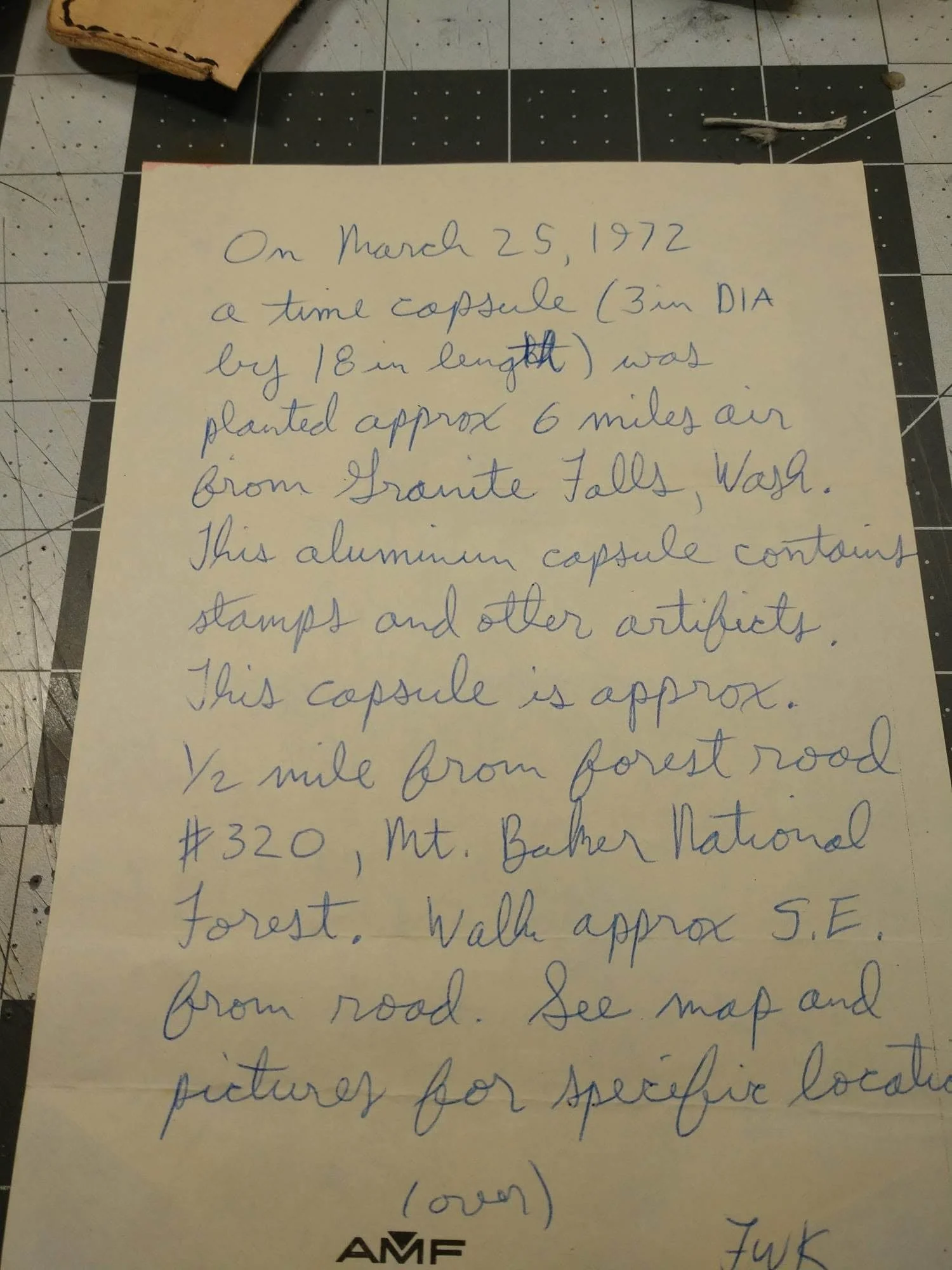
Instead, a handwritten note from 1972 sent his daughter looking through old maps, talking with local historians and following a trail he'd unknowingly left behind.
The photograph I have from that part of the trip isn't a sweeping Washington landscape.
It's a picture of an old handwritten note.
Without the story, that's exactly what it is.
With the story, it's one of the most interesting photographs from the trip.
And it reinforces something I've written about before in [Map First, Book Second]: leaving some room in a trip can matter. We had enough flexibility to chase a 50-year-old family mystery when it unexpectedly landed in our laps.
Sometimes You Don't Know the Story When You Take the Picture
In August 2025, Gina and I went to Red Rocks Amphitheatre in Colorado.
Seeing a concert there was something we'd wanted to do. We had a long weekend available, checked the schedule and found the Beach Boys were playing.
Would I have preferred ZZ Top the following night?
Well...yeah.
But the Beach Boys fit our schedule.
There was something else going on that evening that had nothing to do with the concert.
My dad had died on March 3 of that year.
It was still fresh.
And that night I was wearing one of his shirts.
Then, among thousands of people at Red Rocks, I spotted another guy nearby.
He was wearing the same shirt.
There was no profound reason for taking the picture.
Two guys showed up at the same concert in the same tropical shirt.
That's funny.
We needed a picture.
Then the story got another layer.
During the show, the big screen displayed images from past Beach Boys performances. One of them mentioned the Illinois State Fair, sometime around the early 1990s.
My dad had helped run concessions at the Illinois State Fair while he was president of the American Business Club. He also helped book some of the entertainment.
One of those acts was the Beach Boys.
He had met them.
So there I was at Red Rocks, wearing my dad's shirt, watching the Beach Boys, when a little piece of his own history unexpectedly appeared on the screen.
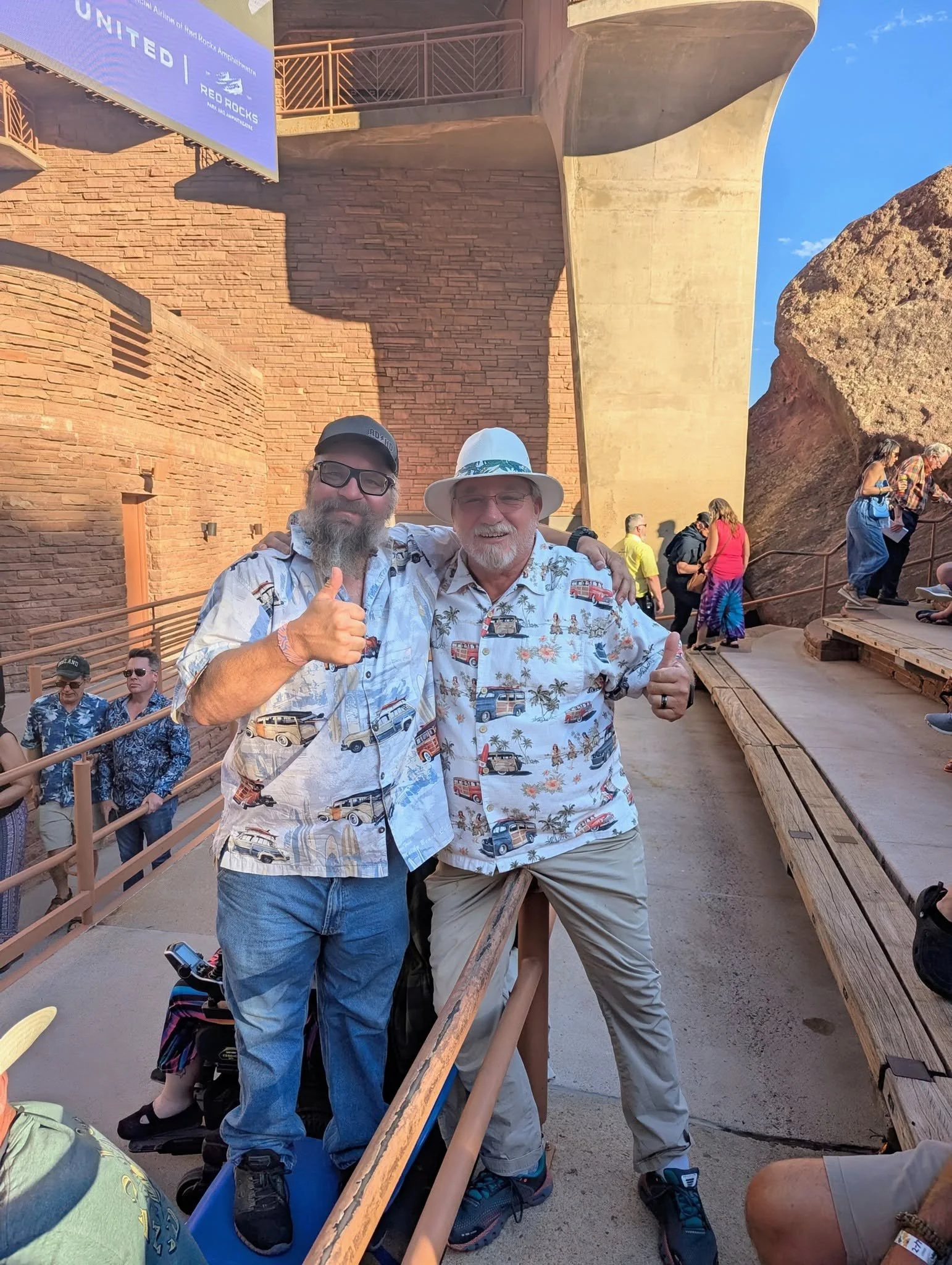
Look at the photograph and you'll see two guys wearing the same shirt.
I see my dad all over that picture, even though he isn't in it.
That's something else photographs can do.
Sometimes you don't know everything a picture will eventually mean when you take it.
Not Every Photograph Needs a Profound Story
Thankfully.
Otherwise travel albums would get exhausting pretty quickly.
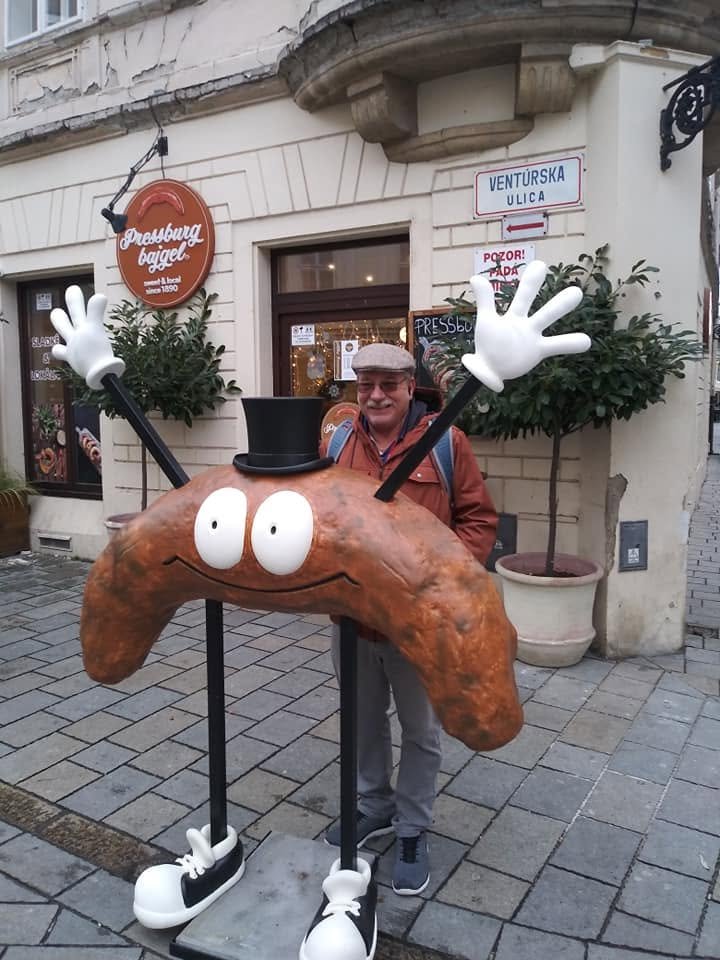
On a Viking cruise in December 2023, we were wandering around Bratislava when I encountered a giant anthropomorphic croissant.
Naturally, I needed photographic evidence.
That's basically the story.
No lost relative.
No family mystery.
No life-changing revelation.
There was a giant croissant. I got a picture with it.
And years later, that photograph makes me smile and immediately brings back wandering around Bratislava.
Take those pictures too.
Travel memories don't have to justify themselves.
Sometimes the story is simply that something was ridiculous and you were there.
Your Biggest Memories Don't Require Your Biggest Trips
The same applies closer to home.
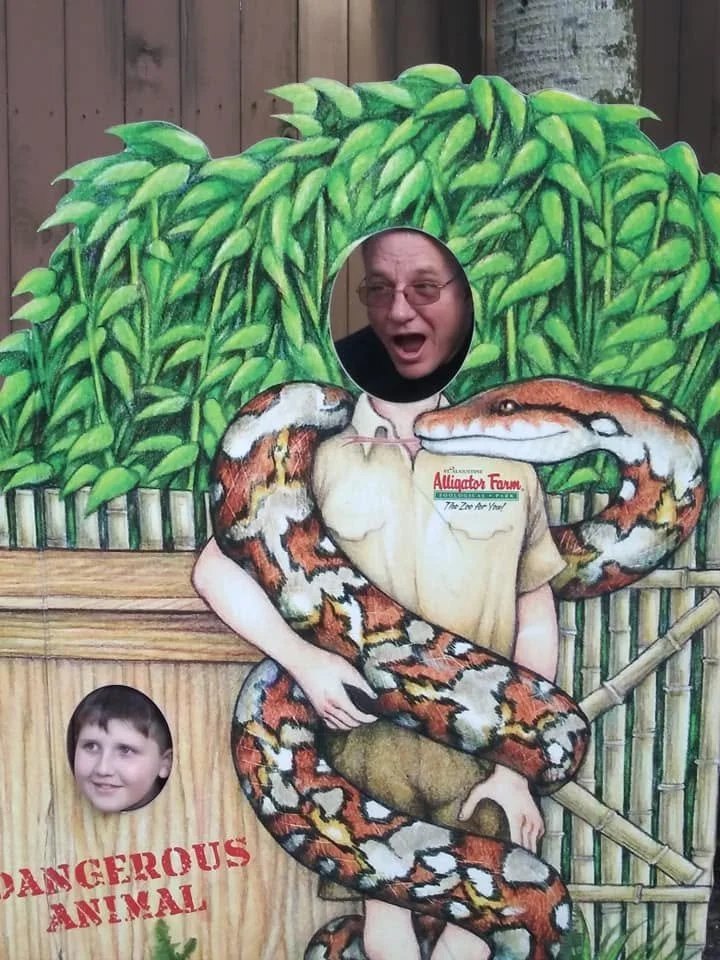
In 2019, we went to the St. Augustine Alligator Farm.
It was about an hour away.
No flights. No complicated itinerary. No major travel planning.
And apparently at some point we decided that sticking our heads through a painted photo board while a giant snake strangled us was worth preserving for posterity.
It was.
Not every photograph needs to represent some grand adventure.
Sometimes the memory is simply who you were with and what made you laugh that day.
That's enough.
Take Pictures of the People, Too
Scenery is easy to photograph.
People can be surprisingly easy to forget to photograph.
And those pictures often become more valuable with time.
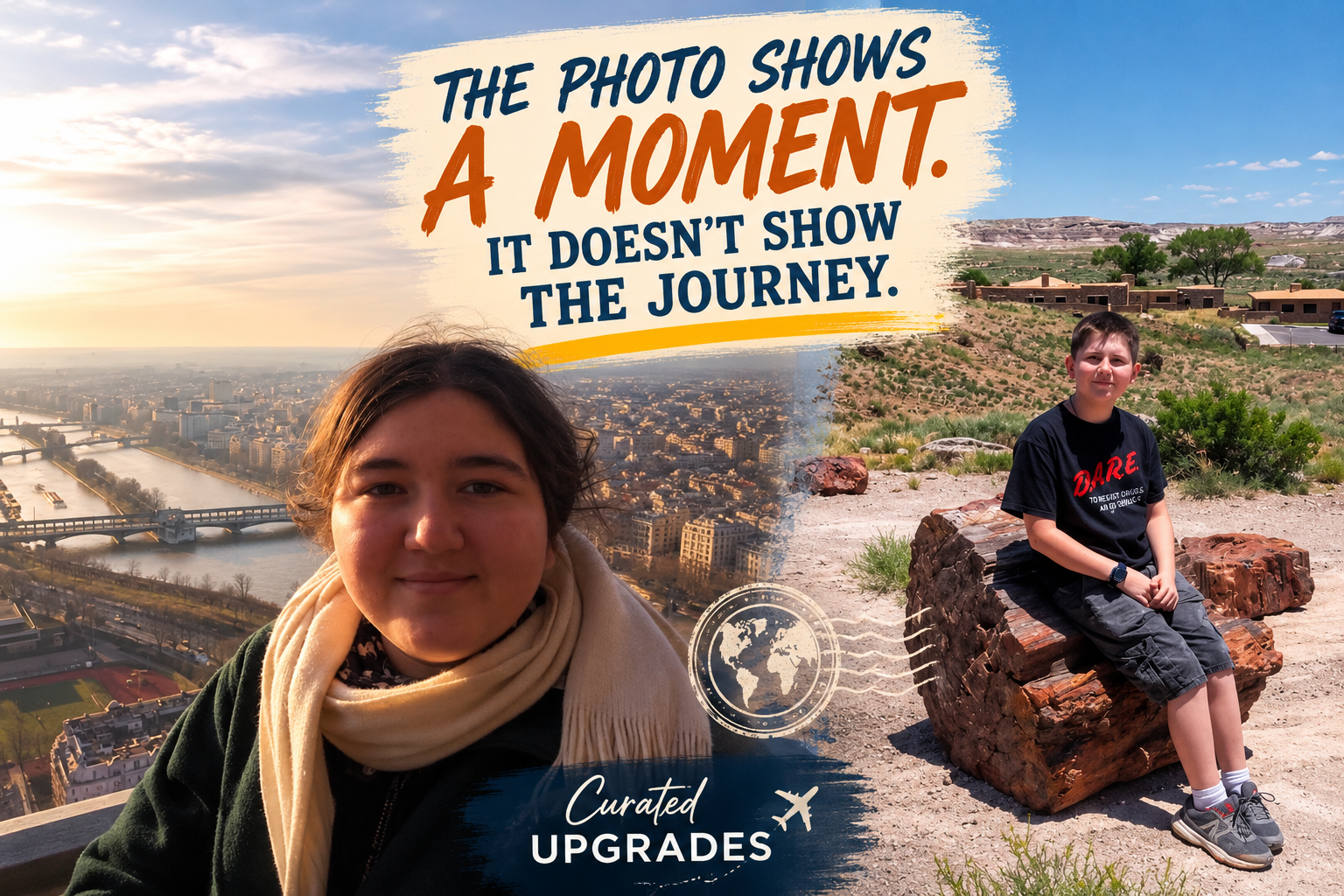
A photograph from the Eiffel Tower records Paris.
Put someone you love in front of that view and now it records your trip to Paris.
The same thing happens somewhere completely different.
A photograph of Petrified Forest National Park records an extraordinary landscape.
A photograph of your kid sitting there records something the landscape photograph can't.
It records who he was when you went there.
Years later, you'll notice things that seemed completely ordinary when you took the picture.
The haircut.
The clothes.
How young everybody looked.
The expression they always made when you pointed a camera at them.
The destination may still be there.
That version of your family isn't.
Take the picture.
Photograph the Ordinary Stuff
This may be the part I've come to appreciate most.
Travel photography doesn't have to mean photographing only things that seem worthy of a photograph.
Photograph the restaurant sign.
The rental car.
The menu.
The strange hotel room.
The road you weren't planning to drive.
The meal before everybody attacks it.
The handwritten note somebody sends you.
The view from the table.
The thing you bought.
The person you met.
Those photographs may never make your “best of the trip” collection.
But five, ten or twenty years later, one of them may unlock a memory that the technically better photograph doesn't.
I've seen that happen repeatedly while building Curated Upgrades.
Some of the strongest stories I've written didn't begin with my best photographs.
They began with an ordinary picture that made me say:
“Wait...I remember what happened here.”
That is also part of why I Ask One More Local when we travel. The restaurant, farm, roadside stop or person we discover through a conversation may become part of the story of the trip. Taking an ordinary picture gives that story somewhere to live later.
Leave Yourself Some Breadcrumbs
The photograph doesn't have to do all the work.
Give Future You a little help.
You don't need to keep a leather-bound travel journal and spend an hour every night documenting the day's emotional significance.
A few words will do.
Photograph the menu.
Take a picture of the restaurant sign.
Save the weird screenshot.
Keep the location information attached to your photographs when you're comfortable doing so.
Write a quick note in your phone.
Add a caption to a shared album.
Something as simple as:
Coffee shop sent us to Carlos. Carlos sent us to Joel. Crazy bridge. Bought coffee at the farm.
Years later, that may be enough to unlock the whole Panama story.
🟢 Take the picture and preserve one or two details that the picture can't show.
🟢 Photograph ordinary things when they're part of the story.
🟢 Include the people you're traveling with, not just the destination.
🟡 Don't feel obligated to document everything. If a photograph has no particular story attached to it, that's fine too.
🔴 Don't assume you'll remember all the details later. Twenty years is remarkably good at erasing restaurant names, people's names and the little details that once seemed impossible to forget.
Take the Beautiful Picture Too
None of this means you should stop taking beautiful travel photographs.
Quite the opposite.
If the light is perfect, take the picture.
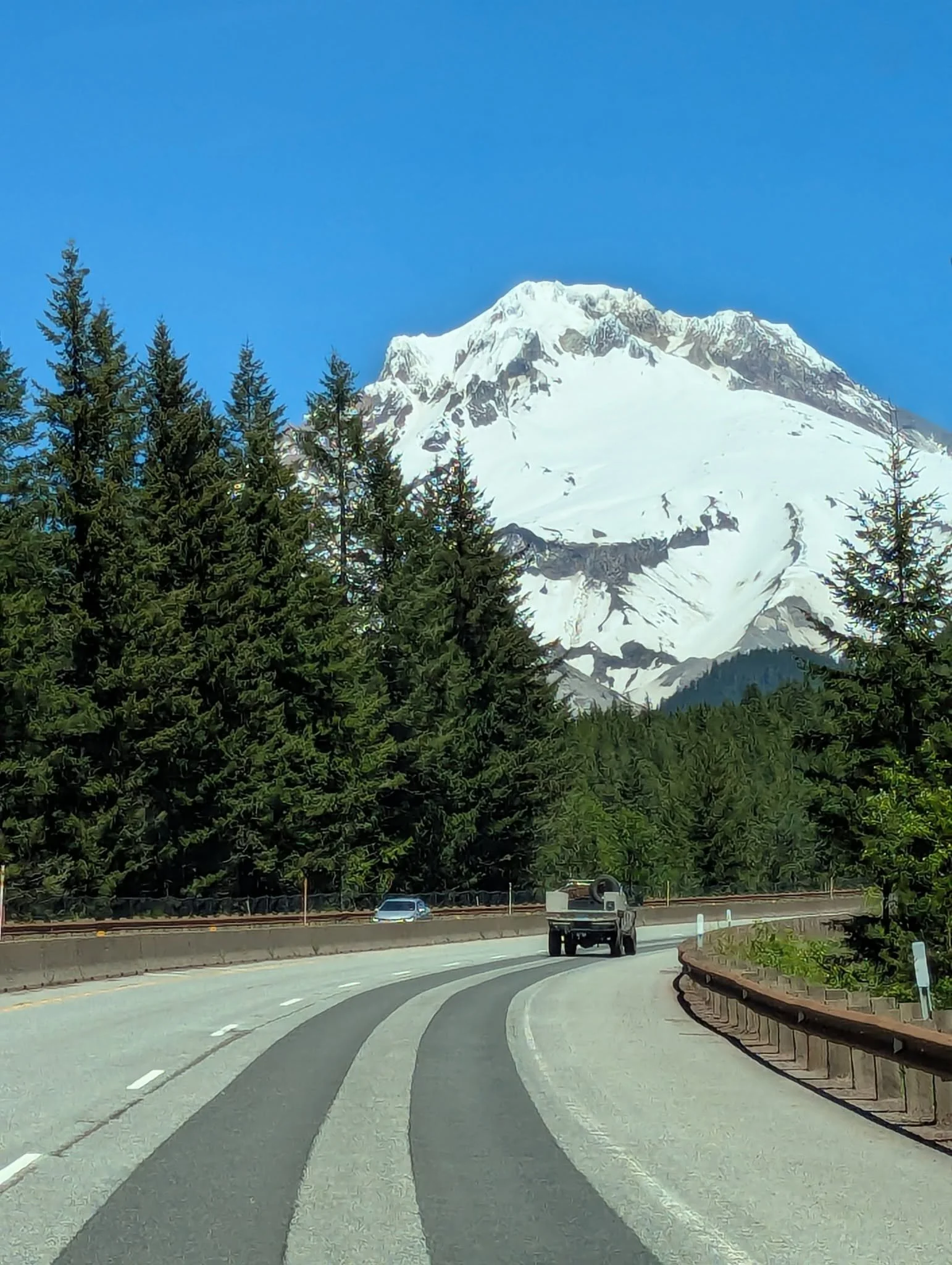
If the mountain looks incredible, take the picture.
If the sunset stops you in your tracks, absolutely take the picture.
Sometimes a mountain really is just a mountain.
And that's perfectly fine.
The Photo Shows a Sunset. It Doesn't Show the Story.
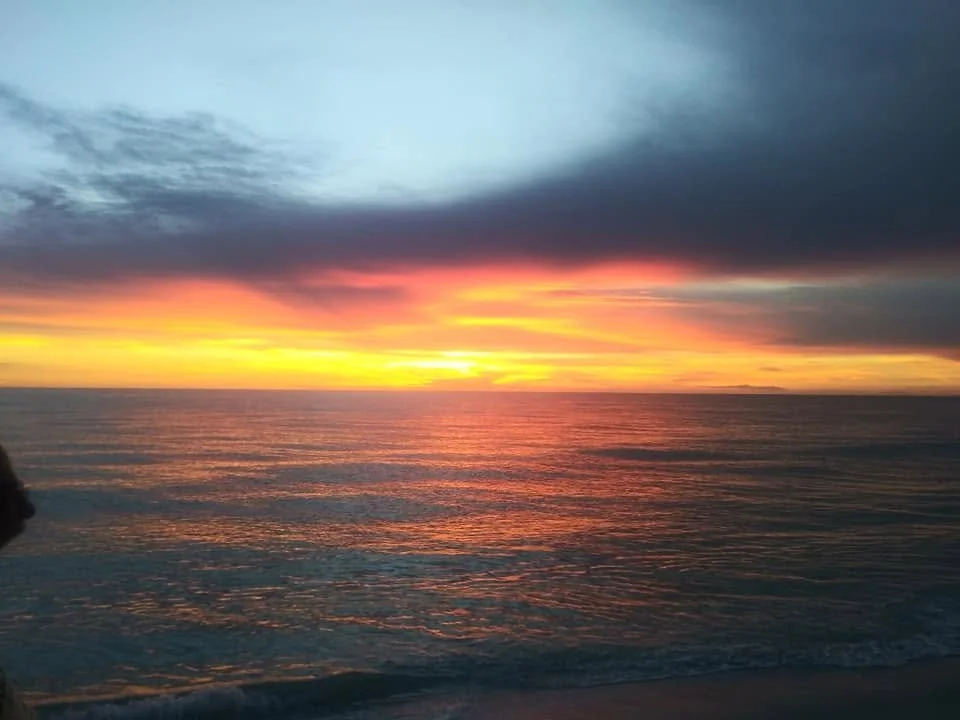
In August 2020, I took a picture of the sunset at Boca Grande, Florida.
It's a beautiful photograph.
Orange light across the Gulf. Dark clouds overhead. The sun disappearing into the horizon.
If you didn't know anything else, that would be enough.
But Boca Grande isn't just another Florida beach to our family.
Gina's family has deep roots in the area.
Her grandparents were caretakers of the old Boca Grande Hotel in the late 1950s and early 1960s and were there during its demolition.
Pieces of that hotel are still part of our lives.
We have an old roll-top desk dating to around 1903.
Some silverware.
And an old globe, the kind that reminds me of something you'd see atop a vintage gas pump, that I eventually turned into a lamp.
Her family roots in the area also include boatbuilding and generations of local history.
And we weren't even in Boca Grande for an elaborate vacation when I took the photograph.
We were there for a funeral.
We decided to stay an extra day.
Then came the sunset.
To anybody else, it's a photograph of a sunset.
That's all the photograph shows.
It doesn't show Gina's grandparents.
It doesn't show the old hotel.
It doesn't show the roll-top desk, the silverware or the old globe.
It doesn't show generations of the Knight family.
It doesn't explain the funeral that brought us there or why we decided to stay another day.
But I know the rest of the picture.
Capture the Story, Not Just the Photos
Take the landmark.
Take the sunset.
Take the family picture.
Take the stupid picture with the giant pretzel.
Photograph the handwritten note nobody else would understand.
Get the selfie with the stranger wearing your dad's shirt.
Photograph the menu, the road, the sign and the thing that makes absolutely no sense without an explanation.
And every once in a while, leave yourself a few words explaining why you bothered.
Because years from now, the best photograph from a trip may not be the prettiest one.
It may not even be a particularly good photograph.
It may simply be the one that makes you start telling the story.
The photograph captures the moment.
The story keeps the rest of it alive.