


The Cheapest Time to Travel Isn’t Always the Best Time
Stop chasing the lowest price on the calendar. Find the sweet spot where weather, crowds, cost and the experience you actually want come together.
Whenever friends find out how much we travel, one of the first questions I get is some version of this:
“When is the cheapest time to go?”
Pick the destination. Japan. Greece. Alaska. Costa Rica. A Caribbean cruise.
Same question.
And I understand why.
Airfare matters. Hotel prices matter. If moving a vacation by three weeks saves $1,000, I absolutely want to know about it.
But I think “When is it cheapest?” is usually the wrong first question.
You can almost always make a trip cheaper by moving far enough away from the season everyone actually wants to visit.
Go when the weather is lousy.
Go when restaurants are closed.
Go when the days are shorter.
Go when the experience you wanted isn't happening.
Congratulations.
You saved money.
You may also have purchased a cheaper version of the wrong trip.
What I'm usually looking for instead is the sweet spot.
Good weather.
Fewer crowds.
Lower prices.
Most of the things I actually want to see and do are still available.
In travel-speak, we usually call that shoulder season.
I just think of it as getting more trip for the money.

Cheapest, Best and Best Value Are Three Distincly Different Things
This distinction matters.
The cheapest time to visit a destination may be cheap for a reason.
The best time may mean perfect weather, every attraction operating, long daylight hours and every other traveler on Earth arriving with you.
And then there's best value.
That's the interesting one.
Best value is where I'm willing to make a small compromise to get a much bigger benefit.
Maybe the temperature is 72 degrees instead of 80.
Fine.
Maybe there's a chance of an afternoon shower.
I can live with that.
Maybe the water is slightly cooler, daylight ends a little earlier, or one seasonal attraction isn't operating yet.
Now we're talking about trade-offs.
But I don't want to save $200 on airfare only to discover that the excursion I crossed an ocean to experience doesn't start operating until two weeks after I leave.
Price is part of the decision. It shouldn't make the decision.
Start With What You Want From the Trip
Before I start hunting airfare, I want to know something much more important:
Why am I going?
If I want beaches, my timing needs to support a beach trip.
If I want wildlife, I need to know when that wildlife is actually there.
If I want hiking, I care about trail conditions.
If I'm going to Japan specifically because I've dreamed about standing beneath the cherry blossoms, telling me that November might be cheaper isn't particularly helpful.
The blossoms aren't there.
That's not a bargain.
It's a different trip.
Once I know what I want to experience, then I can start moving around the calendar.
How early can I go and still get that experience?
How late?
What happens to the weather?
What closes?
When do crowds begin building?
What happens to hotel prices?
That's how I find the sweet spot.
And the sweet spot isn't the same everywhere.
Japan: Autumn Can Be Its Own Main Event
Cherry-blossom season gets an enormous amount of attention, and understandably so.
But Japan doesn't suddenly become uninteresting after the blossoms disappear.
Autumn brings comfortable temperatures across much of the country and its own spectacular foliage. Japan's tourism organization notes that autumn color progresses from colder northern areas toward central and southern Japan, with the broader season stretching from late September into early December depending on location and elevation. October can be excellent in northern and higher-elevation areas, while Tokyo, Kyoto and other warmer destinations often see their best color later.
So I wouldn't simply circle “October and November” on a calendar and assume I've cracked Japan.
Where you're going matters.
But if cherry blossoms aren't the reason for your trip, autumn deserves a serious look.
You'll get an entirely different version of Japan: fall colors, seasonal food, cooler walking weather and plenty happening outdoors.
One caution: don't confuse shoulder season with no crowds. Japan's autumn foliage is popular in its own right, and Kyoto can be especially busy when colors peak.
That's another reason I prefer the idea of a sweet spot over rigidly labeling months “cheap” or “expensive.”
There are peaks inside seasons.
Greece: Let Summer Loosen Its Grip
Greece is another destination where I wouldn't automatically chase the lowest fare.
A Greek island vacation in the depths of the off-season can be a very different product from the one you imagined when you booked it.
July and August give you the classic summer experience, but they also bring summer demand and heat.
Move toward early fall and you can potentially keep much of what you came for while letting some of the peak-season pressure ease.
The important word is potentially.
Greece has thousands of islands and enormous geographic variation. The country's official tourism site specifically notes that climate conditions can vary significantly by geography and elevation.
Santorini isn't Corfu. Crete isn't Athens.
And a small seasonal island isn't going to operate on exactly the same calendar as a major city.
So for Greece, I'd narrow the question:
Where exactly am I going, and what do I need to still be open?
If swimming, ferries, restaurants and island life are central to the trip, I'd look at the edges of summer rather than simply chasing the lowest winter price.
That's the sweet-spot mindset.
Costa Rica: Don't Automatically Be Afraid of Green Season
This one is particularly appropriate for us because we've actually traveled to Quepos, Costa Rica for a week one year.
Costa Rica generally divides its year into dry and green seasons rather than the four seasons most of us are accustomed to. But even that is an oversimplification because the country's microclimates vary dramatically between regions and elevations.
The official tourism organization identifies May, June and November as transitional shoulder-season months and notes that May begins the green season across much of the country. The landscape gets greener, crowds can be lighter and prices are often lower. Afternoon rain becomes part of the equation, so mornings can become particularly valuable for outdoor activities.
That doesn't mean:
“Costa Rica is sunny every morning and rains for exactly two hours every afternoon.”
Weather doesn't read travel blogs.
It means you're accepting a greater chance of rain in exchange for some potentially very attractive benefits.
And that's exactly the kind of trade I'm willing to consider.
Costa Rica during green season is still Costa Rica.
In fact, part of the appeal is right there in the name.
Green.
Alaska: Timing Changes More Than the Price
Alaska may be my favorite example of why this isn't simply a money question.
The main summer travel season broadly runs from May through September. May is generally one of Alaska's drier months, while temperatures begin cooling again as August moves into September and fall colors start appearing. Alaska's tourism authority specifically recommends spring and fall shoulder periods for travelers interested in fewer crowds and potential deals.
Sounds perfect.
But there's a catch.
What do you want to do in Alaska?
Because moving the date can change the experience.
Wildlife patterns change. Tours have operating seasons. Daylight changes dramatically. Some remote areas become harder to access. Bear-viewing windows differ by location. For example, Alaska's tourism authority lists July through September as peak bear-viewing months for Katmai and Lake Clark, while Denali's strongest general wildlife-viewing period stretches from late May into early September.
So “May is cheaper” isn't enough information.
If the thing you want to do isn't happening in May, who cares?

Timing a trip isn't only about finding lower prices. In a place like Alaska, the season can change the wildlife, scenery and experiences you encounter.
This is where travel planning gets interesting.
Suppose moving your Alaska trip two weeks saves you $500.
Great.
But suppose those two weeks also move you outside the best window for the wildlife experience that motivated you to book Alaska in the first place.
You didn't save $500.
You traded away part of the trip you wanted for $500.
Maybe that's still worth it.
Maybe it isn't.
But at least now you're making the decision consciously.

Our Alaska trip was a good reminder that the “best time to visit” depends heavily on what you actually want to do once you get there.
Caribbean Cruises: Cheap Dates Come With an Asterisk
Cruising provides one of the clearest examples of demand-driven travel pricing.
When families have limited opportunities to travel, demand rises.
That's why summer, spring break and major holidays can get expensive.
Move into lower-demand periods and cruise fares can become much more attractive.
But there's an enormous asterisk attached to some of the cheapest Caribbean sailings:
Hurricane season.
The Atlantic hurricane season officially runs from June 1 through November 30, with activity historically peaking around September 10 and most activity concentrated from mid-August through mid-October.
That doesn't mean you shouldn't cruise then.
It means the lower price is buying you a different risk profile.
A cruise line may alter an itinerary because of weather. A port can disappear from your schedule. Your departure city can be affected even if the ship itself avoids the storm.
If I'm considering a bargain Caribbean cruise in September, I don't treat the weather risk as fine print.
I put it directly into the value equation.
Would I be okay if the itinerary changed?
Do I have appropriate travel insurance?
Am I flying to the embarkation port early enough?
Is the savings meaningful enough for me to accept the uncertainty?
If yes, great.
That's an informed trade.
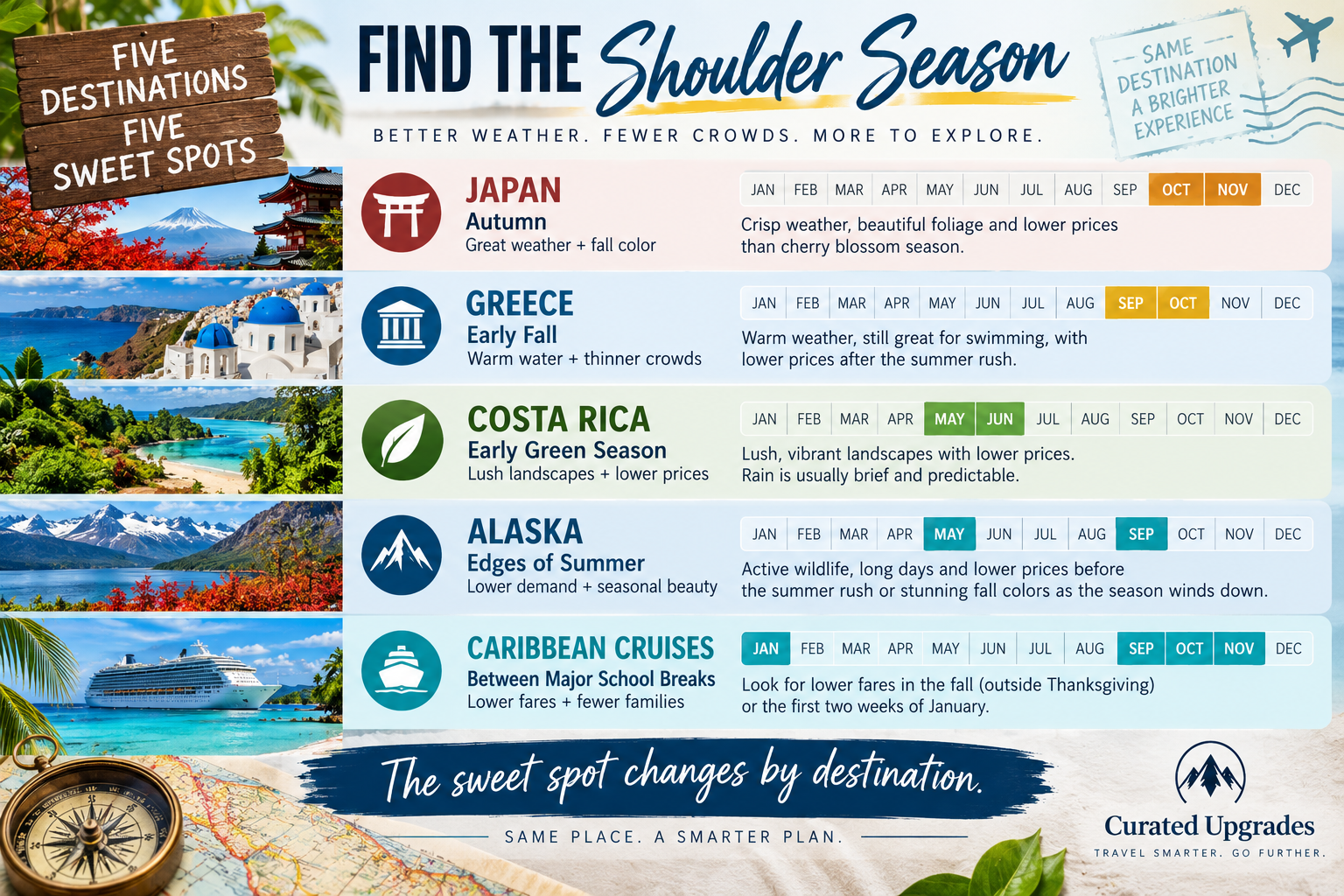
Editor's note: I would treat the month highlights in this graphic as starting points rather than guarantees, especially for Japan, Greece and Alaska. Conditions vary significantly by region, elevation and the experience you're pursuing.
Shoulder Season Isn't a Magic Month
This may be the most important point in the entire article.
There is no universal shoulder season.
Sometimes there isn't even one shoulder season for an entire country.
Costa Rica's Caribbean coast doesn't behave exactly like its Pacific coast.
Japan's autumn color doesn't arrive everywhere simultaneously.
Alaska is enormous.
A Greek island whose economy revolves around summer tourism has a different rhythm from Athens.
And every year is slightly different.
So I don't Google:
“Cheapest month to visit Greece.”
At least, I don't stop there.
I look at the specific place.
Then the weather.
Then what I want to do.
Then operating schedules.
Then crowds.
Then price.
That order matters.

A Cheaper Version of the Wrong Trip Isn't a Bargain
This is where my thinking about travel value has changed over the years.
I like saving money.
I like points.
I like finding a fare that makes me wonder whether somebody at the airline fell asleep on the keyboard.
But cheap and valuable aren't synonyms.
If I save $300 but spend the entire vacation wishing we'd come three weeks earlier, that wasn't a particularly good deal.
If I spend slightly more and get better weather, fewer closures and the experience I actually wanted, that may be the better value.
And sometimes the opposite is true.
Maybe I don't care if it rains in the afternoon.
Maybe I prefer cool weather.
Maybe fewer restaurants being open doesn't bother me.
Maybe seeing Alaska's fall colors matters more than having the longest possible days.
That's the beauty of the sweet spot.
It doesn't have to be everybody else's sweet spot.
It has to be yours.
But What If Peak Season Is the Whole Point?
There's one problem shoulder-season advice can't solve.
Sometimes you actually want peak season.
If you've dreamed for years about seeing Japan's cherry blossoms, I am not going to tell you to go in November because the fall foliage is lovely.
You want cherry blossoms.
If you're going somewhere for a specific festival, holiday celebration, sporting event or natural phenomenon, changing the month might eliminate the entire reason for going.
Sometimes the experience is tied to the date.
Fine.
Go.
Peak season isn't inherently bad.
Paying more isn't inherently bad either.
The question simply changes.
Instead of:
“How do I avoid peak season?”
it becomes:
“How do I travel during peak season without paying the maximum possible price for everything?”
That's exactly what we'll tackle in the companion article:
→ How to Spend Less When You Have to Travel in Peak Season
Because sometimes the smartest travel decision isn't moving the trip.
It's keeping the trip you actually want and finding savings somewhere else.
Final Thoughts
The next time you're planning a vacation, resist the urge to sort the calendar from cheapest to most expensive and automatically pick the bottom number.
Start with the experience.
What do I actually want from this trip?
Then figure out when that experience exists.
Look at the weather.
Look at crowds.
Look at what's open.
Look at seasonal differences.
And once you understand those trade-offs, then start looking for the deal.
Sometimes you'll land right in shoulder season.
Sometimes you'll discover that traveling a few weeks earlier or later saves a surprising amount without sacrificing much of anything.
And occasionally you'll discover that peak season is exactly where you belong.
That's okay too.
Because the goal isn't to book the cheapest trip.
The goal is to get the trip you actually wanted at a price you're happy to pay.
Good travel planning isn't about finding one perfect rule. It's about understanding the trade-offs and deciding what matters to you.