

How to Spend Less When You Have to Travel in Peak Season
Sometimes peak season is the reason you’re going. Keep the experience you want, then find smarter places to save.
“Travel during shoulder season” is great advice right up until the thing you want to experience only happens during peak season.
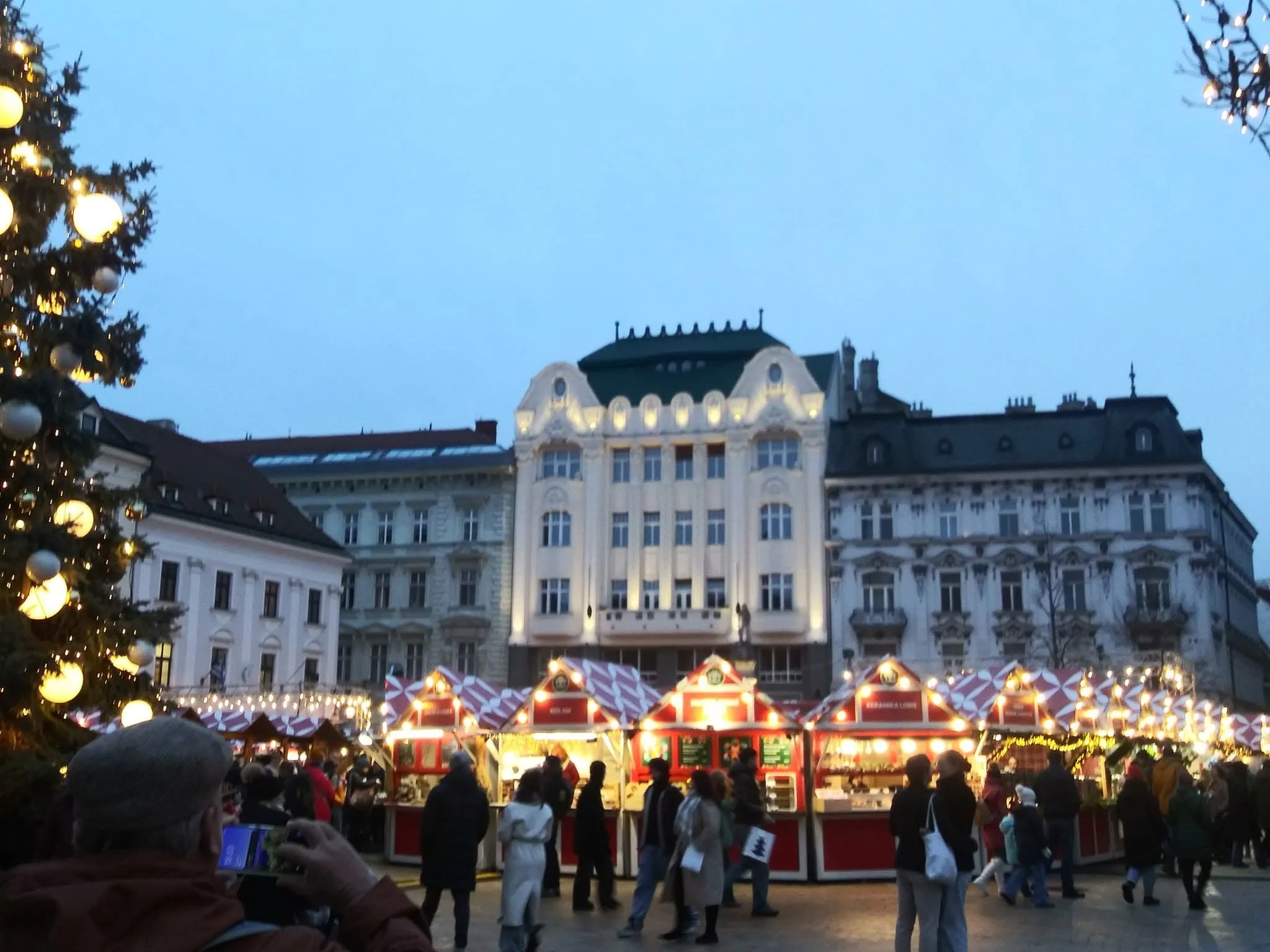
You can't visit a Christmas market in February.
You can't move Japan's cherry-blossom season because airfare is cheaper three weeks later.
And if your vacation revolves around a festival, school break, family event or another experience tied to a particular date, changing the dates may mean changing the entire trip.
We've traveled specifically for Christmas markets. Moving that trip to a cheaper month wouldn't have been clever travel planning.
There wouldn't have been any Christmas markets.
Sometimes peak season isn't the problem.
It's the reason you're going.
So instead of asking how to avoid peak season, I think there's a better question:
How can I keep the trip I want without paying the peak-season premium on every single part of it?
That's where things get interesting.
First, Accept the Part You Can't Change
If Christmas week is Christmas week, stop fighting the calendar.
If you're traveling because your kids are out of school, those are your dates.
If you want cherry blossoms, you need to be there when they're blooming.
There may still be some flexibility around the edges, but the fundamental travel window is what it is.
And that's okay.
The mistake isn't traveling during peak season.
The mistake is assuming that because one part of your trip has to happen during peak season, every other decision has to be expensive too.
It doesn't.

Keep the Experience. Attack the Premium.
That's really the strategy.
I don't want to save money by removing the thing that made me want to take the trip.
I want to find all the places around that experience where I'm paying extra simply because demand is high.
Some of those premiums are worth paying.
Some aren't.
And some can be avoided with surprisingly little effect on the trip.
Book the Hardest Pieces First
When dates are fixed and demand is predictable, I generally want the difficult pieces handled early.
That doesn't necessarily mean buying everything the instant reservations open.
It means understanding what could become scarce.
A particular hotel in a small town?
A Christmas-market river cruise?
A limited-capacity tour?
A flight that works substantially better than the alternatives?
A restaurant that's part of the experience?
Those deserve attention before something with hundreds of substitutes.
I wouldn't wait until the last minute hoping for some mythical bargain if losing that reservation would materially change the trip.
That's not saving money.
That's gambling with the vacation.
Flexible Reservations Are Your Friend
This is one of my favorite strategies because booking something doesn't necessarily mean I'm finished shopping.
If I find a hotel I like at a price I'm willing to pay and it has a reasonable refundable rate, I'll often book it.
Now I have a room.
Problem solved.
But I'll keep looking.
Hotel rates move. Inventory changes. Another property may become attractive. The hotel I booked may lower its rate.
If that happens and my reservation allows changes or cancellation, I can rebook.
There's an important distinction here:
I'm not waiting to book. I'm booking and continuing to shop.
That gives me something increasingly valuable during peak season:
Options.
Just pay attention to the cancellation terms. A cheaper nonrefundable rate can become very expensive if your plans change.
Move a Little, Not a Lot
One of the easiest ways to reduce a peak-season premium can be changing where you sleep, not where you vacation.
The most famous few blocks of a destination can carry some extraordinary hotel rates.
Sometimes moving a neighborhood or two away changes the price considerably while barely changing the trip.
But I wouldn't automatically stay miles away just because the room is cheaper.
Transportation costs money.
Transportation takes time.
And vacation time has value.
If I save $75 a night but spend an extra hour every day commuting back and forth, I haven't necessarily found an upgrade.
I've just purchased a cheaper hotel and added a daily chore.
This is where I compare total value, not simply the nightly rate.
A Great Location Can Be Worth Paying For
And here's the other side of that argument.
Sometimes I will gladly pay more for location.
If the hotel lets us walk everywhere...
If we can come back to the room during the afternoon...
If it eliminates taxis or a rental car...
If it puts us right where we want to be early in the morning before the crowds arrive...
Then that premium is buying something.
Time.
We've talked about this throughout Curated Upgrades: one of the best travel upgrades you can buy is often time saved.
So I don't automatically reject the expensive hotel in the center of town.
I ask what I'm getting for the extra money.
If the answer is “a famous address,” I'm less interested.
If the answer is “two extra hours of usable vacation every day,” now you've got my attention.
Compare Nearby Flight Dates Even When the Trip Dates Are Fixed
Your trip may have fixed dates without your flights needing to match them exactly.
Suppose an event starts Saturday.
Flying Friday may be expensive.
What about Thursday?
Could an extra hotel night cost less than the airfare difference?
Could arriving earlier make the trip easier while also lowering the total cost?
Same thing on the return.
I don't rely on rules like “Tuesday is always cheapest” because airfare isn't that tidy.
Instead, I use flexible-date searches and compare the dates immediately around the trip.
Sometimes nothing useful appears.
Sometimes shifting by a day creates a completely different set of options.
And if you're traveling internationally for something you absolutely don't want to miss, arriving earlier also buys you another valuable commodity:
Buffer.
That's an upgrade I particularly like.
Check Nearby Airports, But Don't Get Cute
Nearby airports can also change the equation.
But again, compare the whole trip.
Saving $150 on airfare sounds wonderful until the alternate airport requires a $100 transfer and two additional hours.
The spreadsheet says you saved $50.
Your exhausted future self may have a different opinion.
I look at:
Fare + transportation + time + inconvenience.
Sometimes the alternate airport wins easily.
Sometimes the “more expensive” flight is actually the better deal.

Peak Season Is When Points Can Get Interesting
This is where points and miles can become particularly useful.
I don't automatically use points because the cash price looks painful.
I compare.
Let's say a hotel normally costs $250 but jumps to $500 during a major event.
If the points requirement hasn't increased proportionally, suddenly those points may provide considerably better value.
The reverse can happen too.
An airline may want an enormous number of miles for a peak-date ticket.
In that case, paying cash might still make more sense.
That's why my rule isn't:
Peak season = use points.
It's:
Peak season = definitely compare points.
Look at the cash rate.
Look at the points requirement.
Look at taxes and fees.
Look at cancellation rules.
And remember that points have value too.
If you haven't already read our guide to comparing portal bookings and transfer partners, this is exactly the kind of situation where that process becomes useful.
→ Portal vs. Transfer Partners: Compare Before You Book
Don't Pay Peak Prices for Every Meal
Food is part of travel for us.
So this isn't an argument for living on protein bars because the restaurants are expensive.
That's not happening. 😄
Instead, decide which meals matter.
Maybe there's a restaurant you've been looking forward to for months.
Book it.
Enjoy it.
Order the thing.
But breakfast doesn't necessarily need to be an event every morning.
Lunch doesn't always need a view.
A bakery, market, café, grocery store or casual neighborhood restaurant can balance an expensive dinner beautifully.
We'd rather spend deliberately on a few meals we'll remember than spend heavily on every meal simply because we're in a tourist district.
Again:
Save where it doesn't change the trip.
Reserve the Experiences That Would Hurt to Miss
Peak season isn't the time to assume you'll figure everything out when you arrive.
That doesn't mean scheduling your vacation in fifteen-minute increments.
Please don't.
But if there's something you would genuinely be disappointed to miss, investigate reservations early.
Popular museums.
Limited tours.
Special events.
Certain restaurants.
Timed-entry attractions.
Experiences with only a handful of departures.
I separate these into two mental categories:
Would be nice.
and
We came here for this.
The second category gets booked.
I'll happily leave open space around it.
Use Timing as Well as Money
Not every peak-season strategy involves spending less.
Sometimes the better upgrade is experiencing the same place at a better time of day.
Early morning can transform a popular attraction.
So can evening.
Eating slightly earlier or later can sometimes make restaurant reservations easier.
Visiting the headline attraction first and wandering afterward can be much more pleasant than arriving with the largest wave of visitors.
You're still traveling during peak season.
You're simply not insisting on doing everything at peak hour during peak season.
That's an important distinction.
Don't Save Money Everywhere
This may sound strange in an article about spending less, but I don't think the goal should be to reduce every expense.
That can become its own trap.
If I spend weeks planning a trip I've wanted for years, I don't want to get there and nickel-and-dime the experience to death.
Some premiums are worth paying.
A better room might be worth it.
A nonstop flight might be worth it.
The hotel beside the attraction might be worth it.
The private tour might be worth it.
Dinner overlooking the place you traveled 4,000 miles to see might be worth it.
The question isn't:
“Can I make this cheaper?”
You usually can.
The better question is:
“Would making this cheaper make the trip worse?”
Now we're talking about value.
Spend More Where It Changes the Trip
This is probably the simplest way I can explain our entire approach.
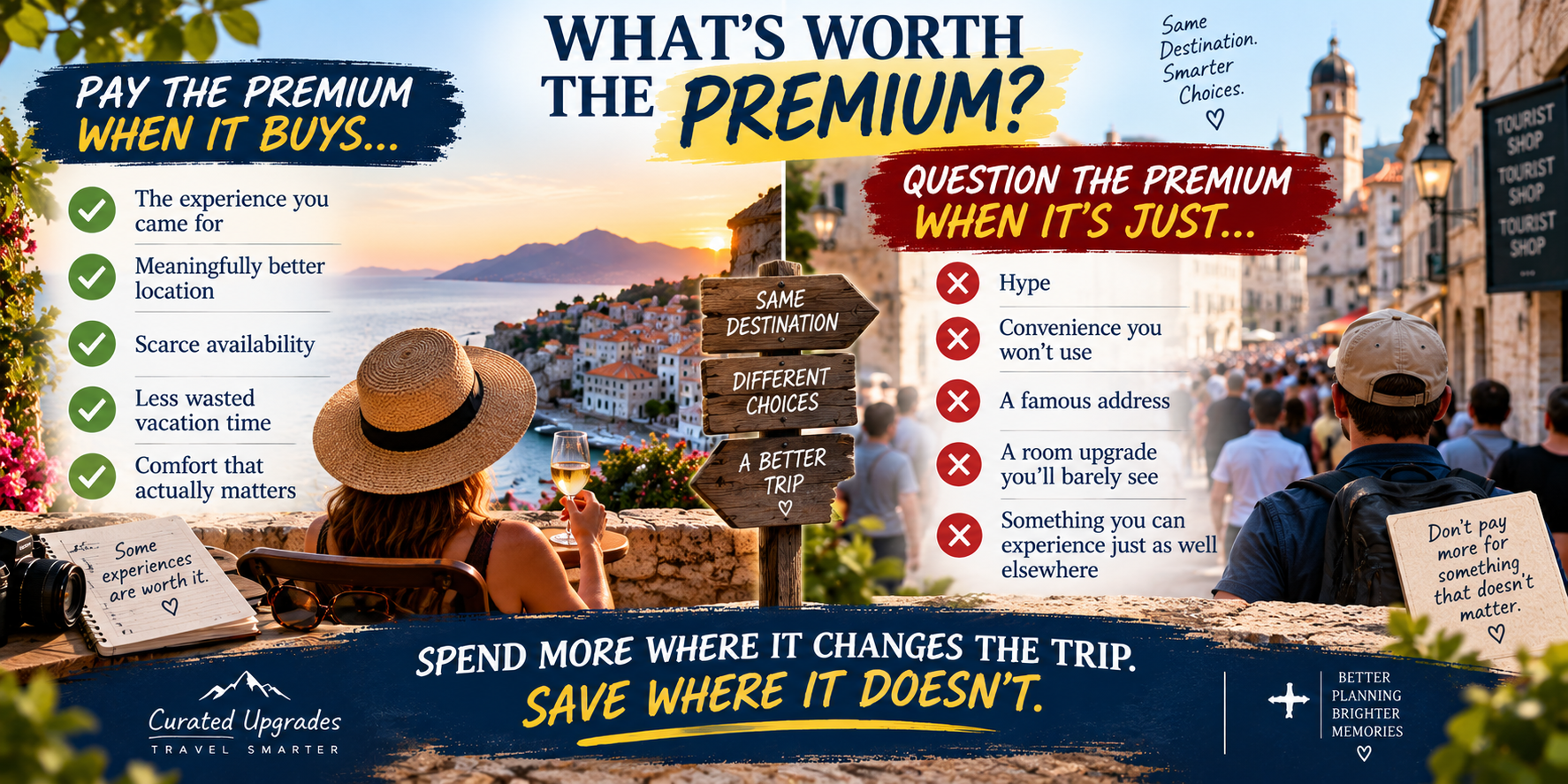
I'll spend more where the money changes the experience.
I'll spend more to remove a miserable connection.
I'll spend more for a location that saves substantial time.
I'll spend more for an experience we genuinely came to have.
I'll spend more for comfort when the comfort matters.
But I'm much less interested in paying extra because something has the fashionable address, the recognizable name or the word “premium” attached to it.
Spend more where it changes the trip.
Save where it doesn't.
That's not just a peak-season strategy.
That's pretty much Curated Upgrades.
Sometimes Shoulder Season Is Still the Better Answer
Of course, before you commit to peak season, it's worth asking one final question:
Do I actually need to go then?
If you're traveling for Christmas markets, cherry blossoms, a festival, a family event or something else tied to specific dates, the answer may be an easy yes.
Go.
But if your dates are flexible and you're simply traveling during peak season because that's when everyone seems to go, you may have another option.
A few weeks earlier or later can sometimes change the crowds, weather, availability and price without taking away the experience you actually want.
That's the other half of this conversation:
← The Cheapest Time to Travel Isn't Always the Best Time
That article explains how we look for the travel sweet spot, where price, weather, crowds and experience come together.
These aren't competing strategies.
They're two answers to the same question.
If you can move the trip, find the sweet spot.
If you can't, make peak season smarter.
Final Thoughts
Peak-season travel doesn't automatically mean you've planned badly.
Sometimes you're there precisely because it's peak season.
You wanted the Christmas markets.
You wanted the festival.
You wanted the blossoms.
You wanted summer in Alaska.
You wanted your kids to be able to come.
Keep that part.
Then look around it.
Book the scarce pieces.
Keep reservations flexible when possible.
Compare nearby dates and locations.
Check cash against points.
Reserve what matters.
Spend deliberately.
And don't destroy a great vacation trying to win some imaginary competition for the cheapest possible trip.
Keep the experience. Attack the premium.
That's the upgrade.