


Your Connection Airport May Matter More Than Your Airline
Airport layout, connection time and backup flights can determine whether your itinerary works—even when the airline looks perfect on paper.
When travelers compare flights, they often begin with the airline.
American, Delta or United? Which one has the best seats? Where can I use my miles? Which carrier offers the lowest fare or most convenient departure?
Those questions matter. But if the itinerary includes a connection, another question may have an even greater effect on the trip:
Where will you connect?
A 55-minute connection in one airport may be manageable. At another, it may require a terminal change, a train ride and a sprint to a gate that begins boarding before your first flight reaches the jet bridge.
The itinerary may technically meet the airline’s minimum connection time. That does not necessarily make it a comfortable—or sensible—choice for you.
Airport layout, weather, immigration, security, departure frequency and the location of your arrival gate can all affect the real connection.
The airline sells the itinerary.
You are the one who has to make it work.
Start With the Route, Not the Airline
An airline may be excellent overall and still offer a poor itinerary for your particular trip.
That is why I recommend beginning with the route:
What time does the first flight depart?
Where does the itinerary connect?
How long is the scheduled connection?
How difficult is the airport to navigate?
Are later flights available if something goes wrong?
What time would you reach the destination after a disruption?
This follows the same principle discussed in American, Delta or United: Start With the Route, Not the Airline.
A nonstop flight is generally the simplest option when the price and schedule are reasonable. When a connection is necessary, however, the hub becomes part of the itinerary—not merely the place where you change planes.
American may route you through Charlotte or Dallas–Fort Worth. Delta may send you through Atlanta. United may offer a connection through Denver.
Those airports provide access to extensive airline networks, but the passenger experience is not identical.
The better choice depends on the entire itinerary.
Bookable Does Not Always Mean Realistic
Airline booking systems may display connections that appear surprisingly short.
The itinerary is bookable because it satisfies the airline’s established minimum connection time. That minimum is an operational threshold. It is not a personal guarantee that you will reach the next gate calmly—or at all.
The displayed connection time includes more than walking between gates.
Imagine that your first flight is scheduled to arrive at 2:00 p.m. and the next flight departs at 3:00 p.m.
You do not necessarily have a full hour.
The aircraft must reach the gate. The jet bridge must be attached. Passengers ahead of you must collect their belongings and leave. Then you must reach the next gate before its door closes.
If you are sitting near the front of First Class, you may be among the first passengers off.
If you are in seat 57B, it could take 20 minutes just to exit the aircraft. That is one reason seat location can affect more than comfort, as discussed in Tired of Seat 57B? How to Escape the Worst Seats on the Plane.
Your connecting flight may also begin boarding before you have left the first aircraft.
A 60-minute connection on the reservation may provide only 25 or 30 usable minutes.

My Connection-Time Targets
I generally prefer more time than the shortest connection an airline is willing to sell.
Domestic connections: About 90 minutes
For a domestic connection, I usually look for approximately 90 minutes.
That provides some protection against a modest departure delay, slow deplaning or a trip between distant concourses. It may also leave enough time to use the restroom, purchase food or address a gate change without turning the connection into a race.
I might accept less in a smaller, familiar airport when the schedule includes several later flights. I would be more cautious in a large hub, during winter weather or when the connecting flight is the last departure of the day.
International outbound connections: Two to three hours
For a trip departing the United States, I generally prefer two to three hours before the international flight.
Missing a domestic connection can be frustrating. Missing the only transatlantic departure of the evening may cost an entire day of the trip.
The additional time also protects the most difficult-to-replace portion of the itinerary.
International inbound connections: Three to four hours
When entering the United States before taking another flight, I prefer three to four hours.
Unless an exception applies, the process may include:
Immigration
Baggage collection
Customs
Rechecking checked luggage
Returning through security
Traveling to another terminal or concourse
Reaching the gate before boarding closes
A short line can make the process relatively easy. Several international flights arriving together can make it far slower.
Global Entry and TSA PreCheck may help eligible travelers, but I would not build an entire itinerary around the assumption that every checkpoint and baggage belt will operate perfectly.
These are my targets, not universal rules. The appropriate connection depends on the airport, itinerary and traveler.
Someone moving quickly with a carry-on will have different needs from a family traveling with children, a passenger requiring mobility assistance or anyone unfamiliar with the airport.

Compare the Hub, Not Just the Flight
Atlanta, Dallas–Fort Worth and Denver offer a useful comparison because each is a major hub for one of the three large U.S. network airlines.
Atlanta: Delta’s major connecting hub
Atlanta has parallel concourses connected by the Plane Train and a pedestrian walkway.
The layout can make the airport relatively logical once you understand it. A passenger may still need to travel from one end of a concourse to another—or between distant concourses—but the overall pattern is consistent.
Delta’s extensive Atlanta schedule can also provide valuable recovery opportunities when a flight is canceled or missed.
That does not mean a tight Atlanta connection is automatically safe. Large passenger volumes, thunderstorms and distant gates can consume the available time quickly.
Dallas–Fort Worth: A major American hub
Dallas–Fort Worth contains five terminals connected inside security by Skylink.
Skylink can make terminal changes manageable, but DFW is enormous. Reaching the train, waiting for it and traveling several stops all require time.
The airport offers a broad lounge selection and an extensive American Airlines schedule. Both can be valuable during a longer connection or a disruption.
DFW is one of the airports where I am comfortable deliberately allowing additional time. If the connection works normally, there may be time to eat or visit a lounge. If something goes wrong, the buffer becomes protection.
Denver: A major United hub
Denver’s terminal and three concourses are connected by an underground train.
The layout is reasonably understandable, but travelers must account for the train and the distance between gates. Crowded platforms, a gate at the far end of a concourse or winter weather can change the experience.
United’s large Denver operation may provide additional routing and recovery possibilities. As with Atlanta and Dallas–Fort Worth, however, an extensive schedule does not eliminate the risk of a tight connection.
None of these airports is always the best.
Atlanta may be preferable for one trip, DFW for another and Denver for a third. Departure time, connection length, weather and the number of later flights all matter.

Charlotte Deserves Special Attention
Charlotte appears frequently in American Airlines itineraries, particularly for travelers in the eastern United States.
It can be a convenient connection when the timing works. It can also feel crowded, and a connection may require more walking than the airport map initially suggests.
A short connection in Charlotte is not automatically impossible. Many passengers make them every day.
But I would not treat a 35- or 40-minute connection as equivalent to a relaxed hour at the gate. A late arrival, distant gates or slow deplaning can erase that margin quickly.
This is particularly important when the Charlotte flight is merely the first option displayed by a search engine. Another American itinerary through Dallas–Fort Worth—or a different carrier through Atlanta or Denver—may provide a more comfortable schedule.
The best choice cannot be determined by the airline name alone.
Look at What Happens After a Missed Connection
Most travelers compare itineraries as if every flight will operate as scheduled.
A better comparison includes the recovery plan.
Before booking, look at the airline’s schedule between the hub and your destination.
Ask:
Are there several later departures?
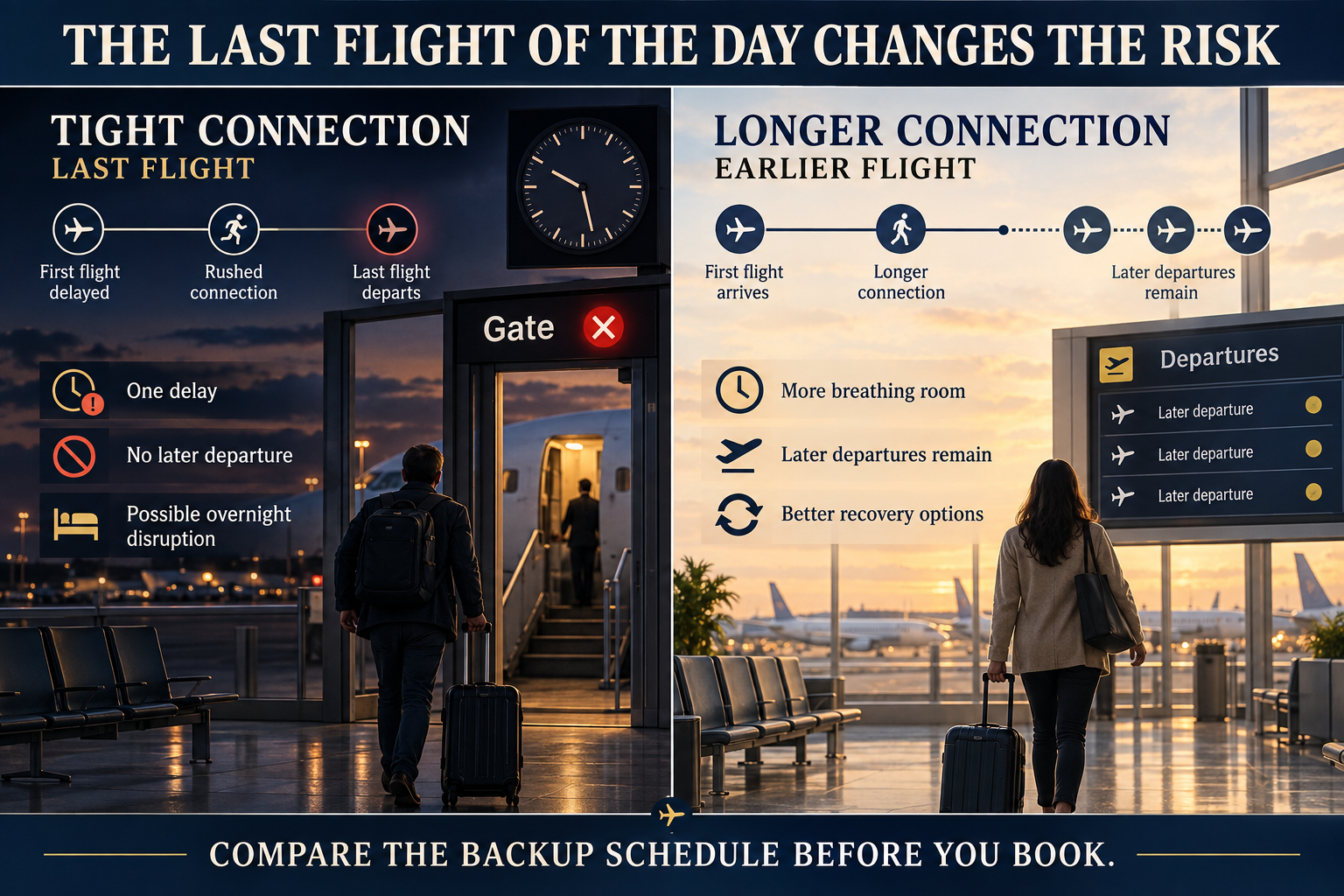
Is your connection the final flight of the day?
Could the airline route you through another hub?
Would a cancellation require an overnight stay?
Is the next available flight likely to be the following morning—or the following evening?
Would another airline offer more recovery options?
An early connection with three later departures may be safer than the final connection of the evening, even if the earlier itinerary costs more or requires a longer layover.
The last flight of the day concentrates the risk.
One late inbound aircraft can lead to an overnight disruption, missed hotel reservations, canceled activities and delayed baggage.
We experienced the consequences on an itinerary from Orlando to Dublin through Toronto. The Orlando departure was late, we missed the onward flight and ultimately arrived in Ireland a day behind schedule.
Our bags arrived seven days later. Seven Days Without Our Bags: What We Learned About Delayed Luggage
That experience changed how I evaluate connections. I no longer view the scheduled arrival time as the only important outcome. I also consider what the trip would look like if the connection failed.
Weather Can Change the Best Hub
A connection that looks attractive in one season may be less appealing in another.
Denver and Chicago may face winter weather. Dallas–Fort Worth and Atlanta can experience thunderstorms. Coastal airports may be affected by hurricanes or tropical weather.
No major hub is immune to delays.
The objective is not to identify an airport that never has bad weather. That airport does not exist.
Instead, consider:
The season
The time of day
The airport’s layout
The length of the connection
The number of later departures
Whether the itinerary involves the final flight of the day
Morning flights often provide more recovery opportunities because more of the operating day remains. Delays may also accumulate as aircraft and crews move through their schedules.
That does not mean the first flight is always necessary. It means time of day is part of the risk calculation.
A Longer Itinerary Can Be the Better Itinerary
Flight search results encourage travelers to focus on duration.
A seven-hour itinerary appears better than an eight-hour itinerary. A 45-minute connection appears more efficient than a two-hour connection.
Sometimes it is.
But total scheduled duration does not measure stress, missed-flight risk or recovery options.
I will accept a longer itinerary when it provides:
A more manageable connection
An airport I find easier to navigate
More later flights
A better chance of reaching the destination that day
Enough time to eat or rest
Less dependence on every part of the schedule operating perfectly
This is not an argument for spending six unnecessary hours in an airport.
It is an argument for recognizing that efficiency and resilience are different things.
The shortest itinerary may save an hour when everything works. The more resilient itinerary may save an entire day when it does not.
Lounges Can Improve the Right Connection
A comfortable lounge can make a deliberate connection buffer far more pleasant.
At Dallas–Fort Worth, I once paid $35 for a coworker to accompany me into the Capital One Lounge. The visit was worth the cost because we had time to use it.
That last point matters.
A lounge should improve a connection—not endanger it.
Before planning a visit, confirm:
The lounge’s terminal or concourse
Whether you can reach it without leaving security
Whether your access applies at that location
Guest fees and restrictions
Operating hours
How long it will take to return to the gate
Then set a firm departure time based on when boarding begins, not merely the scheduled flight departure.
Do not travel to a distant terminal for a 20-minute lounge visit when your flight is already boarding elsewhere.
A lounge may make a two- or three-hour connection feel comfortable. It does not transform a tight connection into a safe one.

Do Not Ignore Your Own Airport Needs
The same connection does not work equally well for every passenger.
Consider additional time if:
You travel with young children
You require mobility assistance
You are uncomfortable walking long distances
You need time for medication or meals
You are traveling with a large group
You are unfamiliar with the airport
You will have checked baggage during an international arrival
A missed flight would jeopardize an important event
An airport map may describe the physical route. It does not account for your pace, a crowded train platform, a restroom stop or the time required to reorganize a family after leaving the aircraft.
A realistic itinerary should fit the traveler taking it.
My Curated Verdict
🟢 Go for it: A comfortable connection with backup flights
Choose the itinerary when the connection provides enough usable time, the airport is manageable and later departures remain if something goes wrong.
A slightly longer layover may provide valuable protection without consuming the entire day.
🟡 Evaluate it: A short connection in a major hub
Pause when the airline offers a connection that technically works but leaves little room for deplaning, terminal transportation or a gate change.
Consider your seat location, airport familiarity, mobility, weather and the consequences of missing the next flight.
🟡 Evaluate it: The last flight of the day
The final departure may still be the right choice, particularly when your schedule provides no reasonable alternative.
Before booking, understand that a delay could mean an overnight stay and a substantially later arrival.
🟢 Go for it: A longer connection with a useful lounge
A longer layover can be worthwhile when it protects an important flight and provides time to eat, work or relax.
Confirm the lounge location and access rules before treating it as part of the plan.
🔴 Skip it
Skip an itinerary when making the connection requires every part of the trip to operate perfectly—especially when it involves a large airport, terminal change, international arrival or final flight of the day.
A bookable itinerary is not automatically a good itinerary.
The Bottom Line
The airline matters.
So do the fare, schedule, seats, service and loyalty benefits.
But on a connecting itinerary, the airport may determine whether all those other benefits ever reach the destination with you.
Compare the hub. Allow enough usable time. Check the later schedule. Consider the season and understand what happens if the connection fails.
Then, if the itinerary includes enough breathing room, enjoy the lounge.
Choose the connection that protects the trip—not merely the one that makes the schedule look shortest.