

SkyPesos: Does Delta SkyMiles Really Deserve the Nickname?
We searched real Delta awards and compared the alternatives to find out whether SkyMiles are really as bad as their reputation.
I’ve had Delta SkyMiles for years.
For most of that time, I earned them the old-fashioned way: flying Delta, putting some spending on a Delta American Express card, and letting the miles accumulate. I occasionally used them for a seat upgrade or something similarly unexciting, but I wasn’t spending my evenings calculating cents per point or plotting elaborate award redemptions.
That has changed.
As we’ve gotten more serious about using points and miles for travel, I’ve started asking a different question. Not, “How can I use my Delta miles?” but, “What is the best way to book the trip I actually want?”
That distinction matters.
Because once you start comparing Delta SkyMiles with other airline programs and flexible points, you eventually run into a nickname that has followed the program for years:
SkyPesos.
It isn’t exactly a term of endearment.
But rather than repeat the joke, I wanted to see whether Delta actually deserved it.
So I started searching real trips.
Why Do People Call Them SkyPesos?
The biggest frustration with SkyMiles is that it can be difficult to know what a mile is worth until you actually search for a flight.
Delta does not give travelers a simple published award chart saying a flight between two regions costs a particular number of miles. Award pricing can vary dramatically by route, date, cabin and demand.
That doesn't automatically make SkyMiles bad.
Cash airline tickets work much the same way. A seat might cost $300 today, $450 tomorrow and $250 next Tuesday.
The problem becomes more noticeable when the currency isn't dollars.
When a business-class award costs 80,000 miles on one search and several hundred thousand somewhere else, it becomes much harder to know what your pile of miles can actually buy.
And our searches produced some spectacular examples.
Let’s Go to Europe
I started with a trip that would make sense for us: Jacksonville to Amsterdam.
For January 13, 2027, Delta wanted 403,300 SkyMiles plus $6 for a one-way Delta One award.
So I moved the trip farther out.
Surely searching approximately nine months ahead would improve things.
Not exactly.
For August 4, the lowest Delta One option was still 403,300 miles plus $6. The faster itinerary was 499,900 miles plus $6.
Nearly half a million miles for a one-way ticket gets your attention.
But one ugly search doesn't prove much. Maybe Jacksonville was the problem. Maybe the connections were the problem. Maybe I had simply picked lousy dates.
So I decided to give Delta every possible advantage.
Atlanta to Paris: Give Delta Every Advantage
Atlanta is Delta's home turf. Paris is a major international destination. Delta flies the route nonstop.
No positioning flight. No tiny regional airport. No strange connection.
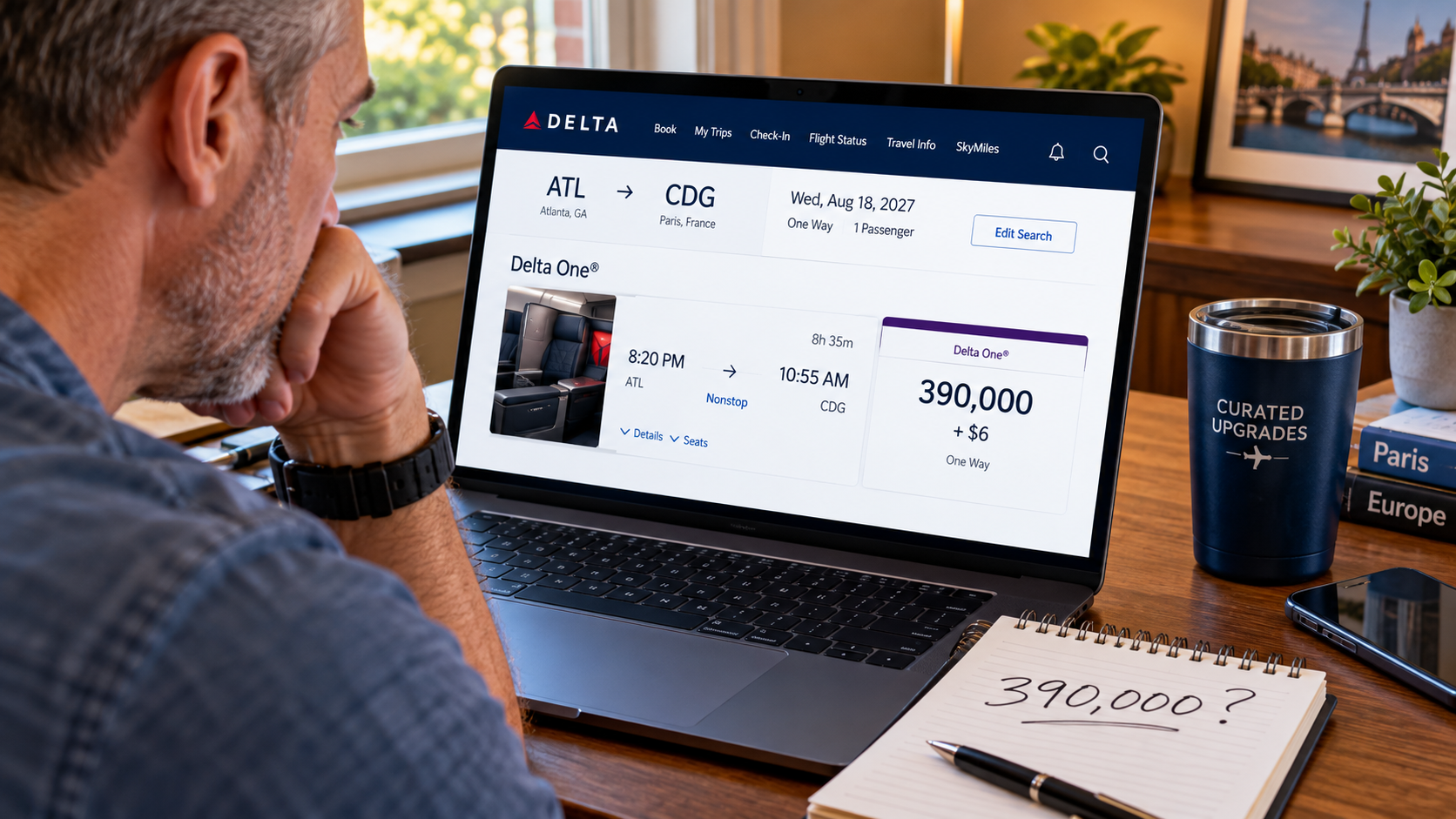
I searched Atlanta to Paris for August 18, 2027.
Main Cabin was 70,300 SkyMiles plus $6.
Not cheap, but hardly evidence that SkyMiles are worthless.
Then I clicked Delta One.
390,000 SkyMiles plus $6. One way.
Okay.
Maybe August 18 was just an expensive day.
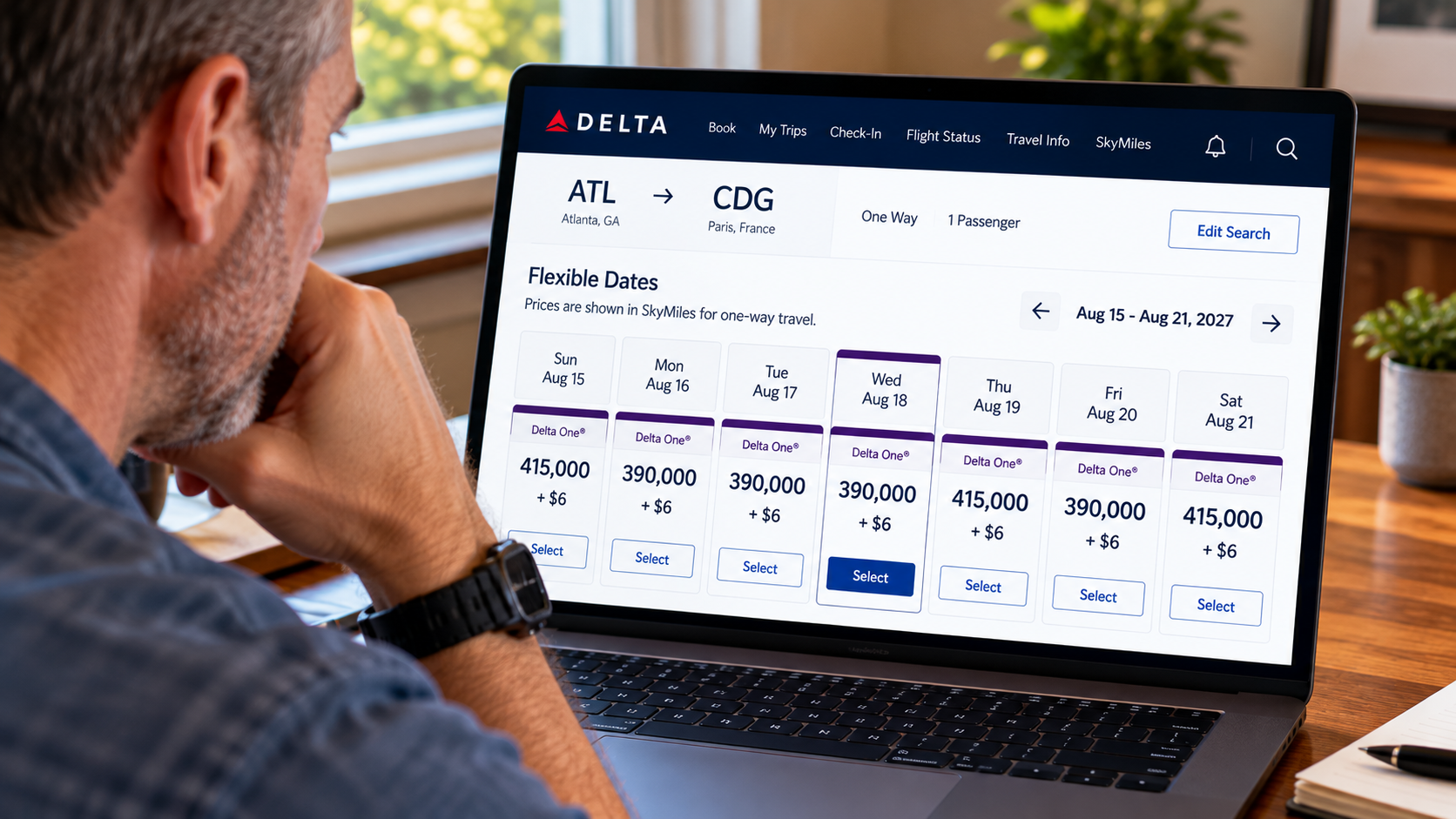
Delta's flexible-date calendar answered that question rather efficiently.
Across August 15 through August 21, Delta One pricing ranged from 390,000 to 415,000 SkyMiles plus $6.
The lowest price wasn't hiding Tuesday morning at 4:17 a.m.
It wasn't hiding Wednesday.
It wasn't hiding anywhere that week.
At that point, calling 390,000 miles an unfortunate date starts getting difficult.
But Don’t Stop at the First Search
This is where our approach to points has changed.
If Delta wants 390,000 miles, that doesn't mean the trip to Paris costs 390,000 miles.
It means Delta wants 390,000 SkyMiles.
Those are two very different statements.
Our destination is Paris. Our objective is getting there comfortably at a price we're willing to pay.
The points don't get to plan the trip. We do.
So I opened another tab.
Then another.
This is the same basic principle behind Portal vs. Transfer Partner: Which Should You Use? and Award Availability: Why Having the Points Doesn't Mean You Can Book the Flight.
Compare before you transfer. Compare before you redeem.
And perhaps most importantly:
If you don't ask, the answer is always no.
American Looked Amazing Until It Didn’t
American's flexible calendar initially made Delta look ridiculous.
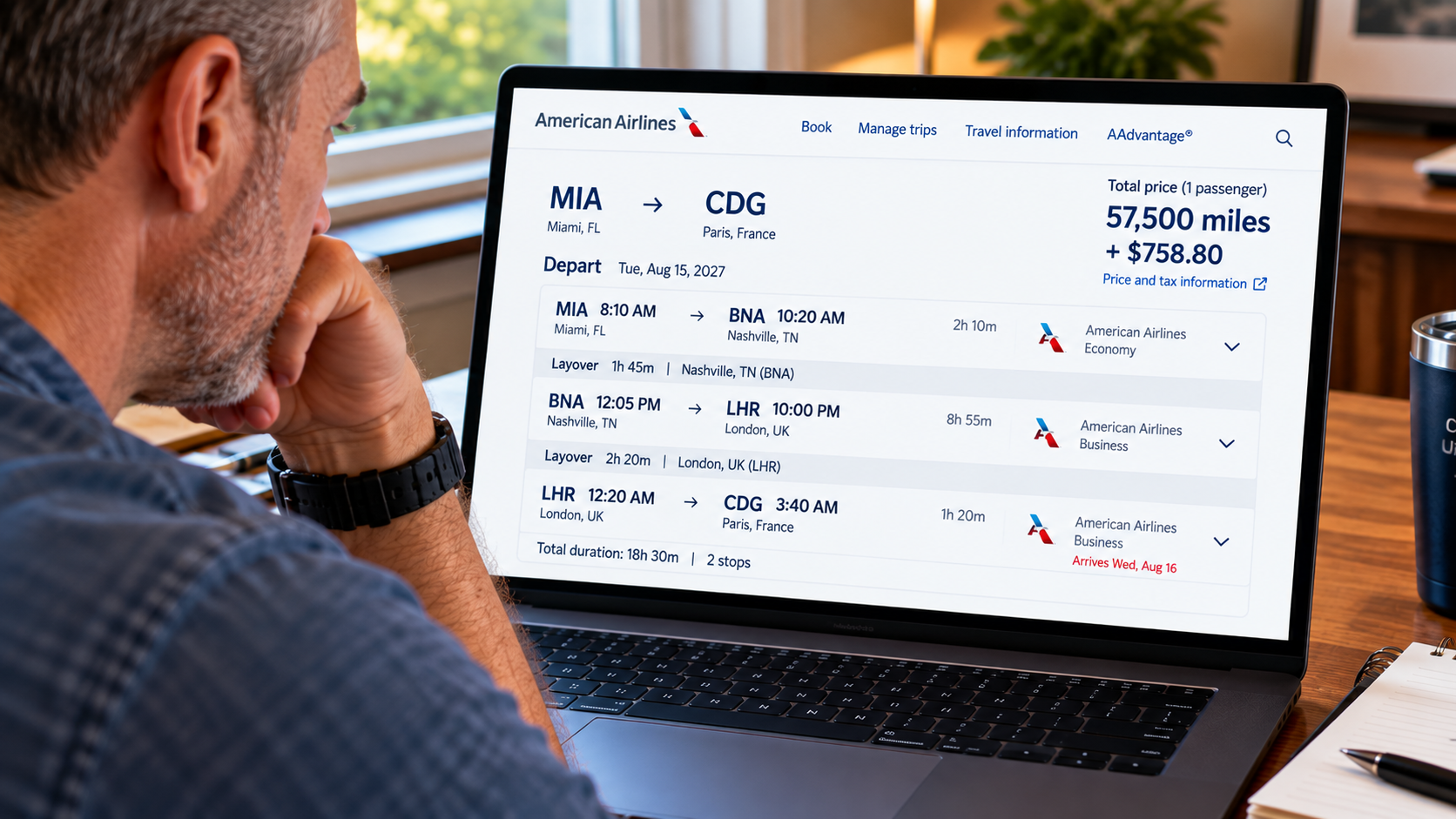
Searching Miami to Paris in business class for August produced multiple dates showing awards for only 57,500 AAdvantage miles.
Delta wanted 390,000.
American wanted 57,500.
Case closed?
Not remotely.
I clicked the 57,500-mile option.
The itinerary was Miami to Nashville to London Heathrow to Paris.
18 hours and 30 minutes. Two stops. And $758.80 in taxes and fees.
Suddenly 57,500 didn't look nearly as magical.
Another American option cost 71,500 miles plus $5.60, which sounded much better until we looked at the itinerary.
It required flying into New York LaGuardia and then making our own way across New York to JFK for the flight to Paris.
No thank you.
This is exactly why we wrote Award Travel Looks Free. The Mistakes Aren’t.
The number on the award calendar isn't the whole trip.
You have to look at the miles, the cash, the routing, the connections and what cabin you're actually getting.
A cheap award that turns your vacation into an obstacle course isn't necessarily a bargain.
Then United Gave Us a Real Alternative
United was more interesting.
On our exact August 18 date, business class from Newark to Paris was 200,000 miles plus $5.60.
Still expensive.
But the flexible calendar showed something else.
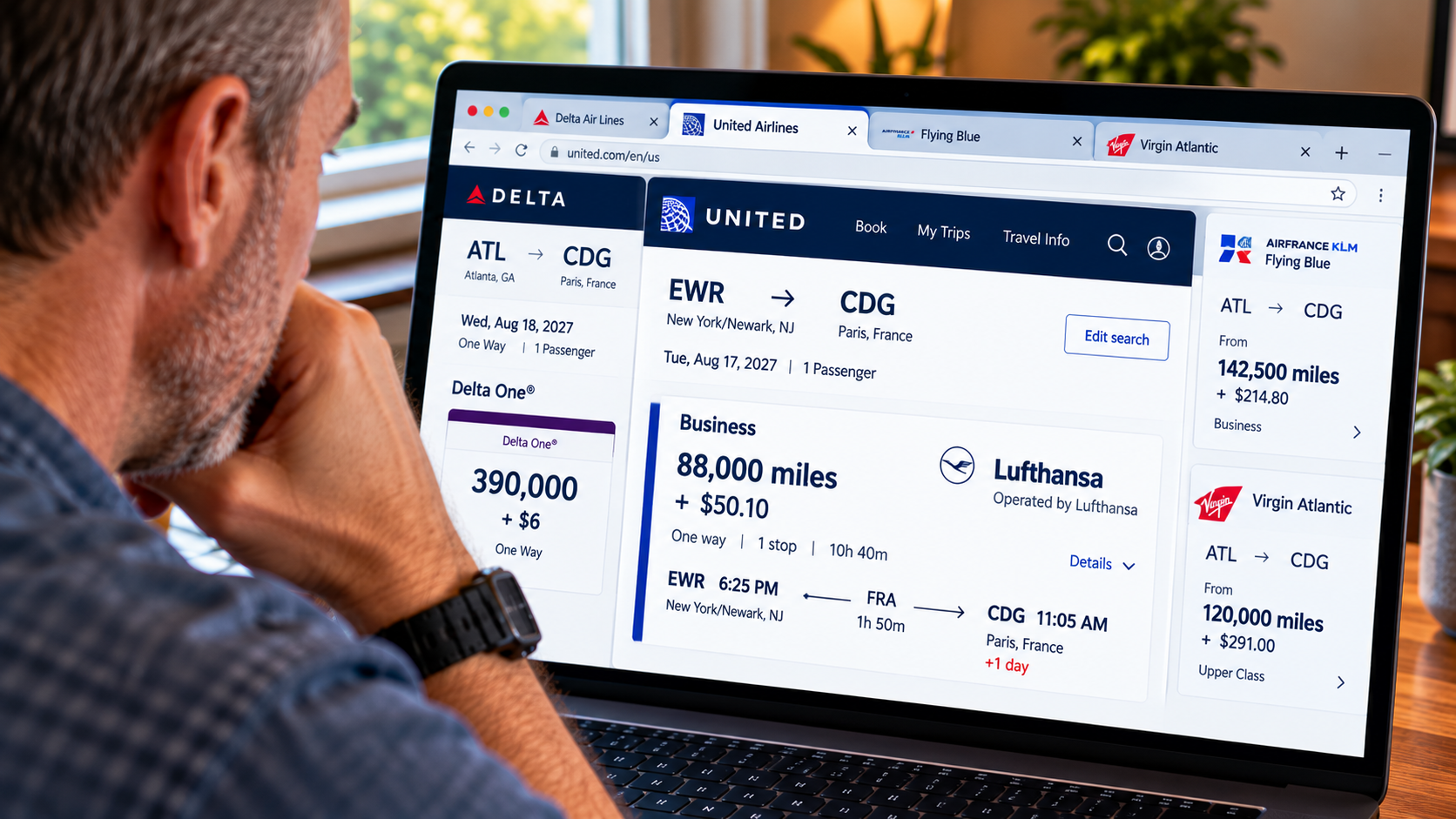
August 7 and August 9 were available for 88,000 miles plus $50.10.
This time I clicked through expecting the catch.
There really wasn't much of one.
The 88,000-mile itinerary was Lufthansa business class from Newark to Frankfurt and then Frankfurt to Paris.
One stop.
10 hours and 40 minutes total travel time, including a 1-hour 50-minute connection in Frankfurt.
Now we had an actual decision.
Delta offered a nonstop from Atlanta for 390,000 miles plus $6.
United showed an itinerary from Newark for 88,000 miles plus $50.10.
That is a difference of 302,000 miles.
No, those aren't identical trips. Getting ourselves to Newark has a cost. A nonstop from Atlanta is more convenient than connecting through Frankfurt. Positioning flights add their own risks and logistics.
But now we're asking the right question:
Is that convenience worth 302,000 additional miles?
For us, that's at least worth opening another browser tab.
What About Booking Delta Through a Partner?
There's another tab worth opening.
Delta belongs to SkyTeam, which means Delta flights can sometimes appear as award options through partner programs such as Air France-KLM Flying Blue or Virgin Atlantic.
The important word is sometimes.
We've found Delta flights through partners before. We've also searched and found no Delta award inventory at all.
On one Jacksonville-to-Amsterdam search, Flying Blue offered an itinerary for 242,500 miles plus $340.50. That's fewer miles than Delta wanted, but enough additional cash that I wouldn't automatically call it a better redemption.
On another search, the Delta flight we wanted simply wasn't available through Flying Blue.
That's the lesson.
Don't assume Flying Blue or Virgin Atlantic will have your Delta flight.
But don't assume they won't, either.
It costs nothing to check.
Airline Alliances Explained: The Shortcut to Better Award Travel goes deeper into why these partner searches can uncover options you won't see if you only search the airline whose miles happen to be sitting in your account.
Flexible Points Change the Game
This is one reason I've become much more interested in flexible points.
Airline miles ask:
What can I book with these miles?
Flexible points let me ask:
What's the best practical way to make this trip happen?
That might mean Delta.
It might mean United.
It might mean transferring points to Flying Blue.
It might mean paying cash and saving the points for another trip.
I'm not particularly interested in being loyal to an airline simply because its currency is already sitting in my account.
I'm loyal to my checkbook.
And I don't want 390,000 miles controlling where, when or how we travel just because they're the miles I happen to have.
So Are SkyMiles Actually Terrible?
Here's where the prosecution rests and the defense gets its turn.
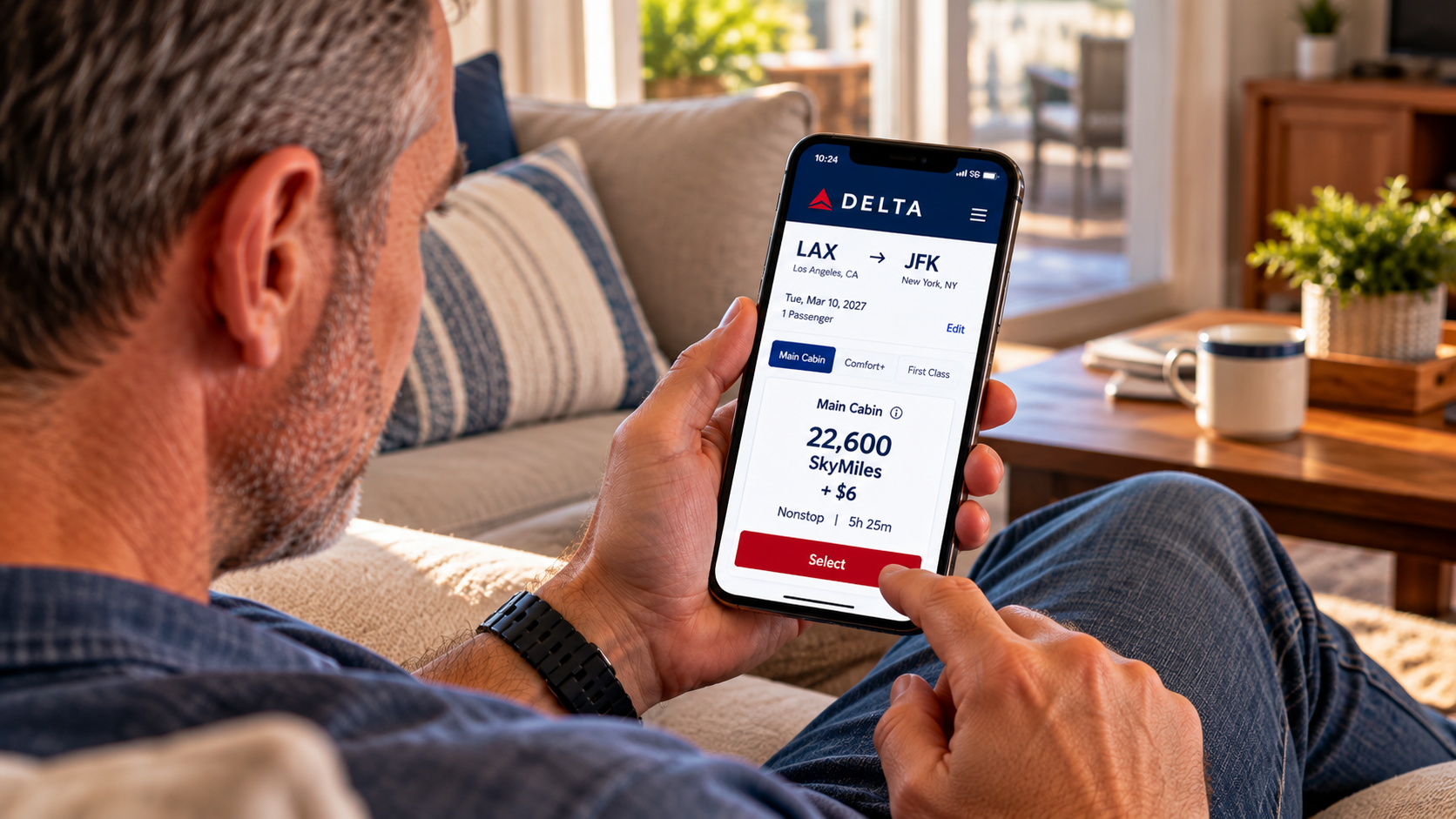
I searched Los Angeles to New York JFK on Delta.
A nonstop Main Cabin award was 22,600 SkyMiles plus $6.
American had nonstop economy options for 18,000 miles plus $5.60. United showed a nonstop to Newark for 15,000 miles plus $5.60.
Delta wasn't the cheapest.
But 22,600 miles for a transcontinental nonstop isn't remotely in the same universe as 390,000 miles to Paris.
I'd call that reasonable.
Delta Comfort on the same LAX-to-JFK search was 28,100 miles plus $6.
Still reasonable depending on the flight and what the extra comfort is worth to you.
Then things escalated.
Premium Select was 78,400 miles plus $6.
Delta One was 212,300 miles plus $6.
That's where the SkyPesos argument becomes much easier to understand.
Delta can offer perfectly usable awards in economy while simultaneously asking extraordinary amounts of SkyMiles for premium cabins.
Delta Does Have Some Genuine Advantages
It would be easy to stop with the outrageous premium-cabin numbers and declare SkyMiles useless.
That wouldn't be fair.
According to Delta’s current SkyMiles redemption information, SkyMiles do not expire. You can leave them in your account without watching an expiration clock.
Delta also provides useful flexibility on many awards. Under its current rules, award tickets booked with a Classic travel experience for travel within the United States, and international travel originating in the United States or Canada, can be changed or canceled without a mileage-redeposit fee. Basic award tickets have different restrictions and fees, so you still need to check the rules of the ticket you're booking.
Eligible Delta SkyMiles American Express cardholders also have TakeOff 15, which provides a 15% mileage discount on eligible Delta-operated award travel booked through Delta. The discount doesn't apply to partner-operated flights or taxes and fees.
And Delta does run award deals. Delta has specifically promoted discounted award opportunities to SkyMiles members, which means a flexible traveler can sometimes find substantially better value than the examples we found.
Those are real advantages.
But there's an important distinction.
A 15% discount on an excellent redemption is excellent.
A 15% discount on an outrageous redemption is a somewhat smaller outrageous redemption.
The Real Problem With SkyMiles
After all these searches, I don't think the biggest problem with SkyMiles is that they're worthless.
They aren't.
The problem is uncertainty.
With some programs, you can at least develop a rough idea of what an award should cost.
With Delta, you really have to search.
And search again.
A domestic economy award might be perfectly reasonable.
A premium international award might make you wonder whether Delta accidentally added a zero.
Tomorrow's price could be different.
Another date could be different.
An award sale could change everything.
That makes SkyMiles usable.
It doesn't make them predictable.
The Curated Upgrades Verdict
🟡 PARTLY WARRANTED
Do Delta SkyMiles deserve the nickname SkyPesos?
Sometimes, absolutely.
22,600 miles for a nonstop transcontinental Main Cabin flight?
🟢 Reasonable.
390,000 miles for a one-way Delta One flight to Paris when another workable business-class option showed up for 88,000 miles?
🔴 That's the problem.
SkyMiles aren't worthless. Domestic awards can make sense. Miles don't expire. Delta offers useful flexibility on eligible awards, TakeOff 15 can help eligible cardholders, and award sales can produce better opportunities.
But the unpredictable pricing and some staggering premium-cabin awards make the SkyPesos reputation difficult to dismiss.
So I'm not throwing away my Delta miles.
I'll use them when they make sense.
And when they don't?
I'll open another tab.
Because if you don't ask, the answer is always no.