

Portal vs. Transfer Partner: Which Should You Use?
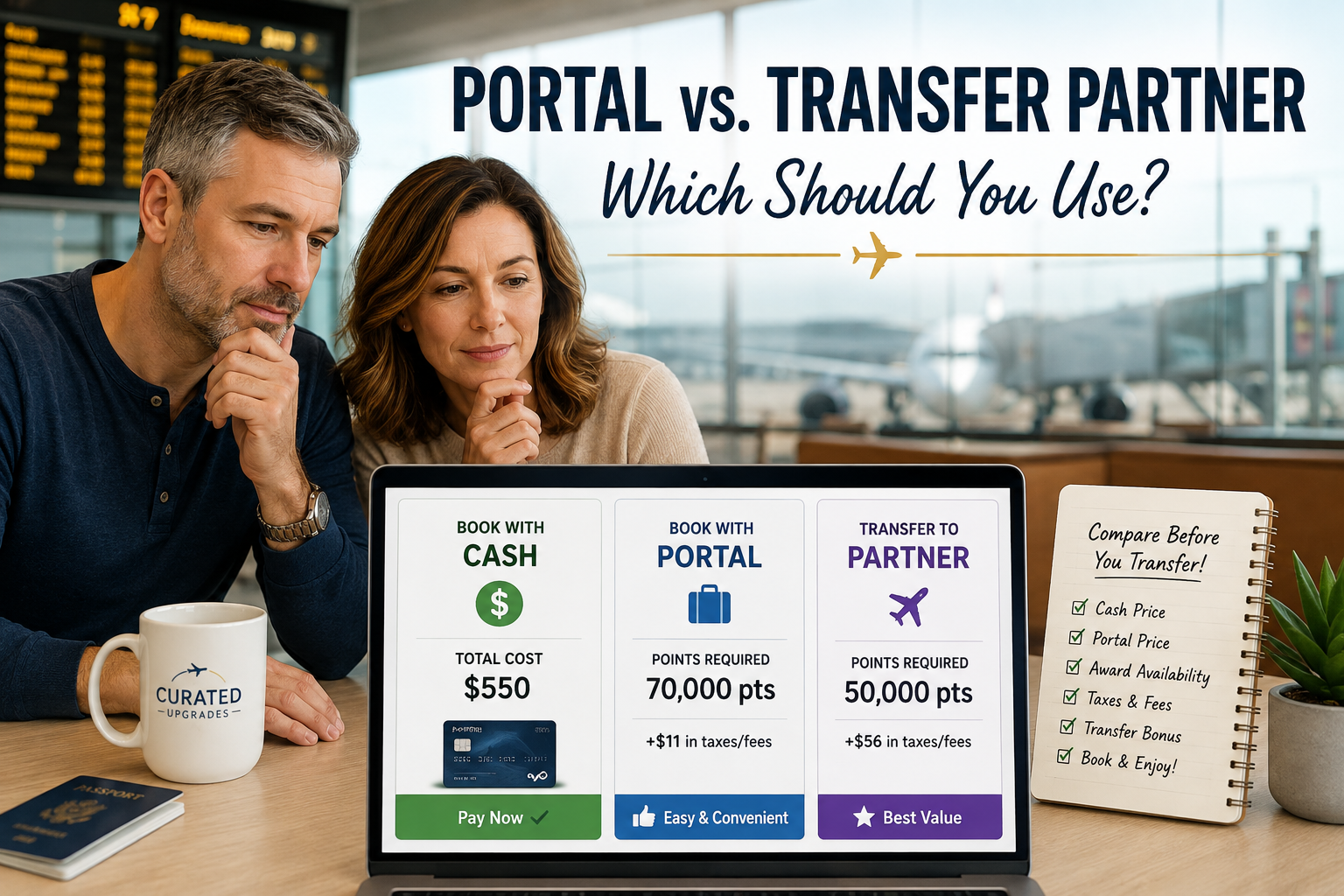
You have the points and found the trip. Now comes the important part: deciding whether to book through a travel portal, transfer your points to a partner, or simply pay cash.
You've built up a nice balance of travel points.
Now you actually want to use them.
This is where points and miles get interesting.
Maybe your credit-card travel portal shows the flight you want for 70,000 points. But an airline's frequent-flyer program has an award available for 50,000 miles.
Does that automatically mean you should transfer your points to the airline?
Not necessarily.
Maybe the portal booking earns airline miles. Maybe the award ticket has substantial taxes and fees. Maybe there's a transfer bonus. Maybe the cash fare is surprisingly inexpensive.
Or maybe you shouldn't use points at all.
The best way to redeem your points depends on what you're booking, what the alternatives cost and what matters to you on that particular trip.
My approach is simple:
Compare before you transfer.
New to Points and Miles?
If terms like travel portal, transfer partner, award ticket and airline alliance still sound like another language, start with my Points & Miles 101: The Travel Rewards Lingo You Need to Know guide.
That article covers the terminology. Here, we're going to put it to work.
Option 1: Book Through Your Credit-Card Travel Portal
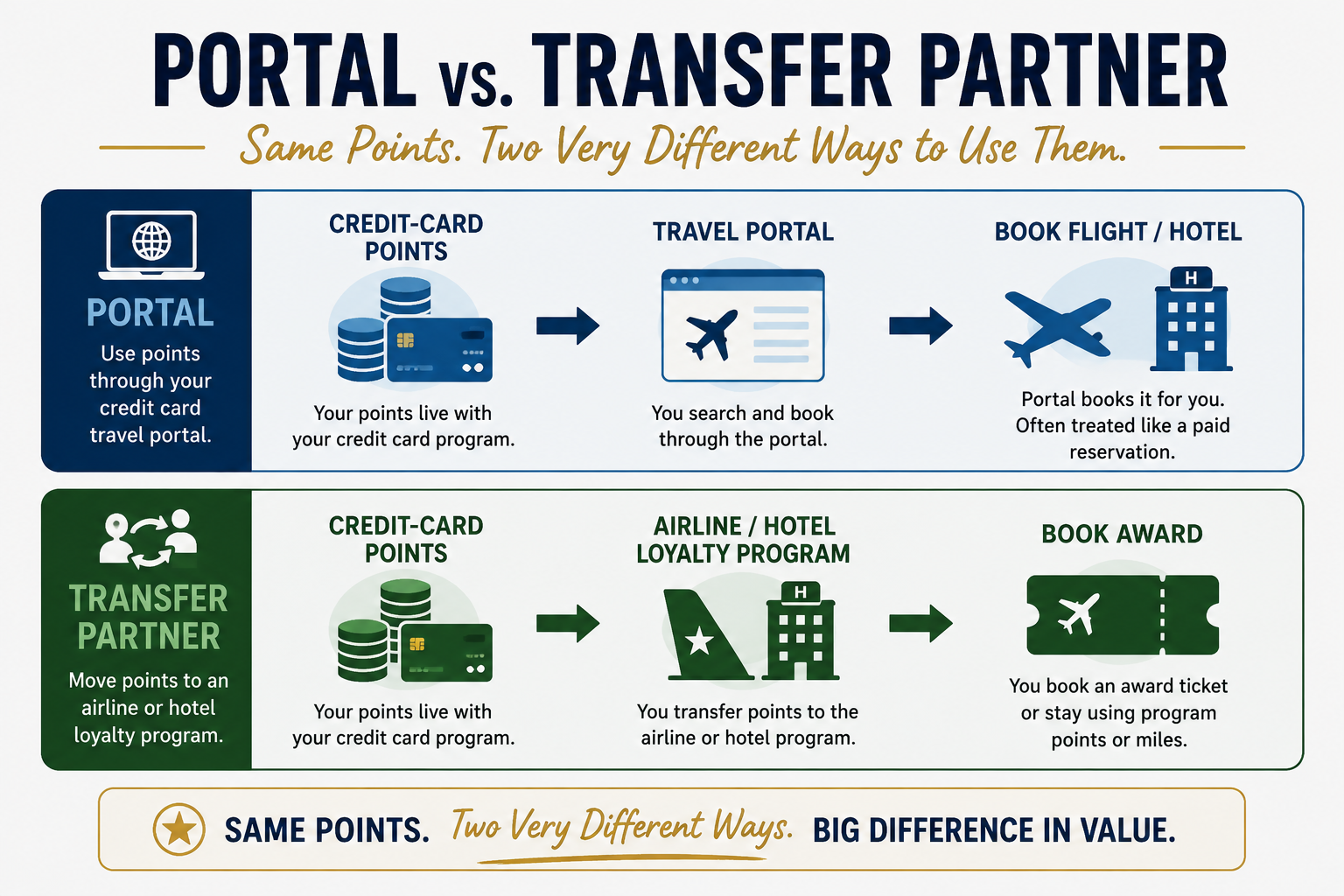
A credit-card travel portal lets you use your points to book flights, hotels and other travel through your card issuer's booking system.
The biggest advantage is obvious:
It's easy.
Search for your trip, find an option you like and use your points toward the booking.
You don't have to find award availability.
You don't have to transfer anything.
You don't have to figure out whether Airline A's miles can somehow book a flight operated by Airline B.
For someone getting started with points, that simplicity has real value.
You're Often Buying a Regular Ticket
When you redeem points through many travel portals for an airline ticket, the underlying reservation is generally treated more like a paid ticket than a traditional airline award ticket.
Depending on the airline, fare and rewards program, that can mean earning airline miles or receiving credit toward elite status.
Always check the rules for your particular booking, but it's one factor worth including in the comparison.
The Downside: You're Adding a Middleman
This is the part I pay attention to.
When you book directly with an airline, your relationship is straightforward:
You → Airline
Book through a portal and it can become:
You → Travel Portal → Airline
Usually, everything goes exactly as planned.
But when a flight gets canceled, a schedule changes or you need to modify something, having another company involved can sometimes complicate the process.
That doesn't mean I refuse to use portals.
It means convenience when booking isn't the only thing I consider.
Option 2: Transfer Your Points
This is where transferable credit-card points can become especially powerful.
Instead of spending your points through the credit-card portal, you transfer them into a participating airline or hotel loyalty program.
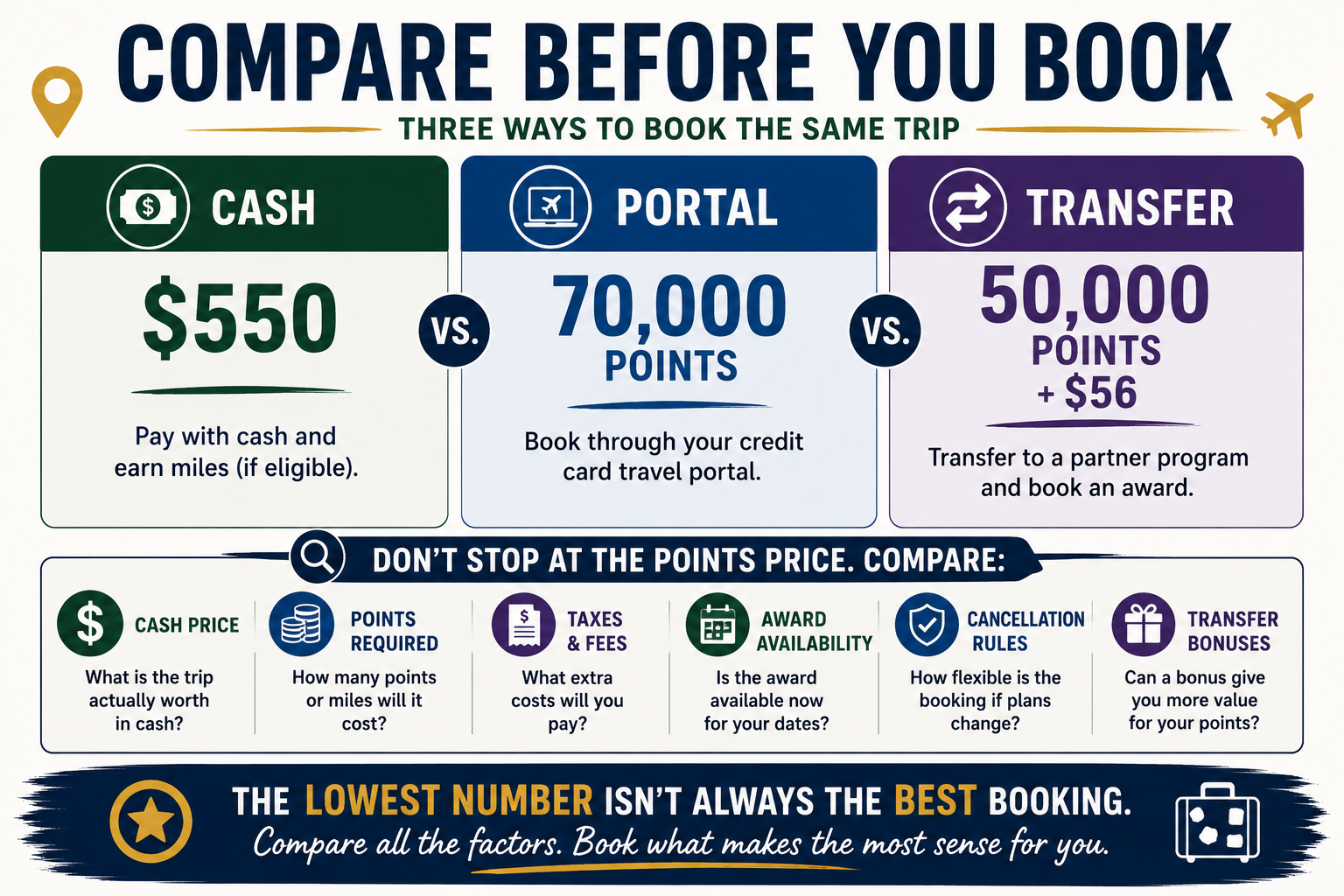
Suppose your portal wants:
70,000 points
But an airline transfer partner has the same flight available for:
50,000 miles + taxes
If your credit-card program transfers to that airline at 1:1, you might transfer 50,000 points and book the award.
You just kept 20,000 points in your account for another trip.
That's the basic idea.
But transfers can get considerably more interesting.
You Don't Necessarily Transfer to the Airline You're Flying
This is one of the most useful things to understand about points and miles.
Airlines have alliances and individual partnerships.
That means the airline operating your flight isn't necessarily the airline whose miles you need to use.
You might transfer points to one airline's frequent-flyer program and use those miles to book a flight operated by one of its partners.
So instead of asking only:
"Can I transfer my points to this airline?"
Start asking:
"Which loyalty programs can book this flight?"
That one change in thinking can uncover options you wouldn't see by checking only the operating airline.
If airline alliances and partner bookings are still new territory, I explain those concepts in Points & Miles 101.
Never Transfer Points Just Because You Can
This may be the most important rule in this entire article:
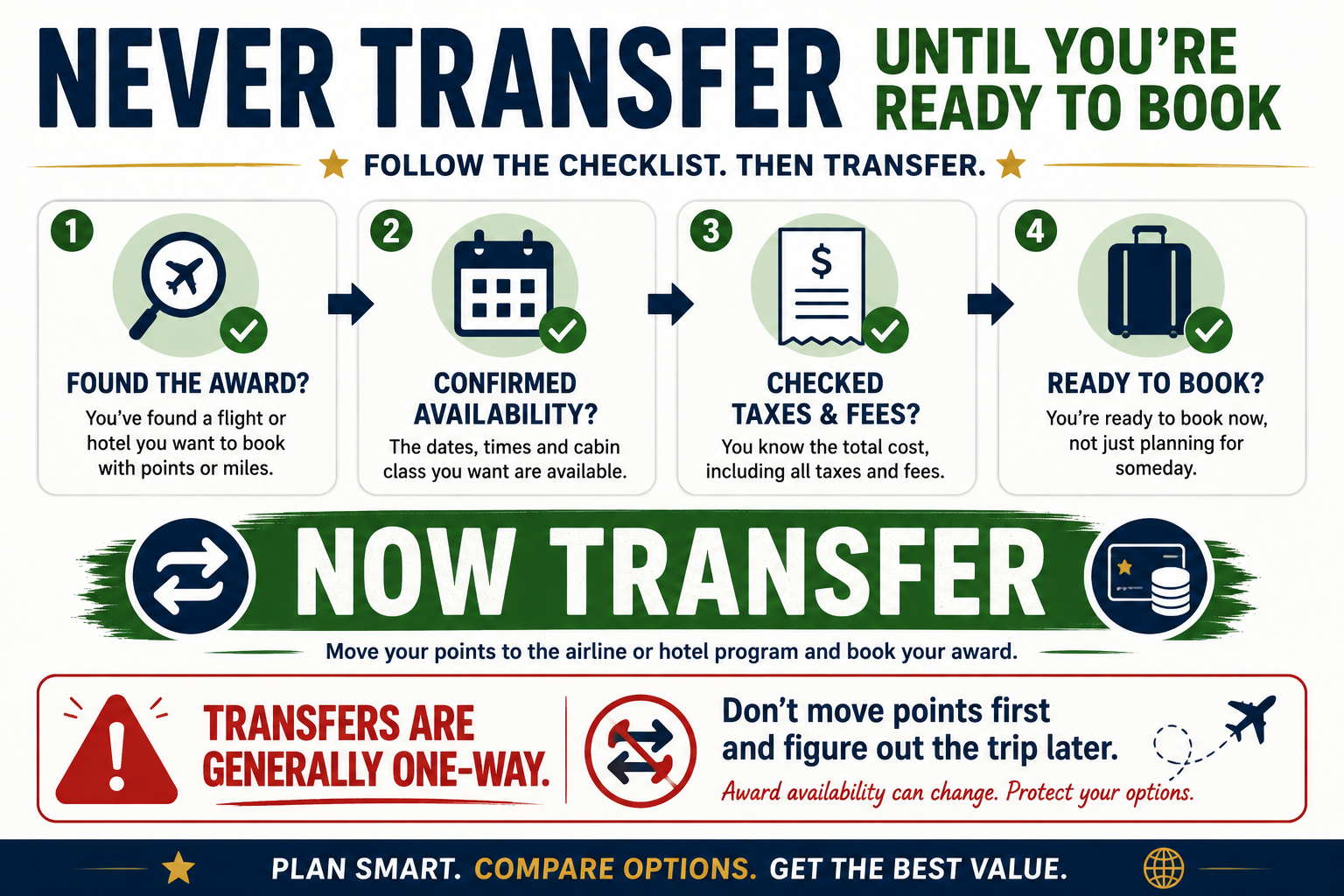
Don't transfer points until you've found the award you want and you're ready to book it.
Transfers are generally one-way.
Once those flexible credit-card points become airline miles or hotel points, you usually can't change your mind tomorrow and send them back.
And award availability can disappear.
You don't want to transfer 80,000 points because you think you've found a great flight, only to discover that the award is gone by the time you're ready to book.
Now you have 80,000 miles sitting in a program you may not otherwise use.
My order is simple:
Find the award.
Confirm availability.
Check the taxes and fees.
Be ready to book.
Then transfer.
Transfer Bonuses Can Change the Math
Occasionally, a credit-card rewards program offers a transfer bonus.
Imagine you need 60,000 airline miles for an award.
Normally, at a 1:1 transfer ratio, you'd need to transfer 60,000 credit-card points.
But if there's a 20% transfer bonus, you'd need fewer credit-card points to end up with the 60,000 miles required for the booking.
That's real value.
It can turn a good redemption into a very good one.
But a transfer bonus by itself isn't a reason to move points.
I still want a specific use for those miles before I transfer them.
A bonus on points that end up sitting unused in an airline account isn't much of a bonus.
Don't Forget the Taxes and Fees
Here's where a transfer can look better than it really is.
Suppose the portal wants:
80,000 points
The airline wants:
55,000 miles
Easy decision, right?
Not necessarily.
What if that airline award also carries $600 in taxes, fees and carrier-imposed surcharges?
Now the comparison looks very different.
When I compare a portal booking with an award booking, I don't look only at the number of points.
I look at:
Points or miles required + cash required
That's the real cost of the redemption.
Option 3: Pay Cash and Keep the Points
This option gets overlooked surprisingly often.
You don't have to use points just because you're traveling.
Sometimes airfare is inexpensive.
Maybe the flight costs $250 cash, the portal wants 25,000 points and the airline wants 22,500 miles.
I might look at that and decide:
I'll pay the $250.
Why?
Because those transferable points might be much more useful later for an expensive international flight or another trip where the cash price is painful.
Points give you options.
You don't have to spend them every time an opportunity appears.
At the same time, there's nothing inherently wrong with using points to eliminate a $250 expense if that's valuable to you.
Maybe you've accumulated plenty of points and your goal is simply to make this vacation cheaper.
That's perfectly reasonable.
Cents Per Point Is a Tool, Not a Competition
People who enjoy points and miles love calculating cents per point, usually shortened to CPP.
It's useful.
If a $1,000 ticket costs 50,000 points, you're getting roughly 2 cents of value per point before considering any taxes and fees.
That gives you a way to compare different redemption options.
What I don't believe in is treating CPP like a high score.
Someone on the internet may tell you they received 6 cents per point flying first class halfway around the world.
Great.
That doesn't mean your redemption was bad.
If 40,000 points save you $600 on a trip you actually want to take, that may be a perfectly good use of your points.
The goal isn't to win points.
The goal is to use them to travel better.
My Process: Compare Before You Book
When I'm considering using points for a trip, this is the basic process I follow.
1. Find the Cash Price
Start with what the trip actually costs.
Without that number, you don't have a meaningful baseline for comparing anything else.
2. Check the Travel Portal
See how many credit-card points the same flight or hotel would require.
Also make sure you're comparing the same thing.
Same cabin?
Same baggage allowance?
Same cancellation rules?
Same hotel room type?
A comparison isn't very useful if the products aren't actually equivalent.
3. Check the Airline or Hotel Loyalty Program
Now look for award availability.
How many miles or hotel points does it require?
What taxes and fees are added?
What are the cancellation or redeposit rules?
4. Check Other Transfer Partners
This is where airline alliances and partnerships can matter.
Another loyalty program may be able to book the same flight for fewer miles.
Don't assume the airline operating the flight is automatically the best program through which to book it.
5. Look for a Transfer Bonus
If you've already found an award you want, check whether your credit-card program is currently offering a transfer bonus to that program.
Notice the order:
Find the award first. Check the bonus second.
Not the other way around.
6. Compare the Real Cost
Now put the options next to each other:
Cash
Portal points
Transferred points + taxes and fees
Then consider the things that don't fit neatly into a calculator:
Convenience.
Flexibility.
Cancellation rules.
Award availability.
Whether you'll earn airline miles.
How comfortable you are dealing with the booking if something changes.
And what else you might want to do with those points.
7. Book It
Only after I've made that comparison am I ready to transfer points.
Once I transfer them, I generally consider those points committed.
A Real Example: Booking Scotland With Points
This isn't just theoretical for me.
When planning our Scotland trip, I compared the actual cash cost of our flights with the award options available through American Airlines.
The difference was substantial enough that using miles made sense.
I documented that booking separately, including screenshots showing the award price compared with the cash fare.
Booking Scotland With Points →
That's exactly the kind of comparison I recommend making before spending or transferring points.
The Card You Use Determines the Options You Have
There's another reason I like flexible travel points.
An airline-branded credit card generally earns rewards within that airline's loyalty program.
A flexible travel card can potentially give you several ways to use the rewards you've earned.
Neither is automatically better.
They simply do different jobs.
I've used both, and the right choice depends on how you travel and what benefits you're trying to get from the card.
Airline Card vs. Flexible Travel Card →
Big Trips Are Where This Can Really Matter
The difference between portal pricing, cash fares and transfer-partner awards becomes especially interesting when you're looking at expensive international travel.
A points balance that doesn't seem particularly exciting when you're pricing a short domestic flight may suddenly put a much bigger trip within reach.
That's part of what makes learning how to use transferable points worthwhile.
Portal or Transfer Partner: Which One Wins?
There's no universal answer.
I lean toward the portal when:
The points price is competitive.
Award availability is poor.
I value the simplicity.
I want the booking to function more like a regular paid ticket.
I lean toward transferring when:
Award availability is good.
The mileage requirement is substantially better than the portal price.
A partner airline offers an especially good redemption.
A transfer bonus improves an award I was already planning to book.
I'm getting meaningful value from using points instead of cash.
And I pay cash when:
Neither redemption gives me enough value to make me want to part with my points.
That's it.
No secret formula.
No requirement that every point achieve some mythical maximum value.
Just compare the options and use the currency that makes the most sense for that particular trip.
The Most Important Thing to Remember
Transferable points are valuable because they give you choices.
The portal is one choice.
Transfer partners give you others.
Cash is another.
Don't decide how you're going to pay for the trip before you've looked at all three.
Compare first. Transfer second. Book the option that works best for you.
Because the best points redemption isn't necessarily the one that produces the biggest number on a spreadsheet.
It's the one that helps you take the trip you want at a cost that makes sense.