


The conversation that inspired this article began while new windows were being installed at our cabin in North Carolina.
How 30 Minutes of Searching Put Australia Within Reach
A bucket-list trip didn’t become cheaper. It became possible once we looked at it differently.
A bucket-list trip was hiding in an airline account.
The conversation began while new windows were being installed at our cabin in North Carolina.
Over two days, the installers and I talked about work, travel and places we still hoped to see. One of the contractors mentioned that he and his wife had always wanted to snorkel at the Great Barrier Reef.
It was a bucket-list trip—but Australia seemed prohibitively expensive.
I told him that airline miles might change the equation. When he showed me their American Airlines accounts, the opportunity became much more tangible. He had approximately 120,000 AAdvantage miles, and his wife had about 90,000.
Together, they already had roughly 210,000 miles.
They didn’t need to earn enough miles to make Australia possible. They needed to understand what the miles they already had could do.
That evening, I spent about 30 minutes searching.
What I found surprised even me.
Start With the Experience, Not the Famous Airport
When many Americans begin planning an Australian vacation, they automatically search for Sydney.
But Sydney wasn’t the reason for this trip. The Great Barrier Reef was.
That changed the starting question from:
How do we get to Australia?
to:
Which airport gets us closest to the experience that inspired the trip?
For the Great Barrier Reef, Cairns was the logical destination.
Searching all the way to Cairns produced an itinerary from Charlotte through Los Angeles and Brisbane. The flights continued to Cairns on the same award reservation, eliminating the need to arrive in Sydney and then arrange another flight north.
That one decision made the itinerary more direct and put the travelers where they actually wanted to be.
The Outbound Flight That Changed the Conversation
For Wednesday, October 21, I found the following itinerary:
Charlotte to Los Angeles
Los Angeles to Brisbane on Qantas
Brisbane to Cairns on Qantas
Total travel time: 27 hours, 45 minutes
Arrival in Cairns: Friday, October 23
The cash fare was $1,489 per person.
The exact same itinerary was available through American Airlines for:
40,000 AAdvantage miles + $48.70 per person
That wasn’t a theoretical mileage valuation or a promotional “starting at” price. It was an available itinerary on the date searched.
For two people, the outbound would require 80,000 miles plus $97.40.
The couple already had enough miles sitting in their accounts.
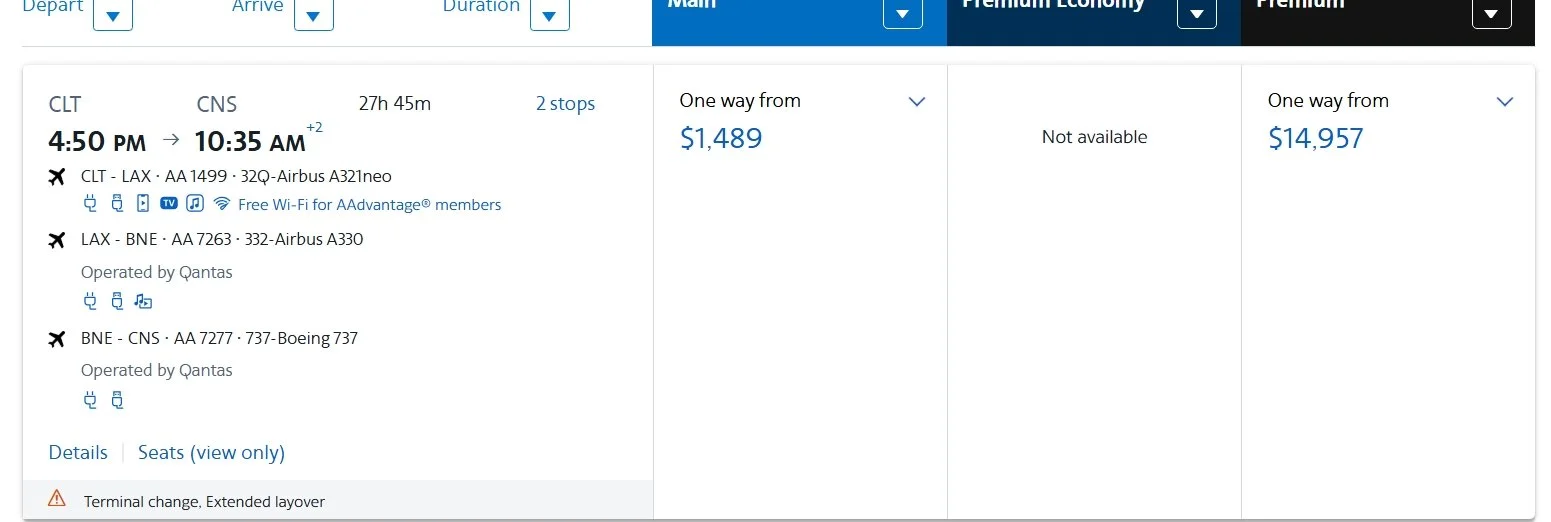
The Same Flights. The Same Date. Two Very Different Prices.
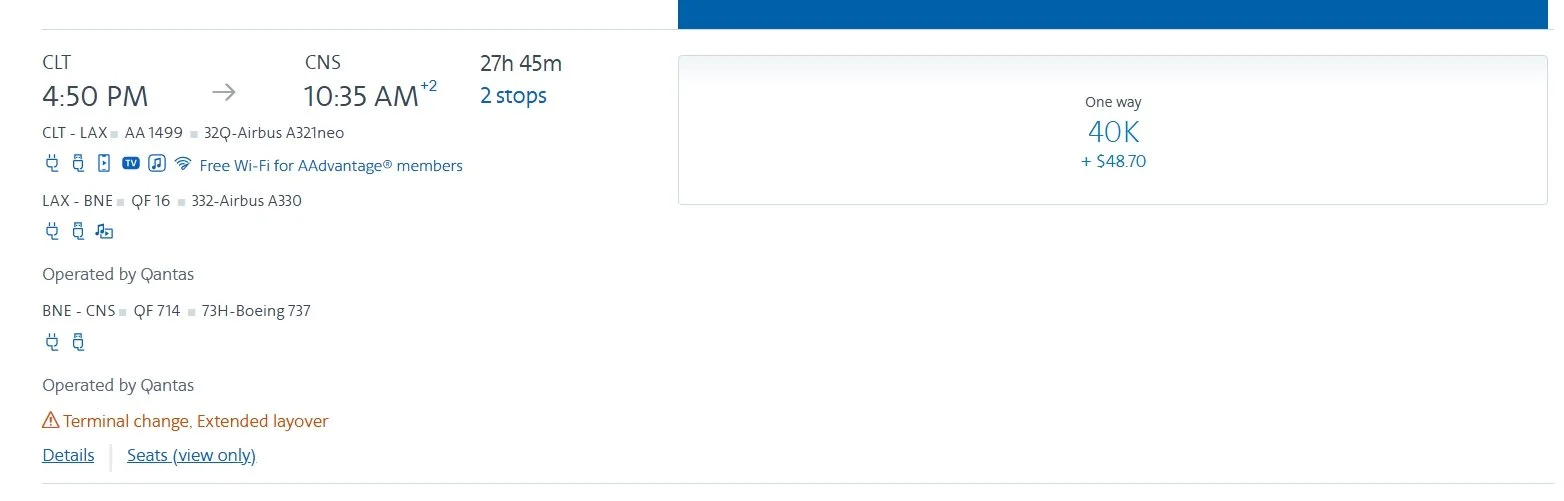
The identical Charlotte-to-Cairns itinerary was priced at $1,489 or 40,000 AAdvantage miles plus $48.70 per person.Editorial note: The cash result uses American Airlines codeshare flight numbers while the award result displays the operating Qantas flight numbers. The schedules and underlying flights are the same.The Seat Can Be the Upgrade
The 14½-hour flight from Los Angeles to Brisbane was scheduled on a Qantas Airbus A330 with a 2-4-2 economy layout.
For a couple, that matters.
The two seats along each side allow them to sit together without sharing the row with a stranger. They would have the window, the aisle and a small space that feels more private than the typical three-seat economy section.
If the budget allowed, I would prepay for a desirable side pair rather than spending thousands more for premium economy or business class.
That is a very Curated Upgrades decision:
Upgrade the part of the experience that matters most—not necessarily the cabin printed on the boarding pass.
A carefully chosen economy seat won’t turn into a lie-flat bed. But on a flight that long, a good location and the right seating arrangement can provide meaningful value for far less money.
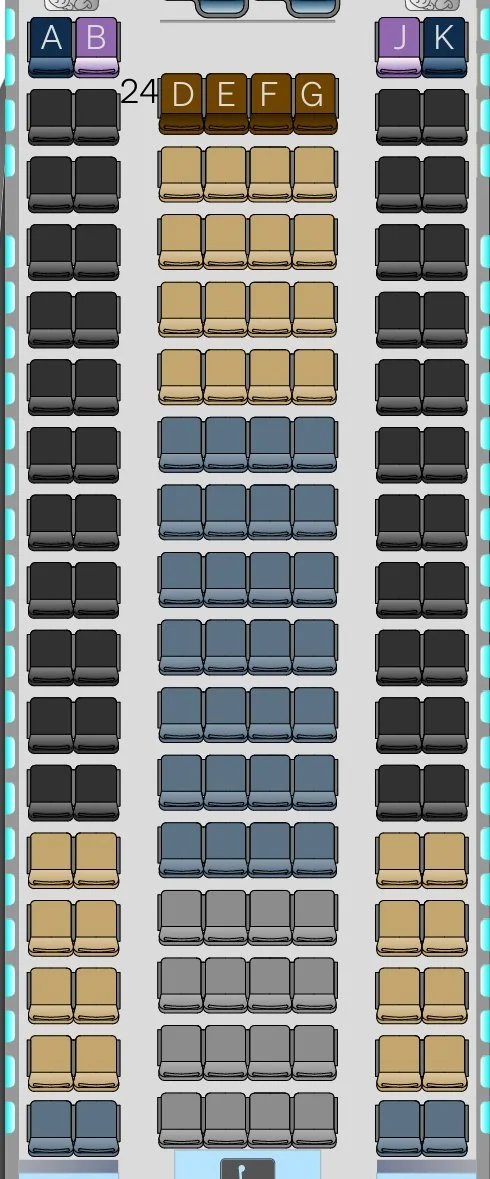
Qantas configures this A330 economy cabin in a 2-4-2 layout, giving couples the option of reserving a two-seat pair along either side.
Don’t Force the Return to Mirror the Outbound
Round trips are convenient to search, but they can restrict both award availability and the itinerary itself.
Instead, I searched each direction separately.
After spending most of the trip around Cairns and the Great Barrier Reef, the couple could fly to Melbourne on Virgin Australia:
Cairns to Melbourne
Sunday, November 1
Nonstop
3 hours, 25 minutes
AUD $231.01 per person
Approximately US $150 at the exchange rate when searched
They would arrive shortly after midnight on November 2 and have nearly three days to experience Melbourne before departing late on November 4.
The return flight I found was:
Melbourne to Los Angeles on a Qantas Boeing 787-9
Los Angeles to Charlotte on American Airlines
Total travel time: 22 hours, 16 minutes
One stop
40,000 AAdvantage miles + $99.63 per person
The equivalent economy fare was $1,263 per person.
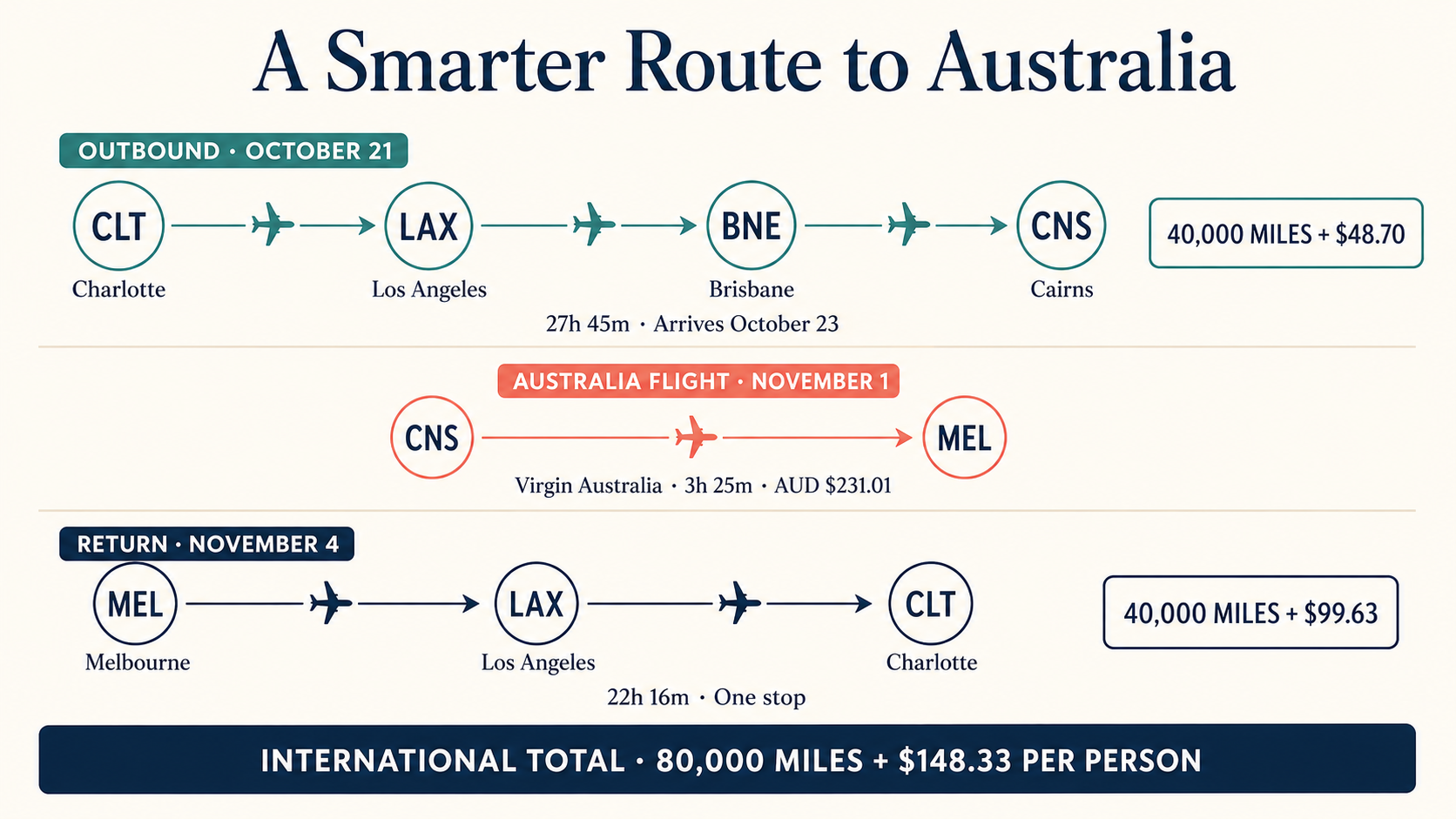
By booking each international direction separately and adding one paid domestic flight, the itinerary includes both tropical Queensland and Melbourne.
Melbourne Is the Upgrade
The most efficient approach might have been to return through Brisbane after visiting Cairns. Brisbane is closer and would keep the itinerary concentrated in Queensland.
But efficiency isn’t the only measure of value.
Cairns provides tropical coastline, rainforest and access to the Great Barrier Reef. Melbourne offers something distinctly different: laneway cafés, historic architecture, tram culture, food and a more urban side of Australia.
After traveling that far, adding Melbourne creates two noticeably different Australian experiences.
The flight home is slightly longer, and the itinerary requires a separate flight from Cairns. But the trip becomes more varied, memorable and complete.
Melbourne is the upgrade—not because it provides a better airplane seat or a premium cabin, but because it adds more value to the journey.
Sometimes the best upgrade isn’t greater comfort. It’s a richer experience.

Brisbane offers subtropical ease; Melbourne adds a distinctly different urban experience through its historic architecture, laneway cafés and tram culture.
What the Flights Would Cost
Here is the sample flight plan on a per-person basis:
Using AAdvantage miles
Charlotte to Cairns: 40,000 miles + $48.70
Cairns to Melbourne: AUD $231.01, approximately US $150
Melbourne to Charlotte: 40,000 miles + $99.63
International award total:
80,000 miles + $148.33 per person
Approximate flight-related cash outlay, including Cairns–Melbourne:
About $298 per person
Paying cash
Charlotte to Cairns: $1,489
Cairns to Melbourne: approximately $150
Melbourne to Charlotte: $1,263
Approximate total airfare:
$2,902 per person
For two travelers, the international award flights would require:
160,000 AAdvantage miles + $296.66
After adding the Cairns-to-Melbourne tickets, their combined flight-related cash outlay would be approximately $600.
They already had about 210,000 miles, so they could cover both international itineraries and still retain approximately 50,000 miles.
That is dramatically different from assuming Australia requires thousands of dollars in airfare before the vacation even begins.
This comparison does not include hotels, meals, ground transportation, reef excursions or the cost of getting from the Asheville area to Charlotte. It isn’t intended to represent the complete cost of an Australian vacation.
It illustrates what their existing miles could accomplish.
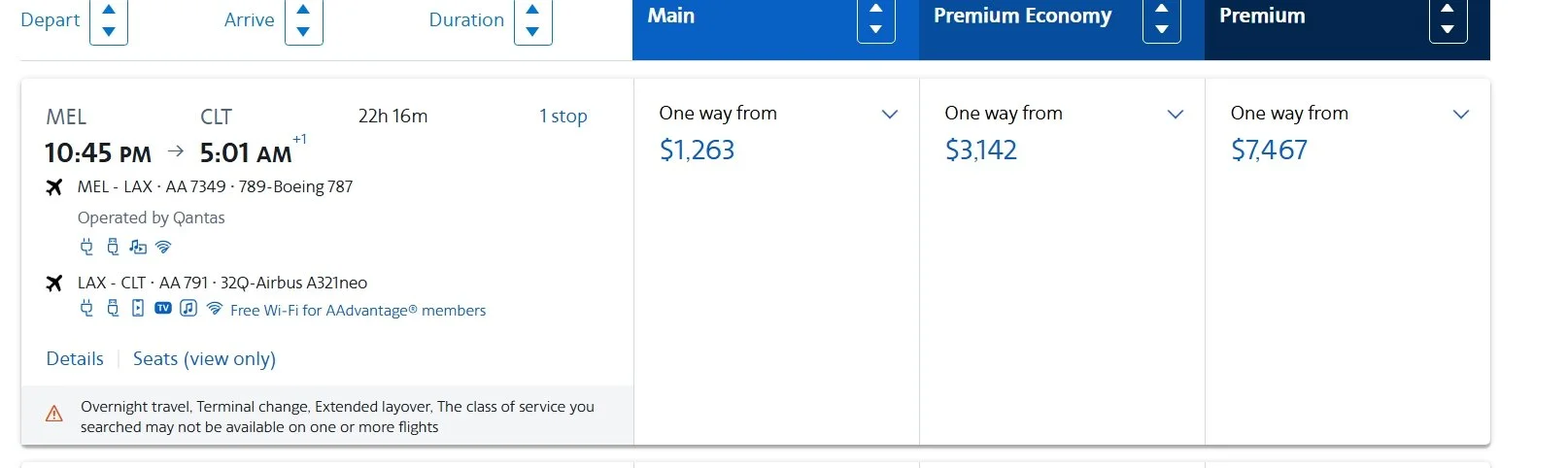
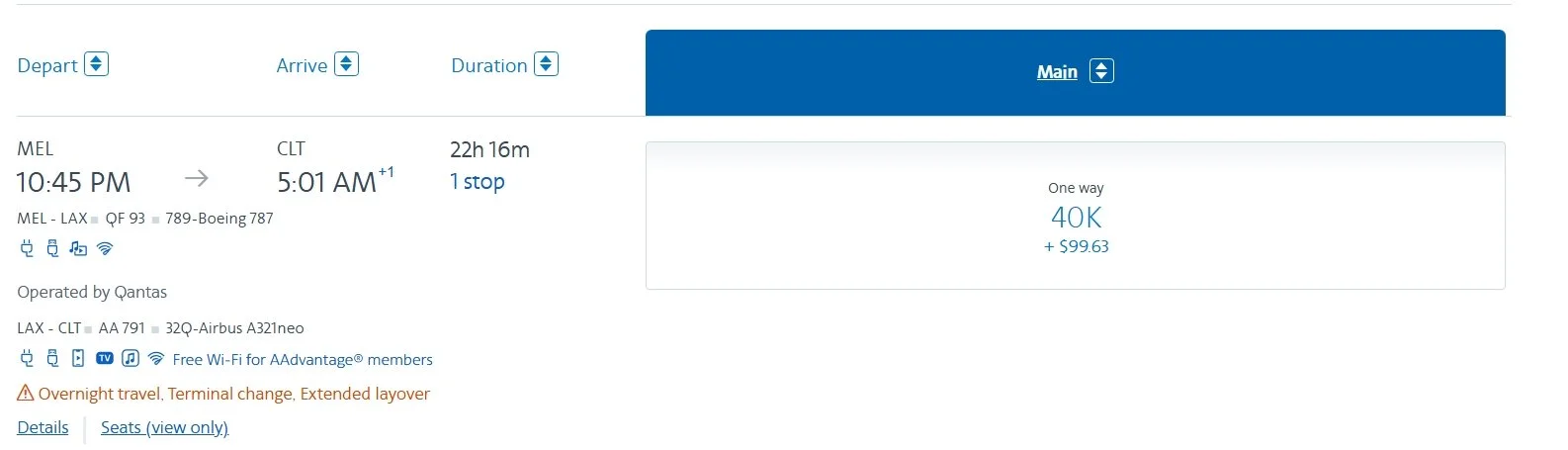
On the return itinerary, economy was $1,263 per person, premium economy was $3,142 and business class was $7,467.
Not Every Flight Needs to Be Upgraded
The Qantas 787-9 used for the Melbourne-to-Los Angeles flight has a 3-3-3 economy configuration. Unlike the outbound A330, it does not offer two-seat pairs in regular economy.
Premium economy would provide a more comfortable 2-3-2 arrangement—but the cash fare was $3,142 per person. Business class was $7,467.
That creates another practical decision.
Would premium economy be more comfortable? Absolutely.
Would it provide enough additional value to justify paying almost $1,900 more per person than economy on this particular example? That depends on the traveler and the budget.
The affordable economy award preserves the larger opportunity: getting two people to Australia using miles they already possess.
Not every individual component of a trip must be upgraded. Choose the improvements that add the most value to the complete journey.
Thirty Minutes Changed the Question
When the contractor first mentioned Australia, he seemed overwhelmed by the cost and complexity.
That was understandable. Australia is far away. The flights are long, the date line can make the schedule look confusing, and premium cabins can cost several thousand dollars in each direction.
But after about 30 minutes of searching, the conversation was no longer:
Could we ever afford to go?
It became:
When could we realistically make this happen?
No flights were booked, and this particular itinerary may never be the one they choose. Award availability and prices can change quickly.
The important discovery was that their dream wasn’t as distant as it appeared.
They already had the miles. They simply hadn’t connected those miles to a real journey.
The Credit-Card Lesson Behind the Story
Their miles were held in American Airlines accounts, so searching through American and its airline partners was the natural starting point.
Airline-branded cards can be extremely valuable when their miles align with the trip you want to take. But flexible rewards from programs such as Capital One or Chase may offer more ways to book flights, transfer points or offset other travel expenses.
Neither approach is automatically superior. The best card depends on your spending patterns, home airport, preferred airlines and travel goals.
I explore that decision more fully in:
Airline Card vs. Flexible Travel Card: Which Is Better?
The larger lesson is simple: before assuming a dream trip is unaffordable, look at every resource you already have—and search for the experience you actually want.
Thirty minutes may not book the vacation.
But sometimes it is enough to make the vacation feel possible.
Pricing disclaimer
This was a sample itinerary researched on August 22, 2026, and was not booked. Cash fares, award pricing, seat assignments, schedules, aircraft and availability can change at any time. The approximate U.S. dollar conversion for the Virgin Australia fare reflects the exchange rate available when researched.