

Airline Credit Card or Flexible Travel Card: Which One Actually Gets You Farther?
A real-world comparison of the Citi AAdvantage Platinum Select, Capital One Venture X, and Chase Sapphire Preferred
A contractor working at our house once mentioned that he and his wife dreamed of snorkeling the Great Barrier Reef. They had never seriously planned the trip because he assumed flights to Australia would cost too much.
Then he showed me their American Airlines AAdvantage accounts.
Together, they had accumulated approximately 210,000 miles, mostly through ordinary credit-card spending. Those miles had been sitting there without a particular trip attached to them.
Within about 30 minutes, I found a workable two-week Australia itinerary using miles they already had. He was genuinely surprised by how little mileage it could take.
Their AAdvantage miles were valuable. They could potentially turn a trip they assumed was financially out of reach into something achievable.
But our conversation raised a broader question:
Was an American Airlines credit card the best way for them to earn those miles—or would a flexible travel-rewards card have fit their spending and travel habits better?
That is not an argument against airline credit cards. I carry one myself.
It is an argument for choosing a card based on how you actually spend and travel—not simply because you recognize the airline’s logo.
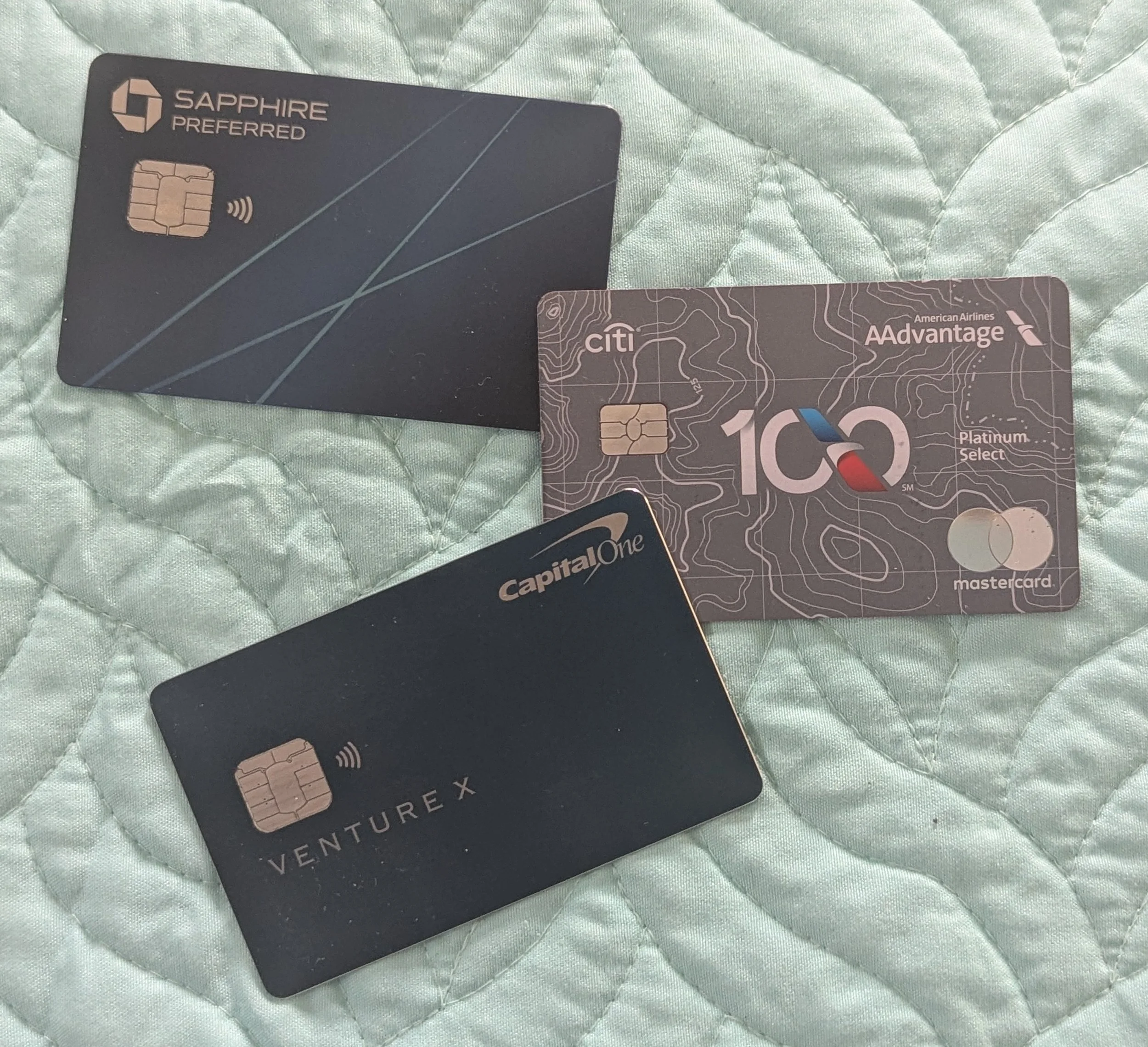
Disclosure: Credit-card offers; benefits, annual fees, and transfer partners can change. Verify the current terms directly with the issuer before applying. I personally carry and use all three cards discussed in this article. This article reflects my experience and is not individualized financial advice.
There Is No Universally “Best” Travel Card
I personally use three primary travel-rewards cards:
Citi® / AAdvantage® Platinum Select®
Capital One Venture X
Chase Sapphire Preferred®
Each has a different job in my wallet.
The Citi AAdvantage card provides benefits when I fly American Airlines. Venture X is my primary card for ordinary daily spending. Chase Sapphire Preferred earns additional points in categories that match some of my larger expenses.
I did not choose one winner and discard the others. I chose each card because it does something useful for the way my wife and I travel.
That does not mean everyone needs three cards. It means the right answer depends upon your spending, home airport, preferred airlines, travel goals, and ability to use the benefits.
The Airline Card: Citi AAdvantage Platinum Select
I fly American Airlines regularly for domestic travel, so the Citi AAdvantage Platinum Select card makes sense for me even though it is not my everyday spending card.
The card currently carries a $99 annual fee after the introductory first year. Its American Airlines benefits can include:
First checked bag free on qualifying domestic American Airlines itineraries for the cardholder and up to four companions on the same reservation
Preferred boarding
25% savings on qualifying American Airlines inflight food and beverage purchases
Two AAdvantage miles per dollar on eligible American Airlines purchases
Two miles per dollar at restaurants and gas stations
One mile per dollar on most other purchases
No foreign-transaction fees
A $125 American Airlines flight discount after spending $20,000 during the card membership year and renewing the card, subject to the card’s terms
For someone who regularly checks bags on American Airlines, the baggage benefit alone can offset the annual fee surprisingly quickly.
That is why I keep the card.
I originally applied while targeting a specific Japan itinerary. I had found a Japan Airlines flight through American’s website that I liked for our return, but I did not have enough AAdvantage miles to book it. We were flying American home from Las Vegas when I saw a card promotion.
Because we already flew American regularly, the card’s ongoing benefits—not only the introductory bonus—made sense for us.
Our plans eventually changed from Japan to Scotland. The miles still proved useful. We used AAdvantage miles to book British Airways business class for the outbound portion of that trip.
Where the AAdvantage card shines
The card is a strong fit when:
You fly American Airlines regularly
You check bags on domestic American itineraries
Preferred boarding matters to you
You want to earn AAdvantage miles or Loyalty Points
You have a particular American or oneworld-partner redemption in mind
You can obtain more than $99 in real value from the benefits
Where it is less compelling
Most purchases outside its bonus categories earn one mile per dollar. If your primary goal is maximizing rewards on general household spending, another card may earn faster.
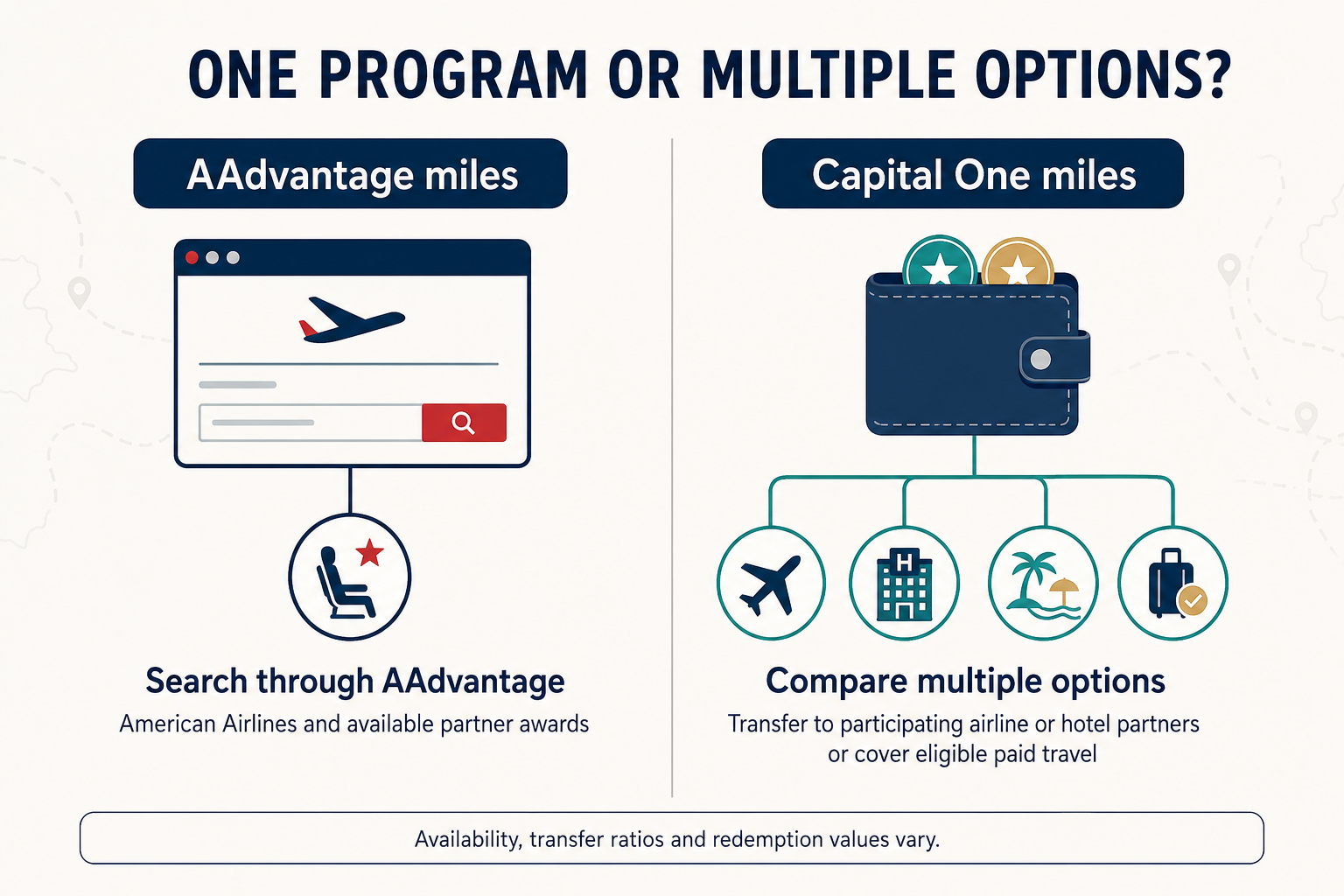
AAdvantage miles also remain inside the American Airlines program. You cannot move them to another airline when another program has better award availability.
That does not make them bad miles. It makes them more specialized.
I am not pursuing airline elite status. As I have said before, I am loyal to my checkbook. I keep this card because its practical American Airlines benefits justify its fee for me.
The Everyday Card: Capital One Venture X
Capital One Venture X is my default card for most ordinary spending.
I use it for groceries, Amazon purchases, events, recurring bills that do not impose a credit-card fee, and the countless purchases that do not fit neatly into a special rewards category.
The reason is simple:
Venture X earns two miles per dollar on ordinary purchases.
The card currently has a $395 annual fee, which initially sounds expensive. For me, however, two recurring benefits offset most or all of that fee:
A $300 annual credit for eligible purchases through Capital One Travel
10,000 anniversary miles each year, beginning with the first anniversary
If I use the entire travel credit—and I do—the remaining difference is $95. The 10,000 anniversary miles can potentially offset that amount, depending on how they are redeemed.
Other benefits include:
Two miles per dollar on ordinary purchases
Five miles per dollar on flights and vacation rentals booked through Capital One Travel
Ten miles per dollar on hotels and rental cars booked through Capital One Travel
Capital One Lounge access
Priority Pass lounge access, subject to current program terms
Transfer opportunities with multiple airline and hotel loyalty programs
No foreign-transaction fees
A credit toward Global Entry or TSA Pre-Check, subject to the current card terms
Where Venture X shines
Venture X works especially well for people whose spending is spread across many ordinary categories.
Consider $50,000 in purchases that would otherwise earn one mile per dollar:
At one mile per dollar: 50,000 miles
At two miles per dollar: 100,000 miles
That is a significant difference.
The other advantage is flexibility. Capital One miles can be transferred to participating airline programs, potentially allowing you to compare several programs before choosing how to book a trip.
Instead of asking only:
“What can I find through AAdvantage?”
You can ask:
“Which available program offers the best combination of schedule, experience, mileage, and fees for this trip?”
Capital One miles may also be used in other ways, including covering eligible travel purchases, although the value can differ from transferring to a loyalty program.
Flexibility still requires homework
Transferable points do not guarantee that the award you want will be available.
You must still:
Find the flight you want.
Confirm that award space is available through the transfer partner.
Verify the mileage requirement and taxes.
Transfer only the points needed.
Complete the booking promptly.
Transfers are generally irreversible. Never move flexible points to an airline merely because you might use them someday.
Find the award first. Confirm the availability. Then transfer.
The Category Card: Chase Sapphire Preferred
I chose the Chase Sapphire Preferred instead of the more expensive Sapphire Reserve because many of the Reserve’s premium benefits would duplicate benefits I already receive through Venture X.
I already have lounge access. I already receive a Global Entry or TSA PreCheck credit. Paying another premium annual fee for overlapping benefits did not make sense for me.
The Sapphire Preferred currently carries a $95 annual fee and earns:
Five points per dollar on travel purchased through Chase Travel
Three points per dollar on dining
Three points per dollar at gas stations and EV-charging stations
Three points per dollar on qualifying online grocery purchases
Three points per dollar on select streaming services
Two points per dollar on other qualifying travel
One point per dollar on most other purchases
It also offers access to Chase transfer partners and includes various travel and purchase protections, subject to the card’s terms.
This card fits our spending unusually well.
I own a diesel truck and a Tesla Model X, so we buy both fuel and EV charging. We also dine out regularly. Those three-point categories make the card useful without duplicating the role Venture X plays for our general spending.
I also compare rental-car pricing through Chase Travel and Capital One Travel before booking. Neither portal automatically has the best price or policies every time.
Where Sapphire Preferred shines
The card may be particularly useful for someone who spends heavily on:
Restaurants
Gasoline
EV charging
Travel
Online groceries
Eligible streaming services
Chase points can also be transferred to participating airline and hotel programs, giving travelers another flexible pool of points.
For my household, Venture X provides the simple two-mile foundation, while Sapphire Preferred adds stronger rewards in several categories where we spend heavily.
How Much Do You Earn After Meeting the Initial Spending Requirement?
Welcome offers change frequently. The offers shown in an advertisement, referral page, mailed promotion, airport display, or card issuer’s website may not always be identical.
When comparing offers, do not look only at the headline bonus. Also compare:
The required spending
The deadline for completing that spending
The annual fee
Points earned from the qualifying purchases themselves
Bonus restrictions and eligibility rules
Whether you can pay the balance in full
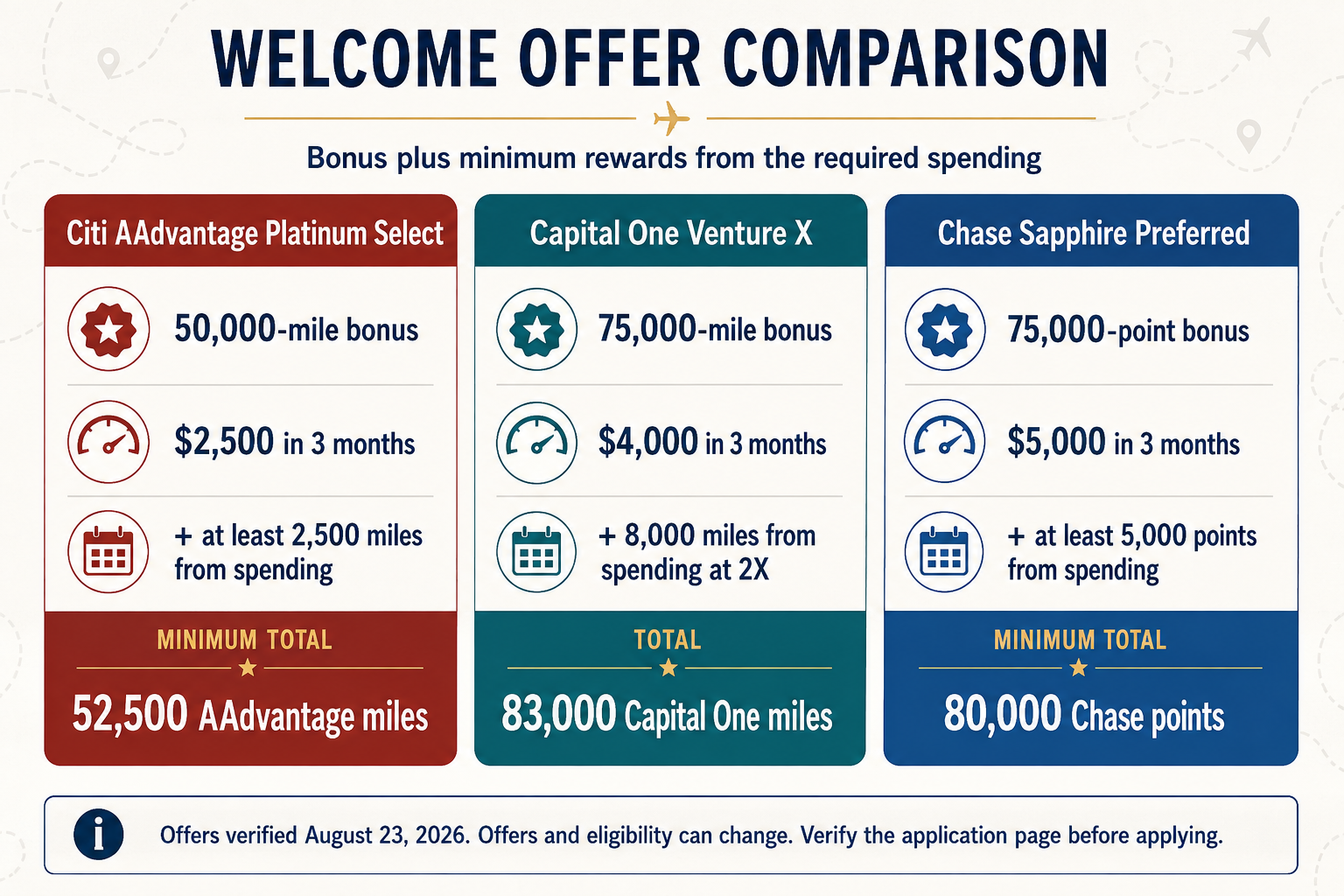
Offers can change. Use the terms shown on the application page when preparing the final graphic.
At the time this article was prepared, public offers included 75,000 miles for Venture X after $4,000 in qualifying purchases and 75,000 points for Sapphire Preferred after $5,000 in qualifying purchases. A Citi page showed 50,000 AAdvantage miles after $2,500 in qualifying purchases, although targeted offers may differ.
Always verify the live application page immediately before publishing or applying.
Do Not Spend Money You Don’t Have to Earn a Bonus
This is the most important section of the article.
A welcome bonus can be extremely valuable—but not if earning it causes you to carry credit-card debt.
Do not spend $5,000 you would not otherwise spend merely because a card offers a large pile of points. Do not use a welcome offer to justify an unaffordable purchase. Do not treat the spending requirement as free money.
If you already planned to spend that amount and have the cash available to pay the statement in full, that is different. A planned insurance payment, household expense, trip deposit, or other budgeted purchase might help satisfy a requirement without changing your total spending.
But credit-card interest can quickly destroy any value the rewards provide.
Miles and points are not an upgrade if earning them puts you in debt.
A Travel Portal Is Still a Travel Agency
Capital One and Chase travel portals can provide good prices, elevated rewards, and useful credits. But booking through a trusted credit-card company does not eliminate the need for due diligence.
I once found a good rental-car rate through Capital One Travel with NU Car Rentals. I trusted Capital One, so I booked without properly researching the rental company.
Later, I discovered extremely poor reviews and restrictive policies. When my father died and I needed to change the reservation, the booking could not be changed. I lost approximately $100.
Capital One provided what it advertised. My mistake was assuming that appearing inside a trusted portal meant the underlying company and reservation terms automatically suited my needs.
Before booking through any portal:
Research the actual airline, hotel, or rental company
Read the cancellation and change rules
Check connection times
Compare the price with booking directly
Understand who controls the reservation if something goes wrong
Save copies of the terms shown when you book
A credit-card portal is still acting as a travel agency between you and the travel provider.
Should You Carry an Airline Card and a Flexible Card?
For many travelers, the answer may be yes.
A practical two-card strategy could be:
Keep an airline card when its baggage, boarding, discount, or companion benefits justify the annual fee.
Use a flexible two-mile-per-dollar card for most ordinary spending.
Use another card for categories where it earns meaningfully more.
Pay every statement balance in full.
The airline card does not necessarily need to be your primary spending card to earn its place in your wallet.
My Citi AAdvantage card provides useful American Airlines benefits. My Venture X earns double miles across everyday spending. My Sapphire Preferred earns more in several categories that fit our life.
Each card has a defined role.
Questions to Ask Before Choosing a Travel Card
Be honest with yourself about your spending and travel habits.
Ask:
Which airlines do I actually fly?
Does my home airport have an airline, Capital One, Chase, or Priority Pass lounge I can realistically use?
Do I normally check bags?
How much do I spend on dining, gasoline, EV charging, groceries, and general purchases?
Do I use services such as DoorDash often enough for those benefits to matter?
Am I seeking a particular airline redemption?
Do I want access to several transfer partners?
Will I naturally use the card’s annual credits?
Does the card duplicate benefits I already have?
Can I meet the welcome-offer requirement without increasing my spending?
Will I pay the statement in full every month?
Do not assign full cash value to a benefit you would never purchase or use.
A $300 travel credit can genuinely offset a fee if you would have spent that $300 anyway. A food-delivery membership is not worth its advertised price to someone who never orders food delivery. Lounge access is less valuable if the lounges are not located in airports you use.
Calculate value based on your life—not the card issuer’s marketing total.
My Bottom Line
I have not been dissatisfied with any of these three cards. So far, each has provided what it advertised.
The Citi AAdvantage card earns its place through American Airlines benefits.
Capital One Venture X earns its place through simple two-mile-per-dollar earning, flexible redemption options, travel credits, anniversary miles, and lounge access.
Chase Sapphire Preferred earns its place through strong categories that match our spending, access to another group of transfer partners, and a reasonable annual fee.
I do not believe there is one travel card everyone should carry.
The wrong question is:
“Which travel card is best?”
The better question is:
“Which card—or combination of cards—best supports the journeys I want to take?”
Choose the card that fits your real spending. Use the benefits deliberately. Read the terms. Pay the balance in full.
Then let the rewards take you somewhere worth going.
Current Card Offers
The following are referral links. If you apply through one of these links and are approved, I may receive referral miles or points. Your cost is not increased by using the link, but the offer available through a referral may differ from an offer available elsewhere. Compare the terms and choose the offer that is best for you.
Offers and benefits are subject to change. Review the issuer’s application page, eligibility requirements, rates, fees, and complete terms before applying.