


Points & Miles 101
The Travel Rewards Lingo You Need to Know
Points, miles, portals, transfer partners, award travel and airline alliances, explained in plain English.
You open your credit-card app and see 42,650 points.
Great.
Then you find a flight to Cancun and the airline wants 22,500 miles.
Also great.
Except...you have points.
It wants miles.
Can you use one for the other? Are 22,500 miles the same thing as 22,500 points? Do you book through your credit-card company? Transfer the points somewhere? And what exactly is a transfer partner?
Welcome to points and miles.
The travel-rewards world can be incredibly useful, but it has developed a language of its own. Once you've been doing this for a while, terms like award availability, transfer partner and airline alliance become second nature.
For someone just getting started, they can sound like airport alphabet soup.
This guide is your decoder ring.
You don't need to become a points expert. You just need to understand enough of the language to start making smarter decisions with the rewards you've earned.
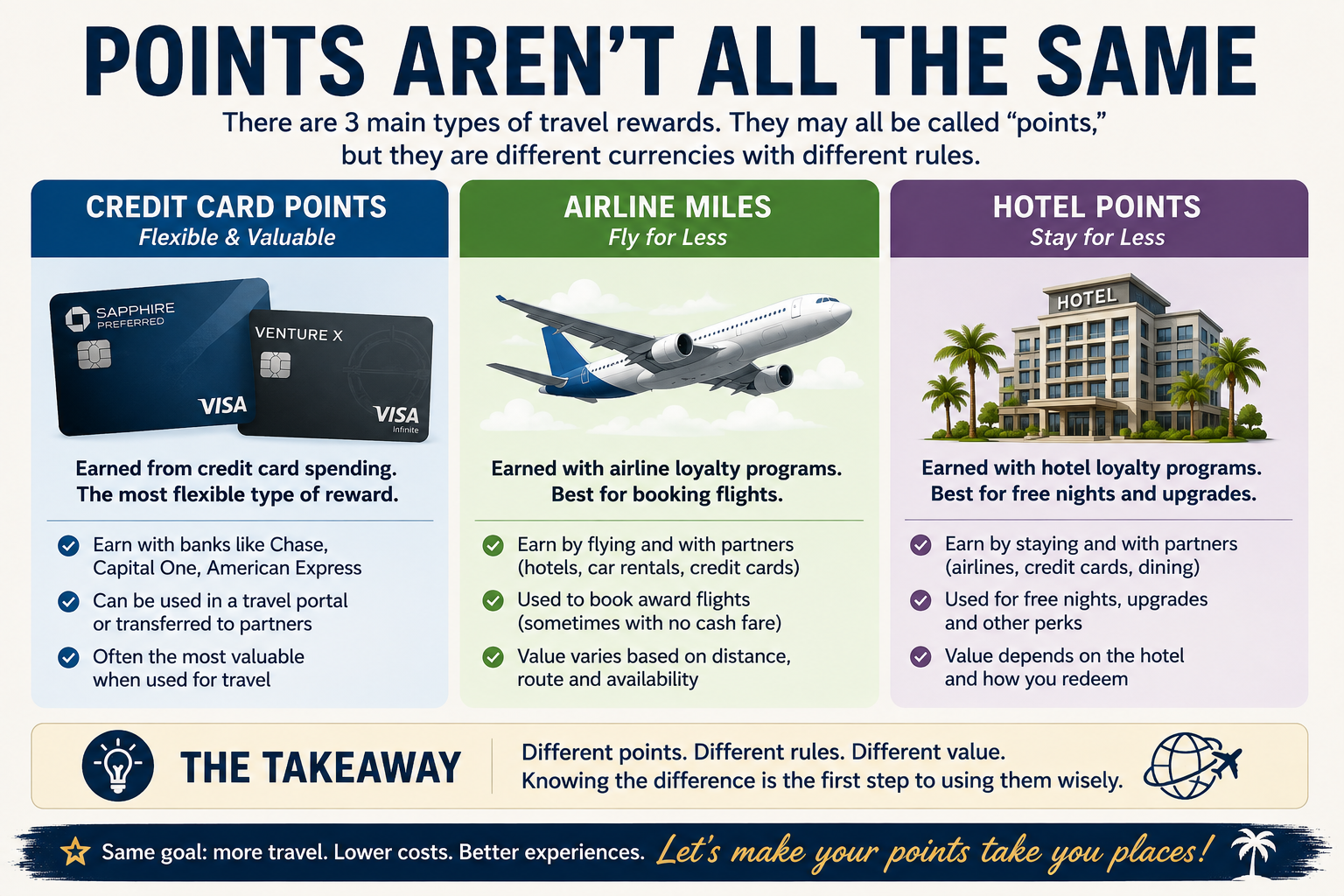
First Things First: Points and Miles Aren't All the Same
This is probably the single most important thing for a beginner to understand.
There isn't one universal currency called "travel points."
You may have points or miles sitting in several completely separate programs, and each program has its own rules.
Credit-Card Points
These are rewards earned through a credit-card program.
Examples include programs such as Chase Ultimate Rewards, Capital One miles and American Express Membership Rewards.
You generally earn them by using an eligible credit card for everyday purchases, travel, dining and other spending.
Depending on the program, those points may be used to book travel through the card issuer's travel portal or transferred to participating airline and hotel loyalty programs.
That flexibility is one reason transferable credit-card points can be so useful.
Airline Miles
Airline miles belong to a specific airline loyalty program.
American Airlines has AAdvantage miles. Delta has SkyMiles. United has MileagePlus miles. Other airlines around the world have their own programs.
Despite the word miles, these generally aren't a literal measurement of how far you can fly.
Having 25,000 airline miles does not mean you can fly 25,000 physical miles.
They're simply that airline program's reward currency.
Hotel Points
Hotel points work much the same way.
You earn points within a hotel loyalty program and can redeem them for hotel stays and, depending on the program, other benefits.
Again, these are their own currency. Having 50,000 hotel points and 50,000 airline miles does not mean they have the same value.
How Do You Earn Points and Miles?
There are plenty of ways, but you don't need to master all of them on Day One.
Welcome Bonus
A welcome bonus, sometimes called a sign-up bonus, is a large number of points or miles offered for opening an eligible credit card and meeting its spending requirements.
For example, a card might offer a bonus after you spend a certain amount during your first few months.
These bonuses can be one of the fastest ways to build a meaningful points balance.
Minimum Spend
The minimum spend is the amount you need to charge to the card within the specified time period to earn that welcome bonus.
Don't spend money you wouldn't otherwise spend just to earn points.
Travel rewards aren't particularly rewarding if you're paying interest on unnecessary purchases.
Earning Rate
The earning rate tells you how many points or miles you receive for your spending.
A card might earn one point per dollar on some purchases and several points per dollar in particular categories.
Bonus Category
A bonus category is a type of spending that earns additional rewards.
Depending on the card, that might include travel, restaurants, groceries, gas or other categories.
This is where having more than one travel card can become useful. Different cards can reward different kinds of spending.
Airline Credit Card or Flexible Travel Card: Which One Actually Gets You Farther?
What Is a Redemption?
A redemption is simply using your points or miles for something.
If you use 25,000 miles for an airline ticket, that's a redemption.
If you use hotel points for a free night, that's a redemption.
If you use credit-card points to pay for a flight through a travel portal, that's also a redemption.
The interesting part isn't whether you can redeem your points.
It's figuring out how you should redeem them.
That's where travel portals and transfer partners enter the picture.
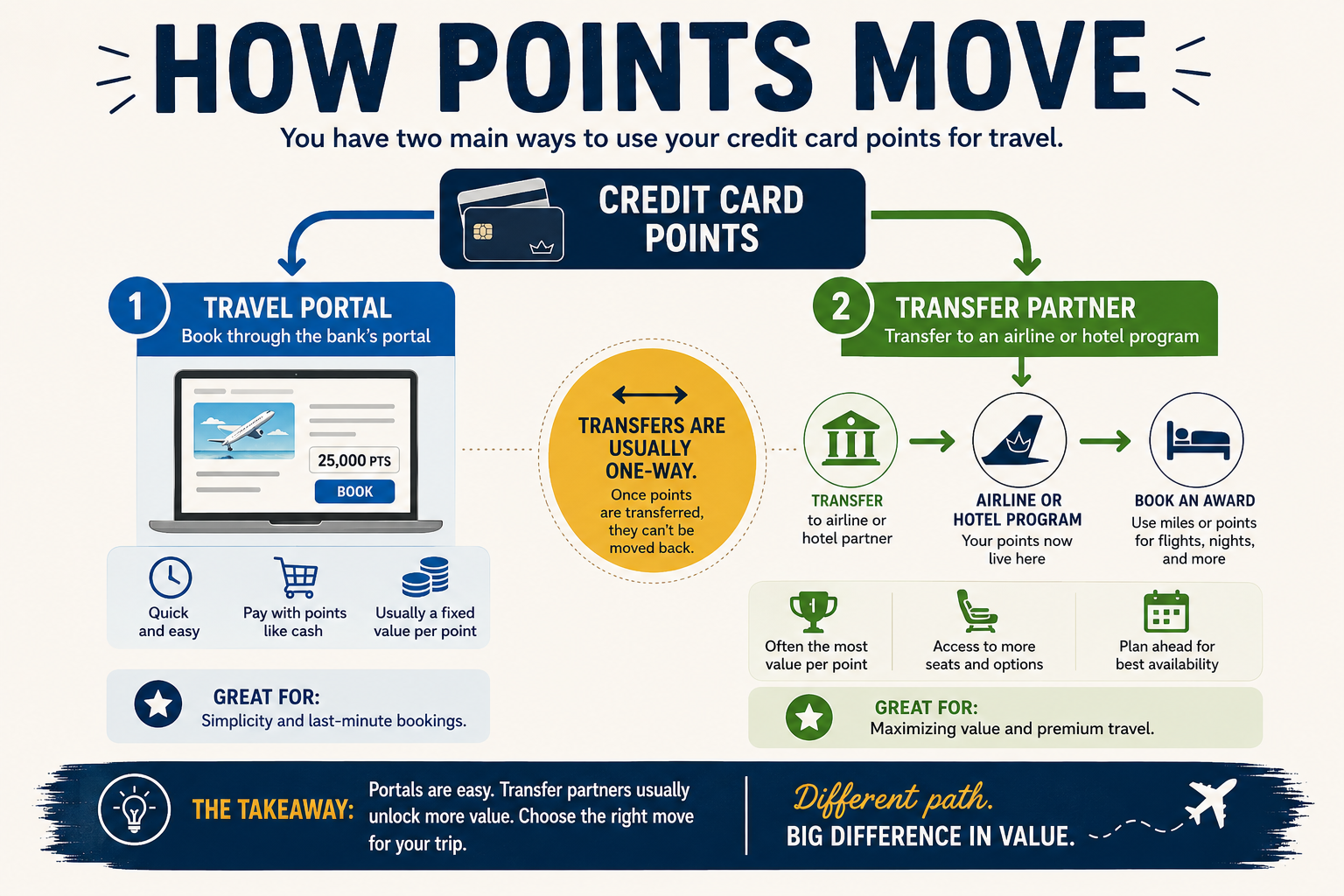
What Is a Travel Portal?
A travel portal is a travel-booking website operated by or for a credit-card rewards program.
It works somewhat like the travel-booking sites you may already be familiar with.
Search for your destination and dates, compare available flights or hotels, and make a reservation.
The difference is that your credit-card rewards may be available as a form of payment.
For a beginner, this can be one of the simplest ways to use points.
You have points.
You find travel.
You use the points toward the purchase.
Done.
But simple doesn't necessarily mean it's always the best value.
What Is a Transfer Partner?
This is where points and miles become considerably more interesting.
Some credit-card reward programs allow you to transfer your points into participating airline or hotel loyalty programs.
Those airlines and hotels are called transfer partners.
Instead of spending your credit-card points through the bank's travel portal, you move them into a loyalty program and then use that program's points or miles to book your travel.
What Does a 1:1 Transfer Mean?
If a program offers a 1:1 transfer, 1,000 credit-card points become 1,000 points or miles in the receiving loyalty program.
But this is important:
1:1 does not mean equal value.
The value you can receive from those 1,000 points depends on how you ultimately use them.
What Is a Transfer Bonus?
Sometimes a credit-card program offers a temporary bonus for transferring points to a particular partner.
For example, instead of 1,000 points becoming 1,000 miles, a promotional transfer bonus might give you more.
That can make an already-useful redemption even better.
But don't transfer points merely because there's a bonus.
One Important Rule
Transfers are generally one-way.
Once you've moved your transferable credit-card points into an airline or hotel program, you usually can't change your mind and move them back.
That's why I don't recommend transferring points until you have found the award you actually want and are ready to book it.
What Is an Award Ticket?
An award ticket is an airline ticket booked using miles or points rather than paying the normal cash fare.
You may still have to pay taxes, government fees and sometimes airline-imposed surcharges.
So when someone says:
"I booked that flight for 40,000 miles."
That doesn't necessarily mean the flight cost absolutely nothing.
It means miles were the primary currency used for the fare.
Award Price
The award price is the number of points or miles required to book the award.
Award Availability or Award Space
This one is important.
Just because an airline has an empty seat for sale doesn't necessarily mean that seat is available to book with miles at the price you're hoping for.
Award availability, often called award space, refers to seats an airline makes available for mileage redemptions.
Availability can vary by flight, date, cabin and loyalty program.
This is one reason finding a great points redemption sometimes requires flexibility.
What Is a Frequent-Flyer Program?
A frequent-flyer program is an airline's loyalty program.
You create an account and can earn miles or points through eligible flights, credit cards and various partners.
Those miles live inside that program until you use them or, depending on the program's rules, they expire.
And here's where things get more interesting:
You aren't necessarily limited to flying the airline whose miles you have.
Enter airline partnerships.
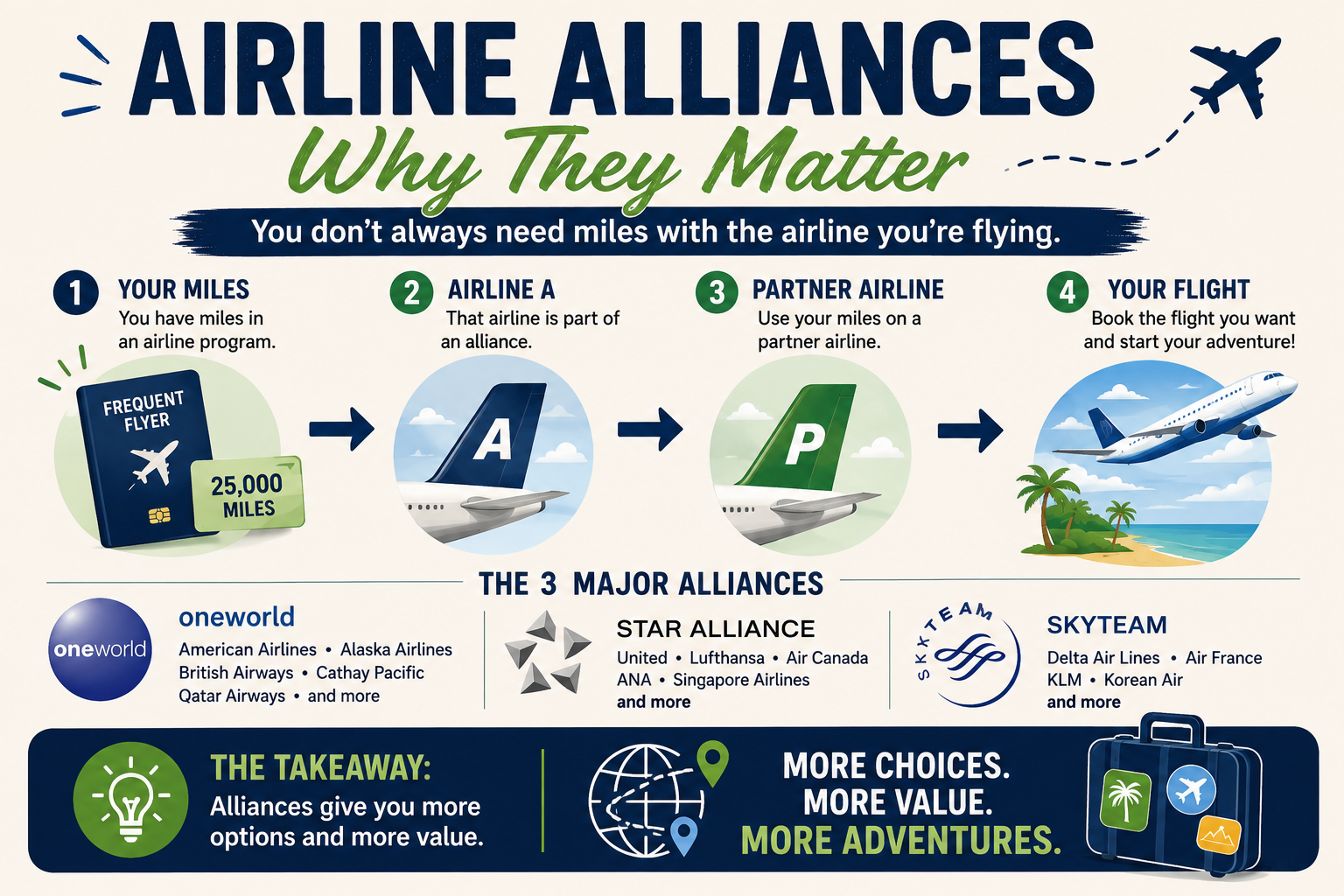
What Is an Airline Alliance?
Airlines don't all operate independently.
Many belong to large groups called airline alliances.
The three major global alliances are:
oneworld
Members include airlines such as American Airlines, Alaska Airlines, British Airways, Qatar Airways and Cathay Pacific.
Star Alliance
Members include airlines such as United Airlines, Air Canada, Lufthansa, ANA and Singapore Airlines.
SkyTeam
Members include airlines such as Delta Air Lines, Air France, KLM and Korean Air.
Why should you care?
Because airline partnerships can sometimes allow you to use miles from one loyalty program to book a flight operated by another airline.
That single idea opens an enormous number of possibilities.
What Is a Partner Airline?
A partner airline is another airline with which an airline or loyalty program has a relationship.
Alliance members are partners, but airlines can also form partnerships outside their formal alliances.
That means the list of airlines you can potentially book with a particular type of mileage can extend beyond the airline printed on the account.
This is one of the concepts that can make points and miles enormously powerful.
It's also one of the concepts that makes beginners wonder why this couldn't all just be simpler.
Fair question.
Operating Carrier vs. Marketing Carrier
You may eventually see two airline names associated with the same flight.
The operating carrier is the airline actually flying the airplane.
The marketing carrier is the airline whose flight number is being sold.
For example, you might purchase a ticket carrying one airline's flight number while another partner airline actually operates the aircraft.
This arrangement is commonly called a codeshare.
For Points 101, you don't need to become an expert in codeshares.
Just understand that the airline selling your ticket isn't necessarily the airline whose airplane you'll board.
Dynamic Award Pricing
Once upon a time, many airline programs relied heavily on award charts that told you approximately how many miles a particular trip would cost.
Today, many programs use some form of dynamic award pricing.
That means the number of miles required can change depending on things such as demand, travel date, route or cash price.
A flight might cost one amount in miles today and a very different amount another day.
Award Chart
An award chart is a published table showing how many miles a program requires for certain awards.
Some programs still use charts extensively. Others have moved toward dynamic pricing or a combination of approaches.
Saver Award
A saver award generally refers to award space available at a lower mileage level.
You'll encounter this term frequently as you get deeper into award travel.
Sweet Spot
A sweet spot is an especially valuable way to redeem points or miles within a loyalty program.
Maybe one program charges significantly fewer miles than another for a particular route or cabin.
That's a sweet spot.
You don't need to chase every one of them.
What Is Cents Per Point?
You'll see this abbreviated CPP throughout the points-and-miles world.
It's simply a way to estimate how much value you received from your points.
If a $500 flight costs 25,000 points, you're getting roughly 2 cents of value per point before accounting for any taxes or fees you still have to pay.
It's useful for comparing redemption options.
But I don't treat CPP like a high score at an arcade.
The theoretical maximum value of your points isn't always the most important thing.
If your points help you take the trip you want, at a price you're comfortable with, and perhaps give you an experience you wouldn't otherwise purchase, that has value too.
Points are a travel tool.
They're not a collectible.
A Few More Terms You'll Eventually Encounter
Cash + Points
A booking that combines rewards with a cash payment.
Taxes and Fees
Award tickets aren't necessarily completely free. Government taxes, airport fees and sometimes airline-imposed charges can still apply.
Carrier-Imposed Surcharge
An additional fee charged by some airlines on certain award tickets. These can sometimes turn an attractive mileage price into a considerably less attractive redemption.
Open Jaw
An itinerary where you fly into one city and return from another.
For example:
Fly into London → travel through the UK → fly home from Edinburgh.
Stopover
A longer planned stop in an intermediate destination before continuing to your final destination. Different loyalty programs have different rules regarding stopovers on award tickets.
Positioning Flight
A separate flight used to get you to the airport where your primary award trip begins.
Someone might find an excellent international award departing New York, for example, and separately book a flight from their hometown to New York.
Devaluation
When a loyalty program changes its rules or pricing so that your points or miles effectively buy less than they did before.
It's one reason I generally prefer earning points with a purpose rather than accumulating them indefinitely.
You Don't Have to Learn Everything at Once
If this was your first introduction to points and miles, you just encountered a lot of terminology.
Don't worry about memorizing it.
The important concepts are actually pretty simple:
Points and miles are different currencies.
Credit-card points can sometimes be transferred to airline and hotel programs.
Airline partnerships can give you more ways to use your miles.
Award availability determines whether the redemption you want is actually bookable.
And:
Having points doesn't automatically mean using them is the best deal.
That's the next part.
Now Let's Actually Use Them
Once you understand the language, the practical question becomes:
Should I book through my credit-card travel portal, transfer my points to an airline or hotel, or simply pay cash and save the points?
That's where the numbers, availability and your own travel priorities come together.
Portal vs. Transfer Partner: Which Should You Use?
See How We've Used Points in the Real World
Points and miles make considerably more sense when you see actual bookings instead of hypothetical ones.
Booking Scotland With Points
See how I compared the actual cash fare with the American Airlines award price and decided how to book our Scotland trip.
Booking Scotland With Points: My Step-by-Step Process
Australia
See another real-world example of how points and miles helped shape one of our international trips.