


Do You Really Need a Rental Car?
When walking, public transit, rideshare or a conventional taxi may be the smarter ground-transportation choice.
A rental car can be an essential travel tool.
It can provide the freedom to explore rural areas, reach places with limited public transportation and change plans without waiting for someone else to provide a ride.
But that does not mean every trip requires one.
I frequently see travelers book a rental car almost automatically. They reserve their flights, choose a hotel and then add a car before examining where anything is located.
They may be visiting for only two or three nights. Their hotel may be close to the airport, inside a walkable district or surrounded by dependable public transportation. The vehicle spends most of the trip sitting in a paid parking garage.
At that point, the rental car is not providing freedom. It is adding expense and another set of logistics.
Before reserving one, apply the MAP FIRST, BOOK SECOND philosophy to the entire itinerary.
Where are you staying? What do you plan to do? How far apart are those places? How many times would you actually use a car?
The answer depends on both the destination and the trip you are planning.

Start with the destination
Some destinations naturally favor rental cars. Others make them expensive and inconvenient.
A car may be unnecessary when:
The stay is short
The hotel is close to the airport
Most planned activities are concentrated in one district
The area is genuinely walkable
Public transportation connects the places you want to visit
Rideshare and taxi services are readily available
The hotel or nearby attractions charge substantial parking fees
A compact downtown stay is different from a week exploring the countryside. A resort weekend is different from a road trip. Two nights near an airport are different from several days visiting small towns.
Even within the same destination, two travelers can reach different conclusions.
Someone spending a week using Las Vegas as a base for regional day trips may benefit from a rental car. Someone flying in for one concert and staying beside the venue may not.
The destination matters, but the itinerary makes the decision.
What are Uber and Lyft?
Uber and Lyft are app-based transportation services commonly described as rideshare companies.
You create an account, enter your destination and choose from the available ride types. The app generally displays an estimated upfront price before you request the ride. Once a driver accepts, the app provides information about the driver and vehicle and allows you to follow the trip’s progress.
Payment is handled through the app, and a tip can normally be added afterward.
Uber explains its ride-request process here, while Lyft provides information about riding with Lyft here. Uber says its app displays an estimated upfront price before the request, while Lyft says its pricing can reflect the route, ride type, driver availability and demand.
That last part is important: rideshare prices are not fixed.
A ride that costs $20 at one time may cost considerably more during a major event, bad weather or a period of high demand. Availability can also be limited in rural areas, small towns and during early-morning or late-night hours.
Rideshare can be convenient, but it should be evaluated—not assumed.
Don’t overlook conventional taxis
Uber and Lyft are not the only alternatives to renting a car.
A conventional taxi may be easier at an airport, particularly when taxis are waiting directly outside baggage claim while rideshare passengers must walk to a designated pickup area.
At Harry Reid International Airport in Las Vegas, taxis are available outside baggage claim. Uber and Lyft pickups occur in designated areas inside the parking garages.
Depending on the airport and time of day, that difference may make the taxi faster or more convenient.
A taxi may also be useful when:
You do not want to establish a rideshare account
Cellular service is unreliable
The taxi line is shorter than the rideshare wait
The destination uses regulated or flat taxi fares
Surge pricing makes rideshare unusually expensive
You prefer to speak directly with a dispatcher or driver
You have luggage or mobility needs that are easier to address in person
Before leaving the terminal, compare the options available at that specific airport. The best choice might be Uber, Lyft, a taxi, public transportation or a prearranged shuttle.
The goal is not to pledge loyalty to one type of transportation. It is to select the one that works best at that moment.
Our two-night Las Vegas test
In February 2026, Gina and I flew to Las Vegas for a very short trip built around one priority: seeing Def Leppard at the Colosseum at Caesars Palace on Saturday night.
We arrived late Friday and used Uber to reach our first hotel. On Saturday, we moved to Caesars Palace, where we would be staying after the concert.
Because the show was at our hotel, we did not need transportation to the venue or have to worry about getting back afterward.
Our original plan for Saturday was simple. We would spend the day sightseeing along the Strip, stop for something to eat and return to Caesars Palace with plenty of time to prepare for the concert.
That plan did not require a rental car.
We could walk as long as we were comfortable, stop whenever something interested us and take an Uber or taxi back to Caesars when we were tired.
We had only one full day, and our evening plans were fixed. There was a practical limit to how far we could comfortably roam before it was time to return to the hotel.
A rental car would not have created more time.

Def Leppard at Caesars Palace was the reason for our two-night Las Vegas trip.

The upgrade we couldn’t book
When we planned the trip, we did not know whether my son would be available Saturday.
Then he was able to get the day off.
He picked us up at the hotel, took us to Hoover Dam and joined us for Korean barbecue before bringing us back to Caesars Palace.
Suddenly, our free day became something much better than we had originally planned.
My son was the upgrade.
Yes, having him with us provided transportation and expanded how far we could comfortably explore. But that was not what made the day valuable.
The real upgrade was getting unexpected time together.
Had he not been available, we still would not have rented a car. We would have followed our original plan and enjoyed the Strip on foot, using a taxi or rideshare whenever walking no longer made sense.


The best upgrade of the weekend wasn’t a rental car. It was having our son spend the day with us.
What the rental car would have cost
When I planned the trip, the lowest-priced rental car I found was $125.79, including taxes and fees, for pickup Friday night and return Sunday morning.
This was not an upgraded vehicle. It was simply the least-expensive available option.
Both hotels charged $25 per night for parking during our stay. Keeping the rental car for the weekend would therefore have cost:
Rental car with taxes and fees: $125.79
Parking at the first hotel: $25
Parking at Caesars Palace: $25
Rental and parking combined: $175.79
Fuel: additional
That amount still would not include the time required to collect and return the car.
Harry Reid International Airport serves rental-car customers through a separate Rent-A-Car Center reached by complimentary shuttle buses from the terminals. Current airport rental-car instructions are available here.
Parking rates change, so travelers should always check their hotel’s current policy. Caesars Entertainment publishes its current parking information here. Our graphics and calculations use the $25-per-night amount charged during our February 2026 trip.

What we actually spent
We used Uber twice:
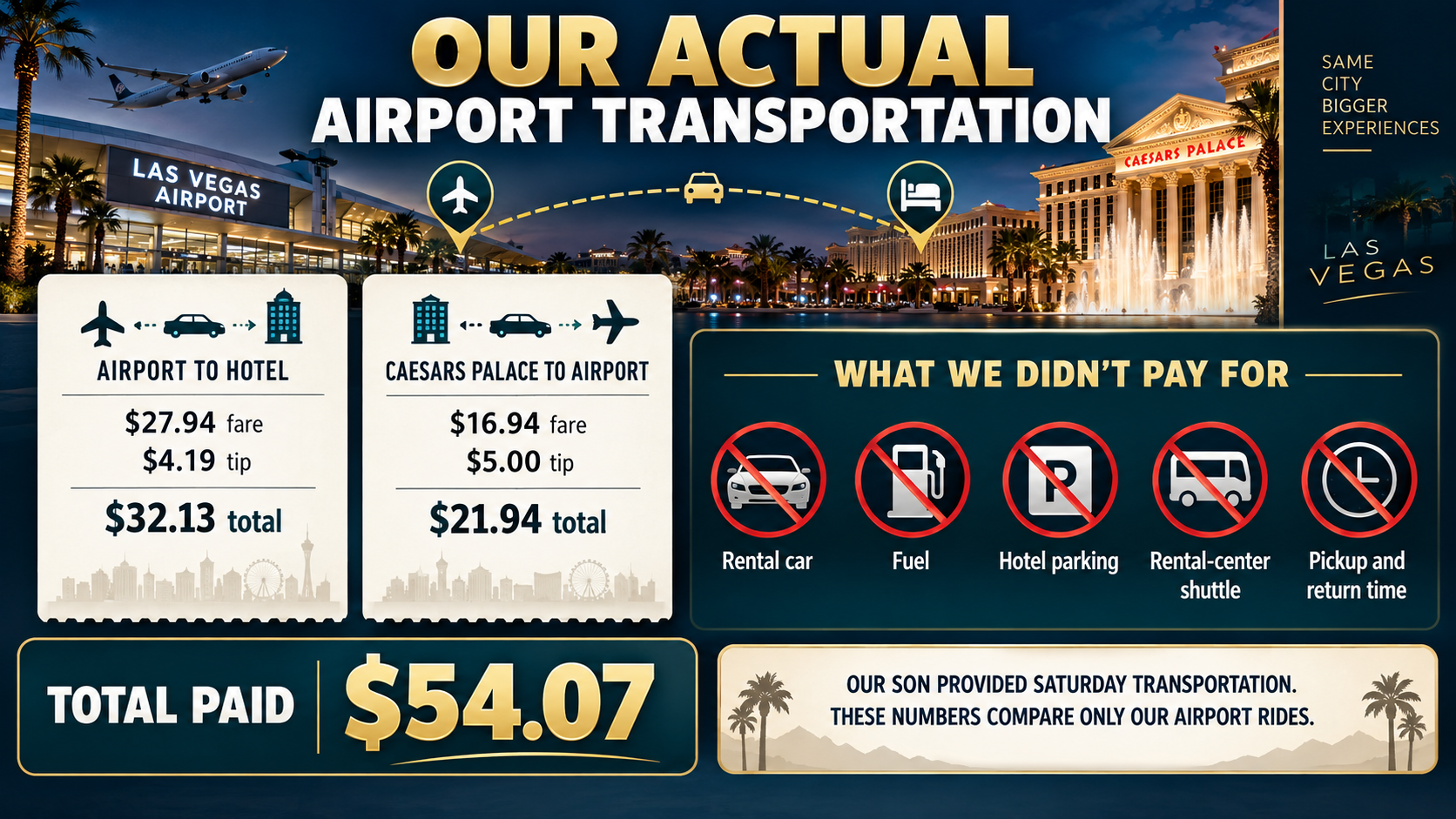
Airport to the first hotel: $27.94 fare plus $4.19 tip
Caesars Palace to the airport: $16.94 fare plus $5 tip
Total paid: $54.07
Compared with the $175.79 rental-and-parking option, we spent $121.72 less, before accounting for fuel.
That comparison needs an important qualification: my son provided our Saturday transportation.
I am not claiming that $54.07 in Uber rides covered every mile we traveled. It covered our airport transportation. Our son’s availability allowed us to add Hoover Dam and Korean barbecue to the day.
But we planned the trip without a rental car before we knew he could join us. Without him, we would have remained around the Strip and used an occasional taxi or rideshare if necessary.
The rental car was never essential to the original itinerary.
The ride back to the airport became part of the story
Our return Uber also provided a small reminder that transportation can add something to a trip without becoming its focus.
The driver asked what had brought us to Las Vegas. When we told him we had flown in to see Def Leppard, he put Def Leppard on his playlist for the drive to the airport.
It was a simple gesture, but it made a memorable ending to the weekend.
Instead of navigating a garage, buying fuel, returning a rental car and boarding the airport shuttle, we listened to Def Leppard and talked about the concert.
Sometimes the best transportation choice is the one that removes a task from the final morning.
Car-free does not mean walking everywhere
Choosing not to rent a car does not commit you to walking every mile.
Walkability depends on:
The traveler’s mobility and endurance
Weather and temperature
Sidewalks and pedestrian crossings
The apparent versus actual distance between properties
Luggage, shopping bags or equipment
The time available
How comfortable the route feels after dark
Las Vegas is a good example. Resorts that appear close together on a map can be enormous, and extreme heat can turn a reasonable-looking walk into an uncomfortable one.
Our plan was not to prove we could walk everywhere.
We could walk while it was comfortable and interesting, then call an Uber, Lyft or taxi when we were ready to return. That still would have cost far less than renting and parking a car for the entire weekend.
The question is not whether you can eliminate every vehicle ride. It is whether you need exclusive use of one vehicle throughout the trip.
Consider a hybrid strategy
The decision does not have to be rental car versus no rental car for the entire vacation.
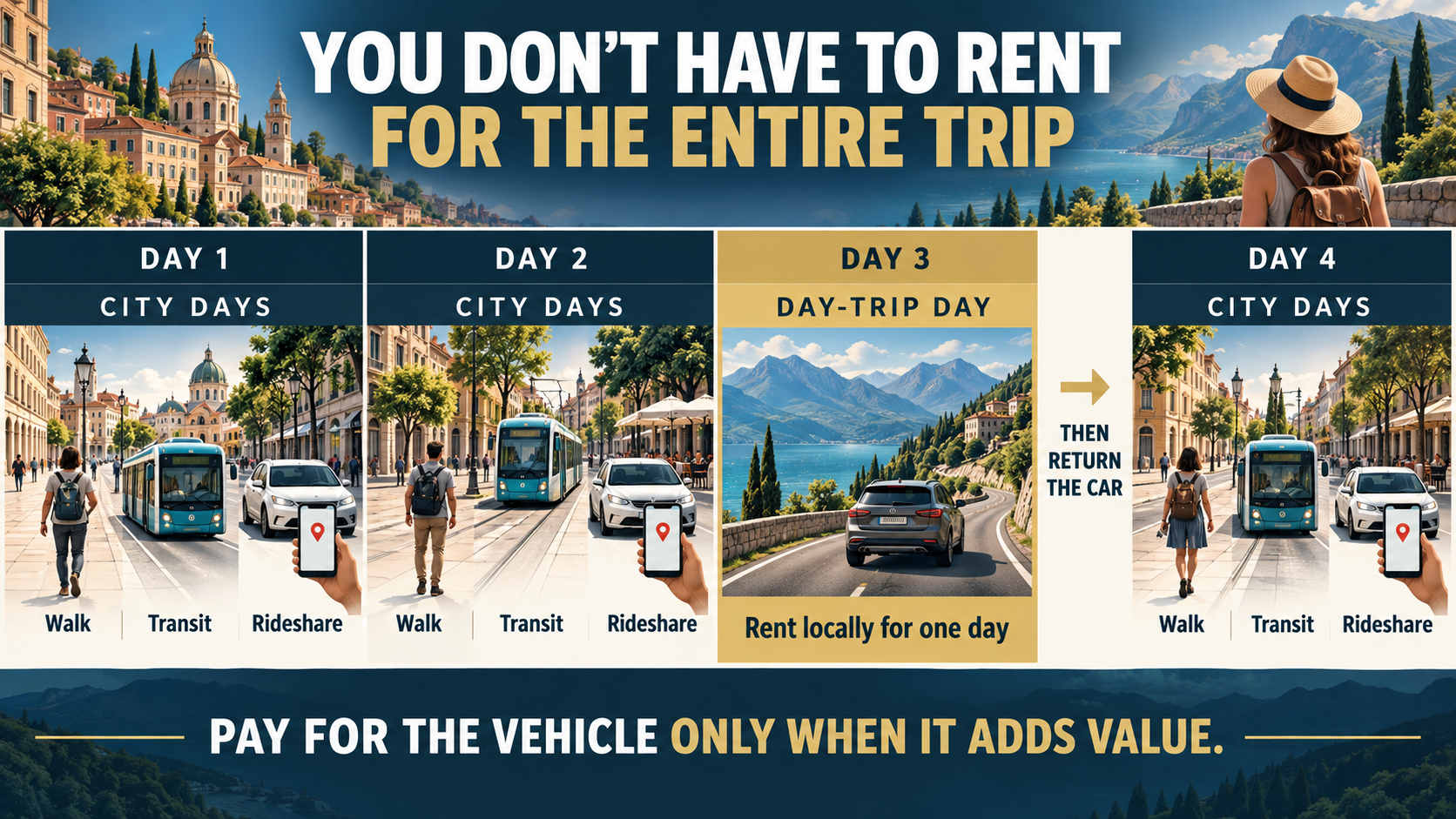
Suppose you are spending four days in a city with good public transportation but want to take one trip outside the transit network.
You could:
Walk, use transit or take rideshares during the city portion
Rent a car from a neighborhood location for one day
Complete the excursion
Return the car that evening
Avoid paying several days of rental and parking expenses
Before choosing this approach, compare the neighborhood rental location’s hours, price and transportation required to reach it. An airport rental is not automatically the only available option.
Pay for the vehicle on the day it adds value—not while it sits in a garage.
When the rental car is still the right choice
This is not an argument against renting cars.
A rental car remains the smarter choice when:
The trip covers a large geographic area
Public transportation is limited
Rideshare availability is uncertain
The itinerary includes rural or remote destinations
You expect to make numerous stops
A family or larger group would require several rideshare vehicles
You need to transport substantial luggage or equipment
Mobility needs make door-to-door independence important
Child-seat requirements make repeated rides complicated
The complete rental cost is lower than the realistic alternatives
The freedom to change plans has meaningful value
For our upcoming Scotland trip, for example, the rental car is central to the experience. We are moving between cities, villages, rural guesthouses and scenic destinations over more than two weeks. We are also intentionally returning it once we arrive in Edinburgh and exploring that city utilizing local trams and busses.
That is entirely different from flying to Las Vegas for two nights and staying at the concert venue.
The same traveler can correctly rent a car for one trip and confidently skip it for another.
Run the rental-car test
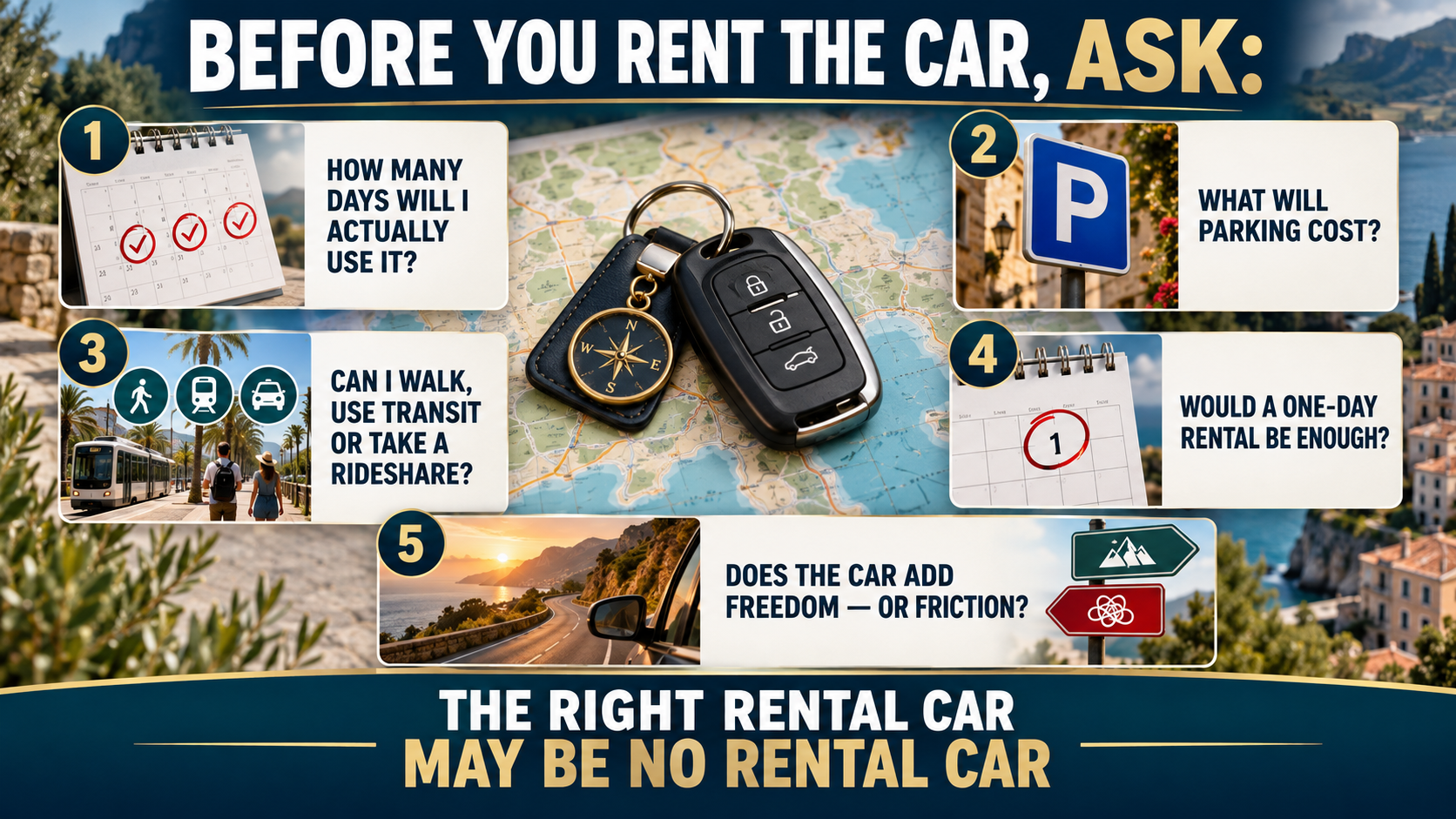
Before adding a rental car to your reservation, ask:
How many days will I actually use it?
What will parking cost?
Can I walk, use public transit or take a rideshare or taxi?
Would a one-day rental be enough?
Does the car add freedom—or friction?
Those questions take only a few minutes to answer.
They can prevent you from paying for a vehicle that spends most of the vacation waiting for you.
My Curated Verdict
🟢 GO FOR IT WITHOUT A RENTAL CAR
When the trip is short, the hotel is centrally located and walking, public transportation, taxis or rideshare can comfortably cover the itinerary.
🟡 EVALUATE A HYBRID PLAN
When most of the trip is concentrated in one area but you have one excursion beyond the transit or rideshare network. A one-day rental may provide the flexibility you need without several days of parking costs.
🔴 DON’T SKIP THE RENTAL CAR
When the itinerary is spread out, transportation alternatives are unreliable or the vehicle provides essential independence, accessibility or access to remote destinations.
For our Las Vegas concert weekend, leaving the rental car behind saved us at least $121.72 before fuel and removed several logistical steps.
But the best part of the transportation plan had nothing to do with that savings.
We planned a perfectly enjoyable Saturday without a car. Then my son got the day off and gave us something no reservation could guarantee: an unexpected day together.
The cheapest upgrade was skipping the rental car.
The biggest upgrade was my son.