


Downgraded on a European or UK Flight: What Are You Owed?
The seat may be worse. The refund rules may actually be better.
You bought Business Class.
Maybe you paid for Premium Economy.
Then somewhere between booking the trip and boarding the airplane, the airline decides you're flying in a cheaper cabin.
If this happened in the United States, figuring out exactly what you're owed can get a little murky.
Europe took a different approach.
How about percentages?
And they're percentages worth remembering:
30%.
50%.
75%.
Depending on the flight, an involuntary downgrade covered by European or UK passenger-protection rules can entitle you to reimbursement of a substantial portion of the price of that flight.
That makes this considerably easier to explain than the U.S. version.
Mostly.
Because this is airline travel. We weren't getting out of here without at least a couple of “it depends.”
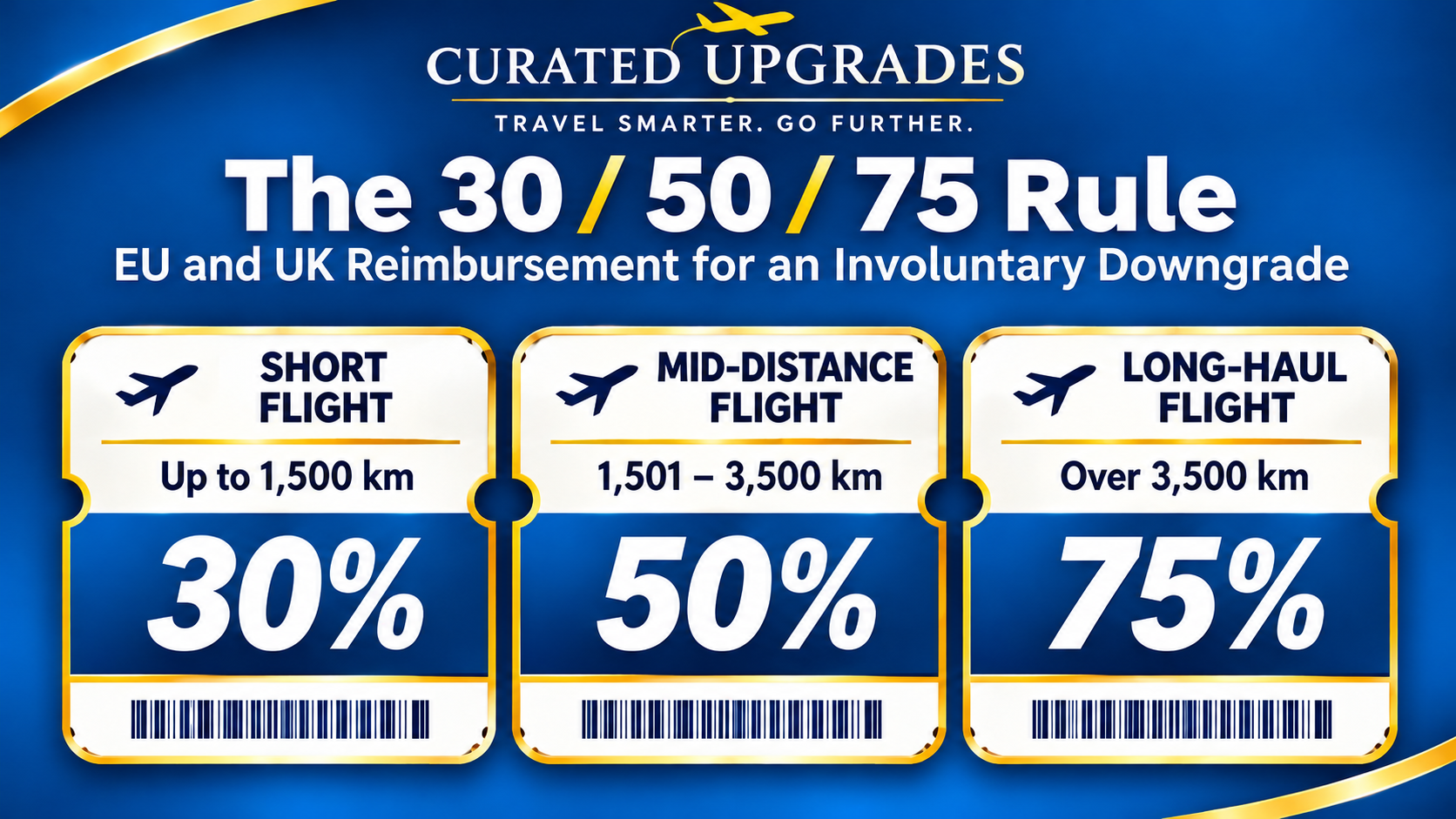
The 30 / 50 / 75 Rule
Under current EU passenger-rights rules, if an airline places you in a lower cabin than the one you purchased, the reimbursement generally works like this:
30% of the relevant flight price for flights of 1,500 kilometers or less.
50% for intra-EU flights over 1,500 kilometers and other qualifying flights between 1,500 and 3,500 kilometers.
75% for qualifying flights beyond 3,500 kilometers.
The UK retained essentially the same structure. The UK Civil Aviation Authority also explains downgrade reimbursement using the 30%, 50% and 75% framework.
So if you've been involuntarily moved from Business Class to Economy on a covered long-haul flight, that 75% number suddenly becomes very interesting.
And unlike the U.S. system, you're not starting with:
What did Economy cost when I bought the ticket?
What does Economy cost today?
What fare bucket was I in?
The European system gives you a percentage.
That's the good part.
Now for the fine print.
Seventy-Five Percent of What?
This is where people can understandably see 75% and start doing some very optimistic arithmetic.
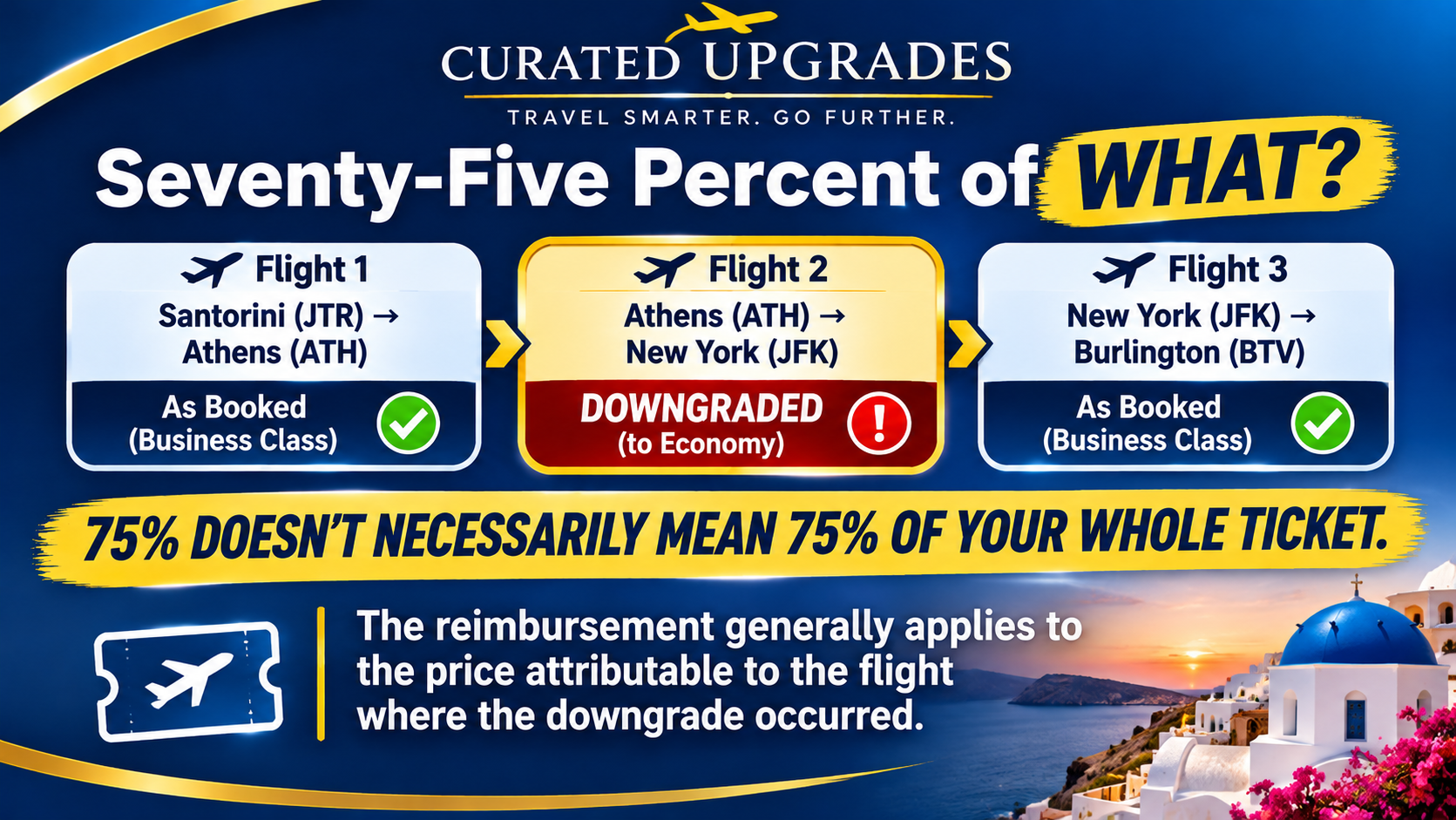
Suppose you're returning from a trip to Greece.
You fly from Santorini to Athens, connect to a nonstop flight from Athens to New York and then continue to Burlington.
Everything goes exactly as booked except Athens to New York.
You paid for Business Class.
The airline puts you in Economy.
That long-haul downgrade may fall into the 75% category.
But that doesn't necessarily mean you're getting 75% of the price of the entire Santorini-to-Burlington ticket back.
The reimbursement generally applies to the price attributable to the flight on which you were downgraded.
The Court of Justice of the European Union has addressed this issue on multi-flight tickets. When only one flight is downgraded, the reimbursement is tied to the price of that affected flight. When the ticket doesn't separately identify that price, an allocation may have to be made.
Fortunately, you don't need to stand at the gate doing international fare-construction mathematics.
The important thing to remember is much simpler:
The percentage can be substantial, but don't automatically apply it to the price of your entire trip.
Does This Apply to Every Flight in Europe?
No.
And this is probably the one part of the article where we have to tolerate a little airline-law geography.
EU passenger protections generally cover flights within the EU, flights departing the EU, and certain flights arriving in the EU when operated by an EU airline.
The official Your Europe passenger-rights guide provides the current coverage rules and is worth checking when you're unsure whether a particular itinerary qualifies.
The UK has its own coverage rules following Brexit, so simply seeing London somewhere on your itinerary doesn't magically place every flight under UK passenger law either.
Where the flight starts, where it ends and which airline operates it can matter.
You don't have to memorize the entire coverage map before your vacation.
If you're downgraded, check whether your flight falls under EU or UK passenger-rights rules before accepting whatever explanation or reimbursement the airline initially offers.
What Actually Counts as a Downgrade?
This part is refreshingly sensible.
You bought Business Class.
The airline puts you in Economy.
That's a downgrade.
You bought Premium Economy.
The airline puts you in Economy.
That's a downgrade.
But suppose you remain in Business Class and lose the exact seat you selected.
Or an amenity you expected isn't available.
That's frustrating, but it isn't necessarily the kind of cabin downgrade covered by these rules.
European Commission guidance distinguishes an actual move to a lower class from situations where a passenger remains in the same class but receives different amenities or seating arrangements.
The important question is:
Did the airline actually move you into a lower class of service than the one you purchased?
That's what we're talking about here.
What If I Take the Lower Cabin?
You don't necessarily have to abandon your trip to protect your downgrade reimbursement.
If the airline transports you in the lower cabin, the European downgrade rules address reimbursement for the class difference.
That means the practical decision may look a lot like the one we discussed in Downgraded From First, Business, or Premium Economy: What Are You Owed in the U.S.?
Business Class tomorrow or Economy today?
Sometimes getting where you're going matters more than preserving the premium seat.
Take the flight if that's the choice that works for your trip.
Then pursue the reimbursement you're entitled to.
Keep This Simple at the Airport
You don't need to debate European aviation law with the gate agent.
Keep the reservation showing the cabin you purchased.
Keep the replacement boarding pass showing the cabin you actually flew.
Keep any email, text or app notification explaining the change.
Then ask the airline how it will process the downgrade reimbursement.
That's enough to get started.
If the amount eventually offered doesn't make sense, that's when the 30 / 50 / 75 rule becomes particularly useful.
You have something concrete to compare it against.
One Important EU Change Is Coming
European passenger-rights rules are changing.
EU Regulation 2026/2202 was adopted in 2026 and includes new provisions affecting downgrade reimbursement, including automatic reimbursement within 14 calendar days.
But there's an important date attached to those changes:
They don't apply until October 23, 2027.
So if you're reading this before then, don't claim a right that hasn't taken effect yet.
For now, we're dealing with the rules currently in force.
We'll update this article when the new provisions become applicable.
Flying Somewhere Else?
Different part of the world, different answer.
For U.S. flights, see Downgraded From First, Business, or Premium Economy: What Are You Owed in the U.S.?
The U.S. system doesn't use the European 30 / 50 / 75 reimbursement structure, which is exactly why we separated these articles.
And Asia is different again.
There isn't one continent-wide Asian passenger-rights system that gives us a simple percentage chart.
See Downgraded on an Asian Airline: What Are You Owed?
That one gets interesting because the individual airline can matter as much as the route.
The Curated Verdict
🟢 KNOW THE 30 / 50 / 75 RULE
If your covered flight is involuntarily downgraded, European and UK passenger protections can provide substantial percentage-based reimbursement.
🟡 MAKE SURE THE RULES COVER YOUR FLIGHT
A European destination alone doesn't automatically mean EU or UK passenger protections apply. The route and operating airline can matter.
🔴 DON'T ASSUME 75% MEANS 75% OF YOUR ENTIRE TRIP
The reimbursement generally applies to the price attributable to the flight on which the downgrade occurred.
The Bottom Line
Getting moved from the cabin you paid for still stinks.
But if it happens on a flight covered by European or UK passenger protections, at least the reimbursement rules give you something unusually useful in airline travel:
actual numbers.
Remember 30 / 50 / 75.
Then get where you're going and deal with the airline afterward.
Passenger-rights regulations and airline policies can change. This article provides general travel information, not legal advice. Information current as of November 2026.