

EES, ETIAS & UK ETA: What Americans Traveling to Europe Need to Know
Europe has changed how visitors cross its borders, while the United Kingdom operates a completely separate system. Here's what's already in effect, what's still coming and what you actually need before your trip.
Spend much time in international travel groups and three acronyms keep appearing:
EES. ETIAS. ETA.
Depending on which post you read, Americans supposedly need to register for all three, Europe has stopped stamping passports, everyone needs a new visa, or somebody's cousin has already purchased an ETIAS online.
Some of that is true.
Some of it is outdated.
And some of it is simply wrong.
The good news is that the actual system is much easier to understand once you separate three things that frequently get lumped together.
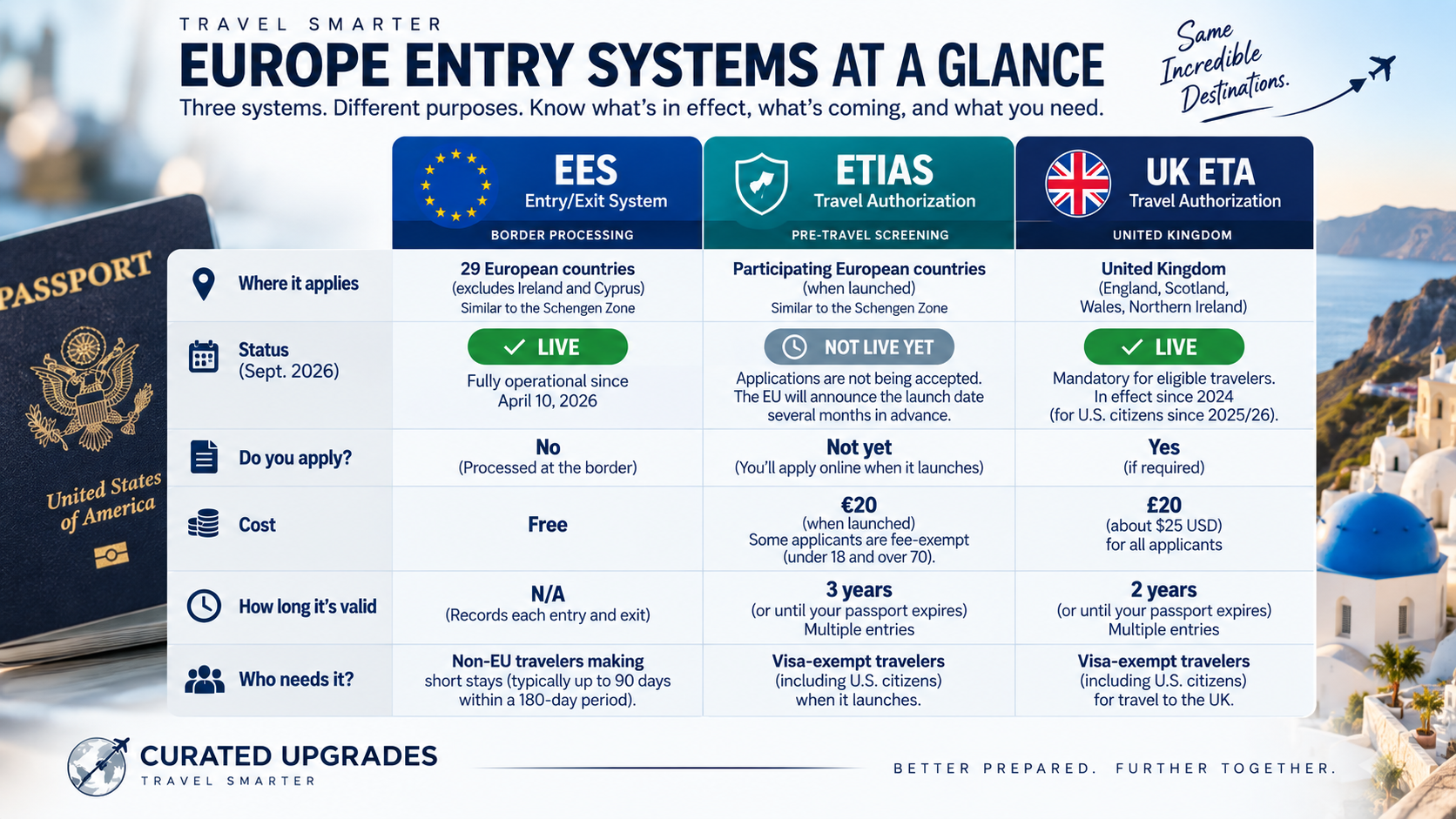
EES is a border-processing system.
ETIAS will be a pre-travel authorization for participating European countries, but it isn't operating yet.
The UK ETA is Britain's separate travel authorization, and it is already operating.
If you're an American planning a European trip, here's what you need to know.
CURRENT AS OF SEPTEMBER 2026
EES is fully operational. UK ETA is in effect for eligible U.S. travelers. ETIAS is not yet accepting applications. The EU currently says ETIAS is expected to begin operations in the last quarter of 2026, with the specific launch date to be announced in advance
Official ETIAS information:
https://travel-europe.europa.eu/etias
Three Systems, Three Different Jobs
The easiest mistake is assuming EES, ETIAS and UK ETA are competing versions of the same thing.
They aren't.
Think of them as different checkpoints in the travel process.
EES happens at the border.
ETIAS will happen before you travel.
UK ETA also happens before travel, but only for the United Kingdom.
That distinction clears up most of the alphabet soup.
EES: Europe's New Entry/Exit System
The Entry/Exit System, or EES, is already here.
Europe progressively introduced EES beginning October 12, 2025, and it became fully operational on April 10, 2026. It digitally records covered non-EU travelers entering and leaving 29 participating European countries for short stays.
You don't fill out an EES application before your vacation.
You don't purchase an EES authorization.
And there is no EES fee.
Instead, the system records information when you cross an external border of a participating country. That can include your travel-document information, facial image and fingerprints.
For most covered travelers, EES replaces the old routine of relying on passport stamps to record entries and exits.
For current requirements and official information, use the EU Travel to Europe EES portal:
https://travel-europe.europa.eu/ees
Ireland and Cyprus Are Different
Here's one of those European-border details worth knowing before it becomes a trivia question at passport control.
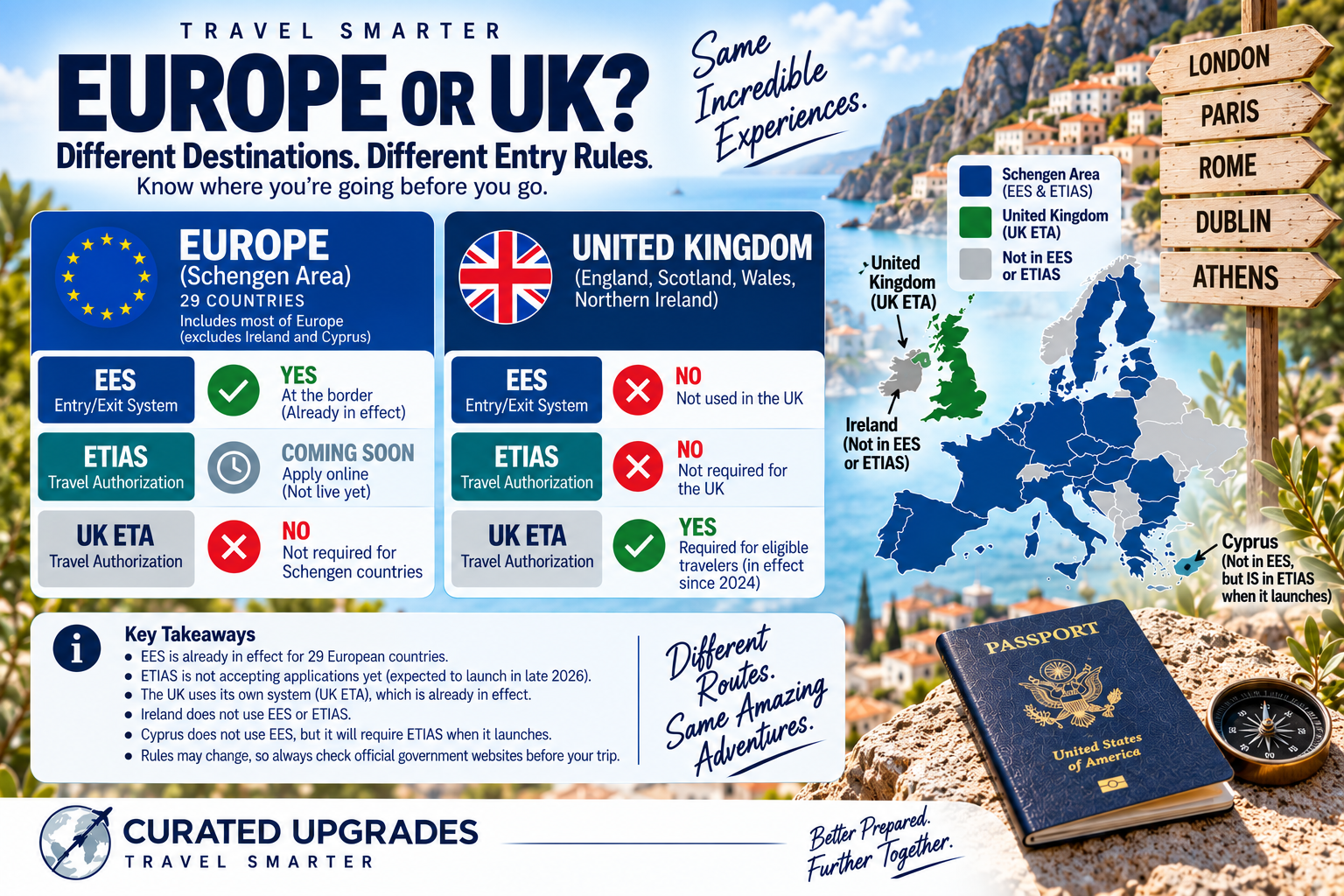
Ireland and Cyprus do not use EES.
Both continue to stamp passports manually for these crossings.
But don't put Ireland and Cyprus into the same bucket for everything.
When ETIAS begins, Cyprus is included among the countries requiring ETIAS, while Ireland is not.
That's a perfect example of why “Europe,” “EU” and “Schengen” shouldn't automatically be treated as interchangeable terms when you're dealing with border rules.
ETIAS: Coming, But Not Here Yet
This is probably the biggest source of current confusion.
The European Travel Information and Authorisation System, or ETIAS, will eventually require eligible visa-exempt travelers, including Americans, to obtain electronic travel authorization before visiting participating European countries for a short stay.
But as of September 2026:
You cannot apply for ETIAS.
The official EU site says ETIAS is not operating and applications are not being collected. The EU currently expects it to begin in the last quarter of 2026 and says the specific launch date will be announced in advance.
So if you're reading this today and somebody offers to obtain your ETIAS for an upcoming trip...
Close the tab.
When ETIAS launches, the application fee is currently set at €20, with certain applicants exempt from the fee. The authorization will generally be valid for three years or until the associated passport expires, whichever happens first.
And an important terminology point:
ETIAS is not a visa.
It's a travel authorization for eligible travelers who are otherwise visa-exempt.
For current status and, eventually, the official application process, use the EU ETIAS portal:
https://travel-europe.europa.eu/etias
The Simplest Way to Remember EES vs. ETIAS
If the acronyms still want to fight for space in your head, remember this:
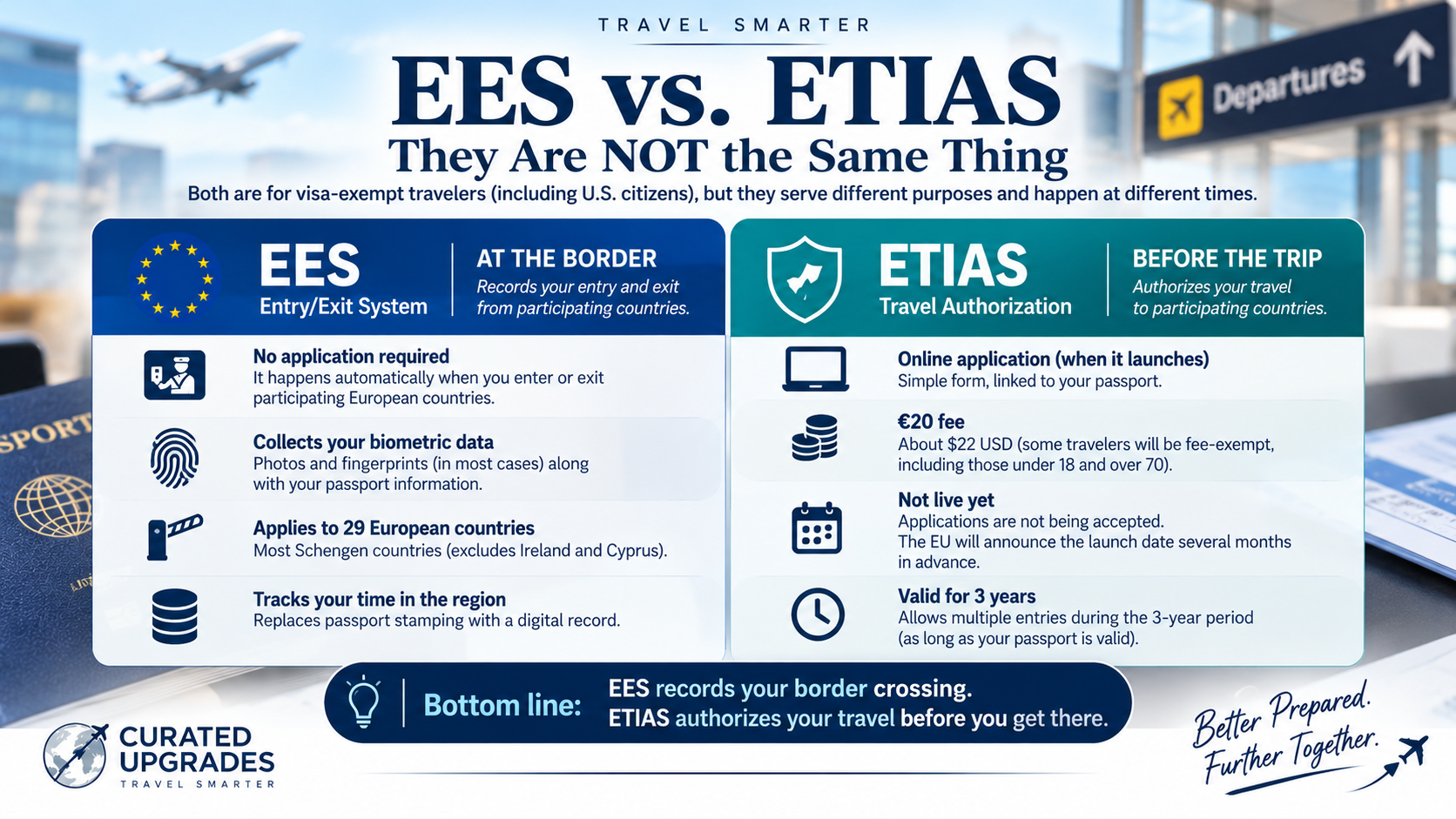
EES = AT THE BORDER
It records your crossing.
ETIAS = BEFORE THE TRIP
It authorizes eligible visa-exempt travel before you arrive.
You don't apply for EES.
Eventually, you will apply for ETIAS.
That's it.
The United Kingdom Has Its Own System
Now cross the Channel and the rules change.
The United Kingdom does not use EES or ETIAS.
Instead, it operates the UK Electronic Travel Authorisation, usually shortened to UK ETA.
For eligible American visitors, this one is not hypothetical.
It's live.
The UK now requires covered visa-exempt visitors, including U.S. citizens, to have the appropriate digital permission to travel.
As of September 2026, a UK ETA costs £20.
It's generally valid for two years or until the passport used for the application expires, whichever comes first, and it permits multiple trips during that validity period.
There's one detail I'd put in bold on the planning checklist:
New passport = new ETA.
The ETA is electronically linked to the passport you used when applying. If that passport expires or changes, you'll need another ETA.
Check whether you need an ETA through the official UK Government ETA checker:
https://www.gov.uk/check-eta
When you're ready to apply, use the official UK Government ETA application service:
https://www.gov.uk/eta/apply
England, Scotland, Wales and Northern Ireland Use the Same UK ETA
For our purposes as travelers, don't treat Scotland or Northern Ireland as though they have separate entry-authorization programs.
The UK ETA covers travel to the United Kingdom, which includes:
England
Scotland
Wales
Northern Ireland
So an American flying into Edinburgh for a Scotland road trip isn't applying for some Scottish version of ETIAS.
It's the UK ETA.
Likewise, flying into London and continuing domestically to Scotland doesn't mean passing through another international immigration checkpoint between England and Scotland.
What About Connecting Through London?
Here's where itinerary details matter.
A connection at Heathrow doesn't automatically mean every traveler needs a UK ETA.
Under current UK rules, you do not need an ETA if you're transiting through a UK airport without passing through border control, often called airside transit.
If your connection requires you to pass through UK border control, the rules are different and an eligible traveler may need an ETA.
Don't guess based solely on the airport.
Check your particular itinerary and, when you're unsure whether you'll pass through UK border control, check with the airline.
You can also review the UK Government's official ETA exemption and transit guidance:
https://www.gov.uk/eta/when-not-need-eta
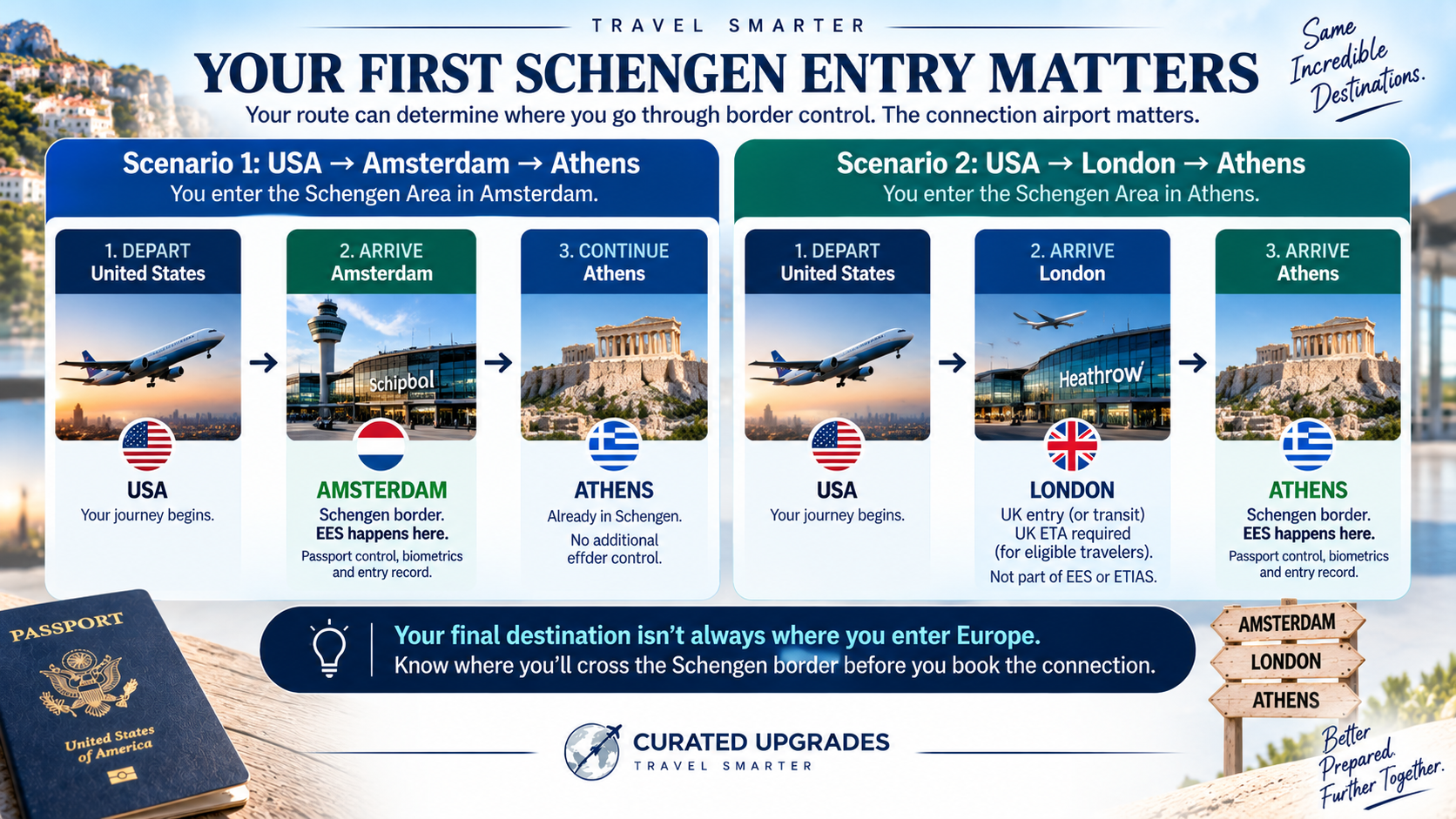
Your First Schengen Entry Matters
Now consider a different kind of connection.
Suppose you're flying:
United States → Amsterdam → Athens
Athens may be your final destination, but Amsterdam is where you first enter the Schengen Area.
That means you'll normally complete the applicable external-border formalities in Amsterdam before continuing to Athens.
Once you've entered the Schengen Area, Amsterdam to Athens functions differently from that first international arrival.
Now change the itinerary:
United States → London → Athens
The UK isn't part of Schengen.
Assuming you're transiting London and don't enter the Schengen Area there, your first Schengen entry occurs when you reach Athens.
That's why the airport where you connect can matter almost as much as the airport printed as your final destination.
Don't Automatically Book the Shortest Connection
This is where border requirements become a travel-planning issue, not merely an immigration issue.
If your connection requires you to clear passport control and complete EES processing at your first Schengen entry, build that into the itinerary decision.
I wouldn't prescribe a universal “you need exactly 90 minutes” rule.
Amsterdam isn't Frankfurt.
Tuesday afternoon isn't necessarily Saturday morning.
And your particular terminals, airline and itinerary matter.
Instead:
Know where you'll clear immigration before you book.
Check the airport and airline connection guidance.
Then decide whether the connection gives you enough margin.
The airline may be willing to sell a connection that technically meets its minimum requirements. That doesn't mean you have to buy it.
How This Fits With TSA PreCheck, Global Entry & CLEAR
This is also where these European systems make a natural companion to the trusted-traveler programs we use at home.
TSA PreCheck, Global Entry and CLEAR help solve different parts of the U.S. airport and border experience.
EES, ETIAS and UK ETA also perform different jobs, but on the international-entry side of your trip.
If you've ever wondered whether you need TSA PreCheck, Global Entry, CLEAR or some combination of them, we've broken those programs down separately:
READ MORE: TSA PreCheck, Global Entry & CLEAR: Which One Do You Need?
The common lesson is simple:
Know what each program actually does before assuming you need all of them.
Watch Out for Fake Application Sites
New government travel programs create an almost perfect environment for questionable third-party websites.
People know they need something.
They don't know exactly what.
And they're worried about being denied boarding.
That's fertile ground for somebody selling an unnecessary “application service.”
For EES, there's nothing for you to buy.
For ETIAS, applications aren't being accepted yet.
For the UK ETA, third-party application services may charge more than the official government service, and using one does not get you a faster decision.
Before entering passport information, uploading a photograph or handing over a credit-card number, verify where you are.
For ETIAS information, use the official European Union ETIAS site:
https://travel-europe.europa.eu/etias
For UK ETA applications, use the official UK Government ETA service:
https://www.gov.uk/eta/apply
And if a website wants money to process your EES application?
There isn't one.
That's your cue to leave.
🟢 CURATED VERDICT: GREEN
HANDLE THE REQUIREMENTS BEFORE TRAVEL DAY
If your destination requires a travel authorization that's actually operating, take care of it before you head for the airport.
For a UK trip, that means checking whether you need an ETA and completing it through the official government service.
For ETIAS, it currently means doing nothing, because applications aren't open yet.
Preparation doesn't mean completing every form you've heard about.
Sometimes preparation means knowing which form doesn't exist yet.
🟡 CURATED VERDICT: YELLOW
LOOK AT THE CONNECTION, NOT JUST THE DESTINATION
Your final destination doesn't necessarily tell you where you'll encounter passport control or EES.
A connection through Amsterdam on the way to Athens is different from a connection through London.
Know where you actually cross the border before choosing a tight connection.
🔴 CURATED VERDICT: RED
DON'T PAY A THIRD PARTY BECAUSE IT LOOKS OFFICIAL
Government travel programs are catnip for copycat websites.
Use official sources.
Double-check the domain.
And never let a countdown timer or a giant red APPLY NOW button convince you that a requirement exists when the government itself says it doesn't.
The Bottom Line
Europe isn't suddenly closing its doors to American travelers.
The infrastructure around those doors is changing.
EES is already operating and records covered travelers as they cross participating European borders.
ETIAS is coming, but it isn't operating yet.
UK ETA is already live and applies to eligible travelers heading to the United Kingdom.
The biggest mistake isn't failing to memorize another acronym.
It's assuming they're all the same thing.
Know which system applies to your trip, use official sources, understand where you'll encounter border control and build enough breathing room into your itinerary to deal with it.
Then get back to planning the part of Europe you actually went there to see.
CURRENT INFORMATION
This article reflects official European Union and United Kingdom guidance available as of September 2026. Entry requirements, fees, implementation dates and procedures can change, particularly as ETIAS approaches launch. Verify current requirements through official government sources before travel.