

The EV Road Trip Nobody Talks About: What Happens When You Get There?
Getting there may be the easy part. Our first rural road trip in a Tesla taught us that spending several days at a destination can require a completely different kind of charging plan.
Most conversations about EV road trips focus on getting from Point A to Point B.
Where are the fast chargers? How far can the car go? How long will charging take? Can you make it to the next Supercharger?
Those are reasonable questions. But after taking our first genuinely rural trip in a Tesla, I discovered another question that mattered just as much:
What happens after you get there?
In June 2023, we'd owned our Tesla Model Y Dual Motor for about five months. We'd driven it around town and taken some shorter trips, but we'd never ventured very far from places where home charging, hotel charging or Tesla Superchargers were readily available.
Then we drove from Southeast Georgia, to Rabun County in the North Georgia mountains.
We weren't going there for a weekend getaway.
We were shopping for a cabin.
And for the first time since buying the Tesla, we were going to spend several days somewhere without an obvious place to plug it in overnight.
That's where things got interesting.
We Had Actually Planned Ahead
We weren't heading into rural Georgia assuming electricity would magically appear when we needed it.
Before the trip, I'd mapped the homes we wanted to see. They were reasonably close together, and I organized them geographically rather than bouncing back and forth across the county.
That's how I would have done it in my diesel truck, too.
I'm not into backtracking whether I'm burning electrons or diesel. Either way, it wastes energy, time and money.
We had also looked for Airbnb properties with EV charging. At the time, we couldn't find one in the area that worked for us.
But the house we rented near Clayton and Rabun Gap had something interesting in one of the listing photos:
A standard 120-volt outlet near the front door.
That looked promising.
I knew 120-volt charging would be slow. According to Tesla's Mobile Connector guidance, an ordinary household outlet can add only a few miles of range per hour.
But we weren't trying to refill an empty battery every night.
If the car sat there for 10 or 12 hours and picked up another 30 or 40 miles, that could replace much of our local driving.
Good enough.
I also knew there was public Level 2 charging in Clayton. I'd already downloaded the appropriate charging app and set up the account before we left.
So we weren't going in without a plan.
We actually had several.
Then Some Flowers Defeated Plan A
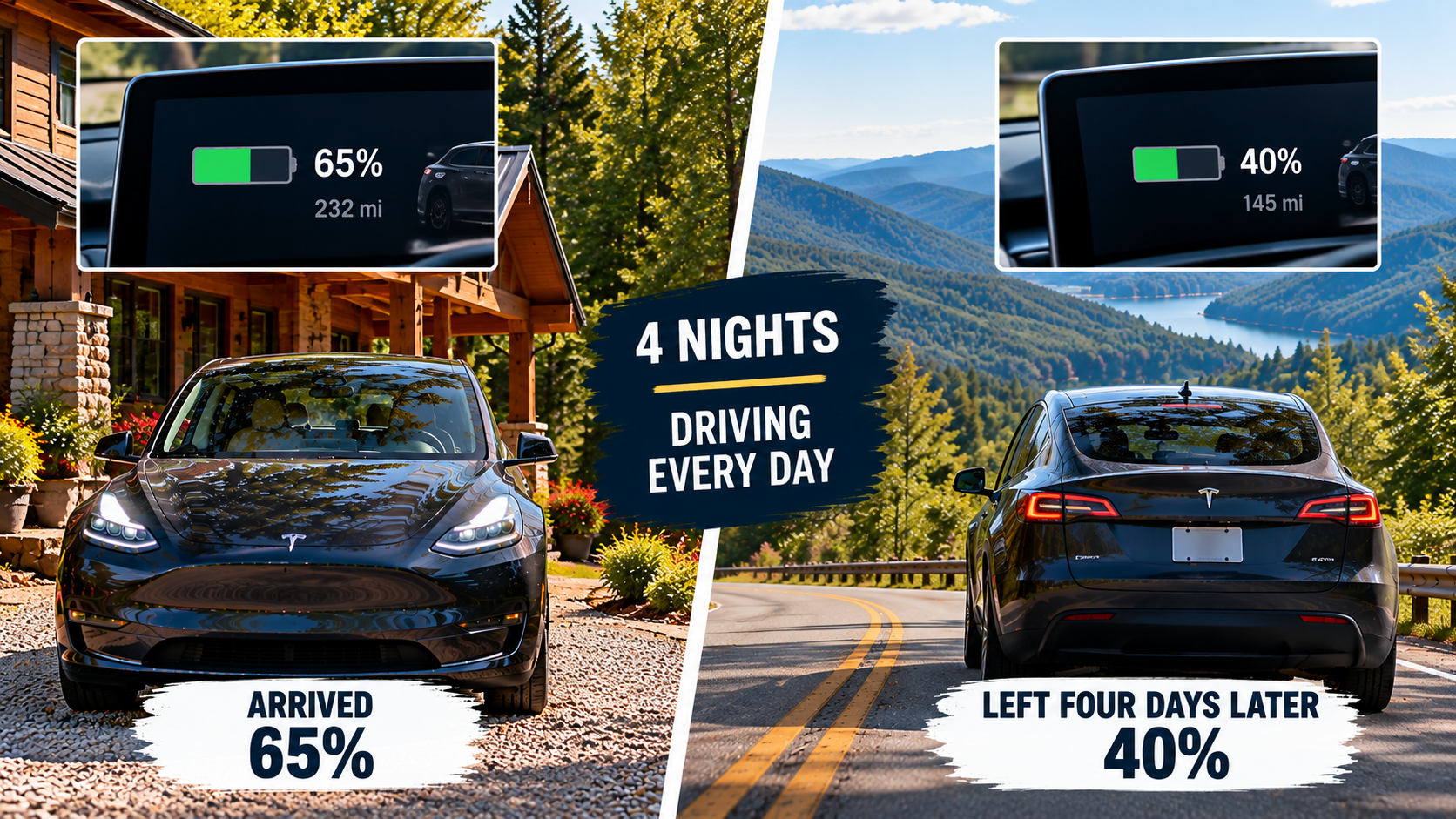
We arrived at the Airbnb with roughly 65% charge.
Plenty.
Then I tried to get the Model Y close enough to that outlet we'd seen in the photograph.
Nope.
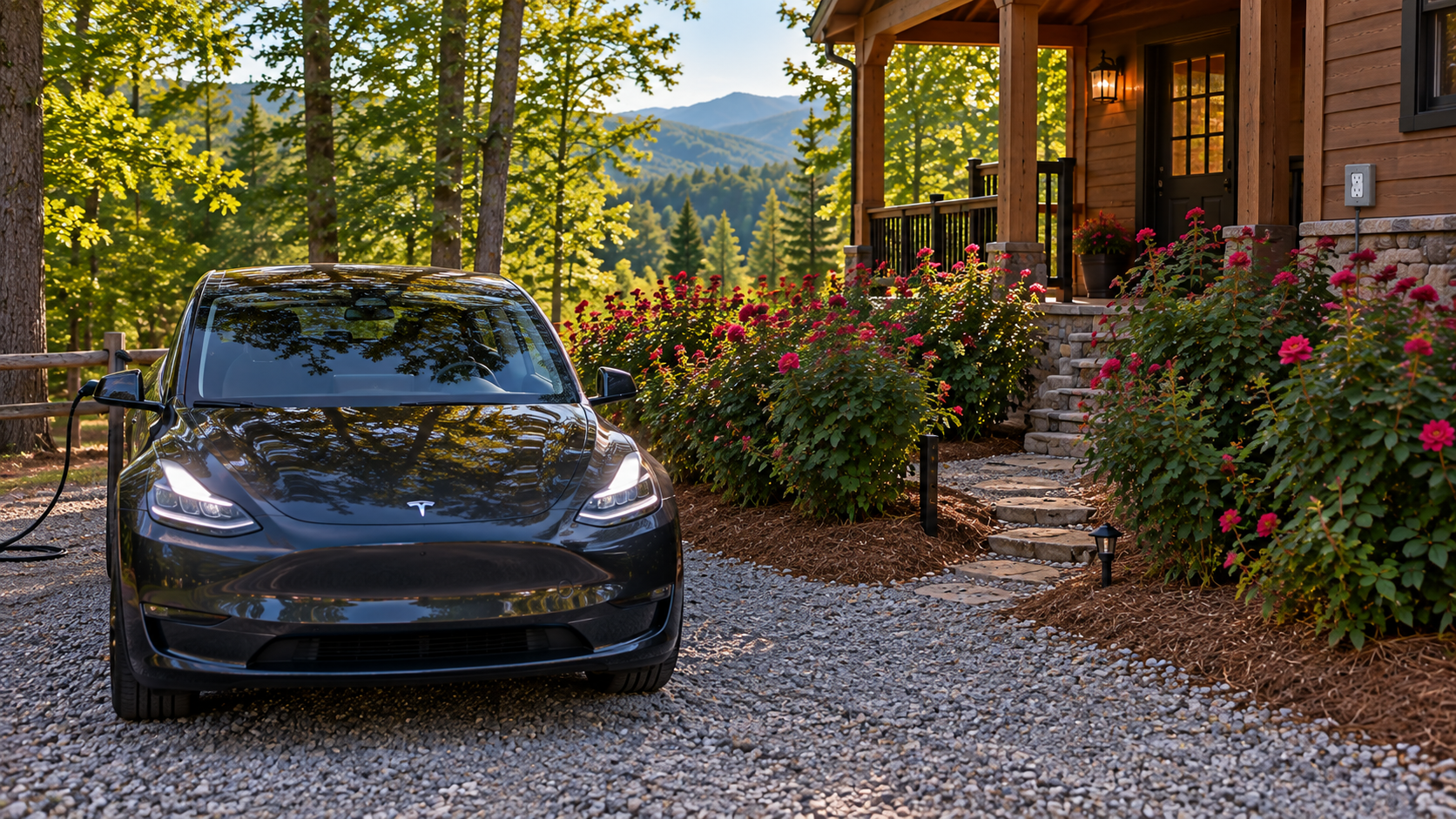
A row of newly planted rose bushes stood about 15 feet from the house. There was a narrow opening with a walkway leading toward the front porch, but it wasn't wide enough to drive the Tesla through.
We could park near the landscaping, but not close enough to the house for our charging cable to reach the outlet.
Technically, the Airbnb had the outlet we'd seen.
Practically, it might as well have been on the roof.
An extension cord might have bridged the gap, but we didn't have one, and using an ordinary extension cord with EV charging equipment isn't an appropriate workaround. Tesla's Mobile Connector owner's manual specifically warns against using extension cords.
So much for Plan A.
That taught me something I've remembered ever since:
Knowing an outlet exists isn't the same as knowing you can charge from it.
Distance from the parking area matters. Access matters. The type and condition of the outlet matter. And if it isn't your property, permission matters.
A photograph can tell you only so much.
This Was the First Time I Felt Range Anxiety
We weren't remotely close to running out of charge.
We had arrived with about 65%.
We already knew there were Level 2 chargers in town.
Our property-shopping route wasn't going to involve hundreds of miles of driving.
But the car was still new to us.
We were learning how its advertised range translated into our real-world driving. We were learning what affected energy consumption. We even learned little things, such as not unnecessarily leaving the climate control running while the car was parked.
And for the first time, we didn't have the psychological security blanket of plugging in at home that night or knowing there was a Supercharger just down the road.
So yes.
There was some range anxiety.
Not panic.
Not "we're going to be stranded in the mountains."
Just the nagging awareness that every local trip was subtracting miles from a battery we couldn't replenish at the house.
As it turned out, that feeling didn't last very long.
Breakfast Changed the Entire Trip
The next morning, we drove into Clayton for breakfast.
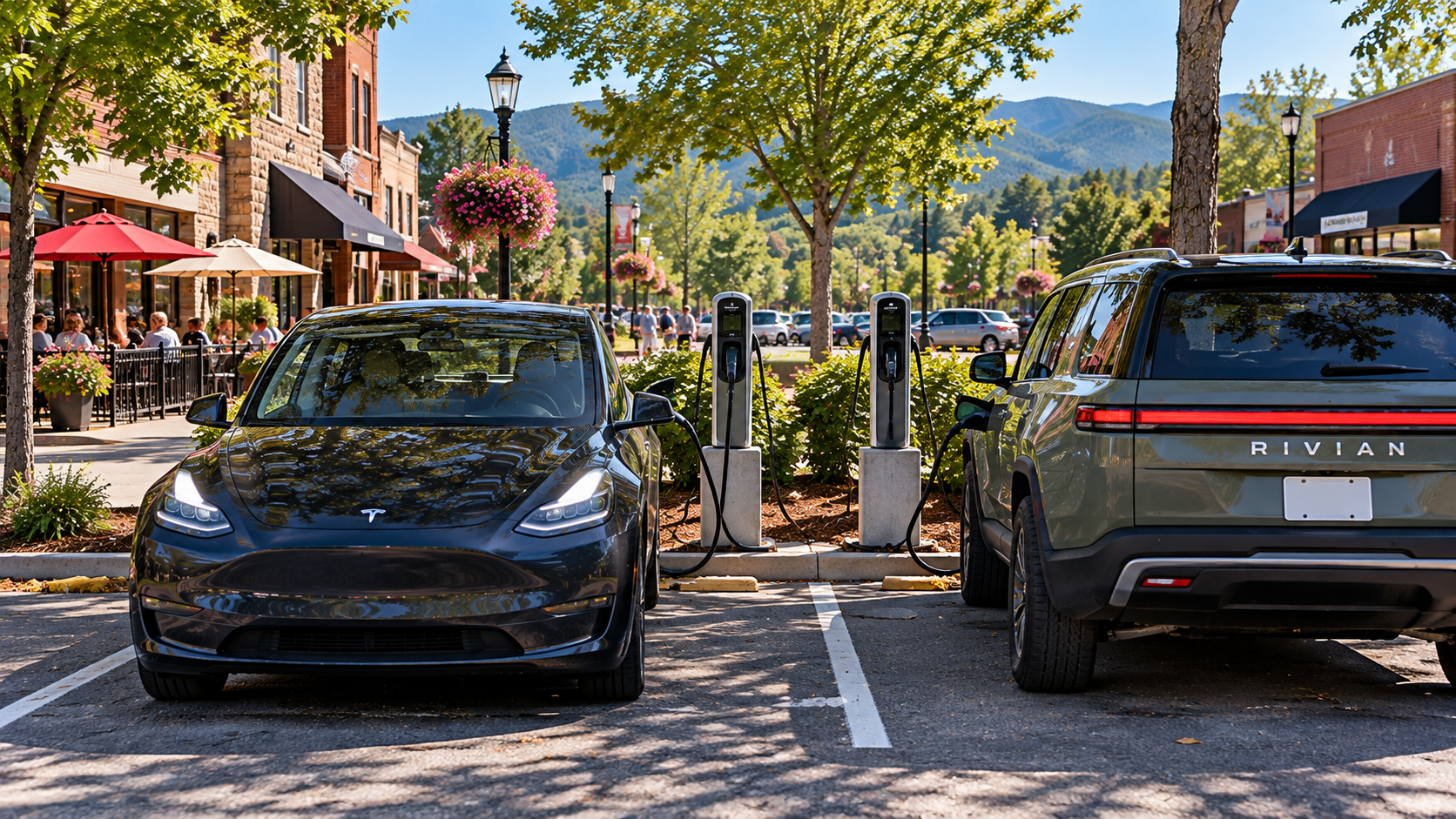
The two Level 2 chargers we'd identified were side by side in a public parking area about half a block from the main street.
And that location turned out to be almost ideal.
There were restaurants. Shops. Places to walk. Ice cream. A spot for an after-dinner drink.
And because we were seriously considering buying a home in the area, we wanted to spend time downtown anyway. We talked with local small-business owners and got a feel for the community.
So we plugged in and went to eat.
The Tesla didn't need us to stand beside it and watch electrons crawl through the cable.
That's one of the practical advantages of slower destination charging. You can add energy while you're already doing something else.
The Adapter Suddenly Became Pretty Important
The public chargers weren't Tesla chargers.
They used J1772 connectors.
Fortunately, I'd purchased a J1772 adapter when we bought the car and had it with us.
Plug in the adapter, connect the charger and go eat.
Tesla confirms that compatible third-party J1772 stations can be used with the appropriate adapter in its charging guidance.
That little piece of hardware turned two non-Tesla chargers into our local fueling station for the next several days.
And it reinforced something I still believe about EV road trips:
Carry the adapters that give your car more options.
You may never need them.
Until suddenly you do.
We Didn't Spend Our Vacation Sitting at a Charger
This is where I think people's mental picture of EV travel can get distorted.
We weren't spending three hours a day sitting in a parking lot staring at the battery percentage.
We were staying four nights.
We needed to eat.
The charging area was about five minutes from the Airbnb, and there were enough restaurants nearby that we could eat in that part of town once a day without repeating restaurants.
We'd park.
Plug in.
Have breakfast or a casual dinner.
Window-shop.
Maybe get ice cream or an after-dinner drink.
Talk to people.
An hour or so later, we'd come back to the car with more charge than we'd arrived with.
Call it the Alton Brown approach to EV travel:
No unitaskers.
Dinner wasn't just dinner. It was dinner plus charging plus exploring the town we'd potentially be calling home.
And because those were things we wanted to do anyway, charging wasn't really consuming our vacation time.
We Did Have to Wait Once
On one occasion, both charging spots were occupied.
A Rivian was using one.
We parked beside it and waited about 15 minutes.
I left a note asking the owner to text me when they were finished.
That was it.
During the trip we also saw a Mustang Mach-E and another Tesla using the chargers.
It wasn't some vast EV charging complex with dozens of stalls.
It was two chargers in a public parking lot.
And for what we needed, they worked.
The charging wasn't free, but it wasn't expensive either. As I remember it, it cost less than Supercharging would have, although naturally it was considerably slower.
But speed wasn't particularly important.
We weren't waiting for the car.
The car was waiting for us.

After the First Charging Session, the Anxiety Was Gone
This may be the most important thing I learned during those four days.
Once we'd successfully used the Level 2 charger and saw how easily it fit into our day, the range anxiety pretty much disappeared.
We didn't obsess over getting the battery back to 80% or 100%.
We didn't make special trips into town just to charge.
And we certainly didn't spend four days eating every meal at a gas station because it happened to have a charger.
We simply replaced some of the energy we were using while doing things we were already going to do.
Meanwhile, I kept doing what I'd normally do on a property-shopping trip.
If several houses were in one part of the county, we looked at them together.
We didn't drive north, then south, then north again because somebody scheduled the appointments badly.
Gasoline, diesel or electricity, unnecessary miles are still unnecessary miles.
We Arrived With 65%. Four Days Later, We Left With About 40%.
That's the number that changed my perspective.
We arrived with approximately 65% battery.
The Airbnb charging plan completely failed.
We stayed four nights.
We drove the car every day.
We looked at real estate.
We went out to eat.
We explored the area.
And when it was time to head home, we still had roughly 40% charge, representing more than 100 miles of usable range for us.
We charged shortly after leaving the area and continued home.
There was no dramatic rescue.
No tow truck.
No extension cord running through somebody's rose bushes.
We just used the charging infrastructure that was available and adapted our routine slightly.
The car exceeded my expectations.
More importantly, I had stopped worrying about it.
Destination Charging Doesn't Have to Be at Your Destination
That's probably the biggest lesson I took from Rabun County.
Before the trip, I thought about destination charging primarily as:
Can I charge where we're staying?
Today I'd ask a broader question:
Where can I charge while we're doing something we'd already be doing?
Those aren't the same thing.
A charger at the Airbnb would have been wonderfully convenient.
But so was a charger five minutes away in an area where we wanted to eat, shop and spend time.
It's also why I've become a fan of the [Charge While You Sleep] approach whenever overnight charging is available, and why I don't let charging become the only consideration in How I Choose Road Trip Hotels When I'm Driving an EV.
The principle is the same whether you're sleeping, eating or exploring:
Let charging happen while you're doing something else.
Now I Plan Beyond the Arrival Pin
If I were planning another rural EV trip today, I wouldn't stop my research after confirming that the car can reach the destination.
I'd look at the area where we're actually going to spend the next several days.
🟢 Public charging: Where are the Level 2 chargers, and are there fast chargers nearby?
🟢 Convenience: What's within walking distance of those chargers? Can we charge while eating or sightseeing?
🟢 Rental charging: Is there actually a usable charging setup, rather than merely an outlet visible in a photograph?
🟢 Equipment: Do I have the correct adapters and Mobile Connector?
🟢 Local driving: How many miles are we realistically going to cover during our stay?
I also wouldn't assume the charging map I remember from a previous trip is still accurate.
Charging infrastructure changes. New stations appear. Networks expand. Equipment changes.
I'd check PlugShare for public charging options and recent user reports, along with Tesla's own charging map and navigation system.
And I'd research the destination again before returning rather than relying on what was available in June 2023.
Sometimes an Outlet Is All You Need
There's another experience that happened later that reinforced the same lesson.
Our church band had been invited to play at a youth-group event in a rural town about two hours from home.
We had plenty of charge to get there, and I already knew there was a Supercharger we could use for the return trip.
While unloading my guitar, I noticed the building's air-conditioning equipment.
And near it were some 240-volt outlets.
By then, I'd learned to notice things like that.
I asked the pastor whether I could plug in.
He said yes.
So while we were inside playing music, the Tesla was outside charging.
By the time we finished, we'd added roughly 75 miles of range.
We didn't need the Supercharger stop on the way home after all.
A compatible 240-volt outlet can charge considerably faster than an ordinary 120-volt household outlet, as explained in Tesla's Mobile Connector documentation. But outlet compatibility, circuit condition, proper grounding and charging equipment all matter. Permission alone doesn't establish that an outlet is electrically suitable for EV charging.
There's also an important part of that story that shouldn't get lost:
I asked first.
Seeing an outlet doesn't make it public charging.
If it's somebody else's electricity, get permission.
What Rabun County Taught Me About EV Road Trips
The trip changed the way I think about EV travel.
The first challenge is getting there.
The second is living there for a few days.
Those can require completely different charging strategies.
On the highway, a fast charger may be exactly what you want. At the destination, speed may matter far less than convenience.
An hour of Level 2 charging while you're having dinner can be more useful than a faster charger 20 miles out of your way.
A 120-volt outlet at a rental might be enough if the car is parked there all night.
A suitable 240-volt outlet you have permission to use can turn several hours at an event into useful range.
And sometimes two ordinary public Level 2 chargers in a small mountain town are all you really need.
The important part is recognizing that the trip doesn't end when the navigation system announces you've arrived.
If you're going somewhere rural for several days, spend a few minutes looking at what charging will be available after you get there.
Then go enjoy the destination.
Because by the end of our four nights in Rabun County, we weren't thinking much about charging anymore.
We were thinking about whether we wanted to buy a cabin there.
And that's exactly how I want an EV road trip to work.