

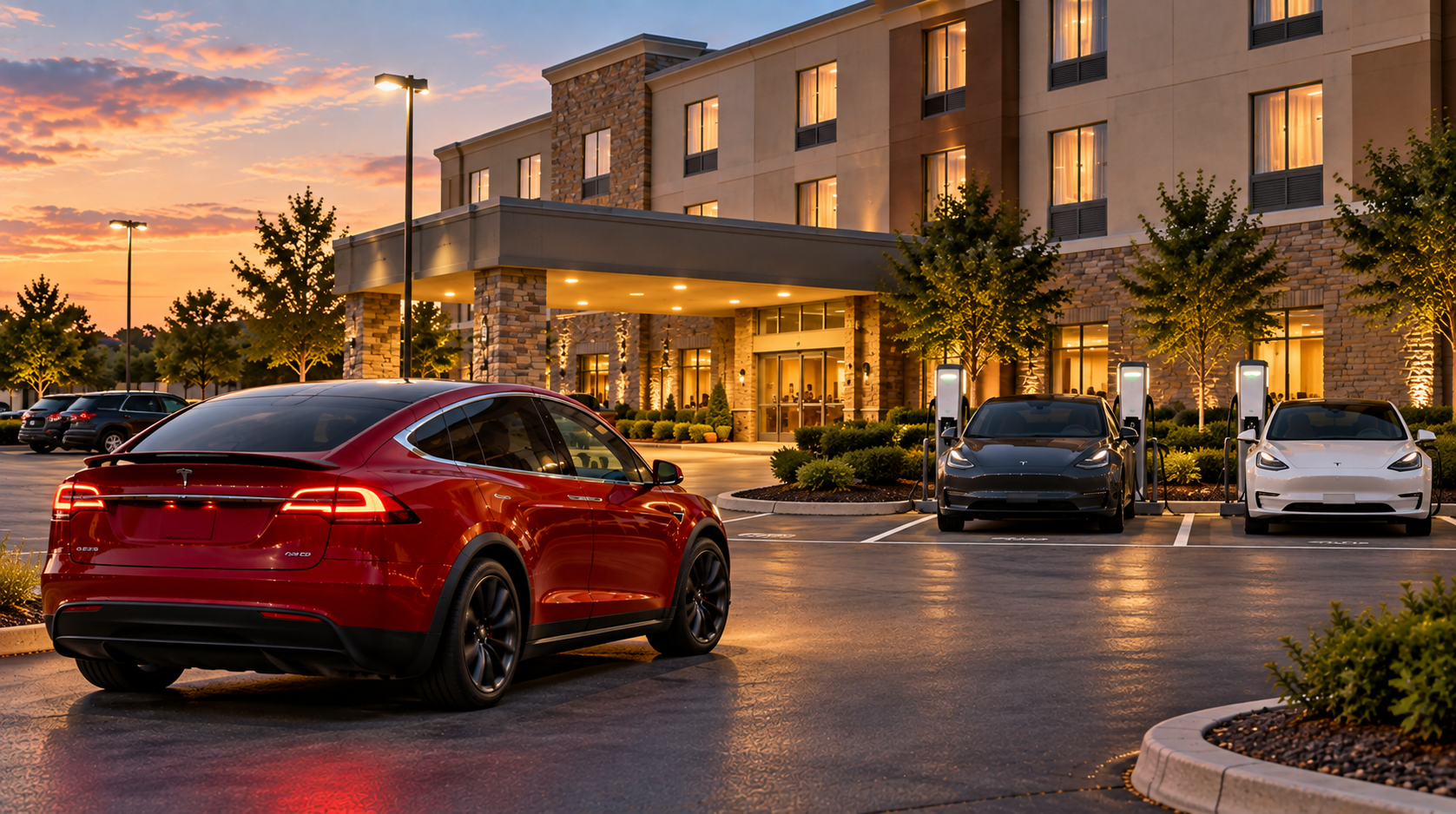
How I Choose Road Trip Hotels When I’m Driving an EV
Charging matters, but it isn’t the first thing I look for. Here’s how I choose an overnight stop, verify the charger, compare its real value and make sure I have another option if it doesn’t work.
When I’m planning a road trip in our Tesla Model X, I don’t search for a charger and then figure out where we’re going to sleep.
I do almost the opposite.
First, I decide where we should stop for the night. Then I look for a hotel that makes sense for the trip. EV charging is one of the amenities I consider, but it doesn’t automatically determine where we stay.
That distinction matters.
A hotel can have six chargers and still be a terrible road-trip stop. Another might have only two, but be right off the interstate, reasonably priced, comfortable, close to dinner and perfectly positioned for the next morning.
I’m planning a road trip.
I’m not planning a tour of charging stations.
First, I Decide Where We Should Stop
Before I start comparing hotels, I look at the trip itself.
How far do we want to drive that day? Where does that put us around dinner time? What does the next day’s drive look like? Is there a convenient town near the interstate where we can get a decent room, eat something and get back on the road easily the next morning?
Only after I have that general area do I start looking at hotels.
That keeps the charging infrastructure from dictating the entire trip.
Tesla’s route planning makes this considerably easier because the navigation system can incorporate Supercharger stops into the route and estimate battery charge at the destination. I don’t need to manually calculate every mile between home and the hotel.
I want the overnight stop to work for us first.
Then I figure out how charging fits into it.
Charging Can Break a Tie
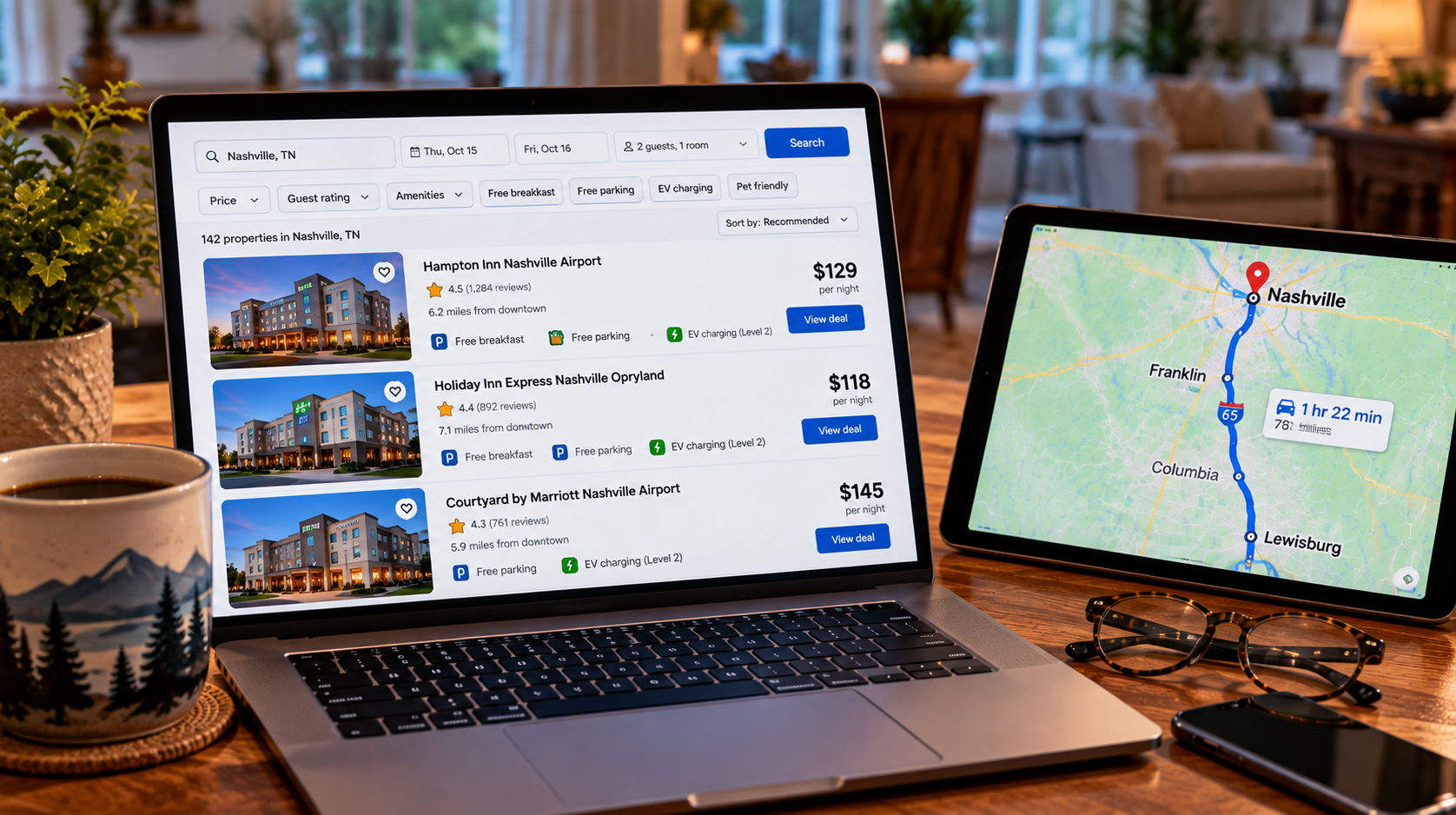
Once I have several hotels that meet our basic needs, EV charging becomes much more interesting.
Suppose two hotels are similarly priced, similarly rated and equally convenient to the highway.
One has overnight Level 2 charging.
The other doesn’t.
🟢 I’m probably choosing the one with the charger.
Not because I couldn’t make the trip without it. I simply prefer waking up with more energy in the battery rather than making charging my first order of business in the morning.
That’s one of the reasons Charge While You Sleep is such a useful strategy on an EV road trip.
But I don’t automatically pay substantially more for a room just because somebody installed an EV charger in the parking lot.
The numbers still have to make sense.
A “Free” Charger Doesn’t Automatically Make a Hotel Cheaper
This is where I think EV hotel shopping gets interesting.
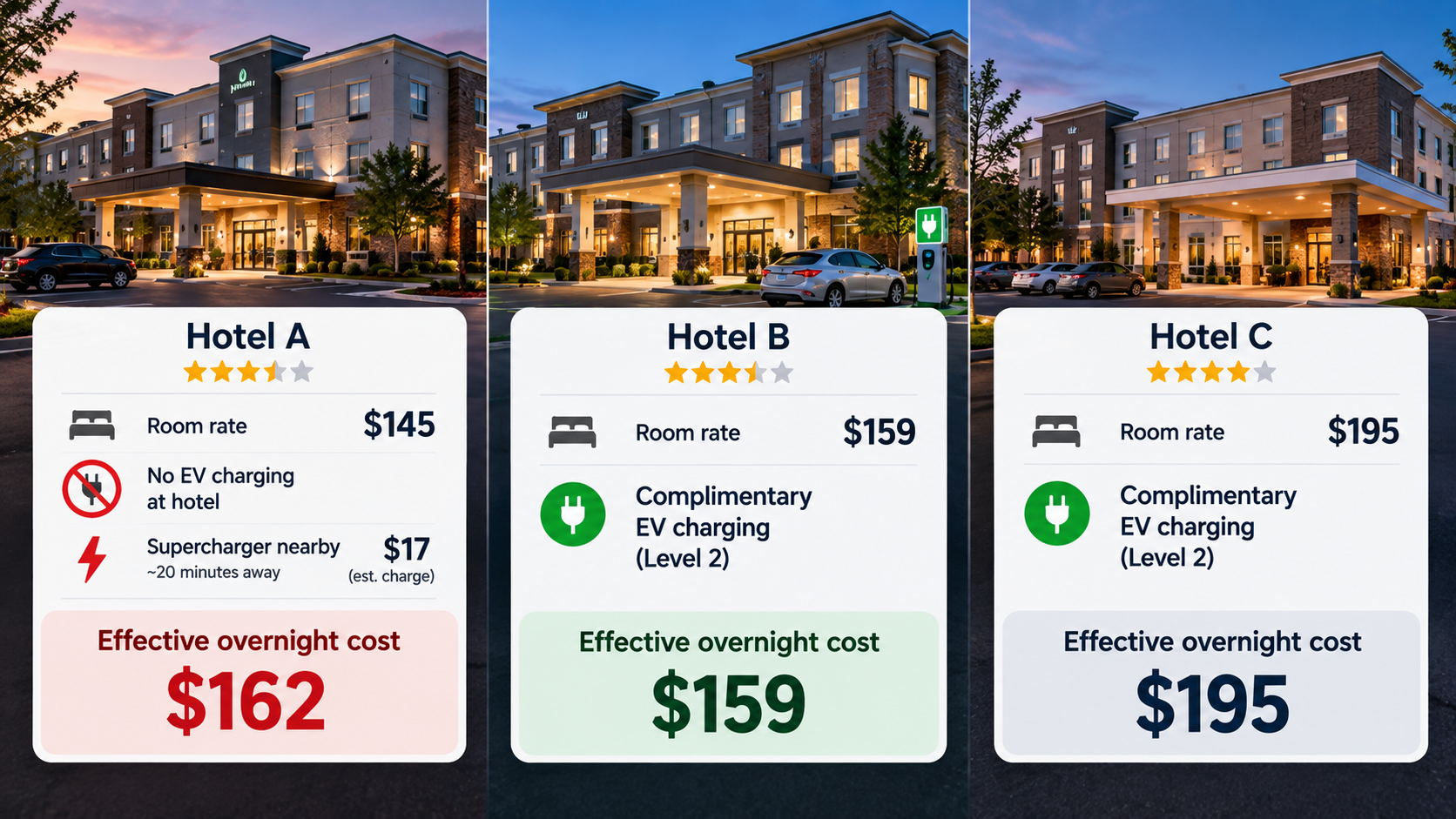
Imagine one perfectly acceptable hotel costs $145 for the night but doesn’t offer charging.
Another comparable hotel costs $159 and includes complimentary Level 2 charging.
At first glance, the $145 hotel is cheaper.
But if staying there means I’ll probably spend another $17 at a Supercharger, my effective overnight transportation-and-lodging cost is closer to $162.
Now the $159 hotel with charging may actually be the better deal.
On the other hand, if the hotel with “free” charging costs $195?
🔴 No thanks.
I’m not paying an extra $50 for $15 or $20 worth of electricity.
The charger has value.
It just doesn’t have unlimited value.
I Never Trust the Little EV-Charging Icon
A hotel booking site may say EV charging available.
That’s useful information.
It isn’t enough information.
Before I book a hotel where charging is going to matter, I call the property directly.
Not the national reservation line.
The actual hotel.
I want to know what is physically sitting in that parking lot today.
I ask how many chargers they have, what type they are, whether they’re Level 2, whether there’s a fee and whether they’re currently operational.
🟢 How many chargers?
🟢 Tesla/NACS, J1772 or both?
🟢 Level 2?
🟢 Free or paid?
🟢 Working right now?
That last question may be the most important one.
A charging station can remain listed as a hotel amenity long after something has stopped working. There’s a considerable difference between “our website says we have EV charging” and “yes, we have four chargers and they’re working.”
I want the second answer.

Arrival Charge Matters More Than It May Seem
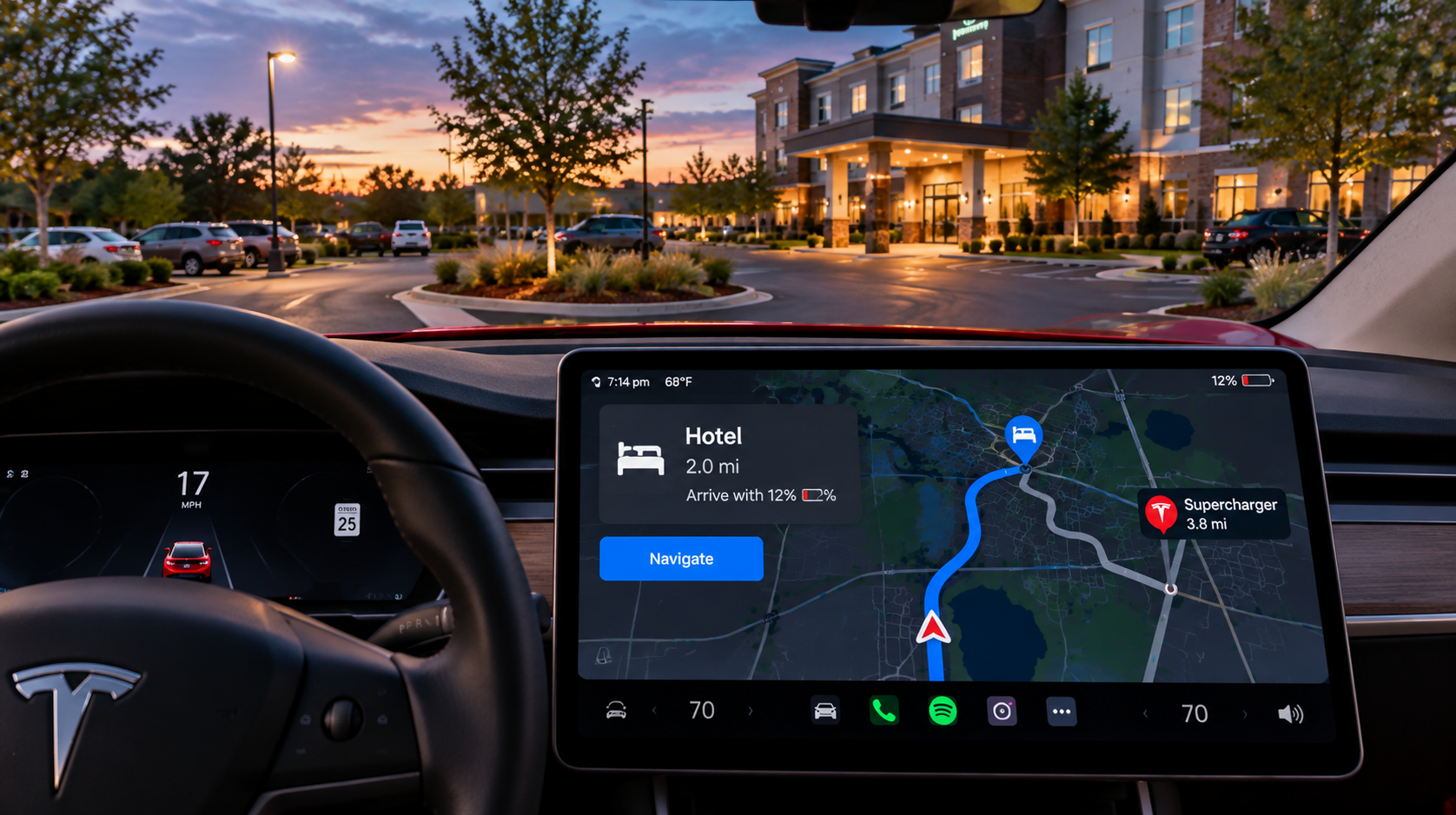
I also pay attention to what the Tesla predicts we’ll have left in the battery when we arrive.
If the navigation system says we’re going to reach the hotel with 55% remaining, I’m not particularly concerned about the hotel’s charging situation.
We have options.
If we’re expected to arrive with 12%?
That’s different.
🟡 Now the hotel’s charging setup matters considerably more.
That doesn’t mean 12% is some emergency threshold. It simply means my flexibility that evening and the next morning depends much more heavily on whether I can charge overnight.
And that’s when another part of my planning becomes important.
I Always Know Where the Backup Charger Is
Even when I’ve called the hotel.
Even when they’ve confirmed the chargers are working.
Even when everything looks perfect.
I still know where the nearest Supercharger is.
I don’t build an elaborate emergency charging spreadsheet or map out six contingency plans.
I usually want one good backup.
If we arrive and every hotel charger is occupied, one is broken or something has changed since I called, I already know what I’ll do.
🟢 Hotel charger works: plug in and forget about it.
🟡 Hotel charger doesn’t work: use the nearby Supercharger.
That’s enough redundancy for me.
It also keeps a minor inconvenience from turning into a problem at 7:30 the next morning.
I Carry My Own Charging Equipment Too
There’s one more layer to the backup plan.
I travel with my own charging cord and adapters so I can use an appropriate 120-volt or 240-volt outlet when one is available and we have permission to use it.
I’m not counting on finding an outlet everywhere we stay, and I’m certainly not suggesting plugging into random electrical outlets without permission.
It’s simply another option already riding in the car.
Most EV owners who road-trip probably have some version of this equipment. This is less a recommendation to go shopping than a reminder:
🟢 Bring it with you.
The best backup charging equipment in the world isn’t terribly useful sitting in the garage 400 miles away.
The Best EV Hotel Is Usually Just a Good Road-Trip Hotel
Ultimately, I’m looking for the same things I’d want if we were traveling in a gasoline vehicle.
A comfortable place to sleep.
Easy access from the highway.
Restaurants or food nearby.
A reasonable room rate.
A location that makes sense for the next day’s drive.
And, when possible, overnight EV charging.
The charger isn’t the destination.
It’s an amenity that can make an already-good overnight stop even better.
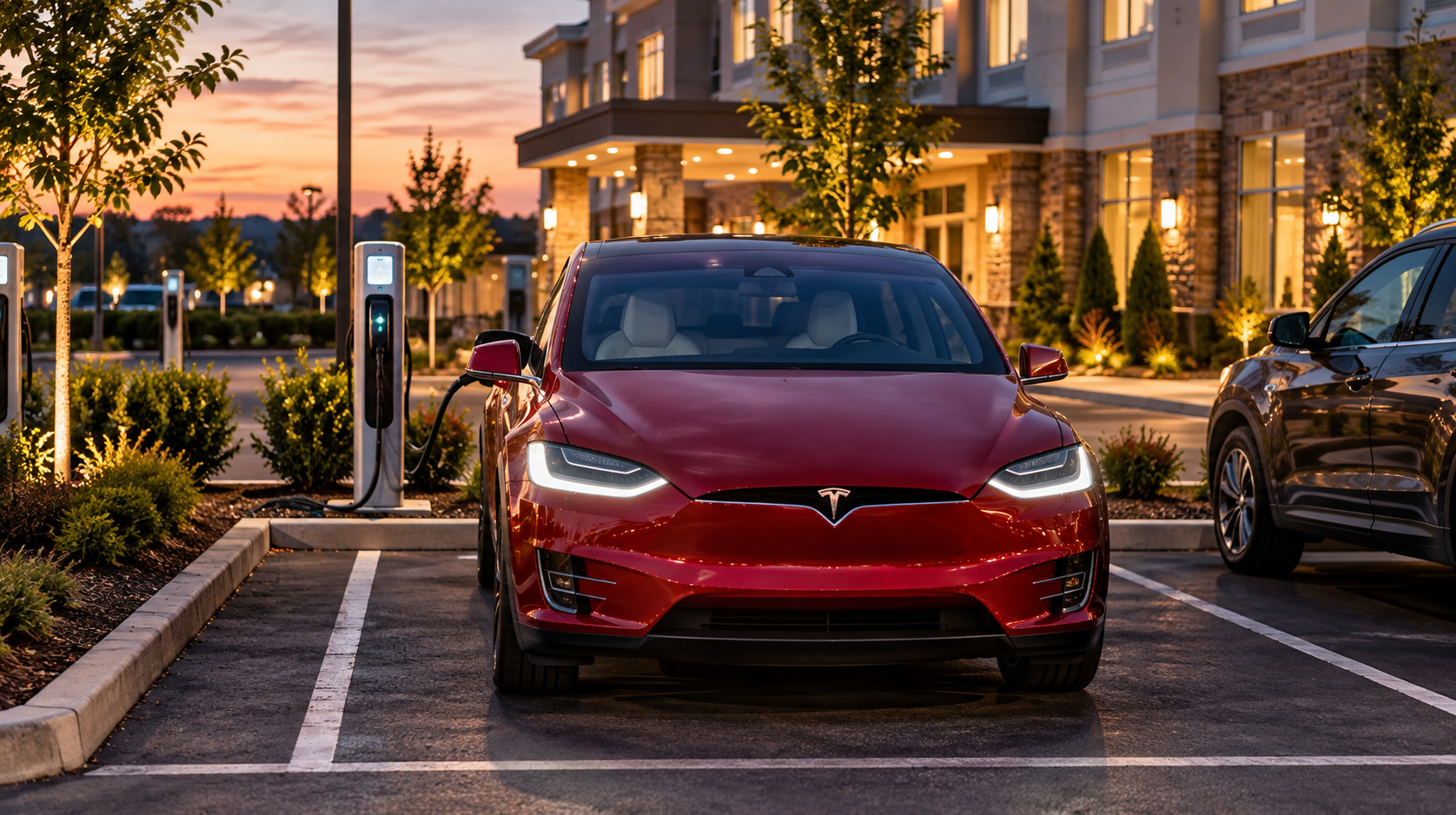
My EV Hotel Planning Rule
I don’t choose a hotel simply because it has a charger.
I choose the part of the route where we should stop, find hotels that meet our normal travel needs, and then determine whether EV charging improves one of those choices.
If charging matters to the plan, I call and verify it.
If we’re arriving with a low battery, I take that into account.
And whether the hotel has two chargers or twenty, I know where my nearest backup is.
That’s really it.
No charging anxiety.
No spreadsheet worthy of NASA mission control.
No driving 30 miles out of the way because a hotel happens to have a plug.
Just a little additional planning that eventually becomes as routine as checking the room rate, parking situation or breakfast hours.
The goal isn’t to build the trip around the car.
The goal is to make the car fit naturally into the trip.