

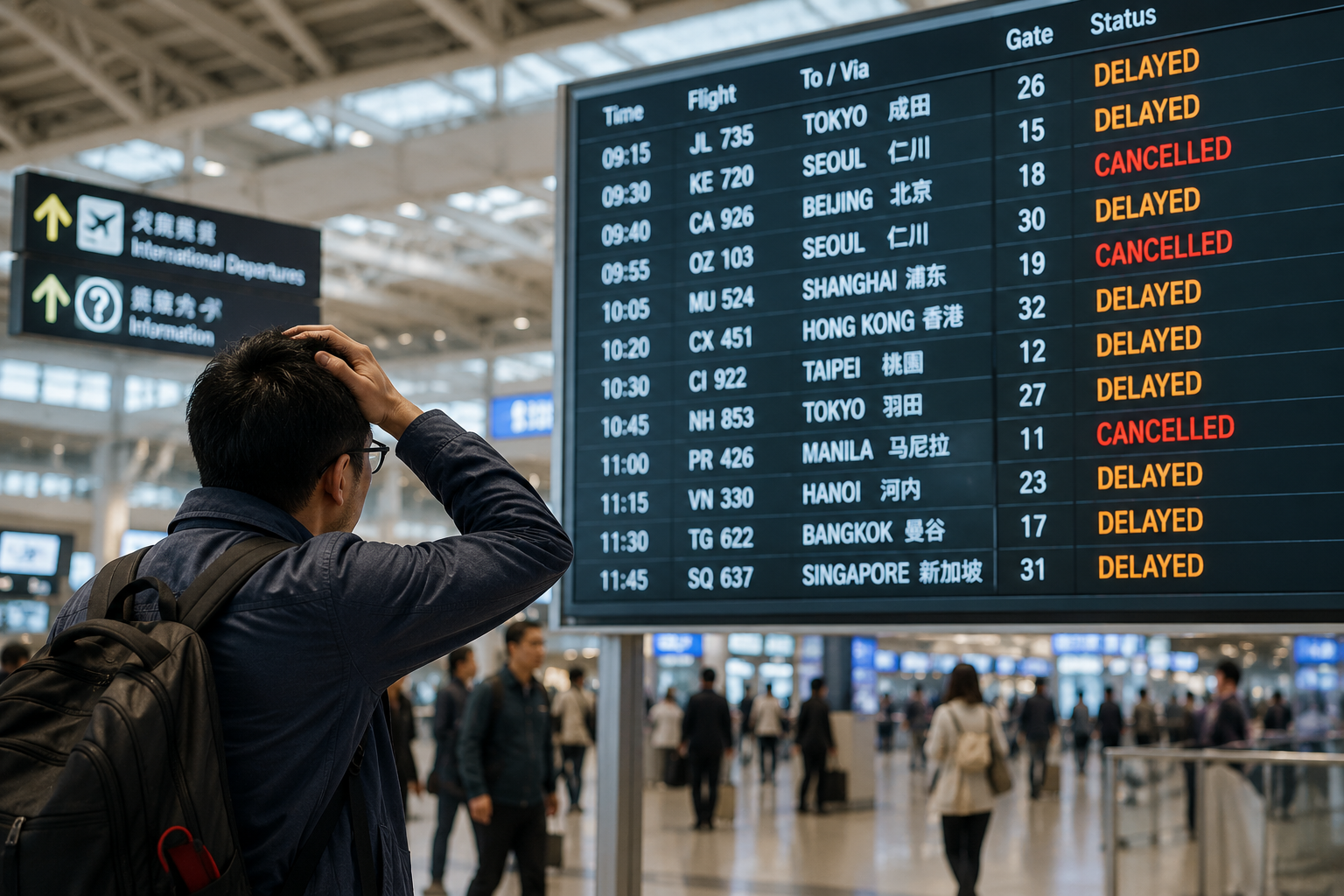
Flight Delayed in Asia? Your Rights in Japan, South Korea & China
What happens when your flight is delayed or cancelled in East Asia? The answer can change dramatically depending on whether you're in Japan, South Korea or China. Here's what to know before you reach the airline counter.
Few travel moments produce quite the same sinking feeling.
You arrive at the airport. Bags are checked. You've made it through security. Maybe you're already sitting at the gate.
Then the departure board changes.
DELAYED.
An hour later, it changes again.
Or worse:
CANCELLED.
If you're traveling in Japan, South Korea or China, the questions come quickly.
Will the airline rebook me?
Am I entitled to a meal?
What happens if I'm stranded overnight?
Can I get a refund?
Does the airline owe me compensation?
And perhaps the most important question:
Which rules actually apply here?
That's where East Asia gets interesting.
Unlike the European Union, there isn't one regional passenger-rights system covering Japan, South Korea and China. Each country approaches flight disruptions differently, and airline policies can matter too.
So while the problem may look identical on the departure board, your rights may be very different depending on where you're standing.
CURRENT INFORMATION: Passenger-rights regulations and airline policies can change. The regulatory information in this article was reviewed and is current as of August 2026. Before relying on a particular benefit or filing a claim, verify the current rules with your airline and the appropriate government or consumer agency.
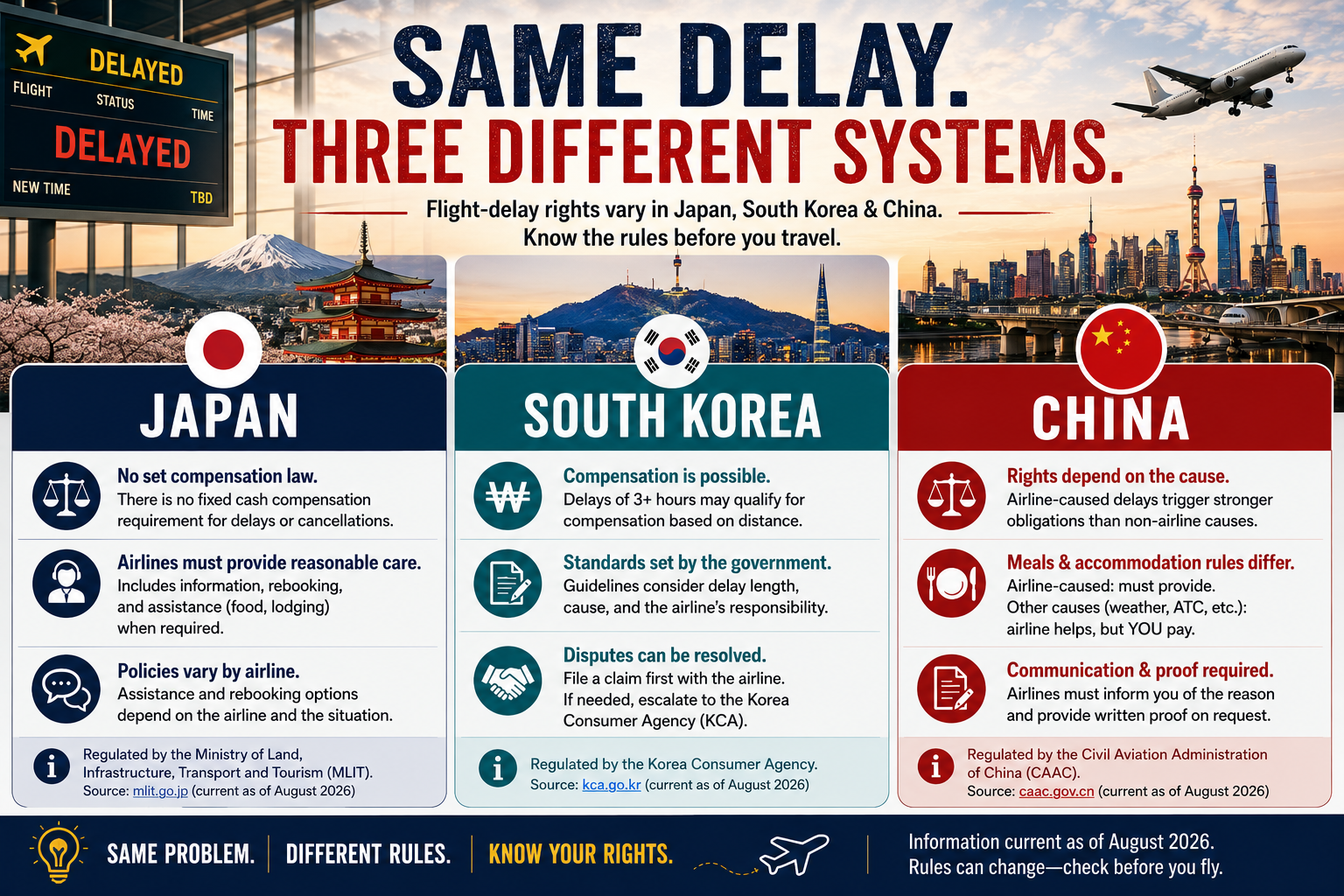
Same Delay. Three Different Systems.
Suppose three travelers each experience the same four-hour flight delay.
One is in Tokyo.
One is in Seoul.
One is in Shanghai.
They shouldn't necessarily expect the same outcome.
Japan does not have an EU261-style law that automatically pays passengers a standardized amount of cash simply because a flight reaches a particular delay threshold. Airline policies, ticket conditions and the circumstances surrounding the disruption matter.
South Korea has Consumer Dispute Settlement Criteria that can provide compensation for qualifying airline-caused delays. Eligibility and compensation depend on factors including the length and reason for the delay. The Korea Consumer Agency also provides a path for consumer redress when a dispute isn't resolved directly with the airline.
China has detailed passenger-service regulations covering flight disruptions, including airline obligations involving information, meals, accommodations and tarmac delays. Crucially, some obligations depend on what caused the disruption and where it occurred.
Same frustrating announcement.
Three different rulebooks.
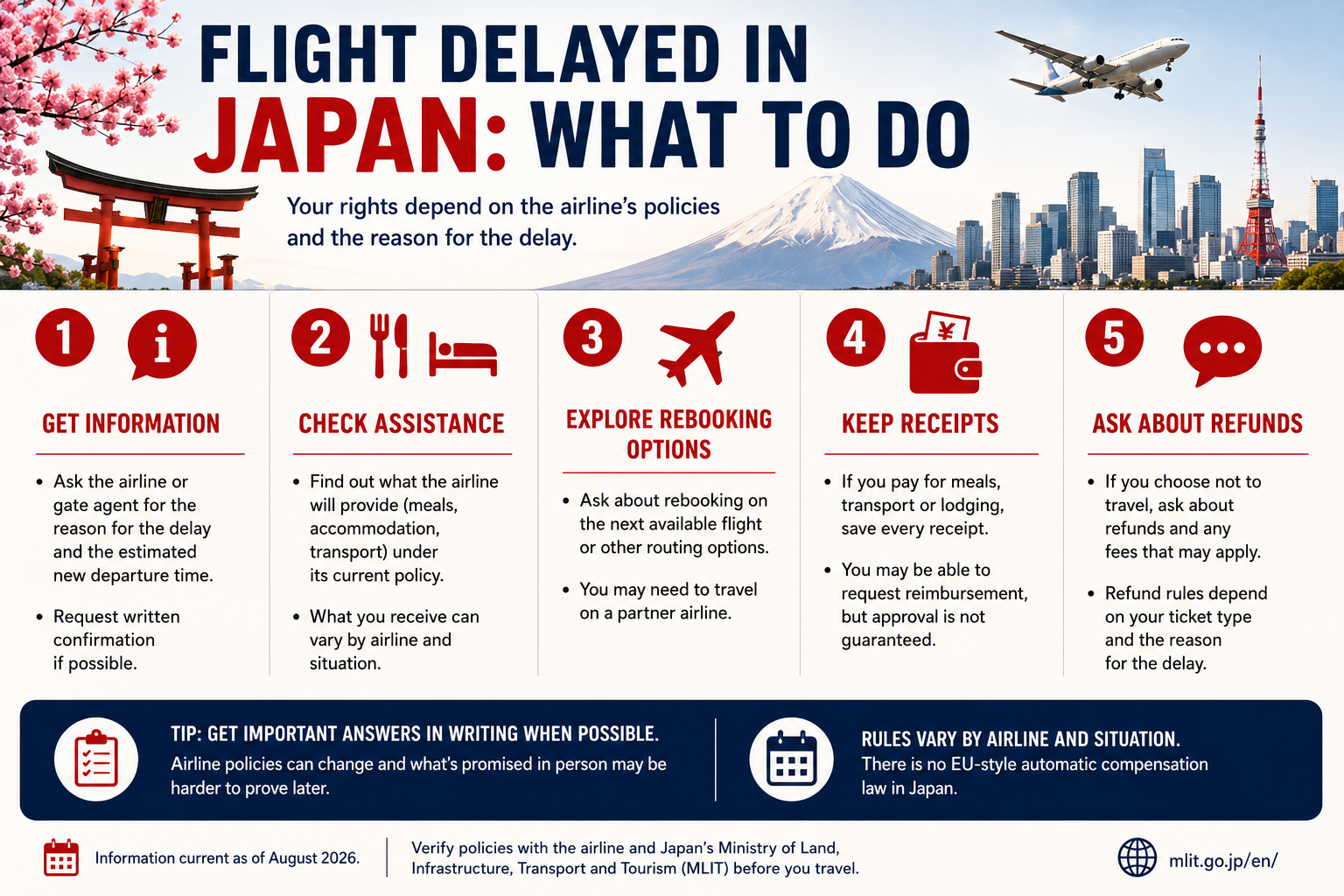
Japan: Start With the Airline
Japan may surprise travelers accustomed to reading about European passenger protections.
There isn't a Japanese equivalent of EU261 providing an automatic standardized cash payout simply because your flight arrives three or four hours late.
That doesn't mean you're left without options.
It means the operating airline's policies, conditions of carriage, your ticket and the circumstances surrounding the disruption become particularly important.
When you learn your flight is delayed, start gathering information.
Ask the airline or gate agent:
Why is the flight delayed?
What is the estimated new departure time?
What rebooking options are available?
What assistance is the airline providing for meals, transportation or accommodation?
If I decide not to travel, what refund options apply to my ticket?
And there's another question worth adding:
Can I have that in writing?
A verbal promise from a busy airport employee may become difficult to prove later.
Take screenshots of airline notifications. Keep your boarding pass and booking information. Photograph the departure board. Save emails and text messages.
If the airline says it will reimburse a hotel, meal or transportation expense, ask about the reimbursement procedure before spending your own money whenever practical.
Japan's national aviation authority is the Ministry of Land, Infrastructure, Transport and Tourism.
Official source:
Japan Ministry of Land, Infrastructure, Transport and Tourism (MLIT)
You'll also want to check the disruption policy and conditions of carriage for the airline actually operating your flight.
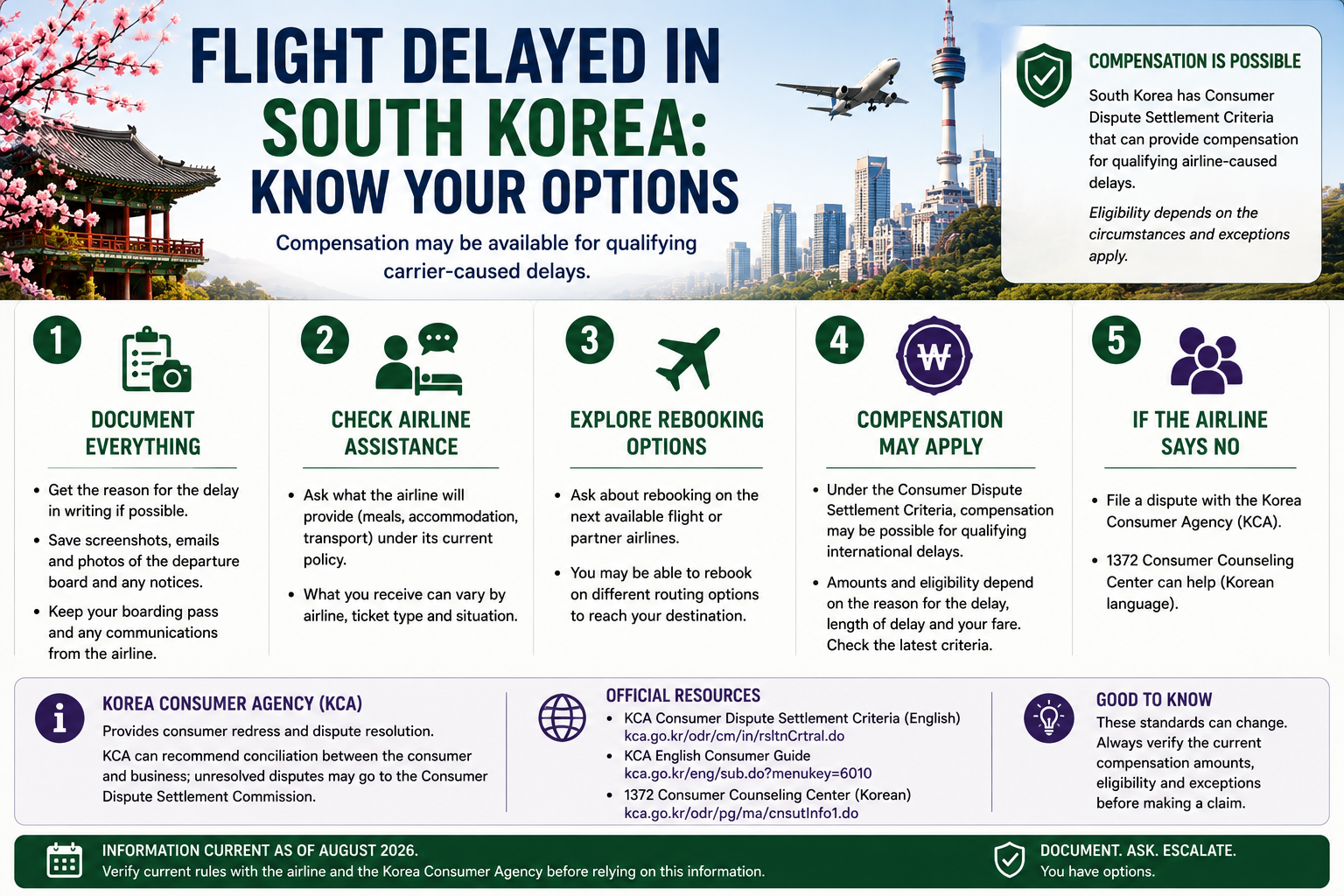
South Korea: Compensation May Be Available
South Korea is a different story.
The country's Consumer Dispute Settlement Criteria include standards covering air transportation and qualifying flight delays.
For international flights, the published criteria provide compensation for certain airline-attributable delays based on the fare and length of the delay. The criteria identify 10% of the fare for delays of 2 to 4 hours and 20% for delays of 4 hours or more, with reasonable room and board when necessary. Exceptions can apply for circumstances such as qualifying weather, airport conditions, flight-connection problems and unforeseen measures necessary for safe operation.
That's an important distinction from Japan.
But don't reduce the Korean system to:
My flight was late, therefore I automatically get money.
The reason for the delay matters.
So does the length of the delay and whether the circumstances meet the applicable criteria.
The Korea Consumer Agency itself advises consumers that compensation depends on the relevant standards and circumstances.
That makes documentation especially valuable.
If the airline identifies the disruption as an operational or mechanical problem, screenshot it.
Save airline messages.
Photograph the departure board.
Keep your boarding pass.
And if possible, obtain written confirmation of the stated reason for the delay.
Today's annoying notification could become tomorrow's supporting evidence.
What If the Airline Rejects Your Claim?
This is one of the more useful features of the Korean system.
You aren't necessarily finished when the airline says no.
The Korea Consumer Agency (KCA) provides consumer redress and dispute-resolution services. KCA can recommend conciliation between a consumer and business. If the parties can't reach agreement, a dispute can proceed to the Consumer Dispute Settlement Commission.
Official resources:
Korea Consumer Agency Consumer Dispute Settlement Criteria
Korea Consumer Agency English site
Korea's 1372 Consumer Counseling Center can also provide consumer counseling, although travelers should be aware that much of this system operates primarily in Korean.
China: Ask Who Caused the Delay
China gives us one of the most useful practical lessons in this entire article.
When your flight is delayed, don't merely ask:
How long?
Ask:
Why?
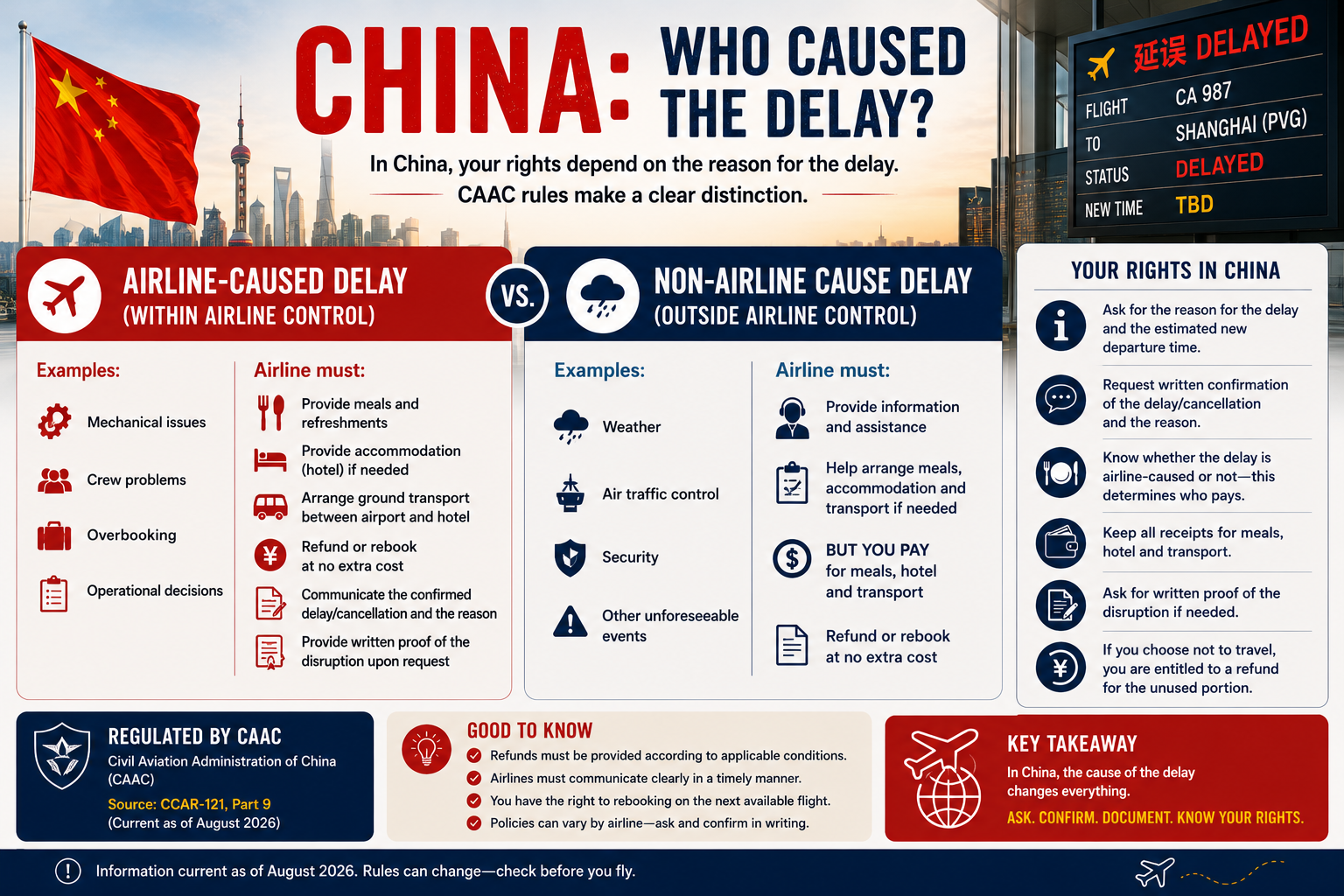
Under China's passenger-service regulations, the cause of a domestic flight disruption can affect who pays for meals and accommodations.
For certain domestic flights delayed or cancelled at the point of origin for reasons attributable to the carrier, the airline must provide meals or accommodation to passengers as required.
When a delay or cancellation at origin results from reasons outside the carrier's control, such as weather, unexpected events, security inspection or air-traffic-management reasons, the carrier must assist passengers in arranging meals and accommodation, but the passenger bears the cost.
That's a major distinction.
Airline-caused problem?
The carrier may be responsible for providing care.
Weather, air traffic control or another qualifying outside cause?
The airline may help arrange that care without necessarily paying for it.
China also has different provisions for domestic disruptions occurring at a stopover or after a diversion. For example, the regulations state that carriers must provide food and accommodation during delays or cancellations at a domestic-flight stopover regardless of the cause.
So in China, two questions matter:
Why is the flight disrupted?
and
Where in the journey did it happen?
Stuck on the Airplane in China? Watch the Clock
China also has unusually specific rules for tarmac delays
If you're sitting aboard the aircraft waiting to leave, the regulations require the carrier to provide passengers with updated information about the reason for the delay, estimated delay and other flight information every 30 minutes
Once the tarmac delay reaches two hours, the carrier must provide food and water
If it reaches three hours with no definite takeoff time, the carrier must arrange for passengers to disembark when doing so is consistent with safety and security requirements.
That's worth remembering because it's actionable information while you're actually sitting aboard the airplane
Official source
Civil Aviation Administration of China (CAAC) passenger-service regulation
These provisions were current when reviewed in August 2026. Check current CAAC regulations before relying on them during a future disruption.
What About an International Flight?
This is where things get more complicated
Consider four trips:
Los Angeles → Tokyo
Tokyo → Seoul
Seoul → Shanghai
Shanghai → Los Angeles
They all involve East Asia.
That does not mean they are governed by one identical set of passenger protections.
The applicable rules can depend on the itinerary, operating carrier, ticket, country involved and nature of the disruption.
International treaties may add another layer. The Montreal Convention, for example, addresses carrier liability for certain damages caused by delay during international carriage. That's different from a European-style system that says reaching a particular delay threshold automatically produces a fixed cash payment.
So avoid searching simply:
“Asia flight delay compensation.”
Get specific.
Search the airline, airport or country actually involved in your trip.
Specific beats generic when regulations are involved.
Don't Let the Language Barrier Stop You
Dealing with a disruption in another country adds another complication.
Communication.
Fortunately, your phone is now one of the best tools in your carry-on.
A translation app can help, but keep your questions short and specific:
Why is the flight delayed?
When will it depart?
Can you rebook me?
What assistance is the airline providing?
Who pays for the hotel?
Can I have that in writing?
That last distinction can be especially important.
An employee saying:
“We can arrange a hotel.”
does not necessarily mean:
“The airline will pay for your hotel.”
Ask.
Don't Just Stand in Line
When a major disruption hits, the customer-service line can grow astonishingly fast.
You don't have to make the line your only strategy.
While you're waiting:
Open the airline app.
Check for automatic rebooking.
Search later departures.
Look for alternate routings.
Check partner airlines.
If you're traveling together, divide the work. One person can deal with the airline app or phone while the other speaks with an airport representative.
And document the disruption while it is happening.
Information can change.
Screens disappear.
Notifications get replaced.
A screenshot takes two seconds.
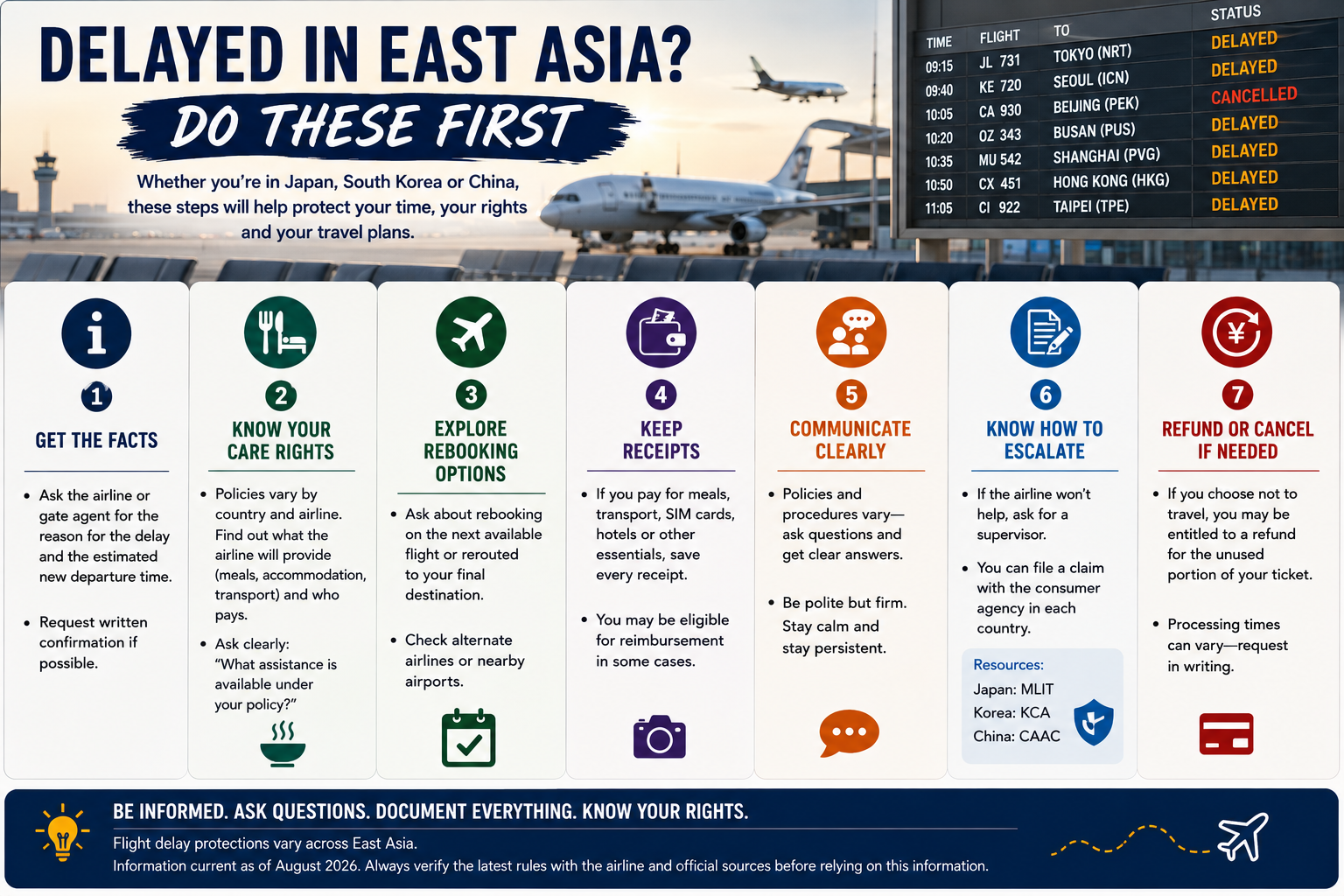
Save Every Receipt
This advice keeps appearing throughout Curated Upgrades for a reason.
If you spend your own money during a disruption:
Save the receipt.
Meal?
Save it.
Hotel?
Save it.
Taxi or train?
Save it.
SIM card or another reasonable expense needed because you're unexpectedly stranded?
Save it.
And don't depend solely on a little thermal-paper receipt surviving two weeks in your suitcase.
Photograph it.
Create a folder on your phone for the disruption and put the receipts, airline screenshots, boarding passes and other documentation together.
If you later seek reimbursement from an airline, insurer or credit-card benefits administrator, you've already built your file.
Your Credit Card May Be Another Layer of Protection
Government regulations and airline policies aren't necessarily your only protection.
Some travel credit cards provide trip-delay or trip-cancellation coverage for qualifying disruptions.
Depending on the card and circumstances, eligible expenses can include things such as meals, lodging or transportation that the airline doesn't cover.
But this is another area where assumptions can become expensive.
Benefits vary by card.
Covered reasons vary.
Required delay periods vary.
Dollar limits vary.
And benefits can change.
So check the current Guide to Benefits for the exact card you used to purchase the trip rather than relying on something you remember reading when you opened the account.
The Biggest Lesson: Geography Matters
A delayed flight feels pretty much the same everywhere.
The rules don't.
Japan, South Korea and China are a perfect illustration.
Japan doesn't provide an EU-style automatic cash-compensation system for flight delays, making the airline's policies, ticket and circumstances particularly important.
South Korea has consumer dispute-resolution criteria that can provide compensation for qualifying airline-caused delays and a formal mechanism for pursuing unresolved consumer disputes.
China has detailed passenger-service regulations in which the cause and location of a disruption can affect an airline's obligations.
Three countries.
Three systems.
But one strategy travels remarkably well:
Ask questions. Document everything. Know why the flight is delayed. Find out what the airline will provide. Save every receipt.
You don't need to memorize international aviation law before vacation.
You just need to know enough to ask the right questions when the departure board turns red.
Before You Fly
Spend five minutes before an international trip identifying three things:
Who regulates aviation at your destination?
Where is your airline's disruption policy?
Does the credit card you used provide trip-delay protection?
Bookmark those pages on your phone.
Hopefully you'll never look at them again.
But if ON TIME suddenly becomes DELAYED, you'll know where to start.
Important
This article provides general travel information, not legal advice. Aviation regulations, consumer-protection standards, airline policies, compensation amounts and credit-card benefits can change. Information was reviewed against official sources and is current as of August 2026. Always verify the current rules applicable to your specific itinerary, operating airline and circumstances before relying on a particular protection or making a claim.
Last reviewed: August 2026