

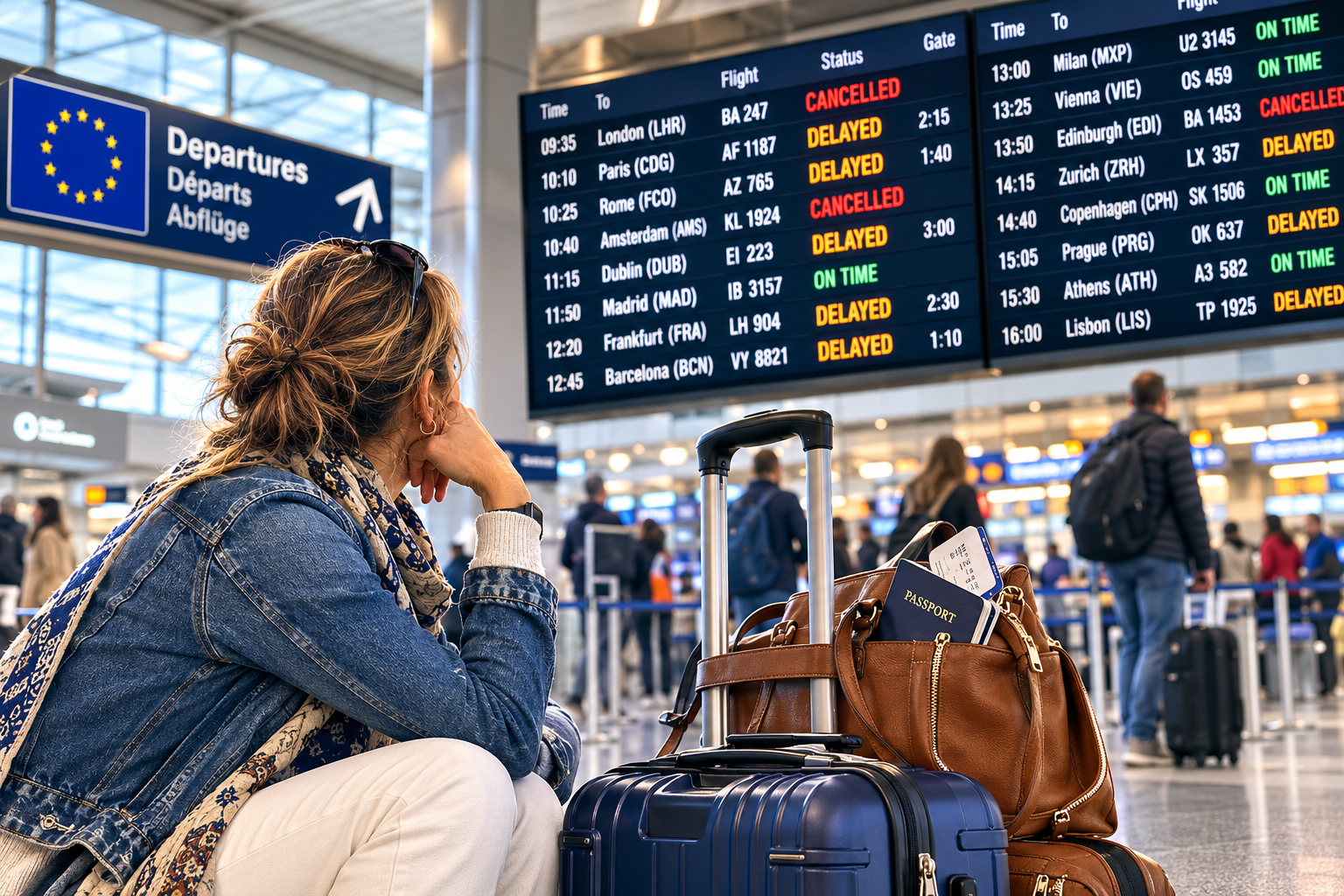
Flight Delays in Europe: Your EU261 & UK261 Rights
Flying to, from or within Europe? A serious delay or cancellation may entitle you to meals, a hotel, rerouting, a refund and, in qualifying cases, up to €600 or £520 in cash compensation.
If you've ever been stranded in a U.S. airport, you probably know the routine.
The departure board turns red. A line forms at customer service. Maybe the airline offers a meal voucher or a hotel. Maybe it doesn't.
And unless you decide not to travel after a qualifying cancellation or significant change, there generally isn't a federal rule requiring a U.S. airline to hand you hundreds of dollars simply because you arrived several hours late.
Cross the Atlantic and the rulebook changes dramatically.
In the European Union and United Kingdom, passengers have some of the world's strongest statutory protections when flights are delayed or cancelled.
Under EU Regulation 261/2004, commonly called EU261, and the UK's post-Brexit passenger-rights regime commonly called UK261, a qualifying disruption can trigger several different rights.
And this distinction is important:
Cash compensation is only one of them.
Depending on what happened, you may also have rights involving meals, refreshments, accommodation, transportation, reimbursement or rerouting.
You don't have to be European to qualify.
An American traveler on vacation can have exactly the same protections.
The trick is knowing which rules apply to your particular flight.
IMPORTANT AUGUST 2026 UPDATE
The European Union adopted revised air-passenger-rights rules in July 2026. According to the European Commission, those changes are expected to enter into force in summer 2027.
Until then, travelers continue to benefit from the existing EU rules described in this article. If you're reading this after summer 2027, verify the current rules before relying on the thresholds or procedures below.
Official source: European Commission passenger-rights update
First Question: Is Your Flight Covered?
This is where many American travelers get tripped up.
Your citizenship doesn't determine whether EU261 or UK261 protects you.
Your itinerary and operating airline do.
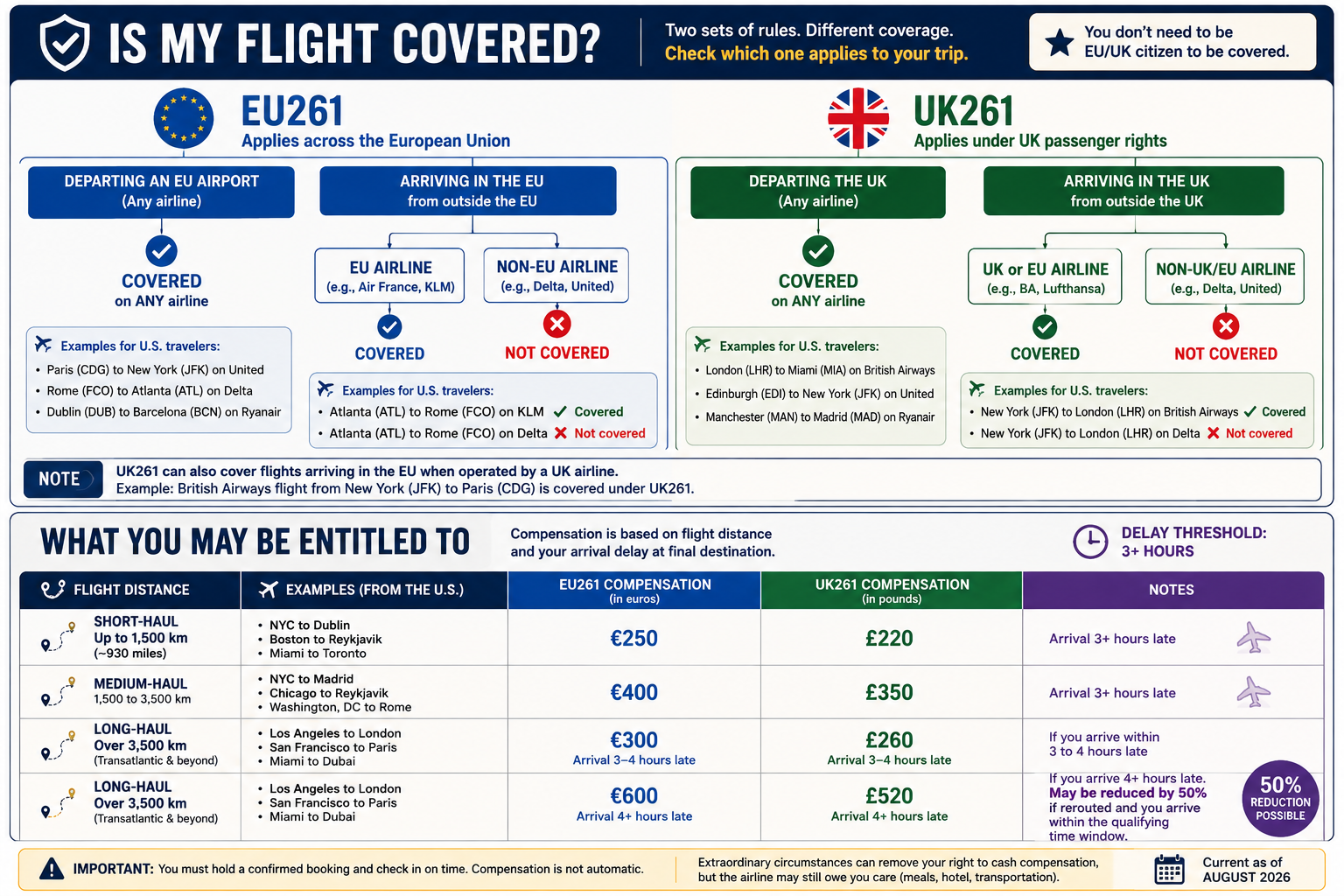
Under current EU rules, flights departing an EU airport are generally covered regardless of the airline.
That means:
Paris → New York on Air France?
Covered.
Paris → New York on Delta?
Also covered.
But when you're flying into the EU from outside the EU, the operating carrier matters.
New York → Paris on Air France?
Covered.
New York → Paris on Delta?
Generally not covered by EU261.
The UK has its own geographic rules.
Flights departing a UK airport are covered regardless of airline. Flights arriving in the UK can be covered when operated by a UK or EU carrier, and certain UK-airline flights arriving in the EU are also covered by UK law.
That's why simply asking:
“I'm flying to Europe. Am I covered?”
isn't enough.
Ask:
Where does my flight depart? Where does it arrive? And which airline actually operates it?
A Three-Hour Delay Could Mean Cash Compensation
This is the protection that gets everyone's attention.
Under the EU rules applicable in August 2026, passengers who reach their final destination three or more hours late may qualify for fixed compensation when the applicable requirements are met and the disruption wasn't caused by extraordinary circumstances.
The amount isn't based on what you paid for the ticket.
It's primarily determined by flight distance and the length of the qualifying arrival delay.
For EU261, compensation can reach:
€250 for shorter flights.
€400 for qualifying medium-distance flights.
€600 for qualifying long-distance flights.
Under UK rules, corresponding compensation can reach:
£220
£350
or
£520
depending on distance and delay.
That means an inexpensive economy ticket can potentially generate compensation worth considerably more than the original fare.
And notice the language:
Arrival delay.
For compensation purposes, what matters isn't simply how long you sat at the departure gate.
It's how late you ultimately reach your destination.
Current EU and UK guidance also contains circumstances in which compensation can be reduced, including certain rerouted journeys that reach the final destination within specified time limits.
Cash Compensation and Right to Care,
They Are NOT the Same Thing
This may be the most important distinction in the entire article.
Travelers often lump everything the airline might provide into one bucket.
European passenger-rights rules don't work that way.
Think of them as two separate lanes.
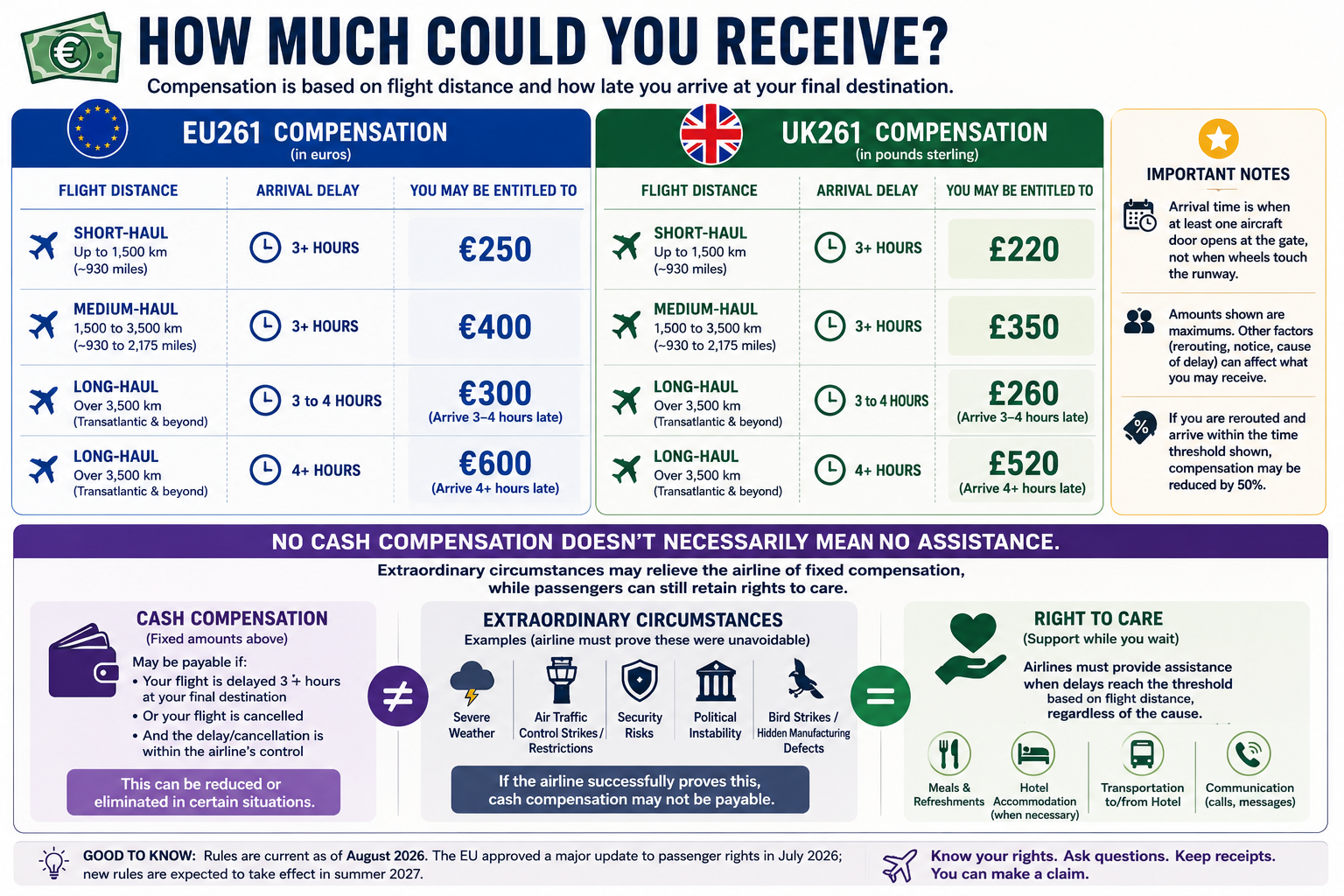
CASH COMPENSATION
This is the fixed payment that can reach €600 under EU261 or £520 under UK rules.
Eligibility depends on factors including the length of the disruption, flight distance and why the disruption occurred.
RIGHT TO CARE
This involves taking care of you while you're stranded.
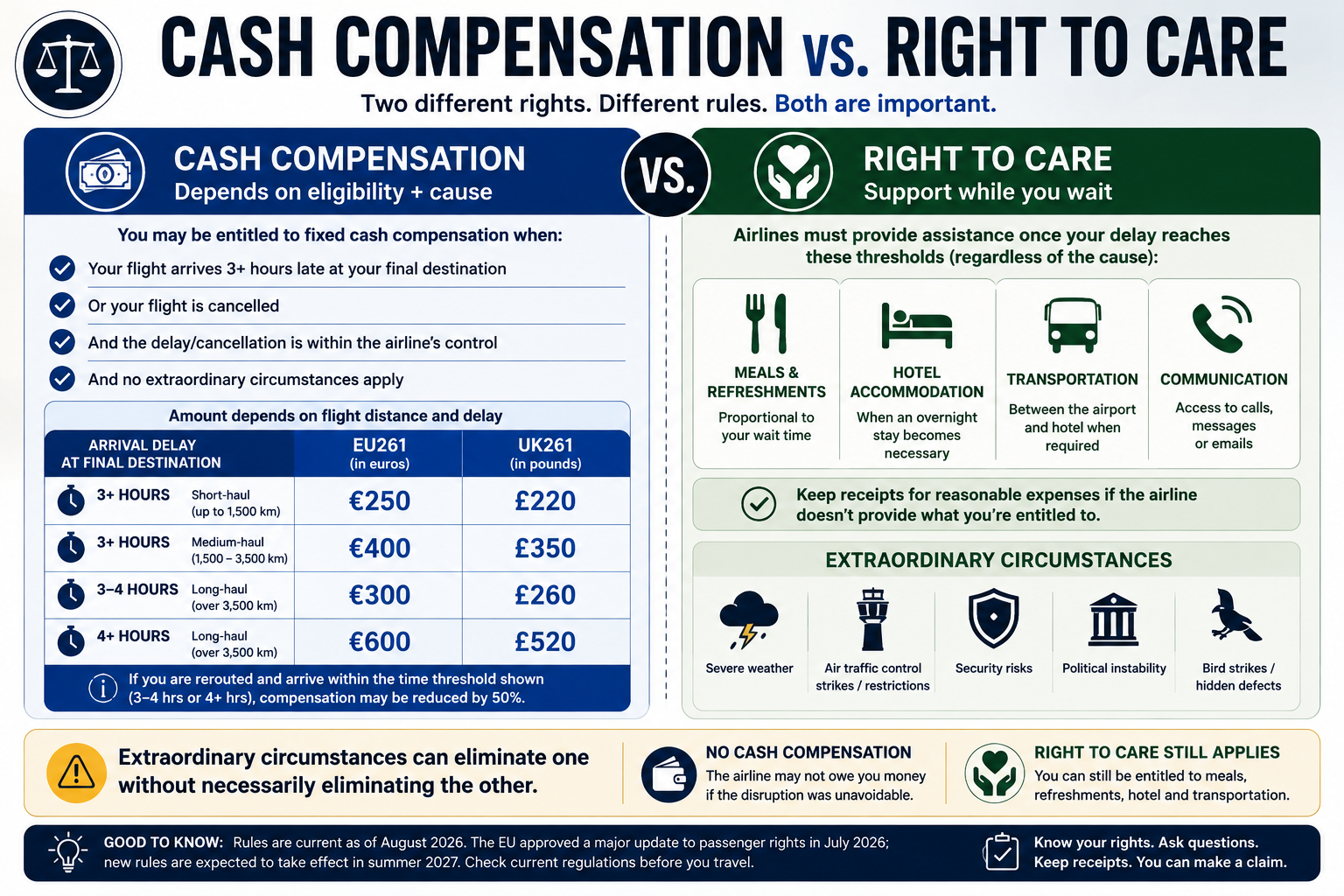
Depending on the length and circumstances of the disruption, that can include reasonable:
Meals and refreshments
Hotel accommodation when an overnight stay becomes necessary
Transportation between the airport and accommodation
Communication
For delayed flights, the point at which care becomes due varies by flight distance. Under current UK guidance, for example, the thresholds begin at two hours for flights under 1,500 km, three hours for flights between 1,500 and 3,500 km, and four hours for longer flights. EU rules use corresponding distance-based care thresholds.
And here's the part worth remembering:
No cash compensation does not necessarily mean no assistance.
A disruption caused by extraordinary circumstances may eliminate the fixed cash payment while leaving applicable care obligations intact.
What If the Airline Doesn't Give You a Meal or Hotel?
Ask first.
During a major disruption, however, airline employees may be dealing with hundreds or even thousands of stranded passengers.
Sometimes vouchers don't materialize.
Sometimes the hotel desk has a line stretching halfway across the terminal.
Official EU guidance says that if required assistance isn't offered and you pay yourself, the airline should reimburse necessary, reasonable and appropriate expenses.
UK CAA guidance similarly advises passengers who must make their own arrangements to keep itemized receipts and avoid excessive spending.
So don't interpret your right to accommodation as:
“Excellent. The airline is buying me a suite at the Ritz.”
Book something reasonable.
Buy a reasonable meal.
Keep every receipt.
And if possible, document that you attempted to obtain assistance from the airline first.
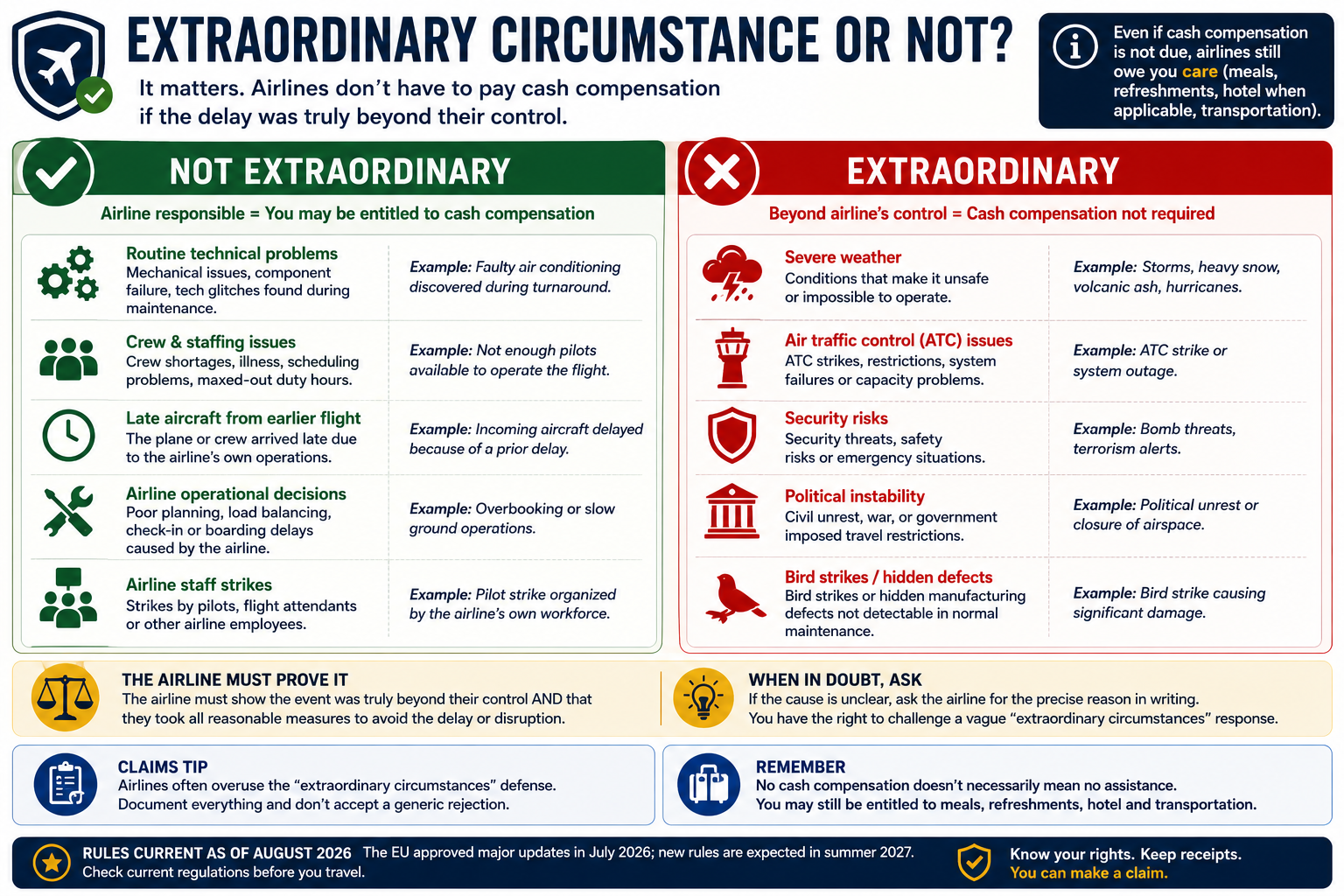
The Big Exception: Extraordinary Circumstances
Here's where many compensation claims are won or lost.
An airline doesn't generally owe the fixed cash compensation if it can establish that the disruption resulted from extraordinary circumstances that couldn't have been avoided even if reasonable measures had been taken.
Examples that may qualify include:
Severe weather
Air-traffic-control restrictions or external ATC strikes
Certain security risks
Political instability
Other situations that are part of the airline's normal operation may not qualify as extraordinary.
Official EU guidance specifically notes that an internal strike organized by an airline's own employees does not automatically qualify as extraordinary, while an external strike such as one involving air-traffic controllers or airport staff may.
Routine technical problems can also be more complicated than an airline simply saying:
“Mechanical issue. No compensation.”
The exact facts matter.
So if an airline rejects your claim because of “extraordinary circumstances,” don't assume those two words automatically end the conversation.
Ask:
What specifically caused the disruption?
And:
Why does the airline believe that qualifies as an extraordinary circumstance?
Your Flight Was Cancelled. Now What?
Delays get most of the attention, but cancellation protections can be even more useful.
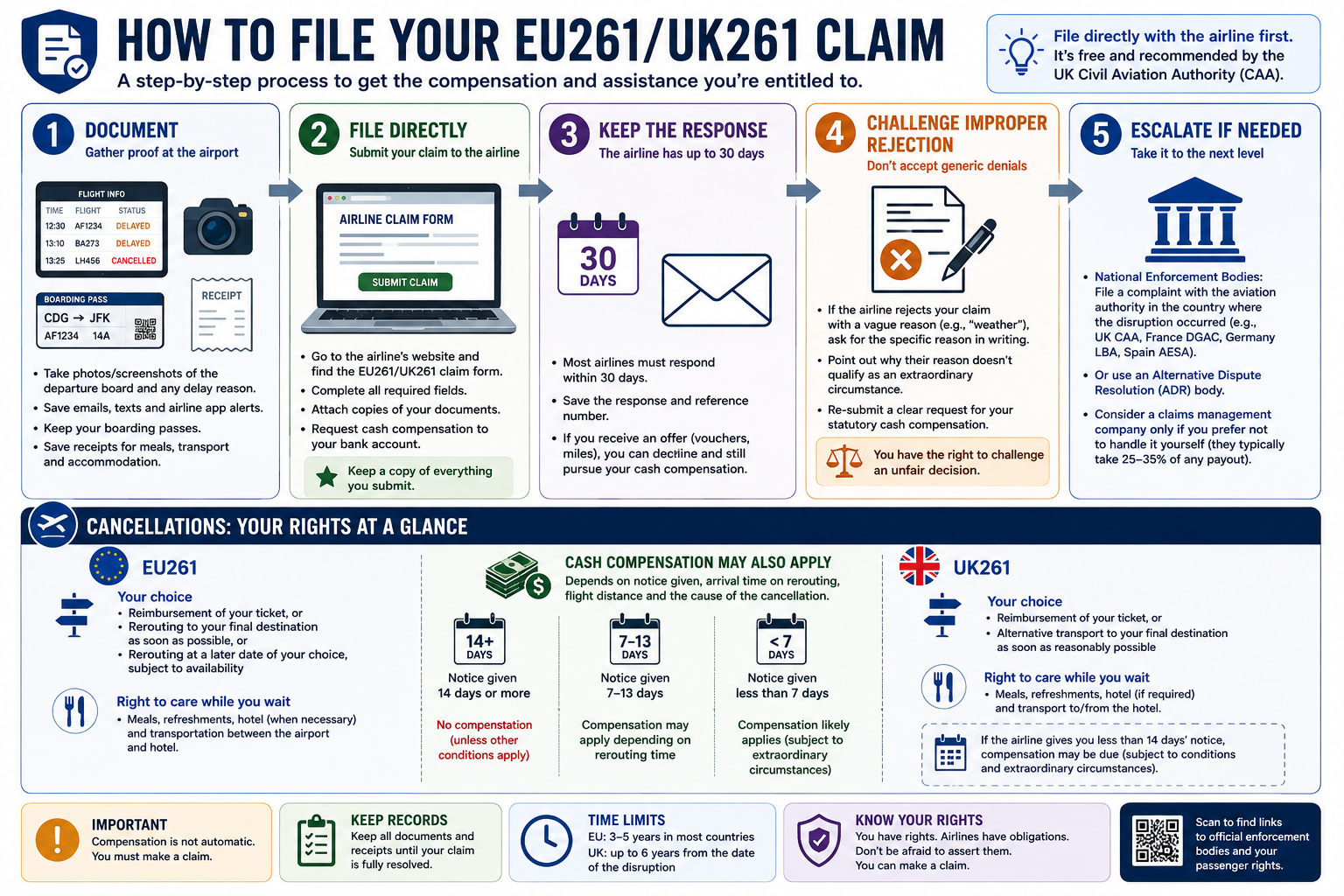
Under current EU rules, when a covered flight is cancelled, the airline generally must offer a choice between:
Reimbursement
or
Rerouting to your final destination at the earliest opportunity
or
Rerouting at a later date under comparable conditions, subject to availability.
Once you choose one of these paths, you generally can't later switch among all three as though you hadn't made a choice.
Fixed compensation may also be payable.
For cancellations, however, factors such as how much advance notice you received, the timing of replacement transportation and the reason for the cancellation become important.
Under both EU and UK systems, the 14-day mark matters.
A cancellation announced less than 14 days before departure can potentially trigger compensation, although the timing of an offered replacement flight and extraordinary circumstances can change the result.
So don't think:
Refund OR compensation.
Depending on the circumstances, those can be separate rights.
A Five-Hour Delay Can Give You Another Choice
There's another EU protection worth knowing.
If your departure is delayed by at least five hours and the trip no longer serves its purpose, EU rules can give you the right to reimbursement of the ticket and, when applicable to a connecting itinerary, a return flight to your original departure point at the earliest opportunity.
This can matter enormously on short trips.
Suppose you're flying from Paris to Rome for a one-night event.
A huge delay may make arriving the next morning essentially pointless.
Sometimes the most valuable right isn't compensation.
It's the ability to say:
This trip no longer works. I want my money back.
Don't Fight About Compensation at the Gate
When your flight is cancelled, the gate agent's immediate job is getting airplanes and passengers moving again.
Use that interaction for your immediate needs:
Rebooking
Rerouting
Meals
Accommodation
Transportation
Information about the disruption
Then document everything.
You can pursue statutory compensation afterward.
Take screenshots of the airline app.
Photograph the departure board.
Save texts and emails.
Keep boarding passes.
Write down the stated reason for the disruption.
Save receipts.
And note when you actually reached your final destination.
Your future claim is much easier when you've already built the evidence file.
File the Claim Directly With the Airline First
You don't necessarily need a claims company to pursue EU261 or UK261 compensation.
Start with the airline.
Look on its website for terms such as:
EU261 compensation
UK261 compensation
Passenger rights
Flight disruption claim
or
Delay compensation
Submit the requested documentation and keep a copy of your claim.
If the airline offers miles or a voucher instead, understand exactly what you're accepting before agreeing.
If you're entitled to statutory monetary compensation and that's what you want, clearly request it.
And if the airline rejects your claim?
Read the reason.
A specific, well-supported explanation is very different from a generic:
“Extraordinary circumstances.”
If you believe the rejection is incorrect, challenge it and provide your evidence.
If necessary, you can then investigate the appropriate national enforcement or alternative dispute-resolution route.
What About Claims Companies?
You've probably seen them advertised.
Enter your flight number, answer a few questions, and they'll pursue the airline for you in exchange for part of whatever they recover.
They can be useful, particularly when a difficult claim requires more effort than you're willing to invest.
But don't assume they're the necessary first step.
For a straightforward claim, file directly with the airline first.
If the airline pays you €600 directly, you keep €600.
There's no reason to voluntarily give away a substantial percentage of a simple claim you could submit yourself in a few minutes.
If the claim becomes complicated or repeatedly rejected, you can decide whether outside help is worth the cost.
One More Thing: Your Credit Card May Still Matter
EU261 and UK261 protections don't make travel insurance or credit-card protections irrelevant.
Quite the opposite.
Government-mandated passenger rights, airline obligations and credit-card insurance can act as different layers of protection.
One may cover something another doesn't.
So if you paid for your trip with a card that includes travel protections, check its current Guide to Benefits after a significant disruption.
Just don't assume you can collect twice for the same expense.
Before You Leave the Airport
You don't need to become an aviation lawyer while standing underneath a departures board.
You need to remember a handful of things:
Find out why the flight is disrupted.
Ask what care the airline will provide.
Know whether you want a refund or still want to travel.
Document the disruption.
Keep every receipt.
File directly with the airline afterward if compensation may apply.
Most importantly, don't assume the rules you're accustomed to in the United States follow you across the Atlantic.
They don't.
A delay that might produce little more than an apology in one country can potentially trigger meals, accommodation, rerouting and hundreds of euros or pounds in compensation under another system.
The departure board may look exactly the same.
Your rights don't.
Important
This article provides general travel information, not legal advice. Passenger-rights laws, court interpretations, compensation rules, airline policies and claim procedures can change. Information in this article was reviewed against official EU and UK sources and is current as of August 2026.
The European Union adopted revised air-passenger-rights rules in July 2026 that are expected to enter into force in summer 2027. If you're reading this after that point, verify the current EU rules before relying on the thresholds or procedures described here.
Last reviewed: August 2026