

How Much Does Public EV Charging Cost?
Kilowatt-hours, charging speeds, changing rates, and surprise fees. Here's how to understand what you're paying before you plug in.
Where's the Price Sign?
Pull off the interstate for gasoline and you know the routine. The price is displayed on a giant sign, often before you even reach the exit. You know what a gallon is, roughly how much your tank holds, and what filling up will cost.
Now pull into a public EV charging station.
Where's the price?
There probably isn't a giant sign advertising electricity at 38 cents per kilowatt-hour, with fresh coffee inside.
Instead, you may need to open an app, check the charger screen, or look up the station's rates before knowing what you're going to pay.
And depending on the station, you might pay for the electricity you receive, the time you spend charging, or a combination of charges.
First, let's translate the terminology.
EV Charging Terms, Explained
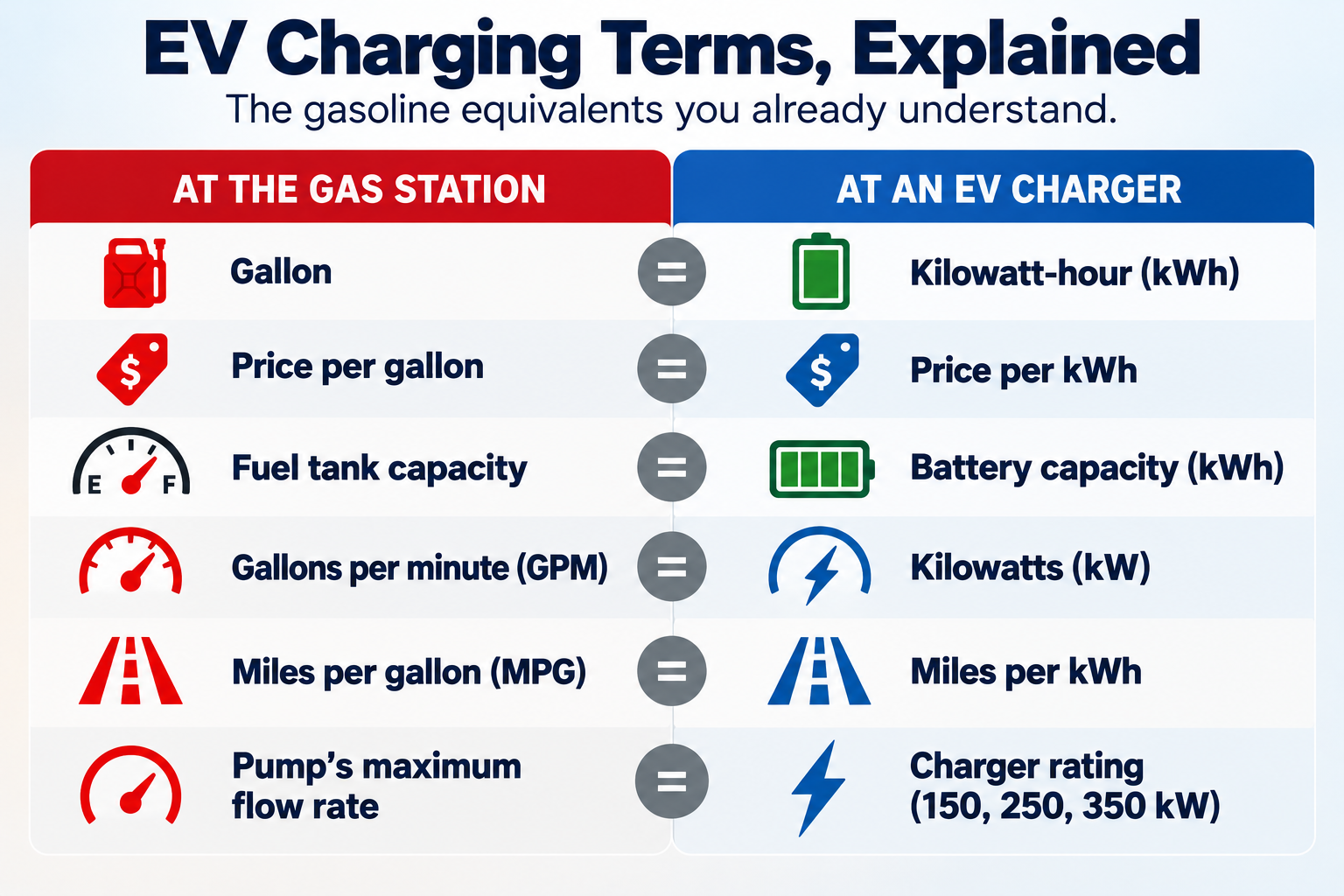
We've spent generations buying gasoline by the gallon. Electricity uses a different vocabulary, but the concepts aren't entirely unfamiliar.
A gallon measures how much fuel you're buying. A kilowatt-hour measures how much electrical energy you're buying. And just as gasoline flows through a pump at a certain rate, electricity flows into a battery at a measurable rate.
The two terms you'll encounter most often are kW and kWh.
Kilowatts (kW) measure power. Think of how quickly gasoline flows through the pump.
Kilowatt-hours (kWh) measure energy. Think of the gallons that actually go into your tank.
For example, a charger delivering a steady 100 kW for 30 minutes supplies 50 kWh of electricity.
And when you see a charger advertised as 150, 250, or 350 kW, that's its maximum power rating, not a promise of how quickly your particular vehicle will charge.
Your EV controls how much power its battery can accept. Battery temperature, charge level, and vehicle design all matter. Charging usually slows as the battery fills.
That's particularly important when you're paying by the minute.
Same Electricity. Different Bill?
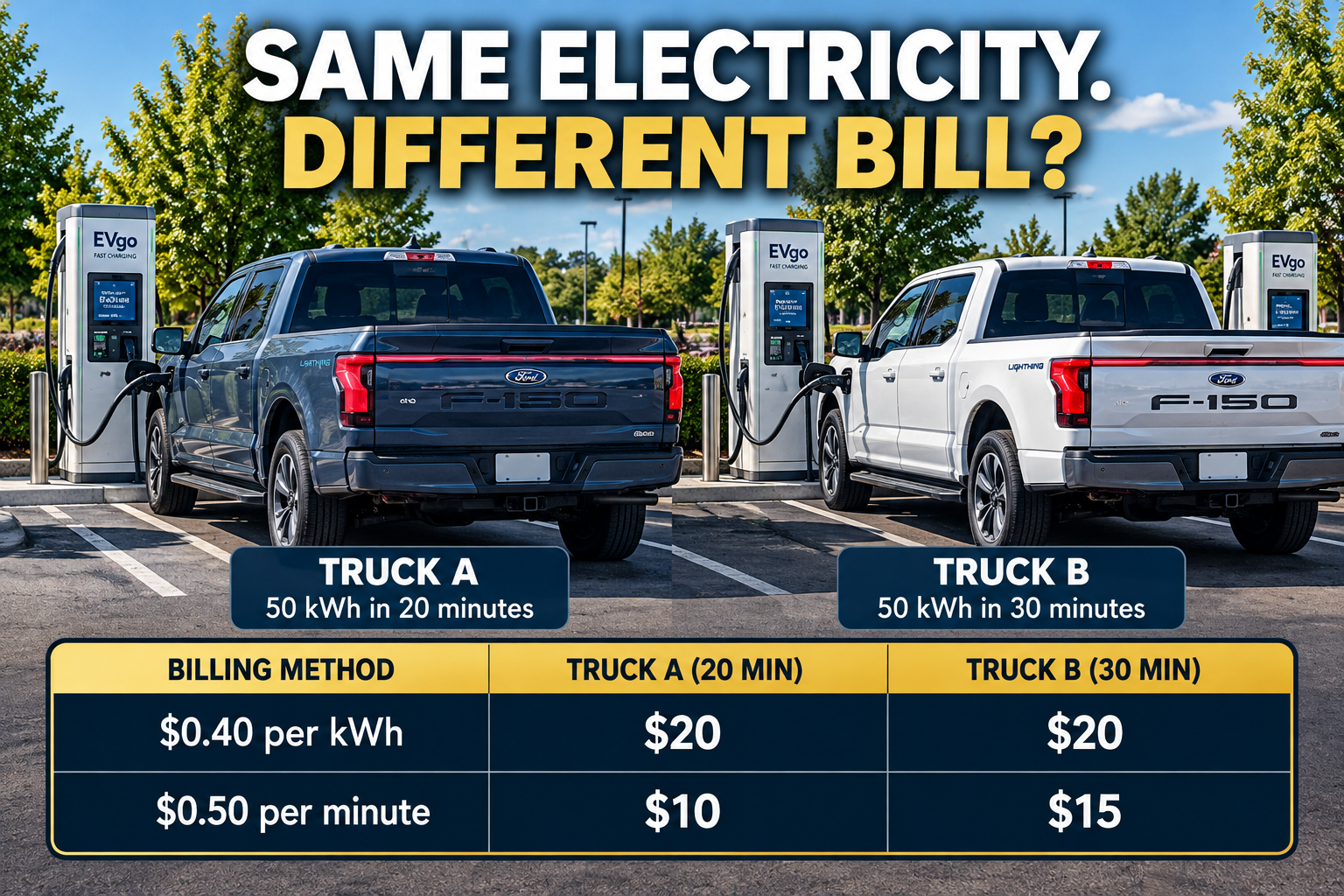
Imagine two Ford F-150 Lightnings pulling into neighboring fast chargers.
Both receive 50 kWh of electricity.
Truck A finishes in 20 minutes. Truck B takes 30 minutes.
At $0.40 per kWh, each truck pays $20. Same electricity, same price.
But suppose the station charges $0.50 per minute.
Truck A pays $10. Truck B pays $15.
Same electricity. Different bill.
Unlike a gasoline driver deliberately squeezing the nozzle more slowly, an EV driver often has little control over how quickly the battery accepts electricity.
That's why per-minute billing can produce different costs for the same amount of energy.
Some networks also use different per-minute rates depending on charging power. And per-minute energy billing isn't permitted everywhere, so the billing method depends on the location and applicable rules.
Why Does the Price Change?
There's no universal price for public EV charging.
One station might charge $0.39 per kWh while another charges $0.60. These are illustrative rates, but the differences between locations are real.
There are three important pricing models.
Station-specific pricing: Different locations have different rates. A charger beside a busy interstate may cost more than one across town. That doesn't necessarily mean the prices are changing dynamically.
Time-of-use pricing: Rates change according to a schedule. Charging during peak hours may cost more than charging late at night. Electrify America offers time-of-use pricing at select stations, and EVgo offers rates that can vary by time and location.
Dynamic pricing: Rates can respond to changing conditions. Tesla has introduced live Supercharger pricing at certain locations, using factors such as station occupancy and expected demand. A busy location may cost more than the same station during a quieter period.
With Tesla's live pricing, the rate can change while you're driving toward the station, but the price is locked when your charging session begins.
You can review current pricing through Tesla Supercharging, Electrify America, and EVgo.
ChargePoint works somewhat differently. Many stations are independently owned, and their owners establish the rates. One location might offer free charging, while another charges for electricity, time, or both.
The important distinction: Different prices at different chargers aren't necessarily dynamic pricing. Always check the rate at the particular station you're considering.
The Price on the Screen Might Not Be Your Final Bill
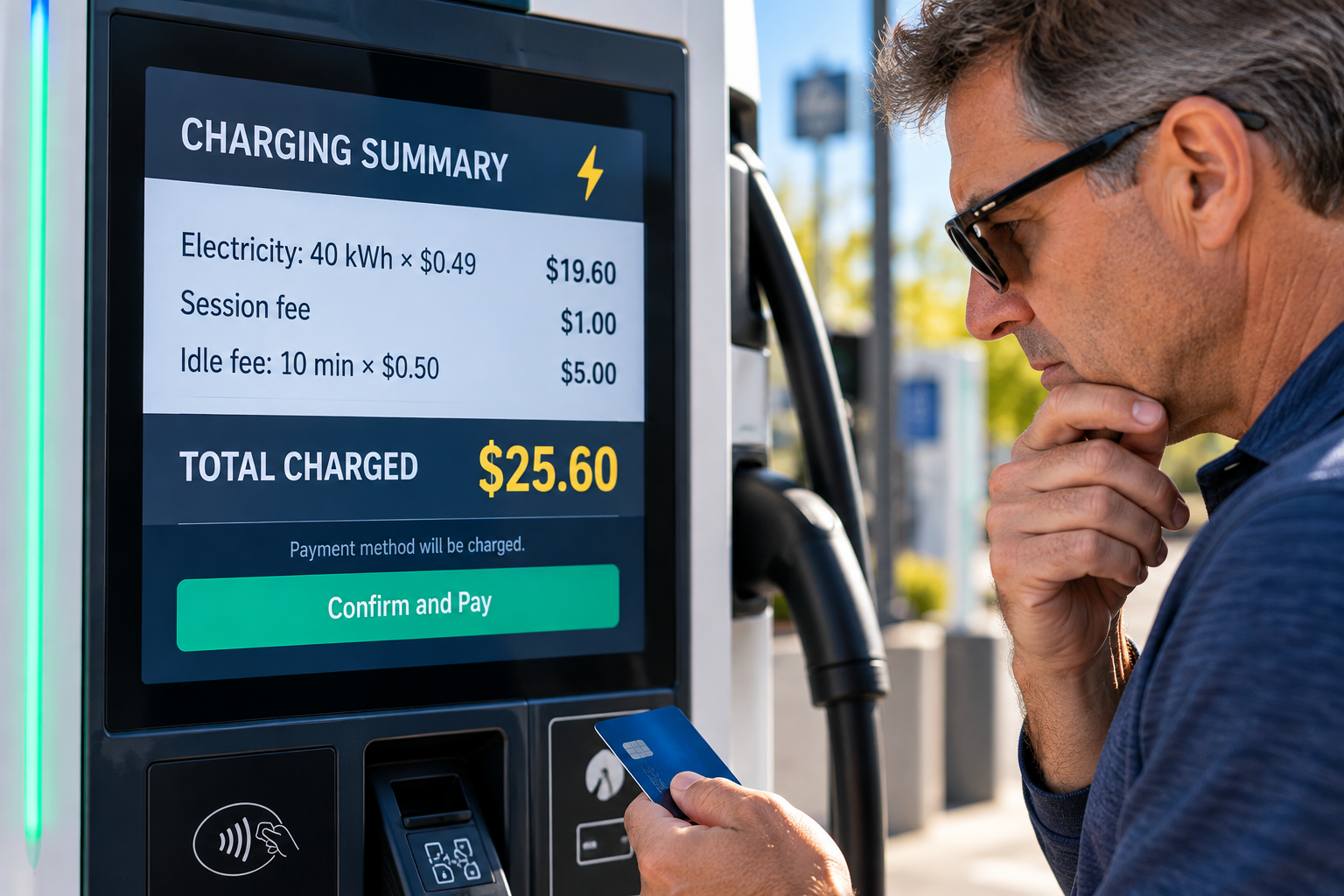
Suppose you find a charger advertising electricity at $0.49 per kWh.
You receive 40 kWh, so the electricity costs $19.60.
Simple enough.
But imagine that station also charges a $1 session fee. Then you leave the car connected after charging finishes and incur a $5 idle fee.
Your final bill is now $25.60.
That's $6 more than the electricity alone.
These are the additional charges worth watching for:
Session fees: A flat fee for starting a charging session.
Idle fees: Charges for leaving a vehicle connected or occupying the space after charging ends, subject to the station's rules.
Congestion fees: Charges that some busy stations impose when a vehicle remains at the charger beyond a specified battery level or after charging finishes.
Payment authorization holds: Temporary amounts reserved on your credit or debit card. They aren't necessarily additional charges, but they can temporarily reduce your available balance.
Some fees have grace periods, and not every station imposes them.
The lesson is simple: don't look only at the electricity rate. Check the full pricing terms before charging.
Can a Membership Save You Money?
Possibly, especially during a road trip when you'll use the same network repeatedly.
Electrify America's Pass+ offers approximately 25% savings on eligible charging, while EVgo has paid plans offering reduced rates and waived session fees.
But the subscription isn't automatically a bargain.
Suppose a membership costs $7 per month and saves you $0.15 per kWh.
Charging 50 kWh saves $7.50 before the membership cost. You've barely broken even.
Charge 150 kWh during a longer trip and your gross savings reach $22.50, leaving $15.50 after the membership fee.
Those are illustrative numbers, not a guaranteed network discount.
For occasional users, a free account may be enough. For a longer trip, a one-month paid membership could make sense.
Check the current price, participating stations, and renewal terms before subscribing.
Renting an EV? Check the Return Rules
Rental EVs add another potential cost.
Depending on the rental company, public charging may be billed through your own account or added to the rental bill.
Some companies also require the vehicle to be returned with a minimum battery charge. Return it below that level and you may face a separate fee.
That means you could pay for electricity during your trip and still owe a charging-related fee when you return the car.
Before leaving the rental lot, check how public charging is billed and what battery level is required at return.
Curated Upgrades Recommends
🟢 Go for it! Check the actual charging rate before arriving whenever possible. Use the network's app or your vehicle's navigation, and look for additional fees.
🟢 Go for it! Compare nearby stations when your route allows. A lower rate may be worth a short detour, provided the charger is compatible, available, and fast enough for your needs.
🟡 Maybe. Consider a paid charging membership for a trip involving repeated stops on the same network. Calculate the likely savings first.
🔴 Pass on it. Don't assume the charger's advertised 350 kW rating means your car will charge at 350 kW, or that the displayed per-kWh rate represents every possible charge on your bill.
The Bottom Line
Public EV charging isn't particularly difficult once you understand the terminology.
kWh tells you how much electricity you're buying.
kW tells you how quickly it can be delivered.
The station's pricing rules determine what you'll pay.
Unlike gasoline stations, public chargers don't generally announce their prices on enormous roadside signs.
So before plugging in, check the rate, understand the billing method, and look for additional fees.
A little preparation can make the difference between a routine charging stop and an unexpectedly expensive one.
For help finding compatible chargers and understanding payment methods, read How Do You Pay for Public EV Charging?