


How Much Is Your Vacation Time Worth?
The cheapest way to get somewhere isn't always the best use of your vacation.
Two Extra Days in Alaska. Worth Every One.
When Gina and I planned our Alaska trip, we made a couple of decisions that probably wouldn't have impressed someone looking strictly at the cheapest way to get there.
We were flying out of Orlando, so we drove down the day before, checked into a hotel near the airport, and went out for a nice dinner.
No frantic early-morning drive. No worrying about traffic on the way to catch a flight. We had already made it to Orlando, and the vacation was underway.
We also arrived in Alaska a day before our organized tour began.
That gave us time to visit family members who lived there, relax, and adjust to the time difference. By the time the tour started, we felt rested and ready to enjoy what we'd traveled all that way to see.
Those decisions added two days to our trip, along with some additional expenses.
Were they worth it?
Absolutely.
But here's the important part: I had the vacation time available to use.
If I'd been short on annual leave, I might have made an entirely different decision.
And on another trip, that's exactly what happened.

Same Travelers. Completely Different Decision.
When we booked our Viking river cruise, we didn't have the luxury of adding extra vacation days.
I would have loved to arrive in Budapest a day early, explore a little, and have some breathing room before boarding the ship.
But we simply didn't have the time.
We looked at flights from Orlando, but getting to and from Orlando would have required another vacation day. That wasn't an option.
So we booked a longer flight itinerary from Jacksonville instead.
We arrived in Budapest on the day the cruise began and flew home when it ended.
Was it a more hurried way to travel? Sure.
Would I have preferred a buffer day? Absolutely.
But we had enough time to take the cruise, and that was what mattered.
We also booked our airfare through Viking. That was a deliberate part of the decision. If flight delays or cancellations disrupted our arrival, I wanted the cruise line involved in helping us reach the ship.
Viking's air travel services include flight monitoring and assistance with disrupted itineraries. That doesn't mean every possible expense or missed sailing is automatically covered but having that assistance was valuable to us.
We weren't eliminating every risk. We were choosing an arrangement that made sense within our limitations.
Alaska was worth two extra vacation days. Viking was worth a more demanding travel schedule.
Same travelers. Different circumstances. Both good decisions.
That's why I don't believe there's a universal dollar value you can assign to vacation time.
The Cheapest Flight Isn't Always the Cheapest Trip
When I start looking at airfare, Jacksonville is usually my first search.
It's a convenient airport for us. But depending on where we're going, the available flights may require connections or have schedules that aren't particularly appealing.
So I expand the search.
Orlando. Tampa. Miami.
Sometimes those airports offer nonstop flights that aren't available from Jacksonville. Sometimes the fares are lower. Sometimes the departure times are better.
And sometimes, after looking at everything involved, Jacksonville still wins.
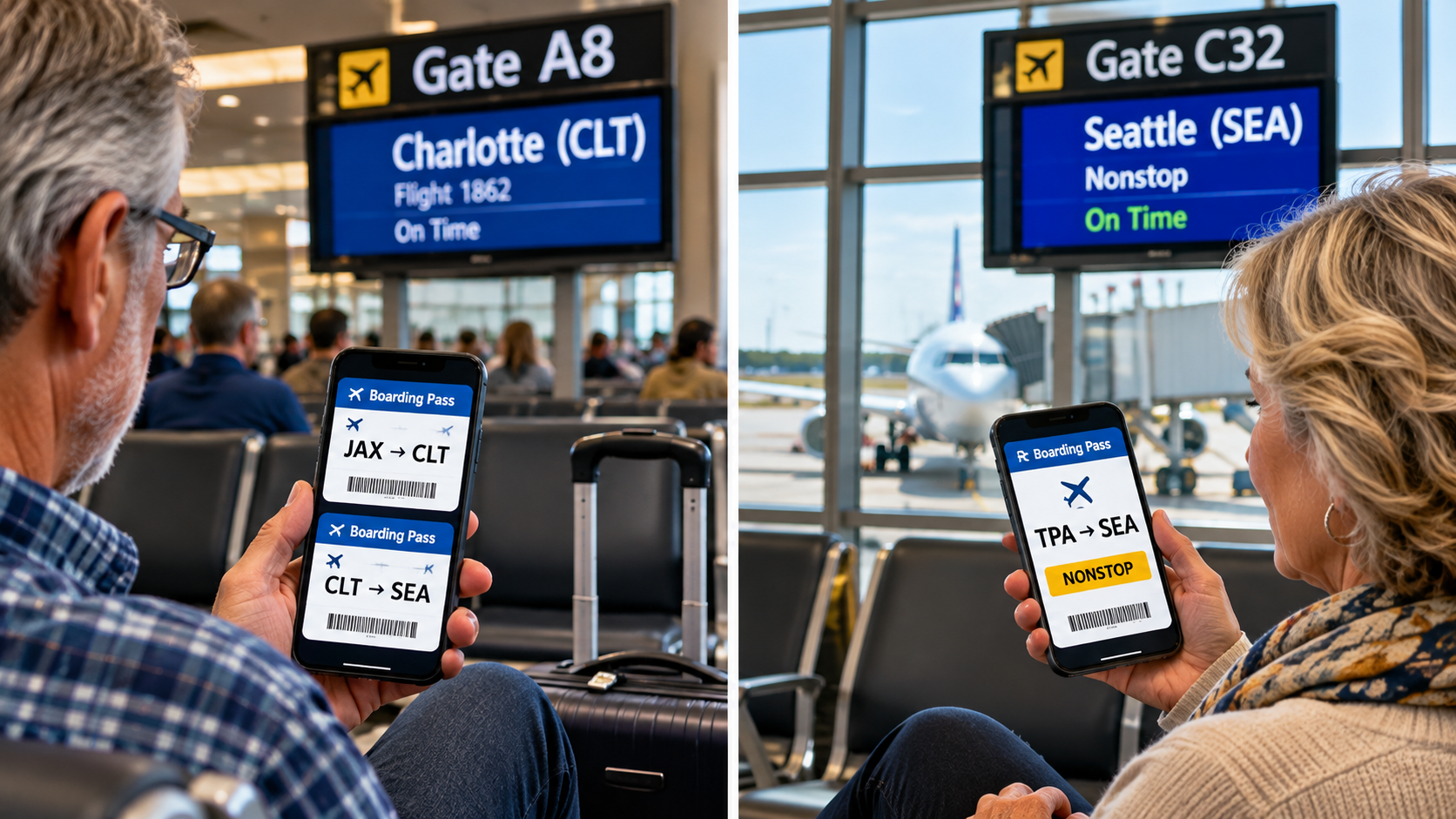
I've flown nonstop from Tampa to Seattle, for example. That's the kind of longer journey where I'm willing to seriously consider driving farther to reach a different airport.
Compare that with an itinerary from Jacksonville connecting through Charlotte before continuing to Seattle.
Both can get you to the same destination, but the experience is different.
With Jacksonville, I have a shorter drive to the airport but a connection along the way.
With Tampa, I have a longer drive before the flight, but potentially a much simpler trip through the air.
Which is better?
That depends on the actual schedules, fares, transportation costs, and how much time each option consumes.
Here's where I think travelers can get caught.
They see a cheaper flight from another airport and immediately assume they've found a better deal.
But what does getting to that airport involve?
A three-hour drive? An overnight hotel? Fuel? Parking? A rental car?
And what about the return trip?
If you land late at night, are you really going to want to drive another three hours home?
The airfare savings might disappear before you even reach the airport.
On the other hand, driving a few extra hours could eliminate a connection, save several hours of total travel time, or give you a much better arrival time.
In that case, the farther airport might be the better choice even if the airfare costs more.
I don't compare airline tickets in isolation. I compare the entire journey.
Sometimes the Departure Time Changes Everything
We're doing something along these lines for our upcoming Scotland trip.
Our international flight departs Miami at 10:30 at night.
That schedule gives us the option of driving to Miami during the day and heading directly to the airport without paying for a hotel the night before.
If the flight departed at 7:00 in the morning, I'd approach the trip differently.
I'd probably want to drive down the previous day, stay overnight, and arrive at the airport rested rather than start a long travel day with a middle-of-the-night drive.
Of course, that hotel becomes part of the cost comparison.
Parking matters, too.
For a short trip, leaving our vehicle at the airport might make perfect sense. For a longer trip, I'll compare parking costs with renting a car one way to the airport and another one-way rental when we return.
We've used hotel parking arrangements, and we've used one-way rental cars.
There isn't one method that's always cheaper or more convenient.
The point is to look at the whole picture before deciding.
And sometimes the difference between a great itinerary and a miserable one isn't the ticket price at all.
It's the departure time.
Six Hours. Three Very Different Experiences.
Let's say you're comparing flights and one itinerary involves six additional hours of travel.
Is that automatically a bad choice?
Not necessarily.
Imagine three ways those hours could play out.
Option One: Six Hours at the Gate
You find a significantly cheaper connecting flight, but it means spending six hours waiting at an airport.
Maybe you bring a book, download a movie, grab some lunch, and settle in.
It's not particularly exciting, but the savings might pay for a wonderful dinner, a special excursion, or another experience once you arrive.
If that trade-off works for you, there's nothing wrong with it.
Option Two: Six Hours in an Airport Lounge
You have the same long connection, but you've got access to a comfortable lounge.
Instead of spending the afternoon at the gate, you relax, enjoy something to eat, perhaps have a drink, and make the most of the time.
You're still traveling. You're still spending six hours between flights.
But the experience is different.
If lounge access is already included with a credit card or ticket, that may be a particularly attractive option. If you're paying separately, the cost becomes another part of the decision.
Option Three: Six Hours Already at Your Destination
You choose a more direct itinerary and arrive six hours earlier.
By the time the other travelers are boarding their connecting flight, you're collecting your rental car and heading out to explore.
Maybe you have time for a leisurely lunch, an afternoon sightseeing, or simply settling into your accommodations without feeling rushed.
That has value, too.
So which traveler made the best decision?
Potentially all three.
The first saved money. The second made the travel day more comfortable. The third gained more time at the destination.
The right choice depends on the trip, the budget, and what matters most to the person taking it.
And the same traveler might make all three choices on different vacations.

Sometimes Convenience Matters More Than Time
When we took my parents to Cape Cod, I booked a nonstop flight from Jacksonville to Boston.
My mother had Alzheimer's, and I wanted the travel day to be as simple as possible.
A connection would have meant another airport, another boarding process, more walking, and more opportunities for confusion or stress.
So the nonstop flight mattered to me for reasons that went well beyond saving time.
I don't remember the exact fare difference, and I don't need to.
The decision wasn't about getting the lowest possible ticket price.
It was about making the trip easier for my mother and for everyone traveling with her.
I also think about checked luggage when comparing flights.
Every connection introduces another point where checked bags may need to be transferred. That doesn't mean something will go wrong, but fewer transfers can simplify the journey.
The U.S. Department of Transportation's air travel guidance is a useful resource for understanding passenger protections and baggage issues, but even when airlines meet their obligations, a baggage delay can still disrupt the beginning of a vacation.
Sometimes the value of a simpler itinerary is difficult to measure in dollars.
That doesn't make it any less real.
Not Every Hour Traveling Is an Hour Wasted
There's another side to this conversation.
I don't believe the goal of every vacation should be to get from Point A to Point B as quickly as humanly possible.
Sometimes the journey is part of the experience.
A leisurely drive through an interesting region, stopping at small towns, enjoying a meal somewhere unexpected, or taking a scenic train ride can be some of the best parts of a trip.
Those hours aren't lost.
They're the reason you're traveling.
Our extra day in Alaska is a good example. We weren't sitting around waiting for the tour to start. We were visiting family and enjoying time together.
Even the dinner and overnight stay in Orlando made the beginning of the trip more pleasant.
And remember our six-hour airport example?
If the cheaper itinerary lets you afford an experience you otherwise would have skipped, those six hours might be a perfectly reasonable investment.
It's not just how much time a journey takes. It's what you get to do with that time.
Your Vacation Time Doesn't Have a Fixed Price
You'll sometimes see travel advice suggesting that you assign a dollar value to every hour of vacation.
If your time is worth $50 an hour, the argument goes, then spending $200 to save five hours is automatically a good deal.
I understand the logic.
But I don't think vacations work that neatly.
Someone with ten days of annual leave may value an extra day at their destination differently from someone who has the flexibility to travel for six weeks.
A family traveling with young children might gladly pay more to avoid a complicated connection.
A solo traveler with flexible dates might enjoy the challenge of finding a bargain and have no problem spending an afternoon in an airport.
And a retiree with plenty of available time might still prefer the nonstop flight because they simply don't enjoy connections.
None of those travelers is wrong.
Even the same person can make completely different decisions depending on the trip.
I certainly have.
When we went to Alaska, I had extra vacation time available, so we used it.
When we took the Viking cruise, I didn't.
The right choice changed because our circumstances changed.
The Curated Upgrade: Time, Money, Experience
When I'm planning a trip, I start with the airfare.
But I don't stop there.
I look at the total travel time, the number of connections, departure and arrival times, baggage, driving distances, parking, hotel nights, and transportation costs.
Then I ask myself what kind of experience each option gives us.
Would spending another $150 eliminate a miserable connection?
Would driving three hours to another airport get us a nonstop flight and a better arrival time?
Would an extra hotel night make the beginning of the vacation more relaxing?
Or would those expenses add very little to the trip?
There's no automatic answer.
For me, it comes down to three things:
TIME: How much of the trip will this option consume, and how much usable vacation time will I have?
MONEY: What's the complete cost, not just the advertised airfare?
EXPERIENCE: What will the journey actually feel like, and does it support the vacation I want?
I weigh all three together. None automatically outweighs the others.
Sometimes the cheapest option wins.
Sometimes the fastest option wins.
And sometimes the best choice costs a little more and takes a little longer.
That's perfectly fine.
Because the objective isn't to spend the least money or travel the fewest hours.
It's to get the most out of the vacation you have.

Vacation Starts Before You Reach the Destination
I often say that our vacation starts in our living room, not when we reach the destination.
That's the philosophy behind Vacation Starts in My Living Room, and it influences almost every transportation decision I make.
The airport drive, the flight, the connection, the arrival, and the journey home are all part of the experience.
I don't want to spend the entire trip worrying about whether I made the cheapest possible choice.
I want to make a thoughtful decision beforehand, then enjoy the vacation.
Sometimes that means spending an extra night near the airport.
Sometimes it means accepting a connection because that's what makes the trip possible.
Sometimes it means driving to another city for a better flight.
And sometimes it means sitting at the gate for six hours, knowing the money we saved will make the rest of the trip more enjoyable.
So the next time you find a cheaper flight, don't immediately click Book.
Look at what you're saving.
Then look at what you're giving up.
The cheapest way to get there isn't always the best use of your vacation.