

Mechanical Problems on a Cruise: What Are Your Rights?
A mechanical problem can mean a late departure, missed port or inconvenience onboard. It can also cancel the cruise or end it early. Those situations aren't treated the same way.
Cruise ships are enormous floating hotels packed with propulsion systems, generators, plumbing, air conditioning, elevators, kitchens and enough electrical equipment to make your breaker box feel inadequate.
Things can break.
Most mechanical problems don't end a cruise. Some may barely affect passengers at all.
But occasionally the problem is serious enough that the cruise cannot leave, cannot continue as scheduled or has to end early.
That's when knowing what actually applies becomes important.
There's an Industry Passenger Bill of Rights
This one needs a little labeling before we use the word rights.
The Cruise Lines International Association's Cruise Industry Passenger Bill of Rights is an industry commitment adopted by CLIA's oceangoing member cruise lines. It is not a federal passenger-rights statute.
But that doesn't make it meaningless.
CLIA says its oceangoing members have adopted the current Passenger Bill of Rights for oceangoing cruises worldwide. For member lines with North American-based operations, passenger contracts are supposed to state that if the contract directly conflicts with the Passenger Bill of Rights in effect when the cruise was booked, the Passenger Bill of Rights controls.
And mechanical failures get some very specific treatment.
If a Mechanical Failure Cancels Your Cruise
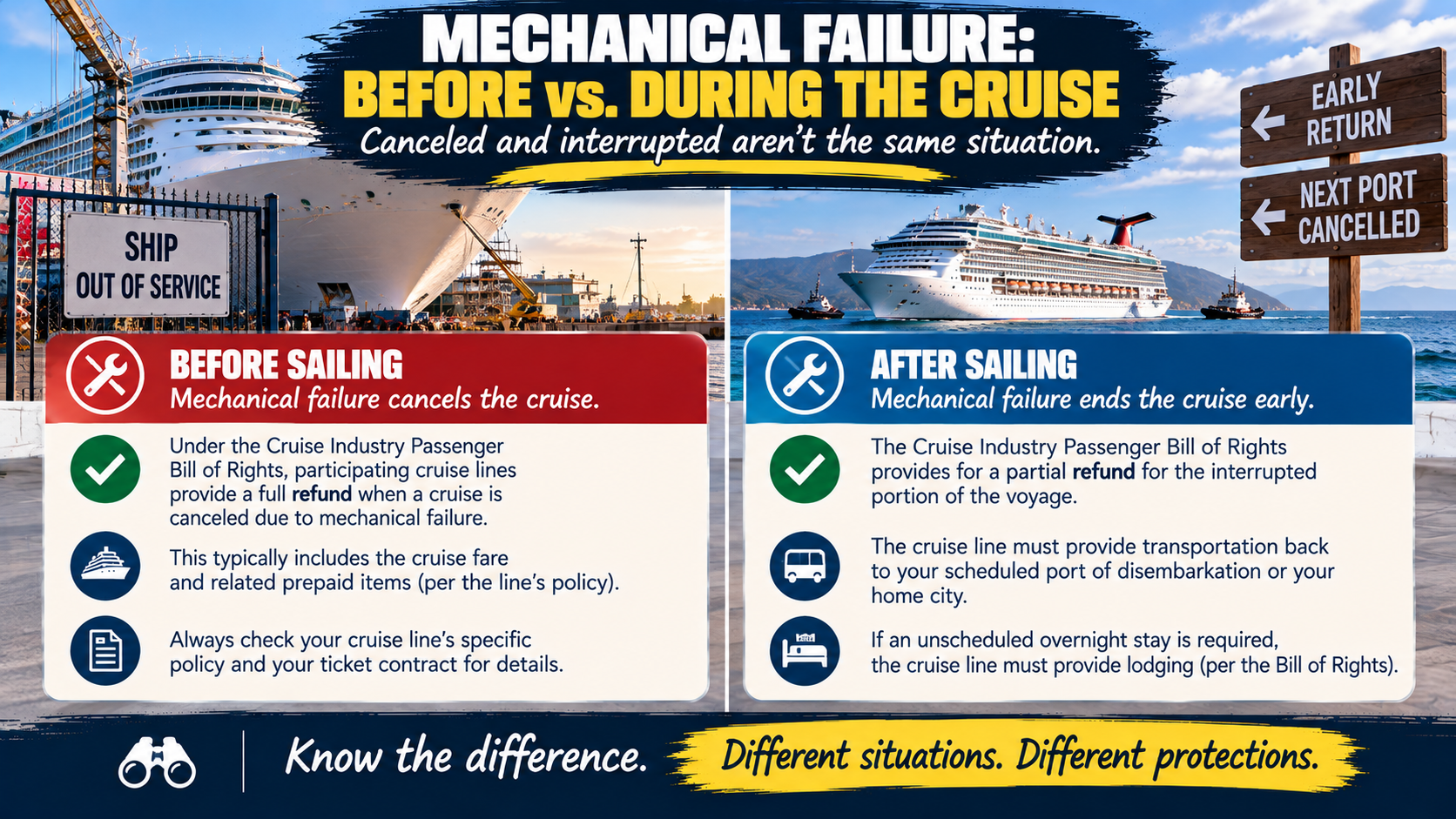
The Passenger Bill of Rights says passengers have the right to a full refund when a cruise is canceled because of mechanical failure.
That's considerably clearer than many ordinary cruise disruptions.
A current Princess U.S. passage contract provides a useful real-world example. It says that when mechanical failure causes the scheduled cruise to be canceled, the passenger is entitled to a full refund of the Total Cruise Price.
Notice the important phrase:
Canceled because of mechanical failure.
A broken piece of equipment somewhere aboard does not automatically equal a full cruise refund.
The consequence of the failure matters.
What If the Cruise Has Already Started?
Now the situation changes.
Under the CLIA Passenger Bill of Rights, if mechanical failure causes a voyage to terminate early, passengers have the right to a partial refund.
There are also protections for getting passengers home.
The Passenger Bill of Rights says passengers have the right to transportation to the ship's scheduled port of disembarkation or their home city when a cruise is terminated early because of mechanical failure.
If the early termination requires passengers to disembark and spend the night in an unscheduled port, it also provides a right to lodging.
Again, the Princess contract provides an example of how this can appear in an actual passenger agreement. Its current U.S. contract provides for a partial refund when mechanical failure terminates the cruise early, along with transportation to the scheduled disembarkation port or the passenger's home city at the carrier's discretion, plus overnight lodging when an unscheduled stopover is required.
What If the Ship Keeps Sailing?
This is where expectations need a little ballast.
Suppose the ship has a mechanical problem but the cruise continues.
Maybe departure is delayed.
Maybe the ship sails more slowly.
Maybe a port is changed or dropped.
Maybe certain onboard systems aren't operating normally.
That does not automatically mean you're entitled to a full or partial cruise refund under the mechanical-failure provisions we just discussed.
The specific CLIA refund commitments concern a cruise canceled because of mechanical failure or a voyage terminated early because of mechanical failure.
A cruise line may still offer onboard credit, Future Cruise Credit or another form of compensation when a mechanical problem seriously disrupts a voyage that continues.
But that's where you need to distinguish:
Passenger Bill of Rights commitment
from
passenger contract
from
cruise-line customer-service decision.
We've already covered a related problem in Your Cruise Changed or Skipped a Port: Are You Owed Anything?
You're Also Entitled to Information
Money isn't the only thing addressed by the Passenger Bill of Rights.
CLIA's policy says passengers have the right to timely updates about itinerary adjustments caused by a mechanical failure or emergency, as well as updates on efforts to address the mechanical problem.
It also addresses more serious onboard situations, including the right to an emergency power source if the ship's main generator fails.
And if a docked ship cannot adequately provide essential provisions such as food, water, restroom facilities and access to medical care, the Passenger Bill of Rights provides for the right to disembark, subject to the captain's safety and security concerns and local customs and immigration requirements.
That's a very different situation from:
“The air conditioning in my cabin stopped working.”
Both are mechanical problems.
They are plainly not the same problem.
What Should You Do While You're Still Onboard?
If the issue affects your cabin or something you're supposed to be receiving, report it while the cruise line still has an opportunity to fix it.
Take photos or video when they actually help document the problem.
Save written notices from the cruise line.
Keep screenshots of itinerary changes.
Keep receipts if the disruption causes you to spend money unexpectedly.
And listen carefully to what the cruise line says it is providing.
If the ship is ending the voyage early, you want clear information about:
Where you're disembarking.
Where the cruise line is transporting you.
Whether overnight lodging is being arranged.
How the refund will be handled.
What happens to cruise-line-booked transportation or other services.
Don't rely solely on what another passenger says they heard from someone who talked to somebody at Guest Services. Cruise ships can manufacture rumors faster than the buffet can manufacture bacon.
Get important information from the cruise line itself, preferably in writing.
What About Your Flights, Hotels and Other Costs?
Ending a cruise early can create a domino line of other expenses.
Your return flight may be leaving from somewhere else.
You may have a post-cruise hotel.
You may have prepaid transportation.
You may have independent excursions that never happen.
The mechanical-failure provisions can provide certain transportation and lodging protections when the cruise itself terminates early, but that doesn't mean every independent expense you've booked automatically becomes the cruise line's responsibility.
That's why we're treating that problem separately in:
Your Cruise Was Refunded. What About Your Flights, Hotel and Excursions?
Travel insurance or applicable credit-card travel protections may become important for costs that aren't reimbursed elsewhere.
What If the Cruise Line Doesn't Resolve the Problem?
Start with the cruise line and its passenger contract.
For cruises embarking passengers at U.S. ports, the Federal Maritime Commission explains its cruise-passenger role and limitations. The FMC regulates certain Passenger Vessel Operators with at least 50 passenger berths that embark passengers at U.S. ports and requires financial responsibility for nonperformance of transportation.
The FMC's consumer-assistance office can also assist eligible passengers with certain disputes, although its jurisdiction isn't a general federal cruise customer-service guarantee.
For most travelers, though, the practical first steps remain much simpler:
Document what happened. Read the cruise line's written offer. Read your passenger contract. And know whether you're dealing with an inconvenience, an itinerary change, an early termination or an outright cancellation.
Those distinctions matter.
The Curated Verdict
🟢 CANCELED FOR MECHANICAL FAILURE? KNOW THE REFUND PROVISION
CLIA's Passenger Bill of Rights provides for a full refund when mechanical failure causes the cruise to be canceled.
🟡 A MECHANICAL PROBLEM DOESN'T AUTOMATICALLY MEAN A REFUND
If the cruise continues, the remedy depends on what actually happened, your contract and what the cruise line offers.
🔴 CRUISE TERMINATED EARLY? DON'T WALK AWAY WITHOUT THE DETAILS
Find out about the partial refund, transportation and any required overnight lodging before making expensive arrangements on your own.
What to Do Next
If a serious mechanical problem affects your cruise:
Save every notice → Document the disruption → Determine whether the cruise is continuing, canceled or ending early → Read the passenger contract → Get transportation and lodging instructions in writing → Keep receipts → Follow the cruise line's refund process.
A wrench in the machinery doesn't automatically put a wrench through your entire vacation.
But if that wrench actually cancels or ends the cruise, the distinction matters.
Information reviewed September 2026. The Cruise Industry Passenger Bill of Rights is an industry commitment adopted by CLIA oceangoing member lines, not a federal statute. Passenger contracts, cruise-line policies and applicable laws vary by cruise line, itinerary and booking jurisdiction.