

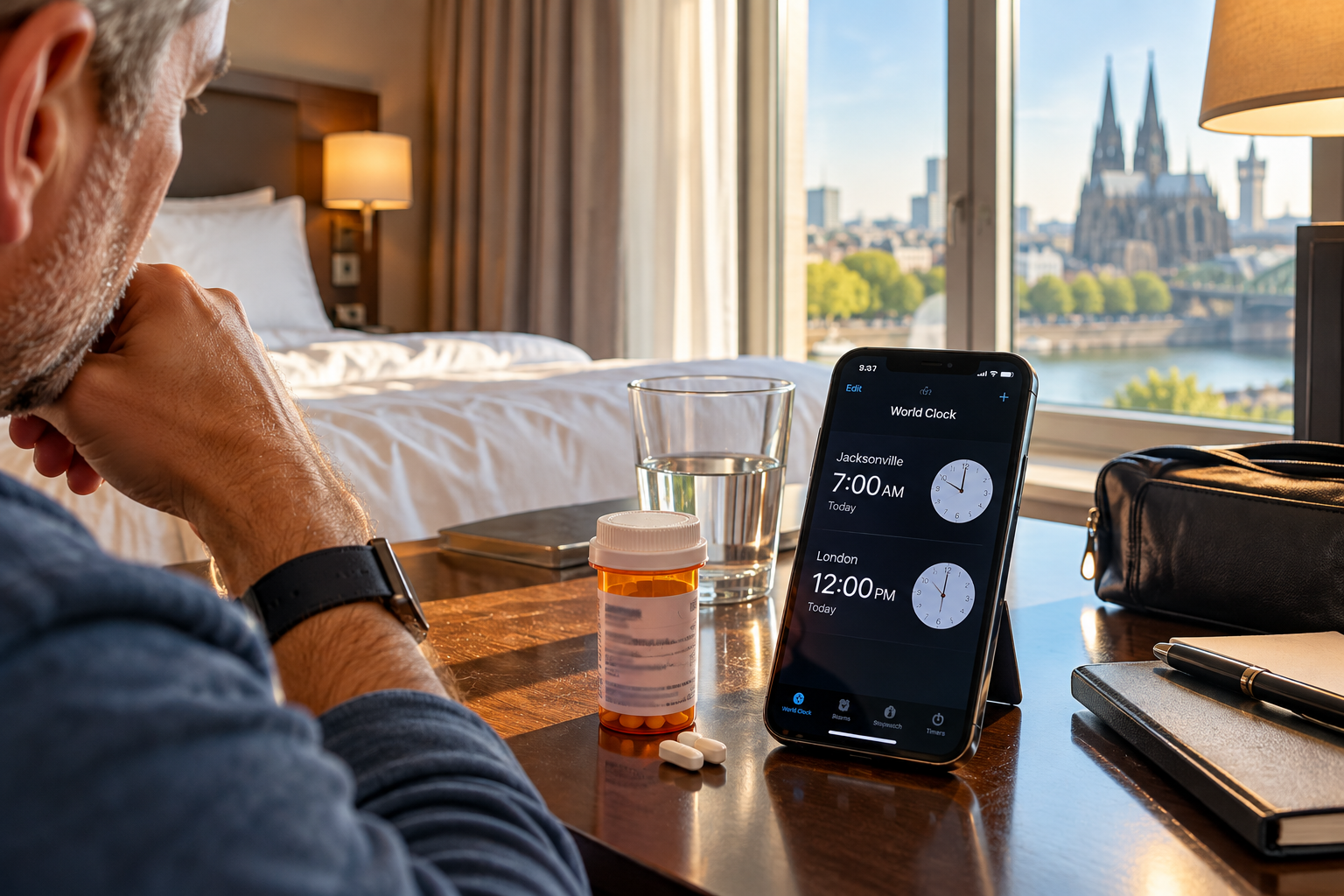
Medication Across Time Zones: Which Clock Should You Follow?
Your watch changes time zones automatically. Your medication schedule might need a little more thought.
You take a prescription pill every morning at 7 AM. Once a day. You've been doing it for years.
Then you travel halfway around the world.
Your phone automatically adjusts to the new time zone. You wake up, look at the clock, and it's 7 AM.
Time to take your medication, right?
Maybe. But how many hours has it actually been since your last dose?
The Clock Says 7 AM. But How Much Time Has Passed?
Depending on your itinerary, the direction you're traveling and when you last took your medication, the next 7 AM on your clock could arrive considerably sooner or later than the usual 24 hours.
It might be 12 hours. It might be 20. It might be 28.
And depending on the medication, that difference could matter.
Some medications allow flexibility in their schedules. Others need more consistent spacing between doses.
The important thing is recognizing that taking a pill at the same local time every day doesn't necessarily mean you're taking it at the same interval.

Ask Before You Travel
Before your trip, ask your doctor or pharmacist a simple question:
"I take this medication every morning at 7 AM. I'm traveling eight time zones away. Should I stay on my home schedule, switch to local time or adjust gradually?"
And don't forget to ask how to handle the return trip.
Your doctor or pharmacist can explain whether your particular medication requires careful timing and help you establish an appropriate schedule.
This is also a good example of why we encourage travelers to Ask Better Questions, Get Better Travel Answers.
And please, don't rely on some dude in a Facebook travel group who says he always switches to local time and has never had a problem.
That's wonderful for him. But he might not even be taking the same medication.
Make a Plan Before You Leave
Once you've received professional guidance, put the schedule in your phone and check how your medication reminders behave when you change time zones.
Don't assume every alarm automatically adjusts the way you expect.
And remember, the trip home deserves the same attention as the trip out.
The CDC's Yellow Book guidance on traveling with chronic illnesses also emphasizes planning medication schedules when crossing time zones.
The Curated Upgrades Takeaway
Your phone knows when you've crossed a time zone. Your prescription bottle doesn't.
Before traveling, find out whether changing the clock changes when you should take your medication.
Ask your doctor or pharmacist, make a plan, and enjoy your trip without doing medication arithmetic at 35,000 feet.
This article provides general travel information, not individualized medical advice. Always consult your healthcare professional before changing your medication schedule.