

Sick or Injured on a Cruise: What Happens and Who Pays?
You get sick. You fall and hurt yourself. Or an illness starts spreading around the ship. Cruise ships have medical facilities, but what happens next can depend on what you need, where the ship is and what insurance you have.
Nobody boards a cruise planning a visit to the medical center.
But you're on a ship carrying hundreds or thousands of people, potentially hundreds of miles from home. People get sick. People fall. Chronic conditions flare up. And occasionally someone needs more care than can reasonably be provided aboard the ship.
The first thing to understand is simple:
A cruise ship medical center is there to provide medical care. It isn't the same thing as your doctor's office or hometown hospital.
And getting treated onboard doesn't necessarily mean the treatment is included in your cruise fare.
If You Get Sick or Injured Onboard
For an individual illness or injury, your first stop should generally be the ship's medical center.
Depending on the problem and the ship's capabilities, medical staff may be able to evaluate you, provide treatment, dispense certain medications or determine that you need additional care ashore.
For something minor, that may be the end of the story.
For something serious, the ship's medical staff and captain may have to determine whether you can safely remain aboard or need treatment on land.
That can potentially mean:
Going ashore for medical care at the next port.
Leaving the cruise early.
A change in the ship's itinerary for a medical emergency.
Or, in exceptional circumstances, medical evacuation.
At that point, the medical problem can become a travel problem very quickly.
Who Pays for the Medical Center?
Don't assume your cruise fare covers medical treatment.
Onboard medical services can result in charges to your shipboard account, and whether those expenses are ultimately covered depends on your health insurance, travel medical coverage or travel insurance policy.
This is one of those things worth investigating before you sail.
Call your health insurer and ask specifically:
What happens if I need medical treatment aboard a cruise ship?
Am I covered outside the United States?
Do I pay first and file for reimbursement later?
Is emergency medical evacuation covered?
That last question can matter enormously.
Medicare Has a Very Specific Cruise-Ship Rule
For travelers on Medicare, there's an especially important limitation.
Medicare says it may cover medically necessary services aboard a cruise ship when the doctor is legally permitted to provide those services and the ship is in a U.S. port or no more than six hours away from a U.S. port when the services are received. Outside those circumstances, Medicare generally doesn't cover health care received outside the United States except for limited exceptions.
That's a pretty good reason not to assume that carrying your regular insurance card means you're financially covered everywhere the ship can take you.
Some Medigap policies may provide foreign-travel emergency coverage, and other insurance arrangements vary.
Check yours.
One Sick Passenger Isn't the Same as an Outbreak
This distinction matters.
If you get food poisoning symptoms, that doesn't automatically mean the ship has an outbreak.
If several people you met at dinner aren't feeling well, that still doesn't necessarily establish one.
For ships within its jurisdiction, the CDC's Vessel Sanitation Program tracks acute gastroenteritis, or AGE, among passengers and crew. Cruise ships report qualifying gastrointestinal illness cases to the program, allowing CDC to monitor illness patterns.
That's one reason you shouldn't quietly hide in your cabin when you're experiencing significant gastrointestinal symptoms.
Report them to the ship's medical center.
CDC specifically says passenger and crew reports to medical staff help outbreaks get detected quickly so measures can be taken to limit their spread.
When Does CDC Consider It an Outbreak?
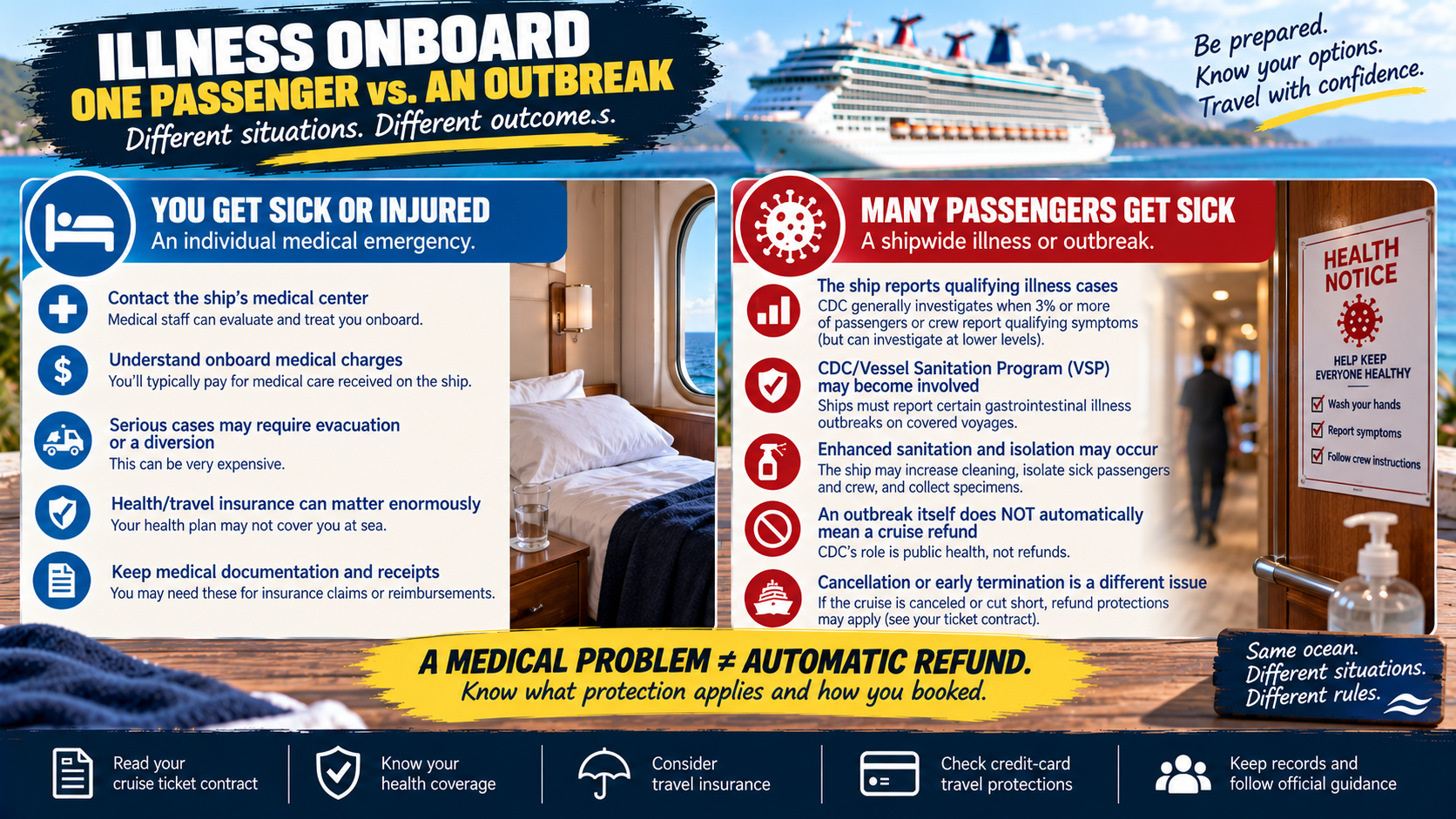
For acute gastrointestinal illness, CDC's current Vessel Sanitation Program generally considers 3% or more of passengers or 3% or more of crew reporting qualifying symptoms to be an outbreak.
CDC can also investigate an unusual gastrointestinal illness pattern even when the rate is below 3%.
And this isn't merely theoretical.
CDC's 2026 outbreak records include cases involving norovirus, E. coli and outbreaks where the causative agent wasn't immediately known.
When an outbreak occurs, responses can include increased cleaning and disinfection, isolation of ill passengers and crew, specimen collection and consultation with CDC. In some circumstances CDC may conduct its own environmental assessment or outbreak investigation.
Does an Outbreak Mean You Get a Refund?
Not automatically.
This is where our two sides of the graphic come back together.
Public-health response and passenger compensation are different questions.
CDC's Vessel Sanitation Program is concerned with detecting, investigating and controlling illness. It isn't there to decide whether every passenger on an affected sailing receives a cruise refund.
If the cruise continues despite an outbreak, any compensation may depend on what actually happened, the passenger contract, cruise-line policy and potentially other circumstances.
If the voyage itself is canceled or terminated early, then we're into a different category of disruption.
That's why I wouldn't start with:
“There was norovirus aboard. How much money am I owed?”
I'd start with:
“What happened to my cruise, what did the cruise line provide, what does my contract say, and what expenses did I actually incur?”
What If You're Isolated in Your Cabin?
If medical staff instruct you to isolate because of a contagious illness, follow those instructions.
It's miserable timing. Nobody paid for a balcony cabin so they could admire the ocean between trips to the bathroom.
But preventing illness from spreading to hundreds of other passengers is bigger than salvaging one afternoon at the pool.
Document the instructions you're given and any services or accommodations the cruise line offers while you're isolated.
If the cruise line offers compensation or a Future Cruise Credit because of isolation, get the terms in writing.
Don't assume every cruise line or every situation will be handled identically.
What If You Have to Leave the Ship for Medical Care?
This is where good travel planning earns its keep.
If you're taken to a hospital in another country or must leave the ship early, you may suddenly be dealing with:
Medical bills.
Transportation.
Hotels.
New flights.
A traveling companion who may need to leave with you.
Prescription medications.
And potentially getting yourself home from somewhere you never intended to end your vacation.
This is where travel medical insurance and medical evacuation coverage can become far more important than whether your policy reimburses you for a missed shore excursion.
Before spending large amounts of money, contact your insurer or assistance provider as soon as reasonably possible. Some policies have procedures for coordinating treatment, transportation or evacuation.
And keep everything.
Medical reports.
Receipts.
Cruise-line documentation.
Hospital records.
Transportation receipts.
Proof that you left the ship.
Insurance companies have a remarkable fondness for paperwork precisely when you'd rather be doing anything else.
Before You Sail
You don't need to turn vacation planning into disaster planning.
But there are a few things I'd know before boarding:
What medical coverage do I have outside the United States?
Does it cover treatment aboard a cruise ship?
Does my travel insurance include emergency medical treatment?
Does it include medical evacuation?
What are the limits and exclusions?
Who do I call if something serious happens?
And bring enough of your regular prescription medication for the trip, preferably with some cushion for unexpected delays.
A cruise ship has a medical center.
That doesn't mean its pharmacy carries every medication you might need.
The Curated Verdict
🟢 REPORT SIGNIFICANT ILLNESS TO THE MEDICAL CENTER
Especially with gastrointestinal symptoms, reporting helps the ship identify and respond to potential outbreaks. CDC's surveillance system depends on illness being reported.
🟡 KNOW YOUR MEDICAL COVERAGE BEFORE YOU SAIL
Your normal health insurance may not follow you everywhere your cruise goes. Medicare's cruise-ship coverage, for example, has very specific geographic limits.
🔴 DON'T ASSUME AN OUTBREAK AUTOMATICALLY MEANS A REFUND
CDC's role is public health. Whether compensation is owed is a separate question involving what happened to the voyage, your contract and cruise-line policy.
What to Do Next
If you become seriously sick or injured aboard:
Contact the medical center → Follow medical instructions → Notify your insurer when appropriate → Save medical records and receipts → Document any cruise interruption → Get cruise-line arrangements or compensation in writing.
And if illness appears to be spreading around the ship?
Report your symptoms rather than becoming Passenger Zero's silent accomplice.
The sooner the ship knows what is happening, the sooner it can respond.
Information reviewed September 2026. Medical capabilities, cruise-line policies and insurance coverage vary. CDC Vessel Sanitation Program jurisdiction and reporting requirements depend on the voyage. This article provides general travel information and isn't medical or insurance advice.