


Traveling With a CPAP: The Rules, the Myths and What We Actually Do
From airport carry-on rules and distilled water to international power and cruise cabins, traveling with a CPAP is easier when you know what really matters.
If you travel with a CPAP machine, you already know the logistical anxiety can begin long before you reach the airport.
Open a travel forum for some quick research and you’ll encounter a tidal wave of panic. There are endless threads about finding distilled water in Italy, learning the precise French terminology for it or locating a specific London pharmacy at 10:00 p.m. just to fill a plastic reservoir.
Then come the questions about airport security, international airlines, extension cords, cruise-ship outlets and whether a CPAP counts as an extra carry-on.
By the time you finish reading, you may feel like leaving the machine at home and risking a week of terrible sleep.
Don’t buy into the panic.
Traveling with a CPAP does require some preparation, but it does not require you to become an amateur electrician, hunt through foreign supermarkets or devote another suitcase to medical equipment.
Gina and I both travel with CPAP machines. That means we manage two machines, two masks, two power supplies and two travel cases everywhere we go. We have taken them on domestic trips, international flights and cruises without ever checking them—and neither of us has ever been stopped, questioned or given a hard time about them.
That does not mean everyone’s experience will always be identical. It means the process is usually much less dramatic than the internet makes it sound.
My goal isn’t to tell you how to manage your health or disregard the instructions supplied with your machine. It is to explain the applicable travel rules, identify the areas where policies differ and share what we actually do on the road.
Let’s clear up the biggest myths.
How We Pack Two CPAP Machines
We use the manufacturer’s carrying case for each machine. The CPAP, mask, hose and power supply stay together so we aren’t digging through different bags when it is time to set everything up.
The machines always remain with us in the cabin. We have never checked either one.
That matters because a CPAP isn’t something you want disappearing into the baggage system. Even if the airline eventually delivers a delayed suitcase or reimburses you for a damaged machine, that doesn’t solve the immediate problem of sleeping without it.
We occasionally use a little remaining space in a CPAP case for one or two GLP-1 pens when needed. Those are also medical supplies. We don’t use the cases as overflow luggage for clothing, souvenirs or other unrelated belongings.
That distinction matters under the carry-on rules.
Does a CPAP Count Against Your Carry-On Allowance?
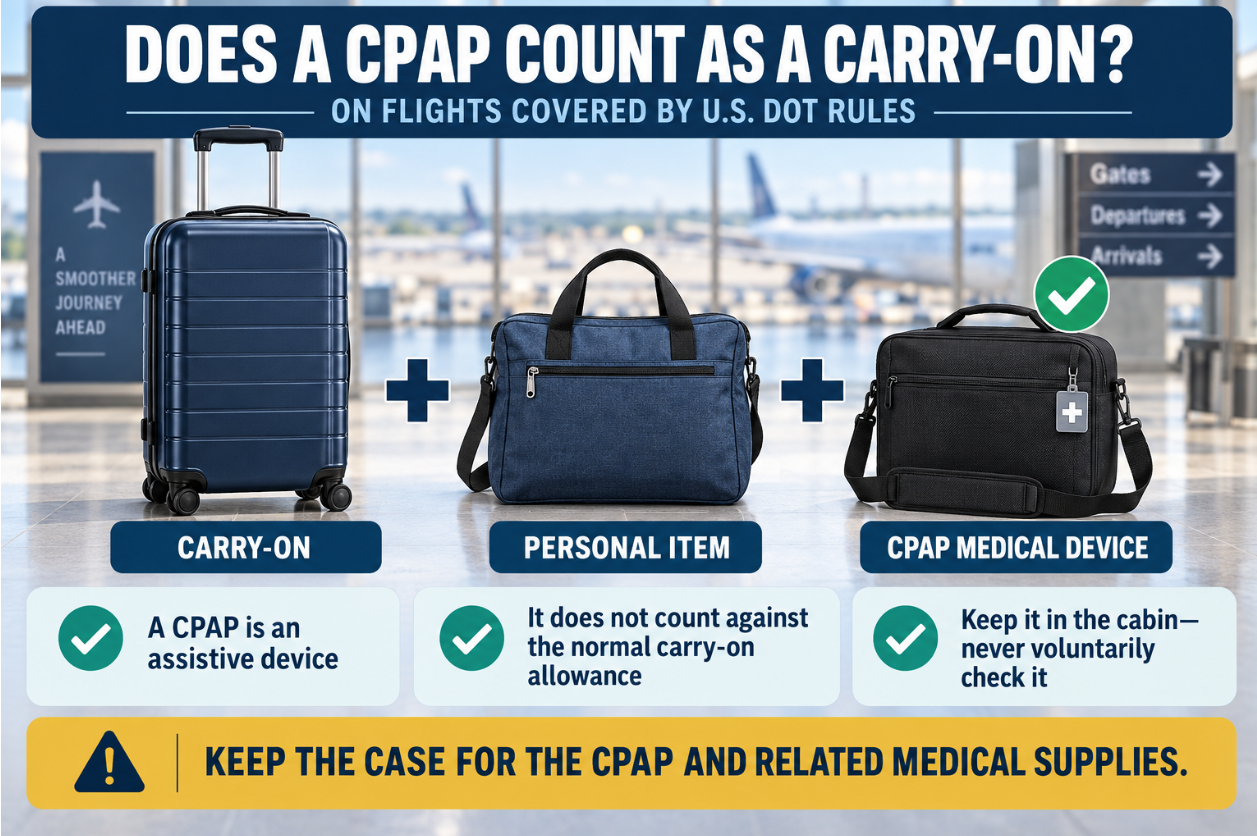
On flights covered by U.S. Department of Transportation accessibility rules, a CPAP is considered an assistive device. It may be carried in the cabin without counting against the airline’s normal carry-on limit, subject to applicable safety and stowage requirements.
This protection comes from the Department of Transportation, not the TSA.
The TSA screens the machine at the security checkpoint. The DOT governs the airline’s treatment of the assistive device and its baggage allowance.
There is an important qualification: if you fill the CPAP case with unrelated personal belongings, the airline may count the entire bag toward your carry-on allowance. Keep the bag limited to the machine and related medical supplies if you are relying on the exemption.
In other words, don’t turn the CPAP case into a cleverly disguised third suitcase.
The DOT states that small assistive devices can be placed under the seat or in an overhead compartment and do not count toward the airline’s normal carry-on limit. It also says that a bag containing personal items may be counted. (U.S. Department of Transportation assistive-device guidance)
What About Airport Security?
Our experience has been remarkably uneventful.
We have taken both machines through security on domestic and international trips without being questioned. Screening procedures can vary, however, so pack the case in a way that allows the machine to be removed without dismantling your entire carry-on setup.
Empty the humidifier chamber before leaving for the airport. Aside from preventing leaks, that eliminates an unnecessary liquid issue during screening.
A clear plastic bag can also be useful if an officer asks you to remove the machine and you don’t want it placed directly into a screening bin.
International Flights Require One More Check
The U.S. carry-on exemption does not automatically describe every flight everywhere in the world. Coverage depends on the airline, route and applicable disability-access rules.
Before taking a flight operated entirely outside the United States—especially on a strict regional or budget airline—check that carrier’s medical-device and cabin-baggage policy.
If the language is unclear, save a screenshot or digital copy of the policy. Also leave enough room in your primary carry-on to consolidate equipment if a gate agent interprets the rules differently.
We have never encountered a problem overseas, but “it has never happened to me” is not the same as a travel policy.
Hope is a bad plan. Ten minutes of research is a much better one.
The Distilled-Water Debate
Now let’s tackle the question that seems to generate more CPAP travel anxiety than anything else:
Where can I buy distilled water overseas?
People will provide detailed instructions for finding a particular grocery aisle in Rome or a specific pharmacy in Tokyo.
Here is the unvarnished truth from our own travel experience:
Gina and I have never purchased distilled water while traveling.
That is our personal practice—not universal medical advice and not a claim that every CPAP manufacturer approves the same water for every machine.
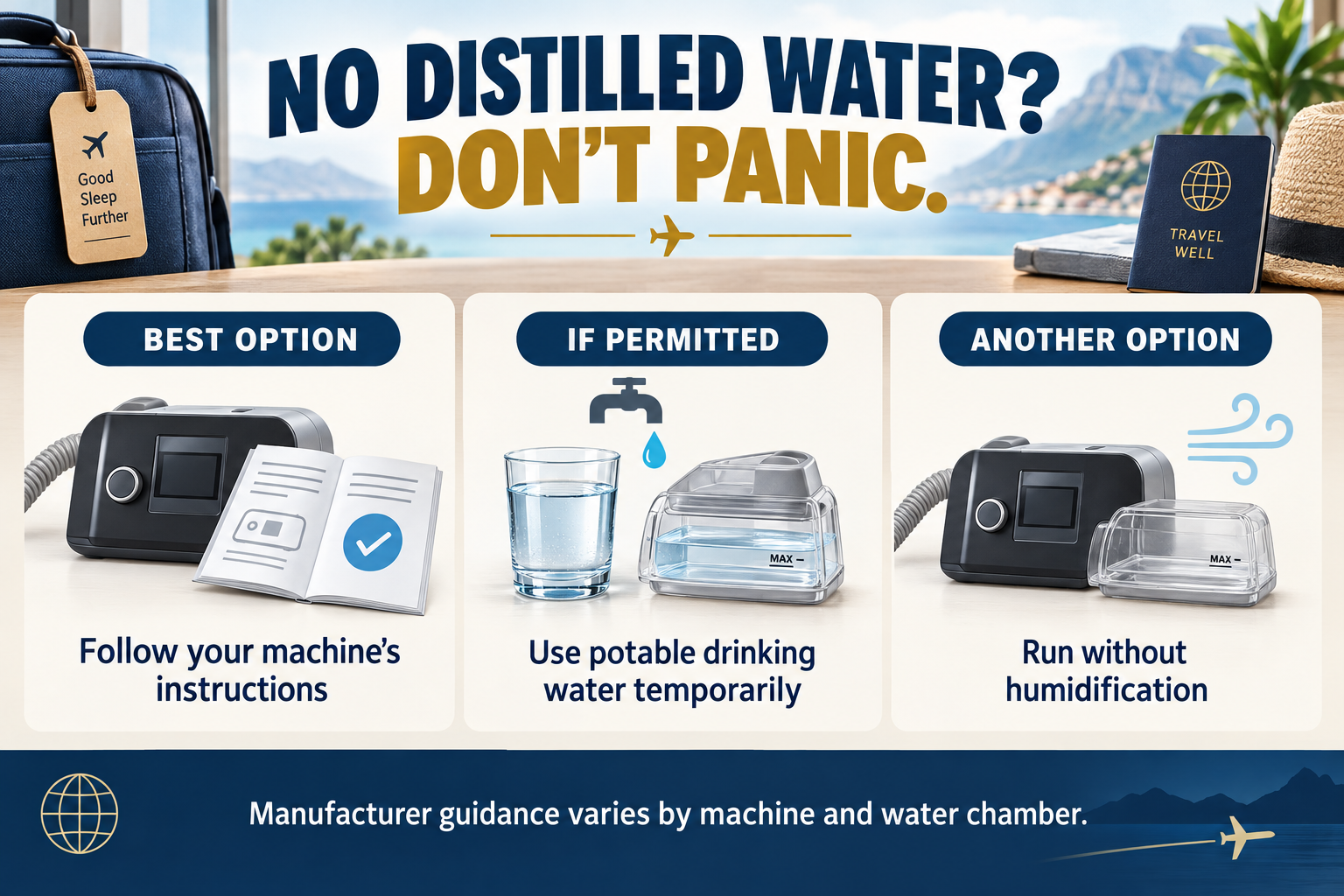
Manufacturer instructions genuinely differ. ResMed, for example, specifies distilled water for its HumidAir 11 Standard tub but permits drinking-quality potable water in its HumidAir 11 Cleanable tub. Philips recommends distilled water when available to reduce mineral buildup and provides additional cleaning guidance when tap or bottled water must be used.
That produces a much more sensible rule than “you must find distilled water at any cost”:
Follow the instructions for your specific machine and water chamber.
Use distilled water when it is readily available or required.
If your equipment permits potable drinking water, it may be a practical short-term option.
If you cannot obtain suitable water, many machines can operate without water in the chamber—you simply won’t receive humidification.
ResMed confirms that compatible machines can continue operating safely when the water chamber is empty, although humidification stops. (ResMed Air Solutions FAQ)
What We Actually Do
For short trips, we use potable tap water when it is safe to drink and suitable for our equipment. We accept that hard water may leave some mineral scale behind.
When we arrive home during the daytime, we soak the chambers in a vinegar solution and then wash them with soap and water.
If we arrive late at night, we don’t create another travel-day project. We hook up the machines, get some sleep and clean the chambers the following morning or as soon as practical.
ResMed’s published cleaning guidance suggests mild dishwashing liquid or a solution of one part vinegar to nine parts water, followed by a thorough rinse with drinking-quality water. Follow the instructions for your own reservoir. (ResMed cleaning guidance)
The real point isn’t that everyone should copy our water routine. It is that you should understand your equipment before the trip and make a reasonable plan—not surrender half a vacation day to a frantic distilled-water scavenger hunt.
Powering a CPAP Overseas
The best packing plan in the world doesn’t help if you can’t plug the machine into the wall beside your bed.
Fortunately, most modern CPAP power supplies are designed to work with a broad range of international voltages—but you must verify your own equipment.
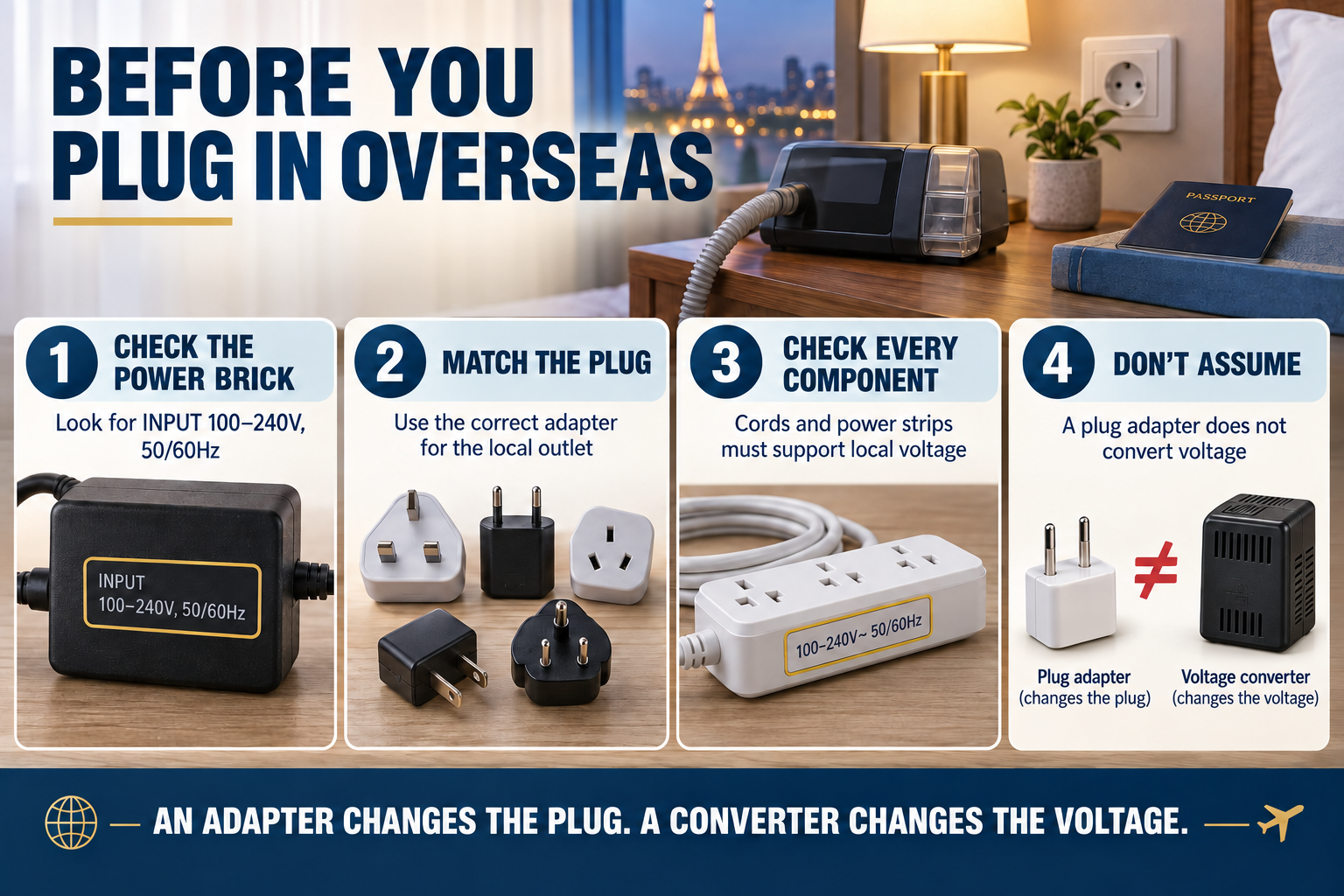
Look at the power brick, not just the CPAP machine. You are looking for language similar to:
INPUT: 100–240V, 50/60Hz
If the power supply displays that range, it generally accepts both the approximately 120-volt electricity used in the United States and the 220–240-volt systems found in many other countries.
You will normally need the correct plug adapter for the destination, but not a voltage converter.
Remember:
An adapter changes the plug. A converter changes the voltage.
They are not the same thing.
Check Every Component
A dual-voltage CPAP power brick does not magically make an incompatible extension cord, USB hub or power strip safe.
Every powered component in the chain must support the local voltage.
For upcoming travel, we purchased a new travel power strip marked for international voltage. That gives us extra cord length and enough outlets to operate two CPAP machines from one conveniently located wall outlet.
But don’t copy a product recommendation blindly. Read the label on your own strip. A standard American strip labeled only for 125 volts should not be treated as an international-voltage device merely because it fits into a plug adapter.
Why an Extension Cord Matters
Hotel outlets have improved, but older hotels, inns and unconventional accommodations can still place the nearest available outlet across the room, behind furniture or on the wrong side of the bed.
That becomes more complicated when two people need CPAP machines.
Our extension setup isn’t about creating a portable electronics command center. It is about reliably getting power from the available outlet to the machines beside the bed.
Keep cords away from walking paths and avoid creating a nighttime trip hazard.
We have a guide for Travel Power Adapters.
CPAP Machines on Cruise Ships
Cruise discussions generate another stubborn travel myth:
All extension cords and power strips are prohibited at sea because of one universal maritime law.
That isn’t an accurate way to describe the rules.
Cruise lines establish their own prohibited-item and electrical-equipment policies. Those policies can differ substantially.
For example:
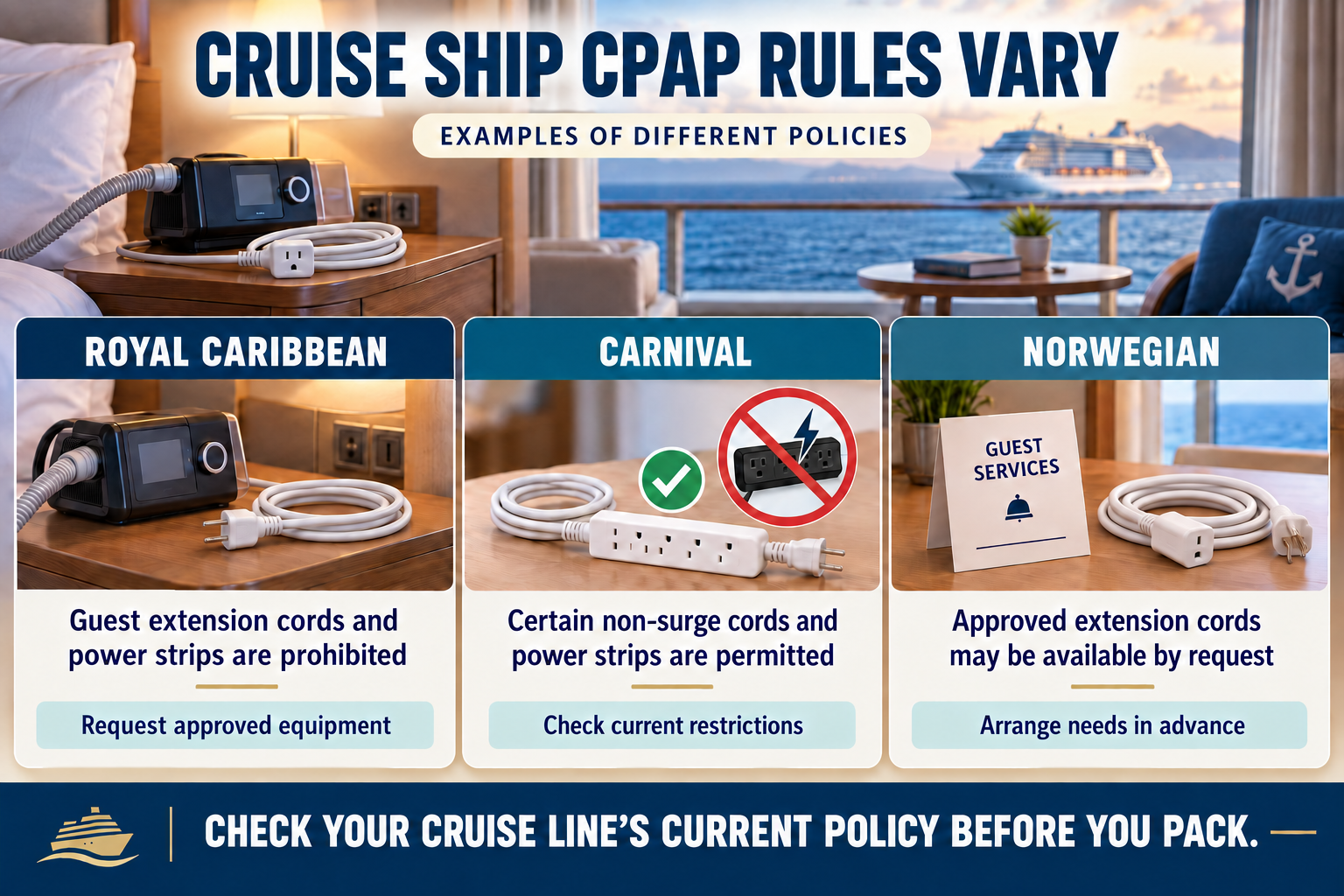
Royal Caribbean prohibits guests from bringing extension cords, power boards and surge-protected power boards. Its accessibility program allows passengers to request an extension cord and distilled water for a CPAP. (Royal Caribbean electrical-equipment policy)
Carnival permits extension cords and certain power strips without surge protection when used properly. Its CPAP guidance says surge protectors are prohibited and recommends bringing an acceptable extension cord. (Carnival electrical-outlet guidance)
Norwegian Cruise Line advises passengers bringing medical equipment to notify the cruise line before sailing. It says a limited supply of extension cords may be available through Guest Services and permits passengers to request distilled water before sailing. (Norwegian accessibility information)
Policies can change, so verify the rules directly with your cruise line before packing.
What We Have Experienced
On Royal Caribbean, we obtained an approved extension cord for our machines rather than bringing our normal travel setup aboard.
On our Viking river cruise, the cabin had plenty of accessible outlets and we didn’t need an extension cord.
We have never requested or used distilled water on a cruise.
That doesn’t mean you shouldn’t request it. If distilled water is required for your equipment or simply makes you more comfortable, arrange it before sailing. It is better to have the request documented than to begin hunting for someone to help after bedtime on embarkation day.
The lesson isn’t “bring a cord” or “never bring a cord.”
The lesson is:
Check the policy for your ship and cruise line.
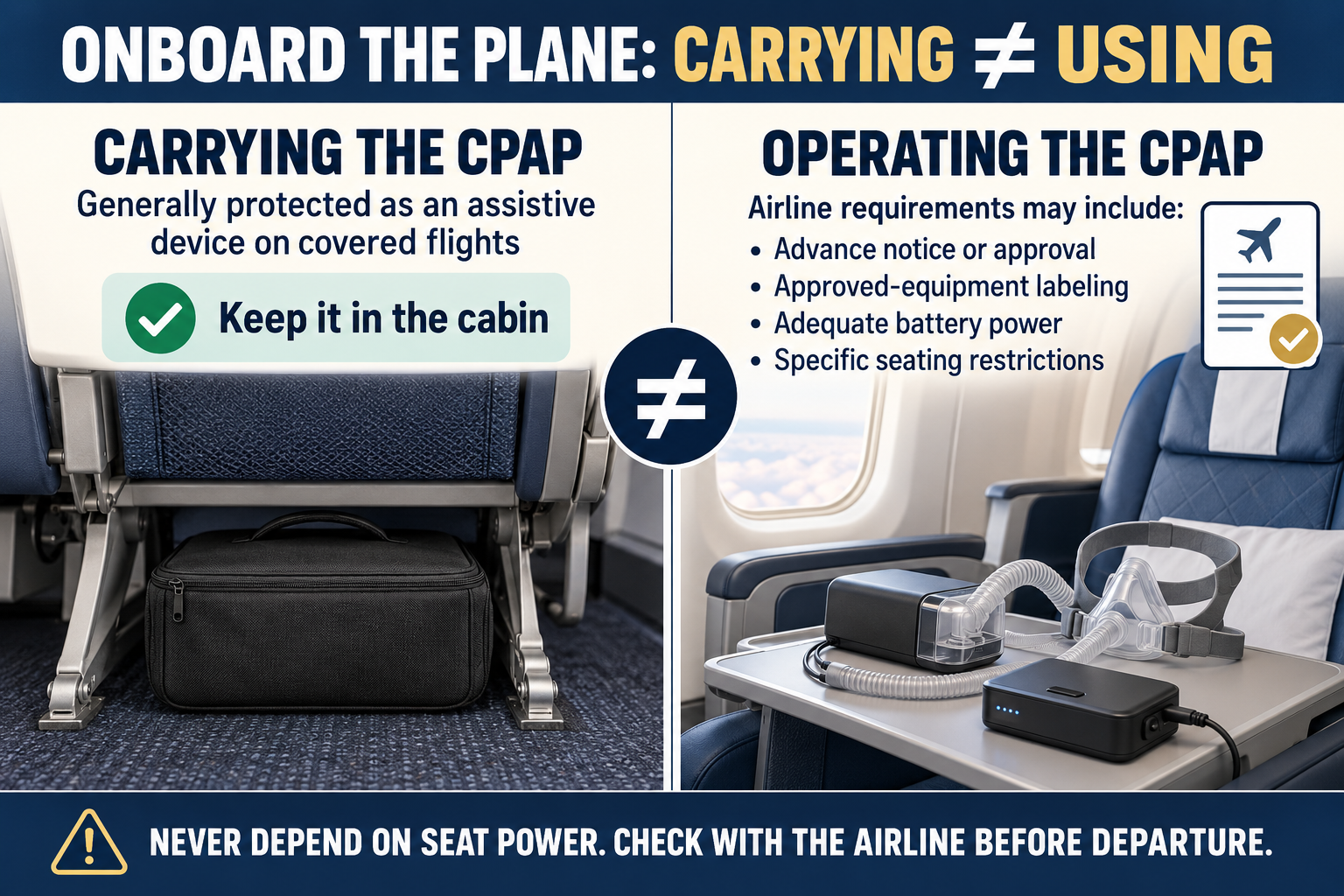
Carrying a CPAP and Using It During a Flight Are Different
Gina and I have never operated our CPAP machines during a flight. We carry them onboard, keep them safely stored and use them after reaching our destination.
Travelers who need or want to use a CPAP during an overnight flight have additional planning to do.
Permission to carry a medical device does not automatically settle every requirement for operating it at cruising altitude.
An airline may require:
Advance notice
A manufacturer’s label showing that the device meets applicable FAA requirements
A medical certificate in certain circumstances
Battery capacity sufficient for the airline’s required operating time
Earlier check-in
A seat location that does not create an obstruction
DOT guidance says an airline may require at least 48 hours’ advance notice and fully charged batteries sufficient for at least 150% of the flight’s duration before a passenger uses a CPAP aboard the aircraft. (DOT CPAP guidance)
Do not assume the seat outlet will operate your machine—or work at all.
If you plan to use a CPAP during the flight, contact the operating airline before departure and obtain its requirements in writing.
CPAP Batteries and Power Banks
Portable CPAP batteries are useful when you need to operate a machine in flight, during a power interruption or somewhere without a reliable outlet.
They are also lithium batteries, which means aviation limits apply.
FAA guidance says spare lithium batteries and power banks must remain in the passenger cabin. Batteries above 160 watt-hours are generally prohibited aboard passenger aircraft; batteries in the 101–160 watt-hour range typically require airline approval. Always verify the battery’s watt-hour rating and the airline’s rules before departure. (FAA PackSafe battery guidance)
A large battery marketed for camping or household backup may be far beyond what an airline permits.
A Practical CPAP Travel Checklist
Before leaving home:
Confirm the voltage printed on the CPAP power brick.
Pack the machine, mask, hose and power supply together.
Empty and dry the humidifier chamber.
Keep the CPAP in its manufacturer’s case.
Keep unrelated personal belongings out of the medical-device bag.
Check the airline’s assistive-device policy.
Check the operating airline’s requirements if you plan to use the machine onboard.
Verify the watt-hour rating of any CPAP battery.
Pack the correct destination plug adapter.
Confirm that every extension cord or power strip supports the local voltage.
Check the cruise line’s current electrical-equipment policy.
Request distilled water or an approved extension cord in advance when needed.
Consider packing a spare cushion, filter or other small component that would be difficult to replace during the trip.
None of these tasks is particularly complicated. The secret is handling them before you are tired, jet-lagged or standing at a gate.
Our Curated Verdict
🟢 GO FOR IT
Bring the CPAP and travel with confidence. We routinely carry two machines domestically and internationally without checking them, and neither of us has experienced a problem.
🟡 EVALUATE
Check the requirements for your specific machine, airline, cruise line and destination. Pay particular attention to humidifier-water instructions, international voltage, cruise electrical policies and advance approval for in-flight use.
🔴 SKIP IT
Don’t check the machine voluntarily, assume every power strip is internationally compatible, depend on seat power or treat one cruise line’s electrical policy as a universal rule.
Final Thoughts
Traveling with a medical device should not feel like a compromise on your freedom.
You don’t have to travel perfectly light to be a real adventurer, and leaving behind equipment that helps you sleep isn’t some kind of travel achievement.
The meaningful upgrade is learning how to integrate the tools that keep you healthy into the way you travel.
For us, that means two CPAP machines, two manufacturer cases and a small amount of preparation. We have carried them through airports, foreign countries and onto cruise ships without drama.
Because the best part of visiting a beautiful new place isn’t simply seeing it.
It is waking up with enough energy to enjoy it.