

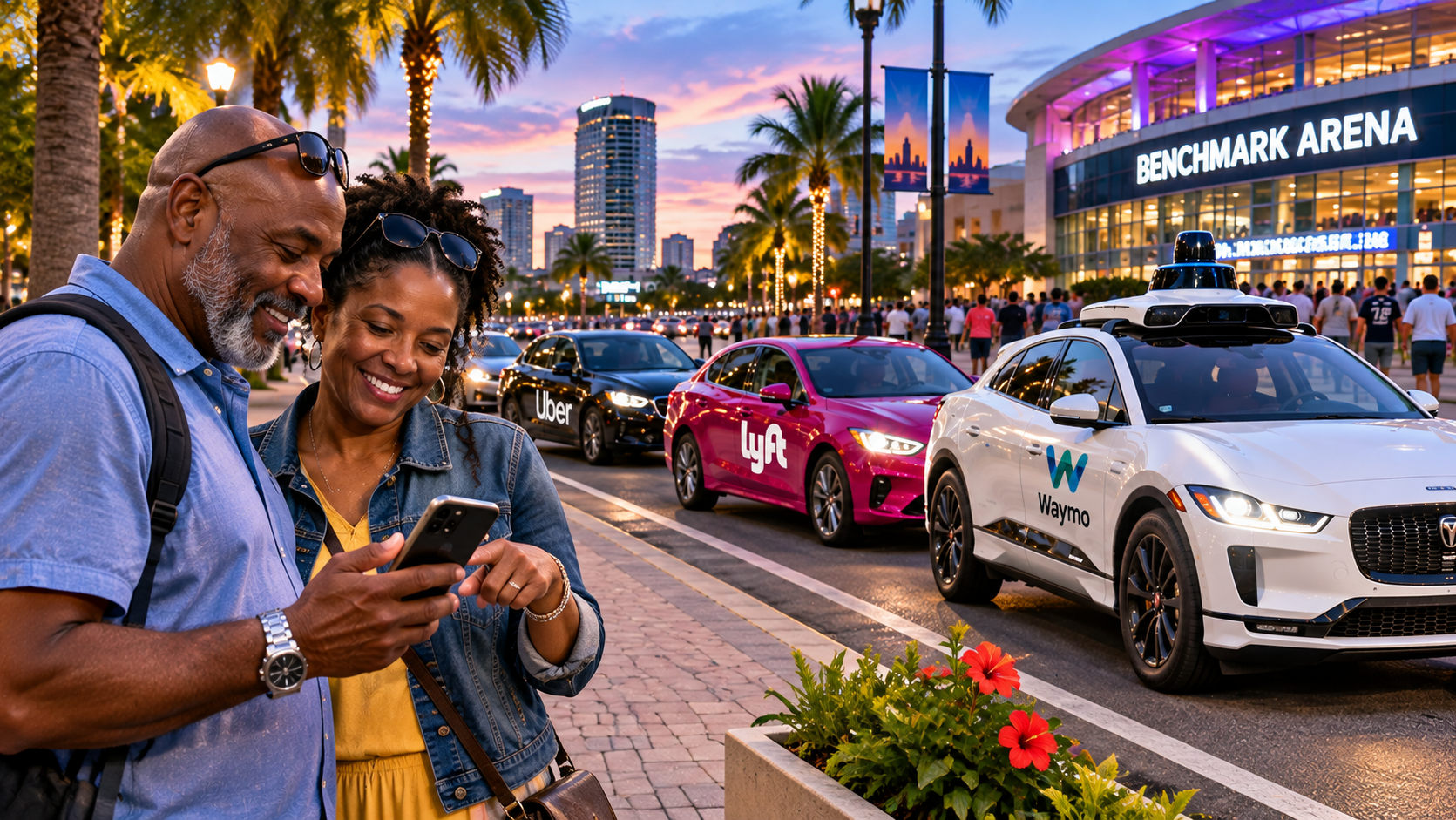
Uber vs. Lyft vs. Waymo: The Cheapest Ride Isn't Always the Best Deal
Three rideshare apps, one Tampa route, and a real-world comparison of fares, pickup times, tipping, rewards, and the value of knowing your options.
Three Apps. One Destination. Three Different Prices.
When I'm traveling, I like knowing my options.
And when it comes to getting around an unfamiliar city, those options have gotten pretty interesting.
Uber and Lyft are familiar names. But now there's another option in some cities: Waymo, with its fully autonomous vehicles.
No driver behind the wheel. No conversation with a driver. Just a vehicle that arrives and takes you to your destination.
During our recent Tampa weekend, Gina and I had an opportunity to compare all three.
We were staying at the Barrymore Hotel Tampa Riverwalk for a Rush concert at Benchmark Arena. We also had dinner reservations at Bern's Steak House, several miles away.
One morning, standing at our hotel, I opened Uber, Lyft, and Waymo to compare the cost of getting from the Barrymore to Bern's.
Same starting location. Same destination. Real-time quotes captured within two minutes of one another.
And the results were interesting.
Not because one company was dramatically better than the others, but because the comparison showed how many factors can influence what a ride is actually worth.
The Tampa Test: Barrymore Hotel to Bern's Steak House
Between 7:43 and 7:45 a.m., I checked all three apps for an immediate ride from our hotel to Bern's Steak House.
These were live quotes, not scheduled rides. We were comparing what each service offered at that moment.
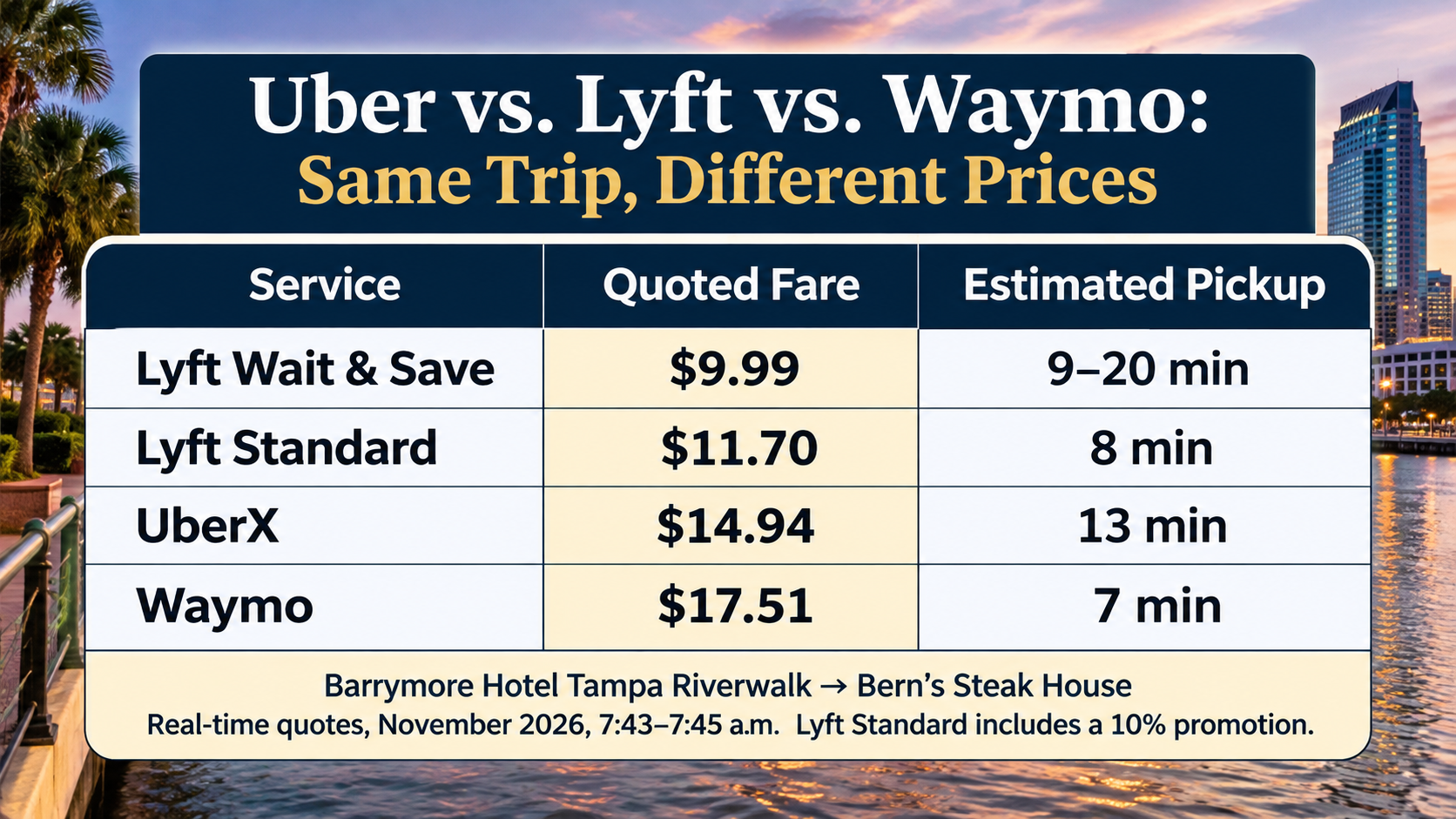
The screenshots captured four options: Lyft Wait & Save, Lyft Standard, UberX, and Waymo. Each offered a different combination of price and estimated pickup time.
At first glance, Lyft looked like the obvious winner.
Its Wait & Save option offered the lowest fare, although with a potentially longer wait. Lyft Standard was also competitively priced, and its quoted fare already included a 10% promotional discount.
Waymo had the shortest estimated pickup time but the highest quoted fare.
But there were a few other things worth considering.
The Price on the Screen Isn't Always What You'll Spend
Let's talk about tipping.
Uber and Lyft use human drivers. While tipping is optional, it's something I normally factor into the cost of a ride.
Waymo doesn't have a driver, so there's no driver tip to consider.
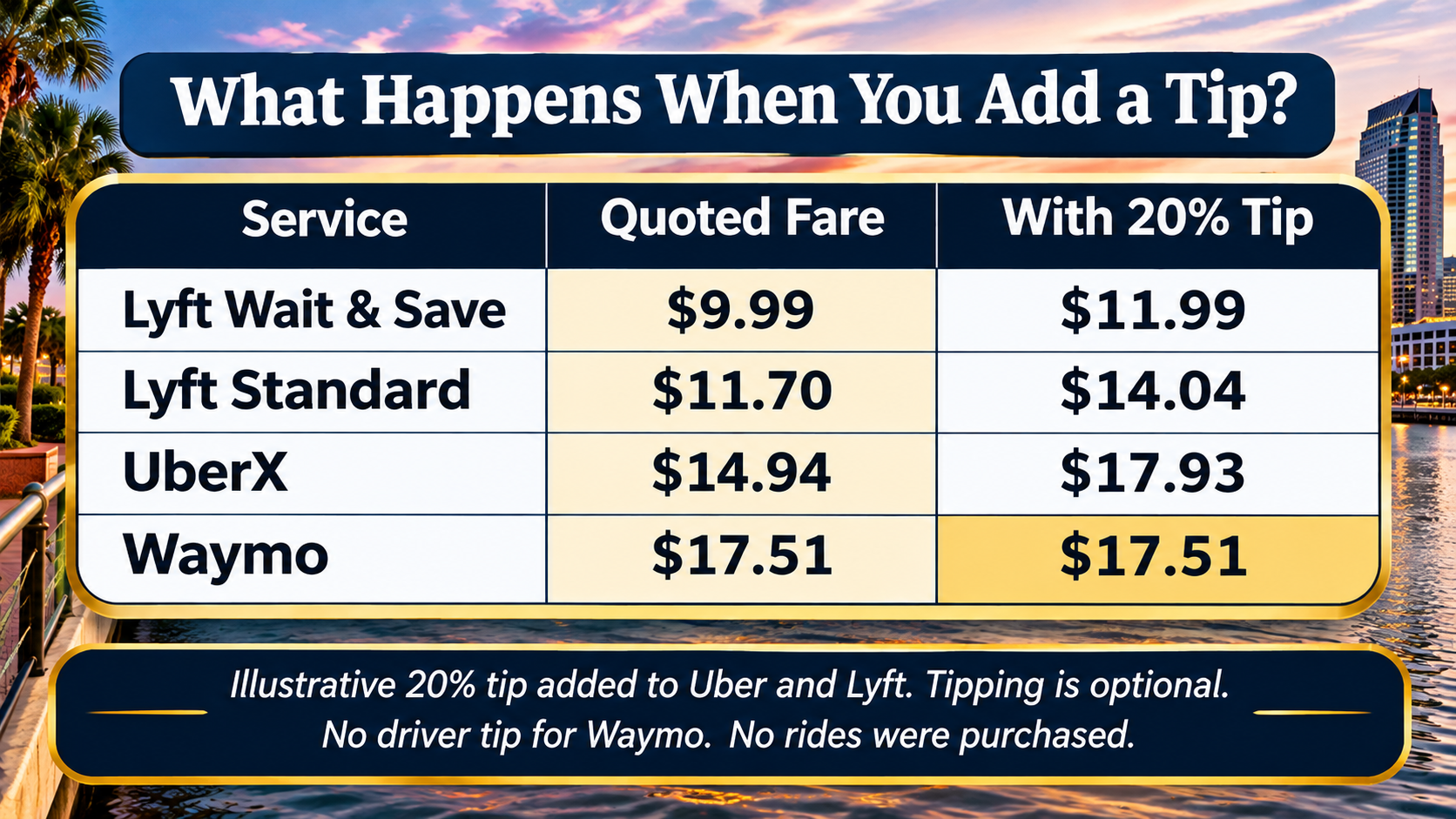
For our comparison, I used an illustrative 20% tip for Uber and Lyft.
Now the comparison gets interesting.
Lyft remained the least expensive option.
But Waymo, despite having the highest initial quote, became 42 cents cheaper than UberX once we included that hypothetical tip.
That's not a huge difference, but it demonstrates why I prefer comparing the total amount I expect to spend rather than just the initial fare.
Of course, tipping is a personal decision. These are hypothetical totals, not charges we actually paid.
And there's another factor: time.
How Much Is Your Waiting Time Worth?
Look at the pickup estimates again.
Lyft Wait & Save could take as long as 20 minutes.
Waymo estimated seven minutes.
If I'm sitting in the hotel lobby with nowhere urgent to be, waiting an extra ten or fifteen minutes to save a few dollars might make perfect sense.
But if I have a dinner reservation, a flight to catch, or a concert starting soon, I might make a different decision.
That's why the cheapest ride isn't necessarily the best deal.
Sometimes I'm willing to spend a little more for convenience.
Sometimes I'd rather keep the money.
And sometimes, particularly when traveling with luggage or dealing with bad weather, pickup location and vehicle availability might matter more than either price or waiting time.
There's no universal answer.
Dynamic Pricing: Why Yesterday's Winner Might Lose Today
We also compared Uber and Lyft during the evening, around 6:40 p.m.
The quoted fares were $12.52 for Lyft and $12.93 for Uber.
Only 41 cents separated them.
Compare that with our morning screenshots, when UberX was $3.24 more expensive than Lyft Standard.
Same general trip, different time, different pricing.
That's the nature of rideshare services.
Both Uber and Lyft use pricing systems that can respond to demand, traffic, driver availability, and other conditions.
Waymo also has its own pricing and vehicle availability, with a different fleet and operating model.
Each platform is working with its own supply of vehicles and its own demand at any particular moment.
So the company offering the best price at breakfast might not be the best choice before dinner.
And the cheapest company on Tuesday might be the most expensive on Saturday night.
Don't assume one rideshare company will always be cheaper than another.
Check the options when you actually need transportation.
Concerts, Crowds, and the Cost of Getting Home
Our Tampa weekend was a perfect example of why these matter.
We were there for a Rush concert, and thousands of people were heading to the same arena.
When a major event ends, a large number of people may request rides at essentially the same time.
That sudden increase in demand can affect prices and pickup availability.
But it doesn't necessarily affect every platform equally.
Uber might have more available drivers in one area. Lyft might have fewer. Waymo's autonomous fleet may have different availability and operating constraints.
Each service responds to its own conditions.
That means an inexpensive ride to the concert could become a considerably more expensive ride home.
We considered the potential for event-related surge pricing when choosing our hotel and planning our transportation.
Our screenshots don't establish how much surge pricing occurred after the Rush concert. They show the actual quotes available when we checked.
But the possibility of higher demand, longer waits, and increased fares was an important planning consideration.
And it's one of the reasons we chose a hotel within walking distance of the arena.
After the show, we walked approximately a mile back to the Barrymore.
No rideshare queue. No waiting for a driver. No wondering what the fare would be.
Sometimes the best way to avoid surge pricing is to plan your transportation before you ever leave home.
Discounts, Promotions, and the Rewards You Might Be Missing
There's another layer to the comparison that can make the final value a little more interesting.
Promotions and rewards.
Our Lyft screenshot showed a 10% discount on the Standard ride.
The regular displayed fare was $12.99, reduced to $11.70.
That discount was already included in our comparison. We wouldn't subtract it again.
But beyond promotional pricing, there's the opportunity to earn rewards.
For example, the Chase Sapphire Preferred offers five total Ultimate Rewards points per dollar on eligible Lyft purchases through September 30, 2027, under the applicable benefit terms.
The Capital One Venture Rewards card offers its standard two miles per dollar on eligible purchases.
And Lyft has travel loyalty partnerships that can offer additional value.
At the time of our comparison, the Lyft app advertised:
United MileagePlus: 1–4 miles per dollar on qualifying rides.
Hilton Honors: Three points per dollar on eligible standard rides.
Atmos Rewards: Two or three points per dollar, depending on the qualifying ride type.
There's a catch, though.
You can't earn rewards from all three Lyft travel partners on the same ride. You select an eligible linked partner.
Certain lower-priced ride categories, including Wait & Save, may also be excluded from some partner rewards.
Credit card rewards may be earned separately from the linked loyalty program, subject to the applicable terms.
Does that mean I would pay five dollars more for a ride just to earn a handful of points?
Absolutely not.
But when two rides are priced similarly, rewards can help tip the decision.
The key is knowing which benefits are available and remembering that promotions and partnership terms change.
What About Waymo?
Waymo brings something entirely different to the comparison.
It's not just another rideshare app competing for drivers.
It's an autonomous transportation service.
The car drives itself.
That made it a particularly interesting option to investigate during our Tampa weekend.
Our screenshot showed a $17.51 fare, a seven-minute estimated pickup, and a projected drop-off at 8:16 a.m.
It was the highest quoted fare of the three standard options.
But because there was no driver tip to consider, it became slightly cheaper than UberX under our illustrative tipping scenario.
Would I try it?
Sure. I'm interested in the technology, and I wouldn't rule it out simply because there's no human driver.
But I also wouldn't pay substantially more just for the novelty.
The same questions apply:
Is it available where I am? Does it serve my destination? What's the estimated pickup time? And what will the ride cost?
We didn't actually take a Waymo ride during our Tampa weekend, so I'm not going to review the experience of riding in one.
That's a story for another day.
For this comparison, Waymo was simply another transportation option with a real-time price we could evaluate.
So Which One Did We Choose?
None of them.
And that's probably my favorite part of this story.
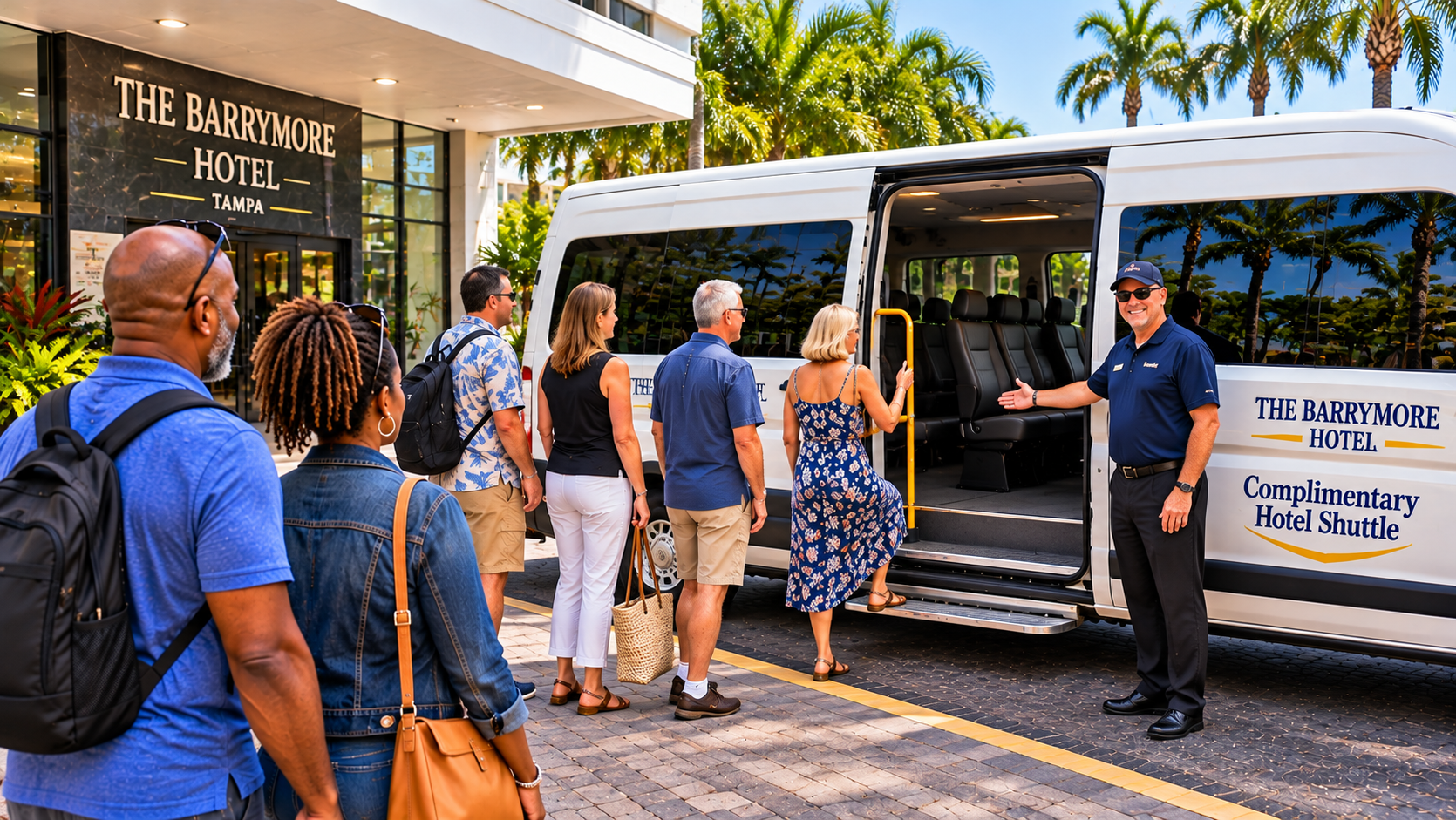
We were staying at the Barrymore Hotel Tampa Riverwalk, which offered a complimentary local shuttle.
Our driver, John, took us to Bern's Steak House and picked us up after dinner.
On the way back, he even gave us a little tour of Tampa and shared recommendations for places to explore.
The following evening, the hotel shuttle also helped us get to the Rush concert.
And afterward, we walked back.
No Uber. No Lyft. No Waymo.
We had compared the alternatives, understood the approximate costs, and knew what options were available if we needed them.
But ultimately, the hotel shuttle was the better choice for our actual plans.
That's one of the reasons we were so pleased with our stay, as I explain in The Barrymore Hotel Tampa Riverwalk: Location Over Luxury.
It also illustrates why transportation planning shouldn't begin and end with opening a rideshare app.
Sometimes a hotel shuttle, public transit, or simply choosing accommodations in the right location can be the better solution.
Our Verdict: Compare the Options, Not Just the Brands
Here's how I'd approach rideshare transportation on a future trip.
🟢 Go for it: Compare multiple services. Checking Uber, Lyft, and Waymo, where available, takes very little time and can reveal meaningful differences.
🟢 Go for it: Consider the total expected cost. Include any tip you plan to leave, promotional discounts, and potential rewards.
🟢 Go for it: Plan around major events. Concerts, sporting events, and conventions can create significant transportation demand. Think about your return trip before the event begins.
🟢 Go for it: Check your hotel's transportation options. A complimentary shuttle or walkable location might eliminate the need for rideshare entirely.
🟡 Maybe: Pay more for a faster pickup. Depending on your schedule, convenience may justify a higher fare.
🟡 Maybe: Choose Waymo. If it's available for your route and you're comfortable with autonomous vehicles, it's worth including in the comparison.
🔴 Pass on it: Assuming one company always has the best price. Each platform has its own pricing, demand, and vehicle availability. A winner in one comparison may lose the next.
The Bottom Line
Our Tampa comparison wasn't about proving Uber, Lyft, or Waymo was the best rideshare company.
It was about understanding our choices.
Within two minutes, we found a substantial difference in quoted fares for the same trip.
Adding an illustrative tip changed the comparison.
Considering pickup times changed it again.
And looking at promotions and rewards added another layer.
But none of those numbers would necessarily hold up later that evening, especially when thousands of concertgoers were trying to get home.
The smartest transportation choice isn't always the cheapest fare. It's the option that gives you the best combination of cost, convenience, reliability, and value for that particular trip.
For us, that turned out to be the hotel shuttle, and a leisurely walk back to the hotel later that evening after the concert.
And that's exactly why we compare before we commit.