

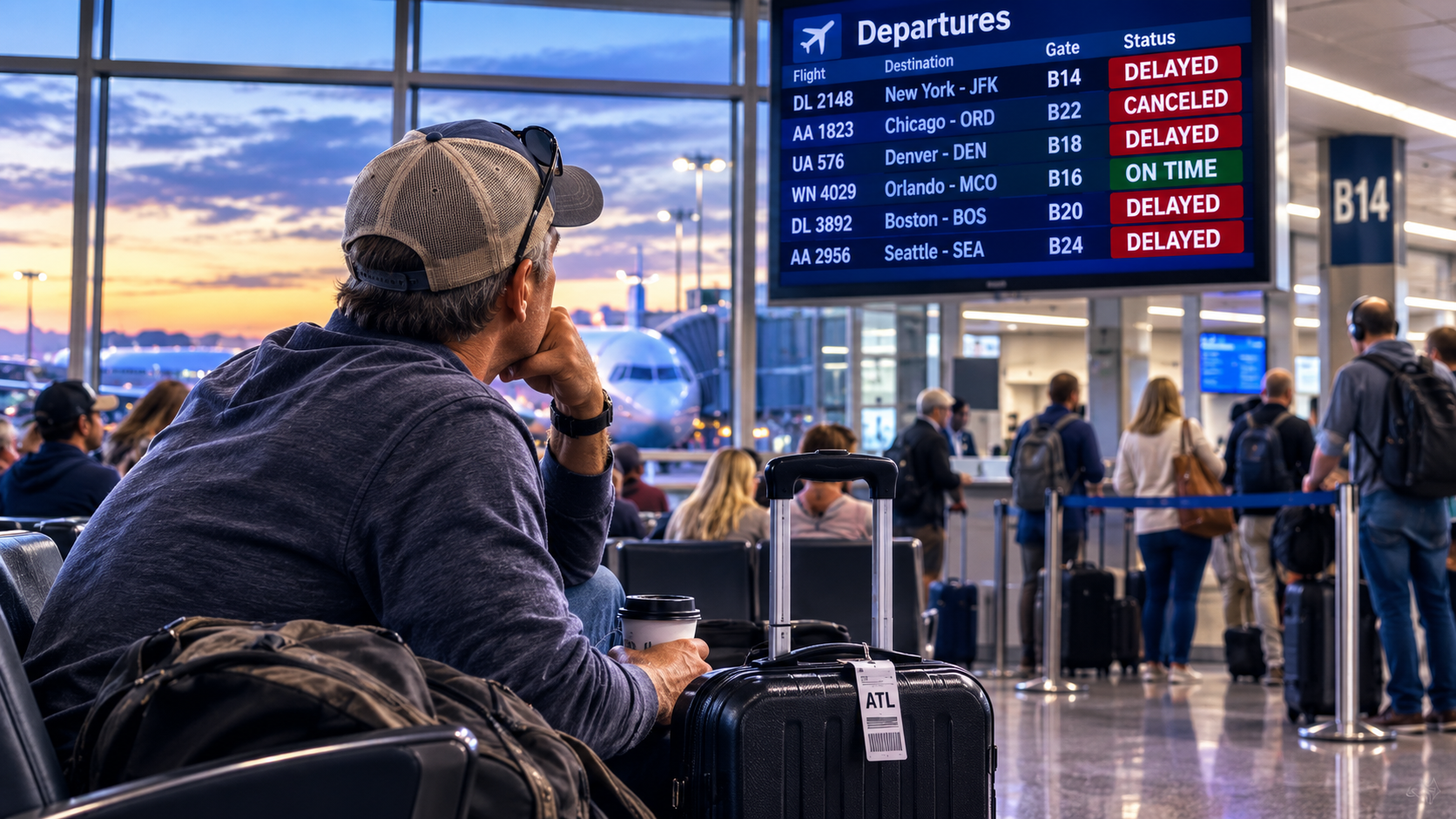
Stuck at the Gate: Your Real Rights During U.S. Flight Delays
Your flight just went from ON TIME to DELAYED. Before you join the line at the gate, here's what U.S. travelers should know about refunds, rebooking, meals, hotels and getting themselves moving again.
There are few sights in travel that drain your enthusiasm quite as quickly as watching ON TIME disappear from the departure board and DELAYED take its place.
Then the choreography begins.
Phones come out. Airline alerts start chiming. People stand up almost simultaneously. And within a minute, a line has formed at the gate desk.
Your instinct may be to join it.
Don't. At least, not yet.
Pull out your phone first.
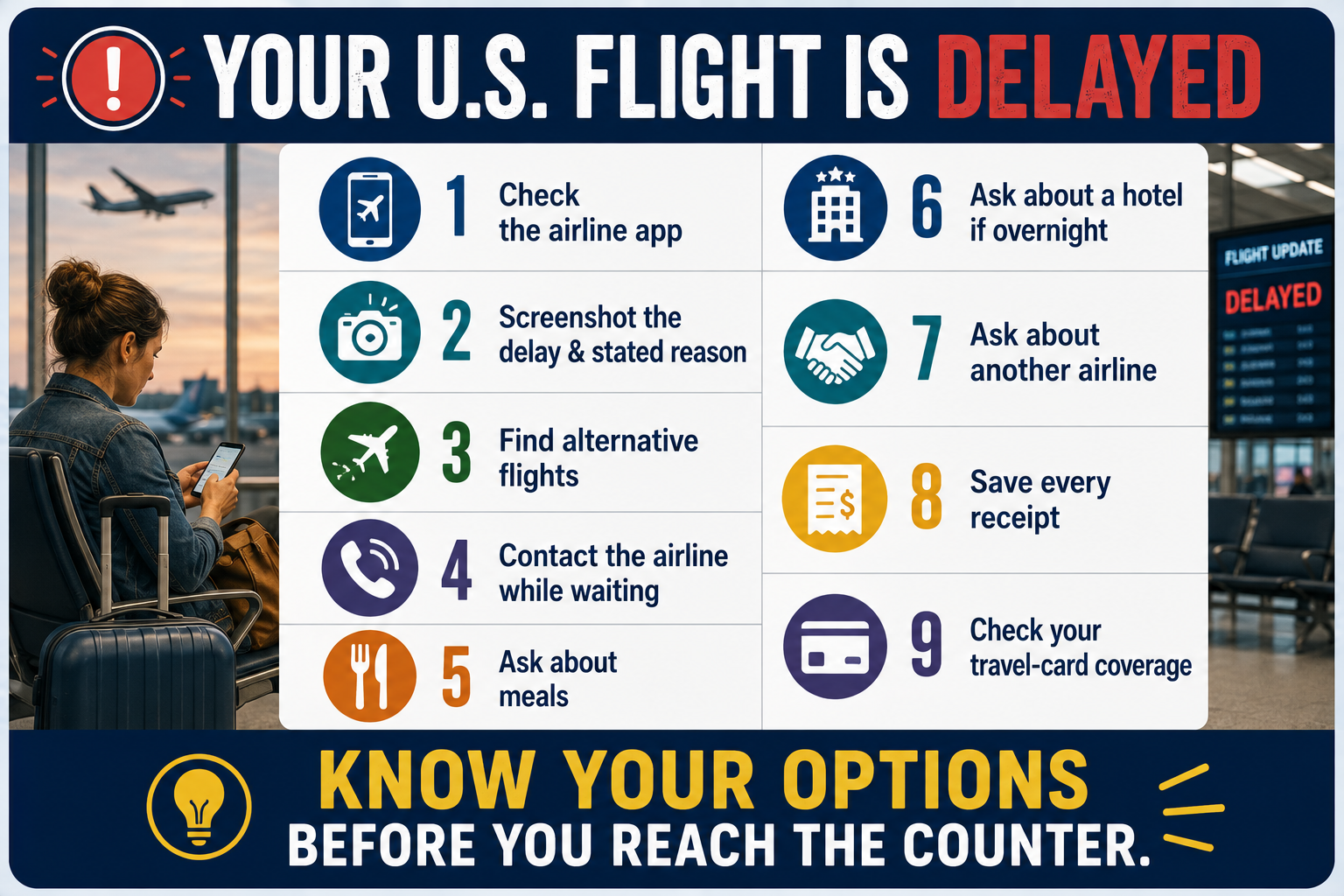
Check the airline app. Find out why you're delayed. Look at your connecting flight if you have one. Search for alternative flights. Screenshot what you're seeing.
Then get in line if you need to, already knowing what you're asking for.
Because during a U.S. flight disruption, information can be considerably more valuable than your place in line.
And the first thing to understand is that passenger protections in the United States work very differently from those in Europe.
The U.S. Reality: A Delay Doesn't Automatically Mean a Payout
One of the biggest misconceptions about flying in the United States is that a sufficiently long delay automatically means the airline owes you cash for the inconvenience.
Generally, it doesn't.
There is no broad federal rule requiring U.S. airlines to pay passengers cash compensation simply because a flight arrives several hours late.
What U.S. travelers do have are important federal refund protections, along with separate customer-service commitments made by individual airlines for things such as meals, hotels and rebooking.
Those are two different things, and understanding the difference is important.
Regulatory information in this article was current as of August 2026. Rules and airline commitments can change. Always verify current information with the U.S. Department of Transportation and your airline.
When a Delay Gives You the Right to Walk Away
Under current DOT rules, a flight can qualify as significantly changed when its scheduled departure or arrival shifts by three hours or more for a domestic itinerary or six hours or more for an international itinerary.
Other significant changes can include moving you to a different airport, adding connections, downgrading your class of service, or certain accessibility-related changes.
Here's the important part:
You don't get to take the replacement flight and also demand your entire airfare back.
The refund protection applies when the airline cancels or significantly changes your flight and you choose not to accept the changed flight, rebooking, travel credit or other alternative compensation.
Imagine you're flying to Chicago for a meeting.
Your flight is delayed so badly that you'll arrive after the meeting is over.
Or you're traveling to a wedding and the replacement itinerary gets you there the following day.
At some point, getting there later may no longer serve the purpose of the trip.
That's when knowing you can potentially say,
“This no longer works for me. I'd like the refund I'm entitled to.”
becomes considerably more valuable than another voucher.
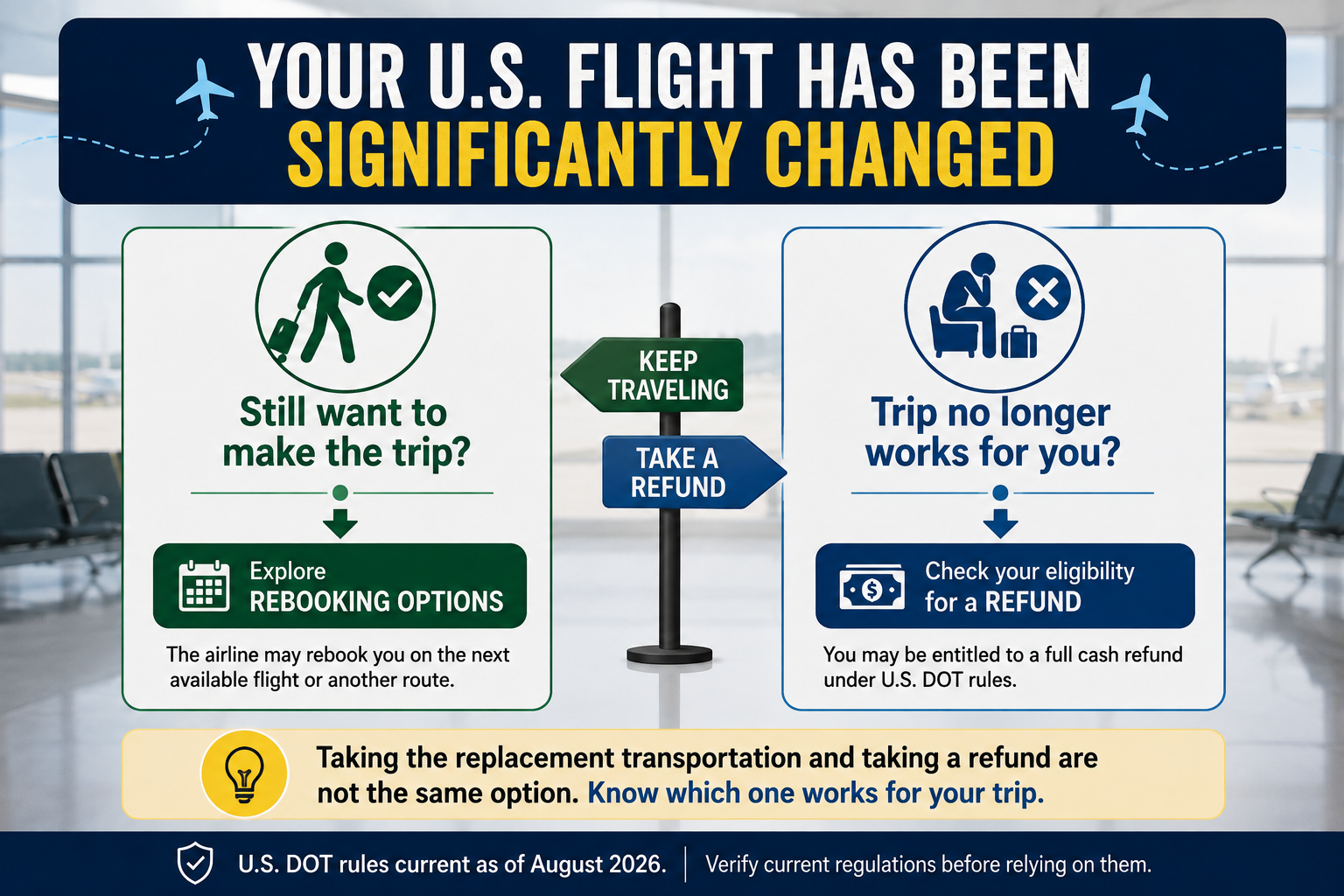
A Refund Means Money Back, Not Just an Airline Voucher
When you're legally entitled to a refund, an airline can't require you to accept an expiring travel credit instead.
You can certainly choose a voucher if the airline makes you an attractive offer.
But know what you're giving up before clicking ACCEPT.
Under DOT's current rules, qualifying refunds generally must be returned to the original form of payment within seven business days for credit-card purchases and 20 business days for other forms of payment.
And the refund rules don't stop with airfare.
If you paid for an ancillary service that the airline failed to provide, such as a particular seat, Wi-Fi or another service, you may also be entitled to have that fee returned under applicable DOT rules.
The lesson isn't that every disruption produces a payday.
It's much simpler:
Know what you're entitled to before accepting whatever appears first on your phone.
Why the Reason for Your Delay Matters
Now we leave the world of federal refund requirements and enter another category entirely:
what your airline has committed to do for you.
This is where one word becomes particularly important:
Controllable.
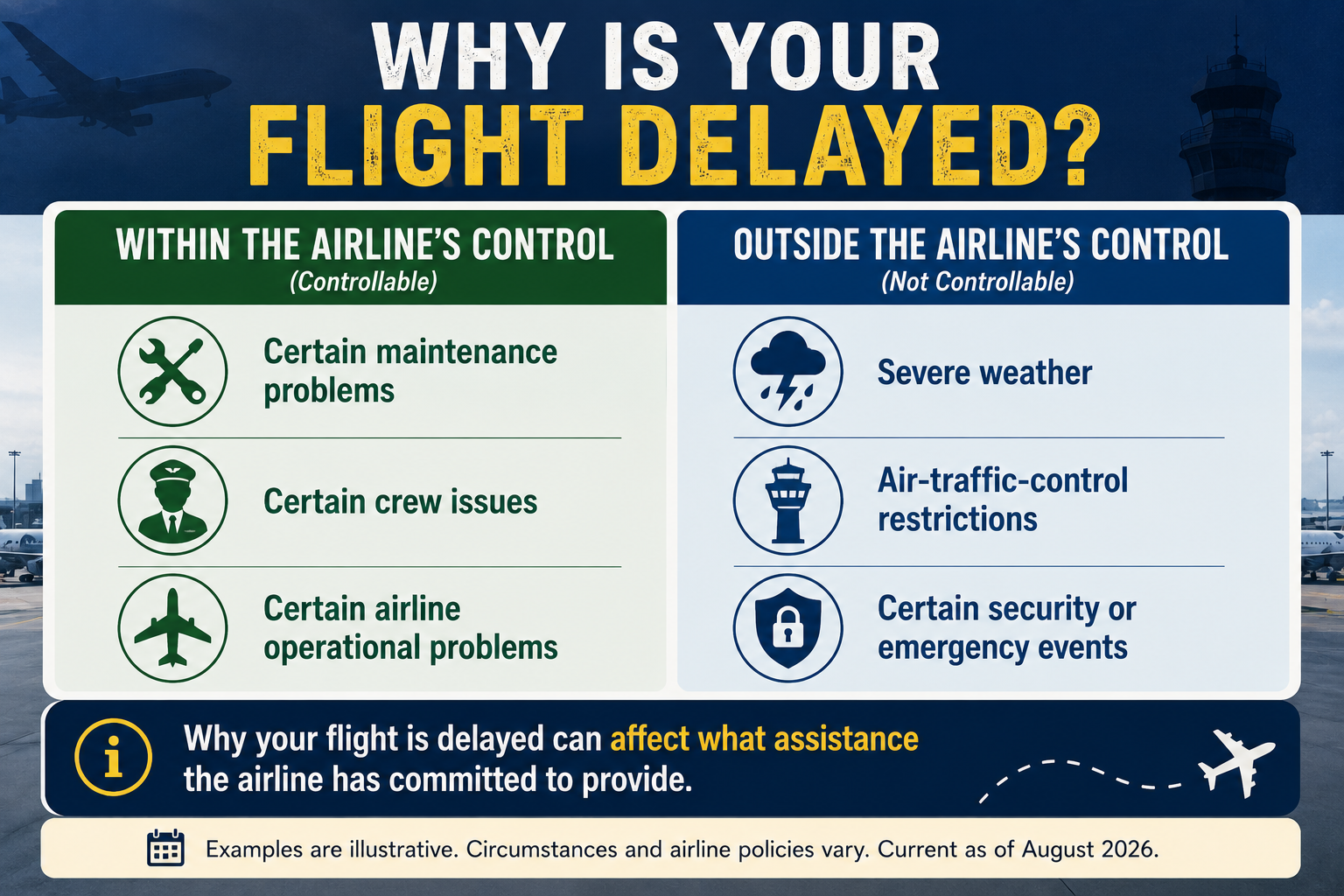
DOT describes a controllable delay or cancellation as essentially one caused by the airline.
That can include certain maintenance, crew or operational problems.
Severe weather and air-traffic-control disruptions generally aren't within the airline's control.
And that distinction can determine whether your airline has committed to providing things such as meals, a hotel room or ground transportation.
Three Hours at the Airport? Ask About Food
Here's a useful one to remember.
As of August 2026, all nine airlines currently displayed on DOT's Cancellation and Delay Dashboard commit to providing a meal, meal cash or meal voucher when a controllable delay causes a passenger to wait three hours or more.
That's much more specific than assuming:
“I've been delayed three hours, so the airline owes me dinner.”
The reason for the delay matters.
Instead, ask:
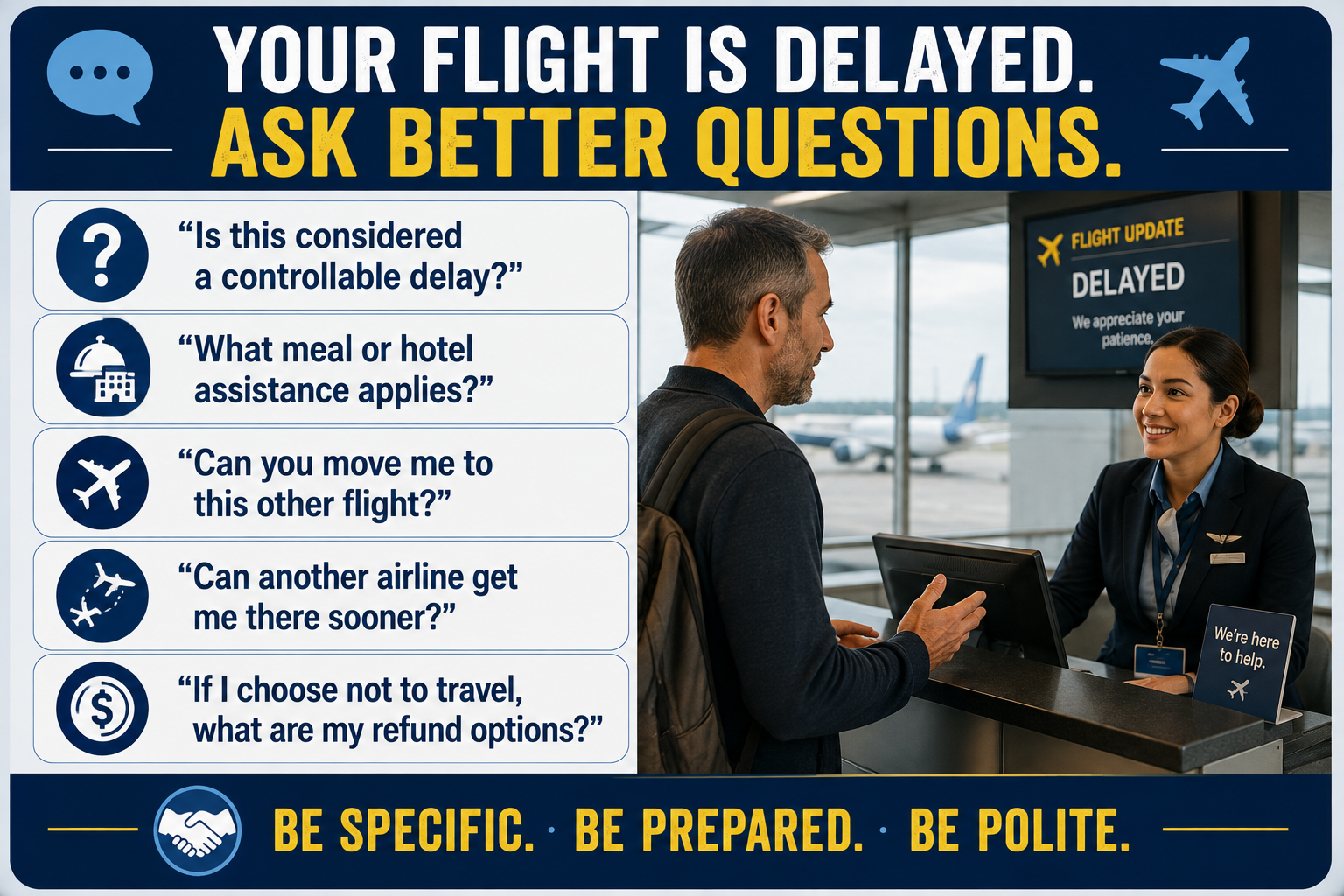
“Is this considered a controllable delay, and does your meal-voucher commitment apply?”
Now you're asking a question tied directly to the airline's published commitment.
DOT Airline Cancellation and Delay Dashboard
And bookmark that page.
Seriously.
This is neo of those rare government webpages that can actually be useful while you're standing in an airport.
Overnight? Don't Book the Hotel Quite Yet
This is another place where internet advice gets muddy.
There isn't a blanket federal requirement forcing every U.S. airline to provide every passenger a hotel whenever a delay strands them overnight.
Instead, airlines make individual customer-service commitments.
As of August 2026, DOT's dashboard shows eight of the nine listed airlines committing to complimentary hotel accommodations for passengers affected by a controllable overnight delay. Frontier does not currently make that commitment. The same eight also commit to ground transportation between the airport and hotel.
So before pulling out your credit card and booking the airport Hilton:
Ask.
Find out how the airline has classified the delay.
Ask whether it is providing accommodations.
Ask how you're supposed to obtain them.
And if you do have to spend your own money, save every receipt.
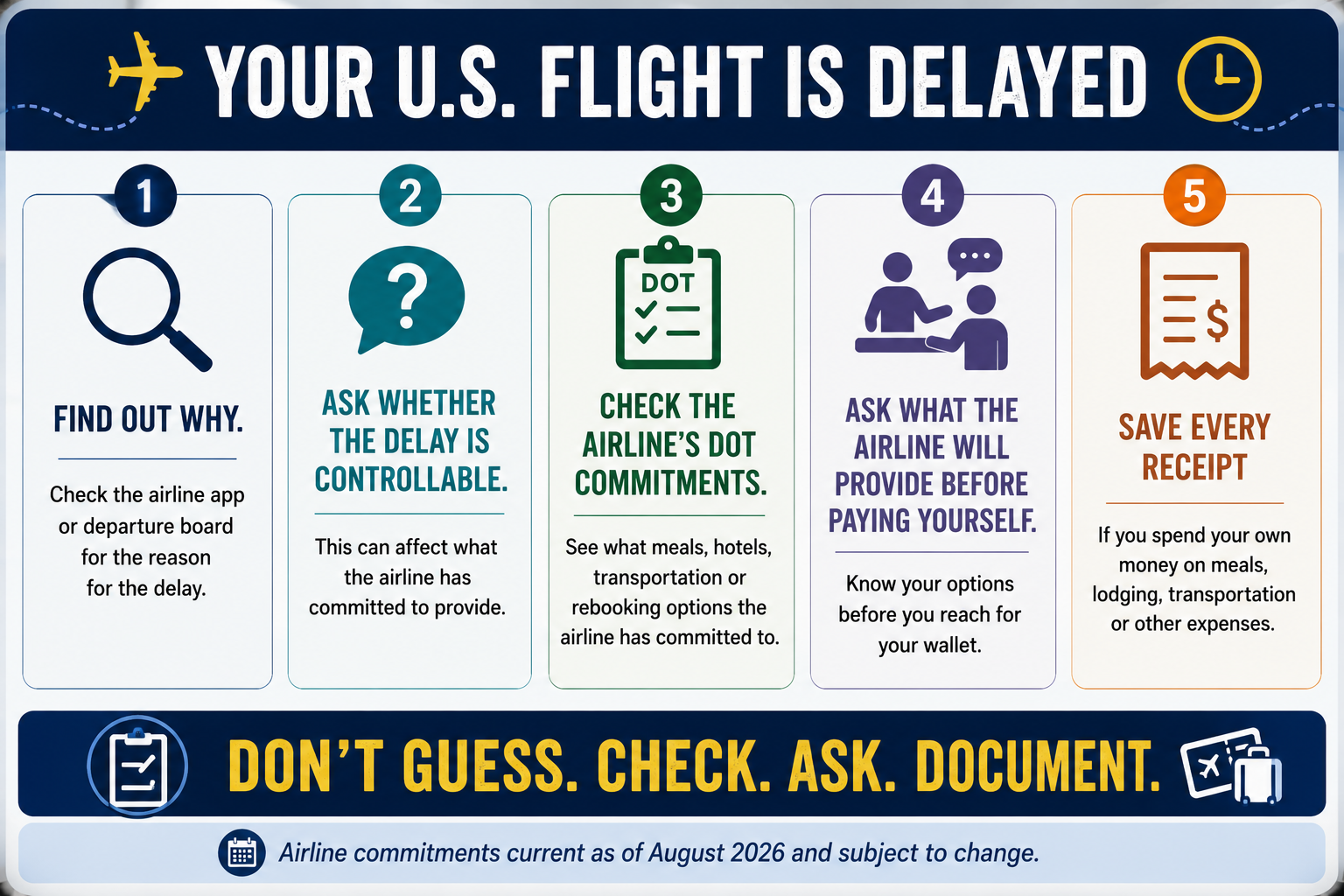
Don't Just Stand in the Gate Line
Now we get to the part no federal regulation can solve.
Your flight gets badly delayed.
Seventy people stand up.
Sixty-nine of them immediately get in line.
You don't have to be passenger number seventy.
Get in line while doing something else.
Open the airline app and see whether you've already been automatically rebooked.
Search the airline's other flights.
Look at possible connections.
Call customer service.
Try the airline's chat or messaging system if one is available.
If you're traveling with someone, divide and conquer. One person can hold your place while the other works the phone.
You now have several paths toward solving the problem instead of one.
Find an Alternative Before You Reach the Desk
Compare these two approaches:
“What are you going to do about this?”
versus:
“I found a 4:15 flight through Atlanta that appears to have seats. Could you see whether you can move us to that itinerary?”
The second gives the agent something useful to work with.
Look at your airline's own flights first.
Then consider partner airlines or other carriers if your airline can't get you moving.
You aren't guaranteed the agent can put you on the flight you've found.
But you're no longer asking someone to invent a solution while dozens of people wait behind you.
You're bringing them one.
Ask About Another Airline
Suppose your airline tells you:
“Our next available flight is tomorrow afternoon.”
Meanwhile, you can see another carrier departing for your destination in two hours.
Ask:
“Do you have an agreement with another airline that would allow you to rebook me on a flight leaving today?”
As of August 2026, DOT's dashboard shows Alaska, American, Delta, Hawaiian, JetBlue and United committing to rebook passengers on a partner airline or another airline with which they have an agreement at no additional cost during qualifying controllable significant delays.
Allegiant, Frontier and Southwest don't make that same commitment on the dashboard.
That doesn't mean another carrier will necessarily have a seat.
And it doesn't mean an airline without that commitment will never help you.
It means it's worth asking.
Remember Who You're Talking To
The gate agent didn't break the airplane.
They didn't summon the thunderstorm.
And they didn't personally schedule your crew in Cincinnati when your airplane is sitting in Atlanta.
They're trying to untangle the same disruption you're caught in, usually for a lot of people at once.
Be prepared. Be specific. Be polite.
Something as simple as:
“I know you're dealing with a lot of people. I found another flight that might work. Could you see whether this is an option?”
is enough.
You might not get the answer you want.
But making it easier for someone to help you usually beats making them absorb your frustration first.
Your Credit Card May Be Plan B
The airline isn't necessarily your only source of protection.
Some travel credit cards include trip-delay benefits that may reimburse eligible expenses such as meals, lodging or transportation when a qualifying delay occurs.
But don't assume you're covered.
The required delay length, covered reasons, reimbursement limits, eligible travelers and documentation requirements can vary significantly by card and can change.
Before traveling, read the current Guide to Benefits for the specific card you used to purchase the trip.
Then, if something goes wrong:
Save every receipt.
Again.
We're going to sound like your accountant by the end of this series. 😄
The Bottom Line
When your flight suddenly turns red on the departure board, don't panic and don't assume the gate line is your only option.
Find out what's happening.
Document it.
Look for alternatives.
Understand whether the disruption is within the airline's control.
Know what your airline has committed to provide.
Ask specific questions.
Save your receipts.
And if the disruption becomes significant enough that the trip no longer makes sense, understand your refund rights before accepting a rebooking or travel credit.
Knowing the regulations matters.
Knowing what to do with that information while you're standing at the airport matters even more.
Important
This article provides general travel information and is not legal advice. U.S. Department of Transportation regulations, airline customer-service commitments and credit-card benefits can change. Regulatory and airline-policy information in this article was checked against official DOT sources and was current as of August 2026. Always verify the current regulations, your airline's policies and your credit card's current benefits before relying on a particular protection.
Last updated: August 2026