

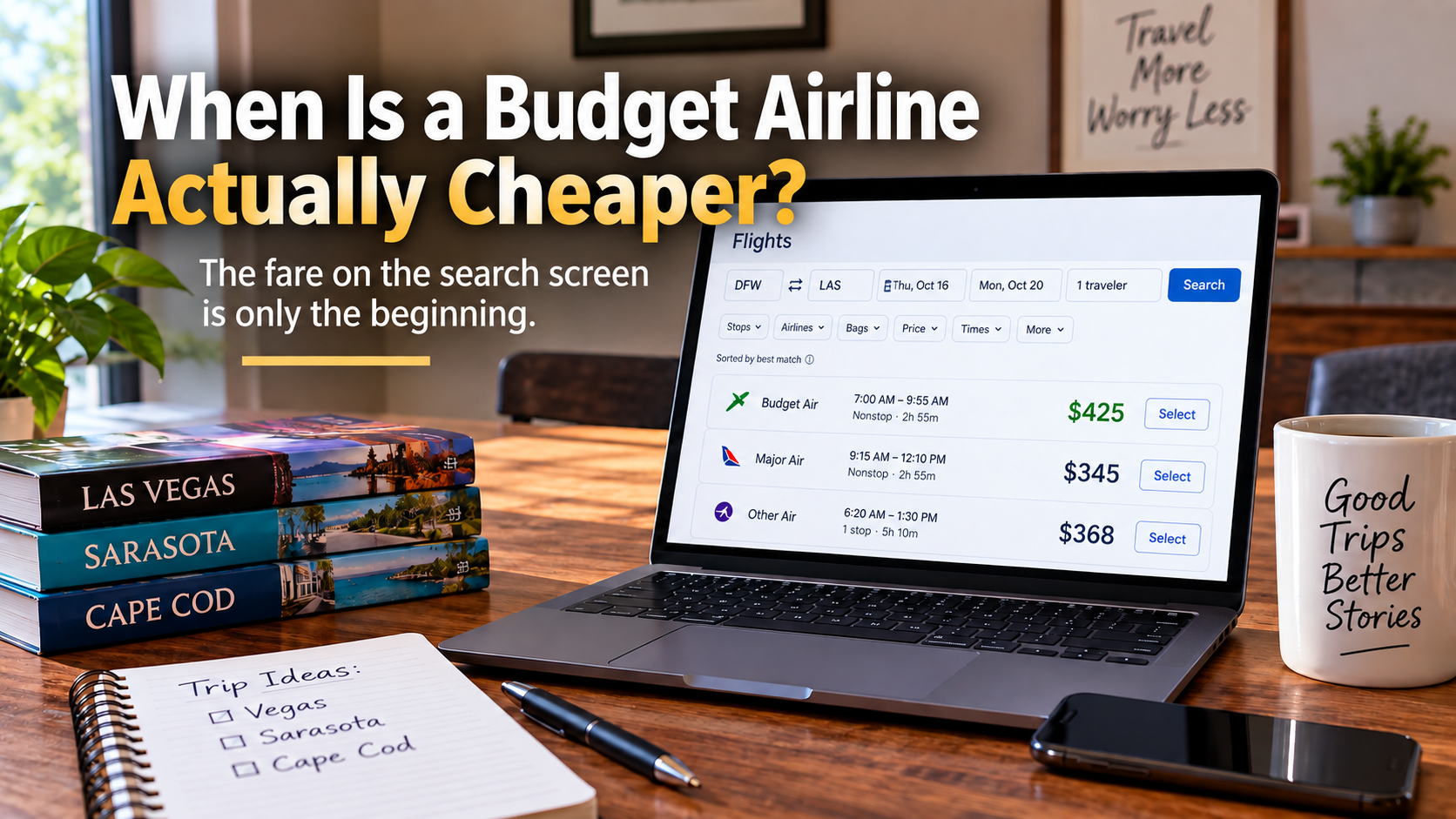
When Is a Budget Airline Actually Cheaper?
The fare on the search screen is only the beginning.
A budget airline shows up in a flight search for $59.
Another airline wants $129.
Easy decision, right?
Maybe.
Now add the carry-on you're actually bringing. Pick the seat you actually want. Look at the departure time, whether the flight is nonstop, which airport you're using and what happens if the flight gets canceled.
That $59 fare might become $147.
It might also remain the best deal on the screen.
And sometimes the supposedly more expensive airline turns out to cost less.
That's why I don't think the useful question is:
Are budget airlines worth it?
The better question is:
Which flight gives this traveler the best value for the dollar on this particular trip?
That's an important distinction because two travelers can compare the exact same flights, do the math correctly, and choose different airlines.
Neither one has to be wrong.
Budget Airline Doesn't Mean Bad Airline
Let's get this out of the way first.
This isn't an article about why you shouldn't fly a budget airline.
I've flown them. I'll fly them again.
Their business model can create some terrific opportunities, particularly when they offer a nonstop route that another airline doesn't. Sometimes the stripped-down fare is exactly what you need.
But the number that first appears in a search isn't necessarily the number you should compare.
Google itself makes that point. Google Flights explains that its displayed price covers the passenger air transportation and that additional fees such as baggage may apply. Google also notes that not every airline or available flight necessarily appears because participation requires a partnership.
So I use Google Flights as a starting line, not the finish line.
Search the market. See what's available. Then check the relevant airlines directly, especially smaller carriers serving the route.
And then build the trip you're actually going to take.

Three Travelers. Three Trips. Three Different Decisions.
To see how this works, I ran three actual flight searches.
I deliberately gave our travelers different trips because that's how people really travel.
One is going to Las Vegas for two nights.
Another is going to Sarasota and wants to come home on a particular day.
The third is spending a week on Cape Cod.
Their luggage needs aren't identical. Their schedules aren't identical. Their airports aren't identical.
Why would we expect their best airline choice to be identical?
Trip One: Dallas to Las Vegas for Two Nights
For a two-night Vegas trip, our traveler doesn't need a checked suitcase. A carry-on will do.
The Frontier search produced a $355 round-trip Basic fare, but that isn't the fare our traveler would actually buy. Frontier's current Basic fare includes a personal item, while its Economy bundle includes a carry-on and standard seat selection.
For our flights, that Economy bundle brought Frontier to $425 round trip.
American's Basic Economy fare was $235 round trip, with a carry-on included. Advance seat selection would cost extra if our traveler wanted it.
That's a pretty substantial difference.
But notice what we did.
We didn't automatically add a checked bag to both tickets because that's what some comparison chart says we're supposed to do.
Our traveler isn't bringing one.
We priced the trip this person is actually taking.
That's the rule:
Don't change the trip to fit the fare. Price the fare for the trip you're actually taking.
In this particular search, American makes a very strong case on price. The flights we compared were also both nonstop and departed within roughly the same part of the morning.
Someone else could still make a different choice. Frontier status or benefits, a preferred flight time, previous experience with either airline or simply a different set of priorities could alter the equation.
But for this traveler, the numbers tell an unusually clear story.
Trip Two: Cincinnati to Sarasota
Now things get interesting.
Our traveler wants to leave Cincinnati on November 13 and return from Sarasota on November 18.
Allegiant offers the great big shiny thing travelers love:
Nonstop flights.
Once we added the carry-on, checked bag and standard seat our traveler wanted, the Allegiant trip came to $442 round trip.
American came to $521 round trip, including the comparable baggage and seating needs.
So Allegiant saves $79.
Case closed?
Nope.
Allegiant wasn't flying the return route on Wednesday.
To take the Allegiant option, our traveler had to return Thursday, November 19, one day later than planned.
American could get the traveler home Wednesday, but both directions involved connections. The flights we found were about 5 hours 20 minutes outbound and 7 hours 13 minutes returning.
Now we have a genuine decision.
One traveler may look at that and say:
“I'll save $79, fly nonstop and spend another day in Florida. Where do I sign?”
Another may say:
“I need to be home Wednesday. The extra $79 is irrelevant.”
Same search. Same prices. Different answer.
And neither traveler needs an airline reviewer on the internet to tell them they're doing it wrong.
There are onboard differences, too. Allegiant currently sells snacks and drinks on select flights and says it does not offer Wi-Fi or inflight entertainment.
How much does that matter on a relatively short domestic flight?
That's up to you.
For some people, not one bit.
For someone hoping to work during the flight or keep the kids entertained, perhaps considerably more.
Trip Three: Jacksonville to Cape Cod for a Week
Our third traveler is heading to Cape Cod for a week.
This comparison also demonstrates why searching by airfare alone can miss part of the story.
Breeze could take our traveler from Jacksonville to Providence. JetBlue could take them to Boston.
The Breeze headline fare looked extremely attractive. But our traveler wasn't going with the bare-bones version. We priced the Nicer option with the seat, carry-on and checked bag they actually wanted.
Breeze: $400 round trip.
The comparable JetBlue trip, using its Main fare and adding the checked bag, came to:
JetBlue: $528 round trip.
Breeze is still $128 cheaper.
That's important.
The budget fare didn't mysteriously become a bad deal once we added everything. It still won the cash comparison.
But there are other differences.
Our Breeze itinerary had a connection each way, about 4 hours 36 minutes outbound and 4 hours 3 minutes returning.
The JetBlue itinerary gave us a 2 hour 43 minute nonstop outbound, although the return connected through JFK and took about 5 hours 40 minutes.
Then there's Providence versus Boston.
Depending on exactly where you're going on Cape Cod, those airports may affect the rest of your trip. I'm not going to calculate every possible rental car, toll, traffic jam and clam-chowder stop for you.
Just recognize that the airport belongs in the equation too.
Breeze also offers Wi-Fi on its A220 aircraft, free with Nicer and Nicest bundles, along with free inflight entertainment. JetBlue currently includes a carry-on with all fares and offers free high-speed Wi-Fi, seatback entertainment, snacks and drinks across its onboard product.
Is that worth another $128?
I don't know.
Neither does anyone else until we know the traveler.
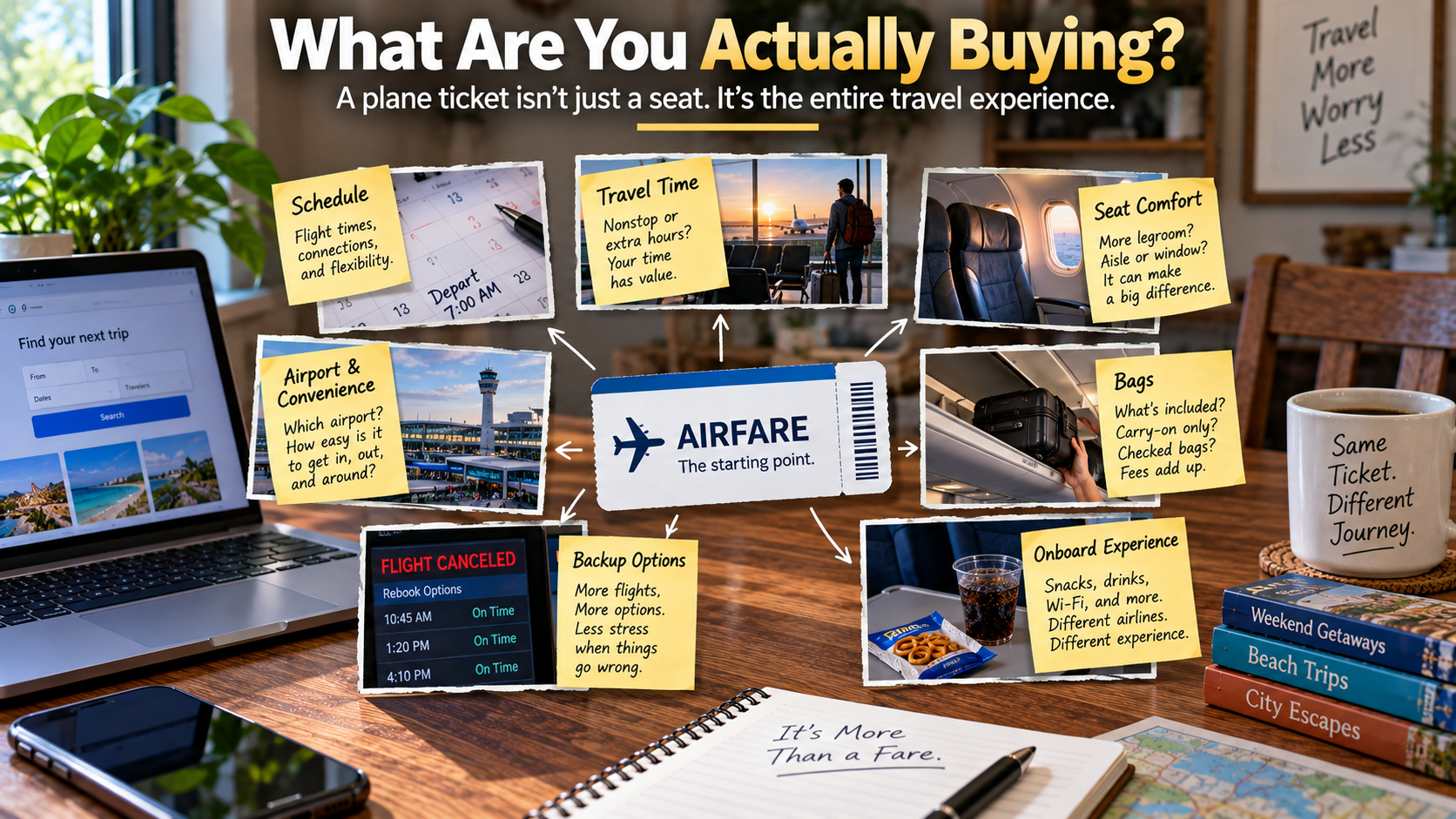
What Are You Actually Buying?
This is where budget-airline comparisons often go sideways.
We build a spreadsheet of baggage fees and declare a winner.
But you're not buying a baggage allowance.
You're buying a trip.
So when I compare flights, I'm looking at more than the number in the big blue button.
Bags
Start with what you're actually bringing.
A two-night Vegas traveler may need only a carry-on. Someone spending a week away may check a suitcase.
Don't pack less just to make an airline win your spreadsheet unless you genuinely want to travel that way.
Seat
Do you care where you sit?
If not, don't manufacture a seat-selection expense merely to make the comparison look fair.
If you do care, price the seat you'd actually choose.
Frontier, for example, currently includes standard seat selection in its Economy bundle, while its Basic fare assigns a seat for free if you don't purchase one in advance. JetBlue's current Base fares include the carry-on but not advance seat selection, while its Standard fares include seat selection.
Those aren't good or bad policies.
They're simply things to price.
Schedule
A 6:15 a.m. flight and a 7:00 a.m. flight are pretty comparable.
A nonstop Wednesday flight and a Thursday flight are not.
Time saved belongs in the value calculation.
Nonstop Versus Connection
Sometimes the budget airline offers the nonstop while the larger airline wants to take you sightseeing through Charlotte.
That's not a disadvantage. That's potentially the budget airline's biggest advantage.
Sometimes the nonstop is the upgrade.
Onboard Experience
For a short domestic flight, I'm not selecting an airline because the aircraft has a prettier tray table.
But comfort and onboard service aren't imaginary either.
Seat space, Wi-Fi, entertainment, snacks, drinks and the ability to work during the flight can matter.
The trick is not assigning my value to them.
It's deciding what they're worth to you on this flight.
Airport
Different airlines may serve different airports in the same region.
That can affect drive time, parking, rental cars and ground transportation.
Check it.
Then move on.
You don't need a doctoral dissertation in airport economics to book a weekend trip.
Frequency Has Value
This is the factor I think gets overlooked most often.
Suppose everything goes perfectly.
The airplane arrives. You board. You land.
Wonderful.
Now pretend your flight has just been canceled.
What happens next?
A large airline operating multiple flights from a major hub may have several later departures, connecting possibilities and more aircraft and crews moving through its network.
A carrier operating that route only a few times each week may have far fewer ways to recover you.
That doesn't mean the large airline will always recover you quickly. It doesn't mean the smaller airline is unreliable.
It means the number of alternatives is part of what you're buying.
Our Sarasota example makes this especially easy to understand. If the schedule doesn't even offer your preferred return day under normal circumstances, your recovery choices after a disruption may also be limited.
That's worth considering before clicking Purchase.
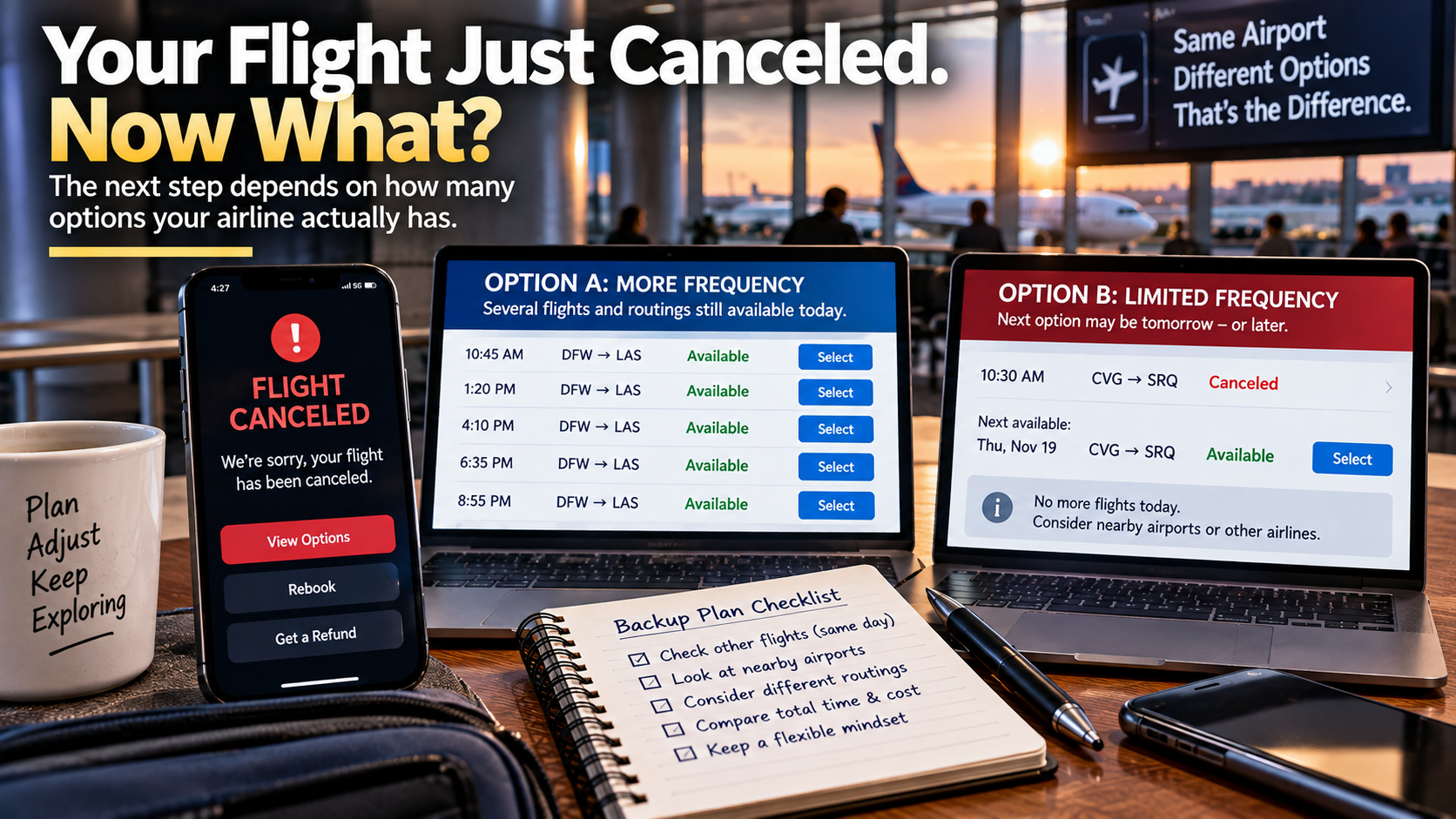
The Backup-Plan Test
Before booking, I like one very simple thought experiment:
Pretend this flight has just been canceled. Now what?
Look at the airline's schedule.
Are there three more flights today?
Could you connect through another hub?
Is there another nearby airport?
Or does the next flight operate Thursday?
You don't have to automatically choose the airline with the biggest network.
You're simply identifying another tradeoff.
For a two-night Vegas trip, losing a day could destroy half the vacation.
For a weeklong trip where your schedule is flexible, perhaps you're willing to accept more disruption risk in exchange for a lower fare or better nonstop.
Again:
Different traveler. Different trip. Different answer.
Don't Forget the Search Itself
There's one more wrinkle.
You can't compare a flight you never found.
Google Flights says it works with more than 300 partners, but it also explicitly says not every airline or available flight is necessarily included.
Credit-card travel portals can have their own inventories and commercial relationships as well.
So my process is simple:
Search broadly.
Then check the airlines that actually serve the route, particularly budget and smaller carriers.
Build the fare you would really buy.
Then decide whether booking directly or through whatever portal you're considering makes sense.
The booking method is supposed to serve the trip. Not the other way around.
Who Counts as a Budget Airline Now?
Even that question has gotten fuzzier.
Frontier still offers a very stripped-down Basic fare, but it also sells Economy, Premium and Business bundles that progressively add bags, seating and flexibility.
Allegiant remains heavily oriented toward leisure travel and à la carte choices.
Breeze includes a personal item with every fare and lets travelers add a carry-on separately or through higher bundles.
Avelo has built much of its network around point-to-point flying and smaller or alternative airports, although its network isn't exclusively small airports. Its current strategy includes bases such as New Haven, Wilmington, Concord, Lakeland and Dallas/McKinney.
Meanwhile, the lines aren't as clean elsewhere. Southwest moved to assigned seating in January 2026, with different seating benefits depending on fare, status and credit-card benefits. And JetBlue currently includes a carry-on even with its lowest Base fares while charging separately for advance seat selection at that level.
And if you're wondering why Spirit isn't in our comparisons, there's a rather definitive reason: Spirit's parent company announced an immediate orderly wind-down on May 2, 2026, canceling all Spirit flights.
The labels matter less than they used to.
Price the flight, not the category.
The Curated Upgrades Budget-Airline Test
You don't need a 47-column spreadsheet.
Before booking, answer eight questions:
What's the fare after adding the bags I'm actually bringing?
What will the seat I actually want cost?
Is it nonstop or connecting?
How much total travel time am I buying?
Which airport am I using?
What's the onboard experience, and do I care on this flight?
How frequently does this route operate?
If the flight gets canceled, what are my realistic alternatives?
Then look at the total.
Not merely the total dollars.
The total experience.

Loyal to My Checkbook
But that doesn't mean I'm automatically loyal to the lowest number on the screen.
It means I want value for the dollar I'm spending.
Sometimes that's going to be Frontier.
Sometimes Allegiant.
Sometimes Breeze.
Sometimes American, Delta, United, Southwest or JetBlue.
And sometimes two people sitting next to each other at the same kitchen table, looking at the exact same search results, should choose different flights.
One values the nonstop.
The other has to be home Wednesday.
One couldn't care less about Wi-Fi.
The other has four hours of work to do.
One will happily save $128.
The other thinks the alternative schedule is worth every penny.
That's not inconsistency. That's travel planning.
The cheapest fare isn't necessarily the cheapest trip.
The most expensive ticket isn't necessarily the best experience.
And the budget airline isn't automatically either the bargain or the trap.
Don't ask which airline is better. Ask which flight gives you the best value for your dollar on this trip.
Then book that one.
And keep exploring.